A United Airlines flight was forced to evacuate following an engine fire and an emergency landing at Los Angeles International Airport
Eliana Nunes and Annette Belcher
21:41, 02 Mar 2026
A United Airlines flight was forced to evacuate and perform an emergency landing after a fire broke out mid-air.
The aircraft was flying from Los Angeles International Airport (LAX) to Newark, New Jersey, when air traffic control received reports of a fire in its left engine.
Advertisement
The plane turned back and landed safely at LAX at around 11.20am local time. Smoke could be seen billowing from the engine around 40 minutes later as the aircraft was parked on the runway, ABC7 reports.
All 256 passengers and 12 crew members evacuated the jet using emergency slides and air stairs before being taken by bus to the terminal, United said in a statement, The Mirror reports.
The airline added that it was working to ensure passengers reached their final destinations as soon as possible. One person suffered a cut to their finger, but no other injuries were reported.
The Federal Aviation Agency said in a statement: “United Airlines Flight 2127 returned safely to Los Angeles International Airport around 11:20 a.m. local time on Monday, March 2, due to a left engine issue. Passengers deplaned on a taxiway.
Advertisement
“The Boeing 787-9 Dreamliner was heading to Newark Liberty International Airport in New Jersey. The FAA will investigate. Please contact the airline and airport for additional information.”
This article contains affiliate links, we will receive a commission on any sales we generate from it. Learn more
Advertisement
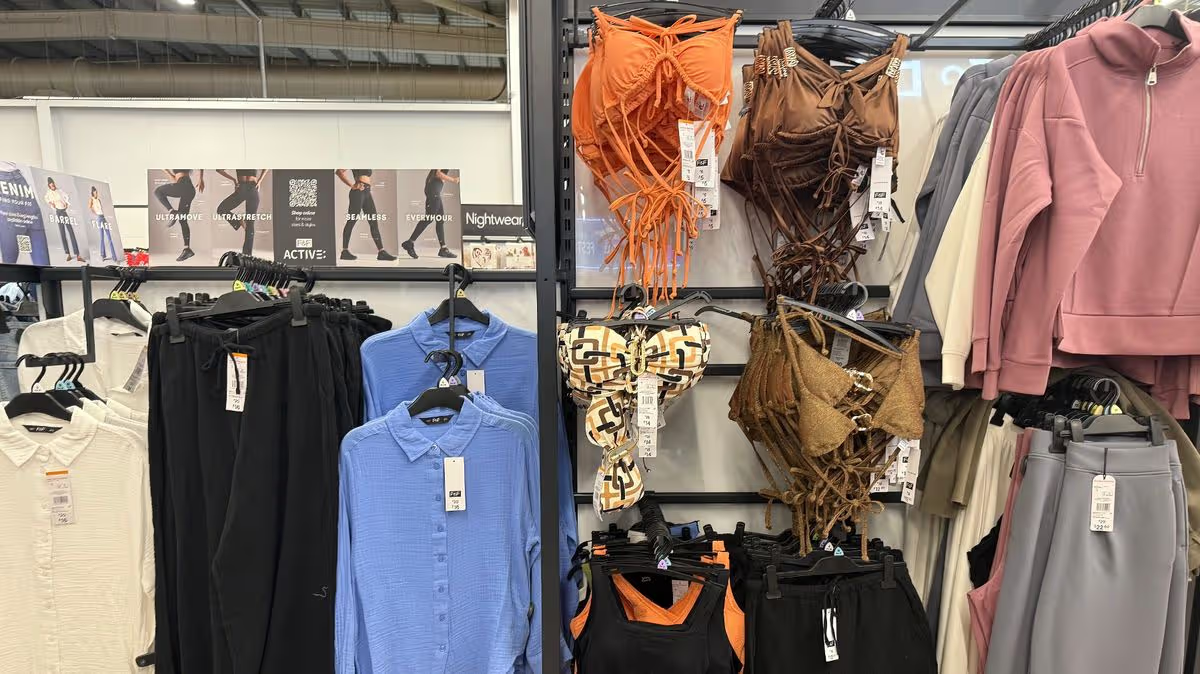
As the weather starts to get hotter, it can be hard to style outfits that keep you feeling cool while also looking chic. If you are looking for some new clothes to wear throughout the summer, you might want to take a trip to Tesco.
The skirt could be worn with a simple vest for “a balanced look” or the matching top, which would be a “pretty addition” to your wardrobe. The skirt is currently being sold for £22.50 and the top costs £16 meaning the whole outfit costs less then £40.
The pastel co-ord was posted to the Tesco F&F Instagram page, which currently has 890K followers. The post was captioned: “Soft blush, bold statement. The perfect set for every spring occasion. Head into stores now to shop 25% off adult clothing until 19/04. Top, £16. Skirt, £22.50. Sandals, £16.”
Advertisement
Content cannot be displayed without consent
Fans of the F&F brand have already started to share their opinions on the co-ord on social media. One commenter said: “Stunning.”
If you want to pick up either the skirt or top, you can head to the Tesco website to browse all of its items. You can also go in person to a Tesco store with a clothing department.
If this set is not what you are looking for, Boden has some co-ords in stock. There are these Belgravia Linen Shorts that reviews say are a “great fit” and can be worn with the matching Sienna Linen Shirt or there is this Occasion Short Linen Dress, which would be good for summer.
England’s Matt Fitzpatrick defeated world number one Scottie Scheffler in a dramatic play-off to claim his second RBC Heritage title at Hilton Head on Sunday
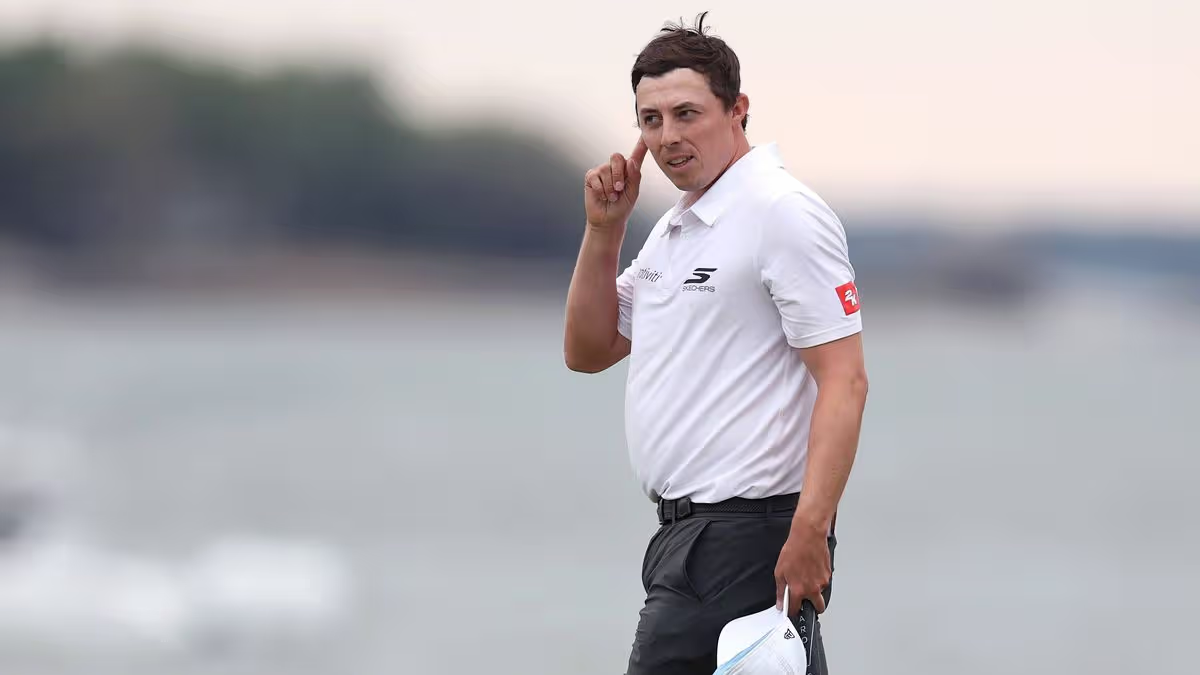
Matt Fitzpatrick defeated world number one Scottie Scheffler in a dramatic play-off to claim his second RBC Heritage title.
Advertisement
Fitzpatrick entered the final round at Hilton Head with a three-stroke cushion and maintained that margin through to the 15th tee.
However, playing alongside him, Scheffler reeled off birdies at the 15th and 16th holes, while Fitzpatrick’s mishit chip on the 18th resulted in a bogey, forcing a play-off where he appeared the underdog.
Yet Fitzpatrick produced a magnificent four-iron approach to within 12 feet and calmly sank the birdie putt to secure victory after Scheffler had missed the green with his second shot and chipped to eight feet.
“It was a lot of grit,” the Yorkshire golfer told CBS following his fourth PGA Tour victory and second within 28 days, having triumphed at the Valspar Championship last month.
Advertisement
“I knew Scottie was going to make some birdies down the stretch and I kind of had to hang in there a little bit.
“The only chip shot I found into grain all week was in regulation there (18th).”
Fitzpatrick – who admits the RBC Heritage holds special significance as he spent family holidays at Hilton Head during his childhood – drew comparisons to Rory McIlroy’s remarkable Masters victory last week after similarly seeing his advantage eroded.
McIlroy had surrendered a six-shot halfway lead at Augusta before capturing his second Green Jacket in a thrilling final round. Having fallen short in regulation play, Fitzpatrick reflected: “He (caddie Dan Parratt) actually said, ‘go and get to the tee. We would have taken this at the start of the week’.
Advertisement
“I know Rory said that the other week so I jokingly said to Dan, ‘OK here he is, Harry Diamond (McIlroy’s caddie)’.
“We had a good laugh about that, but I felt I was in a good spot and to hit the four-iron there was out of this world.
“This was a tournament I wanted to win growing up before any of the majors and before I understood about the game.
“To win it twice means the world. To go toe-to-toe with Scottie and win it on the 73rd hole is special.”
Advertisement
Want to see more of the stories you love from Belfast Live?Making us your preferred source on Google means you’ll get more of our exclusives, top stories and must-read content straight away. To add Belfast Live as a preferred source, simplyclick here.
As I’m A Celebrity camp-mates continue to round on under-fire David Haye, the ITV show’s presenters Ant & Dec have taken the rare step of openly criticising a contestant
09:50, 20 Apr 2026Updated 09:50, 20 Apr 2026
He’s sparked a sexism storm and has been labelled a ‘bully’ for his cutting comments to Adam Thomas, and now the star names have clearly had enough of David Haye.
On Sunday, the actor shared a heartbreaking post about how the boxer “broke” him during his time on the ITV show in South Africa. Adam suffers with autoimmune illness psoriatic arthritis and requested to sit out a Bushtucker Trial on Friday because he felt unwell and dehydrated.
David, not interested in the reasons why said he wasn’t up for the challenge, said his camp-mate was being “useless” and stated that he “doesn’t like men like that” as he tore a strip off the 37-year-old when he wanted to miss Termite Terror. Adam yesterday released a blunt statement, and if left fans wondering if there’s more to come.
Advertisement
He may have said sorry to him since, but the celebs have already started to round on former world champion David, who last week told the world that his girlfriend Sian had “the personality of a proper ugly bird,” before classlessly adding: “Most ugly girls realise they’re not pretty enough so they tell jokes so people overlook the fact that they’re not aesthetically amazing.”
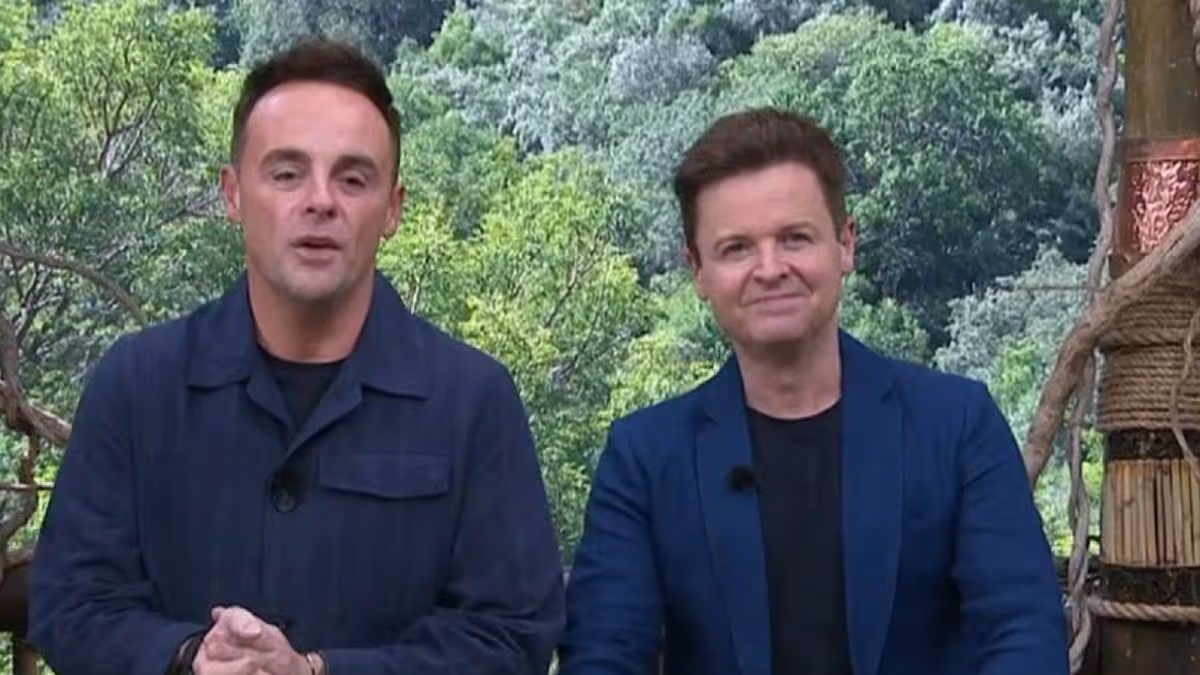
But both Anthony McPartlin and Declan Donnelly launched into David on ITV1 show’s podcast I’m A Celebrity . . . Unpacked and the pair were clearly uncomfortable with what they were watching.
Advertisement
Ant said on the show: “It’s not a nice watch. He just kind of picks and picks at them. Adam has had a bit of a tough time and he’s not coping well. Clearly the banter has got too much. But David won’t stop.”
Agreeing with his co-star, Dec added. “It’s kind of crossed the line from banter. I don’t find it comfortable to watch.”
Ryan has been by his side the whole way in the jungle and told him: “I would like to say i would stick up for you in there but hes not the guy to pick a fight with we need to give @tonybellew a call bro!”
His twin Scott told him: “I wish I could have been there for you my brother…it makes me so angry that you went through that…but I’m so proud of how you’ve come out of the other side of all this…the strongest you’ve ever been and on an incredible journey…standing in your power.”
Gemma Collins
Concerned Gemma Collins revealed she had to “protect” Adam in the jungle.
Advertisement
She spilled on I’m A Celebrity: Unpacked. Gemma said: “I think David Haye might have seen a weakness in Adam, there were times where I had to protect Adam in there.
“If I was going full GC mode on David Haye, and a lot of them, then it would’ve been a disaster in there but I had to remain calm and composed and just remember that I’m not here to be performative. I am here as me. I think the fact that I stretched my arms out, I’m sort of saying to ’em all, without biting their heads off, ‘enough’”.
She went on: “I knew if it was ever gonna get too bad I would be taking David on. You know, bring on the next heavyweight champion fighting the world….. because if I feel that something’s too much, I’m not afraid to step up.”
Scarlett Moffatt
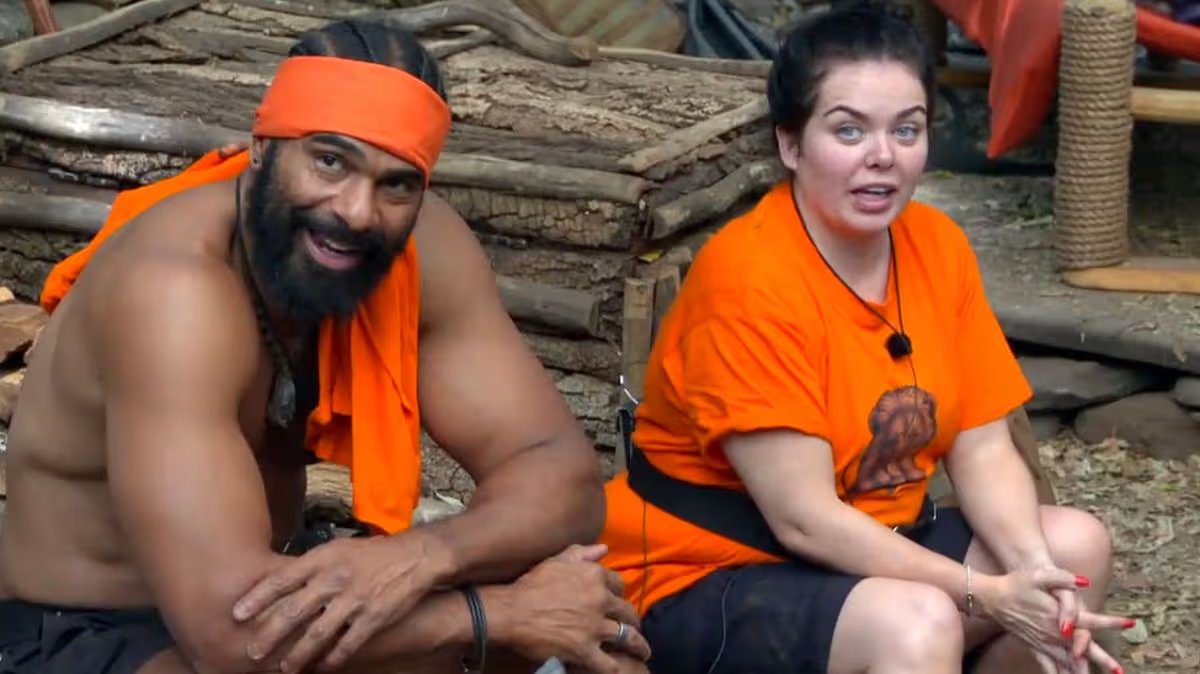
No-nonsence Gogglebox legend and former jungle queen Scarlett Moffatt had to beg David to stop as he ripped into Adam.
We saw the telly favourite, who was left angry and lost for words at the boxer’s sexist rant last week, try to get David to leave Adam alone when he became hellbent on trying to force the struggling star to accept the trial.
Scarlett, clearly in despair at the situation developing, said: “Stop it David, he’s not well!” After Adam took to Instagram to detail his jungle ordeal, she told him: “Adam I bloody love you. You’re one of the kindest men I know, if my little boy ends up being as caring as you then I know I’ll have done a good job a mam.”
Adam’s emotional statement
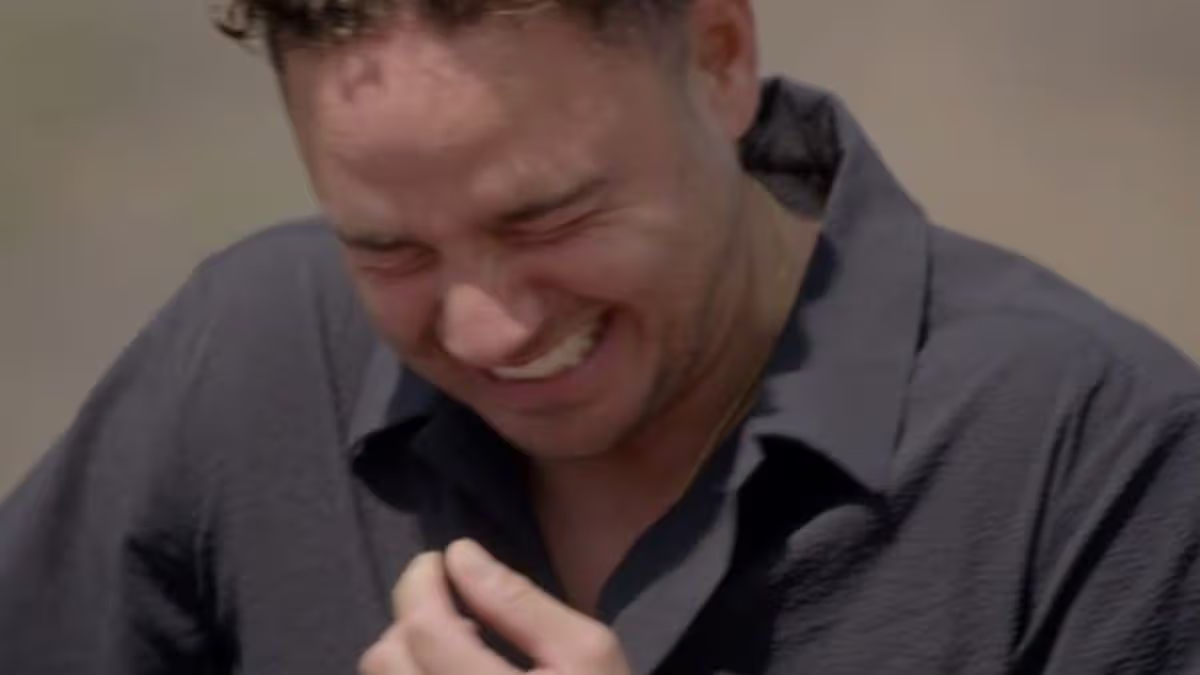
On Sunday, he spoke out and alongside an image from the show, which was filmed towards the end of last year, Adam wrote on Instagram: “Not going to lie,this picture breaks my heart, as I know on the inside what I was dealing with and truth be told I thought it was all my fault. I now know that’s not the reality… My time in I’m a Celebrity South Africa was one of the toughest things I’ve ever been through, physically, mentally, and emotionally.
“Watching it back hasn’t been easy at all. There were moments I felt pushed to my absolute limit, and if I’m honest, times I didn’t even recognise myself. Living with arthritis is something I don’t really talk about, as much as I should do…but in there it really took its toll. My biggest fight was pretending to put on a brave face and trying to hide the pain! that can be exhausting within itself.
“There were days my body just didn’t want to keep going, but I did. “I won’t sit here and say I handled everything perfectly, because I didn’t. I wish I spoke up for myself sooner. I wish I stood my ground instead of trying to keep the peace, but I’ve learned that being kind doesn’t mean being weak, and sometimes it takes going through tough moments to find your voice.
“Since coming out, I’ve taken time to process everything, and I’m in a much better place now. I let go of the anger, had the conversations I needed to have, and chose peace.
Advertisement
“What I’m most proud of, is at times like this I wanted to walk, I wanted to quit but I didn’t. Even when I wanted to walk away, even when it felt like too much, I never give up! and that means everything to me. He broke me in there, he pushed me to my limits, and I’ve told David this and he’s apologised and that’s that!”
US forces have intercepted an Iranian-flagged cargo ship in the Gulf as part of its naval blockade, Donald Trump has said.
The US president wrote on his Truth Social platform that the Touska was seized by the US Navy after failing to respond to a warning to stop.
Iran said it was a violation of the ceasefire and it would retaliate soon for the “act of armed piracy”.
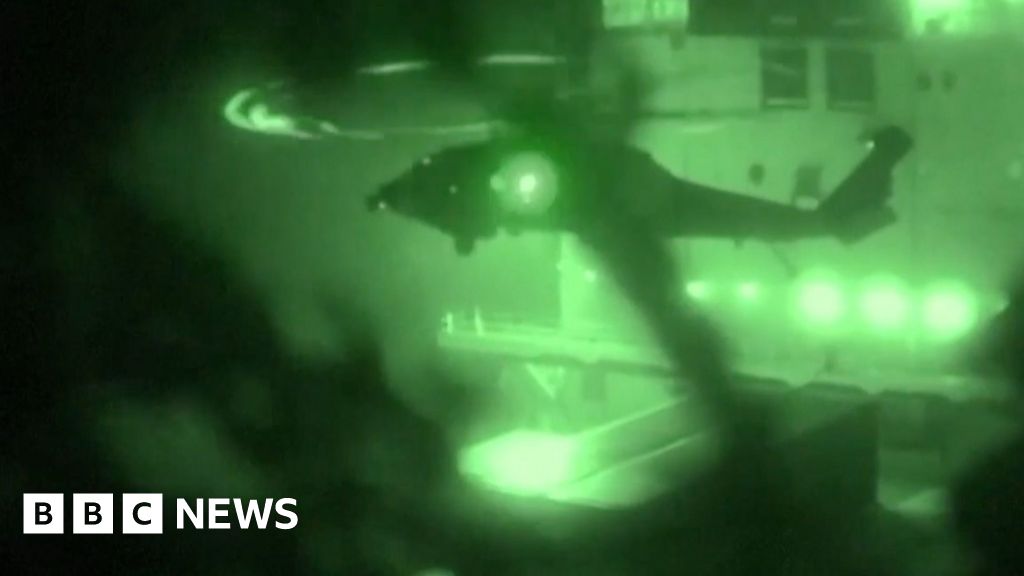
Centcom (United States Central Command) released two videos which have been combined in this edit.
Advertisement
They said one video showed the Iranian ship being warned before shots were fired. The second, they said, showed Marines departing their ship and boarding the Iranian vessel.
A tsunami warning has been issued after Japan was hit with a huge 7.4 magnitude earthquake, with 10ft waves expected “immediately” following the quake
09:31, 20 Apr 2026Updated 09:31, 20 Apr 2026
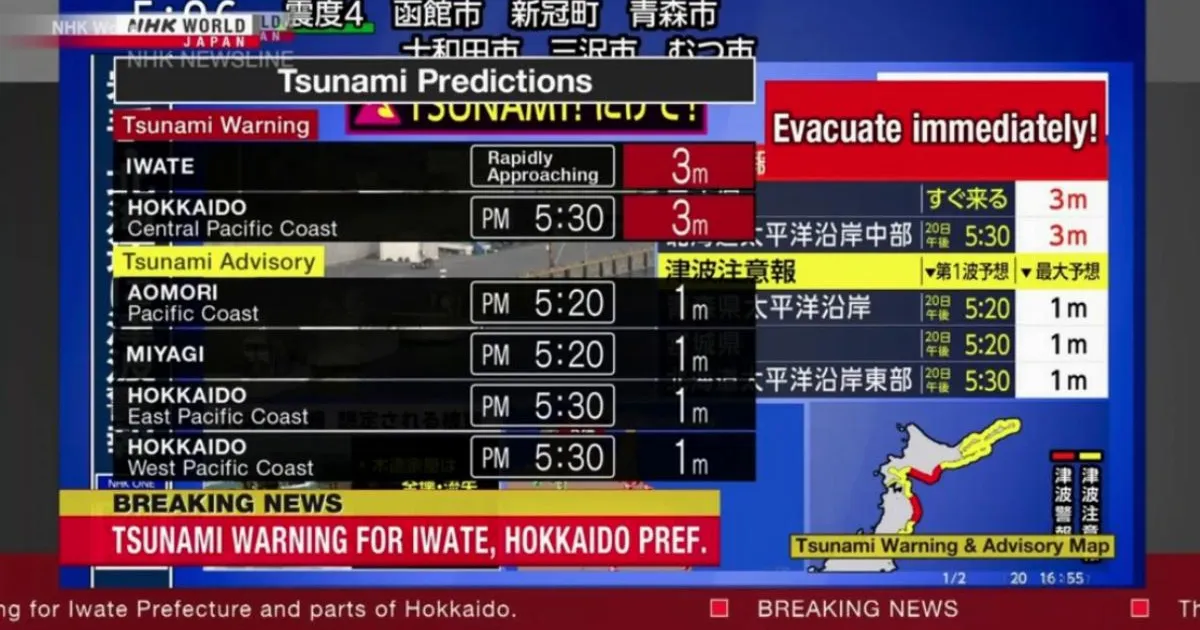
A tsunami warning has been declared after Japan was struck by a powerful 7.4 magnitude earthquake, with waves of up to 10ft forecast to arrive “immediately”.
The enormous three-metre (10ft) tsunami is anticipated to reach Iwate prefecture and parts of Hokkaido “immediately” following the quake, which was recorded at 4.53pm local time (7.53am UK time).
Further tsunami activity is also anticipated across Aomori, Miyagi and Fukushima within the next hour, though these waves are only expected to reach three feet, according to Japanese media.
Advertisement
The earthquake struck at a depth of six miles, with its epicentre located in the Pacific Ocean. The tremor was reportedly powerful enough to rattle large buildings as far away as Tokyo, hundreds of miles from the quake’s origin.
Japan’s Meteorological Agency (JMA) warned: “Evacuate immediately from coastal regions and riverside areas to a safer place such as high ground or an evacuation building.
“Tsunami waves are expected to hit repeatedly. Do not leave safe ground until the warning is lifted.”, reports the Daily Star.
Advertisement
The office of Prime Minister Sanae Takaichi has confirmed it has established a crisis management team in response to the earthquake.
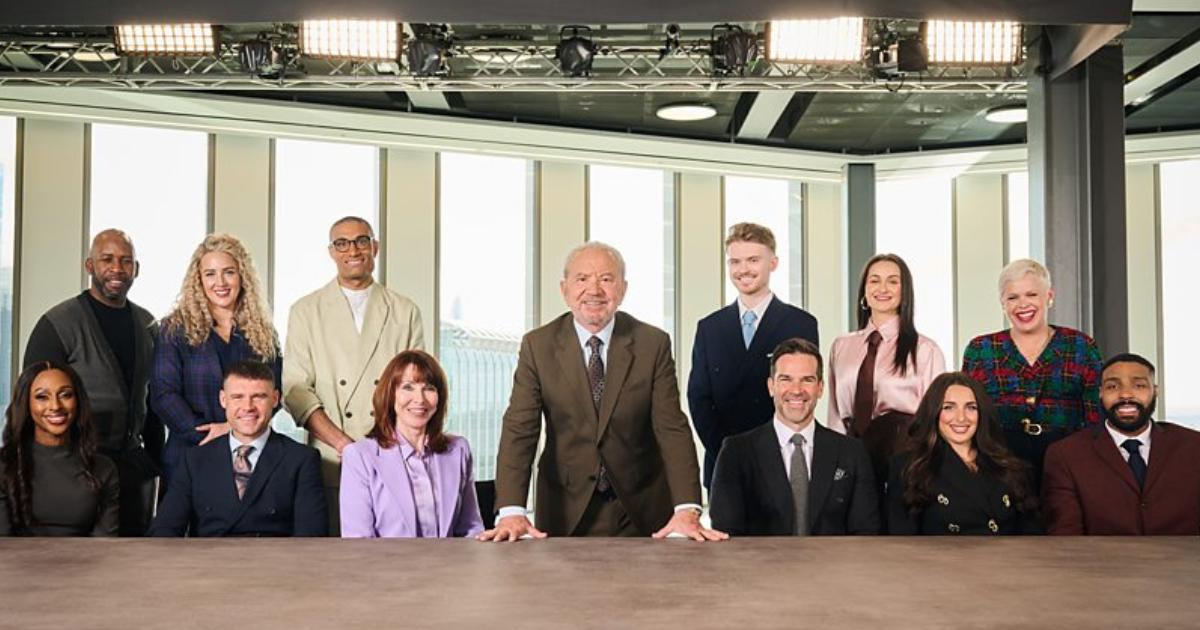
There will be 12 famous faces that will be taking on Lord Alan Sugar’s ultimate business challenge.
Celebrities will face a range of weekly business challenges set by Lord Sugar over six weeks.
The winner will be crowned the first Celebrity Apprentice winner and receive £100,000 for a charity of their choice.
Advertisement
First-ever Celebrity Apprentice line-up confirmed
The BBC has confirmed the 12 celebrities taking part in the special series.
They are:
Alexandra Burke – Singer
Danny Miller – Emmerdale’s Aaron Dingle
Gethin Jones – TV presenter
Jordan Banjo – Diversity dancer
Kay Burley – Journalist
Maddie Grace Jepson – Actress and online personality
Max Balegde – Presenter, podcaster and content creator
Sheli McCoy – Gladiators star Sabre
DJ Spoony – UK garage star
Richie Anderson – TV and BBC Radio 2 presenter
Laura Smyth – Comedian and writer
Toni Laites – TV personality
For the celebrity series, the boardroom will relocate to a London City skyscraper, providing a new setting for Lord Sugar’s final deliberations.
On the new series, Lord Sugar said: “We’ve not done anything like this before, and it’ll be entertaining to see these 12 celebrities being put through six weeks of some brilliant business challenges.
“But just because they’re celebrities, it doesn’t mean they’re going to get an easy ride, especially when there’s £100,000 at stake for their chosen charity.”
The news comes just days after Karishma Vijay was crowned the winner of The Apprentice 2026 (regular series).
Advertisement
She beat 19 other candidates to win the popular BBC show, securing a £250,000 investment from Lord Sugar for her skincare brand, Kishkin.
When is The Celebrity Apprentice on TV?
According to reports, filming for the upcoming series started recently, with it expected to air later this year on BBC One.
The BBC said that broadcast details for The Celebrity Apprentice will be confirmed in due course.
Let us know what you think about the show’s line-up in the comments below.
Ant and Dec have spoken out about David Haye’s treatment of Adam Thomas on I’m A Celebrity South Africa
Sam Elliott-Gibbs Reporter and Mathew Davies Sport content editor
09:16, 20 Apr 2026
Ant and Dec have waded into the David Haye controversy, declaring that the incident which triggered bullying complaints was “not nice” to witness.
The former boxer had already found himself mired in controversy following sexist remarks he made about his girlfriend and other women, before he then rounded on Adam Thomas after the actor said he was feeling too unwell to participate in Termite Terror.
It was the latest outburst to leave the South Africa camp reeling, with Gemma Collins subsequently revealing she felt compelled to “protect” the actor.
Advertisement
The presenting duo have now spoken out, making the rare decision to openly criticise the behaviour of an I’m A Celebrity contestant.
The Geordie pair say Haye simply does not know when to stop, as his comments from last week continue to cause uproar amongst the show’s viewers, who have firmly turned against the sports star.
Ant shared his thoughts on the ITV1 show’s podcast I’m A Celebrity… Unpacked, making clear his displeasure at Haye’s choice of words.
He said: “It’s not a nice watch. He just kind of picks and picks at them. Adam has had a bit of a tough time and he’s not coping well. Clearly the banter has got too much. But David won’t stop.”
Advertisement
Echoing his co-presenter’s sentiments, Dec said: “It’s kind of crossed the line from banter. I don’t find it comfortable to watch.”
Adam, who lives with the autoimmune condition psoriatic arthritis, had asked to be excused from the Bushtucker Trial on Friday after feeling unwell and dehydrated.
Haye said he was being “useless” and stated that he “doesn’t like men like that”.
Gemma Collins was among the celebrities visibly uncomfortable with David’s remarks, and she opened up about it on I’m A Celebrity: Unpacked.
Advertisement
Gemma said: “I think David Haye might have seen a weakness in Adam, there were times where I had to protect Adam in there.
“If I was going full GC mode on David Haye, and a lot of them, then it would’ve been a disaster in there but I had to remain calm and composed and just remember that I’m not here to be performative. I am here as me. I think the fact that I stretched my arms out, I’m sort of saying to ’em all, without biting their heads off, ‘enough’”, reports the Mirror.
She continued: “I knew if it was ever gonna get too bad I would be taking David on. You know, bring on the next heavyweight champion fighting the world….. because if I feel that something’s too much, I’m not afraid to step up.”
Shedding light on how his condition affects his daily life, Adam had previously explained: “It is an autoimmune disease. Basically means my immune system is attacking my own body. It causes a s**t-load of pain.”
Advertisement
Speaking out over the weekend, Adam shared an image from the show — which was filmed towards the end of last year — and wrote on Instagram: “Not going to lie, this picture breaks my heart, as I know on the inside what I was dealing with and truth be told I thought it was all my fault. I now know that’s not the reality… My time in I’m a Celebrity South Africa was one of the toughest things I’ve ever been through, physically, mentally, and emotionally.
“Watching it back hasn’t been easy at all. There were moments I felt pushed to my absolute limit, and if I’m honest, times I didn’t even recognise myself. Living with arthritis is something I don’t really talk about, as much as I should do…but in there it really took its toll. My biggest fight was pretending to put on a brave face and trying to hide the pain! that can be exhausting within itself.
“There were days my body just didn’t want to keep going, but I did. I won’t sit here and say I handled everything perfectly, because I didn’t. I wish I spoke up for myself sooner. I wish I stood my ground instead of trying to keep the peace, but I’ve learned that being kind doesn’t mean being weak, and sometimes it takes going through tough moments to find your voice.”
The Emmerdale star opened up about his I’m A Celebrity… South Africa experience in an emotional Instagram statement, revealing how arthritis struggles and confrontations left him feeling broken
Karen Price Assistant Editor of Screen Time and Jordan Lloyd Beck
08:47, 20 Apr 2026
Adam Thomas has revealed he felt “broken” by David Haye during filming of I’m A Celebrity… South Africa. The 37-year-old actor, recognised for his parts in Emmerdale and Waterloo Road, is currently appearing on the all-stars version of Ant and Dec‘s jungle survival programme, nearly a decade following his initial appearance on the main series.
Earlier in the week, boxer David, who had already attracted criticism for sexist remarks he’d made, attempted to pressure Adam into participating in Termite Terror, refusing to acknowledge that the former Strictly Come Dancing participant simply wasn’t feeling well enough.
Adam suffers from arthritis, a condition he has discussed publicly. Describing its impact, he previously stated: “It is an autoimmune disease. Basically means my immune system is attacking my own body. It causes a s**t-load of pain,” and he has now confessed that watching his I’m A Celebrity experience unfold on television has been difficult.
Advertisement
Accompanied by a photograph from the programme, which was recorded near the end of last year, Adam posted on Instagram on Sunday evening: “Not going to lie,this picture breaks my heart, as I know on the inside what I was dealing with and truth be told I thought it was all my fault. I now know that’s not the reality… My time in I’m a Celebrity South Africa was one of the toughest things I’ve ever been through, physically, mentally, and emotionally.
“Watching it back hasn’t been easy at all. There were moments I felt pushed to my absolute limit, and if I’m honest, times I didn’t even recognise myself. Living with arthritis is something I don’t really talk about, as much as I should do…but in there it really took its toll. My biggest fight was pretending to put on a brave face and trying to hide the pain! that can be exhausting within itself. There were days my body just didn’t want to keep going, but I did.”
Adam continued: “I won’t sit here and say I handled everything perfectly, because I didn’t. I wish I spoke up for myself sooner. I wish I stood my ground instead of trying to keep the peace, but I’ve learned that being kind doesn’t mean being weak, and sometimes it takes going through tough moments to find your voice.
“Since coming out, I’ve taken time to process everything, and I’m in a much better place now. I let go of the anger, had the conversations I needed to have, and chose peace.
“What I’m most proud of, is at times like this I wanted to walk, I wanted to quit but I didn’t . Even when I wanted to walk away, even when it felt like too much, I never give up! and that means everything to me.
“He broke me in there, he pushed me to my limits, and I’ve told David this and he’s apologised and that’s that! I’ve moved on now, am not one to hold a grudge. But thank you for all your lovely messages and all the kind words We all face people and situations that try to break us, but sometimes those moments are what rebuild you stronger than ever. Be kind.”
Advertisement
Adam was flooded with supportive messages from fans, with one commenting: “You came over in there as such a beautiful human @adamthomas21 You know your own truth You were Always my Winner,” reports the Mirror.
A further supporter wrote: “Your genuine and kind. You rose above it and kept going. That is strength. You’ve put it behind you and that stands for everything you are. Thats why you have everyone’s support,” while another added: “Those living with these awful autoimmune diseases are the real strong ones. Try living in pain daily and still putting a smile on your face and looking as if you’re not in pain. The fatigue is often worse than the pain. And symptoms can creep up on you at any moment. No warnings.”
Tensions reached breaking point when Adam attempted to rest and confessed he would struggle to take part in a Bushtucker Trial due to feeling dehydrated. David fumed: “Dehydrated?! We’ve all got the same amount of water! Adam is doing it and that’s it!
Advertisement
“When is your top form gonna come? Why aren’t we forcing this dude to go and do it? Coincidentally, every time there’s something to do, he’s not feeling well.”
It was at this moment that Gogglebox favourite Scarlett Moffatt, who claimed victory on I’m A Celebrity…Get Me Out Of Here! in 2016, stepped in and pleaded with David to “stop it”.
Earlier in the series, he had made remarks about his girlfriend Sian. While discussing his partner’s cooking for the group, he remarked: “She’s like tall, blue eyes. She’s lovely. She’s got the personality of a proper ugly bird.”
Despite Scarlett urging him to leave it there, he pressed on with his outburst, adding: “She has. Most ugly girls realise they don’t they’re not pretty enough to… they gotta have a personality to banter and to tell jokes and s**t, so people overlook the fact that they’re not aesthetically amazing, straight away.
Advertisement
“Which is what’s called Ugly Duckling syndrome, where girls are ugly, when they start off, and then they and then they kind of they, they get pretty as they get older. But they still got the personality of when they’re ugly. Does that make sense?”
In the tirade, which left incensed viewers outraged, he added: “You get a girl who’s pretty from day one, you get a girl who’s different day one. Everyone goes ‘You’re so beautiful. You’re amazing’. She grows up thinking, I’m amazing. Everyone loves me. I can open any door. I can go anywhere I want.
“They don’t have to have a personality, because most super pretty girls are just idiots. But then their ugly friend, they’ve got work a bit harder, be more personable. They got to be nicer to everyone. Gonna get you a drink.”









































You must be logged in to post a comment Login