There is a lot to play for Andy Farrell’s side who, despite losing dismally to France in round one, have bounced back with two wins.
Ireland appear in fine fettle ahead of their penultimate Six Nations clash at home to struggling Wales. A rout of England at Twickenham has banished most of the ghosts from the opening day defeat in France.
For Wales, it’s been one low after another – though their last display at home to Scotland gave reason for encouragement. They had a first round 7-48 defeat to England, a second round 12-54 defeat to France, and that third round 23-26 defeat to Scotland.
The margins have been coming down and confidence is starting to return.
Ireland make five changes from London, Jacob Stockdale, Tom O’Toole, Ronan Kelleher, Jack Conan and Nick Timoney come in.
Wales make three personnel changes to their team, fly-half Dan Edwards, wing Ellis Mee and flanker James Botham all start. Bath centre Louie Hennessey is set for his Test debut off the bench.
Here’s what you need to know about the game:
Who: Ireland vs Wales
What: 2026 Six Nations Championship – fourth round
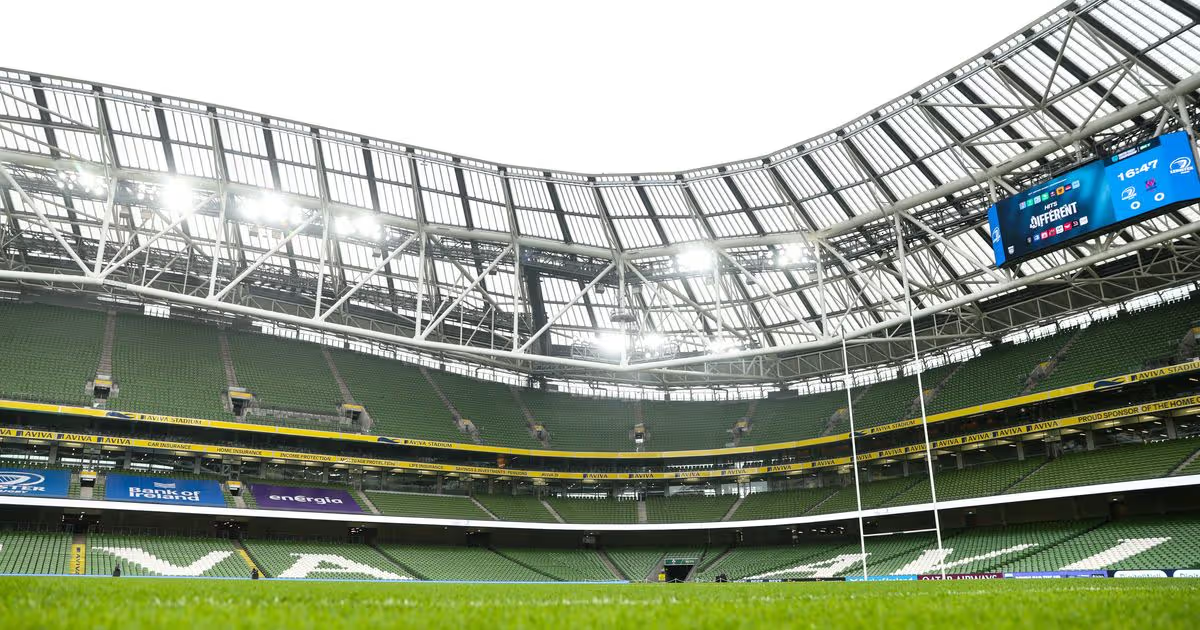
Where: Aviva Stadium, Dublin
When: Friday, March 6th
What time is kick-off? 8.10pm
Referee: Karl Dickson (RFU) will be in charge of Friday’s game.
Assistant Referees: Nika Amashukeli (Georgia), Damian Schneider (Argentina).TMO: Andrew Jackson (RFU)Foul Play Review Process (FPRO): Tual Trainini (FFR).
What are the other fourth round matches? Scotland vs France, Murrayfield, Saturday 2.10pm; Italy vs England, Stadio Olimpico, Saturday 4.40pm.
Did you know? Caelan Doris and Nick Timoney played on the same Leinster Schools Senior Cup winning side for Blackrock in 2014. Doris was a fourth year no6, Timoney captain and try-scoring no8
Did you know? Wales have lost their last 14 games in the Six Nations since 2023, but showed signs of improvement last time out against Scotland.
Quotes corner
Andy Farrell, Ireland coach: “You heard a lot of us talk about ‘character’ in the autumn. You heard me say ‘presence’ today. They’re the same thing. There’s a different mindset to dealing with big occasions.
“That’s why last week against England was a big test because away from home, big stadium, big occasion, good team. You learn your lesson from that and we weren’t ready. We weren’t ready in France for whatever reason and that’s not good enough.
“Not furious,” he added of his post-match reaction at Stade de France. “I’m more glad that we took the learnings from it more than anything.
“We’ll see whether we can carry that on. That’s what we’re all chasing down. It’s very tough at this level to be improving week on week at international level. Yeah, I’m more proud of how we’ve responded then going into our shells.”
Wales coach Steve Tandy: “There were a lot of tough lessons from the England game but we’ve seen incremental growth in each game, to France and then to Scotland.It will be great to see if we have learned those lessons of playing in England when we go to Ireland.
“The boys are starting to grow in confidence around what they are doing. They are always speaking about they can win even more moments in their game and then back that up. Now we will see if we can back it up in Dublin.”
Betting odds: Ireland 1/40 draw 50/1 Wales 18/1
Handicap: Ireland -26 points 1/1
Total Points: +55.5 9/10
Six Nations outright: France 1/14, Scotland 17/1, Ireland 20/1, England, Italy 500/1, Wales n/a
Popular Bets: Ronan Kelleher first try-scorer 11/1, anytime try-scorer 11/10; Stuart McCloskey Man of the Match 10/1. Louis Rees-Zammit Man of the Match 50/1
What TV channel is the match on? Saturday’s match will be shown live on RTE2 and ITV, with live radio commentary available on RTE Radio 1.
LINE-UPS
Ireland: Jamie Osborne; Robert Baloucoune, Garry Ringrose, Stuart McCloskey, Jacob Stockdale; Jack Crowley, Jamison Gibson-Park; Tom O’Toole, Ronan Kelleher, Tadhg Furlong, James Ryan, Tadhg Beirne, Jack Conan, Nick Timoney, Caelan Doris (capt).
Replacements: Tom Stewart, Michael Milne, Thomas Clarkson, Joe McCarthy, Josh van der Flier, Nathan Doak, Tom Farrell, Ciaran Frawley.
Wales: Louis Rees-Zammit; Ellis Mee, Eddie James, Joe Hawkins, Josh Adams; Dan Edwards, Tomos Williams; Rhys Carre, Dewi Lake (capt), Tomas Francis, Dafydd Jenkins, Ben Carter, Alex Mann, James Botham, Aaron Wainwright.
Replacements: Ryan Elias, Nicky Smith, Archie Griffin, Adam Beard, Olly Cracknell, Hardy, Jarrod Evans, Louie Hennessey.
Want to see more of the stories you love from Belfast Live? Making us your preferred source on Google means you’ll get more of our exclusives, top stories and must-read content straight away. To add Belfast Live as a preferred source, simply click here.