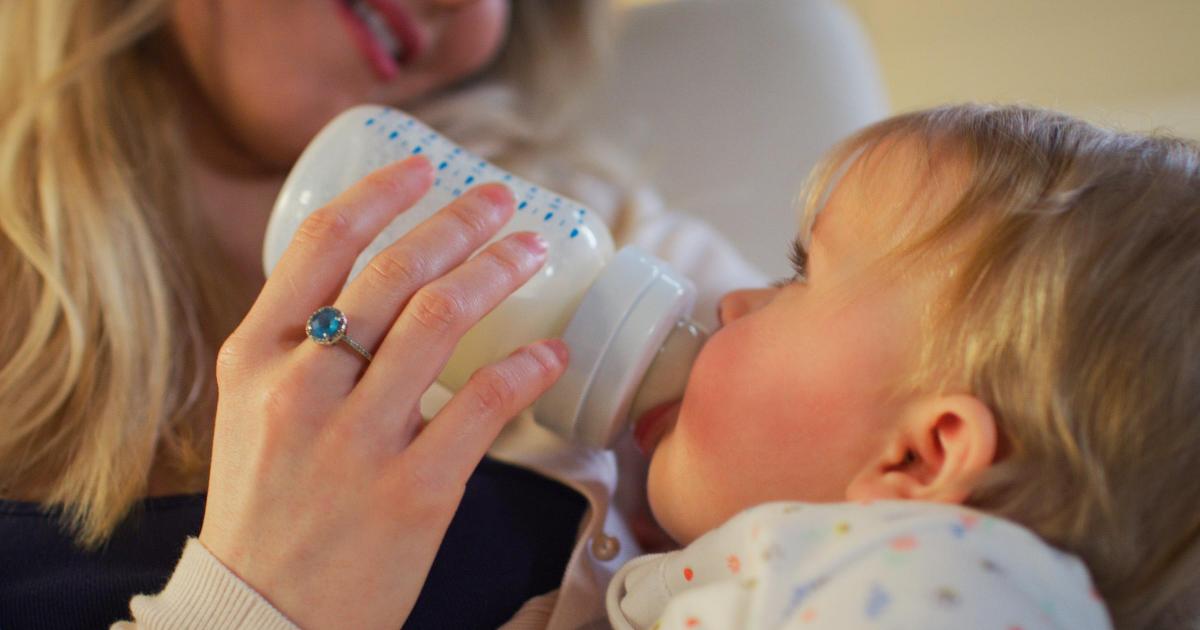
Catharine Alexander gave her newborn Arlo Chalmers Cow & Gate First Infant Milk immediately after giving birth in November.
The 24-year-old had used the formula with her first child and believed the milk to be a “trusted brand”.
However, after bringing Arlo home, the mum-of-two said her tot began projectile vomiting and “screaming in agony”.
Terrified, the health and social care student rushed little Arlo back to hospital where he was treated for a bacterial infection, but Catharine now believes the illness was caused by the milk.
Advertisement
null (Image: KennedyNews/CatharineJaneAlexander)
Arlo remained in hospital for five days whilst on oxygen and a feeding tube where he was then switched to SMA LITTLE STEPS First Infant Milk.
However, after being discharged, Arlo’s symptoms continued to worsen, prompting concerned mum Catharine to try Aptamil’s First Infant Formula instead.
Throughout these three months, Arlo was vomiting daily and battled consistent diarrhoea and constipation, leaving Catharine confused as to the cause of his unexplained symptoms.
It was only this month that Catharine said she realised all three brands of milk that she says she fed little Arlo had since been recalled due to the potential presence of cereulide – a toxin that can cause nausea, vomiting and abdominal cramps if consumed.
Advertisement
Catharine, who lives in Manchester, said: “It hit me like a tonne of bricks. I felt like I’d fed him some poison when all I want to do is protect my babies.
“I tried every single milk brand. Every single one that’s been recalled, I gave Arlo unfortunately.
“This isn’t something any mother should go through.
“After the first bottle of Kendamil, he was a completely different baby. There was no vomiting and his poos went back to normal.
Advertisement
“He’d had symptoms every day for three months. We’ve had long, sleepless nights and back and forth to the doctors with him.
“I’m still going through the ‘mum guilt’ now, I don’t think I’ll ever shift that.”
A Nestlé spokesperson said: “We are very sorry to hear about any cases where babies are poorly, and our teams will work closely with any families who report these types of concerns to us.
“On January 5, Nestlé voluntarily recalled certain batches of SMA formula because we found that one of the ingredients supplied to us was not of the right quality and did not meet the standards we require.
“Quality and safety is non-negotiable and that is why we have acted quickly and decisively with this precautionary recall.
“We have discontinued sourcing the ingredient from the affected supplier and all batches of the ingredient (from other suppliers) are now being systematically tested to confirm the absence of cereulide. As the UK HSA are reporting, the symptoms are generally self-limiting and usually resolve within 24 hours after last consumption.”
A Danone North Europe spokesperson added: “We take all complaints seriously and we have been in contact with Catharine regarding her concerns.
Advertisement
“We understand how worrying it is for parents when their babies are ill. We want to reassure all parents that all our baby formulas are produced under strict food safety and quality standards and undergo rigorous checks before leaving our factories.
“Low levels of cereulide were identified in some specific recalled batches and we have replaced them with new products. All products available for purchase are safe to use.
“To date there are no confirmed cases of sickness or symptoms linked to our products.
“If their baby has no symptoms parents should not be concerned. If a baby is unwell we would recommend parents speak to their healthcare professional.
Advertisement
“To check if a product is part of the recall, parents can refer to the Cow and Gate or Aptamil website.”
Baby formula recall
On January 5, the Food Standards Agency confirmed that Nestle was undertaking a precautionary product recall of several batches of 12 SMA Infant Formula and Follow-On Formula products in the UK due to the possible presence of the cereulide toxin.
The recall was updated with new product expiry dates on January 9.
On January 24, Danone – another infant formula retailer – recalled one batch of Aptamil First Infant Formula with a best before date of October 2026 because of cereulide contamination.
Advertisement
The toxin can cause nausea, vomiting and abdominal cramps, and is unsafe to consume.
It is produced by some strains of Bacillus cereus and is highly heat stable meaning it is unlikely to be destroyed by cooking, or when making the infant milk.
Jane Rawling, head of incidents at the FSA, said: “FSA’s advice is that parents, guardians and caregivers should not feed infants or young children with these products.
“Cereulide is a toxin produced by food poisoning bacteria Bacillus Cereus, and can cause food poisoning symptoms which can be quick to develop and include vomiting, and stomach cramps.
Advertisement
“I want to reassure parents, guardians and caregivers that we are taking urgent action, helping to ensure all of the affected product is removed from sale as a precaution.
“If you have fed this product to a baby and have any concerns about potential health impact, you should seek advice from healthcare professionals by contacting your GP or calling NHS 111.”
These are the Nestle products being recalled:
SMA First Infant Milk – 800g
Advertisement
53390346AB – Best Before December 2027 (only sold in Northern Ireland)
SMA Advanced First Infant Milk – 800g
51450742F1, 52319722BA, 52819722AA – Best Before May 2027
SMA Advanced Follow-On Milk – 800g
51240742F2 – Best Before May 2027
51890742F2, 52879722AA – Best Before July 2027
SMA Anti Reflux – 800g
52099722BA – Best Before April 2027
51570742F3, 52099722BB, 52739722BA – Best Before June 2027
SMA ALFAMINO – 400g
51200017Y3 – Best Before April 2027
51210017Y1, 51220017Y1, 51250017Y1, 51390017Y1, 51420017Y2, 51430017Y1, 51460017Y1 – Best Before May 2027
51690017Y2, 51690017Y3, 51700017Y1, 51710017Y1, 51740017Y1 – Best Before July 2027
52760017Y5, 52790017Y1, 52860017Y1 – Best Before October 2027
53100017Y3, 53110017Y1, 53140017Y1, 53140017Y2, 53150017Y1 – Best Before November 2027
SMA First Infant Milk – 800g
51170346AA, 51170346AB – Best Before April 2027
51340346AB – Best Before May 2027
51580346AA, 51590346AA, 51590346AB – Best Before June 2027
52760346AB, 52760346AD, 52780346AA, 52750346AE – Best Before October 2027
SMA First Infant Milk – 400g
51350346AA – Best Before May 2027
52750346AD – Best Before October 2027
SMA First Infant Milk – 1.2kg
51340346BE – Best Before November 2026
52740346BA, 52750346BA – Best Before April 2027
SMA LITTLE STEPS First Infant Milk – 800g
51220346AD – Best Before May 2027
51540346AC – Best Before June 2027
52740346AD – Best Before October 2027
SMA Comfort – 800g
51240742F3, 51439722BA, 51479722BA, 51769722BA, 52049722AA – Best Before May 2027
52620742F3 – Best Before September 2027
SMA First Infant Milk – 200ml
52860295M, 52870295M, 52870295M, 53030295M, 53040295M – Best Before October 2026
53220295M, 53230295M, 53070295M, 53080295M – Best Before November 2026
SMA First Infant Milk – 70ml
53170742B1 – November 2026
SMA Lactose Free – 400g
51150346AB, 51719722BA, 51759722BA, 51829722BA, 51979722BA, 52109722BA, 53459722BA – Best Before April 2027
The Six Nations is running from February 5 to March 14 and Wales Rugby fans can get the latest jerseys, hoodies and more at Kitbag.
6. Alex Mann 8 – star man
The Cardiff backrower put in a huge defensive shift making a remarkable 28 tackles and getting under the skin of the Ireland pack.
Mann has found his feet as an international player as he won a crucial penalty at the breakdown in the first half, while his carry set up James Botham’s try.
5. Ben Carter 7
Another strong performance from the Dragons lock who put in 19 tackles as he fronted up to the powerful Ireland pack.
Advertisement
Carter also marshalled the lineout well as Wales’ set-piece functioned well.
4. Dafydd Jenkins 7
The Exeter Chiefs lock is a work horse who put in a huge shift.
Jenkins gets through a ton of work making 27 tackles and was a key reason the Wales lineout went well.
3. Tomas Francis 6
Scrummaged well and was arguably not rewarded as much as he should have been by the officials.
Advertisement
Also played his part around the park.
2. Dewi Lake 8
Carried extremely well throughout leading from the front.
Won a crucial turnover at the breakdown when Ireland were building up ahead of steam in the Wales 22.
Also, put in a huge defensive shift making 23 tackles and the lineout also functioned well.
Advertisement
1. Rhys Carré 8
The Saracens man is developing into a high-class Test player.
Solid in the scrum and carried well consistently getting over the gainline. The Wales prop scored a terrific try when he brushed aside Balacoune before running in from just outside the Ireland 22.
Replacements
16. Ryan Elias 6
Threw well into the lineout and offered himself as a carrier
17. Nicky Smith 7
Gave Tadhg Furlong a torrid time at the scrum and put in a strong shift around the park.
Advertisement
18. Archie Griffin 7
Scrummaged very well upon entering the fray.
19. Adam Beard 6
Solid after coming back into the team and ensured the lineout continued to function well.
20. Olly Cracknell 7
Carried extremely well getting Wales over the gainline.
Resident Evil Requiem – the perfect anniversary gift (Capcom)
With the latest Resident Evil game proving to be a major hit once again, a reader explains why they’ve been a fan of the series for three decades now.
Resident Evil is going to turn 30 this month and that worries me because I remember playing the original as a kid (my parents were very lenient) and, well… time certainly does fly. I’ve played almost every Resident Evil game over the last three decades and I love the series more than any other.
Despite all the brain-eating zombies and disgusting mutations, playing Resident Evil is my comfort food. I’m never happier, when playing a video game, than when I’m being scared and thrilled and grossed out by a new Resi.
As I sit down to write this it’s actually kind of hard to explain the appeal of the games, even to another fan. Since Resident Evil 4 they’ve been great action games, but they didn’t start that way. And while some can be very scary at times, especially Requiem, they’re generally more tense than frightening.
Advertisement
They also have an ongoing story that spans that whole 30 years, but it’s complete nonsense and the scripts are always terrible – which is one of the things I love about it the most.
Resi games can be funny, but not always intentionally and they’re not straight up comedies, like something like Army Of Darkness or Shaun Of The Dead. They’re great third person combat games a lot of the time but that never dominates the games and, strangely for a Japanese franchise, the boss battles are often not that memorable.
Expert, exclusive gaming analysis
Sign up to the GameCentral newsletter for a unique take on the week in gaming, alongside the latest reviews and more. Delivered to your inbox every Saturday morning.
Advertisement
Despite how often they’re copied, they’re strangely unique games where even today you don’t know how much of what you enjoy of them is intended, when it comes to the camp and corny dialogue. It has been hit and miss in the more modern games, because it’s hard to be bad on purpose and still be entertaining.
Thanks to Resident Evil 4, Leon S. Kennedy has always been the funniest of the main characters, with his bad jokes and one-liners. He’s also the best looking of the men, with his famous hair and manly stubble. He’s meant to be 50 in Requiem, but he barely looks it and certainly doesn’t move like he’s that old. But I guess the idea is that he’s not just aging with the games, he’s aging with his audience too.
Advertisement
Almost everything that comes out of his mouth in Requiem is hilarious, with dad joke after dad joke, and all delivered with the ultra-confidence that comes from being an invincible video game character.
To my great pleasure, Requiem has been a big hit – the fastest-selling entry for the series – and we’ve still got whatever Capcom might announce for the 30th anniversary itself (on March 22) to look forward to. I’ve seen people saying that it’s proof that big budget single-player games can still be successful and I’m glad of that too. It’s good to see Resi still leading the way after all these years.
For me Resident Evil will always be the perfect video game, in that the gameplay is great, the storytelling is entertaining (bad but in a good way), the graphics are top notch, and the whole thing is weird and fantastical in a way only a video game can be.
The Resident Evil movies are shlock, just like the games, and they do have some of the same DNA in the so good it’s bad sense, but it’s only the dialogue that’s like that in the games. Everything else is the best it can be and that’s certainly not true of the films.
Advertisement
The mix of elements that is Resi only works because it’s a video game, where you’re able to put your own spin on things, and read between the lines, while you’re playing. I love it and with Requiem it feels like the future is looking very bright for my favourite video game series.
By reader Cher
Everyone loves Leon (Capcom)
The reader’s features do not necessarily represent the views of GameCentral or Metro.
You can submit your own 500 to 600-word reader feature at any time, which if used will be published in the next appropriate weekend slot.
There are three types of people in Dubai right now: those off to play padel, those rushing to the Omani border, and those waiting for house prices to drop.
It’s a joke doing the rounds here, and it neatly captures the mood.
Day seven of this war started with the familiar humdrum of daily life – people out jogging, children off to the park, the malls filling with shoppers.
But the mid-morning air was pierced by the screech of another emergency alarm on mobile phones.
Advertisement
Image: A missile alert sent to mobile phones in Dubai
This one warning of incoming missiles, telling people to seek shelter and stay away from windows.
We’ve now had to teach toddlers and childminders to take cover when they hear the warnings or blasts from air defence. I’ve met children in Ukraine who are so familiar with the sounds of war they can tell if it’s incoming or outgoing fire. I never expected to see children enduring this in Dubai.
Normal life continues while the country is attacked every day.
Image: Smoke billows from Dubai’s Jebel Ali port on Sunday after an Iranian attack. Pic: Reuters
The UAE is now having to defend its territory, residents and way of life – in a way it never imagined.
It’s understood Iran has fired more drones and missiles at the UAE than anywhere else – even Israel – in these last seven days of war.
If you want to get people’s attention, aim for a global city and its five-star hotels. Create shock, havoc, and headlines.
But no one expected this – not the government, the military, or the millions of people who live here.
Advertisement
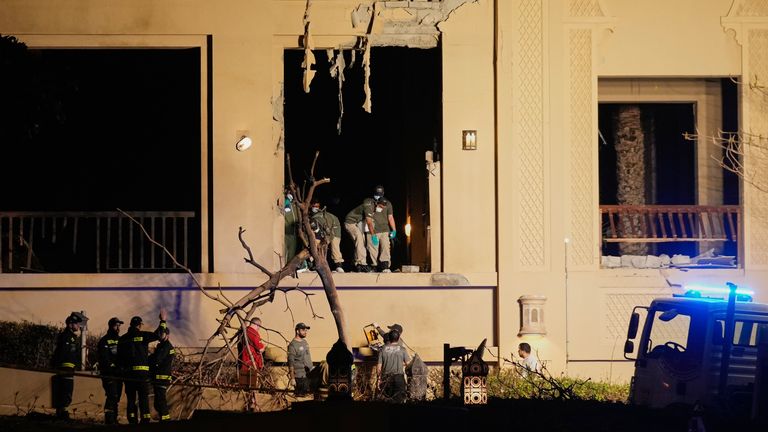
Image: The site of an explosion at the Fairmont The Palm Hotel in Dubai on Saturday. Pic: AP
The US military base in Abu Dhabi was always known to be a possible target, but fairly low down the list given the far larger American military assets in the region. The UAE also made it clear in a public statement several weeks ago that no attacks on Iran were to come from its territory, airspace or waters. It was thought this would add a layer of protection to Iran’s Gulf neighbour.
We couldn’t have been more wrong.
More than 200 ballistic missiles and nearly 2,000 drones have been fired at the UAE in seven days.
Two missiles and 74 drones have got through. Three people have been killed and dozens injured.
Image: A Dubai beer garden sitting almost empty amid ongoing hostilities with Iran. Pic: AP
For some residents, it’s been too much, and community WhatsApp groups are in meltdown with people sharing flight information and tips on the journey to Muscat airport.
I’ve heard from many who have crossed into Oman to catch a flight, others who’ve driven to Saudi Arabia to get out.
Advertisement
I’ve also heard from others making the reverse journey – separated from their children and desperate to get back.
For many stranded tourists, it’s been a nightmare holiday. The initial shock of finding themselves caught up in a war has been replaced by a sense of abandonment.
The UK government took nearly a week to organise its first evacuation flight, and there are tens of thousands of British holidaymakers still trying to get home.
We’ve received hundreds of messages from people at a loss as to what to do. One traveller who did get a flight, called on the way to the airport to say they could see incoming fire.
Advertisement
Image: The US consulate in Dubai on fire
It’s been a surreal and scary week on many levels. The psychological impact has been even greater than any physical harm.
Will this hurt the city? Will this impact the country? For sure. At least for a time. I’ve already spoken to residents who’ve left and don’t want to come back.
Will it impact the sky-high property prices and rents? Probably.
Image: Empty road near Dubai International Airport. Pic: Reuters
Much depends on how long this war lasts – how long Iran is willing to sabotage its relationship with its neighbours.
But what I do know is that seven days on, a country not used to war has shown it can defend itself.
Advertisement
And a population that chose this city for its lifestyle and security – never expecting to confront war on their doorstep – has shown a quiet resilience they can take pride in.
Many Britons aspire to leave a positive mark on the world, yet a significant number have not formalised their wishes through a will, new research reveals.
A survey by Great Ormond Street HospitalCharity (Gosh Charity) found that while 61 per cent of people hope to be remembered for their contributions, only 39 per cent have actually drafted a will.
The figures are even lower for charitable bequests, with just 14 per cent including a gift in their will. A further 11 per cent expressed an intention to donate to charity but have not yet updated their will, and 19 per cent are considering it.
Over half (52 per cent ) of respondents emphasised the importance of their lifetime actions benefiting future generations.
Advertisement
The research also found that two-fifths (41 per cent ) of people said they are not currently considering leaving a gift to charity in their will (Gareth Fuller/PA)
The research was carried out by Opinium and released at the start of Free Wills Month.
Death of a loved one
Becoming a parent or grandparent
Reaching a life milestone
Experiencing a serious illness
The research also found that two-fifths (41 per cent ) of people said they are not currently considering leaving a gift to charity in their will, rising to more than half (51 per cent ) of Baby Boomers (aged 62 to 80) and 44 per cent of Gen-X (aged 46 to 61).
The survey also explored the life moments that prompt people to reflect on the legacy they want to leave behind.
The death of a loved one was the biggest trigger (14 per cent ), followed by becoming a parent or grandparent (12per cent ), reaching a life milestone (10 per cent ) and experiencing a serious illness (9 per cent ).
Advertisement
The research suggests there may be some uncertainty about how accessible legacy giving can be, Gosh Charity said.
Nearly two-thirds (65 per cent ) of people were aware it is possible to leave a gift of any size to charity in a will, while just over a third (35 per cent ) were unaware of this.
Get a free fractional share worth up to £100. Capital at risk.
When asked about leaving a small financial gift of up to £100, nearly half (46 per cent ) of people surveyed believe it would make little difference to a charity, and 8per cent believe would make no difference at all.
Gabi Field, deputy director of public fundraising at Gosh Charity, said: “Every legacy gift, no matter the size, helps Gosh Charity fund vital support for families at the hospital as well as ground-breaking research. Together, these gifts ensure seriously ill children get the best chance and childhood possible, now and for generations to come.”
Gosh said patient Ary Patel and his family have seen the impact of that support first-hand. Ary, who is approaching his 10th birthday this year, underwent heart surgery at the hospital when he was six months old.
This month, he is starring in a Gosh Charity TV advert encouraging people to consider leaving a gift in their will.
Advertisement
Ary’s mother Shiva said: “To see Ary approaching his 10th birthday is truly incredible, and something we will never take for granted. When Ary needed surgery, the care we received at Great Ormond Street Hospital was extraordinary – not just the life-saving treatment, but the support and kindness shown to us every step of the way.”
Opinium Research surveyed 2,000 people across the UK in February.
The Anglo-American “special relationship” has hit a low ebb following American strikes on Iran. US president Donald Trump disparaged British prime minister Keir Starmer with a negative comparison to Winston Churchill, making clear his “disappointment” over British reticence to offer logistical support to the American military.
This is the latest in a series of comments Trump has made about Starmer’s authority on foreign policy concerns – particularly the British return of Diego Garcia to Mauritius.
For his part, Starmer has publicly broken from the president on the matter of Greenland, offering “strong support” to Denmark in response to US threats to take over the territory. In January, when Trump disparaged British troops in Iraq and Afghanistan, Starmer called the remarks “appalling.”. Despite Trump’s attempts on Truth Social to smooth the matter over following a “stern” call from Starmer, one controversial exchange has bled into the next. Trump is understood to be very unhappy that the UK won’t join strikes on Iran. Starmer has stood by his decision and insists it is his duty to decide what action is in “Britain’s national interest,”.
This breakdown in relations between the two heads of state is remarkable – but it is not unprecedented. Britain’s refusal to follow America into a foreign conflict has inflamed tensions before. President Lyndon B Johnson and prime minister Harold Wilson endured a breakdown in the 1960s over Vietnam. The way Wilson handled this situation should be Starmer’s guiding light has he charts his own course on Iran.
Advertisement
Vietnam
The UK did not publicly participate in the Vietnam war. At the time it was searching for a way to join the European single market against French wishes and extricate itself from its military bases in the Arabian Peninsula and Southeast Asia. Wilson was seeking to move away from costly military commitments abroad.
Publicly, Wilson pushed for an end to the war, meeting with the Soviet Union’s Alexei Kosygin to try and move negotiations forward. He backed Johnson when the US agreed to what Wilson called “unconditional negotiations” with North Vietnam in 1966. Behind closed doors, Wilson reiterated his private support for Johnson regularly. He also met with the president to justify British reticence to join the war on several occasions, using trips to Washington as a way of trying to bolster the public image of a strong affiliation.
No love lost: Lyndon B. Johnson with Harold Wilson at the White House in 1967. Library of Congress
However, the Wilson and Johnson governments clashed over a number of concerns. Johnson faced criticism in Britain for failing to attend the funeral of Winston Churchill in 1965. LBJ was allegedly so infuriated by the lack of British troop commitment to the war that he called Wilson a “little creep” behind closed doors. The Americans also lamented the weakness of the British pound, as Wilson had it devalued by 14.3% in 1967. This threatened the stability of the US dollar and other western currencies.
Advertisement
The White House began to see Britain as a much less valuable – or stable – ally in the ongoing cold war. The British in return felt pushed to acquiesce to American pressure, while also relying on American support on issues such as Rhodesia, which unilaterally declared independence from the UK in 1965.
With this change in attitude, Johnson turned to other allies for public support. The then Australian prime minister, Harold Holt, went “all the way with LBJ,” joining other Pacific allies in sending troops to fight alongside Americans. Johnson lavished support on them, granting Australia its first state visit by a sitting US president in late 1966.
Conversely, he never visited Britain once. Johnson’s antipathy towards the UK is perhaps best summed up by an act of political disrespect towards Wilson in 1965, when he had the White House band play “Plenty of Nuttin’” at a diplomatic dinner following economic talks – a sarcastic rejoinder for Wilson’s lack of what he deemed proper support.
A third way
Ultimately, the “special relationship” cooled significantly during the Johnson-Wilson era. But despite the sometimes-wretched relations between the two leaders, the connection between the two countries in terms of intelligence sharing, training and support on other matters remained intact. Wilson saw the value of American support, travelling to the United States several times during the 1960s despite criticism from anti-war campaigners and from some in parliament. Wilson’s conciliatory approach is mirrored by Starmer’s attempts to carve a third way over the first year of Trump’s government. Starmer was heavily criticised for inviting Trump to carry out a second state visit – the first US president to receive a return invite.
Advertisement
The situation has changed since then, and the Iran strikes have indeed put pressure on the US-UK relationship. But there is precedent for resistance to American pressure in the Wilson-Johnson relationship. The effects were stark – it was not until Margaret Thatcher and Ronald Reagan were in charge that the relationship truly felt “special” once again – but it endured and thrived again despite what had been a severe clash in personalities.
Trump’s climbdown over the criticisms he made of Nato troops in January shows that the United States still values its British ally to some extent. The prime minister should remember that the relationship will endure long after the current occupants of both the White House and 10 Downing Street leave their respective offices.
Many in the crowd saw the Cheshire-born star perform for the first time since his mammoth Love On Tour wrapped back in 2023 – and they came dressed for the occasion
For Harry Styles, Friday night in Manchester marked a long-awaited return to the stage. But for thousands of fans outside Co-op Live, it felt like a homecoming of their own.
Advertisement
Many in the crowd saw the Cheshire-born star perform for the first time since his mammoth Love On Tour wrapped back in 2023 – and they came dressed for the occasion.
Feather boas and cowboy hats – a staple of Harry crowds – had clearly been pulled out of storage, joined this time by a fresh wave of sequins and sparkle inspired by the ‘disco’ promise of his brand new fourth album Kiss All The Time. Disco, Occasionally.
At just £20 a ticket, the show became one of the hottest – and most unusual – gigs of the year. The crowd arriving at the sold-out gig on Friday night (March 6) were met with a unique rule: this would be a strictly phone-free event.
Instead of filming the moment for social media, fans were asked to lock their phones away in special pouches on entry. In their place, concertgoers were handed disposable cameras – a nostalgic twist that encouraged everyone to stay present and soak up the moment.
Advertisement
It felt fitting when Styles eventually emerged to open the night – after a unique synth buildup – with Aperture, the first track on the album. It’s a song made for hugging strangers on a dancefloor – and as fans bounced along to the chant of ‘We belong together’, this quickly became the unofficial motto of the evening.
He appeared donning a bright blue jumper over a floral shirt, with classic Harry yellow suit trousers. He brought the same wild dance moves he teased us with last week at the Brits and, understandably, the crowd went wild.
The phone-free rule seemed to work exactly as intended. Instead of a sea of glowing screens, the arena was filled with fans dancing freely and fully engaged in the performance unfolding in front of them. I’ll admit, I thought the disposables would be a bit of a gimmick, but it was a very special way to immerse yourself in the gig.
The show coincided with the release of Styles’ latest 12-track album, which dropped in the early hours of Friday morning. It was the first chance for fans to hear all of the songs live – and possibly their first chance to hear them at all.
Advertisement
He moved onto American Girls – and despite having only 12 hours to revise the lyrics, fans didn’t disappoint. Track 2 is clearly already a favourite. Ready, Steady, Go! followed, allowing Styles to flex his vocals, bringing a similar undertone of rock to what we heard in his first solo album.
Early impressions suggest Kiss All The Time. Disco, Occasionally continues Styles’ habit of refusing to sit comfortably in one genre. The album blends bits of funk, disco rhythms, pop and softer acoustic moments.
Like much of his previous work, there’s a thread of melancholy running beneath the upbeat production. It sparks the sort of nostalgia that makes you feel sentimental for memories you’re not even sure you have.
The heavy beat and impressive guitar solo of Are You Listening Yet? contrasted to the melancholy feel of The Waiting Game, which followed Taste Back – my favourite track on the album, which blends his older pop style with his newer, more mature lyrics.
Advertisement
Throughout the show, Styles was joined by the House Gospel Choir, who added a rich, soulful depth to several of the new songs. The popular choir – known for their own house anthems and recent appearance alongside Styles at last weekend’s BRIT Awards – helped bring Season 2 Weight Loss to life, with their soaring harmonies transforming the track into one of the evening’s standout moments.
The mood then softened as Styles moved into Coming Up Roses, the album’s most delicate offering, accompanied by a stunning live string section that transformed the arena into a quieter, more intimate atmosphere.
Introducing the song, Styles paused to thank one of his closest collaborators.
“There’s a lot of people in the audience tonight who helped me make this record,” Styles told the crowd, before dedicating a song to his friend Tom. “I wrote a lot of songs and typically the songs I write by myself at home are the ones I assume won’t make it onto the album.
Advertisement
“I want to thank Tom for pushing me to believe in me. That’s the reason why this song exists. It’s one of my favourite things I’ve ever done.”
From there, the mood lifted again as the crowd danced along to the infectious Pop, before the funk-leaning Dance No More saw Styles’ signature dance moves make a welcome return.
The choir and band then rejoined him for the emotional Paint By Numbers, with the crowd swaying in unison as flashes from disposable cameras briefly punctured the otherwise hushed moment.
The Manchester show marks a significant moment for the singer. Born in nearby Cheshire, Styles has always maintained a strong connection to the North West – and on Friday night, that sense of homecoming was unmistakable.
Advertisement
“Good evening Manchester,” he grinned at one point, clearly soaking in the reception. “My name is Harry. It is an absolute pleasure to be here tonight.”
The evening concluded with Carla’s Song, which Styles dedicated to a close friend in the audience.
Just when it seemed the night had reached its end, Styles returned to the stage with a surprise encore.
“We haven’t played that one in a while,” he joked after launching into From the Dining Table from his debut album. “Truth be told, we haven’t played anything in a while.”
Advertisement
Fans erupted as he followed with Golden from Fine Line, before the unmistakable opening notes of Watermelon Sugar sent the arena into a frenzy.
Continuing a tradition from Love On Tour, the crowd gleefully screamed the famous ‘leave America’ line during As It Was, an affectionate chant urging the British star to return to the UK for good.
Reflecting on the atmosphere in the room, Styles told the crowd the community created at his shows is something he treasures deeply.
“The community that you guys have built together in this room, and rooms that I’ve seen around the world, is something so unbelievably magical,” he said.
Advertisement
“In a world that we have today that feels so chaotic it’s so easy to become hopeless – and I see what you create together and there is just so much hope in here.”
“I encourage you to keep being the change in the world that you want to see,” he added.
He closed the night with Sign of the Times, the towering ballad from his debut solo album. Arms wrapped around friends and strangers alike, thousands swayed together as Styles delivered the final chorus – many, myself included, teary eyed.
But there was one final moment left. Returning briefly for a reprise of Aperture, Styles hammered home the message that had opened the night: ‘We belong together.’ As the chorus rang out once more, fans jumped arm in arm, rounding off the show in a full circle moment.
Advertisement
The concert ended the same way it began – united.
For those lucky enough to be in the room, the night felt less like a typical arena show and more like a shared experience. The perfect blend of old and new, it felt like fans had witnessed something really special. Something intimate, despite the scale of the venue.
And thousands of voices sang together, one thing was clear: In that moment, Manchester really did belong together.
Frankenstein’s female creature, also known as “the Bride”, was the first female monster to appear on screen, in the 1935 Frankenstein sequel: The Bride of Frankenstein. An unruly and rebellious figure, she has inspired dozens of adaptations since.
Most recently, the Bride, as a dramatic character, has been part of a series of creative reimaginings through an explicitly feminist lens. For instance, the dark coming of age comedy, Lisa Frankenstein (2024). It imagined the Bride (Kathryn Newton) in the role of the scientist, who accidentally brings to life a young Victorian man (Cole Sprouse).
Released just a year earlier, Poor Things (2023) brought an even more complex exploration of power, agency and consent, set in a retro-futuristic Victorian era. In it, the female creature Bella (Emma Stone) negotiates what it means to be both a scientific object and creator (being created out of the pregnant body of a woman and the brain of the mother’s unborn baby). Bella does not abide by the rules and conventions of polite society, using her body against the purpose of her creator and causing several mental breakdowns for the male characters in the process.
Advertisement
The trailer for The Bride!
Now, a new movie directed by Maggie Gyllenhaal, The Bride!, brings the character to life in moody 1930s Chicago. Jessie Buckley plays the female creature brought back from the dead to be Frankenstein’s mate. But she is not the sort of creature that is inclined to serve someone else’s purpose. When Frankenstein (now the monster, not the scientist, and played by Christian Bale) calls her “the Bride of Frankenstein”, she replies: “No, just the Bride.”
Although the film promises a “Bonnie and Clyde” story – two lovers and rebels on the run from the law – this Bride refuses to belong to any man. Instead, gun in hand, she demands to be seen and heard on her own terms.
Reanimating the Bride from novel to screen
Since her inception, the Bride’s struggle has been for autonomy. She first appeared in Mary Shelley’s novel Frankenstein (1818), named after an egomaniac scientist who creates a creature from cadavers. In the novel, Dr Frankenstein begrudgingly agrees to make his male creature a companion, but destroys her before she can live. He is afraid she might reproduce or become even more powerful than the male creature.
Her destruction is the most violent episode in the novel and makes apparent the anxiety that her unruly female body causes to the mad scientist. The erasure of Shelley’s original female creation set the scene for the way she continues to be written out of most adaptations of the novel. This includes, most recently, Guillermo del Toro’s Frankenstein (2025).
One hundred years on from Shelley’s novel, the Bride was finally brought to life in James Whales’ The Bride of Frankenstein and played by Elsa Lanchester. Although central to the film’s title, she appears only in the final five minutes. But that was more than enough time to establish her cinematic legacy.
The monster meets his bride in The Bride of Frankenstein (1935).
She stands tall, dressed in a white gown, her dark, voluminous hair streaked with lightning. Scars and stitches run around her face. She is both alive and dead, a bride and child, beautiful and monstrous, futuristic and otherworldly. Her appearance defies categorisation, not quite the demure wife she is meant to be.
Advertisement
Even more memorable is the Bride’s defiant scream when she rejects the male creature and the role assigned to her by the film’s title and her creator. Feminist scholars have read this as an assertion of sexual autonomy and agency, a rejection of patriarchal control and a refusal of the role of wife and mother. She is a powerful symbol of defiance, and both costume and voice become tools for future Brides to say no to their fate. Lanchester’s Bride, however, is not able to invent alternative possibilities for herself and is ultimately destroyed by the male creature, punished for her rebellion.
The limitations of patriarchy are made even clearer in later adaptations in which Brides who choose to end their lives, such as Frankenstein Created Woman (1967). Her limited options also show the constraints of a narrative in which she is made a mere character in someone else’s story.
The creature Lily (Billie Piper) in the television series Penny Dreadful (2014-2016) is another Bride who attempts to make her own path. But the memories of her body’s previous life as a sex worker have shown her that the world is rotten to the core – her only solution is to destroy it. Lily chooses destruction over radical change, and while she rejects both Frankenstein and the male creature, the man she does willingly choose ultimately betrays her.
Advertisement
The trailer for Poor Things.
For some Brides, power comes from reclaiming the role of creator. This can be seen in Lisa Frankenstein and Poor Things, but also in an earlier adaptation – the exploitation comedy Frankenhooker (1990). The film ends with the Bride taking revenge on her creator by attaching his head to female body parts.
Poor Things is one of the only films where the Bride is not only invested in radical social change, but also escapes the expectations put onto her body as a scientific and sexual object. Bella actively subverts these expectations by repurposing her body as one of personal scientific enquiry. This extends to the way she uses sex. It puts her in a complicated position in relation to exploitation and empowerment, where she is simultaneously both and neither. Instead, her actions sit somewhere on the outside of our current perceptions of both.
As Jessie Buckley’s new Bride graces our screens, she promises to follow in the footsteps of her rebellious predecessors – and a long horror tradition.
This article features references to books that have been included for editorial reasons, and may contain links to bookshop.org. If you click on one of the links and go on to buy something from bookshop.org The Conversation UK may earn a commission.
Abusers use counter-allegations to deflect blame onto their victims and deter them from seeking help in the future (Picture: Maria Korneeva/Moment/Getty)
When the police arrived, Michelle thought her ordeal was finally over.
She sat shellshocked on the sofa, squinting through a black eye with blood seeping from a cut lip after the latest violent assault at the hands of her abusive partner.
But it was Michelle who ended up in a cell that night after he told officers she hit him first.
Her ex had used the counter-allegation tactic.
Advertisement
It’s one that perpetrators often employ, according to Nadia Hughes, head of criminal justice services at Advance, a charity that helps women who’ve experienced harm through domestic abuse and the criminal justice system.
The ploy is particularly effective when a woman has acted in self-defence or retaliated, so the perpetrator himself has injuries. These are then misunderstood by the police as signs of aggression, rather than the culmination of years of abuse.
Nadia says that besides deflecting the blame from the abuser, the tactic also serves another purpose: ‘It’s a really manipulative way to deter a survivor from calling 999 in the future’.
Once the counter-allegation strategy has been used once, the police have a record that this woman might be violent or abusive. Nadia explains that ‘she’s then less likely to report the abuse she’s been subjected to because there is a distrust of statutory services like the police’.
Advertisement
‘Counter allegations actually become a sort of weaponised way of controlling that survivor. It is something we hear a lot unfortunately.’
Around half of recent referrals to Advance, which works at the intersection of domestic abuse and criminal justice, have stemmed from women being arrested as a result of counter allegations.
Research shows that women are three times more likely to be arrested than their male partners at a domestic abuse incident involving them.
This Is Not Right
On November 25, 2024 Metro launched This Is Not Right, a campaign to address the relentless epidemic of violence against women.
Advertisement
With the help of our partners at Women’s Aid, This Is Not Right aims to shine a light on the sheer scale of this national emergency.
You can find more articles here, and if you want to share your story with us, you can send us an email at vaw@metro.co.uk.
Read more:
Advertisement
Michelle tells Metro she suffered years of abuse prior to her wrongful arrest, beginning when she was pregnant.
‘The second time he hit me was after my son was born and he was in my arms,’ she says. ‘That was horrific.
‘My son had a white baby grow on and there was blood all over him where he broke my nose.’
Advertisement
Michelle suffered appalling injuries, including a broken leg and fractured collarbone, when her ex pushed her from a fourth-floor window.
‘When you’re in it you don’t see how serious it is,’ she says. ‘You just know that you survived it.’
She describes how her homelife hinged on her ex’s moods.
Around half of recent referrals to Advance have stemmed from women being arrested as a result of counter allegations (Picture: Getty Images/Johner RF)
‘He would phone me during the day and let me know how good or bad his day was going,’ she says.
‘That would determine what my evening was going to be like. If it was a bad day, I would be walking on eggshells waiting for him to flip at me.
Advertisement
‘It’s like dying a slow death waiting for that snap to happen.’
Looking back, Michelle can’t even remember what that final argument was about.
When her ex started hitting her again, she instinctively threw her arms up to try and defend herself.
But she caught his face with her elbow while doing so, giving him a bloodied nose.
Advertisement
Despite being the one who called the police, she found herself being arrested alongside him.
She lost her job as a family support worker after missing a key court hearing while in custody.
‘I sent myself to university when I was 30 trying to better my life,’ Michelle says. ‘I got the job of my dreams, and it was taken.’
Research shows that women are three times more likely to be arrested than their male partners at a domestic abuse incident involving them (Picture: Getty)
Beyond the physical and emotional toll, counter allegations can cost women their homes, their children and their jobs.
In the case of Bethany Rae Fields, her killer used counter allegations in the lead up to, and on the day he killed her.
Advertisement
After 21-year-old Bethany reported her ex Paul Crowther to the police following threats he had made against her, her friends and family, Paul turned his finger at her multiple times.
Pauline, Bethany’s mum, calls his actions ‘despicable. She was tiny; 21 to his 35 years.’
Staffing issues meant that Paul’s complaint progressed slowly – as did Bethany’s against him – and a week after filing his ‘case’ with the police, he chased it, and then again four days later.
Despite Paul being reported to the police seven times, despite being known to services after having had two former partners complain about harassment – with one resulting in a conviction, and despite Paul telling mental health services that he wanted to take revenge against Bethany, he was still invited to make a statement after reporting her to the police.
Advertisement
He went into the station on September 12, 2019, to make a statement against her. That same day he killed her.
Pauline now urges police to think of Bethany’s initials – BRF – and to ‘Believe. React. Fast’. That means considering whether the counter-allegation tactic is in play.
For Jessica, the experience of being disbelieved by the police has eroded her faith in the force completely.
‘I don’t believe they have listened to me once, or made me feel safe,’ she tells Metro.
Advertisement
Jessica was abused for years by two of her children and ended up having to leave the family home after being arrested and charged when one of them claimed she was the perpetrator.
She says her son would hold a knife to her throat and her daughter would kick and spit at her.
‘It got to the point where I couldn’t go to the rest of the house really. I was living in a bedroom. It was marked cell number five with my name.’
Jessica adds: ‘I don’t think I could even admit to myself how bad it was until now, when I look at the pictures of the injuries and the pictures of my bedroom door – I thought that was normal.
Advertisement
On the day of her arrest, Jessica says her daughter ‘started on’ her again as she was going into her bedroom.
Like Michelle, she put her hand out to signal she’d had enough – but that was not how it was subsequently reported to the police: ‘Apparently that was attempting to push her down the stairs.’
‘We are finding that women are not speaking up – they are not feeling confident or safe to report.’
Jessica is still haunted by the traumatic experience of being arrested.
Advertisement
‘I was in the bedroom with my other daughter,’ she recalls. ‘We were just laying there. There was a bang on the door.
‘My bedroom door regularly banged from the children anyway, but as I went to open it, I was literally pulled out by force onto the little landing.
‘I didn’t have a clue what was happening – there was no reason for the police to be there. I was put in handcuffs.
‘I was crying, and the two children that did this were sat there filming the whole thing and laughing.
Advertisement
‘It was so daunting, and the way they treat you when you’re going to the cells is just horrendous. I’d never been in one before.’
Jessica adds: ‘Everyone always joked and called me Wonder Woman because I had six children. I was a nursery manager. I was a trusted person.
‘They’ve taken all of that away.’
She spent a year under investigation only for the common assault charge to be dropped at the crown court.
Advertisement
Being made to feel like a criminal has now changed how she views the police.
Learn more about Advance
Advance is a charity that helps women who’ve experienced harm through domestic abuse and the criminal justice system.
They deliver wraparound frontline services across the South and East of England, including Greater London.
You can find out more about the charity here; and if you need help now, you can find the relevant contact details here.
Advertisement
‘They just don’t seem to understand domestic abuse. They definitely don’t understand child-to-parent violence.’
In addition to being less likely to call the police, a woman subject to counter allegations is also less likely to be referred by them on to specialist support because she is seen as a perpetrator.
Advertisement
Nadia says: ‘If you’ve got perpetrators who are recording a woman using resistance – someone who has been subjected to abuse for a long period of time and gets to the point where she retaliates as a response to that – that becomes an isolated incident away from the long-term abuse and can be used as evidence against her.
‘We are finding that women are not speaking up – they are not feeling confident or safe to report.’
Research shows nearly 70% of women in prison or under community supervision are victims of domestic abuse. For many, that is directly linked to their offending and can take the form of counter allegations, coerced offending or criminalisation by association.
‘I’ve seen quite a number of cases where very coercively controlling men – very manipulative men – are able to set these situations up. It can all be quite Machiavellian and horrendous.’
Advertisement
The Centre for Women’s Justice is campaigning for a new defence in criminal law that will recognise coercive control as the driver of the offence.
Currently, victims can only rely on the defence of duress – when you are coerced into acting under the use or threat of violence – which has been found to be ineffective in cases of domestic abuse.
Instead, they often depend on the police or Crown Prosecution Service deciding it is not in the public interest to prosecute them.
Harriet Wistrich, founder and CEO of the Centre for Women’s Justice, tells Metro: ‘In a lot of domestic abuse situations, by the time the police have arrived the victim could be very traumatised or hysterical and he’s appearing very calm.
Advertisement
‘If he’s saying, “she’s just a bit mentally unwell and she’s just thrown something at me”, how do the police deal with that situation?
‘And we have seen a lot of situations where the woman has been arrested and she’s really the victim and the police aren’t necessarily able to make a very careful assessment of what’s going on.
‘I’ve seen quite a number of cases where very coercively controlling men – very manipulative men – are able to set these situations up.
‘It can all be quite Machiavellian and horrendous.’
Advertisement
She adds: ‘Our proposed model is based on what we have for victims of trafficking, where it’s recognised that if you’re forced to commit criminal offences that essentially you have a defence if you can show that it’s directly linked with your exploitation.
‘What we’re arguing is that where somebody is in a coercively controlling relationship where they are under control of somebody and they are essentially forced to handle stolen goods or drugs or commit mortgage fraud or whatever it is, they can show circumstances which lead them to commit those acts.
‘Obviously, it’s not necessarily having a gun held to you, but if it’s in that context of the relationship then they should have a defence and be able to argue they are not culpable rather than potentially argue it as mitigation but still be convicted of a crime.’
Tanzanian foursome The Rafikiz stunned the panel with their acrobatic performance on the Britain’s Got Talent stage
Britain’s Got Talent judges were left stunned by an acrobatic performance that prompted gasps of “Oh my God!”
Advertisement
Tanzanian quartet The Rafikiz auditioned for Simon Cowell, KSI, Alesha Dixon and Amanda Holden in Saturday’s (March 7) edition of the ITV show. A preview clip from the programme reveals the panel’s astonished reactions as they witnessed the group’s acrobatic routine.
The contestants stripped to their jeans to demonstrate their abilities on the Britain’s Got Talent stage, captivating the judges with complex balancing sequences. During one segment, The Rafikiz formed a human pyramid, with the uppermost performer balancing upside down on his head atop his colleague’s head, reports Belfast Live.
“That is some serious strength!” Alesha observed as the crowd applauded and both Amanda and KSI exclaimed: “Oh my God!”
“What?” presenter Dec asked incredulously, as he watched from the side of the stage alongside co-host Ant. “Wow!” Ant responded as the act transitioned to a one-handed lift. “It’s like the Avengers or something!”
The spectacle intensified as one performer gripped a stand between his teeth and elevated another Rafikiz member into the air, supporting him entirely with his jaw.
The routine concluded to thunderous applause, with the entire judging panel standing to deliver a standing ovation.
“I am impressed!” KSI declared, whilst Amanda concurred: “It was so thrilling and so dangerous. I literally could not take my eyes off you. At the end I was covered in goosebumps. It was just amazing.”
Alesha expressed that she “loved it”, whilst Simon told them: “It’s a huge yes for me. We saw an act before from Canada.
“Literally, he was just jumping around on the trampoline. They blamed the size of the trampoline because we said no.
Advertisement
“And you don’t have a particularly big staircase, but it doesn’t matter. Because you put on a show.”
For the latest showbiz, TV, movie and streaming news, go to the new **Everything Gossip** website
Britain’s Got Talent airs Saturday 7pm on ITV1 and ITVX
The St Richard Gwyn Catholic High School upgrade is expected to be completed by the end of next year, with the old one completely demolished by December 2028
The Vale of Glamorgan Council has begun work to redevelop St Richard Gwyn Catholic High School – the last of Barry’s four comprehensive schools to undergo such an upgrade. The £67.5m project will see old buildings replaced. Work on the new school is expected to be completed by the end of next year, with the old one completely demolished by December 2028.
Advertisement
Back in 2020, two new school buildings were built at Pencoedtre High and Whitmore High, while Ysgol Gymraeg Bro Morgannwg has been significantly extended.
St Richard Gwyn will now be improved with work by contractor Morgan Sindall. For the biggest stories in Wales first sign up to our daily newsletter here.
The design for the school, which has 1,100+ pupils, includes quiet outdoor spaces filled with greenery, a cycle shelter and repair station to encourage pupils and staff not travel by car.
There will also be provision for children with Additional Learning Needs (ALNs), a 3G sports pitch and Multiuse Games Area which will be available to the school and wider community.
Advertisement
The school hall will feature a full sound system and lighting for performances, while the canteen will get a new snack bar added on offering light meals and drinks.
Vale of Glamorgan Council said sustainability is a key feature of the new buildings, which use eco-friendly materials and energy-efficient systems, maximising solar energy to reduce the reliance on fossil fuels.
This is in line with the council’s Project Zero commitment to become carbon neutral by 2030.
A green roof made of vegetation will help drainage and provide other ecological benefits, the council said.
Advertisement
Meanwhile, work on Ysgol Llyn Derw, a second site for Ysgol y Deri, in Cosmeston between Sully and Penarth continues. Ysgol y Deri, which shares its main site with St Cyres in Penarth, caters for pupils with special educational needs. Ysgol Llyn Derw is expected to be completed by the summer, the council confirmed.
Get daily breaking news updates on your phone by joining our WhatsApp community here. We occasionally treat members to special offers, promotions and ads from us and our partners. See our Privacy Notice