Rice is a cheap and versatile side dish, but it can be bland if not prepared properly. You can easily elevate it with one common ingredient instead of water
Katherine McPhillips and Vita Molyneux Travel reporter
14:23, 06 Mar 2026Updated 14:23, 06 Mar 2026
Rice is an economical and versatile accompaniment that complements numerous meals, yet regrettably, it can prove dull and flavourless if not prepared correctly. Andrea Vaughan, founder of Homemade for Elle, has shared that the secret to transforming rice into something remarkably delicious is to cook it in chicken stock rather than plain water.
She said: “If you happen to love salty, bold, and vibrant flavours, I have a little secret to share with you. Instead of boiling your rice in water, try cooking rice with chicken broth.”
Advertisement
This everyday kitchen staple enriches rice with deeper flavours, as it contains additional herbs and spices, rendering it far more pleasurable and fulfilling to consume.
Beyond enhancing the flavour, chicken broth can also provide a modest nutritional advantage as it delivers protein, vitamins and minerals.
This represents a swift and straightforward method to introduce greater complexity to your rice without investing extra time in the kitchen or additional expense, reports the Express.
Advertisement
Should you follow a vegetarian diet or prefer not to incorporate meat into your meals, there’s no cause for concern, as you can readily employ this cooking method using vegetable broth as an alternative.
How to enhance rice flavour with chicken broth
Place the rice in a pot of cold water, but on this occasion, add a stock cube or some broth alongside it. Bring the broth to the boil, then stir the rice thoroughly to prevent it from clumping together.
Cover the pan and lower the heat to a gentle simmer, then allow the rice to soften.
Be sure to follow the packet guidelines for timing, though it should take approximately 15 to 20 minutes.
It truly is that straightforward to transform rice into a far more appealing dish.
You can also incorporate butter and other taste-boosting ingredients, such as crushed garlic or rosemary, into the water.
Including a touch of butter makes rice creamier and enhances its consistency, as it envelops the grains with cooking fat, which contributes to a much lighter, fluffier result.
Advertisement
That said, you can be as creative as you like with additional ingredients, but substituting broth for ordinary water will ensure that rice becomes a more delicious dish each time you prepare it.
Andrea said: “The chicken broth will leave your rice moist, salty, and for such a simple substitution. Your friends and family will be wondering how you made such tasty rice!”
Netflix has added the acclaimed thriller series to its collection, eleven years after the TV show finished up, with all seven seasons now available to binge
Netflix has welcomed a gripping thriller to its library, more than a decade after the television series wrapped up. The streaming giant revealed to subscribers that every season of The Mentalist, headlined by Simon Baker, would be landing on the platform.
Advertisement
Having arrived on Netflix on Sunday, March 1, long-time devotees of the programme can now devour all episodes at their leisure. For enthusiasts of police procedurals searching for their next marathon-worthy series, there are seven full seasons to explore.
Should you be new to the programme, viewers follow the journey of independent consultant for the California Bureau of Investigation, Patrick Jane (Baker). Jane has built a name for himself through unorthodox and unusual investigative techniques, combined with a disregard for standard procedure. Oh, and he also claimed to be a psychic.
Whilst the “psychic” element may be bogus, Jane possesses razor-sharp observational abilities and an exceptional understanding of human psychology to crack cases, reports the Express.
Beyond collaborating on investigations with law enforcement, he exploits his connections within the CBI to track down the mysterious serial killer Red John, who brutally killed his wife and daughter – a storyline forming the backbone of much of the series. Yet his quest for justice isn’t always straightforward.
Advertisement
The debut season appeared to split critics, though it’s lauded for featuring “all of the key components of the perfect crime investigation series,” according to the Pittsburgh Post-Gazette.
The final series, which broadcast in 2015, achieved an 83 per cent overall score on Rotten Tomatoes. Jeff Jensen wrote for Entertainment Weekly about the concluding season: “That hard-working bunch earned their party. I think the show honored the fans who stuck with it and by it. On a personal note:
“My late wife-who loved The Mentalist, who turned me onto the show, who found the show easy to forgive and enjoy after the disappointment of the Red John denouement-would have been very pleased.
Advertisement
“I enjoyed it on her behalf and chose to take the story’s conclusions, as easy and sentimental as they may have been, as a challenge to hope and optimism for a better tomorrow. Jane and Lisbon, thank you for that gift.”
Darragh McManus wrote for The Guardian: “Funny, thoughtful and intricately plotted, The Mentalist is one of the best things to appear on TV in a long time.”
Ensure our latest headlines always appear at the top of your Google Search by making us a Preferred Source. Click here to activate or add us as your Preferred Source in your Google search settings.
Soham murderer Ian Huntley had his life support switched off today and is hours away from dying after he was brutally attacked in HMP Frankland, it is claimed
21:47, 06 Mar 2026Updated 22:46, 06 Mar 2026
Ian Huntley had his life support switched off today and is just hours from death, new reports claim.
It comes after it was reported that the Soham murderer had been declared blind following an attack in HMP Frankland in County Durham last week.
Huntley, 52, was rushed to hospital last Thursday following the assault at HMP Frankland in County Durham. Sources told how medics “worked miracles” to save him, and how prison staff assumed he was dead when they found him in a pool of blood.
Advertisement
Earlier this week the Mirror revealed that Huntley will not be sent back to the jail known as Monster Mansion if he recovers. His injuries are so horrific that he will instead be sent to Ashworth Hospital on Merseyside.
According to The Sun, medics have now withdrawn the ventilator that was keeping him alive following consultations with his mother Lynda Richards.
Sources told the publication that the decision was taken at around lunchtime after brain tests showed he was in a vegetative state. They also claimed his mum was by his bedside.
A source told the publication: “This is it, this is the end of Huntley. He is effectively dead and, at the best, is drawing his last breaths.
Advertisement
“No one who has dealt with him is shedding a tear. Even his mother has accepted that this is for the best, having seen him and knowing what a state he is in.
“He never really recovered from the beating he took, and never stood much of a chance of doing so. Huntley had been attacked loads of times in prison so the day he was killed was always likely to arrive.” The Ministry of Justice declined to comment.
Previously, Huntley was given just a 5% chance of survival after he was struck multiple times with a metal pole and left with severe head injuries, reports claimed. Emergency services raced to the Category A prison at around 9am on February 26.
In an update on his condition yesterday, a spokesman for Durham Constabulary said: “There has been no change in the 52-year-old man’s condition overnight – he remains in hospital in a serious condition.”
Advertisement
After the vicious assault, the double murderer was rushed to hospital in an ambulance, with armed police forming an escort in front and behind. Two prison guards and an armed officer were inside the ambulance during the high-security operation.
A source said: “He was placed in an induced coma because he was so close to death. The team from the helicopter travelled with him but he could not be evacuated by air in case of any complications. He was transported by road because he was in a coma; this helps to keep him stable.
“The helicopter then travels to the hospital to collect the medics. Two armed officers are guarding Huntley around the clock at the hospital.”
Huntley is serving a life sentence after he was convicted of murdering schoolgirls Holly Wells and Jessica Chapman in August 2002. He will not be eligible for parole until at least 2042.
A migrant worker who was killed in an aerial attack on the United Arab Emirates on the first day of the Iran war would not have been outside if he had known the conflict had started, his son says.
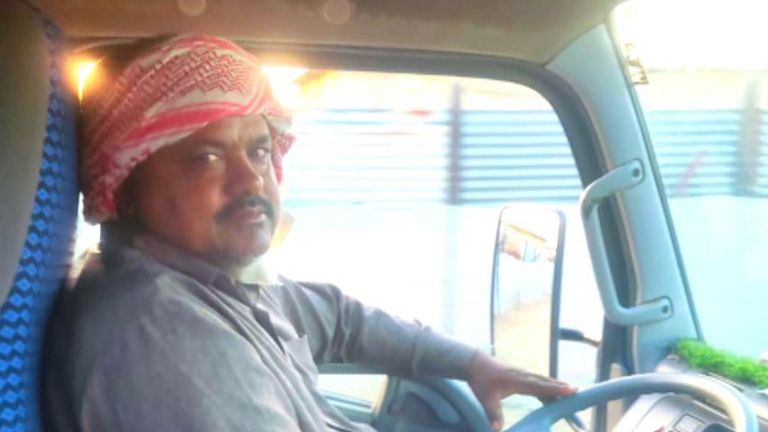
Saleh Ahmed, 55, from Bangladesh, was delivering drinking water in the emirate of Ajman when he was struck by debris after an Iranian missile attack.
Speaking from Bangladesh, his son Abdul Haque told Sky News that Saleh was a hard-working man and the family’s sole breadwinner, who would have not risked his life had he known the US-Israeli war with Iran had started.
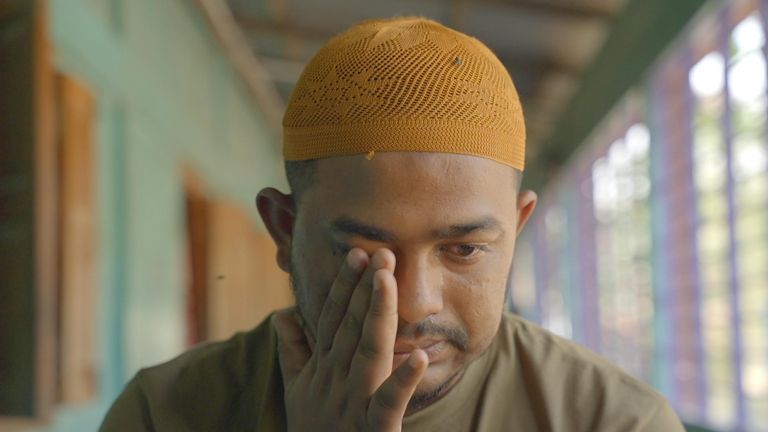
“My father went to deliver water,” Abdul said in tears. “That’s when an Iranian missile landed on him and his car.”
Advertisement
Ten minutes later, Saleh died at the scene, his son said.
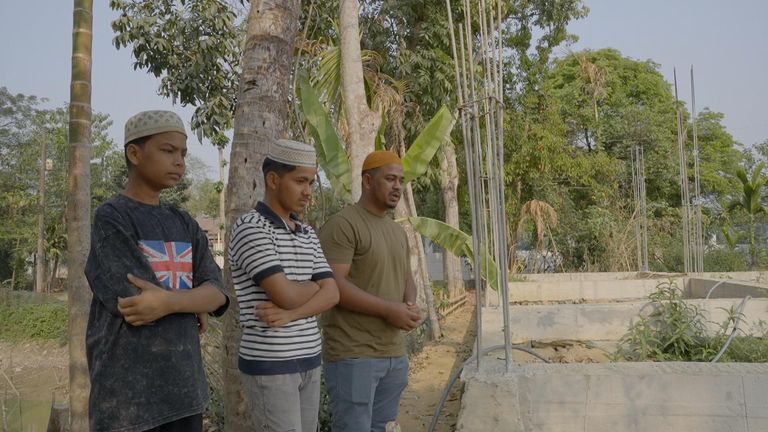
Image: Saleh Ahmed was unaware the war had started when he was killed, his family believe
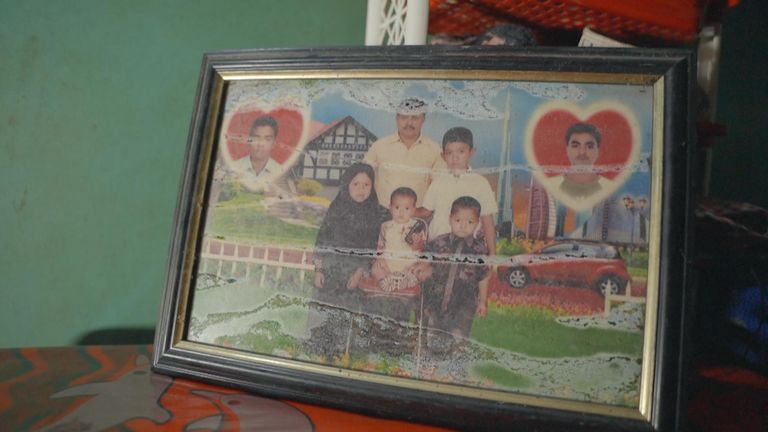
Saleh lived in the UAE as an expat for 25 years, sending under £500 per month in earnings to Bangladesh for his wife and four children.
His family says the attack took them all by surprise.
“No way, he wouldn’t have known,” Abdul said, when asked if his father was aware of the war.
Advertisement
“If he knew he wouldn’t go out like that. We are hungry people, we have nothing and our family is very big. For sure my father didn’t know about the war, or else he wouldn’t have gone outside.
“If I had known, God willing, I would not have let him go outside.”
Image: Abdul wiped away tears as he described his father’s ordeal
Image: Saleh was described by his family as a hard-working man
‘You don’t get friends like my dad’
Five years ago, Abdul joined his father in Ajman to work alongside him at the water company.
“As a child, I’d only spend a month or two here and there with him. But for the last five-and-a-half years we were more like friends. Eating together and everything, we did it all together like friends,” he said.
Advertisement
“You don’t get friends like my dad anywhere in the world.”
Saleh’s life mirrors that of millions of South Asian migrant workers who live and work in the Middle East. Many have roles in construction, hospitality, transport and as domestic help.
Image: Saleh sent money to Bangladesh for his wife and four children
With roots in the 1960s oil boom, today the migrant workforce is made up of workers from countries like India, Pakistan and Bangladesh, and constitutes a large percentage of the overall population. Their remittances support generations of family back home.
“At the beginning my father really struggled and did a lot of different work. He worked at hotels, he washed cars, cut grass, he did everything,” Abdul said.
“And for the last seven or eight years he had a good position at the water company. He did a good job, it was in the service of people, delivering drinking water to people.
Saleh’s family live in a remote village in Sylhet, in northeastern Bangladesh. With the money he sent to them, they had begun building a house. The site remains incomplete, with a concrete foundation lying bare.
Advertisement
Abdul explains how his father did everything he could for the family to have their own home, right up until he died.
Image: Abdul and his family are mourning Saleh
Saleh was not only supporting his family, but Abdul explains his father would gift meat parcels at Eid to friends and neighbours, give money to charity, and donate funds to the local mosques. He last visited his family four months ago.
Airspace closures over the UAE mean Saleh’s body cannot be flown home for burial until commercial flights resume. Abdul says the delay in being next to his father and laying him to rest only prolongs the family’s sadness.
Advertisement
Advertisement
What happens to Gulf if immigrants want to leave?
Bangladesh’s foreign ministry confirmed Saleh’s death on Monday. It said ensuring the safety and security of more than six million Bangladeshis living in the Middle East remains the government’s top priority.
Meanwhile, there are no plans to evacuate Bangladeshi migrant workers. The government has urged its citizens in the Middle East to “remain vigilant and strictly follow guidance issued by respective host governments”.
“I pray for everyone to come quickly to a resolution,” Abdul said, speaking about the US, Israel and Iran.
Advertisement
“I’m seeing videos of many people dying, and I don’t want someone else to die like my father died. I don’t want any other people to lose their parents like we lost our dad.”
With manipulation, deceit and lies on the menu, may we offer you a sample platter of what’s to come, before the main course?
Bon appétit, mon cheri!
Tuesday, March 10
Advertisement
Leanne suggests a girly film night with Megan complete with ice cream, popcorn and no bras.
Before Megan can go, Leanne asks for her advice regarding Sam, concerned that there’s more to the story than he’s letting on.
Megan springs into manipulating Leanne into not pushing the issue, promising that if Sam needs anything, he’ll approach her. Placated, Leanne heads off to work.
Advertisement
As the door closes, Megan’s saccharine smile falls off her face. Has she managed to shut Leanne down? Or is her true nature about to come to light?
Wednesday, March 11
Advertisement
Don’t miss a Soaps scoop! Add us as a Preferred Source
As a loyal Metro Soaps reader, we want to make sure you never miss our articles when searching for stories. We have all the latest soaps news, spoilers, videos, and interviews, with a vibrant community of highly engaged readers.
Click the button below and tick Metro.co.uk to ensure you see stories from us first in Google Search.
Now you can ensure you never miss a story from the Soaps team
Advertisement
As Lauren, quite blatantly, tries to make Ollie jealous with tales of nightclubs and groups of lads, he calls her out.
Dropping her tough exterior, Lauren opens up about her worry over being hurt, especially after her last two relationships. Admitting that this is the reason she ended things and that she regrets it deeply, Ollie is utterly floored.
As the two finally give in to passion, Amy bursts in as Maggie watches on with sinister glee. Withdrawing from the burgeoning love triangle, Amy storms away.
Has Maggie got what she wanted and successfully destroyed any chance of Amy and Ollie?
Advertisement
Thursday, March 12
Steve is buoyed by the support of girlfriend, Cassie Plummer (Claire Sweeney), with daughter Amy by his side, as budding bestie Ben and Eva Price (Catherine Tyldesley) arrive to offer their support.
Advertisement
Tim Metcalfe (Joe Duttine) arrives in a very interesting shirt while Sally (Sally Dynevor) pays her respects, in the most Sally way possible.
As the funeral car arrives, Steve and his family hop in, though Maggie’s conflicted glare at the proceedings remains hidden.
Is the truth of the bond between Steve and Ben about to be revealed?
The Six Nations is running from February 5 to March 14 and Wales Rugby fans can get the latest jerseys, hoodies and more at Kitbag.
6. Alex Mann 8 – star man
The Cardiff backrower put in a huge defensive shift making a remarkable 28 tackles and getting under the skin of the Ireland pack.
Mann has found his feet as an international player as he won a crucial penalty at the breakdown in the first half, while his carry set up James Botham’s try.
5. Ben Carter 7
Another strong performance from the Dragons lock who put in 19 tackles as he fronted up to the powerful Ireland pack.
Advertisement
Carter also marshalled the lineout well as Wales’ set-piece functioned well.
4. Dafydd Jenkins 7
The Exeter Chiefs lock is a work horse who put in a huge shift.
Jenkins gets through a ton of work making 27 tackles and was a key reason the Wales lineout went well.
3. Tomas Francis 6
Scrummaged well and was arguably not rewarded as much as he should have been by the officials.
Advertisement
Also played his part around the park.
2. Dewi Lake 8
Carried extremely well throughout leading from the front.
Won a crucial turnover at the breakdown when Ireland were building up ahead of steam in the Wales 22.
Also, put in a huge defensive shift making 23 tackles and the lineout also functioned well.
Advertisement
1. Rhys Carré 8
The Saracens man is developing into a high-class Test player.
Solid in the scrum and carried well consistently getting over the gainline. The Wales prop scored a terrific try when he brushed aside Balacoune before running in from just outside the Ireland 22.
Replacements
16. Ryan Elias 6
Threw well into the lineout and offered himself as a carrier
17. Nicky Smith 7
Gave Tadhg Furlong a torrid time at the scrum and put in a strong shift around the park.
Advertisement
18. Archie Griffin 7
Scrummaged very well upon entering the fray.
19. Adam Beard 6
Solid after coming back into the team and ensured the lineout continued to function well.
20. Olly Cracknell 7
Carried extremely well getting Wales over the gainline.
Resident Evil Requiem – the perfect anniversary gift (Capcom)
With the latest Resident Evil game proving to be a major hit once again, a reader explains why they’ve been a fan of the series for three decades now.
Resident Evil is going to turn 30 this month and that worries me because I remember playing the original as a kid (my parents were very lenient) and, well… time certainly does fly. I’ve played almost every Resident Evil game over the last three decades and I love the series more than any other.
Despite all the brain-eating zombies and disgusting mutations, playing Resident Evil is my comfort food. I’m never happier, when playing a video game, than when I’m being scared and thrilled and grossed out by a new Resi.
As I sit down to write this it’s actually kind of hard to explain the appeal of the games, even to another fan. Since Resident Evil 4 they’ve been great action games, but they didn’t start that way. And while some can be very scary at times, especially Requiem, they’re generally more tense than frightening.
Advertisement
They also have an ongoing story that spans that whole 30 years, but it’s complete nonsense and the scripts are always terrible – which is one of the things I love about it the most.
Resi games can be funny, but not always intentionally and they’re not straight up comedies, like something like Army Of Darkness or Shaun Of The Dead. They’re great third person combat games a lot of the time but that never dominates the games and, strangely for a Japanese franchise, the boss battles are often not that memorable.
Expert, exclusive gaming analysis
Sign up to the GameCentral newsletter for a unique take on the week in gaming, alongside the latest reviews and more. Delivered to your inbox every Saturday morning.
Advertisement
Despite how often they’re copied, they’re strangely unique games where even today you don’t know how much of what you enjoy of them is intended, when it comes to the camp and corny dialogue. It has been hit and miss in the more modern games, because it’s hard to be bad on purpose and still be entertaining.
Thanks to Resident Evil 4, Leon S. Kennedy has always been the funniest of the main characters, with his bad jokes and one-liners. He’s also the best looking of the men, with his famous hair and manly stubble. He’s meant to be 50 in Requiem, but he barely looks it and certainly doesn’t move like he’s that old. But I guess the idea is that he’s not just aging with the games, he’s aging with his audience too.
Advertisement
Almost everything that comes out of his mouth in Requiem is hilarious, with dad joke after dad joke, and all delivered with the ultra-confidence that comes from being an invincible video game character.
To my great pleasure, Requiem has been a big hit – the fastest-selling entry for the series – and we’ve still got whatever Capcom might announce for the 30th anniversary itself (on March 22) to look forward to. I’ve seen people saying that it’s proof that big budget single-player games can still be successful and I’m glad of that too. It’s good to see Resi still leading the way after all these years.
For me Resident Evil will always be the perfect video game, in that the gameplay is great, the storytelling is entertaining (bad but in a good way), the graphics are top notch, and the whole thing is weird and fantastical in a way only a video game can be.
The Resident Evil movies are shlock, just like the games, and they do have some of the same DNA in the so good it’s bad sense, but it’s only the dialogue that’s like that in the games. Everything else is the best it can be and that’s certainly not true of the films.
Advertisement
The mix of elements that is Resi only works because it’s a video game, where you’re able to put your own spin on things, and read between the lines, while you’re playing. I love it and with Requiem it feels like the future is looking very bright for my favourite video game series.
By reader Cher
Everyone loves Leon (Capcom)
The reader’s features do not necessarily represent the views of GameCentral or Metro.
You can submit your own 500 to 600-word reader feature at any time, which if used will be published in the next appropriate weekend slot.
There are three types of people in Dubai right now: those off to play padel, those rushing to the Omani border, and those waiting for house prices to drop.
It’s a joke doing the rounds here, and it neatly captures the mood.
Day seven of this war started with the familiar humdrum of daily life – people out jogging, children off to the park, the malls filling with shoppers.
But the mid-morning air was pierced by the screech of another emergency alarm on mobile phones.
Advertisement
Image: A missile alert sent to mobile phones in Dubai
This one warning of incoming missiles, telling people to seek shelter and stay away from windows.
We’ve now had to teach toddlers and childminders to take cover when they hear the warnings or blasts from air defence. I’ve met children in Ukraine who are so familiar with the sounds of war they can tell if it’s incoming or outgoing fire. I never expected to see children enduring this in Dubai.
Normal life continues while the country is attacked every day.
Image: Smoke billows from Dubai’s Jebel Ali port on Sunday after an Iranian attack. Pic: Reuters
The UAE is now having to defend its territory, residents and way of life – in a way it never imagined.
It’s understood Iran has fired more drones and missiles at the UAE than anywhere else – even Israel – in these last seven days of war.
If you want to get people’s attention, aim for a global city and its five-star hotels. Create shock, havoc, and headlines.
But no one expected this – not the government, the military, or the millions of people who live here.
Advertisement
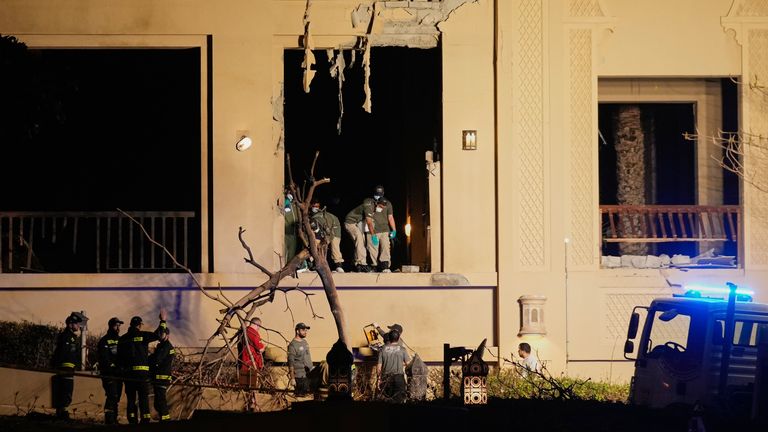
Image: The site of an explosion at the Fairmont The Palm Hotel in Dubai on Saturday. Pic: AP
The US military base in Abu Dhabi was always known to be a possible target, but fairly low down the list given the far larger American military assets in the region. The UAE also made it clear in a public statement several weeks ago that no attacks on Iran were to come from its territory, airspace or waters. It was thought this would add a layer of protection to Iran’s Gulf neighbour.
We couldn’t have been more wrong.
More than 200 ballistic missiles and nearly 2,000 drones have been fired at the UAE in seven days.
Two missiles and 74 drones have got through. Three people have been killed and dozens injured.
Image: A Dubai beer garden sitting almost empty amid ongoing hostilities with Iran. Pic: AP
For some residents, it’s been too much, and community WhatsApp groups are in meltdown with people sharing flight information and tips on the journey to Muscat airport.
I’ve heard from many who have crossed into Oman to catch a flight, others who’ve driven to Saudi Arabia to get out.
Advertisement
I’ve also heard from others making the reverse journey – separated from their children and desperate to get back.
For many stranded tourists, it’s been a nightmare holiday. The initial shock of finding themselves caught up in a war has been replaced by a sense of abandonment.
The UK government took nearly a week to organise its first evacuation flight, and there are tens of thousands of British holidaymakers still trying to get home.
We’ve received hundreds of messages from people at a loss as to what to do. One traveller who did get a flight, called on the way to the airport to say they could see incoming fire.
Advertisement
Image: The US consulate in Dubai on fire
It’s been a surreal and scary week on many levels. The psychological impact has been even greater than any physical harm.
Will this hurt the city? Will this impact the country? For sure. At least for a time. I’ve already spoken to residents who’ve left and don’t want to come back.
Will it impact the sky-high property prices and rents? Probably.
Image: Empty road near Dubai International Airport. Pic: Reuters
Much depends on how long this war lasts – how long Iran is willing to sabotage its relationship with its neighbours.
But what I do know is that seven days on, a country not used to war has shown it can defend itself.
Advertisement
And a population that chose this city for its lifestyle and security – never expecting to confront war on their doorstep – has shown a quiet resilience they can take pride in.
Many Britons aspire to leave a positive mark on the world, yet a significant number have not formalised their wishes through a will, new research reveals.
A survey by Great Ormond Street HospitalCharity (Gosh Charity) found that while 61 per cent of people hope to be remembered for their contributions, only 39 per cent have actually drafted a will.
The figures are even lower for charitable bequests, with just 14 per cent including a gift in their will. A further 11 per cent expressed an intention to donate to charity but have not yet updated their will, and 19 per cent are considering it.
Over half (52 per cent ) of respondents emphasised the importance of their lifetime actions benefiting future generations.
Advertisement
The research also found that two-fifths (41 per cent ) of people said they are not currently considering leaving a gift to charity in their will (Gareth Fuller/PA)
The research was carried out by Opinium and released at the start of Free Wills Month.
Death of a loved one
Becoming a parent or grandparent
Reaching a life milestone
Experiencing a serious illness
The research also found that two-fifths (41 per cent ) of people said they are not currently considering leaving a gift to charity in their will, rising to more than half (51 per cent ) of Baby Boomers (aged 62 to 80) and 44 per cent of Gen-X (aged 46 to 61).
The survey also explored the life moments that prompt people to reflect on the legacy they want to leave behind.
The death of a loved one was the biggest trigger (14 per cent ), followed by becoming a parent or grandparent (12per cent ), reaching a life milestone (10 per cent ) and experiencing a serious illness (9 per cent ).
Advertisement
The research suggests there may be some uncertainty about how accessible legacy giving can be, Gosh Charity said.
Nearly two-thirds (65 per cent ) of people were aware it is possible to leave a gift of any size to charity in a will, while just over a third (35 per cent ) were unaware of this.
Get a free fractional share worth up to £100. Capital at risk.
When asked about leaving a small financial gift of up to £100, nearly half (46 per cent ) of people surveyed believe it would make little difference to a charity, and 8per cent believe would make no difference at all.
Gabi Field, deputy director of public fundraising at Gosh Charity, said: “Every legacy gift, no matter the size, helps Gosh Charity fund vital support for families at the hospital as well as ground-breaking research. Together, these gifts ensure seriously ill children get the best chance and childhood possible, now and for generations to come.”
Gosh said patient Ary Patel and his family have seen the impact of that support first-hand. Ary, who is approaching his 10th birthday this year, underwent heart surgery at the hospital when he was six months old.
This month, he is starring in a Gosh Charity TV advert encouraging people to consider leaving a gift in their will.
Advertisement
Ary’s mother Shiva said: “To see Ary approaching his 10th birthday is truly incredible, and something we will never take for granted. When Ary needed surgery, the care we received at Great Ormond Street Hospital was extraordinary – not just the life-saving treatment, but the support and kindness shown to us every step of the way.”
Opinium Research surveyed 2,000 people across the UK in February.
The Anglo-American “special relationship” has hit a low ebb following American strikes on Iran. US president Donald Trump disparaged British prime minister Keir Starmer with a negative comparison to Winston Churchill, making clear his “disappointment” over British reticence to offer logistical support to the American military.
This is the latest in a series of comments Trump has made about Starmer’s authority on foreign policy concerns – particularly the British return of Diego Garcia to Mauritius.
For his part, Starmer has publicly broken from the president on the matter of Greenland, offering “strong support” to Denmark in response to US threats to take over the territory. In January, when Trump disparaged British troops in Iraq and Afghanistan, Starmer called the remarks “appalling.”. Despite Trump’s attempts on Truth Social to smooth the matter over following a “stern” call from Starmer, one controversial exchange has bled into the next. Trump is understood to be very unhappy that the UK won’t join strikes on Iran. Starmer has stood by his decision and insists it is his duty to decide what action is in “Britain’s national interest,”.
This breakdown in relations between the two heads of state is remarkable – but it is not unprecedented. Britain’s refusal to follow America into a foreign conflict has inflamed tensions before. President Lyndon B Johnson and prime minister Harold Wilson endured a breakdown in the 1960s over Vietnam. The way Wilson handled this situation should be Starmer’s guiding light has he charts his own course on Iran.
Advertisement
Vietnam
The UK did not publicly participate in the Vietnam war. At the time it was searching for a way to join the European single market against French wishes and extricate itself from its military bases in the Arabian Peninsula and Southeast Asia. Wilson was seeking to move away from costly military commitments abroad.
Publicly, Wilson pushed for an end to the war, meeting with the Soviet Union’s Alexei Kosygin to try and move negotiations forward. He backed Johnson when the US agreed to what Wilson called “unconditional negotiations” with North Vietnam in 1966. Behind closed doors, Wilson reiterated his private support for Johnson regularly. He also met with the president to justify British reticence to join the war on several occasions, using trips to Washington as a way of trying to bolster the public image of a strong affiliation.
No love lost: Lyndon B. Johnson with Harold Wilson at the White House in 1967. Library of Congress
However, the Wilson and Johnson governments clashed over a number of concerns. Johnson faced criticism in Britain for failing to attend the funeral of Winston Churchill in 1965. LBJ was allegedly so infuriated by the lack of British troop commitment to the war that he called Wilson a “little creep” behind closed doors. The Americans also lamented the weakness of the British pound, as Wilson had it devalued by 14.3% in 1967. This threatened the stability of the US dollar and other western currencies.
Advertisement
The White House began to see Britain as a much less valuable – or stable – ally in the ongoing cold war. The British in return felt pushed to acquiesce to American pressure, while also relying on American support on issues such as Rhodesia, which unilaterally declared independence from the UK in 1965.
With this change in attitude, Johnson turned to other allies for public support. The then Australian prime minister, Harold Holt, went “all the way with LBJ,” joining other Pacific allies in sending troops to fight alongside Americans. Johnson lavished support on them, granting Australia its first state visit by a sitting US president in late 1966.
Conversely, he never visited Britain once. Johnson’s antipathy towards the UK is perhaps best summed up by an act of political disrespect towards Wilson in 1965, when he had the White House band play “Plenty of Nuttin’” at a diplomatic dinner following economic talks – a sarcastic rejoinder for Wilson’s lack of what he deemed proper support.
A third way
Ultimately, the “special relationship” cooled significantly during the Johnson-Wilson era. But despite the sometimes-wretched relations between the two leaders, the connection between the two countries in terms of intelligence sharing, training and support on other matters remained intact. Wilson saw the value of American support, travelling to the United States several times during the 1960s despite criticism from anti-war campaigners and from some in parliament. Wilson’s conciliatory approach is mirrored by Starmer’s attempts to carve a third way over the first year of Trump’s government. Starmer was heavily criticised for inviting Trump to carry out a second state visit – the first US president to receive a return invite.
Advertisement
The situation has changed since then, and the Iran strikes have indeed put pressure on the US-UK relationship. But there is precedent for resistance to American pressure in the Wilson-Johnson relationship. The effects were stark – it was not until Margaret Thatcher and Ronald Reagan were in charge that the relationship truly felt “special” once again – but it endured and thrived again despite what had been a severe clash in personalities.
Trump’s climbdown over the criticisms he made of Nato troops in January shows that the United States still values its British ally to some extent. The prime minister should remember that the relationship will endure long after the current occupants of both the White House and 10 Downing Street leave their respective offices.
Many in the crowd saw the Cheshire-born star perform for the first time since his mammoth Love On Tour wrapped back in 2023 – and they came dressed for the occasion
For Harry Styles, Friday night in Manchester marked a long-awaited return to the stage. But for thousands of fans outside Co-op Live, it felt like a homecoming of their own.
Advertisement
Many in the crowd saw the Cheshire-born star perform for the first time since his mammoth Love On Tour wrapped back in 2023 – and they came dressed for the occasion.
Feather boas and cowboy hats – a staple of Harry crowds – had clearly been pulled out of storage, joined this time by a fresh wave of sequins and sparkle inspired by the ‘disco’ promise of his brand new fourth album Kiss All The Time. Disco, Occasionally.
At just £20 a ticket, the show became one of the hottest – and most unusual – gigs of the year. The crowd arriving at the sold-out gig on Friday night (March 6) were met with a unique rule: this would be a strictly phone-free event.
Instead of filming the moment for social media, fans were asked to lock their phones away in special pouches on entry. In their place, concertgoers were handed disposable cameras – a nostalgic twist that encouraged everyone to stay present and soak up the moment.
Advertisement
It felt fitting when Styles eventually emerged to open the night – after a unique synth buildup – with Aperture, the first track on the album. It’s a song made for hugging strangers on a dancefloor – and as fans bounced along to the chant of ‘We belong together’, this quickly became the unofficial motto of the evening.
He appeared donning a bright blue jumper over a floral shirt, with classic Harry yellow suit trousers. He brought the same wild dance moves he teased us with last week at the Brits and, understandably, the crowd went wild.
The phone-free rule seemed to work exactly as intended. Instead of a sea of glowing screens, the arena was filled with fans dancing freely and fully engaged in the performance unfolding in front of them. I’ll admit, I thought the disposables would be a bit of a gimmick, but it was a very special way to immerse yourself in the gig.
The show coincided with the release of Styles’ latest 12-track album, which dropped in the early hours of Friday morning. It was the first chance for fans to hear all of the songs live – and possibly their first chance to hear them at all.
Advertisement
He moved onto American Girls – and despite having only 12 hours to revise the lyrics, fans didn’t disappoint. Track 2 is clearly already a favourite. Ready, Steady, Go! followed, allowing Styles to flex his vocals, bringing a similar undertone of rock to what we heard in his first solo album.
Early impressions suggest Kiss All The Time. Disco, Occasionally continues Styles’ habit of refusing to sit comfortably in one genre. The album blends bits of funk, disco rhythms, pop and softer acoustic moments.
Like much of his previous work, there’s a thread of melancholy running beneath the upbeat production. It sparks the sort of nostalgia that makes you feel sentimental for memories you’re not even sure you have.
The heavy beat and impressive guitar solo of Are You Listening Yet? contrasted to the melancholy feel of The Waiting Game, which followed Taste Back – my favourite track on the album, which blends his older pop style with his newer, more mature lyrics.
Advertisement
Throughout the show, Styles was joined by the House Gospel Choir, who added a rich, soulful depth to several of the new songs. The popular choir – known for their own house anthems and recent appearance alongside Styles at last weekend’s BRIT Awards – helped bring Season 2 Weight Loss to life, with their soaring harmonies transforming the track into one of the evening’s standout moments.
The mood then softened as Styles moved into Coming Up Roses, the album’s most delicate offering, accompanied by a stunning live string section that transformed the arena into a quieter, more intimate atmosphere.
Introducing the song, Styles paused to thank one of his closest collaborators.
“There’s a lot of people in the audience tonight who helped me make this record,” Styles told the crowd, before dedicating a song to his friend Tom. “I wrote a lot of songs and typically the songs I write by myself at home are the ones I assume won’t make it onto the album.
Advertisement
“I want to thank Tom for pushing me to believe in me. That’s the reason why this song exists. It’s one of my favourite things I’ve ever done.”
From there, the mood lifted again as the crowd danced along to the infectious Pop, before the funk-leaning Dance No More saw Styles’ signature dance moves make a welcome return.
The choir and band then rejoined him for the emotional Paint By Numbers, with the crowd swaying in unison as flashes from disposable cameras briefly punctured the otherwise hushed moment.
The Manchester show marks a significant moment for the singer. Born in nearby Cheshire, Styles has always maintained a strong connection to the North West – and on Friday night, that sense of homecoming was unmistakable.
Advertisement
“Good evening Manchester,” he grinned at one point, clearly soaking in the reception. “My name is Harry. It is an absolute pleasure to be here tonight.”
The evening concluded with Carla’s Song, which Styles dedicated to a close friend in the audience.
Just when it seemed the night had reached its end, Styles returned to the stage with a surprise encore.
“We haven’t played that one in a while,” he joked after launching into From the Dining Table from his debut album. “Truth be told, we haven’t played anything in a while.”
Advertisement
Fans erupted as he followed with Golden from Fine Line, before the unmistakable opening notes of Watermelon Sugar sent the arena into a frenzy.
Continuing a tradition from Love On Tour, the crowd gleefully screamed the famous ‘leave America’ line during As It Was, an affectionate chant urging the British star to return to the UK for good.
Reflecting on the atmosphere in the room, Styles told the crowd the community created at his shows is something he treasures deeply.
“The community that you guys have built together in this room, and rooms that I’ve seen around the world, is something so unbelievably magical,” he said.
Advertisement
“In a world that we have today that feels so chaotic it’s so easy to become hopeless – and I see what you create together and there is just so much hope in here.”
“I encourage you to keep being the change in the world that you want to see,” he added.
He closed the night with Sign of the Times, the towering ballad from his debut solo album. Arms wrapped around friends and strangers alike, thousands swayed together as Styles delivered the final chorus – many, myself included, teary eyed.
But there was one final moment left. Returning briefly for a reprise of Aperture, Styles hammered home the message that had opened the night: ‘We belong together.’ As the chorus rang out once more, fans jumped arm in arm, rounding off the show in a full circle moment.
Advertisement
The concert ended the same way it began – united.
For those lucky enough to be in the room, the night felt less like a typical arena show and more like a shared experience. The perfect blend of old and new, it felt like fans had witnessed something really special. Something intimate, despite the scale of the venue.
And thousands of voices sang together, one thing was clear: In that moment, Manchester really did belong together.