Connect with us

Business

A ‘perfect storm’ points to a much smaller U.S. auto market by 2040

Published

on

A 'perfect storm' points to a much smaller U.S. auto market by 2040
The auto industry is facing a demographic cliff

Ten years ago, a record 17.6 million cars, trucks and SUVs were sold in the U.S. Some forecasts say the country might not come close to that number again.

Analysts at consulting firm Bain & Company said several signs indicate the market is about to shrink even more. Falling birth rates, behavioral changes, high car prices and a growing array of alternatives could drive sales down by more than 2 million units by 2040, according to their analysis.

These indications point to a future where automakers fiercely compete for a shrinking number of customers, said Mark Gottfredson, a partner at Bain & Company.

The auto industry has historically depended on an annual 1% growth rate that tracks the increase of the overall population, Gottfredson said. But all over the world, government statistics show population growth has slowed, and some countries are already seeing declines.

Advertisement

“It is the perfect storm, isn’t it,” Gottfredson said. “It starts with the population declines. You’re no longer a growth industry. You’re a declining industry. You’re a declining industry at a time when the technology is disrupting everything.”

The U.S. fertility rate in 2025 was about 1.6 births per woman. While not as low as some countries in Europe or Asia, it’s considered below the replacement rate of 2.1, according to the Centers for Disease Control.

Bain said that has been offset by relatively high immigration — about a million people coming to the U.S., according to the historical average it cited. But the firm said it expects restrictive immigration policies will last for the next 15 years, cutting historical net migration rates of the past 20 years in half, which means it could again reach low levels seen in 2019.

That remaining population’s behavior has changed — in part due to high prices and affordable alternatives, according to Bain. Half of 16-year-olds today don’t have a driver’s license, compared with nearly 70% of 16-year-olds between the years of 1966 and 1984, Gottfredson said. The stat might reflect a mere delay rather than a total refusal — Bain’s research suggests most people still get licenses by age 25.

Advertisement

Still, the share of new vehicle registrations among people aged 18 to 34 fell from 12% in the first quarter of 2021 to under 10% by mid-2025, according to S&P Global Mobility. Buyers 55 and older account for nearly half of all new registrations and have held the largest share for eight straight quarters, the firm said.

“The engine behind it is affordability,” said Craig Daitch, founder and president of Telemetry, a firm that does market research for the auto industry. New vehicle monthly payments are up 30% over four years, and nearly one in five new vehicles now carries a payment over $1,000 a month, he added.

More monthly auto loan payments are above $1,000, and most are not for luxury models

AutoForecast Solutions, a forecasting firm, expects U.S. new car sales to stay relatively flat at around 16 million through 2033, the furthest year in the future for which the company issues estimates.

“When you look into the future, younger people are more likely to use Uber or Lyft when they’re going somewhere,” Sam Fiorani, vice president of global vehicle forecasting for the company. “We’re still seeing groups of young people who enjoy driving and want a new car, but fewer can afford it.”

If robotaxis become widely available and affordable in the next 15 years, the share of the licensed population could drop around 2 to 3 percentage points, to 85%, according to Bain research. The number of vehicles per driver could drop from 1.2 to 1.1, which would be equivalent to 10% to 20% of U.S. households shedding one vehicle.

Advertisement

The projections Gottfredson shared with CNBC are revisions. He had earlier targeted 2030 as the year when volumes would dip below 14 million, but said he changed those assumptions because autonomous vehicles are taking longer than expected to arrive.

The population numbers though, are baked in.

“We already know how many people have been born and how many people will be of vehicle driving age at age 16 in 16 years from now. And so we can say with quite a bit of certainty that when we get to 2040, we’re going to see we’re going to see some decline in the U.S. That decline is even worse in places like Europe and in places like most of the countries in Asia.”

Gottfredson said the most direct indicator of a potential of a future decline is the rate at which vehicles are “deregistered,” which is when they’re taken off the road and either scrapped or exported to another market, as happens with used vehicles.

Advertisement

In 2000, the rate of deregistration was about 6%, according to the Bain report. As of 2025, the rate was about 5%. Gottfredson said that rate could fall to 4.4% by 2040. This is primarily because vehicles are lasting longer — hitting a record 12.8 years on the road in 2025, according to S&P Global Mobility.

This could reverse. The longevity of electric vehicle batteries is still uncertain. It is also unclear how long automakers will be willing or able to update the software that is increasingly vital to new cars.

However, auto forecasters say that with vehicle prices as high as they are, the industry will have to find a way to keep cars in service.

“Today’s vehicles can’t have a limitation of five to 10 years,” Fiorani said. “It’s not practical for a person who’s spending $50,000 or $100,000 that it’s going to be junk in less than a decade.”

Advertisement

Should these trends hold, the auto industry in the U.S. is liable to become ever more competitive. Consumers have their choice of about 450 nameplates in the country already.

“The competition in the U.S. is going to be ferocious,” Gottfredson said. “There’s too many automakers and too many brands competing for the consumers. The market is going to have to consolidate.”

Choose CNBC as your preferred source on Google and never miss a moment from the most trusted name in business news.
Continue Reading
Click to comment

You must be logged in to post a comment Login

Leave a Reply

Business

Safehold Inc. 2026 Q2 – Results – Earnings Call Presentation

Published

on

OneWater Marine Inc. (ONEW) Q1 2026 Earnings Call Transcript

Safehold Inc. 2026 Q2 – Results – Earnings Call Presentation

Continue Reading

Business

Nearly 12 million Rohto eye drops recalled over sterility concerns

Published

on

FDA issues Class II recall for Lupin steroid eye drops after material found

Nearly 12 million bottles of Rohto eye drops have been recalled over concerns they may not be sterile, according to a Food and Drug Administration (FDA) enforcement report.

The voluntary recall was issued by Vietnam-based Rohto-Mentholatum and includes eye drops marketed to relieve redness, dryness and eye strain.

Advertisement

According to the FDA, the recall affects 11,960,623 cartons of Rohto Cooling Eye Drops distributed nationwide.

The FDA said the products were recalled because of a “lack of assurance of sterility,” meaning the eye drops cannot be guaranteed to be free of potentially harmful microorganisms.

MILLIONS OF PRESCRIPTION EYE DROPS RECALLED NATIONWIDE OVER CONTAMINATION CONCERNS

Rohto Cooling Eye Drops are being recalled nationwide after the FDA cited concerns about the products’ sterility. (Getty Images / Getty Images)

Federal regulators classified the action as a Class II recall, meaning use of the products could cause temporary or medically reversible health effects, but serious adverse health consequences are unlikely.

Advertisement

The recall covers eight Rohto Cooling Eye Drops products — including ALL-IN-ONE, Max Strength, Optic Glow, Digi Eye, Dry Aid and Cool Relief — in single and twin-pack configurations.

Affected products carry expiration dates ranging from July 2025 through February 2029. Consumers should compare the lot number and expiration date on their packaging with the manufacturer’s recall notice or the FDA’s website to determine whether their product is included.

MORE THAN 120K REFRIGERATORS RECALLED AFTER 34 FIRES AND ONE REPORTED DEATH

Woman putting in eye drops.

The FDA said millions of bottles of Rohto eye drops are included in a nationwide recall over sterility concerns. (Getty Images / Getty Images)

The eye drops were manufactured by Rohto-Mentholatum in Vietnam and distributed by The Mentholatum Company, based in Orchard Park, New York.

Advertisement

Consumers whose products are included in the recall should stop using them immediately and either dispose of them or return them to the place of purchase for a full refund.

three unlabled eyedrop bottles

Rohto eye drops sold in the United States are being recalled after the FDA reported a lack of assurance of sterility. (Getty Images / Getty Images)

The recall comes after the FDA recently classified the recall of more than 2.5 million bottles of a prescription steroid eye medication as a Class II action because of concerns about foreign material found in certain lots.

CLICK HERE TO GET FOX BUSINESS ON THE GO

Lupin Pharmaceuticals Inc. voluntarily recalled 2,530,182 bottles of prednisolone acetate ophthalmic suspension USP, 1%, after the presence of a foreign substance was identified, according to an FDA enforcement report.

Advertisement

Last month, the FDA also announced the recall of certain lots of generic cetirizine hydrochloride tablets, commonly sold as generic versions of Zyrtec, over concerns they may have been cross-contaminated with another medication that could trigger potentially life-threatening reactions.

FOX Business’ Brittany Miller and Bonny Chu contributed to this report.

Continue Reading

Business

Chris Wood warns AI capex binge may burn billions as markets turn against Big Tech spending

Published

on

Chris Wood warns AI capex binge may burn billions as markets turn against Big Tech spending
The artificial intelligence (AI) boom is entering a more unforgiving phase as investors begin questioning whether Big Tech’s unprecedented spending will generate adequate returns or merely consume billions of dollars in cash. Jefferies’ Head of Global Equity Strategy Chris Wood said markets are now responding negatively to increases in capital expenditure, a warning signal for hyperscalers that have committed vast sums to AI infrastructure. While announced results have yet to indicate an outright decline in spending, deteriorating free cash flow and sharp share price reactions suggest investors are no longer prepared to reward capex at any cost.

Wood’s long-standing view is that the “hyperscalers will end up blowing a lot of money on their capex binge” and that AI could resemble the airline industry more than the winner-takes-all economics of the internet era.

The warning follows sharp investor reactions to earnings and spending plans from some of the world’s biggest technology companies.

Alphabet was punished after turning free cash flow negative in the second quarter of 2026 for the first time since its IPO in 2004, according to Wood’s GREED & fear report.

Advertisement

Meta shares fell as its free cash flow plunged 91% to $784 million in the second quarter, from $8.5 billion in the same period last year. The company also raised the lower end of its 2026 capex guidance, taking the range to $130-$145 billion from $125-$145 billion.


Microsoft provided the contrast. Its shares gained 8% after it maintained calendar year 2026 capex guidance at approximately $175 billion. That figure was adjusted from an earlier $190 billion estimate because of accounting changes related to the useful life of assets and the movement of finance leases to operating leases, which are not included in capex.
Also Read | Chris Wood’s big warning: The specific risk that will finally trigger the end of AI tradeThe divergent market reactions suggest investors are becoming more selective about AI spending. Companies may still be able to commit billions of dollars to infrastructure, but the market increasingly wants evidence that this spending can support revenue and cash-flow growth.

Wood said results announced so far have not signalled a decline in hyperscaler capex, which is why analysts have yet to cut earnings forecasts for companies such as memory chip producers. But the negative response to higher spending represents an important shift in market behaviour.

The continuing unwind in semiconductor stocks has already pushed some companies close to their 200-day moving averages. Wood said the correction could be limited if it merely represents a technical flushing out of leveraged positions accumulated by momentum traders. The bigger risk is that the violent selloff is anticipating an eventual slowdown in hyperscaler spending.

Korea’s AI trade suffers a brutal reversal

The scale of the speculative unwind is particularly evident in South Korea, one of the biggest beneficiaries of the global semiconductor rally.

Advertisement

The Kospi has fallen 40% from its all-time high of 9,385.6 reached on June 19. Foreign investors have sold a net $116 billion of Korean equities so far this year across the cash and futures markets, with technology stocks accounting for $104 billion of that selling.

Assets in domestic leveraged exchange-traded funds tracking Korean equities have collapsed to $17 billion, down 66% from their $50 billion peak on June 22. However, retail margin-loan balances remain elevated at $22.8 billion, only $2.4 billion below their peak in late May.

Dedicated domestic ETFs tracking Korean equities have received net creations of $48 billion this year, providing some counterweight to the foreign exodus.

Korea’s neutral weighting in the MSCI AC Asia Pacific ex-Japan Index has meanwhile fallen to 17.5% from a peak of 24.6% in late June. The sharp decline highlights how rapidly index exposure and foreign positioning can reverse when investors begin questioning the assumptions underpinning a crowded trade.

Advertisement

Wood sees China emerging as the AI winner

Wood continues to believe that China is best positioned to prevail in AI, particularly in the mass consumer market. His thesis does not assume that demand for computing power will collapse. Instead, he expects demand to keep expanding even if the customers and eventual winners change.

That distinction is central to his outlook that AI may continue transforming the economy while still delivering disappointing financial returns for companies funding the infrastructure buildout.

China’s rapidly growing semiconductor industry also provides a striking counterpoint to the selloff elsewhere. CXMT, the country’s leading DRAM manufacturer, surged 500% after listing. Its market capitalisation reached $523 billion, briefly making it the most valuable company listed in mainland China.

CXMT’s valuation exceeded Industrial and Commercial Bank of China’s $410 billion market capitalisation and was just below Hong Kong-listed Tencent’s $547 billion.

Advertisement

The extraordinary debut came during a week in which global memory stocks remained under intense pressure, demonstrating that investor appetite for AI has not disappeared. Instead, capital may be rotating towards companies offering lower starting valuations or greater exposure to China’s domestic technology ecosystem.

The critical question is no longer whether AI demand will grow, but who will capture the economics of that growth. Wood’s warning is that the companies spending the most may not necessarily emerge as the biggest winners and the market has started demanding proof before financing the next phase of the capex boom.

Continue Reading

Business

FTHNX: A Buy On Proven Behavioral Edge Into A Small-Cap Rotation (MUTF:FTHNX)

Published

on

Northern Small Cap Index Fund Q1 2026 Commentary (Mutual Fund:NSIDX)

This article was written by

I focus on a rigorous fundamentals-foremost equity and credit research. I currently work as a financial advisor/planner, and do analysis in my free time. I have an undergrad in business administration, an MBA in finance, and currently am a doctoral candidate (a DBA with a concentration in Finance and Investment Management). My research style typically involves process-driven research, followed by blending several valuation models together to get a blended, 12 month price target. I enjoy utilizing full DCF analysis in conjunction with SOTP, peer/multiples analysis, and risk-adjusted approaches. I thoroughly enjoy reading filings, technical documentation relevant to the sector, and then translating that data into conclusions with actionable insights. I enjoy learning about the various sectors and companies I find myself researching, and always feel like there is something to learn. As a curious individual, equity and credit research is very fulfilling, and even fun!I always try to find 2-4 variables that drive value or hinder growth, stress test them, and then let fundamental evidence incorporated with book-value set my viewpoint for the research project. I enjoy the energy sector, commodities, tech, and financial sectors the most. I joined Seeking Alpha to share my thoughts with a wide audience. I originally started with sharing my analysis with a few of my friends who are also advisors and/or analysts. I am always open to a myriad of viewpoints, as I feel the most accurate viewpoints and research is made through a collection of great minds working together to figure something out. If you appreciate thorough research, and want to learn more about a company beyond just what is inside of their books, then I believe you will enjoy the research that I work on.

Analyst’s Disclosure: I/we have a beneficial long position in the shares of FTHNX either through stock ownership, options, or other derivatives. I wrote this article myself, and it expresses my own opinions. I am not receiving compensation for it (other than from Seeking Alpha). I have no business relationship with any company whose stock is mentioned in this article.

Seeking Alpha’s Disclosure: Past performance is no guarantee of future results. No recommendation or advice is being given as to whether any investment is suitable for a particular investor. Any views or opinions expressed above may not reflect those of Seeking Alpha as a whole. Seeking Alpha is not a licensed securities dealer, broker or US investment adviser or investment bank. Our analysts are third party authors that include both professional investors and individual investors who may not be licensed or certified by any institute or regulatory body.

Advertisement
Continue Reading

Business

Soccer-FIFA faces fresh transparency calls after retreat on World Cup sell-off plan

Published

on


Soccer-FIFA faces fresh transparency calls after retreat on World Cup sell-off plan

Continue Reading

Business

The New York Times Company Has Exceeded My Expectations (NYSE:NYT)

Published

on

The New York Times Company Has Exceeded My Expectations (NYSE:NYT)

This article was written by

Daniel is an avid and active professional investor.
He runs Crude Value Insights, a value-oriented newsletter aimed at analyzing the cash flows and assessing the value of companies in the oil and gas space. His primary focus is on finding businesses that are trading at a significant discount to their intrinsic value by employing a combination of Benjamin Graham’s investment philosophy and a contrarian approach to the market and the securities therein. Learn more.

Analyst’s Disclosure: I/we have no stock, option or similar derivative position in any of the companies mentioned, and no plans to initiate any such positions within the next 72 hours. I wrote this article myself, and it expresses my own opinions. I am not receiving compensation for it (other than from Seeking Alpha). I have no business relationship with any company whose stock is mentioned in this article.

Seeking Alpha’s Disclosure: Past performance is no guarantee of future results. No recommendation or advice is being given as to whether any investment is suitable for a particular investor. Any views or opinions expressed above may not reflect those of Seeking Alpha as a whole. Seeking Alpha is not a licensed securities dealer, broker or US investment adviser or investment bank. Our analysts are third party authors that include both professional investors and individual investors who may not be licensed or certified by any institute or regulatory body.

Advertisement
Continue Reading

Business

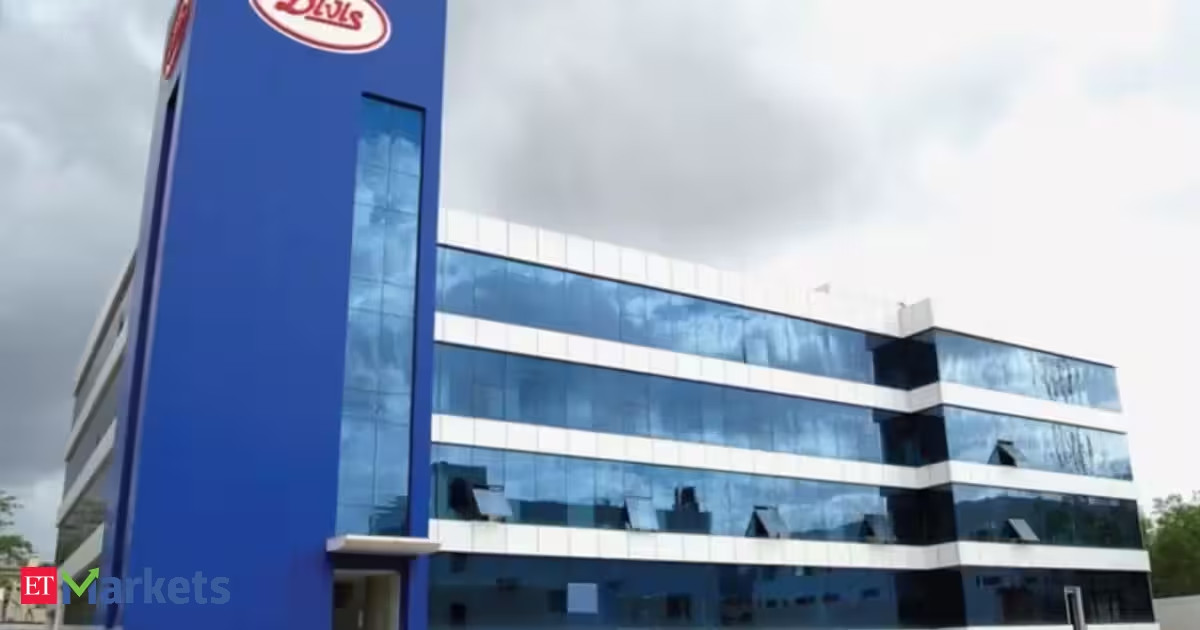
Divi’s Labs Q1 Results: Net profit rises 66% YoY to Rs 902 crore, revenue up 28%

Published

on

Divi's Labs Q1 Results: Net profit rises 66% YoY to Rs 902 crore, revenue up 28%
Pharma player Divi’s Laboratories on Saturday reported a consolidated net profit of Rs 902 crore for the April-June quarter of FY26, marking a 65.5% year-on-year rise from the Rs 545 crore reported in the corresponding quarter of the previous financial year.

The firm’s revenue from operations meanwhile rose around 28% YoY to Rs 3,080 crore in Q1 FY27, from Rs 2,410 crore reported in the year-ago period. Its total income increased over 24% YoY to Rs 3,144 crore, while total expenses rose more than 9% YoY to Rs 1,964 crore during the quarter which ended on June 30, 2026.

For the quarter, Divi’s Labs reported a forex loss of Rs 7 crore as against a forex gain of Rs 39 crore for the corresponding quarter of the previous financial year. Profit before tax (PBT) for the quarter rose to Rs 1,180 crore, as against a PBT of Rs 733 crores for the corresponding quarter of the previous financial year.

Along with the Q1 earnings, Divi’s Labs said that its board of directors have approved the appointment of B Vara Prasad and J Srinivasa Rao as senior management personnel of the company, with effect from August 1.

Advertisement


Also read |
ITC Q1 profit plunges 27% due to record cigarette taxes and West Asia crisis

Divi’s Labs share price

Divi’s Labs shares gained nearly 3% to close at Rs 8,056 apiece on Friday, before the quarterly earnings were announced on Saturday. The stock has gained over 11.5% in one week and 23% in a month.

The shares of the company have overall jumped more than 27% in 2026 so far. In the longer term, the stock has delivered 23% returns over one year, 119% in three years and 65% in five years. The company’s market capitalisation stands at nearly Rs 2.15 lakh crore.
Also read | Bajaj Finserv Q1 Results: Net profit rises 12% YoY to Rs 3,132 crore; shares rally 5%
(Disclaimer: Recommendations, suggestions, views and opinions given by the experts are their own. These do not represent the views of The Economic Times)

Continue Reading

Business

AlzChem Group AG (ALZCF) Q2 2026 Earnings Call Transcript

Published

on

OneWater Marine Inc. (ONEW) Q1 2026 Earnings Call Transcript