Connect with us

Business

AI disruption, metal momentum and defence opportunity: Ajay Bagga maps the market landscape

Published

on

AI disruption, metal momentum and defence opportunity: Ajay Bagga maps the market landscape
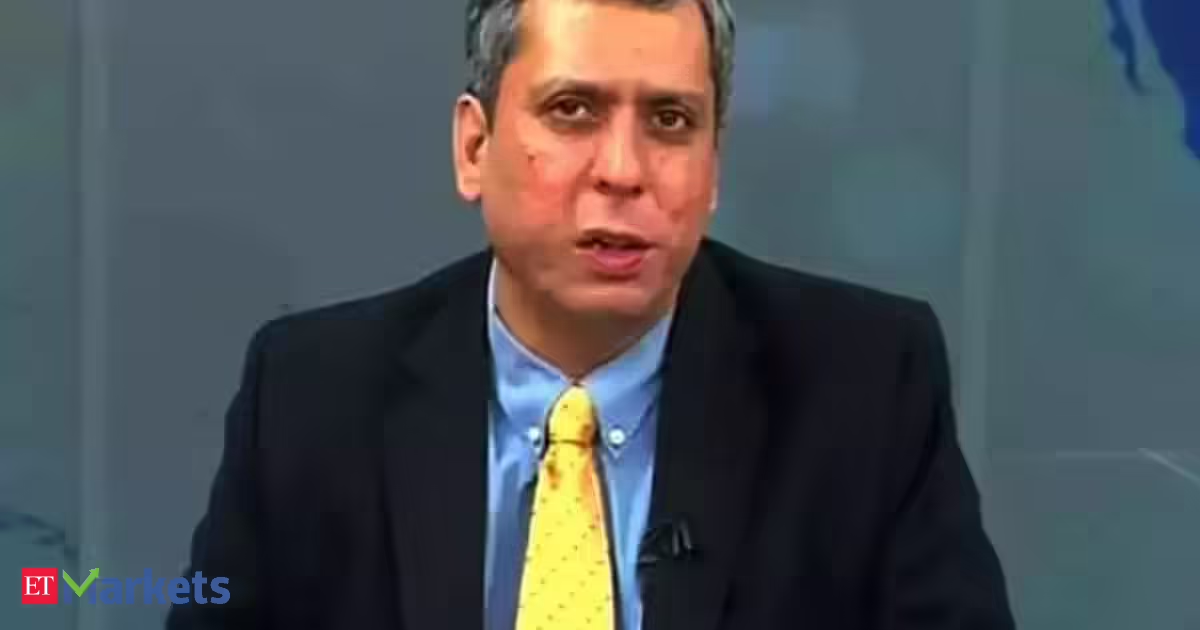
In a conversation with ET Now, market expert Ajay Bagga laid out a cautious stance on Indian IT, a constructive view on metals, long-term optimism on defence, and continued confidence in autos.

From artificial intelligence-led disruption to global stimulus cycles, Bagga argued that investors must differentiate between short-term volatility and long-term structural trends.

IT Sector: Wait and Watch Amid AI Disruption
Responding to whether the recent knock in IT stocks presents a buying opportunity, Bagga advised restraint.“No, I do not think so. Overall, there is no clarity on what Indian IT is going to do about AI. If you look at AI, it is improving by the week, literally. So, what offerings were there a year back are very different from what is being offered today. And people are talking about being able to write a full app, write thousands of lines of code in a very short period of time with the new offers that these AI majors are bringing in.”

He illustrated the shift with a real-world example from a leading consultancy.
“I was talking to a management consultant friend of mine who heads a big consultancy in India, and he was giving me an example that they had a client for whom they would bill about 200 hours of work for a particular segment. He says that work now artificial intelligence delivers in 2 hours. My people spend about 8 hours making sure that every line is correct and then, just to be sure, because I have so much margin now, I put in about 10 hours more dressing it up a little more. But he is saying virtually that 200 hours of work has become 2 hours and it will get better and better.”
According to Bagga, the pace of improvement in AI capabilities is accelerating rapidly.
“He is saying we were training the AI about a year back, we were teaching it accounts, reading accounts, reading annual reports, modelling, and he says now those AIs come in and they are taking over. You just put in what you want done, what analysis, and then you leave it that please learn from what other things you are doing. He is saying they bring in so much more perspective and right now he is spending about another 10 times more time just to be on the safe side not to make any hallucination kind of mistakes, but he is saying the accuracy has increased multi-fold.”

His conclusion was clear: Indian IT companies must articulate concrete AI use cases before investors regain confidence.

Advertisement

“Our IT companies need to bring out use cases, need to bring out application cases of how they will use this, that is unfortunately not coming through. So, in that scenario why should we go out and buy them. We will wait and watch. It will come eventually, but now is not the time.”

Metals: Precious vs Industrial — A Crucial Distinction
Turning to metals, Bagga emphasised the need to distinguish between precious and industrial segments.

“See, we have to differentiate industrial versus precious metals. Precious metals have a lot of tailwinds in terms of central bank buying and industrial growth in silver. So, price action was too strong too swiftly and now we are seeing a consolidation, but the fundamentals have not changed.”

He noted that structural drivers such as central bank demand, de-dollarisation trends, and supply gaps remain intact.

Advertisement

“The demand-supply gaps are still very massive and the de-dollarisation, debasement trade — all those trades — are very much on. So, those will be in a catch-up mode maybe a quarter down the line after some consolidation.”

On industrial metals, the global macro backdrop is supportive.

“As far as industrial metals go, we must remember there is a huge stimulus coming from Japan. China is already expected to unleash a stimulus post the lunar year holidays and Europe is seeing some heavy lifting from the German economy with a big deficit. So, there is stimulus around the world.”

He added that even in the US, fiscal numbers reflect expansionary trends, reinforcing the case for metals.

Advertisement

“Industrial metals will be beneficiaries. So overall, metal pack positive, precious metals positive, industrial metals very positive.”

Defence: Structural Buy with Tactical Swings
On defence stocks such as Hindustan Aeronautics Limited, Bagga maintained a long-term bullish stance despite periodic corrections.

“Yes, absolutely. On a three-year basis, they remain a buy and then within the year you should hear Kunal Bothra and act according to his advice. You see these cycles, two-three months of up move, then you see a selloff, again there is consolidation, again they start moving on some new orders.”

Stripping out short-term noise, he sees a powerful structural theme.

Advertisement

“What is the mega trend if you cut out the noise? We are going to spend a lot on defence. We are becoming a major exporter of defence equipment. Worldwide there is a huge need for defence equipment and the reserves have got really worn down, so there is a need for replenishment. If our companies can deliver, there is a golden opportunity.”

While valuations may trigger intermittent profit-booking, he believes long-term investors remain well positioned.

“On a three-year basis, five-year basis you cannot go wrong on the defence companies.”

Auto: The Consumption Engine Still Firing
The auto sector, one of the standout performers since August 2025, continues to enjoy multiple tailwinds.

Advertisement

“Auto, lot of tailwinds, rural demand has been strong, continues to be strong. You are seeing that in tractors, two wheelers. Secondly, the GST cut has been a big beneficiary and that continues. Third, our export markets are emerging.”

Bagga pointed to large overseas orders and potential trade relief as additional positives.

“So overall, auto sector remains a buy and it is looking good even for the next couple of years. Lot of tailwinds in it and it is reflecting the consumption story.”

Interestingly, he contrasted the sector’s strength with urban consumption softness, visible in recent FMCG numbers. Financing dynamics, however, are aiding auto demand.

Advertisement

“Auto is well positioned, well financed as well in terms of the customer having to pay looking at auto ownership in terms of an EMI rather than putting down the entire amount. So, those well-oiled machines on the finance side are really allowing auto to go up.”

Drawing a comparison with China, he suggested that India’s vehicle penetration story still has significant headroom.

“That population will be in a catch-up mode and autos will be a natural beneficiary.”

Advertisement
Continue Reading
Click to comment

Leave a Reply

Your email address will not be published. Required fields are marked *

Business

Thailand to Reduce Visa-Free Stay Limit to 30 Days

Published

on

Thailand to Reduce Visa-Free Stay Limit to 30 Days

Thailand is preparing to reduce visa-free stays from 60 days to 30 days for citizens of 93 countries, a move aimed at tightening immigration controls while maintaining tourism flows.

Key Points

  • Policy shift: Authorities believe shorter stays will help prevent misuse by foreigners engaging in illegal activities, nominee businesses, or repeated visa runs.
  • Tourism resilience: With most visitors staying around 21 days, officials expect minimal impact on tourism revenue. Extensions beyond 30 days will remain available.
  • Industry support: The Association of Thai Travel Agents backs the reduction, noting that long stays are often exploited for non-tourism purposes.
  • Background: The 60-day visa-free scheme was introduced in mid-2024 under Prime Minister Srettha Thavisin to boost arrivals. While initial surges from China, Taiwan, and India were notable, most tourists continued to stay less than a month.
  • Immigration measures: Since late 2025, the Immigration Bureau has tightened checks on foreigners making repeated border runs.

Authorities seek to balance national security concerns with the country’s reliance on tourism, a key sector of its economy. Officials believe the adjustment will help monitor overstays more effectively while still encouraging international visitors to explore Thailand’s attractions within the revised timeframe.

Economic Outlook

  • Average tourist spending is unlikely to decline significantly, given typical stay durations.
  • Stricter controls may reduce opportunities for foreign-run nominee businesses, protecting domestic operators.
  • Thailand positions itself as a quality-driven tourism hub, balancing economic benefits with immigration enforcement.

Regional Context Thailand’s adjustment contrasts with Malaysia and Vietnam, which continue to offer longer visa-free stays to attract extended visitors. However, Thailand’s established tourism infrastructure and reputation may offset the shorter entry period. The government appears to be prioritizing sustainable tourism and tighter oversight of foreign business activities over aggressive visitor growth.

Continue Reading

Business

India stocks lower at close of trade; Nifty 50 down 1.30%

Published

on


India stocks lower at close of trade; Nifty 50 down 1.30%

Continue Reading

Business

Dutch Bros Is Boiling After Strong Earnings (NYSE:BROS)

Published

on

Dutch Bros Is Boiling After Strong Earnings (NYSE:BROS)

This article was written by

Daniel is an avid and active professional investor.
He runs Crude Value Insights, a value-oriented newsletter aimed at analyzing the cash flows and assessing the value of companies in the oil and gas space. His primary focus is on finding businesses that are trading at a significant discount to their intrinsic value by employing a combination of Benjamin Graham’s investment philosophy and a contrarian approach to the market and the securities therein. Learn more.

Analyst’s Disclosure: I/we have no stock, option or similar derivative position in any of the companies mentioned, and no plans to initiate any such positions within the next 72 hours. I wrote this article myself, and it expresses my own opinions. I am not receiving compensation for it (other than from Seeking Alpha). I have no business relationship with any company whose stock is mentioned in this article.

Seeking Alpha’s Disclosure: Past performance is no guarantee of future results. No recommendation or advice is being given as to whether any investment is suitable for a particular investor. Any views or opinions expressed above may not reflect those of Seeking Alpha as a whole. Seeking Alpha is not a licensed securities dealer, broker or US investment adviser or investment bank. Our analysts are third party authors that include both professional investors and individual investors who may not be licensed or certified by any institute or regulatory body.

Advertisement
Continue Reading

Business

WA ‘dragging the chain’ on density: Lawless

Published

on

WA ‘dragging the chain’ on density: Lawless

The head of research at the nation’s leading real estate data groups says there are not enough apartments being built in this state.

Continue Reading

Business

AD FEATURE: 3 ways a simple international payment solution could help you grow your business

Published

on

AD FEATURE: 3 ways a simple international payment solution could help you grow your business


Managing international payments can be a challenging task but WorldFirst is here to empower businesses to expand globally with confidence

Continue Reading

Business

Fall in the number of shoppers on the high street in Wales

Published

on

Business Live

The Welsh Retail Consortium has published retail footfall figures for January

Shoppers.(Image: WalesOnline/Rob Browne)

Welsh retailers have reported another fall in shoppers, according to new research commissioned by the Welsh Retail Consortium. In January retailers, across the high street, shopping centres and retail parks, reported footfall down 2.8% year-on-year. This was compared to a 3.1% dip in December.

The biggest category year-on-year fall was shopping centres, with footfall down 6.1%. Retail park footfall dipped 2.4%.

For England in January retail footfall was down 1.4%. There were though rises in Northern Ireland, up 3.8% and Scotland 5.1%. Of the UK nations and regions, the fall was only greater in Wales in the east of England, down 3%, and the west Midlands, down 3.9%.

Of the UK’s eleven core cites, Cardiff experienced the second biggest year-on-year fall at 2.4% – although less than the 4.4% dip in December. The biggest fall, 7.1%, was experienced in Birmingham. The highest increase was in Edinburgh, up 5.5%.

Advertisement

TOTAL FOOTFALL BY NATION AND REGION

GROWTH RANK

NATION AND REGION

Jan-26

Advertisement

Dec-25

1

Scotland

5.1%

Advertisement

-1.5%

2

Northern Ireland

3.8%

Advertisement

-1.7%

3

Yorkshire and the Humber

1.2%

Advertisement

-4.5%

4

North West England

0.2%

Advertisement

-2.3%

5

London

-1.1%

Advertisement

-0.4%

6

North East England

-1.2%

Advertisement

-5.0%

7

England

-1.4%

Advertisement

-3.1%

8

South West England

-1.7%

Advertisement

-2.9%

9

East Midlands

-1.9%

Advertisement

-3.3%

10

South East England

-2.0%

Advertisement

-4.4%

10

Wales

-2.8%

Advertisement

-3.1%

12

East of England

-3.0%

Advertisement

-4.5%

13

West Midlands

-3.9%

Advertisement

-5.5%

TOTAL FOOTFALL BY CITY

GROWTH RANK

CITY

Advertisement

Jan-26

Dec-25

1

Edinburgh

Advertisement

5.5%

-0.5%

2

Glasgow

Advertisement

4.8%

-1.2%

3

Leeds

Advertisement

4.0%

-6.3%

4

Manchester

Advertisement

1.8%

-0.8%

5

Belfast

Advertisement

1.4%

-2.8%

6

Sheffield

Advertisement

0.6%

-3.1%

7

Bristol

Advertisement

-0.8%

-1.7%

8

Liverpool

Advertisement

-1.0%

-4.5%

9

London

Advertisement

-1.1%

-0.4%

10

Cardiff

Advertisement

-2.4%

-4.4%

11

Birmingham

Advertisement

-7.1%

-8.1%

Sara Jones, head of the Welsh Retail Consortium, said “January footfall remained below levels seen a year ago, laying bare the deep-rooted challenges facing bricks-and-mortar retail in Wales. Although there was a slight improvement on December, it was far from enough to reverse the damage. Even heavy discounting and widespread promotional activity during the month failed to draw shoppers back to our high streets, showing that retailers cannot discount their way out of these pressures.

“Shopper footfall in Wales has fallen in eight of the past twelve months and the continued downturn is squeezing town and city centres, putting jobs and investment at risk, and steadily draining life from local communities.”

Advertisement

“As political parties finalise their manifestos ahead of the Senedd election, this is a critical moment to decide the future of our high streets. Targeted action – including meaningful reductions in business rates for all stores and clear backing for physical retail – could still stabilise and strengthen town centres. Without that political and policy support, the outcome is clear: more shop closures, more job losses, and high streets left increasingly empty, undermining local economies and the communities that depend on them.”

Andy Sumpter, retail consultant with Sensormatic Solutions, which carried out the research, said:

“January was still a tough month for Wales, with footfall down 2.8% year on year – an improvement on December, but the weakest performance of the devolved nations. Shoppers clearly remain cautious, yet there are signs that value led New Year promotions did tempt some consumers back into stores.

“Storm Goretti added further pressure, disrupting travel and putting an additional brake on visits just as retailers were looking to reset after the golden quarter.

Advertisement

“Even so, the easing in the rate of decline offers a glimmer of optimism. After months of negative figures, retailers in Wales will be hoping that an improvement in January sets the stage for growth as we move into February – and that footfall can finally start to turn the tide.”

For the research footfall is defined as anyone entering a store.

Continue Reading

Business

Stellantis issues ‘do not drive’ warning for 225,000 vehicles over air bags

Published

on

Stellantis issues ‘do not drive’ warning for 225,000 vehicles over air bags

Stellantis is urging owners of roughly 225,000 older vehicles in the U.S. to stop driving them immediately if they have not repaired defective Takata air bags.

The warning applies to certain 2003–2016 Chrysler, Dodge, Jeep and Ram models previously recalled for faulty air bag inflators that can rupture in a crash, the automaker confirmed to FOX Business in an email.

Advertisement

“This action is intended to accelerate the repair of the remaining affected vehicles to safeguard owners, their families and the general public from the risk of serious injury or death,” Stellantis said. 

The company warned that the chemical propellant inside some Takata air bag inflators can deteriorate over time – especially in hot, humid conditions – increasing the risk of rupture and sending metal fragments into the vehicle cabin.

TOYOTA RECALLS 141K VEHICLES OVER DOORS THAT COULD OPEN WHILE DRIVING

The logo of Stellantis

The warning applies to certain 2003–2016 Chrysler, Dodge, Jeep and Ram models previously recalled for faulty air bag inflators. (Stephanie Lecocq/Reuters)

“If you have one of these vehicles, do not drive it until the repair is completed and the defective air bag is replaced,” the National Highway Traffic Safety Administration (NHTSA) said Wednesday.

Advertisement

Affected models include:

  • 2007–2009 Chrysler Aspen SUVs
  • 2007–2008 Chrysler Crossfire coupes
  • 2005–2015 Chrysler 300 sedans
  • 2008–2014 Dodge Challenger coupes
  • 2003–2016 Dodge Ram pickup trucks and Dodge Sprinter vans
  • 2004–2009 Dodge Durango SUVs
  • 2005–2012 Dodge Dakota pickup trucks
  • 2005–2008 Dodge Magnum station wagons
  • 2006–2015 Dodge Charger sedans
  • 2007–2016 Jeep Wrangler SUVs

REGULATORS EXPAND PROBE INTO NEARLY 1.3M FORD F-150 PICKUP TRUCKS OVER TRANSMISSION ISSUES

Chrysler Aspen SUV

A 2007 Chrysler Aspen SUV at the North American International Auto show Jan. 10, 2006, in Detroit. (Bryan Mitchell/Getty Images)

Over 6.6 million Takata air bag inflators have been replaced over the course of more than a decade, but roughly 225,000 vehicles in the U.S. remain unrepaired, according to NHTSA.

“This stop-drive directive is focused on completing repairs on this remaining population,” Stellantis said. “Affected customers were notified beginning Feb. 9, and repairs will continue to be performed free of charge.”

Ticker Security Last Change Change %
STLA STELLANTIS NV 7.89 +0.28 +3.68%

NHTSA has linked exploding Takata air bags to 28 deaths and more than 400 injuries in the U.S.

Advertisement

“Even minor crashes can result in exploding Takata air bags that can kill or produce life-altering, gruesome injuries,” the NHTSA said. “Older model year vehicles put their occupants at higher risk, because older air bags are more likely to explode.”

BMW RECALLS NEARLY 90,000 VEHICLES OVER ENGINE STARTER FIRE RISK

Dodge Charger vehicles row

Over 6.6 million Takata air bag inflators have been replaced over the course of more than a decade. (Daniel Acker/Bloomberg via Getty Images)

More than 100 million vehicles globally, including 67 million in the U.S., have been recalled over the last 10 years because of defective Takata air bag inflators, according to Reuters.

The stop-drive order comes amid a broader wave of auto recalls.

Advertisement

Jaguar Land Rover is recalling nearly 2,300 electric SUVs in the U.S. over concerns that a high-voltage battery could overheat and increase the risk of fire, the NHTSA announced Tuesday.

GET FOX BUSINESS ON THE GO BY CLICKING HERE

Toyota is also recalling about 141,000 Prius and Prius Prime vehicles after discovering that rear doors could unexpectedly open while the car is moving, according to a newly filed report from the Department of Transportation.

FOX Business’ Landon Mion and Bradford Betz contributed to this report.

Advertisement
Continue Reading

Business

Whale’s Digital Asset View: Deep Dive Of Pendle

Published

on

Whale’s Digital Asset View: Deep Dive Of Pendle

Coin on CPU background. data and innovation cryptocurrency technology, Crypto payments.

Getty Images

Our deep dive into Pendle’s “grand narrative” reveals a disconnect: in mature markets, trillion-dollar IRS platforms struggle with unattractive business models due to the bargaining power of institutional players. A high valuation premium based on current “points-driven” volume is, therefore, difficult to sustain.

Continue Reading

Business

Cut the noise, back conviction: Madhusudan Kela on investing through volatility

Published

on

Cut the noise, back conviction: Madhusudan Kela on investing through volatility
The past few days have packed in more action than many months combined — a Union Budget, a major India-US agreement, sharp swings in gold and silver, and turbulence in equities. The question to ask is whether investors should track every development or simply tune out the noise.

Market Veteran, Madhusudan Kela from 35 years experience in the market feels investors should only focus on wealth creation and ignore the noise.

“Thirty-five years of my experience, I have always put the blinders and focused on what truly matters from a wealth creation perspective,” he said, adding that “this noise is what creates opportunity.”

For Kela, volatility is not a threat but an ally. “Volatility is my biggest friend. If there is no volatility, where will I get the opportunity?”

Advertisement

He argues that differentiated returns rarely come from following the crowd. “You rarely make money if you are with the crowd,” he said, recalling how bullish calls on silver today contrast sharply with the silence when prices were far lower. “You would have been a loner at that time.”


In a lighter moment, when asked what he told his maid — who predicted silver would hit ₹10 lakh — Kela laughed: “Honestly speaking, when she told me, I felt like selling all the silver which we have in the house.”
Betting on the Jockey
Looking back at decades of cycles, reforms and crises, Kela believes the enduring lesson lies in Indian entrepreneurship.
“The biggest thing for me has been the real entrepreneurship of Indians,” he said, pointing to their “resilience, perseverance and determination.”

Despite policy shocks and global disruptions, certain companies have multiplied investor wealth many times over. According to Kela, the key is identifying the right leadership. “Am I able to really identify a jockey… who will not get distracted? If you find that, that is the real winning idea.”

He contrasted wealth creators with habitual critics. “Real entrepreneurship is not about a blame game. It is about truly believing in your own self and pursuing what you believe.”

Retail: The Real Heroes
Kela has seen the equity market evolve from a “satta-driven market” to one where “at least 13 crore people in India” see equities as a serious long-term asset class.

Advertisement

The power of compounding, he stressed, remains underappreciated. “A small amount of saving invested over a long period of time can actually generate disproportionate wealth,” he said, citing how disciplined monthly investing at steady returns can build enormous wealth over decades. “That is the real power of belief in investing.”

Unless a severe “black swan” event shakes confidence, Kela believes domestic participation will only deepen. “This faith is only going to get built up,” he said, regardless of whether foreign investors are buying or selling.

In a market filled with headlines and hyperactivity, Kela’s message is to block out the noise, trust conviction, and let volatility work in your favour.

Advertisement
Continue Reading

Business

Costs from Trump’s tariffs paid mainly by US firms and consumers, NY Fed says

Published

on

Costs from Trump's tariffs paid mainly by US firms and consumers, NY Fed says

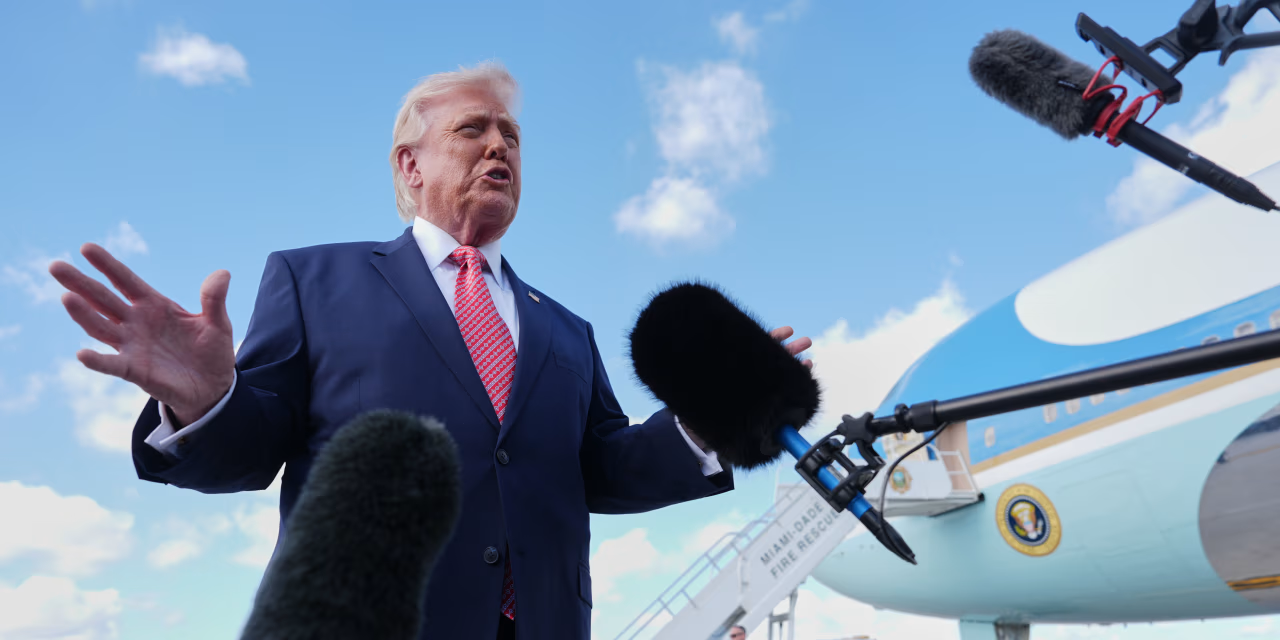
The reaction from exporters in 2025 was essentially the same in 2018, when Trump imposed certain tariffs during his first term in office – the cost of goods for consumers rose, with little other economic impact recorded, the New York Fed said at the time.

Continue Reading

Trending

Copyright © 2025