As we reflect on 2025, it is hard to ignore the constant drumbeat of negative headlines: elevated geopolitical tensions, ongoing conflicts, trade frictions, and a broader shift toward de-globalisation. Yet, despite this backdrop of uncertainty, global equity markets once again delivered strong returns—another reminder that markets often advance not in the absence of risk, but in spite of it.
Market backdrop and performance
Table 1.
2025 market and fund returns.
Index/Fund
2025 Return
AGV Capital
26.3%
S&P 500
17.9%
MSCI ACWI
22.9%
MSCI China
31.4%
Hang Seng Index
27.8%
Vanguard Total World Stock (VT)
22.4%
All performance figures are calculated using the Time-Weighted Rate of Return (TWR), which eliminates the impact of external cash flows and reflects the pure investment performance of the portfolio.
As the old Wall Street adage goes, the market climbs a wall of worry. In 2025, investors had no shortage of reasons to worry—wars, tariffs, interest-rate concerns, and an uncertain macro outlook—yet markets moved higher as businesses continued to grow revenues, earnings, and cash flows.
China, concentration, and where the real opportunity was
In last year’s annual letter, we laid out a clear, contrarian thesis. We tilted our allocation decisively toward China at a time when the consensus was widely viewed as unattractive by the market. In 2024, we placed approximately 86.0% of the portfolio in Chinese equities. That positioning proved well justified in 2025, as the MSCI China Index delivered a total return of 31.4%—its strongest year in nearly a decade—and significantly outperformed the S&P 500 total return of 17.9%.
Advertisement
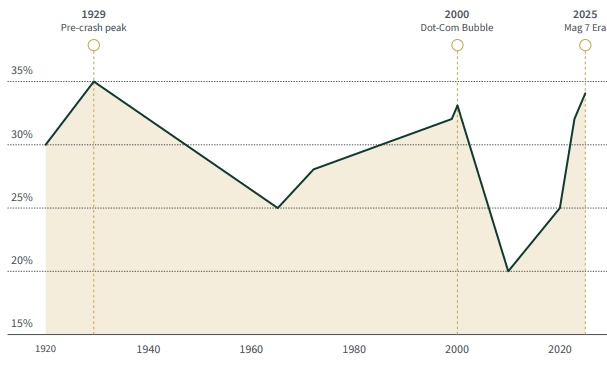
Meanwhile, the S&P 500 itself became even more concentrated. Index levels of concentration reached extremes not seen since the 2000 internet bubble and the roaring 1920s, with the so-called “Magnificent Seven” accounting for roughly 34.0% of the index and contributing about 42.0% of total returns, driven largely by strong investor enthusiasm and momentum around AI-related themes. Excluding the Mag 7, the S&P 500 would have delivered a return closer to 10.0%, roughly in line with the S&P 500 Equal-Weighted Index at 11.0% and Vanguard’s Total US Stock Market Index at around 11.0%.
Figure 1.
Rising impact of the largest 7 U.S. stocks on index returns (1999–2025).
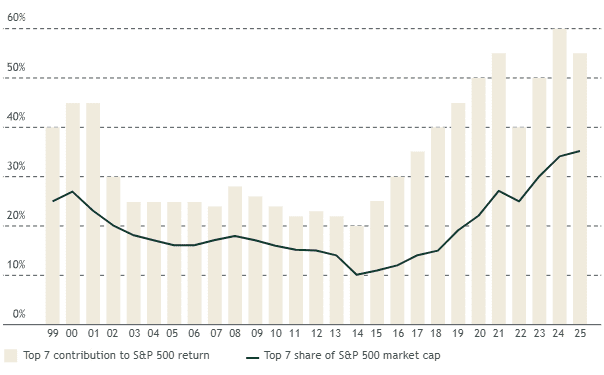
Figure 2.
fiop-7 stock concentration in U.S. market (1920–2025).
Current levels approach 1929 peak, surpassing dot-com era.
In a year when many active US-focused managers struggled to beat a Mag-7-driven benchmark, we delivered a gross return of about 26.3% while deliberately avoiding the US AI bubble and lofty valuations. We stayed anchored to our principles: buying high-quality companies at great valuations. As a result, we outperformed the S&P 500’s 17.9% and the MSCI ACWI Index’s 22.9%. This reinforces an important lesson: earning excellent returns is not about chasing whatever is fashionable; it is about owning great businesses at sensible prices.
China vs. the Magnificent Seven: who really delivered?
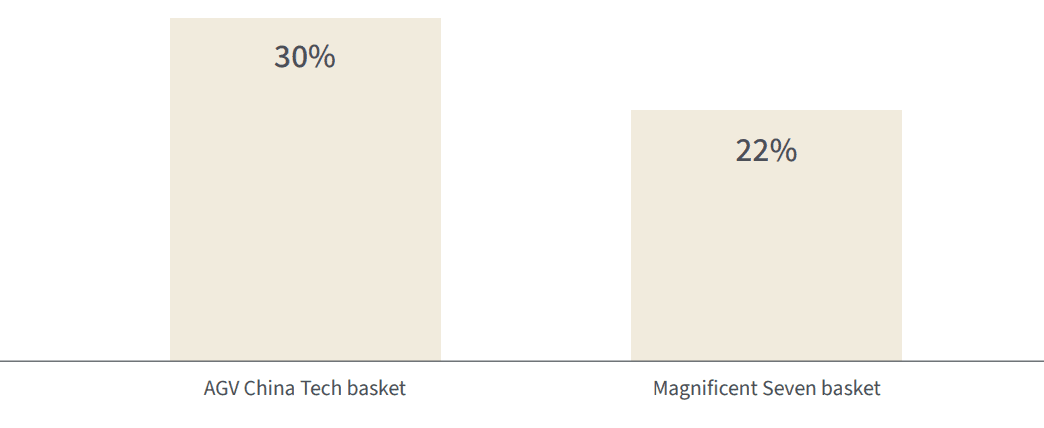
In last year’s letter, we compared a basket of leading Chinese large caps to the celebrated US Magnificent Seven and argued that price and sentiment were pointing in opposite directions. In 2025, that thesis played out in real time. On average, our China basket—Alibaba, BYD, Tencent, Baidu, PDD, and JD.com—returned roughly 30.0%, while the US Magnificent Seven as a group delivered about 22.0%.
Few would have expected the supposedly “uninvestable” Chinese names to outpace their highly praised US counterparts, especially in a year when the Mag 7 enjoyed an AI-driven momentum tailwind and investors were convinced they would “change the world.”
Figure 3.
2025 returns: AGV China tech basket vs. Magnificent Seven (total return, %).
AGV China Tech basket outperformed by 8 percentage points.
As the late Charlie Munger put it, the job is to fish where the fish are. For us, that means using our global mandate to go wherever the real opportunities lie—China, the US, or elsewhere—rather than hugging a single index simply because it feels familiar or popular with the crowd.
Looking through the lens of a holding company
We view the fund as a holding company. When we buy a stock, we think of it as owning a slice of a real business—its revenues, earnings, and cash flows—rather than just a ticker on a screen. To make this concrete, we aggregate the underlying fundamentals of every share we own and translate them into revenue, earnings, and free cash flow per fund unit. This approach allows us to judge our performance the way an owner would: through fundamental growth, profitability, portfolio quality, and valuation.
Advertisement
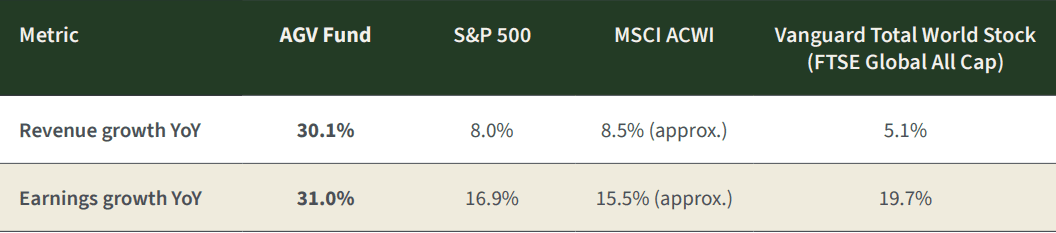
In 2025, our portfolio companies grew revenues by about 30.1% and earnings by 31.0% in US-dollar terms. In the local currencies in which they report, revenues grew 25.6% and earnings 26.6%, with the difference largely driven by dollar weakness and FX translation effects.
Table 2.
Revenue and earnings growth comparison (YoY).
Source: Morningstar, MSCI & Vanguard YoY refers to year-on year comparisons.
As you will see in the growth tables in the report, our companies delivered outstanding growth—substantially higher than the major indices we consider relevant benchmarks. Our roughly 26.3% gross fund performance for the year came almost entirely from this earnings growth. We did not benefit from multiple expansion; returns were driven by fundamentals, not rising valuations.
Valuation: strong returns without paying up
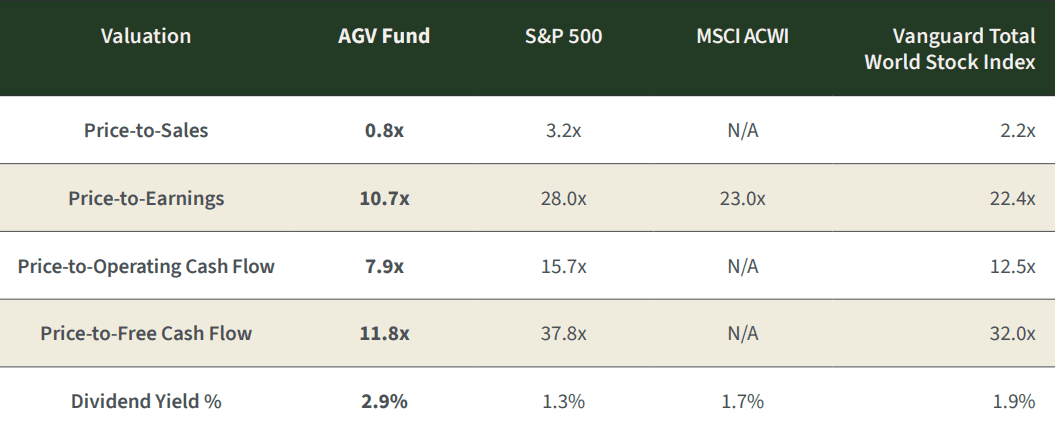
This lack of multiple expansion is visible when we compare our portfolio’s valuation today with last year’s. Despite the strong performance, our portfolio remains cheaper than, or broadly in line with, last year’s levels on most valuation metrics, and continues to trade at a meaningful discount based on our assessment of underlying fundamentals.
Table 3.
Valuation multiples.
Valuation Multiple
TTM FY 2024
TTM FY 2025
Price-to-Sales
0.9x
0.8x
Price-to-Operating Income
9.9x
10.1x
Price-to-Earnings
11.9x
10.7x
Price-to-Operating Cash flow
5.7x
7.9x
Price-to-Free Cash Flow
7.4x
11.8x
When we set these valuations against those of major indices, the contrast becomes even clearer: our holdings trade at a substantial discount to global indices on earnings, sales, and free-cash-flow measures, while offering higher dividend yield and stronger underlying growth. That combination—better businesses at lower prices—is exactly what we look for.
Table 4.
Portfolio quality: returns on capital and profitability
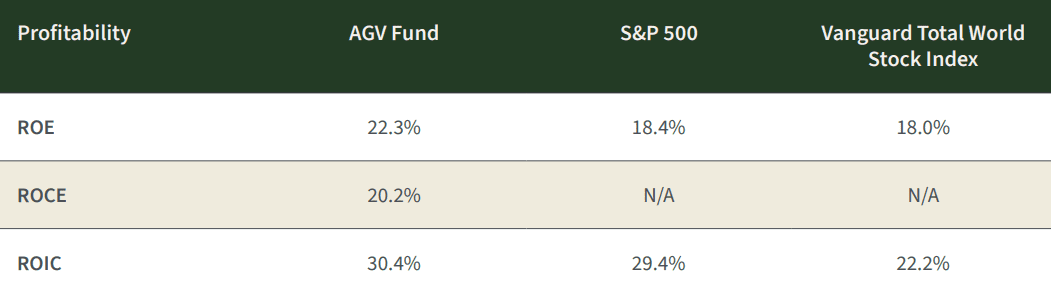
Valuation is only half the equation; quality matters just as much. In 2025 we improved the quality of the portfolio meaningfully. Our return on equity rose from around 17.8% to over 22.3%, and our return on capital employed increased from roughly 17.0% to just over 20.0%. Internal reinvestment ROIC also improved, showing that incremental capital is being deployed at very attractive rates of return.
Table 5.
Portfolio quality metrics.
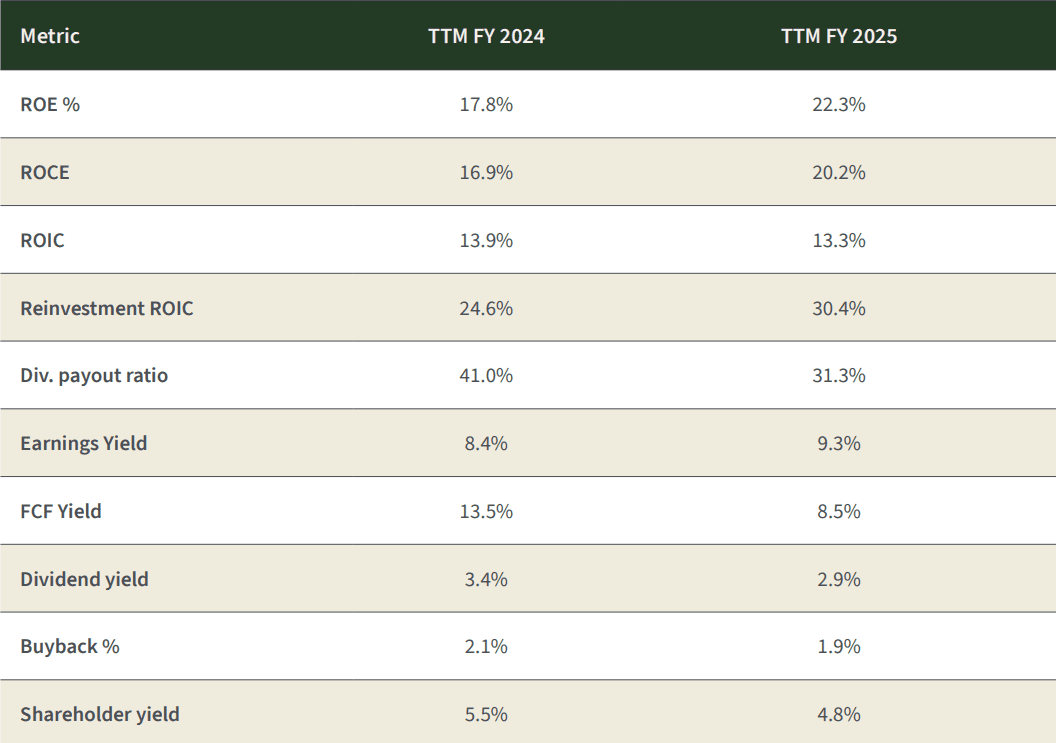
When we compare these metrics to the major indices, the gap is evident. Across Return on Equity, Return on Capital Employed, and Return on Invested Capital, our portfolio companies earn meaningfully higher returns on capital than the broad indices, highlighting both superior business quality and better capital allocation.
Table 6.
Profitability comparison.
Geographic allocation: China still leads, diversification expanded
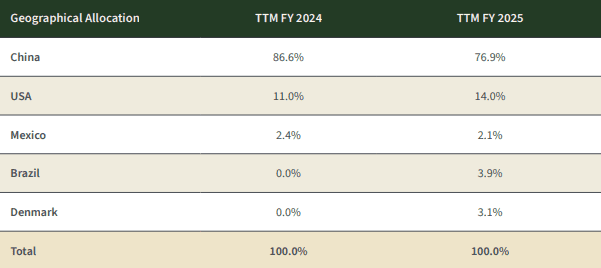
Our current geographic exposure compared with last year reflects both conviction and select diversification. We reduced our China exposure from the mid-80s to the high-70s and introduced two new regions—Denmark and Brazil—where we found exceptional businesses that meet our criteria. The US allocation also increased modestly as select opportunities emerged at reasonable valuations. We remain willing to go wherever the risk-reward profile is most attractive, rather than sticking to any home-market bias. The table & chart below summarizes our geographic allocation at year-end.
Figure 4.
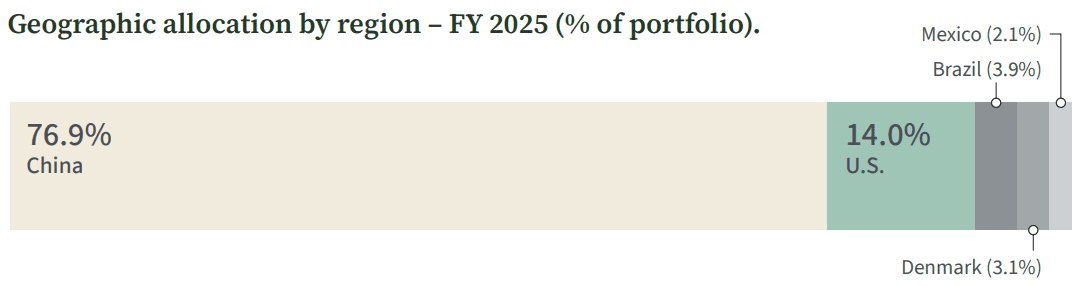
Table 7
Geographic allocation
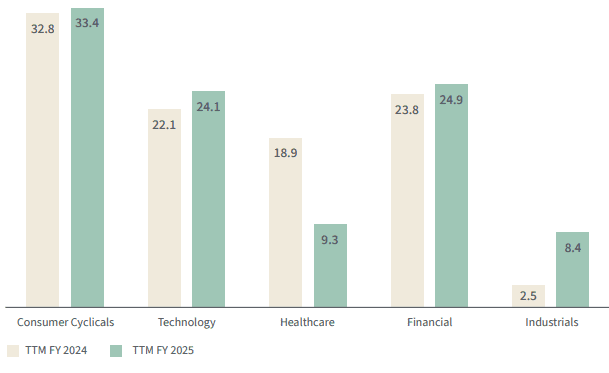
In addition to geography, we also manage diversification by business model and sector. The chart below shows our sector allocation as of year-end and comparison of last year, highlighting where we are finding the most compelling opportunities today.
Figure 5.
Sector allocation – year-on-year comparison (% of portfolio).
TTM = trailing twelve months
Putting it all together
We approach public markets with the mindset of business owners. Investing, to us, is akin to owning a family business: you focus on the long term, the durability of the model, the integrity and alignment of management, and the price you are paying relative to intrinsic value.
Our strategy is simple but demanding in practice:
Own high–quality companies with durable competitive advantages.
Partner with management teams whose incentives are aligned with shareholders.
Pay prices that build in a margin of safety.
Look globally, not locally, for the best mix of quality and value.
In 2025, our companies grew earnings by more than 30.0%, trade at valuations that remain well below global market averages, and exhibit higher returns on capital than the indices. This combination drove approximately 26.3% growth in the fund, allowing us to outperform the benchmarks while still leaving what we estimate to be roughly 30% undervaluation in the portfolio. If valuation gaps were to narrow and our holdings were to move closer to assessed fair value, this would imply meaningful upside potential, before considering any additional fundamental growth.
On top of this, our portfolio offers an estimated total shareholder yield of about 4.8%, combining a 2.9% dividend yield with 1.9% buyback yield. Even without assuming incremental growth, a convergence toward fair value would, in such a scenario, represent a material contributor to forward returns over time.
Advertisement
We are very optimistic about our holdings. We believe the companies we own are high quality, attractively valued, and well diversified by business model and geography. We also believe deeply in alignment: we invest alongside you in the fund, and I have personally increased my investment, reflecting my conviction in the opportunity ahead.
We hope this report gives you the clarity we would want if the roles were reversed and we were in your seat as shareholders. As always, thank you for your trust.
The company reported full-year revenue of roughly $6.69 billion for 2025, down 5% from the prior year. Versant is reporting a breakdown of its earnings from its final year under the ownership of Comcast’s NBCUniversal.
Versant’s linear distribution revenue fell 5.4% to $4.1 billion, and advertising revenue declined almost 9% to $1.58 billion.
Net income attributable to Versant was $930 million, and the company reported $2.18 billion in stand-alone adjusted earnings before interest, taxes, depreciation and amortization.
Advertisement
For the quarter ended Dec. 31, Versant’s total revenue was down nearly 7% from a year earlier to $1.61 billion, according to a Securities and Exchange filing on Tuesday. Specifically, linear distribution revenue was down almost 6% to $997 million and ad revenue declined 9% to $370 million, while platforms revenue was roughly flat at $202 million.
Stand-alone adjusted EBITDA for the quarter was $521 million, down 19% from the same period last year.
The company’s board also declared a 37.5 cents per share quarterly dividend, which represents an annualized dividend of $1.50 per share, and authorized a $1 billion share repurchase program. Due to its low debt load and high-margin business, Versant executives have said they plan to return value to shareholders.
“Returning capital to shareholders remains a top priority for us, alongside disciplined investing to support long-term growth,” said Versant COO and CFO Anand Kini during the company’s earnings call on Tuesday.
Advertisement
Versant marked its first day as a standalone company earlier this year, and started trading on the Nasdaq in early January. However, Versant’s management had been working throughout 2025 on the separation of the assets from Comcast.
The company is made up of a portfolio of pay TV networks including CNBC, MS Now, USA Network, Golf Channel, Syfy, E! And Oxygen, as well as digital properties such as Fandango, Rotten Tomatoes, GolfNow and Sports Engine.
The traditional TV business, while still profitable, has seen continued losses over the years across all media companies as viewers exit the bundle for streaming alternatives.
More than 80% of Versant’s revenue leans on the pay TV business, but its executives have told Wall Street that 2026 will be a year of transition for its business model. The company aims to eventually reach 50% of its revenue from digital, platform, subscription, ad-supported and transactional businesses.
Advertisement
On Tuesday, Versant reported that its non-pay TV revenue reached 19% of total revenue in 2025, with roughly $826 million in platforms revenue.Versant’s platform business — mostly made up of Fandango, GolfNow, Sports Engine and some of the already launched direct-to-consumer businesses — was the only revenue segment to grow revenue year over year.
In the next three to five years, Versant is looking to increase that share of revenue to 33%, with the goal of getting “closer to 50%,” CEO Mark Lazarus said during the earnings call.
Versant considers its growth drivers in that unit to include MS Now’s upcoming direct-to-consumer product, CNBC Pro and a new retail investor product for the brand, and the launch of the ad-supported Fandango at Home service in 2026.
“We’re going to continue to report, of course, kind of good visibility in the platforms revenue line, which we think provides a good, meaningful indicator of how that business is scaling,” Kini said.
Advertisement
Disclosure: Versant is the parent company of CNBC.
Veteran broadcast journalist Joan Lunden has detailed in her forthcoming memoir how an early television boss propositioned her, then retaliated professionally when she rejected his advances, illustrating persistent challenges women faced in the industry during her formative years.
Joan Lunden
In “JOAN: Life Beyond the Script,” set for release March 3, 2026, Lunden recounts the incident from the beginning of her career, before her rise to fame as co-host of ABC’s “Good Morning America” from 1980 to 1997. The former anchor, now 75, describes how one superior made an explicit pass at her, which she firmly declined.
According to excerpts published by People magazine on March 3, the executive responded by undermining her work. “He began to kill my stories,” Lunden writes, explaining that the boss started rejecting her pitches and assignments, effectively sidelining her contributions as a form of punishment for turning him down.
The revelation comes amid Lunden’s broader reflections on sexism, ageism and professional obstacles in television news. She has previously spoken about being pushed out of “GMA” at age 47 in 1997 — a move she has described as tied to a preference for younger talent, despite her strong performance and viewer loyalty. “I was 47 years old. That’s not old. They don’t push men out because they’re 47,” she told Yahoo Life in a 2022 interview.
Lunden’s memoir, her 11th book, offers a candid look at her life beyond the camera, including motherhood, breast cancer survival — she was diagnosed in 2014 and became an advocate — and reinvention in later years. She balances professional triumphs with personal challenges, emphasizing resilience and the evolution of workplace dynamics for women.
Advertisement
The anecdote about the early boss aligns with longstanding accounts of gender-based misconduct in media. Lunden does not name the individual in the published excerpts, and details remain limited to the professional consequences she faced. The story surfaced publicly through People and AOL on March 3, coinciding with the book’s launch and promotional interviews.
Lunden began her career in local news before joining ABC, where she became a household name interviewing presidents, celebrities and newsmakers. Her tenure on “GMA” helped define morning television, blending hard news with lifestyle segments and earning her multiple Daytime Emmy nominations.
In recent years, Lunden has focused on health advocacy, authoring books on wellness and aging, and maintaining an active presence through podcasts, speaking engagements and social media. She frequently discusses empowerment, particularly for women navigating career and family demands. Her daughter Jamie Hess has joined her on platforms like “The Gratitudeology Podcast” to explore family dynamics and personal growth.
The memoir arrives at a time when discussions of workplace harassment remain prominent, years after the #MeToo movement exposed systemic issues across industries, including entertainment and journalism. Lunden’s account adds to voices from her era highlighting unequal treatment and retaliation risks for women rejecting unwanted advances.
Advertisement
Promotional coverage emphasizes Lunden’s optimism and forward focus. In a Woman’s World cover story tied to the book’s release, she reflected on balancing early “GMA” hours with raising seven children, noting how her young daughters would come downstairs to “kiss the TV screen” in the mornings as a way of connecting with her on-air presence.
Lunden has expressed no interest in returning to daily broadcasting, instead embracing reinvention through writing, wellness initiatives and family. She has spoken positively about modern workplace improvements for women while acknowledging progress remains uneven.
The book’s release includes upcoming events, such as a March 10, 2026, appearance at The Temple Emanu-El Streicker Cultural Center in New York, where Lunden will discuss her career barriers and life lessons with moderator Molly Jong-Fast.
As Lunden promotes “JOAN: Life Beyond the Script,” the early-career story serves as a poignant reminder of the personal costs some women paid for professional ambition in male-dominated fields. Her willingness to share it underscores a commitment to transparency and support for future generations in media.
Advertisement
Lunden continues to inspire through advocacy and storytelling, proving that influence extends far beyond any single role or network.
Netflix Inc. (NASDAQ: NFLX) shares closed at $97.09 on March 2, 2026, up 0.88% or $0.85 from the prior session, extending a recent rally fueled by the company’s decision to abandon pursuit of an acquisition of Warner Bros. Discovery and renewed analyst optimism on its advertising and organic growth prospects.
Netflix
The stock opened at $95.26, ranged from a low of $95.20 to a high of $98.07, and saw elevated volume of approximately 79.7 million shares. Pre-market trading on March 3 indicated a dip toward $94.92, down about 2.2%, amid broader market caution tied to geopolitical tensions and oil price surges. Netflix’s market capitalization stood near $410 billion, positioning it as a heavyweight in the streaming and entertainment sector.
The recent momentum traces to late February when Netflix confirmed it would not raise its bid in the speculated $83 billion pursuit of Warner Bros. Discovery (WBD), opting instead for capital discipline and focus on internal investments. Shares surged nearly 14% on the announcement day and have gained close to 30% from multi-year lows hit earlier in the period, with four consecutive sessions of advances marking one of its strongest short-term runs in years.
“This walk-away is a win for shareholders,” one analyst noted in a March 2 report. “By preserving cash and avoiding a potentially dilutive mega-deal, Netflix reinforces its commitment to high-return organic growth, content investment and share repurchases.”
Netflix’s strategy shift emphasizes internal content production, with plans to allocate around $20 billion toward films, series and other programming in the coming years. The company continues to prioritize share buybacks as a means of returning capital, supported by robust free cash flow generation.
Advertisement
Recent analyst upgrades have bolstered sentiment. J.P. Morgan’s Doug Anmuth upgraded NFLX to “overweight” with a $120 price target — implying about 25% upside from the March 2 close — citing insulation from AI disruption risks, strong subscriber momentum and accelerating advertising revenue. The firm highlighted ad-supported tier growth, with 2025 ad revenue more than doubling from 2024 to over $1.5 billion and projected to reach approximately $3 billion in 2026.
Consensus 12-month price targets cluster around $113-$114, reflecting moderate bullishness despite the stock’s premium valuation. At roughly 38 times trailing earnings and about 30 times forward 2027 estimates in some models, NFLX trades at levels that bake in sustained double-digit revenue growth and operating leverage.
The company’s fourth-quarter 2025 earnings, released in late January 2026, provided a solid foundation. Revenue reached $12.05 billion, up 17.6% year-over-year and beating estimates, driven by membership gains, pricing actions and advertising expansion. Operating margin improved to 24.5% from 22.2% a year earlier, reflecting efficient scaling.
Full-year 2025 results included revenue of approximately $45.2 billion, up 16%, with the company meeting or exceeding key financial targets. Netflix ended 2025 with around 325 million global subscribers, though specific quarterly adds were not detailed in recent updates.
Advertisement
For 2026, management guided revenue of $50.7 billion to $51.7 billion, representing 12% to 14% growth, with operating margins targeted near 31.5%. Analysts project continued double-digit increases in revenue, operating income, EPS and free cash flow over the next several years, underpinned by potential U.S. price hikes, global expansion and ad-tier momentum.
Challenges persist in a competitive landscape. Rivals like Disney+, Amazon Prime Video and emerging players pressure market share, while content costs remain elevated. Macro factors, including consumer spending caution amid inflation concerns, could temper subscriber additions. Yet Netflix’s first-mover advantage in advertising-supported streaming and differentiated originals provide resilience.
Technical indicators show the stock trading well above its 52-week low of $75.01 but below the high of $134.12 reached in mid-2025. Support levels hover near $95, with resistance around $100. Volatility has moderated in the recent rally, though broader market risks from energy shocks could introduce near-term pressure.
Investors eye upcoming catalysts, including first-quarter 2026 updates expected in April and further details on ad-tier performance. Earnings are slated for mid-April, with focus on subscriber metrics, content slate strength and advertising traction.
Advertisement
Netflix’s trajectory in 2026 balances mature core streaming growth with high-margin emerging segments like ads and potential gaming expansions. The decision to forgo a transformative acquisition has been viewed positively as a sign of disciplined leadership under co-CEOs Ted Sarandos and Greg Peters.
As shares hover near $97, Netflix remains a bellwether for the streaming industry’s evolution, blending content dominance with monetization innovation in an increasingly fragmented media landscape.
The round has been backed by the Development Bank of Wales and the Cardiff Capital Region’s equity fund
14:03, 03 Mar 2026Updated 14:04, 03 Mar 2026
Antiverse investment deal: L-R Mike Brough, strategic growth director, CCR, Ben Holland, chief technology officer of Antverse and the firm’s chief executive Murat Tunaboylu.
The Development Bank of Wales and the Cardiff Capital Region has backed a £7m equity investment into AI life science venture Antiverse. The Series A funding round boost for the Cardiff-based business has also been supported by international investors, led by Prague-based venture capital firm Soulmates Ventures.
Antiverse applies advanced generative AI and machine learning to predict, design and optimise antibody-based drugs. By dramatically reducing the time and cost of traditional discovery methods, it enables pharmaceutical and biotechnology partners to bring life-changing treatments to patients faster and more efficiently. Antiverse’s platform already supports programmes across oncology, immunology and infectious diseases, positioning the company at the forefront of next-generation therapeutics.
This is the third investment in Antiverse by the development bank since it first provided early-stage seed capital in 2020. The funding will accelerate new intellectual property and expand its local team, with five new jobs created and 19 high- skilled jobs safeguarded.
The deal is the sixth by the Cardiff Capital Region, through its £50m Innovation Investment Capital (IIC) fund, which is managed by Capricorn Fund Managers. The value of the investments by the development bank and the IIC fund have not been disclosed. It is the first time they have both invested in the same investment round.
Murat Tunaboylu, Antiverse’s co-founder and chief executive said of the investment round: “This is a powerful endorsement of both our technology and our roots in Cardiff. This investment not only enables us to scale our platform, grow our team and deepen partnerships with pharma and biotech leaders worldwide, but also positions Antiverse strongly for our next phase of growth. By strengthening our foundations at Series A, we are laying the groundwork for a successful Series B and the opportunity to bring our technology to an even broader global market.
Advertisement
Kellie Beirne, chief executive of the Cardiff Capital Region, a statutory body covering the ten local authorities of south east Wales: “Antiverse is a great example of the kind of cutting-edge innovation we want to see growing in our region. By combining AI with life sciences, the team is tackling some of the most important challenges in healthcare today. CCR is committed to investing in medical tech innovators and we are proud to support a business like Antiverse that is creating global impact from Cardiff.”
Rhian Elston, Wales investment director for the Development Bank of Wales said: “Antiverse represents a compelling life sciences opportunity with the potential to build a business of genuine global scale. By combining deep biological expertise with advanced AI‑led design in a proprietary platform, the company is redefining how antibody therapeutics are developed. We’re pleased to be working alongside Innovation Investment Capital to continue our support for this Welsh‑based tech business as it continues to scale and strengthen its foundations for long‑term growth.”
Expectations of further Bank of England base rate cuts this year have been thrown into doubt after escalating conflict in the Middle East triggered sharp rises in energy prices and government bond yields, raising fears of a fresh inflationary shock.
Only a week ago, markets were confident that the Bank of England would cut rates again at its March meeting, with traders pricing in an 86 per cent probability of a 0.25 percentage point reduction. Now, following military escalation involving the US and Iran and renewed instability across the Gulf region, those expectations have collapsed. Markets are currently assigning less than a 5 per cent chance of a rate cut this month and less than a 50 per cent probability of a move in April.
The Bank’s base rate currently stands at 3.75 per cent, having been reduced four times in 2025 as inflation fell to 3 per cent. Governor Andrew Bailey had previously suggested that a return to the 2 per cent target was “baked in”. However, the geopolitical shock has materially altered that outlook.
UK wholesale gas prices have surged by around 40 per cent in recent days, while oil prices have approached $80 per barrel. Two-year gilt yields have risen to their highest levels since December as markets reassess the inflationary impact of higher energy costs.
The risk, analysts say, is that sustained disruption to global energy supplies, particularly through the Strait of Hormuz, could keep inflation elevated for longer, forcing the Bank of England to pause or even reverse its easing cycle.
Advertisement
Tony Redondo, founder of Cosmos Currency Exchange, said the shift in expectations had been dramatic.
“With 2-year gilt yields hitting December highs due to a 40 per cent surge in UK gas prices and oil nearing $80, the Bank of England faces a significant inflationary shock,” he said. “High-street banks are no longer competing on price but are instead protecting margins against rising swap rates. Buyers may see ‘best-buy’ deals pulled with only a few hours’ notice as lenders move to price in the geopolitical risk premium.”
Swap rates, which underpin fixed-rate mortgage pricing, have risen sharply in response to higher gilt yields. Lenders typically price mortgage products several days in advance, meaning further volatility could quickly feed through into the housing market.
Riz Malik, director at R3 Wealth, warned that the situation could resemble the market turmoil seen in 2022 following Russia’s invasion of Ukraine and the UK’s mini-Budget crisis.
Advertisement
“Last week, the outlook was promising for the 1.8 million mortgages up for renewal in 2026,” he said. “Today, we could see major volatility in the mortgage market with the outlook for further cuts disappearing by the second. If you have a mortgage renewal in the next six months, I would strongly suggest you look at your options and don’t hold off.”
Justin Moy, managing director at EHF Mortgages, said the duration of the conflict would be critical.
“In the short term, any talk of base rate cuts will be null and void,” he said. “If the conflict resolves within weeks, this may be temporary. But if it continues beyond Easter, inflation and base rate expectations will be adversely affected, putting the brakes on rate cuts and pushing deals higher.”
Aaron Strutt, product and communications director at Trinity Financial, said uncertainty was the defining feature of the current environment.
Advertisement
“We do not know what is going to happen yet. Rates could go up, the war might stop and rates drop again as previously forecast. Either way, it makes sense to secure a mortgage rate if you are coming up to remortgage soon.”
Some advisers believe the situation, while serious, differs structurally from the disorderly repricing seen in autumn 2022.
Nouran Moustafa, practice principal at Roxton Wealth, said lenders are better prepared than during the Truss-era turmoil.
“Markets have moved quickly, but mortgage pricing reacts to sustained trends, not single sessions,” she said. “Back in 2022, funding costs moved disorderly and fast. Today’s move looks more like volatility driven by inflation expectations.”
Advertisement
She added that the key question is whether elevated yields persist. “If yields stay elevated for several days, we could see short-notice repricing or selective withdrawals. If this retraces, lenders will prioritise stability.”
The Bank of England now faces a delicate balancing act. While inflation had been easing and economic growth remains fragile, an externally driven energy shock risks reintroducing cost pressures just as policymakers were preparing to loosen monetary conditions further.
If wholesale gas prices remain elevated and oil continues to climb, rate-setters may judge it prudent to delay cuts to prevent inflation expectations becoming unanchored. That would prolong pressure on households and businesses already grappling with high borrowing costs.
For now, the direction of travel depends less on domestic economic data and more on developments in the Middle East. Should tensions subside and energy prices retreat, the easing cycle could resume. But if the conflict deepens or spreads, expectations of multiple rate cuts in 2026 may quickly evaporate.
Advertisement
In the meantime, borrowers and investors alike are being reminded that global geopolitical events can reshape monetary policy forecasts in a matter of days.
Jamie Young
Jamie is Senior Reporter at Business Matters, bringing over a decade of experience in UK SME business reporting.
Jamie holds a degree in Business Administration and regularly participates in industry conferences and workshops.
When not reporting on the latest business developments, Jamie is passionate about mentoring up-and-coming journalists and entrepreneurs to inspire the next generation of business leaders.
The government’s policy on tax thresholds – the point at which you start to pay tax, and the point where you tip into paying a higher rate of tax -has had an impact on this number. In last year’s Budget, Chancellor Rachel Reeves said these would stay frozen until 2031. That is three years longer than previously planned.
Chancellor Rachel Reeves delivered her Spring Statement to the House of Commons under the shadow of escalating conflict in the Middle East and mounting fears of a renewed inflation shock driven by surging energy prices.
In a speech lasting just over 20 minutes, Reeves stressed the importance of “stability in an increasingly uncertain world”, pointing to falling inflation and previous interest rate cuts as evidence that the cost-of-living squeeze on households is easing. However, beyond presenting updated forecasts from the Office for Budget Responsibility (OBR) and criticising opposition parties, she unveiled no new tax or spending measures.
The Chancellor has pledged to hold only one fiscal event each year, the autumn Budget, meaning the Spring Statement was positioned as a forecast update rather than a policy platform.
Growth downgraded for 2026
The OBR has revised down its forecast for UK economic growth in 2026 to 1.1 per cent, weaker than the 1.4 per cent predicted in November. Reeves insisted that the longer-term outlook remains resilient, with growth forecast to reach 1.6 per cent in both 2027 and 2028, slightly stronger than previously projected, before settling at 1.5 per cent in 2029 and 2030.
The downgrade comes amid soft domestic demand, geopolitical instability and renewed energy market volatility following military escalation in the Gulf region. Rising oil and gas prices threaten to complicate the inflation trajectory, particularly if disruption to global supply chains persists.
Advertisement
Unemployment to rise before falling
Unemployment is forecast to peak at 5.3 per cent later this year as weaker labour demand feeds through the economy. The rate is then expected to decline steadily, ending the parliamentary term at 4.1 per cent, lower than at the start.
The Chancellor framed this as evidence that the labour market remains fundamentally strong despite short-term headwinds. However, youth unemployment and business hiring caution remain key concerns across several sectors.
Borrowing falls and headroom improves
The OBR forecasts that borrowing will be nearly £18 billion lower than anticipated in the autumn. Public sector net borrowing is projected to decline from 4.3 per cent of GDP this year to 1.8 per cent by 2030.
Reeves highlighted that fiscal “headroom” against her self-imposed rules has increased from £21.7 billion in November to £23.6 billion. The buffer is designed to reassure financial markets and protect against unexpected shocks.
Advertisement
She also confirmed plans to meet North Sea energy industry leaders to discuss the implications of Middle East tensions on domestic production and energy security.
Night-time economy: “Stability rhetoric won’t save us”
Despite the Chancellor’s emphasis on stability, business leaders were quick to challenge what they described as a disconnect between Westminster messaging and frontline reality.
Michael Kill, chief executive of the Night Time Industries Association (NTIA), said the statement failed to recognise the acute pressures facing hospitality and leisure businesses.
“Across the UK, major brands and corporates are collapsing at pace. Confidence is fragile. Margins are exhausted,” he said.
Advertisement
Kill warned that escalating energy costs, higher National Insurance contributions and ongoing business rates burdens are placing “compounding pressure” on the sector. He called for a VAT cut for hospitality, arguing that targeted intervention would stimulate demand, protect jobs and restore confidence.
With youth unemployment rising, the NTIA stressed that the night-time economy has traditionally provided entry-level employment for young people, and warned that increased employment costs are making it harder to sustain those roles.
Business confidence remains fragile
Separate research from the Zoho Digital Health Study 2026 underscores the cautious mood across UK businesses. Twenty-one per cent of business leaders cited high inflation, recession risk and rising interest rates as their biggest external challenge.
Half of firms reported rising costs per employee over the past year, ahead of a further 4.1 per cent rise in the National Living Wage due in April 2026.
Advertisement
Sachin Agrawal, managing director at Zoho UK, said leaders are prioritising productivity and automation over expansion.
“Businesses want to grow, but they’re doing so more selectively by investing in technologies that deliver clear efficiency gains,” he said.
AI platform Photoroom also urged the government to match pro-entrepreneur rhetoric with tangible digital support for SMEs, arguing that access to AI tools can significantly reduce overheads and increase productivity.
Thames transport: a missed green opportunity
Uber Boat by Thames Clippers said the Spring Statement missed an opportunity to accelerate London’s transition to greener river transport.
Advertisement
Geoff Symonds, chief operating officer at Uber Boat by Thames Clippers, said regulatory reform and green fuel incentives could be implemented at minimal cost.
“Low-key budgets don’t have to mean low ambition for the environment,” he said, calling for parity in green incentives between river transport and land-based networks.
A cautious tone in uncertain times
The Spring Statement was deliberately restrained. Reeves’ strategy is to project fiscal discipline and market stability while preserving room for manoeuvre ahead of the autumn Budget.
However, with energy prices climbing, geopolitical tensions rising and consumer confidence fragile, the path ahead is far from settled. The coming months will test whether stability alone is sufficient, or whether targeted intervention becomes unavoidable.
Advertisement
For now, the Chancellor’s message is clear: hold the line, protect fiscal credibility and hope that inflation continues to fall despite global turbulence. Whether businesses and households feel that stability in practice remains an open question.
Paul Jones
Harvard alumni and former New York Times journalist. Editor of Business Matters for over 15 years, the UKs largest business magazine. I am also head of Capital Business Media’s automotive division working for clients such as Red Bull Racing, Honda, Aston Martin and Infiniti.