

Crypto World
Binance Is Suing a Newspaper in the One Place It Probably Shouldn’t



New York has some of the most robust press protection laws in the country. These give defendants like the Wall Street Journal (WSJ) the right to challenge a lawsuit early and get it thrown out before it becomes costly and drawn out.
Though the move may seem counterintuitive, it could be entirely deliberate. Binance may be signalling that it welcomes scrutiny and has nothing to hide. The move appears designed to send a clear message to those who hold assets on its platform that the exchange will fight back even at the risk of what a full legal proceeding might expose.
Binance Takes the Wall Street Journal to Court
In February, the WSJ published an investigation claiming that Binance dismissed employees who had raised concerns about more than one billion in crypto transactions linked to sanctions against Iranian actors.
Two weeks later, Binance filed a defamation lawsuit against Dow Jones & Company, the publisher of the WSJ, in the Southern District of New York. The exchange claimed the newspaper had published at least 11 false statements in its February report.
The lawsuit was surprising. In general, defamation lawsuits are extremely difficult to prove. Given that this case involves a public figure like Binance and a respected newspaper like the WSJ, there’s a heightened standard of actual malice.
“For defamation to be shown, it can’t just be that parts of the story were false,” said Khurram Dara, an attorney and former policy advisor at Bain Capital Crypto and Coinbase, in a recent BeInCrypto podcast. “[The WSJ] had to have known at the time of publication that there was false information, or they would have had to have reckless disregard for the truth or falsity of the statement.”
On top of that, New York is one of the least forgiving jurisdictions in the country for this kind of legal action.
Why New York Was a Surprising Choice
New York State has one of the strongest legal provisions against SLAPP laws in the country.
The acronym, which stands for Strategic Lawsuit Against Public Participation, describes a situation in which a powerful entity files a lawsuit not because they genuinely expect to win in court, but because the lawsuit itself is the weapon.
The goal is to exhaust the other side financially and emotionally until they back down.
Anti-SLAPP laws were created specifically as a shield against this tactic. They give defendants, like the WSJ, the right to argue whether a lawsuit of that nature is frivolous. If the paper succeeds in such a scenario, Binance would have to cover all of the legal fees.
“I think it’s really interesting that [Binance] picked New York. I would have picked someplace that didn’t have such robust anti-slap laws,” said Amanda Wick, Head of Americas at VerifyVASP, who previously spent over a decade as an attorney at the US Department of Justice.
She also noted that the exchange’s lawsuit against the WSJ isn’t the first time Binance has used SLAPP tactics.
“[Binance] did tend to go after publications to try to silence them and to shut down unfavorable news stories,” Wick said, adding, “I’m not aware of any other crypto exchanges who have sued the press even when they had enforcement actions.”
In November 2020, Binance filed an almost identical defamation lawsuit against Forbes in New Jersey, only to voluntarily dismiss it three months later without ever going to trial. Notably, New Jersey had no press-protection laws at the time, making it a far more favorable jurisdiction for Binance than the one it chose later.
Yet, given that that’s not the case in New York, if the case does go forward, it could be bad news for Binance.
How Discovery Could Backfire on Binance
In the unlikely scenario that a judge allows the case against the WSJ to proceed, the lawsuit would enter the discovery phase. This stage would involve both parties handing over relevant documents, communications, and records.
For Binance, this would mean giving up internal compliance reports, emails between investigators and management, transaction records, and any communications that speak to what the exchange knew about the Iran-linked flows and when it knew it.
The risk is compounded by the fact that Binance is not operating as a normal company. As part of its 2023 criminal settlement, it agreed to operate under two independent government monitors whose job is to verify that the exchange is genuinely overhauling its compliance program.
“If there’s evidence that… these investigators escalated this and they were ignored, or worse, if they were fired in response while there are two monitorships, that’s going to be really problematic,” Wick said.
Dara, who formerly ran as a Republican candidate for New York Attorney General, argued that winning in court may not be Binance’s primary objective in bringing the case.
The Real Motive Behind the Lawsuit
Binance holds assets for over 300 million users. According to Dara, the reputational damage of a journalistic investigation could present an existential business risk to the exchange.
Unlike traditional finance, crypto operates around the clock across a global, natively online ecosystem where information travels at extraordinary speed and bad headlines can trigger platform flight almost instantly.
He drew a direct parallel to the collapse of Silicon Valley Bank, where a single announcement about a capital shortfall spread through social media so rapidly that customers withdrew $42 billion in a single day.
From that lens, the lawsuit is less a legal maneuver and more a public signal.
As Dara put it: “a bad headline in this space can be very damaging… it would be certainly very damaging for them to see a lot of flight from their platform.”
By filing in the toughest possible jurisdiction, Binance may be signaling that it welcomes scrutiny and has nothing to hide.
The move sends a clear message to those who hold assets on its platform that Binance will fight back even at the risk of what a full legal proceeding might expose.
The post Binance Is Suing a Newspaper in the One Place It Probably Shouldn’t appeared first on BeInCrypto.


TLDR
- The prediction market operator Kalshi has established Americans for Fair Markets (AFM), a lobbying organization designed to influence federal policy on prediction markets.
- Taylor Budowich, who previously served in the Trump administration, has joined the organization as a strategic advisor.
- AFM’s debut coincided with the House Oversight Committee’s announcement of insider trading investigations targeting Kalshi and competitor Polymarket.
- The organization frames its mission as countering misinformation from traditional gaming establishments like sportsbooks and casinos.
- Traditional gaming interests have responded by characterizing prediction markets as disguised sports betting platforms.
The federally regulated prediction market operator Kalshi has established a political advocacy organization named Americans for Fair Markets. This new entity seeks to shape how federal policymakers and regulatory agencies approach prediction markets across the country.
Taylor Budowich, who held a senior position in President Donald Trump’s White House, has been brought on as the organization’s strategic advisor. Before departing his role in September, Budowich oversaw communications operations for both the White House and a Trump-aligned super PAC.
Kalshi provided backing for AFM’s formation, though representatives indicate additional members are involved. While a spokesperson characterized the organization as having substantial financial resources, specific funding details were not disclosed.
The organization’s primary objective involves challenging what Kalshi characterizes as misleading claims about prediction markets circulated by established gambling sector players. According to AFM, traditional sportsbooks and casino operators are attempting to safeguard their market positions by portraying prediction markets negatively.
“Entrenched interests protecting their monopolies won’t outspend or out-organize us,” stated John Bivona, who serves as Kalshi’s head of government relations and has assumed a position on AFM’s board.
Congressional Investigation Announced Simultaneously
AFM’s unveiling occurred the very same day House Oversight Committee Chairman James Comer revealed investigations into potential insider trading activities at both Kalshi and Polymarket. Comer highlighted questionable wagers placed before military operations involving Venezuela and Iran, incidents that have already resulted in arrests domestically and in Israel.
Kalshi has expressed support for Commodity Futures Trading Commission oversight. The CFTC and state authorities have engaged in jurisdictional disputes, with state officials contending that prediction markets breach local gambling regulations.
Polymarket maintains a regulated platform for US users while handling the majority of its wagering activity through international channels. Kalshi, in contrast, functions predominantly as a federally supervised exchange.
Traditional Gaming Sector Responds
The American Gaming Association has adopted an aggressive position opposing prediction markets. During congressional testimony this week, Bill Miller, the organization’s president and CEO, characterized these platforms as “deceptively calling sports betting financial contracts and investing.”
AFM’s online presence presents a contrasting viewpoint, contending that prohibiting prediction markets would drive them to “unregulated platforms with no identity verification, no consumer protections, no insider trading rules.”
AFM becomes part of an expanding lobbying effort that includes the Coalition for Prediction Markets, which emerged in December 2025 with support from Coinbase, Crypto.com, and Robinhood.
The organization states it will advocate for platforms implementing consumer safeguards including know-your-customer protocols, insider trading prohibitions, and limitations on markets connected to violence or terrorism.
President Trump has expressed conflicting views regarding prediction markets. Last month, he indicated dissatisfaction with these platforms but subsequently moderated his stance, warning the US risked being “left out in the cold” through prohibition. His son, Donald Trump Jr., has made investments in Polymarket and holds positions on both Polymarket’s advisory board and as an advisor to Kalshi.
Kalshi’s company valuation recently reached $22 billion, doubling after securing $1 billion in new funding.


Chun Wang, the Chinese-born Maltese entrepreneur who founded the Bitcoin mining pool F2Pool, has joined SpaceX’s first planned interplanetary mission to Mars after “purchasing” the mission.
SpaceX announced Thursday that the two-year-long mission will explore beyond the moon, fly by Mars, and return to Earth. Wang has also bought a ticket for a planned weeklong commercial spaceflight around the moon that will launch before the Mars mission.
“I believe that even without private investment in lunar flights, we will still reach the Moon, and likely very soon. As competition between the United States and China intensifies, governments will turn lunar bases into reality,” Wang said in a post on X on Friday.
“And I am happy to sit back and watch that happen. On the other hand, I have no confidence that Mars will still happen within our lifetime. And I think I should do something about that. I hope that by purchasing a flyby mission to Mars, SpaceX will have another reason not to forget about Mars. Because we seriously shouldn’t defer Mars to our next generation,” he added.

Source: Chun Wang
A growing number of tech entrepreneurs have started funding and taking part in trips to space, including Amazon founder Jeff Bezos, Virgin Group co-founder Richard Branson and Jared Isaacman, founder of the American payment processing company Shift4 Payments.
Starship cargo flights to Mars for research, development and exploratory missions are expected to start no earlier than 2028, according to SpaceX.
The ultimate goal is to establish a self-sufficient city on Mars, which SpaceX estimates will require more than 1 million people and millions of tons of cargo.
“I hope this mission can show the public that Mars is not just a point of light in a telescope. It is a real place, and humans can fly there and come back alive and come back healthy,” Wang said.
Wang, a Chinese-born citizen of Malta, founded F2Pool in 2013, one of China’s first Bitcoin mining pools. It is currently the third largest pool, with a market share of over 11.85%, according to mempool.space.
Related: F2Pool co-founder says Thailand condo bought for 2,900 Bitcoin sold for 7
Last April, Wang also bankrolled and commanded the “Fram2” mission, another SpaceX venture that flew over the Earth’s poles and carried out experiments such as taking an X-ray in space and growing mushrooms.
German polar scientist Rabea Rogge, Norwegian cinematographer Jannicke Mikkelsen and Australian Arctic adventurer Eric Philips made up the rest of the four-person crew.
Magazine: Polymarket seeks Japan entry, Harvard dumps entire ETH position: Hodler’s Digest, May 17 – 23
Strategy has paused its Bitcoin purchases this week as the company moved to repurchase convertible debt, while Michael Saylor has continued signaling that future Bitcoin sales remain possible as part of the firm’s capital management strategy.
Summary
- Strategy paused Bitcoin purchases this week as the company moved to repurchase nearly $1.5 billion in convertible notes.
- Michael Saylor has said that Bitcoin sales before the end of 2026 are “not unlikely” as Strategy adjusts its capital structure.
- The company currently holds 843,738 BTC worth more than $65 billion.
According to a post published by Strategy executive chairman Michael Saylor on X, the company bought bonds instead of Bitcoin this week, with Saylor stating that the “BitVac is charging.”
The comment came as investors watched for signs of another Bitcoin acquisition following recent weakness in both Bitcoin and MSTR stock.
Earlier disclosures from Strategy showed the company plans to repurchase nearly $1.5 billion in face value of its 0% convertible senior notes due 2029 for about $1.38 billion in cash. Company filings said the repurchase could be funded through existing cash reserves, proceeds from at-the-market stock sales, and potential Bitcoin sales.
Just days before the latest announcement, Saylor said during an interview that it was “not unlikely” that Strategy could sell some Bitcoin before the end of 2026. During the interview, Saylor said models relying only on equity, credit, or Bitcoin underperformed compared with a more flexible capital allocation approach.
Strategy keeps focus on balance sheet and Bitcoin accumulation
Strategy has continued adding to its Bitcoin holdings in recent months. The company previously disclosed that it purchased 24,869 BTC for about $2.01 billion using proceeds raised through sales of STRC perpetual preferred shares and MSTR stock.
Company data showed Strategy currently holds 843,738 BTC valued at about $65.25 billion. Those holdings were acquired for roughly $63.88 billion, leaving the company with unrealized gains based on current Bitcoin prices.
Meanwhile, Saylor has framed the temporary pause in Bitcoin buying as part of a larger financing strategy rather than a retreat from accumulation. In the Coin Stories interview, he described Strategy’s treasury model as programmatic and data-driven, with liabilities managed across cash, equity, credit, and Bitcoin.
While discussing possible Bitcoin sales, Saylor has reiterated that any disposal would likely remain small compared with Bitcoin’s estimated daily liquidity of $20 billion to $50 billion. He also argued that the company could still acquire roughly 20 Bitcoin for every one sold if dividend obligations were fully funded through BTC sales.
In the long term, Saylor said Strategy’s target remains increasing Bitcoin per share through 2033, describing any future Bitcoin sale as a capital allocation decision rather than a change in the company’s conviction around the asset.
Additional comments from Saylor also pointed to the company’s long-term funding structure. He said Strategy does not plan to retire products such as STRF, STRD, and STRK preferred shares, while convertible bonds remain liabilities the company intends to reduce over time.
The debt repurchase has also drawn attention from equity investors because retiring convertible notes at a discount could reduce future stock dilution risks for MSTR shareholders. Strategy stated that the move improves its balance sheet while preserving flexibility to raise capital later through debt, equity offerings, or preferred share issuances.
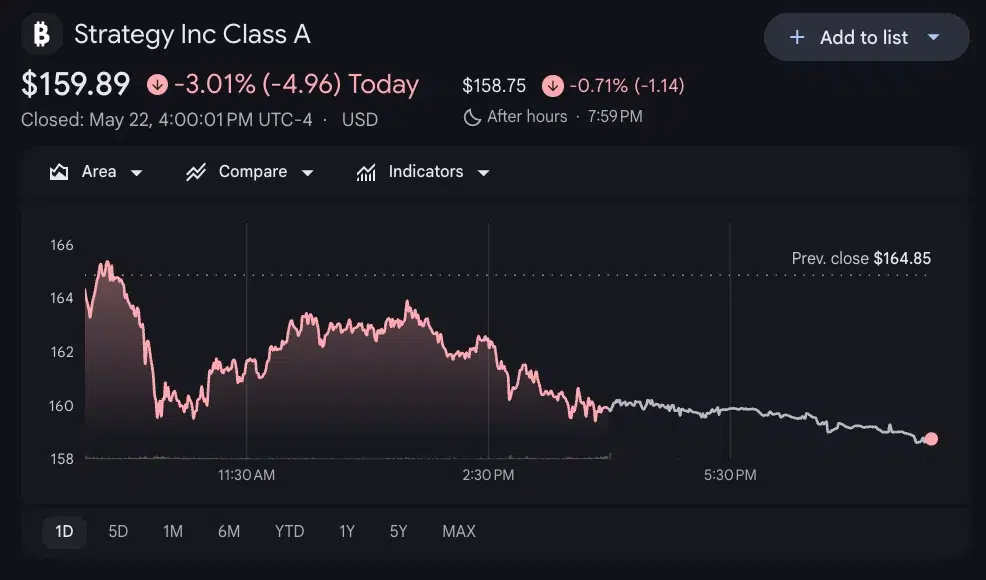
Recent market pressure has nevertheless weighed on the stock. MSTR closed down 3.01% at $159.89 on Friday after falling more than 5% over the week.
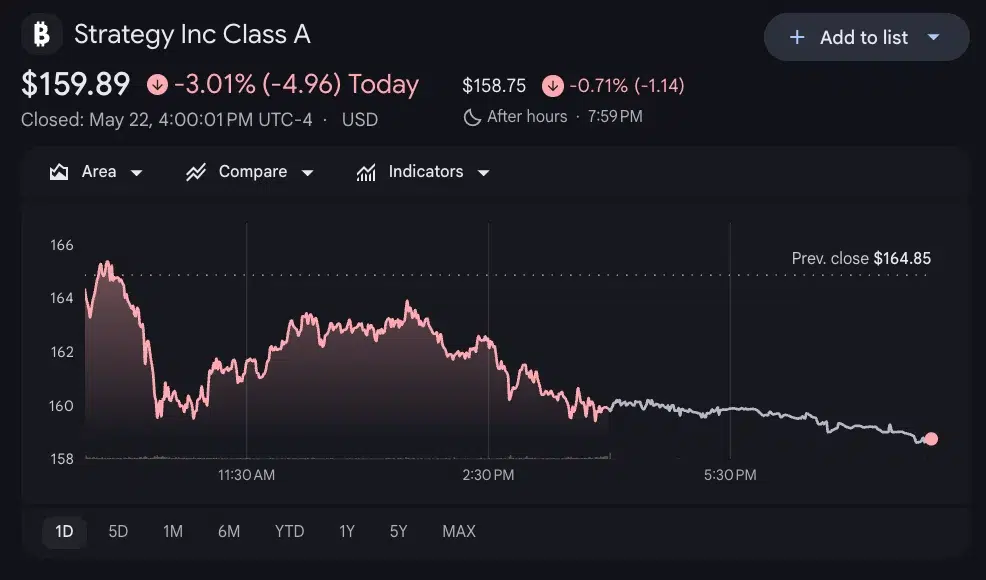
Strategy share price. Source: Google Finance.

Artificial intelligence agents handling settlements in crypto have evolved from a speculative idea to a measurable part of the payments landscape over the past year. A collaborative study by crypto investment firm Keyrock, in partnership with Coinbase and the Tempo blockchain, shows machine-to-machine settlements totaling $73 million across 176 million transactions from May last year through April 2026.
Ben Harvey, a researcher with Keyrock, framed the development as a maturation of the field: “In the past 12 months, machine-to-machine payments have gone from concept to a developed ecosystem.” The report adds that incumbents have already deployed more than $8 billion in acquisitions to secure their foothold in what is becoming a new payment stack. This points to a marketplace where automation and programmable finance are increasingly central to everyday crypto activity.
Key takeaways
- AI agents settled $73 million across 176 million transactions between May 2025 and April 2026, according to Keyrock in collaboration with Coinbase and Tempo.
- By the end of Q1 this year, more than 104,000 AI agents were registered across 15+ directories, with the average transaction size around $0.31.
- Nearly all settlements—about 98%—were conducted in Circle’s USDC, highlighting the centrality of a single stablecoin issuer in the nascent AI-agent economy and raising concerns about systemic risk if reserve management or regulatory status changes.
- Industry signals point to rapid acceleration: Circle’s leadership has projected billions of AI agents operating with stablecoins in the coming years, and surveys show strong user appetite for AI-managed trading and portfolio decisions.
Rapid expansion of AI agent settlements
The scale of activity captured in the Keyrock report underscores a shift from experimental pilots to a functioning settlement layer for machine-driven commerce. The collaboration with Coinbase and Tempo aimed to quantify how far the ecosystem has come and where it might be headed as AI agents autonomously initiate and settle transactions across networks.
Harvey notes that the sub-dollar nature of many AI-agent payments exposes the inefficiency of traditional rails. He pointed out that a typical fixed processing fee—often around 30 cents per transaction—renders micro-payments uneconomical on conventional networks. The study emphasizes that stablecoins have become the practical settlement layer for sub-dollar machine payments, enabling cost-effective, near-instant settlements that would be impractical with legacy rails.
USDC’s central role and the risk it entails
Remarkably, the vast majority of AI-agent settlements—about 98%—used USDC, according to the report. While this confirms USDC as the de facto settlement currency for machine commerce, it also centralizes risk around Circle’s reserves, regulatory standing, and operational reliability. Harvey describes this reliance as both a validation and a vulnerability: “If Circle faces a regulatory challenge, a de-peg event, or even sustained downtime, the agent economy has no fallback.”
These observations contribute to a broader conversation about resilience in crypto payment ecosystems. As automation scales, the ecosystem’s dependence on a single stablecoin issuer could become a focal point for regulatory scrutiny and risk management strategies among startups, exchanges, and developers building AI-driven financial primitives.
Signals of acceleration and user appetite
The trend lines extend beyond settlement volumes. Circle’s leadership has publicly forecast a future in which billions of AI agents operate with stablecoins, representing a substantial expansion of automated, programmable payments. At the same time, user sentiment toward AI-managed finance remains cautiously positive. A CoinGecko survey of 2,632 crypto users found broad comfort with AI involvement in trading, with 87% willing to let AI agents manage at least 10% of their crypto portfolios.
Beyond these polls, the ecosystem is already seeing related product activity. Exodus recently launched an AI-agent-focused stablecoin on Solana, reflecting ongoing experimentation with specialized rails and instruments designed to support autonomous finance. Such developments illustrate a broader push to embed AI capabilities into the fabric of decentralized finance, from settlement layers to on-chain applications and liquidity provision.
What this means for users, developers, and investors
The emergence of AI-agent settlement raises practical considerations for users and builders. For users, the promise is faster, cheaper sub-dollar payments that unlock new use cases—micro-tokens for API calls, service payments, or on-demand access to data streams. For developers, the data suggests a growing demand for robust, interoperable agent frameworks that can operate across networks and wallets while maintaining security and auditability. Investors will likely watch for how the ecosystem handles concentration risks around stablecoins, especially in times of macro or regulatory stress, and which protocols diversify their settlement rails to avoid single points of failure.
As adoption accelerates, observers should monitor regulatory clarity around stablecoins and the resilience of crypto payment rails under stress. The next few quarters will reveal whether the AI-agent economy can sustain its early momentum or whether diversification of settlement assets and governance will become a prerequisite for scalable, permissioned machine commerce.
Readers should stay attentive to regulatory developments affecting stablecoins, the evolution of settlement-layer standards for AI agents, and the emergence of new tools designed to broaden anti-fragility in machine-to-machine payments.
Crypto World
Hyperliquid (HYPE) is emerging as a challenger to traditional exchanges and prediction markets, says FalconX


Crypto trading platform Hyperliquid is beginning to compete with traditional exchanges and prediction market operators as it expands beyond perpetual futures trading, according to a new report from FalconX.
Senior crypto market strategist David Lawant outlined how Hyperliquid’s recent moves into pre-IPO markets, prediction contracts and tokenized real-world assets are broadening the platform’s appeal beyond crypto-native traders.
“Hyperliquid is seeing traction as demand for its HIP-3 markets expands to include pre-IPO markets,” the report said.
Hyperliquid first gained traction through crypto perpetual futures, a type of derivatives contract that dominates offshore digital asset trading. The platform’s native token, HYPE, has skyrocketed 94% over the past three months. But FalconX said newer products could push the platform into more direct competition with firms such as CME Group, Intercontinental Exchange-backed prediction market Kalshi and Polymarket.
The report pointed to growing activity in Hyperliquid’s HIP-3 markets, which allow users to trade assets including equities, commodities, forex and pre-IPO contracts around the clock. FalconX said those markets gained attention after traders used them to speculate on companies such as Cerebras, Anthropic and SpaceX before public listings.
The platform has also begun rolling out HIP-4 outcome markets, which function similarly to prediction markets by allowing traders to bet on binary outcomes tied to politics, economics and crypto events.
FalconX said the ability to trade prediction contracts alongside crypto and real-world asset positions on the same platform could become a major advantage.
“For example you could pair a HIP-3 perps position on NVDA with outcome markets that it could miss or beat earnings,” the report said.
The firm also highlighted strong early interest in newly launched exchange-traded funds tied to Hyperliquid’s HYPE token. Spot HYPE ETFs from 21Shares and Bitwise have attracted a combined $53 million in inflows after only a few trading sessions, according to Bloomberg data cited in the report.
FalconX said those inflows represented a larger percentage of HYPE’s market capitalization than early inflows into spot bitcoin, ether (ETH) and solana (SOL) ETFs at similar stages.
Meanwhile, Hyperliquid’s recent partnership with Coinbase (COIN) and Circle (CRCL) to integrate USDC as an aligned quote asset could significantly increase protocol revenue. FalconX estimated the arrangement could generate as much as $160 million in annualized revenue based on reserve yields tied to USDC balances on the platform.
The report also noted that regulatory developments in Washington could help accelerate adoption of tokenized real-world assets on decentralized trading venues. FalconX cited reports that the SEC is considering an innovation exemption framework for tokenized stocks.
At the same time, the firm warned that growing attention from traditional financial exchanges could bring regulatory scrutiny. CME and ICE have raised concerns with regulators about potential manipulation risks tied to Hyperliquid’s markets.
Even so, FalconX said Hyperliquid continues to lead decentralized perpetual futures markets in trading volumes, revenue and total value locked, positioning it as one of the fastest-growing trading platforms in crypto.
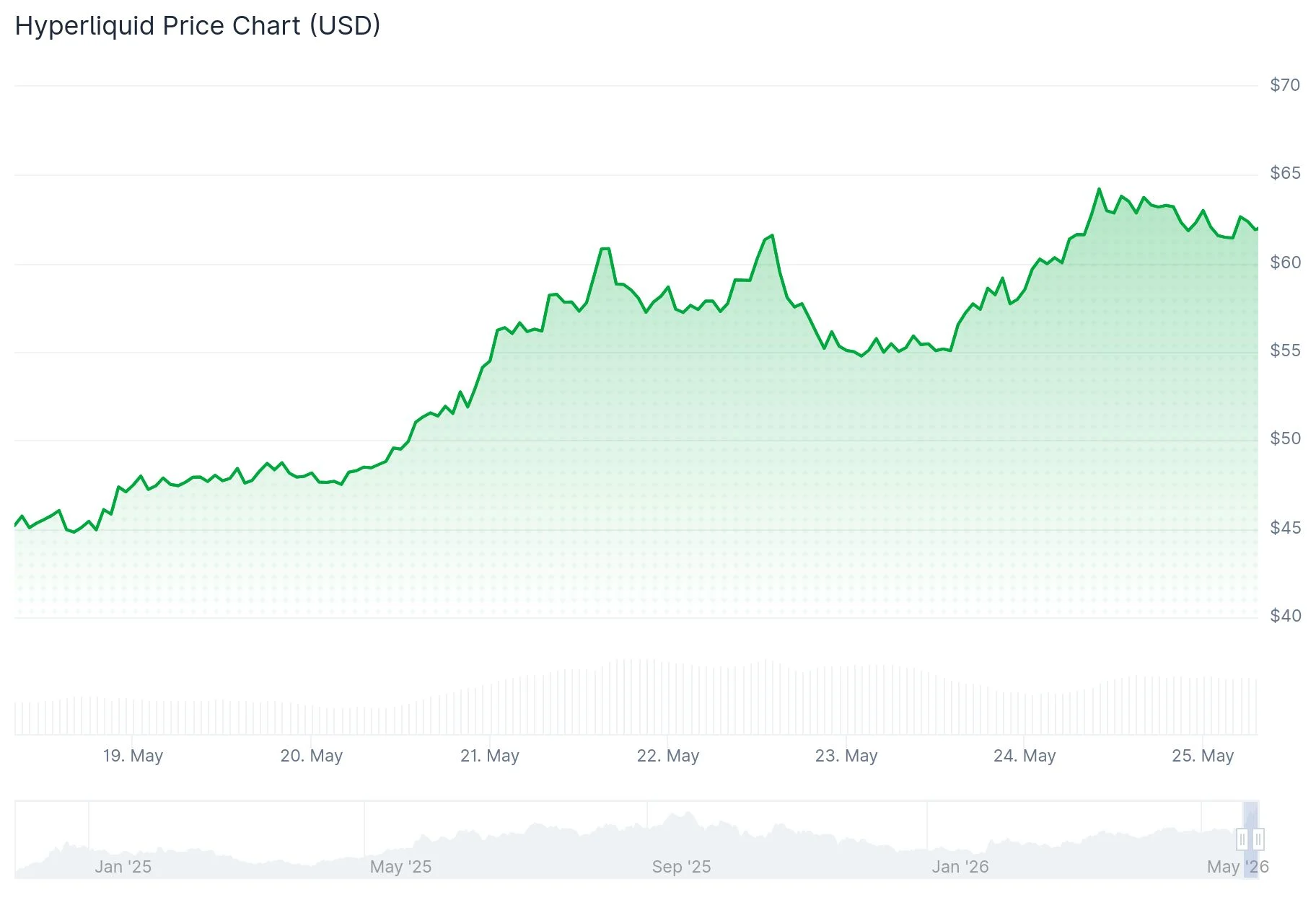
HYPE’s price went parabolic over the last week, surging 40% in the past seven days and reaching a new all-time high above $64.
The rally seems to have slowed over the past 24 hours, and it appears that some investors are taking profits rather than chasing further gains.
Some HYPE Whales Are Cashing Out
HYPE increased from below $40 to above $64 in the past couple of weeks, charting crypto’s most impressive rally in the interim. The move added billions of dollars to Hyperliquid’s total market capitalization and was fueled by surging traded volume and massive interest.

As somewhat expected, the rally has finally slowed a bit as some investors look to book profits.
Popular on-chain analytics account Lookonchain flagged a wallet that sold 151,574 HYPE (worth $9.25 million) a few hours ago. The trader also placed limit sell orders for another 170,000 HYPE worth about $10.6 million between $63.45 and $70.55.
At the time of this writing, HYPE is the 11th-largest cryptocurrency project by total market capitalization (around $15 billion). The altcoin is undoubtedly this week’s best-performing large-cap crypto, and its price surge put it very close to overtaking Dogecoin for the 10th position.
HYPE-based spot exchange-traded funds are also soaring in assets under management among an otherwise declining market. While Bitcoin ETFs bled over a billion dollars in AUM, HYPE attracted more than $70 million, as reported by CryptoPotato.
The post This Hyperliquid Whale Sells $9 Million in HYPE and Is Not Done Yet appeared first on CryptoPotato.

Trump’s patient Iran strategy reset the geopolitical risk premium and lifted Made-in-USA coins to watch above their May lows.
Now three US-aligned AI tokens show bullish chart setups as institutional capital rotates back to American growth and pre-IPO AI plays. Pattern breakouts and key trendline reclaims confirm the macro thaw across US AI hubs and the relevant altcoins plays.
NEAR Protocol (NEAR)
NEAR trades at $2.35 on May 25 after a 55% weekly rally. The Silicon Valley AI Layer-1 leads Made-in-USA coins to watch as Trump’s patient Iran strategy lifts risk-on flow.
NEAR co-founder Illia Polosukhin co-authored Google’s “Attention Is All You Need” paper, the foundation of modern AI. That US AI lineage attracts institutional capital rotating back to growth on de-escalation.
Want more token insights like this? Sign up for Editor Harsh Notariya’s Daily Crypto Newsletter here.

The token is up 66% over the past month, leading the AI Layer-1 cohort.
The 100%+ pole move from May’s $1.24 low coincides with the US risk-on bid building on Trump’s patient Iran signals. NEAR’s strongest leg landed between May 21 and May 24 as the de-escalation thread strengthened across US AI names.
NEAR’s price action shows a classic bull flag pattern. The pole formed from $1.24 to the May 24 peak at $2.51, a 101.72% move. The flag has been consolidating since, with sell volume dropping sharply.

A daily close above $2.42 confirms the flag breakout, opening $2.51 first, then $2.97 and $3.37. A move to $3.37 would mean a near-45% surge from the current level for this Made-in-USA coin. However, a close below $2.33 weakens the pattern and exposes $2.01.
Render (RENDER)
RENDER trades at $1.98 on May 25, slipping 1.83% on the day after an 11% weekly rally. The LA-based GPU compute network rides the US AI infrastructure rotation on Trump’s patient Iran strategy.
The network powers AI compute workloads alongside its rendering business, sitting in NVIDIA’s projected 10x annual GPU demand path.
RNDR’s rally since May 18 carried sizeable buying volume, separating it from low-conviction speculation. The weekly move tracks the broader risk-on rotation back to US-aligned AI plays. Iran de-escalation reduces the macro overhang on growth names.
The chart shows an inverse head and shoulders pattern since April 17. The pattern’s head is at $1.64, and the right shoulder near $1.72.

The neckline slopes upward because the right shoulder formed at a higher price than the head. That signals buyer absorption at progressively higher prices but raises the breakout level RNDR must clear.
A daily close above $2.44 confirms the neckline breakout and opens the path to $2.88. A close below $1.72 invalidates the right shoulder, with $1.64 marking full pattern failure for this Made-in-USA coin.
Worldcoin (WLD)
WLD trades at $0.29 on May 25, slipping nearly 4% after a 22% weekly rally. The Sam Altman-backed protocol completes the Made-in-USA AI trio on Trump’s Iran de-escalation.
The OpenAI CEO connection makes WLD a high-beta proxy for US AI dominance. The Orb device verifies humanness for AI-powered services, positioning World as the identity layer for the AI economy.
WLD’s 22% weekly rally tracks pre-IPO AI buzz around OpenAI and broader US growth rotation. Risk capital is rotating back to identity infrastructure as the Iran tail risk eases.
The chart shows a cup and handle pattern forming since May 10. The cup bottomed at $0.22 on May 16 and the right rim peaked at $0.31 on May 24. The current pullback resembles the handle, with the cup sloping upward to confirm the bullish bias.
WLD reclaimed its 20-day and 50-day exponential moving averages (EMA), price averages weighting recent candles more than older data. The 20-day EMA at $0.26 marks the floor that must hold.

A daily close above the $0.32, the 100-day EMA, confirms the neckline break and opens a 35% path to $0.42. A close below $0.22 fully invalidates the cup and handle structure.
The post 3 Made in USA Coins to Watch as US Iran War Nears End appeared first on BeInCrypto.


Fenwick & West has agreed to pay $54 million to settle a class action lawsuit filed by former FTX customers who accused the law firm of helping facilitate fraud at the collapsed cryptocurrency exchange.
Summary
- Fenwick & West has agreed to pay $54 million to settle claims that it helped FTX conceal the misuse of customer funds.
- Former FTX customers alleged that the law firm advised on legal structures tied to Alameda Research, North Dimension, and unlicensed financial operations.
According to court filings tied to the proposed settlement, the Silicon Valley law firm reached the agreement after initially trying to dismiss the case brought by former FTX users in 2023. The settlement still requires approval from a U.S. judge before it can take effect.
Former customers of the exchange alleged that Fenwick played a central role in legal and corporate arrangements that allowed FTX and its affiliated trading firm, Alameda Research, to move and commingle customer funds without proper safeguards. Plaintiffs claimed the firm helped create structures and entities designed to obscure how customer assets were handled inside the FTX group.
Court records from the original complaint alleged that Fenwick also advised FTX on legal strategies intended to avoid money transmitter licensing requirements in some jurisdictions.
Earlier filings from August 2025 added further accusations against the law firm after plaintiffs sought permission to amend their complaint using evidence from Sam Bankman-Fried’s criminal trial and the FTX bankruptcy process. In that proposed amended filing, former FTX customers argued that testimony from senior insiders and findings from an independent bankruptcy examiner showed Fenwick had become “deeply intertwined” with the exchange’s operations.
At the time, plaintiffs cited testimony from former FTX executives Nishad Singh, Gary Wang, and Caroline Ellison, who allegedly described internal practices involving improper loans, false statements, and misuse of customer funds. According to the filing, Singh told the court that Fenwick had been informed about some of those activities and advised on legal structures connected to them.
Other allegations in the amended filing accused the law firm of helping establish shell companies linked to Alameda Research and North Dimension, an entity used to route customer deposits. Plaintiffs also pointed to the use of encrypted and auto-deleting Signal chats by FTX executives, which they said Fenwick knew about during its legal representation of the exchange.
At the same time, the filing introduced securities law claims under Florida and California statutes tied to the sale of FTT tokens and other FTX-related investment products. Plaintiffs argued that Fenwick attorneys participated in designing and facilitating those offerings for investors.
Legal fallout from FTX collapse continues
Elsewhere in the FTX fallout, former FTX head of engineering Nishad Singh agreed in April 2026 to pay a $3.7 million disgorgement to settle charges brought by the U.S. Commodity Futures Trading Commission.
According to the CFTC, Singh also accepted a five-year trading ban and an eight-year registration ban as part of the supplemental consent order tied to the misuse of customer funds at FTX. CFTC enforcement director David Miller said the resolution accounted for Singh’s cooperation with investigators.
Separately, the FTX Recovery Trust has continued distributing recovered assets to former customers and creditors. In March, the Trust distributed $2.2 billion to claimants, while another reimbursement round has been scheduled for May 29.
Key Highlights
- HYPE token reached an unprecedented peak of $64.48, maintaining levels above $60 through Monday’s trading session
- Institutional investment vehicles from 21Shares, Bitwise, and Grayscale are channeling significant capital, with $72M entering the market last week
- The platform’s innovative buyback mechanism allocates 97–99% of fee revenue toward HYPE token repurchases
- Perpetual futures Open Interest surged to an all-time high of $2.95 billion, indicating robust market participation
- Market analyst Michaël van de Poppe forecasts HYPE could surpass the $100 threshold
Hyperliquid’s native token (HYPE) continues its remarkable ascent, establishing new price records driven by a confluence of institutional adoption, strategic token economics, and expanding platform utility. The digital asset peaked at $64.48 before stabilizing near the $60 level.
The competitive landscape for HYPE-focused exchange-traded products is rapidly evolving. Bitwise introduced BHYP on the NYSE Arca exchange, while 21Shares debuted THYP on Nasdaq. These investment vehicles collectively attracted $72.38 million in fresh capital during the previous week, representing a dramatic increase from the prior week’s modest $2.52 million.
Grayscale has officially entered the competition. According to Bloomberg’s ETF specialist James Seyffart, Grayscale submitted an updated registration document for a HYPE investment trust, proposing the ticker symbol GHYP. The documentation identifies Anchorage Digital Bank as the custodial partner and Bank of New York Mellon as the administrative entity.
Grayscale’s submission incorporates a staking component. Should regulatory authorities approve, the trust may be rebranded as the Grayscale Hyperliquid Staking ETF, potentially offering investors exposure to both price appreciation and staking income.
Token Repurchase Program Generates Sustained Demand
Hyperliquid employs a distinctive economic model that channels 97% to 99% of platform trading fees toward systematic token repurchases from secondary markets. Approximately 210,000 HYPE tokens were acquired through this mechanism during the past week. The platform’s assistance fund currently maintains 44.52 million tokens, with cumulative repurchases totaling 26.81 million HYPE. The aggregate value of all buyback activity has reached $1.16 billion.
Perpetual futures Open Interest climbed to a record $2.95 billion on Monday, according to CoinGlass data. Hyperliquid commands approximately 70% of the decentralized perpetual futures market and represents roughly 7% of total perpetual contract open interest across all trading venues.
Market participant LSTRADER, sharing analysis on X, observed that previous all-time high projections have already materialized. The trader suggested the current strategy involves trend following while capitalizing on temporary retracements, with additional resistance levels now in focus.
New Platform Features Drive Revenue Growth
Hyperliquid’s recently launched HIP-4 prediction market processed 6.05 million contracts on its inaugural day and equaled Polymarket’s two-week Bitcoin binary contract volume within just 48 hours. Additional product offerings generate increased fee revenue, which directly powers the token buyback system.
From a technical analysis perspective, HYPE maintains strong positioning above its 50, 100, and 200-day exponential moving averages. The Relative Strength Index registers at 75, suggesting overbought territory, while the MACD indicator confirms ongoing bullish momentum. Fibonacci extension analysis identifies critical resistance zones at $70.04 and $83.51.
Crypto analyst Michaël van de Poppe has publicly expressed his conviction that HYPE will exceed $100 in the near term.
Bitcoin whale positioning has hit a yearly high while retail demand sits at its most bearish level of 2026.
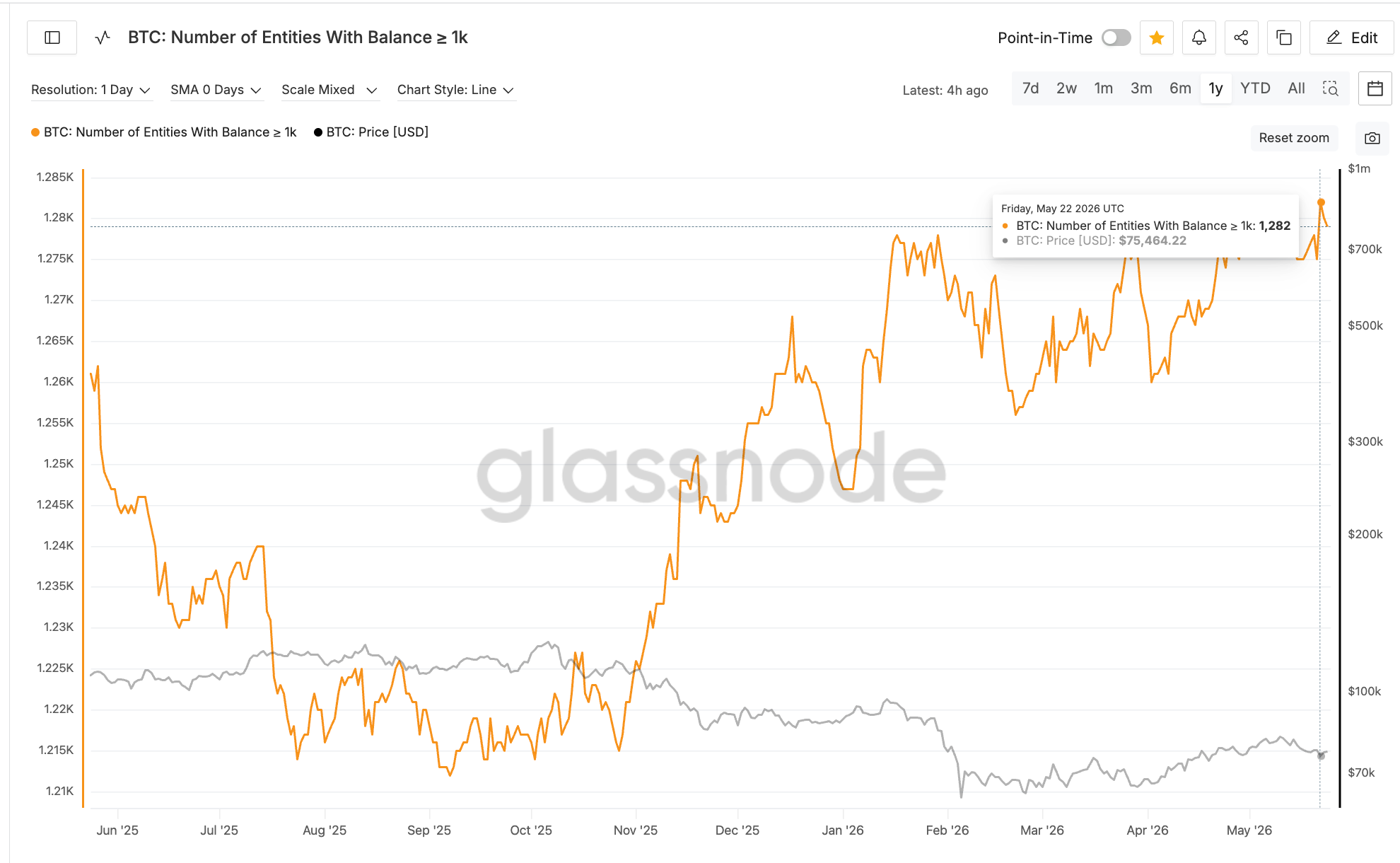
Entities holding 1,000+ BTC reached 1,282 on May 22, matching the year’s peak set on May 3. The Whale vs Retail Delta divergence is the strongest since November 2024, hinting at a proactive accumulation setup.
Retail Demand Hits 5-Month Bearish Low as Whales Quietly Accumulate
Bitcoin’s apparent demand has reached its most bearish level of 2026. But the Whale vs Retail Delta has flipped to its strongest positive divergence in 18 months. Both findings paint an optimistic picture for the Bitcoin price.
Want more token insights like this? Sign up for Editor Harsh Notariya’s Daily Crypto Newsletter here.
CryptoQuant analyst Darkfost reported on May 25 that Bitcoin’s apparent demand fell to roughly -147,000 BTC. The reading is the most bearish since December 2025, signaling new issuance is outpacing structural absorption. Darkfost framed it as a setup where sharp demand drops with excessive pessimism have historically created opportunities for patient investors.
The demand drop is primarily retail-driven. The Crypto Fear & Greed Index sits at 28, deep in fear territory as retail capitulates. Alphractal reported the Whale vs Retail Delta printed its highest positive divergence since November 2024.
Addresses holding 1,000+ BTC accumulated 47,000 BTC over the past 14 days. Strategy added 24,869 BTC last week at an average price above current spot. A dormant 2013 whale also moved 500 BTC for the first time in 12 years.
Alphractal’s Holder Sentiment metric reads 0.82. The last time it hit 0.80 during a Fear reading below 30 was March 2024. Bitcoin rallied 67% in the 90 days that followed.
The aggressive whale bid pushed Bitcoin entities holding 1,000+ BTC to 1,282 on May 22.

That matches the yearly high last printed on May 3. The on-chain reading confirms whales are positioning at record levels despite retail panic.
Large Supply Cluster at $78,258 Stands Above Spot as Key Resistance
The whale positioning aligns with a specific overhead supply zone. Glassnode’s UTXO Realized Price Distribution metric highlights a dense supply cluster at $78,258. Roughly 415,534 BTC last changed hands at this level, accounting for 2.07% of total supply.

The cluster sits as the first major resistance band above current spot. A breach of this zone would convert dormant supply into a support base. Coins last moved at this price tend to remain inactive once they trade through, reducing overhead sell pressure.
Whales appear to be building positions in anticipation of this level breaking and turning into a strong support zone. The setup’s success depends on whether spot demand returns to push Bitcoin through the cluster. For that, the Bitcoin price levels and the proactive setup need to be checked.
Bitcoin Price Eyes a Bullish Pattern Formation Above $74,177
The 12-hour chart shows how Bitcoin could break through the cluster. Bitcoin trades at $77,250 on May 25 with the chart printing an early-stage inverse head and shoulders pattern. The structure is incomplete, with the left shoulder and head visible but the right shoulder still forming.
The head bottomed at $74,177 on May 22, coinciding with the deepest sentiment drop. The first trigger for the pattern would be a rejection at the $78,125 neckline. Such a rejection would send Bitcoin into a higher low between $76,040 and $74,177 to form the right shoulder. The prospective $78,125 neckline also aligns with the supply cluster discussed earlier.

A 12-hour close above $78,125, post the right shoulder formation, followed by a clean breakout above $79,057 confirms the pattern. The measured move projects a 5% surge to $82,073 from neckline confirmation. A 12-hour close below $74,177 invalidates the structure and weakens the whale accumulation case.
Note: Even the lack of rejection at $78,125 keeps the pattern alive. It just pushes the neckline higher.
The chart, supply cluster, and whale positioning point to one read. A proactive setup is forming as whales position ahead of the breakout while retail reacts to fear.
The post Bitcoin’s Quietest Accumulation in 18 Months Is Happening Right Now appeared first on BeInCrypto.

Kristian Gkolomeev bags $1m bonus for smashing 50m freestyle world record at Enhanced Games

Starfish Space shifts its sights to Australian satellite for orbital docking demonstration

Bruno Fernandes accuses Roy Keane of spreading lies about him in brutal response


-

 Crypto World4 days ago
Blockchain.com files with SEC for U.S. IPO
-

 Fashion3 days ago
Holiday Weekend Open Thread – Corporette.com
-
 Crypto World3 days ago
Bitcoin Accumulation Weakens as BTC Realized Losses Hit $600M
-

 Business3 days ago
Dell Technologies DELL Stock Surges 15% on AI Server Momentum and Analyst Upgrades in 2026
-

 Crypto World3 days ago
Space X IPO Is ‘Bad News’ for Tech Stocks: But What About Bitcoin?
-

 Politics3 days ago
Makerfield: a tale of two social-media histories
-
 Crypto World3 days ago
MicroStrategy’s Saylor Says Miners No Longer Set Bitcoin Price, Another Force Has Taken Over
-

 Crypto World2 days ago
Robinhood crypto COO Tanya Denisova exits
-

 Business14 hours ago
NYT Strands Answers May 24 2026 Revealed for Puzzle No. 812 Theme Summer Essentials
-
 Tech3 days ago
A 0.12% parameter add-on gives AI agents the working memory RAG can’t
-

 Tech3 days ago
WhatsApp ads could make Irish debut after discussions with DPC
-

 Crypto World3 days ago
AI infrastructure race heats up as IREN pitches full-stack strategy, WhiteFiber lands $160M deal
-

 Tech3 days ago
You Can Now Add ChatGPT To PowerPoint
-

 Business3 days ago
Trump Invests $1M-$5M in Kura Sushi USA Chain With 27 California Locations
-
Crypto World7 days ago
Revolut Launches Dogecoin Debit Card Across UK and EU
-

 Sports3 days ago
2026 CJ Cup Byron Nelson leaderboard: Brooks Koepka finds putting stroke in Round 1
-
Business3 days ago
Goldman Sachs reinstates Ageas stock coverage with neutral rating
-

 Crypto World4 days ago
Exa Labs raises $250 million in funding led by a16z
-
 NewsBeat4 days ago
Charity run by Reform leader Malcolm Offord accused of ‘law breaking’ over Scottish registration
-

 Crypto World3 days ago
Trump Media’s Bitcoin Stash Shrinks Again as 2,650 BTC Lands on Crypto.com
You must be logged in to post a comment Login