Connect with us
DAPA Banner
DAPA Coin
DAPA
COIN PAYMENT ASSET
PRIVACY · BLOCKDAG · HOMOMORPHIC ENCRYPTION · RUST
ElGamal Encrypted MINE DAPA
🚫 GENESIS SOLD OUT
DAPAPAY COMING

Business

Aldi launches free grocery blind box giveaway amid elevated food prices

Published

on

Aldi recalls frozen spinach bites over possible rodent hair contamination

Aldi is launching a limited-time giveaway of mystery grocery bundles, offering shoppers a chance to claim free boxes containing surprise products.

The discount grocer said it will release a new themed ALDI Blind Box each day from June 22 through June 25. The boxes will be available while supplies last.

Advertisement

Shoppers can claim one box per day beginning at noon ET by visiting AldiBlindBox.com. The boxes will be distributed on a first-come, first-served basis and shipped directly to consumers.

YUM BRANDS SELLS PIZZA HUT FOR $2.7B, SHARPENS FOCUS ON TACO BELL AND KFC

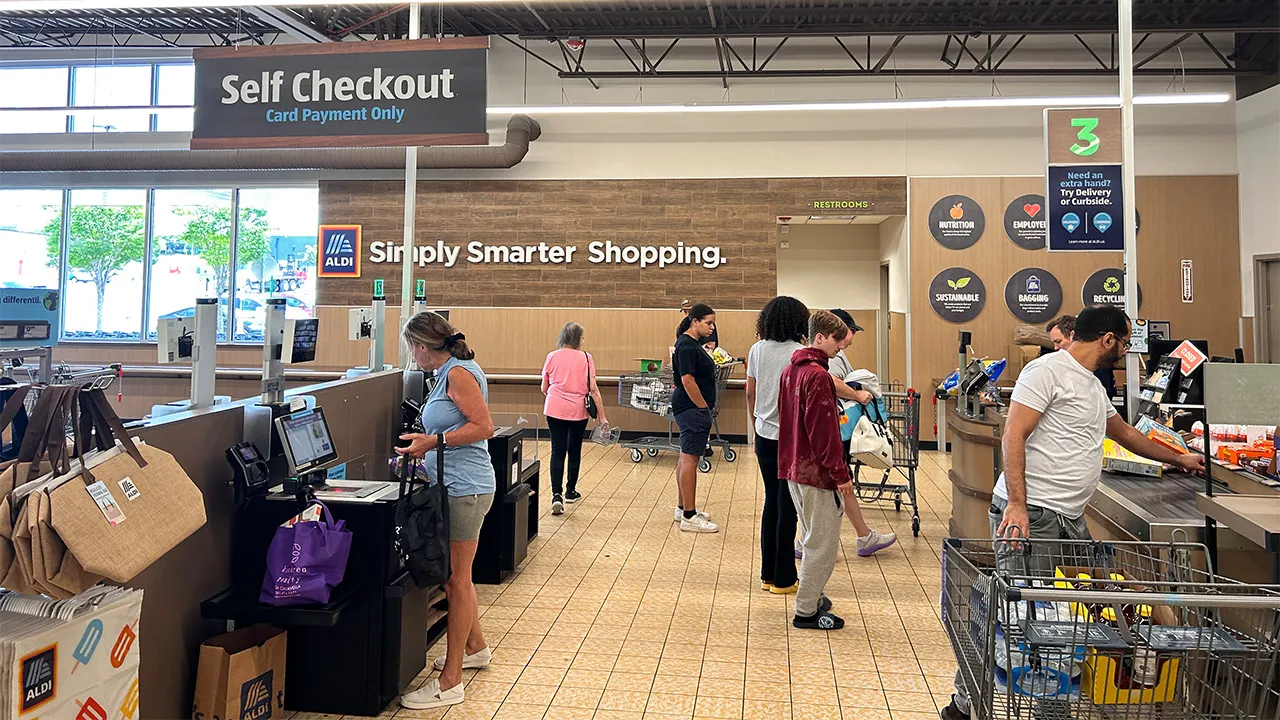
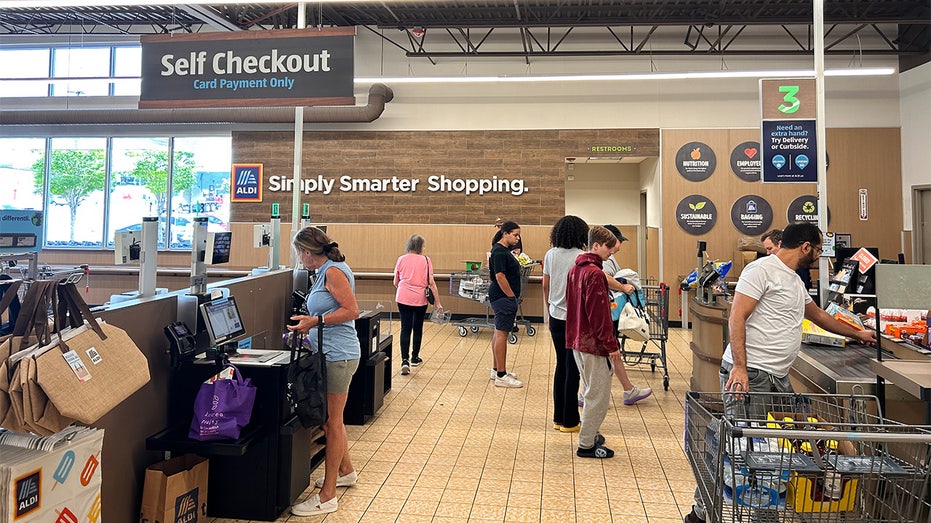
aldi self checkout

Self-checkout machines at an Aldi grocery store in Charlotte, N.C.  (Lindsey Nicholson/UCG/Universal Images Group via Getty Images)

The offerings include a Snack Blind Box, a Fiber Blind Box, a Protein Blind Box and a Mystery Blind Box containing products from across the store.

INFLATION ROSE AGAIN IN MAY AS ELEVATED ENERGY PRICES SQUEEZE CONSUMERS

Advertisement

The promotion is based on the blind box format, in which consumers do not know the contents of a package until it is opened. The concept has gained popularity across several retail categories, including collectibles, beauty products and apparel.

The promotion comes as food prices remain elevated. High inflation has created severe financial pressures in recent years for most U.S. households, which are forced to pay more for everyday necessities like food and rent. Price hikes are particularly difficult for lower-income Americans because they tend to spend more of their already-stretched paychecks on necessities and have less flexibility to save.

INFLATION IS SQUEEZING AMERICAN CONSUMERS AND THE FED’S LATEST REPORT SHOWS IT’S GETTING WORSE

Food prices were up 0.2% in May and are 3.1% higher than a year ago. The food at home index was up 0.1% for the month and 2.7% compared with last year. The food away from home index rose 0.3% on a monthly basis and 3.5% year over year.

Advertisement
An Aldi grocery store in Washington, D.C.

An Aldi grocery store in Washington, D.C. (Kevin Dietsch/Getty Images)

Meats, poultry and fish prices were down 0.4% in May but are up 6.2% from last year. Beef and veal prices fell 1.6% for the month but remain up 12.9% on an annual basis. Egg prices increased 4% in May but are down 35.2% year over year as supply normalized after an avian flu outbreak. Fruits and vegetables prices rose 0.2% for the month and are up 6.1% from a year ago.

Aldi said many of the products included in the giveaway can also be found in stores nationwide and through its rotating ALDI Finds program.

CLICK HERE TO GET FOX BUSINESS ON THE GO

The company said the giveaway will run for four days with a different themed box available each day.

Advertisement

FOX Business’ Eric Revell contributed to this report

Continue Reading
Click to comment

You must be logged in to post a comment Login

Leave a Reply

Business

Bunbury advanced manufacturing hub build begins

Published

on

Bunbury advanced manufacturing hub build begins

Ground has broken on construction of the state government’s $55 million manufacturing precinct near Bunbury.

Continue Reading

Business

A Side-by-Side Breakdown to Help You Hire the Right Full Stack Team

Published

on

In today’s rapidly evolving digital world, technology is more than just a tool for efficiency—it’s a catalyst for transformation. Businesses across the UK are not only adopting digital solutions to stay competitive but are also leveraging them to redefine the very frameworks of their industries.

If you’re building a web product and trying to put together a full-stack team, you’ve probably landed on two options: MERN or MEAN. Both are JavaScript-based. Both cover the full stack. Both have strong developer communities in 2026.

The difference is in the details, and those details matter a lot when you’re deciding who to hire.

This article breaks down both stacks, explains where each one fits, and shows you why hiring through Uplers is the fastest way to get the right developer on your team, regardless of which stack you choose.

What MERN and MEAN actually are

Both stacks share three of their four technologies. That shared foundation is worth understanding before you get to the difference.

MongoDB is the database layer in both. It stores data as JSON-like documents rather than rows and tables. That makes it flexible and fast to work with, especially in early product stages where your data model changes often.

Advertisement

Express.js is the backend web framework in both. It runs on Node.js and handles routing, middleware, and API logic. Most full stack JavaScript developers know it well.

Node.js powers the server in both stacks. It lets developers write server-side code in JavaScript, which means a full stack developer can work across the entire codebase without switching languages.

The one thing that differs: the frontend framework.

MERN uses React. MEAN uses Angular.

Advertisement

That single difference changes the kind of developer you need, the architecture of your frontend, and how your team will work day to day.

React vs Angular: what it means for your team

React is a UI library. You assemble the rest of the frontend stack yourself, choosing your own routing, state management, and tooling. That flexibility lets a skilled developer move fast. It also means the quality of the codebase depends heavily on the developer’s judgment.

Angular is a full framework. It comes with routing, forms, dependency injection, and a defined way of structuring code. There’s less flexibility but significantly more consistency. When your team grows and multiple developers are working on the same frontend, that consistency becomes very valuable.

For startups building fast with a small team, MERN tends to be the easier starting point. React’s ecosystem is larger, the talent pool is wider, and iteration speed is higher when you’re not locked into framework conventions.

Advertisement

For teams building complex, long-lived products, especially internal platforms, fintech tools, or enterprise software, MEAN’s structure pays dividends over time. Angular enforces patterns that make large codebases easier to maintain.

Where most hiring decisions go wrong

Founders make the stack decision, write a job description, and then spend the next two to three months finding out that “MERN developer” or “MEAN developer” on a resume tells you almost nothing useful.

The skill range inside each label is enormous.

A MERN developer who’s written basic React components is not the same as someone who understands Next.js, can manage complex application state, has dealt with performance bottlenecks, and has shipped a full product end to end. They’ll both call themselves MERN developers. One will move your product forward. The other will create technical debt you spend the next year cleaning up.

Advertisement

The same problem exists on the MEAN side. Angular’s complexity is real. RxJS, the reactive programming library Angular relies on heavily, is powerful and genuinely difficult to use well. A developer who hasn’t worked with it in a production environment will introduce bugs that are hard to trace and slow to fix.

Hiring on your own, you’re running multiple interview rounds, making judgment calls with limited signal, and carrying all the risk yourself. If the hire doesn’t work out, you restart from zero.

How Uplers solves this, for both stacks

When you hire MERN stack developers through Uplers, you’re not starting from a pile of unfiltered applications. You’re choosing from engineers who’ve already cleared a rigorous vetting process that tests technical depth, real-world delivery experience, and communication ability. The large majority of applicants don’t make it through.

The same applies when you hire MEAN stack developers through Uplers. Angular’s learning curve means the filtering matters even more. Uplers screens specifically for RxJS proficiency, module and service architecture, and experience working in structured, large-scale codebases. You don’t have to figure that out yourself in a one-hour technical interview.

Advertisement

Most clients get shortlisted profiles within 48 hours of sharing their requirements. That’s not 48 hours from posting a job. That’s 48 hours from the conversation where you explain what you’re building.

For a startup where a three-month hiring process means a three-month delay on product, that difference is significant.

What Uplers vets for, stack by stack

The vetting criteria match what your product actually needs, not just what looks good on paper.

For MERN: Uplers looks at full-stack depth across the entire JavaScript ecosystem. Can they work with MongoDB’s document model and design schemas that don’t fall apart as the product grows? Do they understand Express routing and middleware beyond the basics? On the React side, have they dealt with server-side rendering, hydration, and component-level performance? Have they made real decisions about state management and can they explain the reasoning?

Advertisement

For MEAN: The bar shifts toward structure and discipline. Uplers looks for clean Angular module architecture, real-world RxJS experience with complex async flows, TypeScript fluency beyond the basics, and the ability to work within Angular’s conventions rather than around them. Developers who’ve only worked in small Angular projects often struggle when the codebase scales to a real team. Uplers filters for people who’ve actually been there.

The risk you don’t think about until it’s too late

A bad full stack hire is expensive in ways that don’t show up immediately.

You notice it three months in, when features are late and the codebase has patterns nobody else on the team understands. You notice it when the developer who “knew MERN” turns out to have strong React skills but had never actually set up a Node/Express API from scratch. Or when the Angular hire who looked great in the interview hadn’t actually used RxJS in a real project and was learning on your time.

Uplers includes a replacement guarantee. If a developer doesn’t work out, Uplers replaces them. You’re not starting over from scratch and absorbing the full cost of a mis-hire.

Advertisement

For a startup where one wrong hire can set you back a quarter, that guarantee is worth more than the sticker price.

Which stack should you pick?

If you’re early stage, moving fast, and your team is small: MERN. The React ecosystem is rich, developers are easier to find, and iteration speed is higher before you’ve scaled to a team that needs Angular’s structure.

If you’re building something complex, with a large team or long timeline, and you need the codebase to stay consistent as headcount grows: MEAN is worth the extra ramp-up time. It pays back the investment.

Either way, the stack decision is the easier call. The harder call is finding a developer who actually knows it well enough to use it properly.

Advertisement

That’s what Uplers is for. Whether you’re looking to hire MERN stack developers or hire MEAN stack developers, you get pre-vetted senior engineers, shortlisted profiles in 48 hours, and a process that protects you if something goes wrong.

The stack is just the starting point. The right hire is what actually ships the product.

Advertisement
Continue Reading

Business

German exports to Britain drop 7% since 2016, IW says

Published

on


German exports to Britain drop 7% since 2016, IW says

Continue Reading

Business

NSE IPO, Bata revival and Nykaa growth: Gaurang Shah’s market playbook

Published

on

NSE IPO, Bata revival and Nykaa growth: Gaurang Shah's market playbook
India’s equity markets continue to present selective opportunities despite global uncertainties, according to Gaurang Shah of Geojit Investments. Speaking to ET Now, Shah shared his views on Bata India‘s leadership transition, Nykaa‘s growth strategy, his preferred investment themes, and the much-awaited NSE IPO.

Fresh Leadership Could Revive Bata

Bata India has struggled to reward shareholders over the past five years despite launching new products, consolidating stores, and expanding across customer segments. Shah believes the company now needs a fresh strategic direction under its new leadership.

He also noted that the domestic footwear industry stands to benefit from government measures aimed at curbing cheap imports from China and Bangladesh.

Advertisement

“We do have a positive coverage on Bata India from a long-term fundamental point of view. We feel it is time to bring in new strategies and fresh thinking… With this new leadership, we should see a significant amount of change coming in.”

Nykaa’s AI Push Strengthens Growth Story
Shah maintained a positive outlook on Nykaa after the company outlined its FY30 vision and announced AI-driven initiatives. However, he advised investors not to chase the recent rally and instead wait for better buying opportunities.
He also highlighted that innovation remains essential in the highly competitive e-commerce space.”If you already have investments, you can continue to hold them. If you do not own the stock, do not rush into it. Let the stock correct a little, and then you can gradually accumulate.”

Defence, Asset Management and Power Remain Top Bets
Looking ahead, Shah identified defence, asset management and power as his preferred sectors over the next year. His top stock picks include Bharat Electronics, Nippon Life India Asset Management and Torrent Power.

According to him, these sectors remain relatively insulated from global uncertainties and offer strong long-term growth potential.

“These three sectors are relatively insulated from external global shocks, and there is significant growth potential for both the sectors and these companies.”

Advertisement

NSE IPO Seen as a Big Positive
Shah described the proposed NSE IPO as one of the biggest developments for India’s capital markets in recent years. While he refrained from commenting on valuations until Geojit’s research is complete, he remains optimistic about the broader capital market ecosystem.

He believes exchanges, depositories, registrars and asset managers are all well positioned to benefit as India’s equity markets continue to expand.

“If Indian stock markets continue to grow at 12% to 15% annually over the next three to five years, fundamentally strong capital market-related companies should continue to perform well.”

Long-Term Investing Still the Best Strategy
Across sectors, Shah’s is of the view that investors should focus on fundamentally strong businesses with sustainable earnings rather than short-term market fluctuations. While leadership changes and new growth initiatives can create opportunities, disciplined long-term investing remains the key to generating wealth.

Advertisement
Continue Reading

Business

Gulf airlines get back to business as flights near pre-war levels

Published

on

Gulf airlines get back to business as flights near pre-war levels


Gulf airlines get back to business as flights near pre-war levels

Continue Reading

Business

Scientists Discover Garnet on Mars for the First Time, Unlocking Clues to the Red Planet’s Ancient Past

Published

on

Videographic on the planet Mars. After a seven-month journey, NASA's Perseverance rover prepares to touch down on Mars on Thursday after first negotiating a risky landing procedure that will mark the start of its multi-year search for signs of ancient mic

An international team of scientists has identified a completely new type of rock on Mars and, for the first time ever, discovered the mineral garnet in a sample from the Red Planet — a breakthrough that offers researchers a rare glimpse into Mars’s ancient geological history and could help piece together billions of years of planetary evolution.

The discovery was made by a multinational research team that includes James Darling, professor of Earth and Planetary Science at the University of Portsmouth’s School of the Environment and Life Sciences, alongside researchers from Brock University in Canada, the Royal Ontario Museum, the Università di Trieste in Italy, and the Open University in the United Kingdom.

A Familiar Mineral in an Unfamiliar Place

On Earth, garnet is widely recognized as a dark-red gem that was popular with ancient Egyptians, Romans, and the Victorian elite alike, and it remains January’s official birthstone. Beyond its decorative appeal, garnet serves as a cornerstone mineral in geology, providing scientists with a powerful record of the tectonic forces, ore-forming processes, and fluid-rock interactions that shape Earth’s crust and mantle.

Advertisement

Its discovery on Mars marks an entirely new application for that geological record-keeping ability. The find offers a new geological time capsule, preserving clues about the temperatures, pressures, and processes that shaped Mars billions of years ago.

“The findings add a striking new dimension to our understanding of the geology of Mars and open an exciting new window into the evolution of our planetary neighbour,” said Darling.

How the Discovery Was Made

The research was led by Tanya Kizovski, assistant professor of Earth Sciences at Brock University, who described the discovery’s broader significance for understanding Martian geology. “This discovery is going to expand our knowledge of the geologic processes that are possible on this planet,” Kizovski said. “This new garnet-bearing rock type could give us clues to how Mars has changed throughout its history and new insights into the ancient environments that could have formed the garnet and related minerals.”

Advertisement

The breakthrough emerged somewhat unexpectedly, growing out of routine analysis of an existing meteorite sample rather than a targeted search for new minerals. Kizovski and colleagues at the Royal Ontario Museum came to know of the garnet’s presence while analyzing a fragment of a Martian meteorite known as NWA 8171, held within the museum’s collections. Kizovski had set out simply to identify the fragment’s minerals and chemical composition when she noticed something unusual.

“This little section of the meteorite looked really interesting, and the chemistry was a bit odd,” she said. “At first, we assumed it was a mineral called pyroxene, which is very common, but then we decided to take a second look.”

That second look proved decisive. Using the University of Portsmouth’s Electron Microscopy and Microanalysis Unit along with the Royal Ontario Museum’s specialized laser equipment, the team was surprised to discover garnet — a mineral that had not been identified on Mars until now.

How Garnet Could Have Formed on Mars

Advertisement

After confirming the mineral’s identity, the team turned its attention to analyzing the fragment’s broader chemistry and mineralogy in an effort to speculate on how the garnet might have formed in the first place. Kizovski explained the geological process that typically produces garnet on Earth, and how a similar process could plausibly have occurred on Mars.

“Garnet is a classic example of a mineral often found in metamorphic rocks on Earth. The process of metamorphism transforms igneous or sedimentary rocks into a new form through exposure to extreme heat, high pressure or hot fluids,” Kizovski said. “On Mars, the heat and pressure needed to produce garnet through metamorphism could have come from the impact of a meteorite hitting the surface of Mars, magma rising up into the Martian crust or both.”

Both of those scenarios — a violent meteorite impact or upwelling volcanic activity — would have generated the kind of intense heat and pressure conditions on Mars that are typically required to transform existing rock into garnet-bearing material here on Earth, giving researchers two plausible pathways to explain how the mineral might have come to exist on the Martian surface or within its crust.

An Open Question: Is the Rock Even Martian?

Advertisement

Despite the excitement surrounding the discovery, Kizovski was careful to note a significant unresolved question hanging over the find. The research doesn’t definitively indicate whether the garnet-bearing rock formed on Mars or was delivered to the Red Planet and incorporated into its surface via a meteorite landing from elsewhere, leaving open the possibility of what researchers describe as an “extra-Martian” origin.

In other words, scientists cannot yet rule out that the garnet-bearing fragment originated on a different planetary body entirely and was later transported to Mars’s surface by an impacting meteorite, only to subsequently become embedded in Martian material and eventually find its way to Earth as part of the larger NWA 8171 meteorite.

The Next Step: Studying Oxygen Isotopes

Resolving that uncertainty will require a more invasive form of analysis that scientists have so far avoided due to the sample’s extraordinary rarity. Scientists need to now study the garnet’s isotopic signatures to verify whether it was originally produced on Mars or on another planetary body. “Measuring oxygen isotopes from the garnet-bearing rock type itself would help to confirm if it is Martian in origin or from an exotic meteorite impactor,” Kizovski said. “Isotopes are a collection of atoms with equal numbers of protons and electrons, but different numbers of neutrons.”

Advertisement

However, that process would entail destroying some of the sample, “which was avoided thus far due to its rarity, as it may be the only garnet-bearing Martian rock we have for study,” Kizovski added — a tension that illustrates the delicate balancing act facing planetary scientists when working with exceptionally scarce extraterrestrial material. Every test performed on the fragment carries the risk of consuming a piece of evidence that, for now, appears to be entirely unique among known Mars samples.

What Comes Next

Despite the open questions surrounding the garnet’s precise origin, researchers remain optimistic about what continued study of the sample could reveal. Royal Ontario Museum curator Kim Tait and research assistant Jessica Tomacic, working alongside Professor Darling, are continuing to study the sample in detail. “With their work and more comparisons to rover and orbital data, I’m hopeful that we will be able to learn more about the origin and history of garnet on Mars,” Kizovski said.

That comparative approach — cross-referencing the meteorite fragment’s mineral signatures against data gathered by Mars rovers and orbiting spacecraft — could eventually help researchers determine whether similar garnet-bearing rock formations exist elsewhere on the Martian surface, potentially opening up an entirely new category of geological material for future Mars missions to study directly.

Advertisement

Publication and Funding

The team’s study, titled “Expanding Mars’ lithologic diversity: discovery of a garnet-bearing clast in NWA 8171,” was published Tuesday, June 16, in the journal Geochemical Perspectives Letters.

The research project received funding support from multiple sources, including the Government of Canada’s Natural Sciences and Engineering Research Council, the Killam Trusts’ Dorothy Killam Fellowship, and the Science and Technology Facilities Council’s funding program at the University of Portsmouth.

For planetary scientists, the discovery represents more than simply the addition of a new mineral to the catalog of materials known to exist on Mars. It offers a fresh analytical tool — one already well understood from decades of terrestrial geology — that could help unlock new chapters in the 4.5-billion-year history of a planet that continues to reveal previously unknown facets of its geological past with each new sample subjected to modern laboratory analysis.

Advertisement
Continue Reading

Business

The Economy Is Weakening. That Will Test This Long Rally.

Published

on

The Economy Is Weakening. That Will Test This Long Rally.

The Economy Is Weakening. That Will Test This Long Rally.

Continue Reading

Business

Asia stocks dip amid doubts over US-Iran peace talks; tech loses steam

Published

on


Asia stocks dip amid doubts over US-Iran peace talks; tech loses steam

Continue Reading

Business

Ukrainian drone makers target Asia as Taiwan tensions spur demand

Published

on

Ukrainian drone makers target Asia as Taiwan tensions spur demand


Ukrainian drone makers target Asia as Taiwan tensions spur demand

Continue Reading

Business

Work on UK’s first soft play centre for disabled children gets under way

Published

on

Business Live

The state-of-the-art facility near Bristol will have 10 rooms including a sensory area and a gym

View of Gympanzees new facility from above

View of Gympanzees new facility from above(Image: Gympanzees)

Construction work to build the UK’s first play centre and exercise facility for disabled children and young people is under way at a site near Bristol.

Local charity Gympanzees is behind the huge project to transform the former services station next to the M48 Severn Bridge.

Building work on the project, which is expected to complete later this year, will see the vast 2,350 sq metre ground floor converted into 10 rooms for play.

These will include a gym; light and dark sensory rooms; an active sensory space and trampoline room; a café; music room; and soft play.

Advertisement

The new centre is expected to receive more than 200,000 visitors a year once it is open to the public. Until now, the charity has hosted a series of pop-up events attracting thousands of families from around the country.

Stephanie Wheen, founder and chief executive of Gympanzees said: “We can’t thank our funders, corporate partners, and the public enough for their support.

Stephanie Wheen, chief executive and founder of Gympanzees, at one the organisation's pop-up sessions

Stephanie Wheen, chief executive and founder of Gympanzees, at one the organisation’s pop-up sessions(Image: Helen Sampson)

“We’ve had fantastic feedback on our services so far, but families deserve more than temporary pop-up events and remote support,”

Bristol construction company Oakland is partnering with the charity on the project. Tom Lee-Fox, the company’s managing director, said: “It’s a real privilege to have been instructed on this project. It plays to our strengths as a regional contractor with experience across health, education and care settings.

Advertisement

“We do not see this as just another construction project, but an opportunity to be part of Gympanzees’ journey and to make a difference to the lives of the incredible people who both work for and are supported by Gympanzees – we cannot wait to get started.”

In April, Gympanzees secured nearly £1m from the National Lottery for the scheme. The cash raised by the organisation, including the money from the lottery’s community fund, now stands at £8m.

“At previous sensory play and exercise sessions that we’ve held, we’ve witnessed a three-year-old laugh for the very first time and a teenager pull herself up to stand independently,” added Ms Wheen. “With this centre, we can create hundreds more moments like these.”

Advertisement
Continue Reading

Trending

Copyright © 2025