

Business
Alphabet Owns The Entire AI Stack And Is The Largest Pure Play Option For Investors (NASDAQ:GOOGL)



I am focused on growth and dividend income. My personal strategy revolves around setting myself up for an easy retirement by creating a portfolio which focuses on compounding dividend income and growth. Dividends are an intricate part of my strategy as I have structured my portfolio to have monthly dividend income which grows through dividend reinvestment and yearly increases. Feel free to reach out to me on Seeking Alpha
Analyst’s Disclosure: I/we have a beneficial long position in the shares of GOOGL, AAPL either through stock ownership, options, or other derivatives. I wrote this article myself, and it expresses my own opinions. I am not receiving compensation for it (other than from Seeking Alpha). I have no business relationship with any company whose stock is mentioned in this article.
Disclaimer: I am not an investment advisor or professional. This article is my own personal opinion and is not meant to be a recommendation of the purchase or sale of stock. The investments and strategies discussed within this article are solely my personal opinions and commentary on the subject. This article has been written for research and educational purposes only. Anything written in this article does not take into account the reader’s particular investment objectives, financial situation, needs, or personal circumstances and is not intended to be specific to you. Investors should conduct their own research before investing to see if the companies discussed in this article fit into their portfolio parameters. Just because something may be an enticing investment for me or someone else, it may not be the correct investment for you.
Seeking Alpha’s Disclosure: Past performance is no guarantee of future results. No recommendation or advice is being given as to whether any investment is suitable for a particular investor. Any views or opinions expressed above may not reflect those of Seeking Alpha as a whole. Seeking Alpha is not a licensed securities dealer, broker or US investment adviser or investment bank. Our analysts are third party authors that include both professional investors and individual investors who may not be licensed or certified by any institute or regulatory body.

Business
Apollo Hospitals Q4 Results: Cons PAT jumps 36% YoY to Rs 529 crore, revenue rises 18%; Rs 10 per share dividend declared

The hospital chain posted an 18% revenue growth to Rs 6,605 crore in Q4FY26 versus Rs 5,592 crore posted in the corresponding quarter of the previous financial year.
The company’s PAT grew 5.4% sequentially from Rs 502 crore in Q3FY26 while the topline increased 2% compared to Rs 6,477 crore in the October-December quarter of FY26.
The company’s board recommended a final dividend of Rs 10 per equity share for FY26 and has set the record date on August 14, 2026 for determining the shareholders who are entitled for the final dividend.
The company’s Earnings Before Interest, Taxes, Depreciation and Amortisation (EBITDA) in the quarter under review stood at Rs 1,011 crore, recording a 31% YoY growth.

In its filing to the exchanges, the company reported strong growth in revenue and EBITDA across all three business verticals, as well as at the consolidated level, reflecting sustained operational momentum and resilient demand across healthcare services.
Healthcare service Q4FY26 performance
• Revenue at Rs 3,268 crore vs Rs 2,822 crore in Q4FY25; growth of 16% YoY
• EBITDA grew 14% at Rs 781 crore vs Rs 686 crore in Q4FY25; Margins at 23.9% in Q4FY26
• PAT stood at Rs 412 crore vs Rs 385 crore in Q4FY25, up 7% YoY
Apollo Health and Lifestyle Q4 performance
• Revenue at Rs 489 crore vs Rs 394 crore in Q4FY25; growth of 24% YoY
• EBITDA grew 58% at Rs 75 crore vs Rs 47 crore in Q4FY25; margins at 15.3% in Q4FY26
• PAT profit of Rs 10 crore vs loss of Rs 4 crore in Q4FY25
Apollo HealthCo Q4FY26 performance
• Revenue at Rs 2,848crore vs Rs 2,376 crore in Q4FY25; growth of 20% YoY
• EBITDA at Rs 156 crore vs Rs 36 crore in Q4FY25; margins at 5.5% in Q4FY26
• PAT stood at Rs 107 crore vs Rs 9 crore in Q4FY25
The company reported a strong consolidated performance for FY26, with revenue rising 16% YoY to Rs 25,229 crore compared with Rs 21,794 crore in FY25, driven by robust growth across its healthcare and digital platforms businesses.
EBITDA stood at Rs 3,769 crore against Rs 3,022 crore in the previous financial year, despite continued investments in Apollo 24/7, which incurred costs of Rs 467 crore during FY26, including a non-cash ESOP charge of Rs 118 crore.
Reported profit after tax (PAT) increased sharply to Rs 1,942 crore from Rs 1,446 crore in FY25, while diluted earnings per share (EPS) came in at Rs 134.95 for the year.
Meanwhile, Apollo 24/7 recorded a gross merchandise value (GMV) of Rs 2,037 crore, reflecting continued traction in the company’s digital healthcare ecosystem.
(Disclaimer: The recommendations, suggestions, views, and opinions given by the experts are their own. These do not represent the views of The Economic Times.)

Local Government Minister Hannah Beazley has described the City of Perth council’s conduct as “simply unbelievable” and again warned that amalgamations might be a solution to ongoing problems in the sector.

Immad Akhund, CEO and co-founder of the startup Mercury.
Courtesy: Mercury Technologies
Mercury, a fintech firm that provides banking services to startups, has raised $200 million in funding at a $5.2 billion valuation, CNBC has learned exclusively.
That valuation is 49% higher than the San Francisco-based company’s previous funding round just 14 months ago, bucking the downturn facing much of the fintech sector.
The Series D round was led by venture firm TCV — backer of other well-known fintech firms, including Revolut and Nubank — and included existing investors Sequoia Capital, Andreessen Horowitz and Coatue, Mercury CEO Immad Akhund told CNBC.
Mercury has emerged in recent years as one of a select group of fintech firms, like the larger payments startups Ramp and Stripe, that have continued to thrive after the collapse of the inflated valuations of the pandemic era.
Mercury, with more than 300,000 customers, including a third of early-stage U.S. startups, has been profitable for the past four years and recently hit $650 million in annualized revenue, Akhund said.
While generative AI has hurt many startups created before the arrival of OpenAI’s ChatGPT in late 2022, it has also fueled the formation of new companies — a trend that Mercury, which opens accounts for businesses at their earliest stage, has directly benefited from, according to Akhund.
“We’ve seen a lot of growth, especially recently, and a lot of that comes down to AI being a big enabler for entrepreneurship,” he said. “We’re seeing a lot of people doing AI startups, but also non-AI companies where they’re using AI to build an app really easily or build products and websites really quickly.”
The fundraising comes weeks after Mercury disclosed it received conditional approval from the Office of the Comptroller of the Currency to become a federally regulated bank, part of a wave of fintech and crypto firms seeking entry to the traditional banking system dominated by established lenders.
Building Mercury Bank
The charter, which Akhund says may be ready for final approval in 2027 as Mercury builds its products and internal controls, will enable the firm to keep more revenue for itself.
Once it is a regulated bank, Mercury will also be able to expand its loan offerings, join the Zelle network for instant payments and reduce its reliance on partner banks Column and Choice Financial.
“At the scale Mercury is at, it just makes sense to be directly regulated,” Akhund said. “We tend to be much bigger than our sponsor banks. When a bank regulator goes in there, they really want to be regulating us directly.”
The move also reflects a broader shift underway in fintech after the collapse of fintech middleman Synapse exposed weaknesses in the partnership model that powered much of the industry’s growth over the past decade.
Still, Akhund said Mercury plans to continue working with its partner banks even after obtaining its own charter because some banking services will remain shared across institutions.
Mercury originally gained traction among startups as a more tech-friendly alternative to traditional banks. It later benefited from the fallout of Silicon Valley Bank’s collapse in 2023. Now, it aims to use AI to maintain its lead in digital features for founders of startups and small businesses.
Mercury recently launched tools allowing businesses to interact with accounts through AI coding assistants. It also plans to unveil a broader AI interface later this year that will let customers approve payments, send invoices and manage finances with conversational language.
Akhund said he has no plans to sell the company to a bank, as Brex did in January. He said he eventually wants Mercury to go public.
“I really want to build a strong independent brand,” he said. “I would like it to be a public company.”


Online entertainment can be confusing. New platforms appear all the time, and many of them use terms that sound familiar but do not always mean the same thing. One example is the phrase “sweepstakes social casino.”
For some adults, the term sounds technical. For others, it sounds like online casino gaming. Sweepstakes-style platforms are a specific type of digital entertainment that combine social casino-style games with promotional sweepstakes mechanics.

This article is written as a practical guide for adults who want to understand the category before trying it. We will cover what sweepstakes social casinos are, why they are attracting attention, how they usually work, what users should look for, and how to approach them responsibly.
First, What Is a Sweepstakes Social Casino?
A sweepstakes social casino is an online entertainment platform that offers casino-style games using virtual currencies and sweepstakes-based promotional mechanics. These platforms are generally designed for adult users who want casino-inspired entertainment in a digital format, often without the same structure as traditional online casino gambling.
The key point is that users should understand the platform’s rules before joining. Each site may explain coins, credits, bonuses, entries, redemptions, and eligibility in its own way.
Why Are These Platforms Becoming More Popular?
The rise of sweepstakes-style casino platforms is part of a much bigger trend: people want entertainment that is flexible, mobile-friendly, and easy to access from home.
A few years ago, casino-inspired entertainment was mostly associated with physical venues, resort trips, and destination gaming. Those experiences still exist and remain popular, but they are not always convenient for everyday leisure.
Digital platforms offer something different. They allow users to enjoy short sessions from a phone, tablet, or laptop. That makes them easier to fit into normal routines: after work, during a quiet evening, or on a weekend at home.
The popularity of these platforms also reflects the growth of casual gaming. Many adults who do not consider themselves serious gamers still enjoy simple mobile games, puzzle apps, trivia, card games, and casino-style formats. The appeal is often the same: easy rules, quick access, visual variety, and a sense of anticipation.
Sweepstakes-style platforms add another layer by introducing promotional mechanics that can make the experience feel more structured and engaging.
The Simple Version: How They Usually Work
Every platform has its own terms, so users should always read the official rules. Still, many sweepstakes-style social casino platforms follow a general pattern.
1. Users create an account
The first step is usually registration. Because these platforms are intended for adults, users may need to confirm eligibility and provide accurate account information.
2. The platform uses virtual currencies
Many platforms use coins, credits, or similar virtual currencies. Some may be used mainly for entertainment play, while others may be connected to sweepstakes entries or promotional features.
3. Games are casino-inspired
The games may include slots-style games, table-inspired games, card-style games, or other casual formats. The look and feel may be like casino entertainment, but the rules depend on the platform.
4. Promotions may be available
Users may receive welcome offers, daily bonuses, promotional credits, or other reward-style features. These should always be reviewed carefully.
5. Sweepstakes rules apply
This is the part users should pay close attention to. Sweepstakes mechanics can involve eligibility requirements, entry rules, redemption conditions, geographic restrictions, and account verification.
6. Responsible use matters
Because these platforms are designed to be engaging, users should set time limits, understand the rules, and treat the experience as entertainment.
Why the Sweepstakes Model Appeals to Users
The sweepstakes model has gained attention because it offers a different route into casino-style digital entertainment.
For many users, the appeal comes from five practical benefits.
Convenience
Users can access entertainment from home or on mobile devices.
Familiar game styles
Casino-inspired games are easy for many adults to understand because the themes and formats are already familiar.
Short sessions
Users do not need to commit an entire evening. A short break can be enough.
Promotional features
Bonuses, daily rewards, or sweepstakes entries can make the experience feel more interactive.
Lower friction than destination entertainment
A physical casino trip can involve travel, planning, and cost. A digital platform is much easier to access casually.
The model works because it fits the way many people now use entertainment: in smaller moments, on personal devices, and with more control over timing.
What Users Should Check Before Joining
Before using any sweepstakes-style entertainment platform, adults should take a few minutes to review the basics. This can prevent confusion later.
Read the official rules
This is the most important step. Users should understand eligibility, entry methods, redemption rules, limits, and verification requirements.
Check location availability
Not every platform is available everywhere. Rules may vary by country, state, or region.
Understand the currencies
If a platform uses more than one type of coin or credit, learn what each one does. Do not assume all virtual currencies have the same purpose.
Review redemption terms
If sweepstakes prizes or redemptions are part of the platform, read the requirements carefully. Look for verification steps, processing times, minimums, and restrictions.
Look for responsible play tools
A trustworthy platform should support responsible entertainment through reminders, limits, or clear guidance.
Check support options
Users should know how to contact support before they need help. A clear help center or support channel is a good sign.
Review privacy and security
The platform should provide clear privacy information, secure account access, and transparent handling of user data.
A Practical Example: Understanding the Difference
Imagine two adults exploring casino-style online entertainment.
One person signs up quickly without reading the rules. They see bonuses, credits, and sweepstakes language, but they do not understand how the platform works. Later, they become frustrated because they did not check eligibility, redemption requirements, or the difference between virtual currencies.
Another person takes ten minutes before playing. They read the basic rules, understand which currency is used for which purpose, check whether their location is eligible, and set a personal time limit. Their experience is smoother because they know what to expect.
The difference is not luck or technical knowledge. It is preparation.
Sweepstakes-style platforms are easier to enjoy when users understand the structure from the start.
Common Mistakes to Avoid
Users often run into problems because they treat every platform the same. Terms can vary widely.
Common mistakes include:
- · Skipping the official rules.
- · Assuming all coins or credits work the same way.
- · Ignoring location restrictions.
- · Not checking age or eligibility requirements.
- · Focusing only on promotions.
- · Forgetting to review redemption conditions.
- · Using weak passwords.
- · Playing for longer than planned.
- · Ignoring responsible play tools.
- · Contacting unofficial social media accounts instead of official support.
Most of these mistakes are easy to avoid. The solution is to slow down, read the basics, and use the platform intentionally.
How to Use Sweepstakes-Style Platforms Responsibly
Responsible entertainment does not mean avoiding fun. It means keeping the experience clear, controlled, and enjoyable.
Here are practical habits that help:
1. Set a time limit before starting
Decide how long you want the session to last.
2. Treat play as entertainment
The main purpose should be enjoyment, not pressure.
3. Read promotions carefully
Bonuses and sweepstakes features often have conditions.
4. Use secure account habits
Choose a strong password and avoid sharing account details.
5. Take breaks
Step away regularly, especially during longer sessions.
6. Avoid playing when stressed
Entertainment is better when it is not used as an emotional reaction.
7. Track your activity
Pay attention to time spent and account actions.
8. Use official support channels
If you have questions, go directly through the platform’s help resources.
What Makes a Platform Feel Trustworthy?
Trust is one of the most important factors in this category. Users should feel that the platform is clear about how it works.
A trustworthy sweepstakes-style social casino should offer:
- · Clear terms and official rules.
- · Easy-to-understand currency explanations.
- · Visible support information.
- · Secure website access.
- · Transparent promotional conditions.
- · Responsible play resources.
- · Account verification guidance.
- · Privacy information.
- · Smooth mobile performance.
- · Professional communication.
A platform does not need to be complicated to be credible. In fact, simplicity often builds trust. When users can easily understand the rules, they are more likely to feel comfortable.
FAQ
What is a sweepstakes social casino?
It is a digital entertainment platform that offers casino-style games with virtual currencies and sweepstakes-based promotional mechanics. Users should always read the platform’s official rules.
Is it the same as a traditional online casino?
No. Sweepstakes-style platforms generally use a different structure and should be understood through their own rules, eligibility terms, and promotional mechanics.
Why are these platforms popular?
They are convenient, mobile-friendly, easy to access, and built around familiar casino-inspired games and reward-style features.
Do I need to read the rules before playing?
Yes. This is especially important because coins, credits, entries, bonuses, and redemptions can work differently from one platform to another.
What should I check first?
Start with eligibility, location availability, virtual currency rules, redemption terms, privacy information, and support options.
How can I keep the experience responsible?
Set time limits, take breaks, understand promotions, protect your account, and treat the platform as entertainment.
Final Thoughts
Sweepstakes social casinos are gaining popularity because they match modern entertainment habits. They are digital, accessible, mobile-friendly, and built for adults who enjoy casino-inspired games in a more flexible online format.
Still, the best experience comes from understanding how the platform works before participating.
Key takeaways:
- · Sweepstakes-style platforms use specific rules and promotional mechanics.
- · Users should understand virtual currencies, eligibility, and redemption terms.
- · The appeal comes from convenience, short sessions, familiar games, and interactive features.
- · Responsible use is essential for a better experience.
- · Trustworthy platforms make rules, support, privacy, and account information easy to find.
Before joining any platform, take a few minutes to read the official rules and understand the basics. A little preparation can make online entertainment clearer, safer, and much more enjoyable.


Functional hydration products feature electrolyte-focused formulations and novel formats.

Nvidia's CEO And Trump Agree On ServiceNow; Here's Why

NEW YORK — The Dow Jones Industrial Average closed at 49,296.17 on Wednesday, May 20, 2026, down 67.71 points or 0.14 percent from the previous session.
The blue-chip index opened near 49,350 and traded within a relatively narrow range during the session before finishing modestly lower. Volume remained in line with recent averages as investors assessed ongoing corporate earnings, economic data and geopolitical developments.
The S&P 500 and Nasdaq Composite showed mixed performance on the day, with technology shares providing some support while cyclical and interest-rate-sensitive sectors weighed on the Dow. The session marked a pullback after the index hovered near recent highs in the 49,000 to 50,000 range earlier in May.
Several Dow components contributed to the decline, including shares in financials, industrials and consumer staples. Specific movers reflected sector rotation and responses to individual company news. Energy stocks faced pressure amid fluctuations in oil prices.
The Dow has traded in a broad range throughout 2026, having surpassed the 50,000 milestone earlier in the year before experiencing periodic pullbacks. Year-to-date performance remained positive but moderated as the second quarter progressed.
Market participants monitored Federal Reserve policy signals, inflation readings and corporate earnings reports. Treasury yields moved modestly during the session, influencing rate-sensitive sectors within the Dow.
Broader market context included ongoing attention to U.S.-China relations following recent diplomatic engagements and developments in the Middle East affecting energy markets. Investors weighed the balance between resilient corporate profits and macroeconomic uncertainties.
The Dow Jones Industrial Average, a price-weighted index of 30 large U.S. companies, serves as one of the primary benchmarks for the U.S. stock market. Its components span sectors including technology, finance, healthcare, industrials and consumer goods.
Wednesday’s decline followed a series of sessions where the index approached but did not sustain new record levels. Technical analysts noted support near the 49,000 level and resistance in the low 50,000s.
Trading activity reflected typical midweek patterns with institutional and retail participation. Options expiration effects and positioning ahead of upcoming economic releases may have influenced intraday movements.
Individual Dow stocks showed varied results. Blue-chip names with significant weighting, such as those in technology and financial services, moved differently based on sector-specific news and broader sentiment.
The session occurred amid ongoing earnings season. Companies within the index continued reporting quarterly results, with some beating expectations while others faced challenges from higher costs or shifting consumer demand.
Bond markets provided mixed signals. The 10-year Treasury yield fluctuated, affecting valuations in rate-sensitive Dow components such as real estate, utilities and financials.
Commodity prices, including oil and gold, showed movement that influenced related Dow members. Geopolitical factors and supply dynamics played roles in energy sector performance.
International markets offered context, with European and Asian indices displaying varied closes ahead of the U.S. session. Currency movements, particularly the dollar’s strength, impacted multinational Dow companies.
The Dow’s performance this year has reflected resilience in certain sectors amid volatility. Its 30-stock composition provides a snapshot of industrial and blue-chip America, though it is narrower than broader indices like the S&P 500.
Analysts continue tracking Federal Reserve decisions and inflation data for clues on monetary policy. Expectations around rate cuts or holds have influenced market direction in recent weeks.
As of the May 20 close, the Dow remained well above levels seen at the start of 2026, though short-term fluctuations highlighted ongoing investor caution. Volume and volatility metrics stayed within normal ranges for the period.
Market participants now look toward upcoming economic indicators and the remainder of earnings season. The Dow’s next sessions will test support levels established in recent trading.
The index’s composition ensures representation from established U.S. corporations with global reach. Changes to components occur periodically to reflect economic shifts.
Wednesday’s modest decline contributed to a mixed week for the Dow. Broader market sentiment remained focused on corporate fundamentals and macroeconomic trends.
Investors will monitor futures trading overnight and Thursday’s open for continuation or reversal signals. The Dow’s path will depend on incoming data and sector rotations.

Business News has again received international recognition for its journalism and digital products, taking home three honours at the Alliance of Area Business Publishers awards held in the US.

The manufacturing activity’s share in the GDP has declined to 13 per cent in 2024 compared to 16 per cent in 2015, Careedge Ratings said, adding that this illustrates “structural challenges” in scaling value-added production.
Countries like Bangladesh and Vietnam have been able to expand the manufacturing share of GDP in the same period.
The manufacturing activity has grown at 5 per cent per year during the same period, but increasing the share of manufacturing in the GDP is not sufficient, it said, adding that low R&D spending of 0.6-0.7 per cent of GDP is among the factors hampering the growth in the high-employment sector.
“India should target to increase its R&D spend to 2 per cent by 2035 in line with its Asian peers, to enhance the share of manufacturing in GDP, which will require greater private-sector participation, stronger innovation ecosystems and improved research-to-commercialisation pipelines,” it said.
Efforts need to include strengthening the STEM (science, technology, engineering, mathematics) education, deeper industry-academia collaboration, higher private-sector R&D investment, and integrated innovation-led industrial ecosystems to build long-term global competitiveness, the rating agency said.
Its senior director Ranjan Sharma acknowledged that recent policy initiatives have strengthened production capabilities, but added that the long-term competitiveness will depend on the ability to transition to innovation-driven manufacturing that leads to greater value addition.With R&D spending at just 0.6-0.7 per cent of GDP, India remains significantly behind global peers, Sharma said.
The US spends over 3 per cent of GDP on R&D, China 2.5 per cent, and South Korea’s up to 5 per cent, the report said.
India’s share in patents stands only at 4 per cent globally, which is low because of low researcher density and weak industry-academia collaboration, it added.
R&D spending among listed Indian companies is concentrated in a few sectors like automobiles, pharmaceuticals, chemicals, and metals, while the broader industrial base remains under-invested, the rating agency said.
The innovation, which emerges from the spending, tends to be incremental rather than path-breaking, which forces Indian firms to be followers of global developments instead of leading them and deprives the country’s firms of the first-mover advantage.
Structural constraints on R&D, including low private-sector participation in R&D, risk aversion, talent outflow, and scale-first growth strategies, have hindered the transition towards innovation-led manufacturing, the report said.
Elaborating on education, the report said the per capita expenditure on the sector remains “alarmingly low” at around Rs 6,000, resulting in limited learning outcomes and skill development, particularly in technical and vocational training.
Other aspects, which can help innovation, would be expanding tax incentives for R&D, improving access to risk capital, introducing performance-linked funding models, and encouraging large business groups to invest in innovation and subsequently commercialise the same, Careeedge said.

Why Oil Price Spikes Cause Recessions But High Prices Don't

Movie about Rolling Loud festival faces backlash over Travis Scott casting in light of Astroworld tragedy
Apollo Hospitals Q4 Results: Cons PAT jumps 36% YoY to Rs 529 crore, revenue rises 18%; Rs 10 per share dividend declared

Raoul Pal says AI and crypto are reshaping the global economy faster than most think


![Tom Lee Just Said The UNTHINKABLE About Bitcoin & Ethereum! ["It's a Fake Crash"]](https://wordupnews.com/wp-content/uploads/2026/05/1779287668_maxresdefault-80x80.jpg)


-
 Crypto World5 days ago
BloFin War of Whales 2026 Grand Prix opens registration for $5M trading championship
-

 Fashion5 days ago
Weekend Open Thread: Theory – Corporette.com
-

 Crypto World5 days ago
E-Estate Announces 1 Year Live: Washington DC Summit as Real Estate Tokenization Enters Its Next Phase
-

 Tech5 days ago
Tech Moves: Microsoft AI leader jumps to OpenAI; former AI2 exec joins Meta; and more
-

 Tech5 days ago
Google reimburses Register sources who were victims of API fraud
-
 Crypto World6 days ago
Google’s Gemini AI Predicts Incredible Solana Price by the End of 2026
-

 Business5 days ago
H&R Real Estate Investment Trust (HR.UN:CA) Q1 2026 Earnings Call Transcript
-

 Sports5 days ago
Napoleonic enters 2026 Doomben 10,000 field via Abounding withdrawal
-
 Entertainment6 days ago
Zara Larsson Has Blunt Response To Chris Brown Diss
-
 Crypto World7 days ago
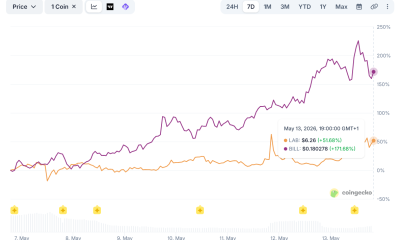
Two AI Tokens Lead May Rally, But Risks Are Rising
-
 Crypto World5 days ago
BeInCrypto 100 Institutional Awards Nomination: KAST for Best Digital Assets Neobank and Best Digital Assets Fintech
-

 Fashion4 days ago
On the Scene at Gucci’s Cruise Show in New York City: Mariah Carey, Kim Kardashian, Lindsay Lohan, Iman, and More!
-
 Crypto World5 days ago
Bitcoin Battles US Bond Nerves With BTC Price Dip Toward New May Lows
-
 Crypto World5 days ago
Wall Street’s Boldest Gold Prediction Has Russians Rushing to Buy
-

 Fashion4 days ago
Trending Western Style Vests Perfect for Summer
-

 Politics6 days ago
DWP PIP Timms review continues to be an absolute farce
-

 Entertainment5 days ago
David Letterman Returns to Late Show, Blasts Cancellation
-

 Crypto World5 days ago
ICE and CME urge US regulators to curb Hyperliquid energy trading
-

 Fashion3 days ago
Amazon Sundays: Memorial Day Hosting
-
 Crypto World6 days ago
Lido Finance Selects Chainlink CCIP as the Official Cross-Chain Infrastructure for wstETH Security
You must be logged in to post a comment Login