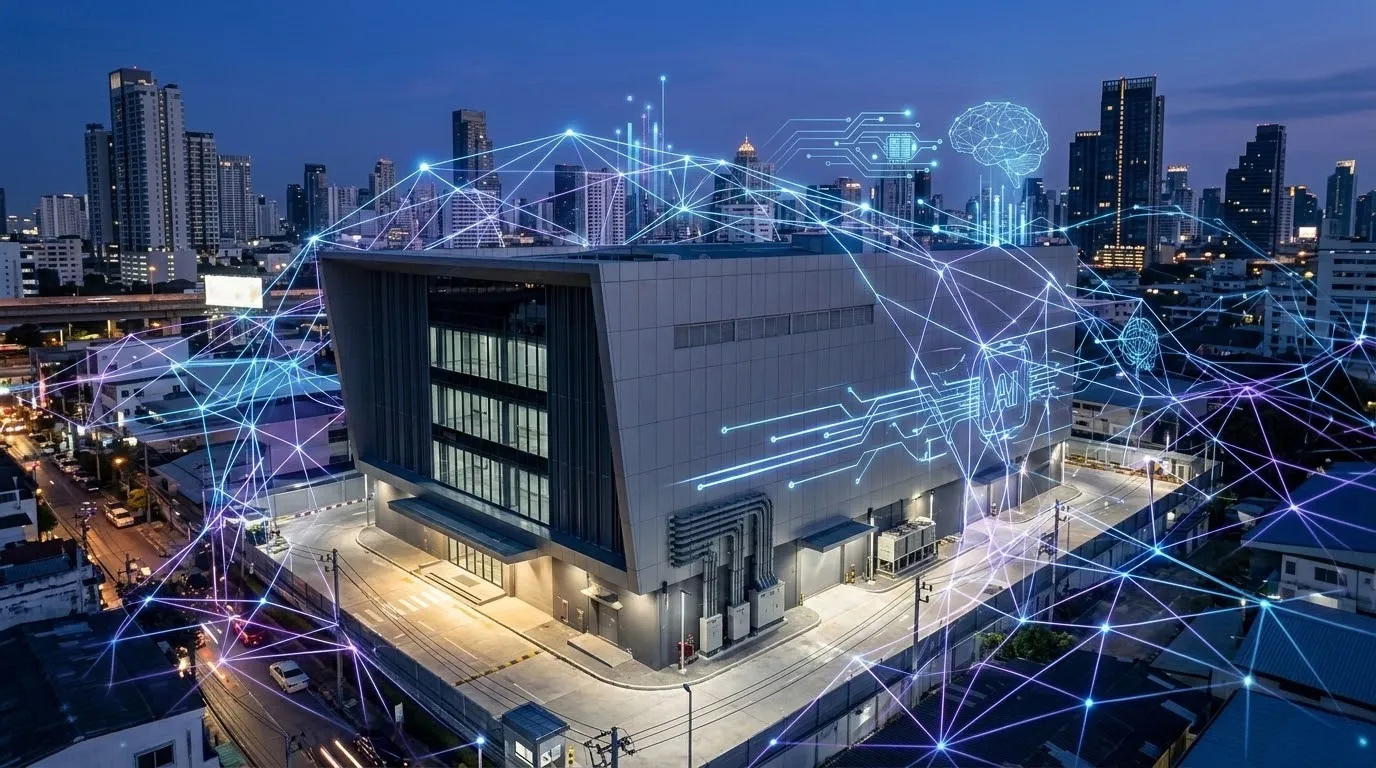
As the capital grapples with an unprecedented AI-driven digital expansion, the government faces a high-stakes reckoning—balancing the promise of a booming tech economy against severe environmental risks, power grid strains, and growing public outcry.
- Bangkok’s rapid data center expansion, driven by major investments, has exposed critical regulatory loopholes where industrial facilities were mistakenly approved as warehouses without adequate environmental oversight.
- In response to public safety concerns and environmental risks, the Thai government has suspended dozens of new projects and initiated comprehensive nationwide regulations covering electricity pricing, water use, and safety.
- Thailand remains committed to the technology sector while implementing strict reforms to balance resource demands, manage grid upgrades, and address public skepticism regarding local economic benefits.
The moment that exposed Thailand’s data center problem did not come from a government inspection. It came from a smell.
Stallholders working a market along Rama XI, one of Bangkok’s arterial roads, started noticing a nauseating oil odor drifting from a boxy structure covered in gunmetal grey panels that had gone up across from their stalls with almost no warning.
A nearby hospital sat close enough to raise its own alarms. When authorities finally looked, they found 200,000 liters of oil being stored on site without a permit. The facility, known as BKK01, was tied to a $1 billion investment from the Dubai-based conglomerate DAMAC, part of a plan to turn Thailand into a Southeast Asian hyperscale hub.
That single discovery cracked open something much larger. Bangkok currently hosts somewhere between 30 and 35 operating data centers, depending on which count you use, with dozens more under construction and well over a hundred additional projects awaiting approval nationwide.
Bloomberg has reported that Thailand has suspended 49 data center projects, more than the number currently in operation, while 117 more sit in a queue awaiting review.
The trigger for the freeze was almost identical to the DAMAC case: a facility built next to a hospital that exposed a basic loophole in Thai law. Data centers were being approved as warehouses.
The loophole that let it happen
That loophole is the real story here, more than any single facility. Under existing zoning and industrial rules, a data center does not have to be classified and regulated as a data center at all.
Digital Economy and Society Minister Chaichanok Chidchob has acknowledged that facilities went up in locations where they were never permitted. Bangkok Governor Chadchart Sittipunt has since ordered a halt to new permits and a review of both urban planning law and the environmental impact assessment process, conceding that the episode exposed a genuine regulatory gap.
When a facility can sidestep environmental review simply by calling itself a warehouse or an office, “regulation” becomes a formality rather than a safeguard, and it is exactly the kind of gap that lets a billion-dollar industrial facility land next to a hospital without anyone official noticing until the neighbors complain.
The resource math nobody checked
The numbers explain why nobody caught this sooner, and why it matters now that they have. Research from the energy outlet JustPow found that Bangkok’s data centers carry a projected electricity demand of at least 247 megawatts and an annual water consumption of roughly 4.4 million cubic meters, comparable to the usage of tens of thousands of households.
Separate reporting has tied one Bang Kapi facility to 429,000 liters of stored diesel, which opposition lawmaker Suphanat Minchaiynunt flagged as just under the threshold that would legally classify it as a fuel depot requiring stricter licensing.
Researchers have also pointed to a “data center heat island” effect, in which clusters of servers and cooling systems measurably raise surrounding temperatures. None of this is exotic. It is the standard resource profile of large-scale computing infrastructure. What is unusual is that so much of it landed inside one of Southeast Asia’s densest urban cores rather than on its outskirts.
Slowing down without pulling back
Thailand’s response so far has been to slow down without pulling back. Prime Minister Anutin Charnvirakul has ordered new nationwide data center rules within a month, covering electricity pricing, water use, siting and safety, and Deputy Prime Minister Ekniti Nitithanprapas is chairing a new supervisory commission tasked with closing the gaps that let this happen in the first place.
Electricity tariffs aimed specifically at large data center operators are reportedly on the table, along with tighter scrutiny of projects proposed in dense districts.
A separate 31 billion baht transmission grid upgrade is already underway, an acknowledgment that the existing grid was never built to support this kind of concentrated industrial load.
None of these measures amount to a retreat from the industry. They are an attempt to keep the investment flowing while giving regulators a legal basis to say no to the next BKK01 before it is built rather than after.
Not anti-AI, just anti-chaos
That balancing act reflects a public mood that is easy to misread. This is not a population turning against artificial intelligence. Survey data cited by the Thailand Development Research Institute found that Thai manufacturers themselves are split: nearly half believe data centers could meaningfully support domestic industry and help the country become a genuine regional hub, while a slightly larger share doubt that local businesses will see much direct benefit, pointing to the sector’s heavy reliance on imported equipment and foreign specialists. That is not rejection. It is skepticism about who actually profits, layered on top of legitimate anger that safety and environmental rules were treated as optional while the investment numbers climbed.
The window Thailand can’t afford to waste
Thailand has been explicit that it has no intention of walking away from this industry, and given how much of its recent industrial growth has been tied to data center investment from firms like Google, AWS and TikTok, that is a defensible position.
What is not defensible is the idea that the last two years of unchecked growth were simply the unavoidable cost of attracting that capital. Other jurisdictions dealing with the same boom, from Spain’s renewable-supply mandates to New York’s temporary construction freeze, have generally tried to write the rules before the concrete gets poured, not after a hospital’s neighbors start complaining about the smell. Thailand skipped that step once. The government now has a narrow window to prove that its promised reforms are a genuine fix rather than a paperwork exercise that legalizes what already got built and calls the problem solved.





















































You must be logged in to post a comment Login