
Business
AMD stock crosses $1 trillion market cap for first time


Advanced Micro Devices crossed $1 trillion in market capitalization for the first time on Monday, as its stock hit a record intraday high of $613.92 on the strength of a five-day rally tied to AI chip demand.
AMD stock climbed as much as 10% on the day, a move that places the chipmaker alongside Micron Technology, Broadcom, Taiwan Semiconductor Manufacturing Company, and Nvidia in the exclusive club of semiconductor companies carrying valuations at or above $1 trillion. There are 15 other publicly traded companies worldwide valued at that level, according to Bloomberg.
The five-session run has added about 24% to AMD stock, bringing its year-to-date gain to more than 180%. Even so, AMD remains well behind AI chip leader Nvidia, which carries a market cap of about $5.4 trillion.
The rally spread across the sector on Monday. Intel shares surged up to 12% and Arm Holdings jumped as much as 14%, with the Philadelphia Semiconductor Index advancing more than 4%.
Part of the renewed investor enthusiasm for chip stocks stems from the rise of Meta Platforms’ Muse AI Agent to the top of Apple’s App Store free applications chart following its launch earlier this month, according to Bloomberg. The product’s reception stoked demand for shares of companies supplying the processors needed to run agentic AI workloads. Meta stock rose more than 7% on Monday. Meta is AMD’s second-biggest customer, accounting for about 5.5% of its revenue, according to Bloomberg.
AMD’s AI-driven data center business has been the engine behind its recent growth. The company reported first-quarter revenue of $10.25 billion, up 38% year over year, with its data center segment generating $5.78 billion — a 57% increase from the prior year. AMD CEO Lisa Su said at the time that the data center unit had become the central engine of revenue and profit expansion.
Growth continued in the second quarter. Second-quarter revenue reached $11.54 billion, a 50% rise compared with the same period last year, while the Data Center segment accounted for $6.7 billion of that total, more than doubling its year-ago result. On last month’s earnings call, Lisa Su told investors the company is targeting a doubling of its data center revenue by 2027.
Meanwhile, the infrastructure spending wave driving chip demand continues to show little indication of losing momentum. Nvidia CEO Jensen Huang added to the bullish sentiment last week, forecasting that his company would ship twice as many chips in the coming year.


Airbus is increasing its workforce at Broughton in Flintshire by nearly 900, or 15 per cent, as it expands wing production to meet a backlog of nearly 5,500 orders for its A321 single-aisle jet.
The company is announcing today that it is taking on 430 workers in addition to the 6,000 already employed at the Broughton complex, its global hub for wing production. Airbus has confirmed that it expects to take on a similar number or more next year.
It will also put an extra £150m into the site to repurpose the West Factory, which was left empty in 2020 when Airbus stopped building wings for the double-decker A380 superjumbo. The building has been used as a warehouse since then.
Former A380 plant to build A321 wings
The West Factory will be retooled to build wings for the A321, the stretch version of the single-aisle family, which can carry 240 passengers.
In its XLR, or extra long range, version, the A321 can fly from the UK to the east coast of the United States and to the superhubs of the Gulf states. It is the aircraft most in demand with airlines, and Airbus has a backlog of nearly 5,500 of the planes to fulfil.
Jerome Blandin, head of Airbus Wing, said the repurposing of the old A380 production plant is “a fundamental part, the finishing touch” of plans for Airbus to make more than 1,000 aircraft a year before the end of the decade.
“This is the busiest Broughton will ever have been. We have been challenged to deliver more and faster,” Blandin said.
The site has faced pressure on its workforce before. Last year Unite members at the plant planned a 10-day walkout over pay, which Business Matters reported could disrupt Airbus assembly lines in Europe, China and the US because the plant makes wings for all its commercial aircraft.
Delivery targets
The hiring comes as Airbus tries to lift output that slowed during the pandemic and the supply chain dislocations that followed.
The company delivered 793 aircraft in 2025 and, as chief executive Guillaume Faury told its annual press conference, aims for around 870 commercial aircraft deliveries in 2026. That would only return it to about where it was before the pandemic, when it delivered 863 aircraft in 2019.
In the first eight months of this year Airbus delivered 475 aircraft. That means its final assembly lines, mainly in Toulouse in France, will have to average around 100 aircraft a month for the rest of the year to reach the target.
The expansion also widens the gap with its American rival, Boeing, which has a delivery target of 670 aircraft for the year.
Wider UK footprint
Broughton is one of several UK sites where Airbus designs and builds wings and fuselage components. According to Airbus, the site has received more than £2bn of investment over the past decade. The company’s UK presence is set to grow further after it agreed to take on around 3,000 staff in Belfast and Prestwick as part of Boeing’s deal for Spirit AeroSystems, which Business Matters reported would take its total UK headcount to about 14,000.

Jamie Young
Jamie Young is Senior Reporter at Business Matters, covering SME finance, employment law and Westminster policy since 2016. He has reported on every Budget and Autumn Statement since 2018, helped make sense of the ‘covid era’ and the bounce-back loan scheme from launch through the fraud investigations, and broke the magazine’s coverage of the 2024 late-payment reforms. He joined Business Matters straight from completing his BA in Administration from Exeter University and is NCTJ-qualified. Reach him at jyoung@cbmeg.co.uk

Federal Aviation Administrator Brian Bedford said Monday that officials discovered that a backup fiber cable was cut in New Jersey, leading to a ground stop at airports in Philadelphia, New York and New Jersey after a circuit failed.
An equipment outage has grounded planes at some major airports in New York, New Jersey and Pennsylvania on Monday, the Federal Aviation Administration (FAA) said.
“The FAA is pausing flights into Philadelphia International, Teterboro and Newark Liberty International airports due to issues with some frequencies at Philadelphia TRACON,” the FAA told Fox News in a statement earlier Monday.
Since the statement, John F. Kennedy International Airport, LaGuardia Airport and Westchester County Airport have also faced ground stops due to an equipment outage, according to the FAA website.
LAGUARDIA SHUTS DOWN RUNWAY FOR SECOND TIME IN WEEKS AFTER PAVEMENT ISSUE RESURFACES

Air traffic control tower at Philadelphia International Airport, the airport 6-year-old Casper left from while heading to Florida. (John Greim/Loop Images/Universal Images Group via Getty Images / Getty Images)
FAA Administrator Brian Bedford said Philly TRACON lost their primary circuit, and when they switched to the backups, they learned the fiber optic cable had a break.
Bedford said the TRACON may come back on at 1:30 p.m. ET if the new circuit is installed. The fiber optic cable, however, will take around 13 hours to fix.

An Airbus A320 plane, operated by JetBlue Airlines at Newark Liberty International Airport (EWK) in front of the skyline of lower Manhattan and One World Trade Center in New York City on Jan. 15, 2026 in Newark, New Jersey. (Al Drago/Getty Images / Getty Images)
Transportation Secretary Sean Duffy told reporters that “these are issues that, aren’t new to us.”
“We know these problems can happen. We know these cuts can happen,” Duffy said, adding that the department has been working to upgrade FAA equipment and its telecom architecture.
“As we work through all the new equipment, all the new architecture of our telecom, which is fans, it all takes money. That’s why we have a holistic view of everything, including how we rework our telecom,” Duffy said.

A United Airlines Airbus A320 passenger jet taxis on the tarmac at LaGuardia Airport in the New York City borough of Queens on Sept. 7, 2016. (Robert Alexander/Getty Images / Getty Images)
Duffy said the work is being done before the department has secured all the necessary money, adding that “when we get the cash” the department will be able to hasten progress.
GET FOX BUSINESS ON THE GO BY CLICKING HERE
“But this is not shocking,” Duffy said of the equipment outage.
Neither Bedford nor Duffy went into details on when the ground stops could be lifted, though the FAA website provided estimated times as early as 2:45 p.m. ET.
This is a developing story; check back for updates.

Olga Seifutdinova/iStock via Getty Images

By Emily Balsamo
Benchmark Grain and Oilseed futures have recorded strong price growth in recent weeks driven by escalating geopolitical conflicts, adverse weather in key growing regions, and tighter-than-expected supply forecasts. While agricultural commodity prices typically peak during the summer months as old-crop inventories draw down ahead of the autumn harvest, price movement this late summer and early fall has been further amplified by exogenous market shocks.
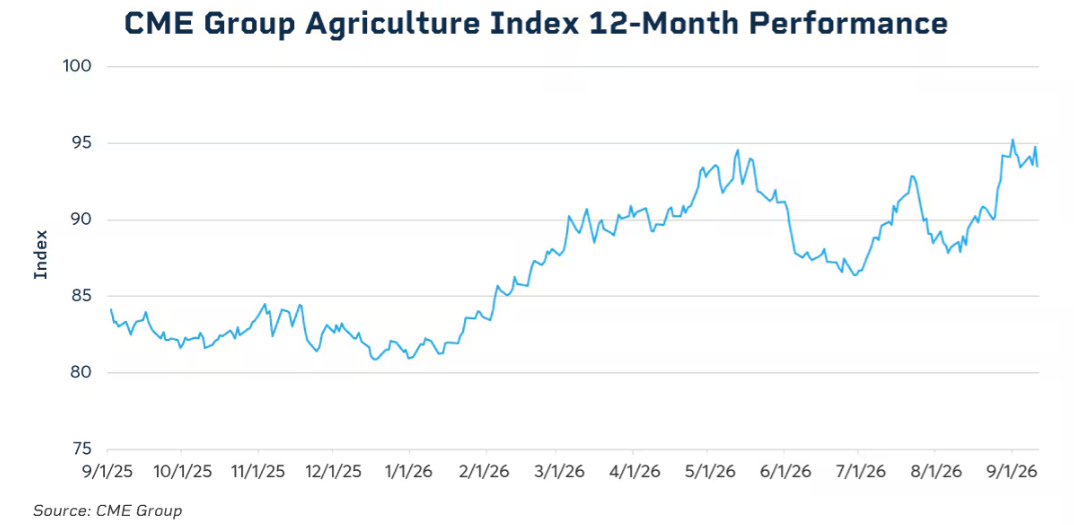
Within the CME Group Agriculture Index, a broad-based, volume-weighted benchmark designed to track the aggregate performance of the global agricultural complex, grains and oilseed constituents have taken the lead on growth. Since the beginning of August, both Corn and Oat futures have each posted a greater than 12% return as of mid-September, followed by Kansas City Wheat, Rough Rice, Soybeans and Soybean Meal, each increasing more than 8% in continuous futures prices.
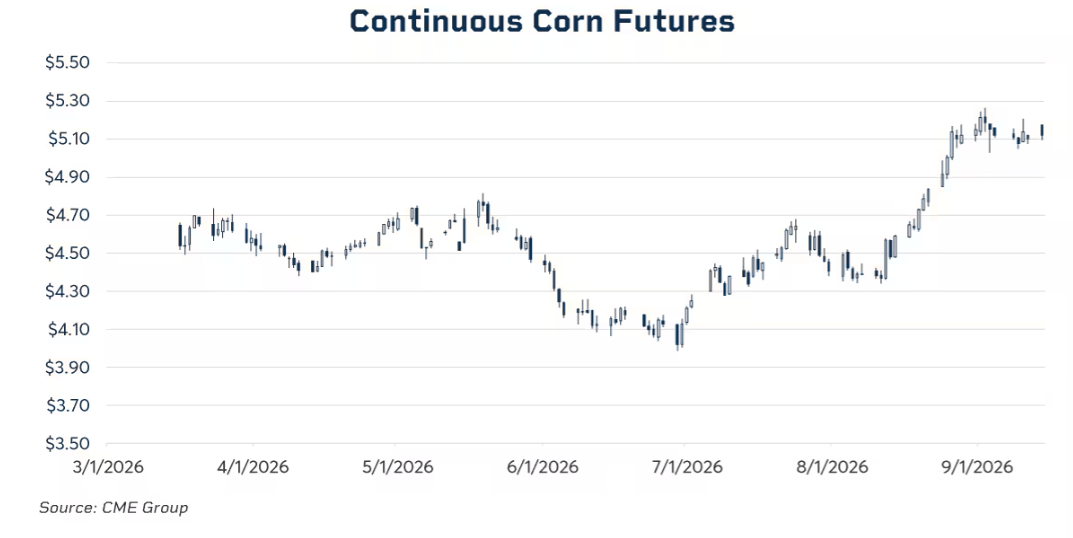
Corn and Soybeans Face Cost Pressures and Tighter WASDE Stocks
U.S. corn and soybean producers reported strong margin pressure during late summer, with regional farmers describing the situation as the most acute operational crisis, for many, in decades. The ongoing conflict with Iran drove global energy costs higher, pushing regional agricultural diesel prices up by more than 40% alongside elevated fertilizer expenses. Despite these cost headwinds and broader trade friction, U.S. corn exports have remained steady at an estimated 20% of total annual production, bolstered by strong domestic ethanol demand.
The U.S. Department of Agriculture (USDA) Crop Progress report in September indicated that corn maturity fell slightly below five-year historical averages, with 56% of the national crop rated in good-to-excellent condition. The latest USDA World Agricultural Supply and Demand Estimates (WASDE) reports, however, have provided a bullish catalyst. In August, the USDA revised its national corn yield estimate downward to 180.7 bushels per acre and reduced projected domestic ending stocks, both coming in below average trade expectations.
In response, continuous Corn futures broke above the $5.00 per bushel threshold during the monthly rally. The September 11, 2026, WASDE report further decreased corn yield estimates, this time to 178.5 bushels per acre, meeting expectations at release. Corn ending stocks were correspondingly reduced, sustaining high prices.
The soybean market similarly overcame early-season pressure ahead of the impending autumn harvest. While the August WASDE trimmed the national soybean yield forecast to 52.7 bushels per acre, an expanded harvested area calculation modestly increased projected domestic ending stocks. Continuous Soybean futures, nevertheless, advanced over 9.5% in the month of August, sustained by solid domestic crush margins and resilient international purchases. Soybean ending stocks were further reduced on the September WASDE, reinforcing August pricing.
Within the Soybean futures complex, Soybean Oil futures sustained early-summer gains despite mid-month volatility triggered by potential Environmental Protection Agency (EPA) Small Refinery Exemptions under the Renewable Fuel Standard, which threatened to dampen domestic biofuel feedstock demand. Robust industrial demand and elevated crushing activity ultimately offset regulatory concerns. Meanwhile, Soybean Meal futures rose on the back of strong export commitments and steady domestic livestock feed consumption.
War Disruptions and Climate Volatility Drive Wheat, Oats and Rice
While corn and soybean markets reacted to Middle Eastern geopolitical developments, wheat markets experienced sharp upward pressure due to escalating disruptions in the Black Sea region. War-related damages to port infrastructure reduced year-over-year agricultural exports from Ukraine and Russia by 75% and 50%, respectively. Continuous Chicago Soft Red Winter Wheat futures, widely seen as a stand-in for global winter wheat, jumped significantly.
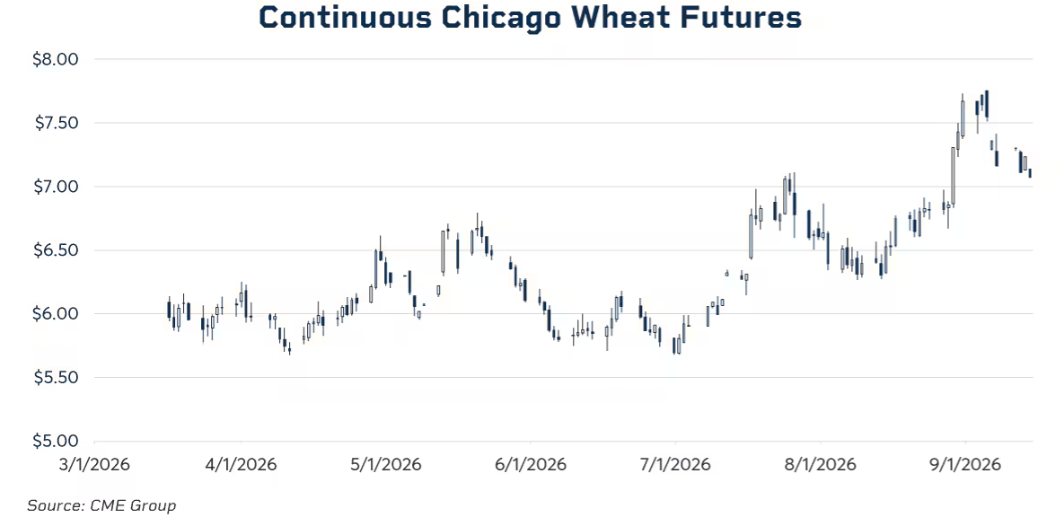
Global wheat supply tightness was further exacerbated by climatic factors. El Niño conditions have impaired international yields, while lingering midwestern drought conditions resulted in lower-than-expected U.S. production of both soft and hard red winter wheats.
Rough Rice futures climbed this quarter to hit an 18-month high. Price gains were bolstered by low domestic production, while uncertainties in India – where erratic monsoon precipitation prompted market participants to price in yield risk premiums for the 2026/27 crop year – added further support.
Oat futures have risen on sentiment that shifted sharply during the second half of August following reported reduced oat seeded acreage, combined with localized cool, wet weather that delayed Western Canadian harvest operations.
Looking Ahead
While oats and winter wheat have already completed their annual harvests, corn and soybeans have crops yet to reap as of early September and are thus still vulnerable to weather-based supply disruption. Though the preponderance of weather variability has passed this crop year, geopolitical volatility may prove the new normal as market attention turns to stocks and demand over the winter.
Editor’s Note: The summary bullets for this article were chosen by Seeking Alpha editors.


CAMDEN, NJ. — Pepperidge Farm, a Campbell’s Co. brand, is debuting Goldfish crackers with 6 grams of protein per serving.
The crackers are baked and formulated with cheese Pepperidge Farm said. They come in two flavors: cheddar and pizza.
“Protein has become a bigger priority for many families, whether it’s after school, between activities or on the go,” said Tiphanie Maronta, senior vice president of Goldfish Crackers. “Goldfish made with 6g of protein is our way of meeting that need with a snack that’s both delicious and familiar, combining the iconic Goldfish experience people love, now with 6g of protein in a way that fits seamlessly into families’ everyday routines.”
Protein-filled Goldfish will launch at Walmart and other grocery store chains in October before expanding to US retailers in early 2027 for a suggested retail price of $3.99 per 6.6-oz bag.
Business
Warren Buffett Says Bear Markets Are an “Investor’s Best Friend.” Decades of History Prove He’s 100% Right.

The September effect appears to be in full swing, as major market indexes have struggled during this historically slow month.
The S&P 500 (SNPINDEX: ^GSPC), Dow Jones Industrial Average (DJINDICES: ^DJI), and Nasdaq Composite (NASDAQINDEX: ^IXIC) have fallen by 1%, 3%, and 0.3%, respectively, over the last two weeks, as of this writing. A rate hike from the Federal Reserve, stubbornly high oil prices, and AI concerns have put pressure on stocks, and a rattled bond market has renewed recession fears.
Missed AI’s “Act 1”? Act 2 Could Be 15x Bigger. Most investors think they missed the AI boat because they didn’t buy Nvidia in 2005. But according to our analysts, we’re only at the end of “Act 1″—the R&D phase. “Act 2” is the global rollout. Continue »
While all of these headwinds don’t necessarily mean a bear market is around the corner, it never hurts to prepare. And according to Warren Buffett, an upcoming downturn could be a lucrative opportunity for smart investors.

Bad news makes for smart buying opportunities
In 2008, Buffett wrote an opinion piece for The New York Times. The U.S. was about a year into the Great Recession at the time, and many investors were deeply discouraged. However, Buffett reassured investors that all recessions are temporary and that the good periods outlast the bad.
He added that the best buying opportunities arise during market downturns, when stocks are far more affordable.
“[I]n the early 1980s, the time to buy stocks was when inflation raged and the economy was in the tank,” he noted. “In short, bad news is an investor’s best friend. It lets you buy a slice of America’s future at a marked-down price.”
The most lucrative strategy, according to history
Bear markets are daunting, but decades of history prove that “buying the dip” can set you up for lucrative long-term returns.
When Buffett offered this advice in October 2008, the S&P 500 had plunged by nearly 40% over the past year, and it still had more to fall before bottoming out in 2009. Yet if you’d invested in an S&P 500 ETF in 2008, you’d have earned total returns of more than 1,000% by today.

On the other hand, say you’d decided to sit out of investing until, say, March 2013 — when the S&P 500 officially reached a new all-time high and entered a bull market.
At the time, that may have felt like a much safer time to invest. The recession was over, stocks were steadily climbing, and the market had plenty of potential still ahead. Yet by today, you’d have only earned total returns of around 518%.

BOSTON — Hormel Foods Corp.’s Foodservice business unit accounts for approximately one-third of company-wide sales and half of its profits. The ascension of the business unit within the organization reflects the pressures foodservice operators are under to better manage costs and streamline operations.
“I think if you step back and look at our Foodservice performance over time, we have proven the business model we have to be very unique and durable to grow even in down markets when industry challenges persist,” said John Ghingo, president of the company, during a Sept. 9 presentation at the Barclays Global Consumer Staples Conference.
During the third quarter of fiscal 2026, ended July 26, Hormel’s Foodservice business segment profit rose 3% to $144.5 million from $141 million the year before. Quarterly sales rose 2% to $1 billion from $987 million the year before.
Ghingo identified three attributes of the business unit he sees fueling additional growth.
“One is our value-added portfolio and the innovation we continue to bring to that portfolio,” he said. “We need to continue to create more value.”
Second is the company’s direct sales team that works with operators to communicate the strengths of the Foodservice unit to operators.
“Our direct sales force is truly a unique engine of culture, talent, capability, and the work they do with our operator partners is critical,” Ghingo said. “They’re gathering insights. They’re building relationships. They’re being creative and solving problems in the kitchen with the operator partners and then bringing back solutions.
“And, so, when you’re doing that even in a challenged environment, you can grow the top line because those operators will gravitate to the partner who’s solving the problems they’re dealing with.”

Hormel Foods’ Flash 180 chicken platform is an example of how the Foodservice business unit is serving its customers.
| Photo: ©EXQUISINE – STOCK.ADOBE.COMFinally, Ghingo said Hormel’s diversified foodservice customer base is an opportunity for the company.
“So, whether you’re talking commercial, noncommercial, independence chains, geographic diversity, channel diversity,” he said. “So, that gives us the opportunity to play different channels where we see pockets of growth and pockets of opportunity to keep the growth engine going.”
An effective foodservice solution identified by Ghingo is Hormel’s Flash 180 chicken platform.
“If you look at the demand space in foodservice around breaded chicken, it’s one of the fastest-growing areas,” he said. “Consumers, diners want more breaded chicken, whether it be chicken tenders, whether it be fried chicken sandwiches, but if you’re an operator … (and) you want to sell more chicken, it gets difficult.
“You’re bringing raw chicken (and) it takes time; you have to handle it; you have to batter/bread in the fryer, 10 to 12 minutes. So, we’re bringing through our Flash 180 chicken platform. One-hundred and eighty seconds from package to plate, pre-prepped. So, it’s super simple to execute (that) saves time …. So, that’s an example of a solution.”

FAA halts flights to Philadelphia and Newark airports

Paramount Skydance and Warner Bros. Stock Pop on Antitrust Settlement

For business leaders, stagnant growth can be frustrating, but it can also provide an opportunity to reassess the organisation and identify what needs to change. The challenge is recognising the underlying cause rather than simply responding to the most visible symptoms. Read on to learn more.
When a Successful Strategy Stops Working
One common reason for stagnation is market saturation. A product or service that once had substantial room to grow may eventually reach a point where most of its readily available customers have already been reached. Continuing to invest in the same channels and audiences can then produce diminishing returns.
Businesses facing this situation may need to consider new customer segments, markets, products, or services. This does not necessarily mean abandoning the core business. Instead, leaders can examine where their existing capabilities could create value elsewhere.
External expertise can also provide a fresh perspective when established assumptions become difficult to challenge internally. Cognosis is one of the leading consulting firms in London, specialising in growth strategy and helping organisations identify opportunities, develop business strategies, and translate those strategies into action.
Losing Sight of the Customer
Customer expectations rarely remain static. New technologies, competitors, and changing buying habits can gradually alter what customers value. A business can continue delivering a high-quality product while still losing relevance if the market has moved in another direction. Regular customer research, competitor analysis, and feedback can help leaders identify these shifts before they become serious barriers to growth.
Companies should also examine their value proposition. Customers need a convincing reason to choose one business over another, particularly in crowded markets. If that distinction has become unclear, refining the proposition may help restore momentum.
Internal Structures Can Restrict Progress
Sometimes the obstacle is inside the organisation. Processes and structures designed for a smaller company may become inefficient as the business expands. Decision-making can slow, responsibilities may become unclear, and teams can become focused on their own objectives rather than wider strategic priorities. Businesses may also accumulate too many initiatives, spreading resources across projects that make little contribution to long-term growth.
Reviewing the operating model can reveal whether people, processes, technology, and investment remain aligned with the company’s ambitions. Simplifying priorities can be particularly valuable when employees are being pulled in too many directions.
Strategy Without Execution
A strong strategy achieves little if it cannot be implemented effectively. Leadership teams may have ambitious growth targets without establishing clear responsibilities, measurable objectives, or adequate resources. Breaking strategic goals into practical actions can help close this gap. Each priority should have clear ownership, realistic timescales, and measures of progress. Regular reviews can then identify problems early and allow the business to adapt.
Turning Stagnation Into an Opportunity
Stagnant growth does not automatically indicate that a business model has failed. It can signal that the conditions which supported earlier success have changed. The businesses most capable of restoring momentum are often those willing to question previous assumptions.
By taking the above points into consideration, leaders can use a period of stagnation as a prompt for renewal and create stronger foundations for sustainable growth.

KANSAS CITY — School meal and snack programs ensure students from kindergarten through 12th grade are served nourishing foods that support lifelong healthy eating patterns. In the United States, these programs rely on food and beverage manufacturers to allow them to meet the nutritional requirements set forth by the US Department of Agriculture (USDA), and at the same time, ensure they are affordable, simple to serve and delicious to eat. This is no easy feat, especially with nutritional requirements evolving and many unknowns still out there.
“Every day, school meal programs are juggling financial, staffing and equipment challenges while trying to meet strict federal nutrition standards and the taste preferences of their students,” said Diane Pratt-Heavner, spokesperson for the School Nutrition Association (SNA). “In addition to following whole grain requirements, they must also meet limits on calories, sodium and now added sugar.”
Since July 2025, US schools have had to adhere to limits on added sugars in cereal, milk and yogurt. Starting in July 2027, they will have to ensure that less than 10% of calories in meals comes from added sugar. New sodium reductions will also take effect at that time.
“With many programs struggling to keep their kitchens fully staffed, schools rely on their K-12 industry partners to offer a variety of menu options that meet these federal standards,” Pratt-Heavner said. “This year, schools will be seeking new whole grain breakfast options that are lower in sugar and sodium, including packaged options that are ideal for grab-and-go or breakfast in the classroom programs. Several states have also passed legislation restricting artificial dyes and additives in school foods, so schools are also looking for products that don’t contain ingredients of concern.”
Addressing the unknowns
The USDA will soon release proposed regulations to align current school nutrition standards with the recently updated Dietary Guidelines for Americans (DGA). It’s a development school lunch program operators are keeping an eye on.
“The new DGAs put an increased emphasis on protein, which could translate to a daily meat or meat alternate requirement for school breakfast,” Pratt-Heavner said. “We’ll have to see how USDA proposes to change the breakfast meal pattern and if they modify breakfast grain requirements.”
Moreover, the USDA may choose to further restrict added sugar limits, establish limits on highly processed foods in schools or restrict ingredients of concern, she said. USDA has also indicated changes are being considered in the Smart Snacks in Schools rules.
Another unknown for bakers surfaced on July 14 when USDA posted an online pledge asking states to engage in “making school meals healthier,” which included a call for 100% whole grain items.
“This pledge was not accompanied with more specific details, so it’s unclear how state-level school foodservice leaders may be considering it,” said Tricia Psota, partner, Nutrition In Demand, a strategic consulting group focused on science-based nutrition. “Currently, most grains offered with a school meal are required to be whole grain-rich, which means that items, such as bread for a sandwich, need to be made with at least 50% whole grains and the remaining grains are required to be enriched.”
If USDA shifts to require that all school foods must be 100% whole grain, school foodservice operators will be challenged with identifying products that meet the requirement, while also addressing budgetary goals and children’s taste preferences. Bakers need to get busy now.

Further restrictions on added sugar and sodium in school meals will be implemented in 2027.
| Photo: ©NEW AFRICA – STOCK.ADOBE.COM“Whole grains remain a policy and public health priority, but in practice, schools need products students will actually eat,” said Sasha Chamberlain, owner, Chamberlain Nutrition Consulting, a public health and nutrition policy consultancy.
The most important baked foods to focus on are the high-volume staples schools serve repeatedly. This includes breads and buns, pizza crusts, tortillas and wraps, and breakfast items, such as muffins, waffles and cereals.
“Bakers can help by developing products that are familiar in taste and texture, operationally easy, clearly documented for school meal crediting and cost-conscious,” Chamberlain said. “In this market, the best formulation is the one schools can actually serve successfully at scale.”
Reformulation provides a first start
After great taste, familiarity is often the key to successful better-for-you foods for students. Kids don’t eat Nutrition Facts panels. They eat food. The bakers who succeed will be the ones who deliver products that are both nutritionally compliant and enjoyable to eat.
“If the bun is soft, the muffin is moist and the cookie still tastes like a cookie, you’ve already won half the game,” said Thom King, chief innovations officer, Icon Foods. “The biggest opportunity isn’t reinventing these products. It’s making them better through smarter formulation.”
There is no one-for-one ingredient replacement. Reformulation requires a systems approach.
“Successful reformulation starts with understanding the role each ingredient plays beyond nutrition,” said Kaitlin Prindle, bakery application scientist, ADM. “Sugar contributes sweetness, but it also provides bulk, moisture retention and browning. Salt delivers flavor while also influencing dough performance and shelf life.”
Replacing these ingredients often requires multiple complementary solutions.
“Successful reformulation for school meal applications requires bakers to think beyond simply removing sodium or sugar or swapping in whole grains,” said Erin Surratt, senior director, research, development and applications, Corbion. “These ingredients play important functional roles in baked goods, impacting everything from flavor and texture to dough handling, freshness and microbial stability.”
Taste is paramount. When lowering sodium content, it is often necessary to include flavor modulators. And, because salt is a natural preservative, shelf life extenders may be necessary.
“For sodium reduction, bakers may look at specialty salt technologies, salt-potassium blends, fermentation-based flavor development, yeast-derived flavors, acids, herbs, spices and other flavor-building ingredients,” said Alexander Blissenbach, senior scientist, bakery applications, Cargill. “The goal is to lower sodium while preserving the perception of a balanced, flavorful product.”
Extending the shelf life
Reformulation requires bakers to revisit product quality throughout desired shelf life. It’s all about managing moisture and texture.
“Water activity directly influences microbial stability, softness, shelf life and texture,” King said. “Polyols can help manage free water while preserving moisture and softness, making them useful for extending freshness and improving eating quality. Fibers add another layer of functionality by contributing bulk, water binding, structure and moisture retention.”
Bakers need to design products for freezing, thawing, distribution and cafeteria holding. Communicating handling requirements is important.
“Bakers must also account for the operational realities of school foodservice,” Surratt said. “Products often move through extended distribution networks and may be exposed to varying storage conditions.”
Other challenges include process difficulties related to machinability and dough rheology and ensuring a consistent product that maintains a long enough shelf life. That’s because whole grain baked foods tend to be more susceptible to faster spoilage.
“Bakers can help to improve their shelf life by using natural mold inhibitors to prevent mold and anti-staling enzymes to prevent the onset of staling,” said Sherrill Cropper, new product development lab manager, bakery formulator, Lesaffre. “This can help to reduce product waste and improve the sensory attributes of the final product.”
Natural mold inhibitors can be used to replace chemical-sounding ingredients such as calcium propionate. This helps clean up labels.
“Lesaffre has a variety of natural mold inhibitors based on wheat flour or wheat starch with and without citric acid,” Cropper said. “In addition, enzymes can also be used to help with improving nutrition as certain enzymes can be added to cut down starch into simple sugars, which can help reduce the amount of added sugars needed in the formulation.”
Lesaffre provides a number of anti-staling enzyme options to meet a variety of shelf life needs, including up to 21 days or more. Enzymes are considered a label-friendly option for preventing mold growth and staling.
“These anti-staling improvers can also enhance the texture of baked goods by providing softness, resilience or even moistness to the crumb,” Cropper said. “They are used at a low dosage, which can lower the bowl costs compared to conventional softening emulsifiers.”
Improving nutrition, ensuring consumption
Reformulating to meet nutritional goals and state regulations is mandatory. Some bakers may choose to add extra nutrition to stand out in the market. Others may invest in premium ingredients to ensure consumption.
“Nutrition only creates value when it’s actually eaten,” said Jessica Wellnitz, director of business development for emerging brands, Bay State Milling. “If students bypass foods because of flavor or texture, the intended nutritional benefits are never realized. For bakers, small nutritional improvements, like increasing fiber across high-volume products served every day can have a meaningful impact on children’s diets.”
An emerging opportunity is the use of high-fiber wheat flour, which can be incorporated into whole grain-rich products to significantly increase fiber content while maintaining the familiar sensory characteristics of conventional whole wheat formulations.
“Our non-GMO variety has high levels of naturally occurring resistant starch,” Wellnitz said. “It’s available in refined and whole wheat formats, giving formulators additional flexibility depending on the application.”

Innovations in whole wheat flour are making whole grain baked foods more palatable for children.
| Photo: ©FOTOFABRIKA – STOCK.ADOBE.COMCompared with traditional whole wheat flour, these ingredients can provide more than twice the dietary fiber. That figure jumps to 10 times the fiber content when compared to traditional white flour.
“Whole wheat ingredient innovation allows bakers to increase whole grain content while maintaining the eating experience students are familiar with,” said Lauren Lahn, senior research and development manager, Ardent Mills.
Ardent Mills offers several whole wheat options tailored to different applications. Their grains have a finer particle size, which helps create a softer texture and appearance that is more similar to products made with refined flour.
“From a formulation standpoint, bakers can generally begin with a one-to-one replacement for traditional whole wheat flour,” Lahn said. “In many applications, up to 30% of white flour can be replaced with minimal adjustments. At higher inclusion levels, additional water may be needed to support hydration and dough performance.”
White whole wheat flour is another option. It has become a leading whole grain for school bakery applications, and it improves nutrition while maintaining student acceptance.
“Bakers may also consider finely milled whole grain flours, enzyme systems, emulsifiers and starch-based texture solutions to support softness, volume and eating quality while helping reduce graininess,” Blissenbach said. “Whole grain-rich formulations can affect color, volume, softness and flavor. Added sugar reduction can affect sweetness, browning, moisture and shelf life. Sodium reduction can change flavor perception.”
Bakers need to account for ingredient interactions while keeping products practical for school kitchens and appealing to students.
“Incorporating alternative and ancient grains, such as sorghum, barley, quinoa, millet and flax, can further elevate nutritional value while supporting whole grain goals,” said Kaitlin Prindle, bakery application scientist, ADM. “Beans, pulses, soy and pea protein also present opportunities to boost nutrition in products like muffins, waffles, pancakes and snack bars.”
Beneo offers whole grain beta-glucan-rich barley flour. It contains about 10 times the total fiber of traditional white flour and is high in protein.
“Its industry-leading content of beta-glucan and other soluble fiber supports the FDA-approved heart health claims, such as those found on oatmeal and whole grain snacks, at a very cost-effective level in baked goods,” said Kyle Krause, product manager, functional fibers and carbohydrates, Beneo. “This nutrient-dense, fiber-diverse, whole grain flour is perfect for children’s school nutrition, which can easily be incorporated into bread, bagels, muffins, cereals and other baked goods.”
Bakers who are suppliers to the K-12 school meal programs have many challenges ahead of them. Products must not only meet nutritional standards, but they also must offer enough menu value, student appeal and operational functionality to fit the school environment.

RSV Vaccines Are Highly Effective in Older Adults

Halle Berry, Alix Earle, Cardi B, and More Celebs Step Out for Create & Cultivate 2026

Meet Shaina Rainford, the Founder Behind Bask & Lather Co., the Haircare Brand Championing Healthy Hair From the Scalp Up

Weekend Open Thread – Corporette.com

Weekend Open Thread: Talbots – Corporette.com

Memory prices are slowing because buyers ran out of money

Is Your XRP Ready for the AI Takeover? The Truth About Ripple’s New Protocol

Send this to ur homies#shorts#bmw#Invisibleman#money

Crypto Live Trading | btc live trading | 20 Sept | gold live trading #cryptolive #btclive #goldlive
-
 Fashion3 days ago
Weekend Open Thread: Talbots – Corporette.com
-

 Tech19 hours ago
Researchers escape OpenAI Codex sandbox to run commands on host
-

 Crypto World7 days ago
Revolut Attackers Warn of Ongoing Daily Customer Data Leaks
-

 Crypto World3 days ago
Circle launches Arc Studio AI agent for building onchain apps
-
 NewsBeat3 days ago
Trump says US has reached an agreement to take permanent control of Greenland’s security
-

 Crypto World7 days ago
Kraken Lets xStocks Holders Earn Yield Through DeFi
-

 Crypto World6 days ago
Robinhood engineers charged over $50K crypto scheme
-

 Crypto World3 days ago
Bitcoin price breaks channel as RSI climbs to 63
-

 Crypto World5 days ago
US Charges Robinhood Engineers Over Crypto Listing Trades
-

 Crypto World6 days ago
What Is the Status of the U.S.-Iran Peace Talks? Here's What Both Sides Are Saying
-

 Crypto World6 days ago
NVIDIA Analysis: Attempted Rising Wedge Breakout Amid Pressure on the AI Sector
-

 Tech6 days ago
Webb’s IC 348 Mosaic Includes Two-Jupiter Dwarfs, Twin Jets, and a Nursery Still Making Worlds
-

 Crypto World3 days ago
World Money launches in 150+ countries with Stripe
-

 Crypto World18 hours ago
Who Needs CLARITY Anyway? ARB Could See 70X Increase: Hodler’s Digest
-

 Crypto World7 days ago
Kraken Adds DeFi Yield on Tokenized Stocks and ETF Assets
-

 Crypto World3 days ago
Silver prices recover quickly, hitting weekly high today
-
Crypto World7 days ago
Can Circle’s Arc Repeat Robinhood Chain’s Meme Coin Boom?
-

 Entertainment6 days ago
Big Brother Update: Melody Explodes at Drew as Illness Sweeps BB28 House
-

 Crypto World3 days ago
Trading Bitcoin on Robinhood? Why 2% Spread Has Traders Worried
-
 NewsBeat3 days ago
US was ‘on brink of war’ with China over false AI report of nukes moving in Middle East
You must be logged in to post a comment Login