

Connect with us

Business

American Airlines redesigns Boeing planes in premium push

Published

on

American Airlines redesigns Boeing planes in premium push

American Airlines seat in its Flagship Suite.

Courtesy: American Airlines

American Airlines is expanding its push into premium travel on its largest planes.

Advertisement

The carrier on Wednesday launched its first retrofitted Boeing 777-300ER, which it uses for its most popular long-haul international flights, including routes to London, Tokyo and Sydney.

The new layout on the wide-body plane features 144 premium seats, including 70 lie-flat seats with sliding doors in its Flagship Suite section at the front of the plane.

American said in 2022 that it planned to get rid of its international first class on many of its planes in favor of the single, larger premium cabin at the front of the plane. It started flying the suites last year after facing delays from suppliers.

The lie-flat seats can bring in close to $10,000 on some long-haul international routes compared with $2,000 or much less for a seat in the back.

Advertisement

There’s also a Premium Economy section, with 44 seats that have privacy headrest wings and adjustable calf and footrests, as well as 30 Main Cabin Extra seats with additional legroom.

There are 186 regular seats in updated plane’s Main Cabin.

American said its full fleet of 20 Boeing 777-300ER aircraft will be retrofitted by next year. The carrier will have a similar but smaller layout on its Airbus A321XLRs.

American Airlines retrofitted Boeing 777-300ER Premium Economy section.

Advertisement

Courtesy: American Airline

The airline has been trying to catch up to its rivals Delta Air Lines and United Airlines, which have a head start on catering to high-spending travelers. The airline’s new suites are a key part of that strategy.

American has also been working to grow its loyalty program, improve its on-time rate and expand its network. Last week, the airline announced it will add seven international routes to its 2027 schedule, though none of those are on the Boeing 777-300ERs.

Choose CNBC as your preferred source on Google and never miss a moment from the most trusted name in business news.
Advertisement
Continue Reading
Click to comment

You must be logged in to post a comment Login

Leave a Reply

Business

Balancing workplace safety and everyday convenience through digital access control

Published

on

London’s transport strikes have driven a surge in demand for flexible offices, with workers increasingly choosing to base themselves closer to home rather than commute into the city centre or remain entirely remote.

Businesses now face the challenge of allowing smooth day-to-day movement while guaranteeing strong safeguards for people, data, and assets. Digital solutions promise to reconcile these needs, offering flexibility and control as organisations adapt to changing ways of working.

Many workplaces no longer follow traditional routines, as hybrid models and shared spaces become common. In this landscape, access control from securitastechnology is much more than a means of keeping doors locked or open; it forms the backbone of workplace safety, business efficiency, and compliance expectations. Organisations are now striving to maintain seamless daily operations while meeting stricter legal, health, and privacy demands. A smarter approach to managing digital access underpins the balance between ease and risk amid changes in how and where work happens.

Why workplace access is now a core issue

Your workplace reality may include flexible scheduling, contract staff, deliveries, and visitors passing through various zones. These patterns mean that controlling movement has become a matter of day-to-day business management, not just traditional security. As entry points multiply and shift, the complexity of managing who is allowed where and when increases sharply.

This operational complexity leaves businesses with greater risk exposure to unwanted access or safety incidents. At the same time, organisational leaders must prevent bottlenecks that frustrate workers or slow down business. Striking a functional balance between open movement and protection is now a central operational concern for many workplaces.

Advertisement

The trade-off between convenience and control

Modern businesses must give employees and visitors a frictionless experience while still safeguarding sensitive areas and assets. Access must feel natural while remaining robust against unauthorised attempts or lapses that could expose sensitive systems or threaten health and safety. This requires systems that streamline entry but do not compromise security standards, especially where regulation is a factor.

Efforts to simplify everyday movement must be weighed carefully against the risk profile of different sites or zones. Organisations rely on tools that support business productivity yet offer administrators granular control and real-time oversight. A poorly calibrated system can frustrate users or, worse, create vulnerabilities in critical operations.

Modern digital solutions and everyday practices

Digital access control typically replaces old-fashioned keys with a suite of credential types, including smart cards, mobile passes, and, in some cases, biometric verification or secure PINs. These systems allow you to assign entry permissions based on staff roles or visitor type, ensuring only the right individuals can enter sensitive zones. Robust digital solutions often integrate with visitor management software, linking real-time presence and permissions.

Practical strategies such as limiting access to certain hours or requiring dual authorisation for restricted areas help reduce the risk of both accidental and intentional breaches. As organisations consider options, integration and adaptability become priorities; flexible solutions seek to provide both oversight and convenience within a single platform. Well-implemented digital controls help align safety with the practical needs of daily business.

Advertisement

Supporting compliance, culture and operational efficiency

Strong digital access control contributes to compliance by generating clear audit trails for who entered where and when without unnecessary intrusion into employee privacy. These electronic records aid internal investigations, demonstrate adherence to health and safety processes, and support audits in heavily regulated sectors. Administrators must design systems that deliver transparency but respect personal data protections, as outlined by widely recognised industry standards.

Operationally, streamlined onboarding and leaver management reduce administrative delays and cut the risk of errors when permissions are updated. Clear, understandable access policies also foster trust and efficiency, helping workers familiarise themselves with routines and exceptions such as lost badges or urgent changes. Businesses benefit from smoother contractor supervision and fewer interruptions due to credential failures when controls are thoughtfully implemented.

Advertisement
Continue Reading

Business

Durham property group snaps up 35-acre business park in multimillion-pound deal

Published

on

Business Live

Tursdale has all the ingredients of a highly successful modern industrial estate and what it needs now is investment

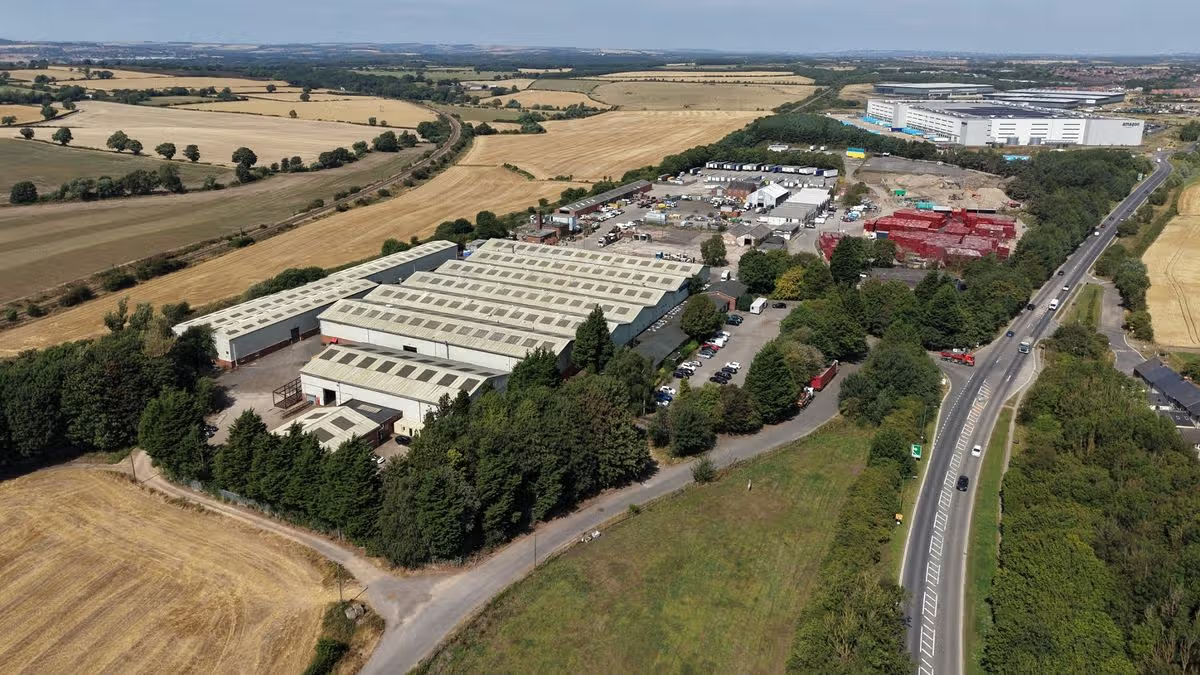
Drone image of Tursdale Business Park, recently acquired by Ward Group Investments.

Drone image of Tursdale Business Park, recently acquired by Ward Group Investments.(Image: Ward Group, Investments.)

A growing property investment company has snapped up a County Durham business park in a multimillion-pound deal. Ward Group Investments (WGI) is set to put a huge programme of investment into action after acquiring the 35-acre Tursdale Business Park near Durham, with plans to upgrade the site, boost its commercial offer and improve estate management.

Set just off the A1 at Tursdale, five miles south of Durham city, the industrial estate is home to 35 tenants. It has a diverse mix of workshops, factory units, high-bay warehouses and open storage land. WGI – established by former Workwear Express founder and owner Andrew Ward – plans to transform the estate through a programme of targeted demolition, refurbishment and the introduction of new, market-leading, open storage.

Advertisement

The group said the investment will create a modern, high-quality commercial estate capable of meeting the needs of a broad range of industrial and logistics occupiers. The acquisition takes WGI’s industrial property portfolio to over one million square feet, strengthening its presence in the North East and adding a strategically located asset with significant scope for improvement and future growth.

The business has made a number of strategic investments over the last few years, with properties added to its portfolio including 104–108 Grey Street and 1 Hood Street in the heart of Newcastle city centre, a Grade II listed building which is home to END Clothing, Clarke Mairs LLP and Rohan.

Last year it also added to its purpose-built student accommodation portfolio with the acquisition of Elvet Residences and the landmark Three Tuns development in Durham – a £30m scheme comprising 178 studios and apartments. And just last month it acquired Hopper House on Atherton Street from Durham County Council – an 18,000 sq ft former office building that lay empty for 12 years. WGI has been given the green light to turn the building into a new 45-bed student development.

Tursale Business Park, meanwhile, was snapped up from a guide price of offers over £10m. It sold by joint agents Delta Capital Property Investment and Lewis & Partners on behalf of the vendor Eggerton Limited.

Advertisement

Andrew Ward, CEO at Ward Group Investments, said: “Tursdale has all the ingredients of a highly successful modern industrial estate – a strong location, an established occupier base and excellent access to the A1.

“What it needs now is investment, ambition and a clear long-term vision. We’re committing to all three and to establishing a dedicated, brand-new, operating company for Tursdale – giving the estate a clear identity and a focused management team with responsibility for driving its next phase of growth.

“Our plans go well beyond simply upgrading the existing buildings. We will invest in the estate, broaden its offer, introduce new facilities and create a modern, well-managed destination for industrial and commercial occupiers across the region.

“Reaching one million square feet in our industrial portfolio is a significant milestone for WGI and Tursdale represents an important step in the next phase of our growth. We see a real opportunity to establish Tursdale as one of the North East’s leading industrial locations.”

Advertisement

Like this story? For more news from the commercial property scene around the regions, visit our dedicated section here for the latest news and analysis within the sector.

Continue Reading

Business

Former Sage head office in Newcastle set for demolition to make way for new homes

Published

on

Business Live

The former Sage headquarters in Gosforth, Newcastle, has been empty for more than five years

Avant Homes' plans for Skyline Quarter would include up to 320 homes

Avant Homes’ plans for Skyline Quarter would include up to 320 homes(Image: Avant Homes)

The former headquarters of prominent North East employer Sage plc could be demolished and transformed into hundreds of new homes. Software giant Sage listed its former base in Gosforth, Newcastle, for sale in March 2021, ahead of its relocation to Cobalt Business Park.

Situated six miles from Newcastle city centre at Great Park, the substantial building was made available on either a leasehold or freehold basis – with property agents at the time suggesting it could be converted into residential use. Now, housebuilder Avant Homes North East has lodged an outline planning application to construct up to 320 homes on the former tech giant’s site – with 48 earmarked as affordable housing.

The development, set to be named Skyline Quarter, will be built across a sizeable 24-acre site, featuring a mixture of two, three, four and five-bedroom semi-detached and detached family homes, alongside a selection of one and two-bedroom apartments.

The proposals would breathe fresh life into a vast stretch of land that has sat vacant for several years, with Avant Homes bosses pledging to transform it into a “vibrant community”. The housebuilder is proposing that at least three quarters of the development, located between North Kenton and Hazlerigg, will comprise family homes, with 15% of all properties designated as affordable housing.

Advertisement

The developer states the urban brownfield location will be incorporated into Newcastle Great Park – with the application encompassing consent for demolishing the 230,000 sq ft former Sage headquarters building. Initial designs for the scheme reveal a “central element” for Skyline Quarter featuring an extensive public realm area, reports Chronicle Live.

The public realm will additionally feature a “radial park” – comprising green space and leisure areas radiating outwards from the centre. Pedestrian and cycle routes will traverse the entire site.

The former headquarters of Software giant Sage in Great Park, Newcastle

The former headquarters of Software giant Sage in Great Park, Newcastle(Image: Craig Connor/ChronicleLive)

The firm explains that Skyline Quarter’s pedestrian and cycling links will also connect to established bus stops, public right of way routes and shared footways and cycleways. This will enable access to Newcastle Great Park’s current town centre development, recreational facilities and educational establishments including Havannah First School and Great Park Academy.

The building had been home to the Stock Exchange Listed software company since 2004, providing a base for more than 1,500 staff who had previously been based across several offices, including Regent Centre and Benton Park.

Advertisement

It was originally designed by Newcastle’s ID Partnership as part of a £55m project, and was shortlisted for the British Council for Offices Corporate Workplace Project award 2005 and was also a runner-up for the Landmark Awards.

Sage’s move to Great Park was, at the time, seen to be a vital part of the plan to create a beating heart for the commercial and residential development on the outskirts of the city. It announced plans to transfer all of its staff into two buildings at Cobalt in 2019, to “provide leading-edge working facilities to improve colleague experience”.

Soon after, Sage revealed the relocation plan had brought huge additional costs to the business, including a one-off charge of around £60m related to the accelerated depreciation of the building.

Avant Homes regional managing director, Richard Hosie, said: “Our outline planning proposal has been carefully considered to regenerate and revitalise the former Sage HQ site with the delivery of up 320 homes. Our design of Skyline Quarter has been from the inside out, starting with the distinctive ‘heart’ at its core and radial structure which all take cues from the original Sage HQ development.

Advertisement

“This design has also allowed us to propose the provision of public realm connected by pathways and cycle ways which radiate outwards. Our vision is for a currently derelict site to be transformed into a vibrant community within this most recent suburb of Newcastle. We now look forward to working with the local authority to bring forward these plans.”

When the Sage building initially came onto the market, property specialists at Cushman and Wakefield’s National Offices team suggested it could be suitable for residential development.

They said at the time: “The Sage building occupies a significant site on the outskirts of Newcastle and offers an unrivalled opportunity within the region with a wide range of possible uses beyond its existing office use, including residential, assisted living or mixed-use development, subject to planning.”

Advertisement
Continue Reading

Business

Slideshow: Texture, flavor innovation elevating the candy aisle

Published

on

Slideshow: Texture, flavor innovation elevating the candy aisle


Advertisement


Slideshow: Texture, flavor innovation elevating the candy aisle | Food Business News

Advertisement

Advertisement


Skip To Content

Advertisement

Continue Reading

Business

Exclusive | Fervo Secures Its Largest-Ever Geothermal Power Deal, With Google

Published

on

Exclusive | Fervo Secures Its Largest-Ever Geothermal Power Deal, With Google

Geothermal company Fervo FRVO -9.42%decrease; down pointing triangle Energy has signed a major deal to sell power to Alphabet’s GOOGL 1.01%increase; up pointing triangle Google from a Utah project that it plans to turn into the world’s largest enhanced geothermal facility.

The agreement for nearly 400 megawatts of electricity is enough to power a midsize city and would be Fervo’s largest-ever power deal. Fervo plans to begin selling power to Google in 2028 from its Cape Station project in southwestern Utah. 

Copyright ©2026 Dow Jones & Company, Inc. All Rights Reserved. 87990cbe856818d5eddac44c7b1cdeb8

Continue Reading

Business

Fed survey shows economic activity edged up, prices rose moderately in recent weeks

Published

on


Fed survey shows economic activity edged up, prices rose moderately in recent weeks

Continue Reading

Business

Treasury bond yields hover near multi-year highs on inflation fears

Published

on

Dow Jones Industrial Average tops 50,000 points for first time

Yields on U.S. Treasurys hovered near multi-year highs on Wednesday, as the global bond market experienced a sell-off amid concerns over energy prices keeping inflation elevated as well as government debt burdens.

The yield on the benchmark 10-year Treasury note was around 4.8% in the early afternoon on Wednesday, slightly lower than the intraday high of 4.818% – which was the highest level since November 2023.

Advertisement

Sovereign debt yields were elevated in other notable developed countries, with Japan’s 10-year yield above 3% for the first time in 30 years, German 10-year Bund yields at their highest level since 2011, and Britain’s equivalent yield at its highest since 2008. Bond yields rise as prices fall, and vice versa.

Bond yields have been under pressure since the Iran war began earlier this year due to the disruption of oil supplies causing gas prices to rise, putting inflationary pressure on consumers. Concerns about government debt have also contributed to the rise in yields.

WARSH SAYS FED’S MAIN FOCUS SHOULD BE ON PRICES WITH CENTRAL BANK’S RATE POLICY IN FOCUS

The traders on floor of NYSE

Government bond yields have been near multi-year highs amid a selloff caused by uncertainty over inflation and sovereign debt. (Michael Nagle/Bloomberg via Getty Images)

Angelo Kourkafas, senior global strategist for investment strategy at Edward Jones, said in a statement, “Rising government bond yields have been the primary challenge for markets amid solid economic growth and strong corporate earnings, as higher rates continue to put pressure on equity valuations.”

Advertisement

“We believe several factors have contributed to the rise in yields, including uncertainty surrounding the Fed’s policy path and increased bond issuance from both public and private borrowers,” Kourkafas added. “More recently, however, investor concerns have shifted toward the potential inflationary impact of higher energy prices.”

Government bond yields are also facing pressure from increased issuance of corporate debt, as tech giants and firms in other sectors use debt to help finance the buildout of artificial intelligence (AI) infrastructure, such as data centers.

Naka Matsuzawa, chief macro strategist at Nomura Securities, said the AI hyperscalers’ willingness to pay reasonably high rates was pulling up yields broadly, with the focus now on whether economic growth can rise along with them to help economies cope with higher borrowing costs.

WHAT WARSH’S JACKSON HOLE SPEECH SIGNALS ABOUT WHERE INTEREST RATES ARE HEADED

Advertisement
Fed Chair Kevin Warsh speaks at a press conference

Federal Reserve Chair Kevin Warsh said the central bank is focused on bringing down inflation during his Jackson Hole address. (Li Yuanqing/Xinhua via Getty Images)

State Street’s head of macro strategy, Michael Metcalfe, said rising energy prices are causing traders to bet on interest rate hikes by the Federal Reserve to tamp down inflation.

Metcalfe added that the “narrative is also getting wrapped up with longer-term concerns about the fiscal path,” and said the bond market sell-off was “orderly.”

The Fed is set to hold its next monetary policy meeting in two weeks on Sept. 15-16, with markets seeing a 64.2% probability that policymakers will hike the benchmark federal funds rate by 25 basis points from the current target range of 3.5% to 3.75%, according to the CME FedWatch tool.

Those odds shifted dramatically over the last week, when the tool showed a 63.4% chance of rates remaining at their current level following the Fed’s meeting this month.

Advertisement

FED’S FAVORED INFLATION GAUGE ROSE MORE THAN EXPECTED IN JULY

Fed Chair Kevin Warsh’s keynote address at the annual Jackson Hole Symposium emphasized that the central bank is aware that inflation remains above its 2% target, with the most recent reading of the Fed’s preferred measure – the PCE index – showing prices 3.7% higher than a year ago.

Warsh said policymakers’ focus should be on the price stability side of the Fed’s dual mandate given “concerning” inflation data and jobs data reflective of a labor market that is “broadly consistent with full employment.”

Policymakers will get fresh data on both the labor market and inflation ahead of the meeting later this month, with the August jobs report due out this Friday and last month’s CPI inflation report set to be released next Friday.

Advertisement

GET FOX BUSINESS ON THE GO BY CLICKING HERE

Reuters contributed to this report.

Continue Reading

Business

European diesel margins hold steady despite US inventory rise

Published

on


European diesel margins hold steady despite US inventory rise

Continue Reading

Business

Harmony Biosciences stock hits 52-week high at $42.70

Published

on


Harmony Biosciences stock hits 52-week high at $42.70

Continue Reading

Business

Pure Genius Protein formulating with fiber

Published

on

Pure Genius Protein formulating with fiber

NEW YORK — Pure Genius Protein is expanding its portfolio with the launch of Protein + Fiber shots.

The shots are formulated with 20 grams of protein and 5 grams of fiber. Each shot is 100 calories.

The shots are available in mango banana and orange blast flavors.

The product may be purchased online through the company’s website, Target and Amazon. 

Advertisement
Continue Reading

Trending

Copyright © 2025