
Connect with us

Business

ASX 200 Flat As Oil Surges On US-Iran Tanker Strikes, Fed Rate Hike Fears Persist Monday In Sydney Trading

Published

on

Australia Housing Market 2026: Two-Speed Boom Persists as Prices Hit

SYDNEY — Australian shares traded essentially flat Monday afternoon, with the benchmark S&P/ASX 200 index sitting at 9,006.0, up just 0.1 points, as energy stocks offset broader caution tied to a renewed weekend escalation between the United States and Iran and persistent expectations of further Reserve Bank interest rate tightening.

The muted session followed a soft finish on Wall Street Friday, when strong U.S. jobs figures further ratcheted up expectations for additional Federal Reserve rate hikes, with key inflation data still to come later in the week. U.S. stock markets were closed Monday for the Labor Day holiday, leaving international exchanges, including the ASX, to absorb weekend developments in the Middle East without guidance from American markets.

Capital.com senior market analyst Kyle Rodda pointed directly to the latest flare-up in the ongoing conflict as a key factor weighing on investor sentiment heading into the new week.

“The US and Iran exchanged fire over the weekend, with both targeting tankers as the battle for control over the Strait of Hormuz continues,” Rodda said.

Advertisement

The renewed hostilities followed news that the United States struck three Iranian oil tankers over the weekend, in what American officials described as retaliation after U.S. warships were targeted with ballistic missiles. The exchange added to more than six months of sustained conflict centered on the strategically vital Strait of Hormuz, through which a significant share of the world’s seaborne oil trade normally passes.

Energy stocks were the clear standout on the local market Monday, with the sector rising more than 1% as Brent crude prices climbed to $96.60 a barrel, extending a sustained rally tied to the ongoing disruption to Persian Gulf shipping. That strength in the energy sector provided a meaningful offset to weakness elsewhere in the market, helping keep the broader ASX 200 near breakeven for the session despite the unsettled geopolitical backdrop.

Monday’s flat session followed a modestly negative close to the previous trading week. The ASX 200 slipped 14.2 points, or 0.16%, to finish at 9,006 on Friday, reversing earlier gains and leaving the index down almost 1% for the week overall, as stronger-than-expected Australian GDP data for the June quarter revived market expectations for another Reserve Bank rate increase later this month. Sentiment heading into the new week was also tempered by anticipation of key economic data due from China, including August consumer and producer price figures along with trade performance numbers, alongside continued digestion of the robust U.S. payrolls report.

Interest rate markets have continued pricing in the likelihood of further Reserve Bank tightening, with traders factoring in roughly 13 basis points of expected tightening for the RBA’s September policy meeting and a full 25-basis-point increase priced in for the central bank’s Melbourne Cup Day meeting on Nov. 3. That hawkish repricing has continued to weigh on rate-sensitive sectors of the Australian market, particularly the major banks, even as resource-linked stocks have found support from elevated commodity prices tied to the ongoing Middle East disruption.

Advertisement

Australia’s housing market has added a further layer of pressure on the banking sector specifically. Continued declines in home prices nationally, which analytics firm Cotality has said could result in the largest housing downturn in 40 years, combined with the persistent grind higher in long-end bond yields, have weighed on major lenders including Commonwealth Bank in recent sessions.

Beyond the immediate market moves, broader statistics compiled by Market Index underscored just how challenging September has historically proven for the Australian market. According to the firm’s analysis, September stands as the ASX 200’s worst-performing month on record, a seasonal pattern that has added to investor caution even as individual sessions this month have shown mixed results.

Regional markets elsewhere in the Asia-Pacific traded considerably stronger than Australia on Monday. Japan’s Nikkei 225 added nearly 1%, with the broader Topix index up 0.55%, while South Korea’s Kospi advanced 3.09% at the open and the smaller-cap Kosdaq gained 1.33%, reflecting a notably more risk-on tone across other regional markets even amid the same weekend developments in the Middle East weighing on Australian sentiment specifically.

In individual company news, South Korean electronics giant LG Electronics saw its shares jump more than 8% Monday following local media reports that the company is exploring a pre-IPO fundraising round for its robotics subsidiary, Bear Robotics. According to reports citing investment banking sources, Bear Robotics, in which LG Electronics reportedly holds a 56.9% stake, has engaged Bank of America to lead a funding round ahead of a planned Nasdaq listing, seeking to raise up to 400 billion won, or roughly $297 million, at a valuation of approximately 2 trillion won.

Advertisement

President Donald Trump has continued to frame the broader U.S. objective in the ongoing conflict with Iran as centered on preventing Tehran from acquiring nuclear weapons capability, even as the administration simultaneously pursues diplomatic engagement alongside its continued military operations. U.S. Energy Secretary Chris Wright, speaking on ABC News’ “This Week,” indicated that a formal nuclear agreement with Iran may not be reached anytime soon, suggesting American strategy could instead focus more heavily on directly degrading Iran’s nuclear infrastructure rather than securing a broader negotiated settlement.

With U.S. markets closed for the holiday and international exchanges left to independently digest the weekend’s developments in the Middle East, Monday’s session offered a preview of the themes likely to dominate Australian trading throughout the week: the trajectory of oil prices amid the ongoing Strait of Hormuz conflict, the path of Reserve Bank policy following recent hawkish domestic economic data, and upcoming inflation readings from both the United States and China that could further shape the direction of global risk appetite as the week progresses.

Continue Reading
Click to comment

You must be logged in to post a comment Login

Leave a Reply

Business

Business Secretary rules out Jaguar Land Rover bailout amid reports of 4,000 job cuts

Published

on

Business Live

JLR is expected to formally announce a major redundancy programme on Monday

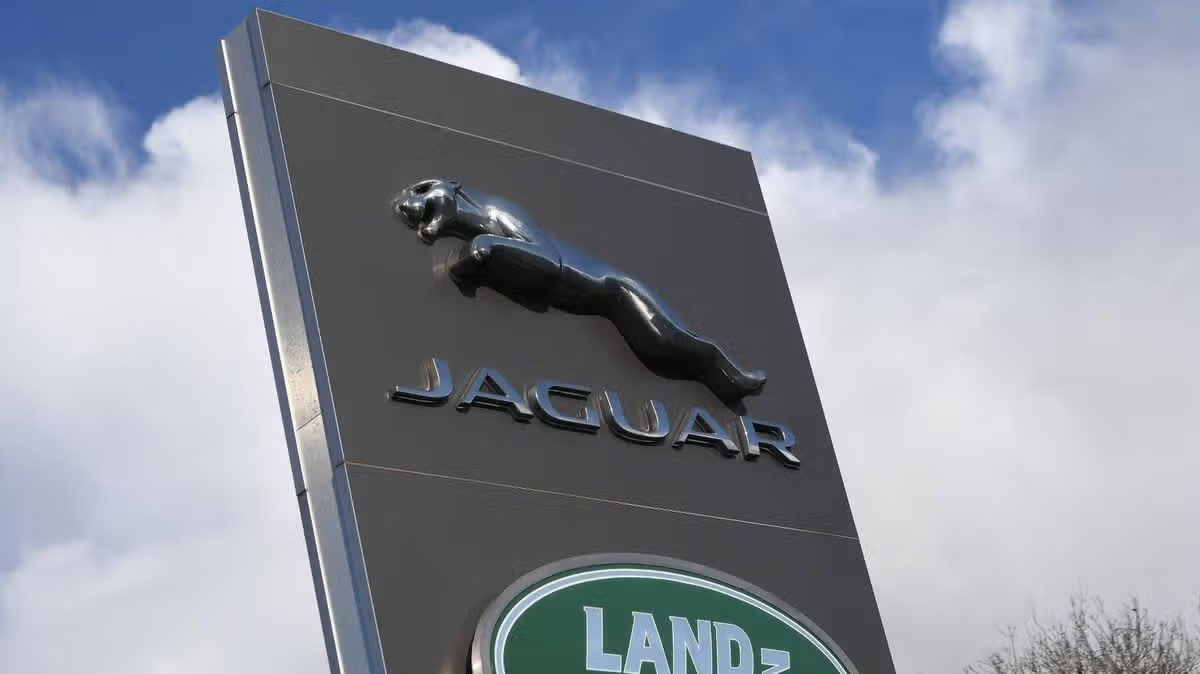
Jaguar Land Rover sign

JLR employs thousands in the Midlands and Merseyside(Image: Darren Quinton/Birmingham Live)

The Business Secretary has ruled out a government bailout for Jaguar Land Rover amid reports that the UK’s largest car manufacturer is set to axe 4,000 jobs.

Advertisement

The company is expected to formally unveil a significant redundancy programme on Monday, with the job cuts to be phased over two years, according to The Times.

JLR confirmed in a statement that it is launching a voluntary redundancy scheme, offering salaried and management staff the opportunity to leave the business.

Business Secretary Jonathan Reynolds has held talks with JLR chief executive PB Balaji and is due to meet the firm’s senior leadership team early this week.

Speaking on Laura Kuenssberg’s programme on the BBC, he said: “A company the size of JLR, which is a huge British success story, at various times in its business cycle, the number of, directly, people it employs will change.

Advertisement

“If this is about making sure over time that the workforce is right to make the business as competitive as possible, that’s the conversation we need to have.

“Of course you want to mitigate any job losses.”

When pressed on whether financial assistance could be made available to safeguard those roles, he added: “Not if it’s to bail people out.

“If it’s about long-term investment in the future, we do invest alongside industry on that.”

Advertisement

JLR is continuing its recovery following a significant cyberattack that forced the manufacturer to suspend production last year. The firm employs approximately 30,000 staff throughout the UK and manufactures the majority of its vehicles at plants across the country, including facilities in Solihull, West Midlands, and Halewood, Merseyside.

A JLR spokesperson said: “Over the past three years, we have strengthened our House of Brands and transformed our product portfolio for the next generation.

“As we deliver the next phase of our strategy, we need to adapt to evolving global market conditions while targeting approximately £1.7 billion of savings over the next two years and reduce break-evens to 300,000 vehicles. To achieve this, we must further simplify our organisation, improve efficiency and build greater resilience.”

The firm confirmed it had notified employees and trade union partners of the voluntary redundancy scheme, adding it would “share further information with our colleagues first”.

Advertisement

A Government spokesperson said: “We understand that this will be an uncertain and concerning time for affected workers, their families and wider communities.

“We have taken significant action to back the UK automotive industry by lowering electricity bills for manufacturers, providing £4 billion of capital and R&D funding to manufacture zero-emission vehicles (ZEVs) and launching a £2 billion electric car grant to encourage people to buy EVs (electric vehicles).”

Unite general secretary Sharon Graham said: “Death by a thousand cuts has been going on under the nose of successive governments.

“Years of under-investment, unsustainable ZEV mandates and high industrial energy costs are crippling the industry. There must be further action.

Advertisement

“There have been intensive Government discussions over the weekend to look at how to mitigate these job losses at JLR.

“The business secretary, Jonny Reynolds and myself are meeting the CEO of JLR next week. Unite was pivotal in securing the £1.5 billion government facility for JLR after the cyber attack.

“Once again, we will leave no stone unturned to support these workers. It cannot be acceptable that workers again are made to pay the price.”

JLR disclosed last month that revenues dropped by 9.6% year-on-year to £6 billion for the three months to June 30, driven by a 9.2% fall in vehicle volumes.

Advertisement

This followed a period in which production was significantly disrupted by a series of factors, amongst them a fire at a supplier’s facility.

JLR temporarily halted production of its Range Rover and Range Rover Sport models at its Solihull plant in March, after a severe fire broke out at a component manufacturer’s factory in Norway.

Sales volumes have also taken a hit following Jaguar’s move to discontinue several diesel and petrol-powered models, including the F-Pace.

Jaguar is pivoting towards electric vehicles as part of a sweeping strategic overhaul aimed at revitalising the brand.

Advertisement

JLR posted a pre-tax profit, excluding exceptional items, of £109 million for the quarter, a marked decline from the £351 million profit recorded in the same period a year earlier. Profit margins took a hit from a one-off provision related to US fuel economy regulations, which partly counterbalanced reduced US-UK tariffs.

Earlier this year, JLR announced plans to slash approximately £1.7 billion in costs over the coming years to bolster its recovery efforts.

The firm has been recuperating from last year’s cyberattack, which had a significant impact on the business, its workforce and the broader UK economy.

The car manufacturer was compelled to halt production at its UK plants for five weeks from 1st September last year, which hit sales in late 2025 and resulted in substantial financial losses.
Advertisement
Continue Reading

Business

Bristol Guildhall set to be turned into luxury hotel after years of delays

Published

on

Business Live

The historic Grade II*-listed building was damaged by fire in March 2020

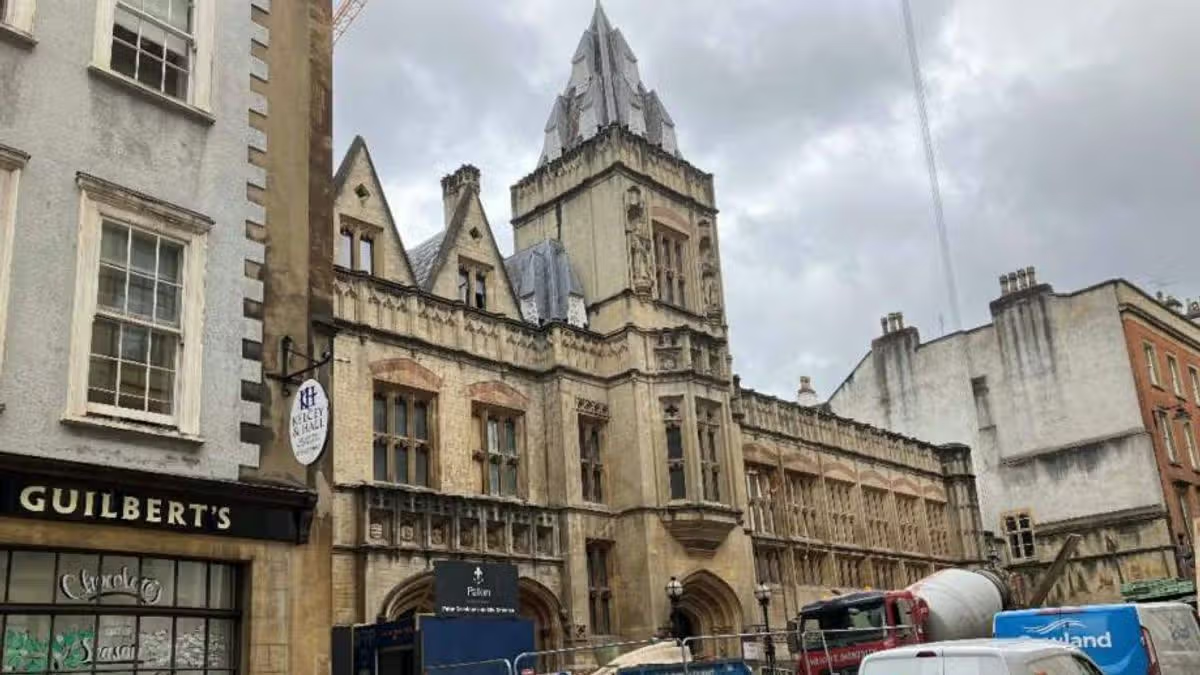
The Guildhall in Small Street, Bristol, which is being turned into a five-star hotel (Image: Nash Partnerships, free to use by all partners)

The Guildhall in Small Street, Bristol(Image: Local Democracy Reporting Service / Nash Partnerships)

Plans to transform Bristol’s historic Guildhall into a five-star luxury hotel are poised to move forward after years of setbacks. Developers are seeking listed building consent from the city council to remove asbestos from the former courtroom, which is earmarked to become a bar for guests and the public.

Advertisement

The scheme was initially approved to convert the property into a hotel back in 2013, but it was devastated by fire in March 2020.

More than 50 firefighters battled the blaze, yet the roof of the historic Grade II*-listed building, which sits on Broad Street and Small Street, caved in as flames tore through it.

A notice on the website for the forthcoming Hotel Gotham indicated it is now expected to open later than originally planned, early next year.

The venue will feature 75 bedrooms, a restaurant and a rooftop terrace bar.

Advertisement

In fresh planning documents lodged with Bristol City Council, the developers’ consultants stated that external works were already covered by existing permissions, and that the latest application concerned internal works only, which would ‘not affect the setting or significance of the surrounding buildings, or the wider conservation area’.

They noted that despite technical surveys carried out prior to construction work, the building had ‘continued to yield ‘surprises’, including previously unrecorded alterations.

“Investigations of the plaster linings through service holes revealed that the upper walls were finished with an asbestos reinforced plaster, requiring removal before any work within the room could proceed to ensure the safety of workers and the public,” the consultants said.

“The proposed works to replaster the former courtroom will not impact on the street scene, or other buildings within the setting and do not require planning permission.

Advertisement

“As they affect the internal fabric of Grade II*-listed building, they do require listed building consent.

“The proposed works are confined to the former courtroom and concern the plaster finishes and linings of the walls above the timber panelling, benching, and doors. The work will require removal of no historic fabric.”

The consultants said the courtroom ranked amongst the most significant spaces within the Guildhall, and would be restored to active use as a hotel bar after falling into a prolonged state of disrepair.

The site traces its origins back to the 13th century and underwent substantial reconstruction during the 1840s, emerging as a gothic revival-style building.

Advertisement

It functioned as the city’s crown court for a considerable number of years, with the basement having served as a prison.

Continue Reading

Business

L3Harris Stock: The Essential Pieces Behind Modern Warfare (NYSE:LHX)

Published

on

L3Harris Stock: The Essential Pieces Behind Modern Warfare (NYSE:LHX)

This article was written by

“AWS Certified AI Practitioner Early Adopter”I am a DevOps Engineer for a major, wholly owned subsidiary of a large-cap Fortune 500. I have been the primary driver of Anthropic-based tooling in our company’s division, and have successfully pushed for the division-wide integration of tools like Claude Code via AWS Bedrock. I am currently spearheading the implementation of AI-infrastructure in our division.I am a true subject-matter expert on the actual buildout, deployment, and maintenance of AI tools and applications. I have increasingly deep knowledge on the science behind generative AI systems as a result of first-hand experience with machine learning algorithms, model training, and model deployment.I contribute to Seeking Alpha as an outlet to share my AI and machine learning insights through an investment-focused lens.Closely associated with LL InsightsPer TipRanks (6/26/25) – 2 Year Timeframe#716 out of 31,463 Financial Bloggers #1,222 out of 41,143 experts

Analyst’s Disclosure: I/we have no stock, option or similar derivative position in any of the companies mentioned, and no plans to initiate any such positions within the next 72 hours. I wrote this article myself, and it expresses my own opinions. I am not receiving compensation for it (other than from Seeking Alpha). I have no business relationship with any company whose stock is mentioned in this article.

Seeking Alpha’s Disclosure: Past performance is no guarantee of future results. No recommendation or advice is being given as to whether any investment is suitable for a particular investor. Any views or opinions expressed above may not reflect those of Seeking Alpha as a whole. Seeking Alpha is not a licensed securities dealer, broker or US investment adviser or investment bank. Our analysts are third party authors that include both professional investors and individual investors who may not be licensed or certified by any institute or regulatory body.

Advertisement
Continue Reading

Business

Cost of living on many minds ahead of Manx election

Published

on

An aerial view of Douglas from the promenade on a bright day, showing hundreds of buildings with areas of trees breaking it up.

Residents, businesses, and charities say they are feeling the pinch of rising costs, with many describing the economy as a key priority ahead of the Isle of Man general election.

Several independent shops in Ramsey said custom was down and running costs had become harder to manage, while the island’s foodbank said demand for support had doubled in two years.

The Isle of Man Chamber of Commerce warned the Island faced “a very hard five years” ahead, citing a shrinking tax base and the recent loss of many high‑earning jobs.

Candidates have been urged to explain how they will fund their plans, support businesses, and reduce the pressures on working families.

Advertisement

Residents in Douglas said rising prices were affecting everyday life, with several describing the cost of living as their biggest concern ahead of the election.

Sharon Cox, from Douglas, said life was “not affordable.. especially for older people and vulnerable people”.

Prices were rising “not just by pennies”, but by “25 or 30 pence” each time she visited the shops, she added.

Advertisement
Continue Reading

Business

Concurrent Technologies sees FY26 results above forecasts

Published

on


Concurrent Technologies sees FY26 results above forecasts

Continue Reading

Business

Ingenia rejects $2b takeover bid

Published

on

Ingenia rejects $2b takeover bid

The retirement village operator, which is set to acquire Peet, has rejected an unsolicited bid from private equity firm Warburg Pincus to buy it.

Continue Reading

Business

CBI warns Healey business costs are hitting investment

Published

on

CBI warns Healey business costs are hitting investment

Rising costs are damaging business investment and undermining the government’s efforts to raise living standards, the CBI has warned the chancellor, John Healey, ahead of his first major economic speech and the budget on 28 October.

In a 75-page report drawing on cross-sector surveys and evidence from trade associations, the industry confederation said businesses paid almost £345bn in taxes in 2025-26. That was 12.7 per cent higher than the previous year and represented 31.3 per cent of all UK tax receipts.

Employer national insurance contributions, which were increased in the Labour government’s first budget in 2024, rose to £123.1bn in 2025-26, according to the CBI’s analysis of business tax contributions. That was a 28 per cent increase year-on-year and meant the levy overtook corporation tax as the largest single source of business tax revenue.

The report also found that UK non-domestic electricity prices were about 45 per cent above the median of G7 countries in 2023 and 2024.

The CBI called on the government’s new cost of living taskforce to prioritise cutting business costs. Rain Newton-Smith, the CBI’s chief executive, said Andy Burnham was right to put the cost of living at the heart of his new government but warned that “business costs are kitchen-table costs too”.

Advertisement

“When firms are forced to absorb higher taxes, energy bills and regulatory costs, the consequences are weaker investment, fewer jobs and less scope to raise wages,” she said.

“Business is the economic engine that powers better public services, creates jobs and raises living standards, the very things we need to revitalise our communities and help them prosper.”

The report identified four barriers holding back investment: labour and energy costs; fragmented rules that raise compliance costs; unnecessary regulatory friction with the EU; and tax complexity. It called for measures in the budget to ease what it described as the most significant pressures, from employment costs, energy bills and business rates.

The CBI’s members include some of Britain’s largest employers, among them Tesco, Centrica and Lloyds Banking Group, as well as trade associations covering retail and hospitality, food and drink manufacturing, construction and energy.

Advertisement

Healey has said he is as concerned about the cost of business as about the cost of living. In his first address to the House of Commons as prime minister, Burnham pledged to “bring back hope” and said life was “too expensive and too hard for too many”, but he declined to say whether taxes would rise in the budget. He also said his administration would be “grounded in fiscal responsibility”, as the cost of government borrowing reached its highest level in almost two decades.

The British Chambers of Commerce made a similar case in its own submission to the chancellor. Its research found that domestic policies have increased the costs facing a typical small or medium-sized business by 70 per cent over the past decade.

The BCC proposed cutting national insurance contributions for under-25s, reducing energy taxes and business rates, and providing greater support for exporters. It said the measures could be partly funded by replacing the triple lock on pensions, and urged Healey to “back business, cut costs and deliver growth”.

Shevaun Haviland, the BCC’s director-general, said: “We know the government is in a fiscal bind and its choices are limited. But support for business is not just money out the door, it generates vital economic returns. Easing cost pressures will give firms breathing space to create jobs, investment and growth. Right now, too many businesses are being held back by ever increasing bills.”

Advertisement

The two submissions follow earlier CBI warnings against further tax rises on business under the previous chancellor, Rachel Reeves.

The government was approached for comment.


Jamie Young

Jamie Young

Jamie Young is Senior Reporter at Business Matters, covering SME finance, employment law and Westminster policy since 2016. He has reported on every Budget and Autumn Statement since 2018, helped make sense of the ‘covid era’ and the bounce-back loan scheme from launch through the fraud investigations, and broke the magazine’s coverage of the 2024 late-payment reforms. He joined Business Matters straight from completing his BA in Administration from Exeter University and is NCTJ-qualified. Reach him at jyoung@cbmeg.co.uk

Advertisement

Continue Reading

Business

Opinion: Private ambition benefits infrastructure

Published

on

Opinion: Private ambition benefits infrastructure

OPINION: The brains trusts in corporate Australia failed to spot an opportunity now embraced by an ambitious businessman.

Continue Reading

Business

Zoopla profit returns despite advertising revenue fall

Published

on

Zoopla profit returns despite advertising revenue fall

Zoopla, the UK’s second-largest property website, returned to a pre-tax profit of £13.3m in 2025 despite a 1 per cent fall in revenue to £83.2m, which the company attributed to a change in its advertising strategy.

The Rightmove rival had reported a loss of £5.2m the previous year, when it wrote down the value of Yourkeys, a business it acquired in 2021 that helps developers manage their sales, by £19.5m.

Revenue had slipped by 7 per cent to £84.2m in 2024. Zoopla put the latest decline down to “lower programmatic and direct advertising revenue” as it moved towards promoting “more relevant property-related advertising” on its site.

The company does not disclose how many estate agents pay to list homes on its website but said its customer base “remained broadly stable” last year.

Paul Whitehead, chief executive of Zoopla, said: “Lots of marketplaces put what’s called programmatic advertising across their sites, but it’s generic.

Advertisement

“There’s some short-term revenue there, but is it the best consumer experience? Probably not. We want to work with [advertisers] that are contextual to the house move, whether that’s lenders or estate agents or credit score providers. It’s a tough decision because you lose some revenue as a result.”

Whitehead, 55, took charge as chief executive last year. He previously ran Cazoo, the used-car website that fell into administration in 2024.

Zoopla has been owned since 2018 by Silver Lake Partners, the American private equity firm that also holds a stake in City Football Group, the owner of Manchester City.

Rather than compete directly with the volume of leads Rightmove generates for its estate agent and developer customers, Whitehead wants Zoopla to offer fewer but better leads. Central to that approach is signing up more people to track the value of their current homes on the platform.

Advertisement

At the end of 2025 there were 5.4 million homeowners tracking their home’s value on Zoopla, a third more than a year earlier. The company says the figure has risen to 6.4 million so far in 2026.

“We believe [having a large number of homeowners using our platform] delivers great value to our partners who are getting more instructions,” Whitehead said.

“We can provide data insights even before people are in that actual moving window. You might start looking at particular types of properties or save a property, these are all signals to us that someone might be thinking about moving.”

He added that the new strategy was “starting to deliver in the numbers”. Alongside the return to profitability, Zoopla reported a 9 per cent increase in revenue in the first quarter of 2026.

Advertisement

Zoopla remains well behind Rightmove on earnings. In the first six months of 2026 alone, Rightmove generated a pre-tax profit of £149.1m on revenue of £225.8m, according to its half-year report, which also showed revenue up 7 per cent on the same period a year earlier.

Rightmove, which rejected a £5.6bn takeover approach from Rupert Murdoch’s REA Group in 2024, reported average revenue per advertiser of £1,726 a month in the first half of 2026. Zoopla does not disclose its monthly cost, which is thought to be as little as half of that.

“We’ll only increase prices if we’re delivering value, we won’t just do it for the sake of it,” Whitehead said. “Our competition is still very much focused on volume of leads, we’re more focused on intent and quality.”


Jamie Young

Jamie Young

Jamie Young is Senior Reporter at Business Matters, covering SME finance, employment law and Westminster policy since 2016. He has reported on every Budget and Autumn Statement since 2018, helped make sense of the ‘covid era’ and the bounce-back loan scheme from launch through the fraud investigations, and broke the magazine’s coverage of the 2024 late-payment reforms. He joined Business Matters straight from completing his BA in Administration from Exeter University and is NCTJ-qualified. Reach him at jyoung@cbmeg.co.uk

Advertisement

Continue Reading

Business

People squeeze dims WA’s golden glow

Published

on

People squeeze dims WA’s golden glow

Yes. Corporate subscriptions are available for teams and organisations, with discounted rates as user numbers increase. Pricing starts from $1,625 + GST per user.
Get in touch
to discuss the right option for your organisation.

Business News subscriptions are used by executives, investors, consultants and professionals who need to stay informed and make better decisions about the WA market. When you subscribe you’ll get

  • Unlimited access to WA’s most trusted business journalism
  • Data & Insights — detailed profiles of WA companies, people, projects and deals
  • MyBN — a personalised feed based on the companies, people and sectors you follow
  • Special publications and industry reports
  • Daily and weekly email newsletters

Data & Insights is a research tool built specifically for the WA market. It draws on more than 30 years of Business News reporting, updated regularly to reflect what’s happening now. Use it to:

  • Look up detailed profiles of WA companies, including financials, directors and ownership
  • Find decision-makers and track their career movements
  • Research live and completed projects across WA industries
  • Monitor deals, appointments and market activity
  • Access industry rankings and league tables

Data & Insights is updated daily by our dedicated research team, which uses the latest announcements, ASX filings and editorial coverage to keep our person, company, list and project records up to date.

Business News welcome all opportunities to make our dataset accurate, complete and current, so if you have an update request, please email the team at
general@businessnews.com.au, and we’d be happy to assist.

Advertisement

MyBN
is part of every subscription. It’s your personalised view of Business News. You can follow the companies, people, sectors and projects that matter to you, and get a news feed and alerts tailored to your interests. You can save articles to read later and retain only what you need.

Only subscribers have full access to all content on the Business News website.

Advertisement

If staying informed about the WA economy is part of your job, and/or you’re looking for networking opportunities in WA, Business News is built for you.

Business News subscribers are:

  • Executives and directors tracking competitors, clients and market movements
  • Investors and advisers researching companies, deals and industry trends
  • Consultants and professionals staying across sectors relevant to their clients
  • Business owners looking for leads, context and market intelligence

Most Business News publications cover national or global markets. Business News is focused entirely on Western Australia, which means the journalism, the data and the intelligence are all built around WA companies, people and projects — not adapted from a national feed. Data & Insights, included with every subscription, combines more than 30 years of WA-specific editorial research with live business data. There’s no comparable product for the WA market.

Advertisement

The Morning Digest Email provides a comprehensive wrap of the major headlines, relevant to WA business, and includes with a snapshot of the overnight news covering oil, gold and ASX-listed companies.

The Afternoon Wrap Email focuses on the news covered by our team of journalists during the course of the working day, including exclusive stories and analysis, all of which relates to WA business and the local economy.

The BN Weekender Email contains a wrap of the Business News from the week that was, highlighting the top stories in each area of WA business.
Sign up for free.

Advertisement

We’re happy to help.
Get in touch
and our team will come back to you.

Advertisement
Continue Reading

Trending

Copyright © 2025