The body responsible for England’s roads has formally apologised to Somerset drivers over repeated closures on the motorway
Daniel Mumby, Local Democracy Reporter
07:51, 28 Jul 2026
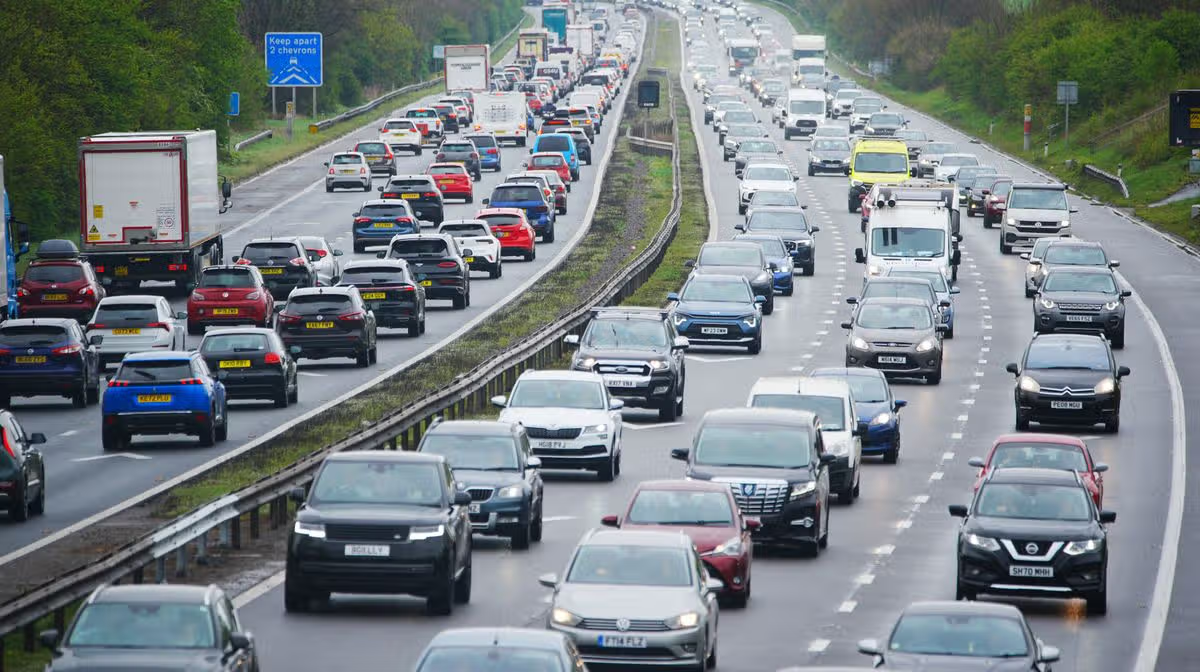
Motorway traffic on the M5 motorway near Burnham-on-Sea, Somerse(Image: Ben Birchall/PA Wire)
National Highways has issued a formal apology to Somerset drivers over the repeated closures that have plagued the M5 in recent years. Drivers in Somerset have endured numerous serious incidents on the M5 in recent memory, with collisions and welfare concerns leading to prolonged closures and diversions through quieter, more rural areas of the county.
Somerset councillors seized upon a recent climate, environment and place scrutiny committee meeting to voice their frustrations, demanding answers from police and National Highways regarding the duration and frequency of the disruption.
Both organisations acknowledged that further work was required to address the problems, while conceding there was “no silver bullet” and only limited funding at their disposal.
Councillor Richard Wilkins, portfolio holder for highways and transport, informed the committee meeting (held in Taunton on July 9) that there were “significant concerns” about both the frequency and length of motorway closures, and urged a “positive and collaborative” approach to tackle the underlying problems.
Mr Wilkins – who represents the Curry Rivel and Langport division – said: “We need to address the year-on-year increase to the frequency and duration of the closures on the M5, and the far-reaching, region-wide impact these incidents can have.
“When traffic is displaced onto the local road network, our roads can quickly become gridlocked, affecting people’s daily lives, disrupting businesses and services, and placing considerable pressure on our communities, our local economy and the wider south west economy.
“That’s not to mention the devastating impact to any individuals and their families who are directly caught up in any incident.
“I am keen to explore what more can be done collectively to reduce both the number of motorway closures and the length of time the motorway remains closed when incidents occur.”
Councillor Mike Rigby, portfolio holder for economic development, planning and assets, said that congestion on the M5 had “deteriorated markedly”, even beyond the peak summer holiday season.
Mr Rigby – who represents the Lydeard division near Taunton – said: “What once appeared to be a summer problem is now year round. This year has been appalling.
“Put simply, we’ve had enough – and by ‘we’, I mean the populations and businesses of Cornwall, Devon and Somerset.
“Following the abandonment of proposals to dual the A303 and A358, we are left with one strategic road in and out of the peninsula, and it needs to work much better than it does.
“The position is immeasurably worse now that it was even a year ago. We have had the rough end of the stick regarding highways investment in the south west, and we’re not prepared to see the only decent road we have turned into a car park.”
Ian Thompson, National Highways’ lead officer for stakeholder relations in the South West, issued a formal apology for the disruption experienced to date, saying: “We’re fully aware that 2026 has not been a good year for the M5.
“We are sorry, and we fully appreciate the impact that these incidents and closures have on the local communities – particularly Bridgwater, Taunton and the surrounding villages on the diversionary routes.
“The approved diversionary routes when the M5 is shut goes through both rural and urban locations; we accept that is not ideal.
“The solution to that is to build a new road along the M5 – that’s not happening. So the only way to deal with the impact of congestion is to reduce the number of incidents.”
Somerset remains the only county in the South West to house two National Highways depots along the M5 — one situated near the Edithmead roundabout in Highbridge (close to junction 22) and another in the Chelston area of Wellington (close to junction 26).
Mr Thompson noted that the positioning of these depots had been “very carefully thought out” to minimise response times to incidents.
He added: “We also use strategic signing campaigns around driving standards, such as drink and drug driving, middle lane hogging – which we know is an issue on the M5 – along with our ‘TRIP’ campaign and other safety measures.”
The majority of the M5 was built during the 1960s and 1970s, with Mr Thompson suggesting that considerable upgrades would be required in the years ahead to accommodate contemporary traffic demands.
He said: “The road is getting old. We need to invest a lot of money, and we are doing that.
“To make sure that’s done seamlessly and efficiently, with the least impact possible, we have established the M5 board to make sure we’re not clashing with local roadworks.
“The majority of the work will happen overnight – you’ll see well over £100m invested up to 2031. It’s an unprecedented amount of money.”
National Highways defines a ‘serious incident’ as one which closes one or more lanes on either or both carriageways of the motorway – such as a major collision or a “person in crisis”.
Mr Thompson explained that police were ultimately responsible for determining how much of the road was shut and for what duration, stating: “What we do is work closely with the police and the council to make sure that, when any investigation is complete, we know what infrastructure damage there is to our asset.
“Our resources are positioned so that, when we get the scene back, our officers will attend with our supply chain. So if we’ve got a significant fuel spill, or a vehicle fire, or there’s significant damage to the road surface and barriers, we’re ready – we come in and we fix what’s happened.
“No incident which has occurred that has shut the M5 this year has been down to our assets – it’s been down to other factors beyond our control.
“It’s driving standards on the M5 that are causing these incidents. These might well be vehicle condition, the way those vehicles are being driven, or just poor driving standards.”
Somerset accounts for 12.9 per cent of the south west’s motorway network, and 15.7 per cent of incidents leading to a closure – but 29.1 per cent of incidents caused by “persons in crisis”, according to National Highways’ own figures.
Karl Parfitt, chief executive of the Avon and Somerset police and crime commissioner’s office, said road safety concerns were being prioritised by current commissioner Clare Moody, given the increasing number of fatalities and serious injuries across Somerset’s road network.
He said: “We need to look at the current coordination and communication we’ve got during an incident, and work to see where we can improve on that.
“There may be scope or merit in having pre-planned contingencies agreed in advance, which identify what resources may be required. There is no silver bullet that can solve this.”
Johnny Hill, National Highways’ current route manager for Somerset, Devon and Dorset, said the agency was exploring measures to alleviate congestion elsewhere across Somerset’s road network in order to reduce the strain on the M5.
He said: “We’re not coming here today to say ‘everything is perfect and there’s no work to be done’. Nobody wins when the road is closed, and nobody wants the road to be closed.
“We are looking at the route between South Petherton and Honiton, and how we can look at that holistically, to see if we try to reduce the number of incidents on it, and therefore increase its resilience. We are looking to address flooding hotspots.
“The current road investment strategy is massively renewals-heavy. Our network was all built at roughly the same time; it all starts to creak at roughly the same time, and that time is basically now.
“That’s not to say they are going to be no improvements. There will be a number of smaller-scale improvements after the next five years.”























































You must be logged in to post a comment Login