Connect with us

Business

Bank of England’s Sarah Breeden: Rate cut should come soon as inflation eases

Published

on

Business Live

MPC member hails resilience of Northern businesses

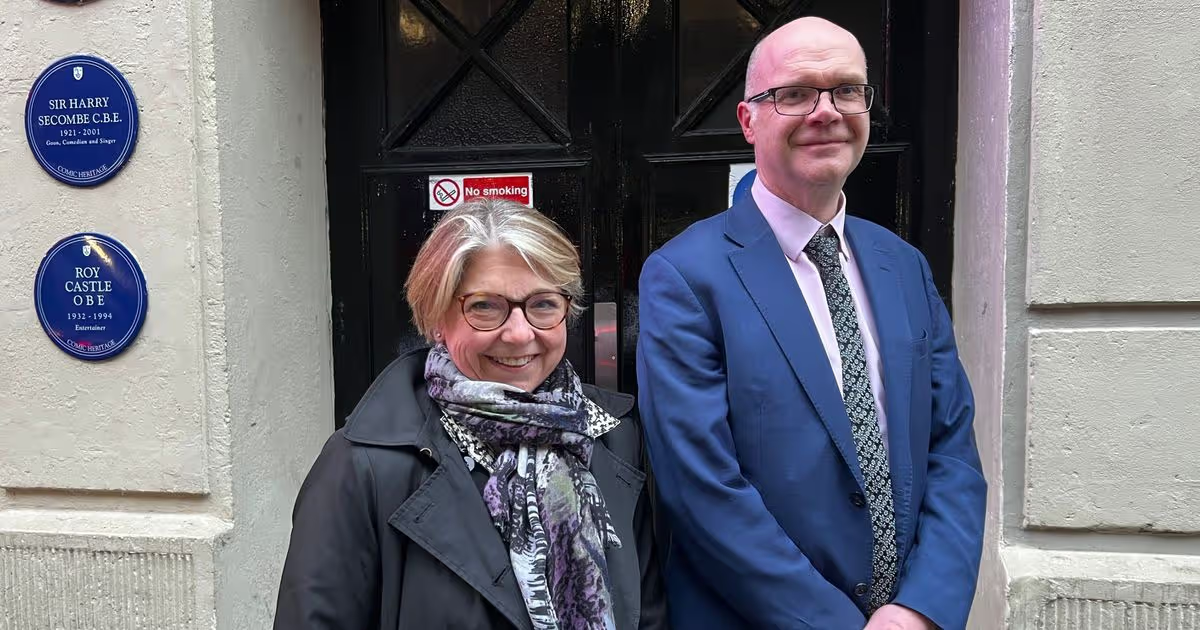
Sarah Breeden, Deputy Governor for Financial Stability at the Bank of England, left, with Ken Clark, the Bank's Agent for the North West, outside the Opera House in Manchester

Sarah Breeden, deputy governor for financial stability at the Bank of England, left, with Ken Clark, the Bank’s agent for the North West, outside the Opera House in Manchester(Image: Alistair Houghton)

The Bank of England should soon take its “foot off the monetary brake” and cut interest rates as inflation continues to ease, a member of the bank’s rate-setting committee has predicted.

Sarah Breeden, deputy governor for financial stability at the Bank of England and a member of the Monetary Policy Committee (MPC), was in Manchester to hear from businesses about what they would like to see from the Bank. She praised the resilience of Northern businesses – and told BusinessLive that without any further economic shocks, she expected a rate cut could come in the next couple of meetings.

Advertisement

At the most recent MPC monthly meeting last Tuesday, she was one of four members who voted to reduce Bank Rate by 0.25 percentage points, to 3.5%. But the rate stayed at 3.75% as five members voted to keep the rate the same.

The minutes of the MPC meeting showed members felt inflation would soon fall back to its 2% target as pay growth and price inflation were easing, but there was debate over how persistent those inflationary pressures still were, and whether a rate cut was needed now or later.

Like other MPC members, Ms Breeden, who is originally from Stockport, regularly tours the country to talk to businesses about how their sectors are performing. She said those discussions help members get a true picture of the wider UK economy, and help them to state their cases at the MPC table.

Asked why she had voted for a cut in rates, she said she felt it would help give more support to businesses sooner.

Advertisement

She said: “When we, all of us, are looking at interest rates and the path for monetary policy, what we’re looking at is ‘where is inflation going to be in the medium term’.

“We’ve had some really good news recently in that inflation is going to hit our 2% target nine months earlier, 12 months earlier, than we had expected it to. We will be at 2% or thereabouts in April and our expectation is that it should stay there from here.

“But of course there are risks around that outlook and so our debate around the MPC table was about the upside risk to inflation, if we continue to have high wages, if they are fuelling increases in prices.

“On the upside, are we having inflation persistence continuing, versus the risk to the downside? Are we going to see a pick-up in activity as we’re expecting? Might there be more of a loosening in the labour market and might that bring inflation below target?

Advertisement

“For me, I was more focused on those downside risks. I wasn’t confident that we’re going to see that pick-up in activity. And so I thought it was appropriate for us to take our foot off the monetary brake a little bit and provide a bit more support for the economy.”

This time round, Ms Breeden’s argument was outvoted on the MPC. But she says that while “there’s no preset path for policy”, a cut remains likely soon if the economy continues on its current path and risks to inflation subside.

She said: “If we continue to have the economy develop as we expected and if there are no shocks – to be clear those are two big ifs… I think it’s reasonable to expect there to be a cut over the next couple of meetings.”

Ms Breeden was confident though that, without shocks, inflation would continue on its downward trend.

Advertisement

She said: “We’ve had four years, haven’t we, when inflation has been above our target of 2%. That’s a really, really long time.

“The original source of those inflationary shocks were external to the UK economy. It was the almost doubling of energy prices, food prices increased by 20%. And perhaps naturally in that context, people were looking to address the cost of living pressures through higher wages.

“What we’re seeing now is that in contrast to the position then when there was a tight labour market, when it was more likely that businesses were to be able to have high wages and then to pass those higher wages on into their costs, we’re seeing less activity in the economy.

“We are seeing a looser labour market and all of that means that the persistence in wage and price inflation, those second round dynamics that have been with us for a long, should be falling away.”

Advertisement

North West businesses ‘resilient’ in face of shocks from Brexit to pandemic

Her overall feeling was that the mood among local businesses was “resilient”.

She said: “There’s been an awareness of some green shoots, some positive stories to tell, but also a recognition that the story isn’t the same across all industries. The story that manufacturing is facing is different to the one in finance and professional services.

“And that’s something that we find really valuable from coming out and talking to businesses, because the more we understand about why firms are experiencing the economy differently, the better able we are to understand it and make policy right.”

That resilience, she said, was particularly striking given the challenges the UK economy has faced.

Advertisement

She said: “If you think about the shocks that the economy has suffered over the last several years, it’s amazingly resilient that we are where we are. We’ve left the European Union, we’ve had a once-in-a-hundred-year pandemic, we’ve had war in Europe, we’ve had the fastest rise in energy prices in many decades, we’ve had the fastest rise in interest rates in decades, and we’ve had a new leader in the U. And all of that has created shocks that businesses have been able to absorb incredibly well – much better than I would have expected.”

Why MPC members must get out and meet businesses

Ms Breeden said she “cannot underscore enough” the importance to MPC members of getting out to meet businesses in person.

She said: “It’s always important to understand businesses and households’ lived experience of the economy. But after those extraordinary shocks that we’ve faced, it is even more important to get out and about and ask people what is happening with their costs, what’s happening with the labour market, what’s happening with demand, what does all of that mean for pricing – and that feeds in very really very really into our decisions. We can’t just look at our models, we’ve got to look out of the window.”


Advertisement
Continue Reading
Click to comment

Leave a Reply

Your email address will not be published. Required fields are marked *

Business

Effective Promotion Strategies in 2026

Published

on

The digital marketing landscape has evolved considerably beyond English-only campaigns. With approximately 70% of global internet users preferring to engage in their native language, businesses seeking international expansion require agencies that understand the nuances of multilingual and multicultural marketing.

The marketing landscape is evolving faster than ever. What delivered strong results just a few years ago may now generate minimal impact.

Audiences have become more selective, competition more intense, and communication channels more complex. In 2026, success belongs not to the loudest brands, but to those that systematically manage customer attention and turn it into long-term relationships.

Personalization as the Standard

Personalization is no longer a competitive edge — it is an expectation. People do not want generic messages. They expect relevant offers, clear communication, and a sense that the brand understands their needs.

Personalization operates on three levels:

  1. Content — adapting messaging to interests, behavior, and funnel stage.
  2. Offers — tailored conditions, product recommendations, and service options.
  3. Communication — choosing the right channel and frequency for each individual.

The key is not simply collecting data, but using it thoughtfully. Overcommunication creates irritation, while timely and relevant interaction builds trust.

BassWin: A Platform Built on Modern Marketing Principles

Within the framework of today’s marketing landscape, BassWin demonstrates a comprehensive approach to growth and audience engagement. The brand actively leverages personalized communication, data analytics, and automation to deliver relevant content and a tailored user experience. BassWin follows an omnichannel strategy, maintains a transparent reputation, and builds a loyal community around its ecosystem.

Advertisement

At the same time, the platform prioritizes usability, fast performance, and seamless adaptation across devices. Strong attention is given to data protection and transaction security, ensuring a high level of privacy and reliability. By combining advanced technology, customer-focused design, and a well-structured promotional strategy, BassWin aligns with the evolving standards of the 2026 digital market.

Content as a Strategic Asset

In 2026, content is not a supplement to advertising — it is a core growth driver. Brands increasingly operate like media platforms, producing expert articles, case studies, analytical insights, educational materials, and short-form content for digital platforms.

What truly resonates:

  • practical value instead of abstract statements
  • transparency and honesty
  • real experience supported by facts
  • clear and accessible language

Audiences quickly detect artificial tone. Authentic voice and structured information outperform exaggerated promises.

AI Integration in Marketing

Automation is no longer reserved for large corporations. Small and medium-sized businesses are actively implementing tools for data analysis, demand forecasting, and campaign optimization.

Advertisement

Artificial intelligence enables companies to:

  • segment audiences with greater precision
  • anticipate customer behavior
  • automate communication workflows
  • test hypotheses more efficiently

However, technology remains a tool, not a strategy. Without clear positioning and deep audience understanding, even advanced systems cannot deliver sustainable results.

Omnichannel and Seamless Experience

A customer journey rarely follows a straight line. A person may discover a brand through search, explore social platforms, read reviews, subscribe to updates, and only later make a purchase. Every touchpoint must feel consistent and connected.

An omnichannel approach ensures:

  • unified communication style
  • consistent offers across platforms
  • preserved interaction history
  • fast responses in every channel

Companies that eliminate internal silos between marketing, sales, and support create a stronger and more reliable customer experience.

Reputation and Trust as Growth Drivers

In a competitive environment, trust becomes decisive. Customers analyze reviews, evaluate pricing transparency, and pay attention to how a company behaves in challenging situations.

Advertisement

Reputation management includes:

  • responding quickly to feedback
  • sharing real business cases
  • maintaining openness during difficulties
  • acting consistently over time

Any misstep can spread rapidly online. Promotion must therefore align with long-term credibility.

Communities Instead of One-Time Transactions

Modern marketing focuses on sustainable relationships rather than isolated sales. Brands are building communities — professional groups, private clubs, and educational initiatives — that strengthen engagement and loyalty.

A strong community provides:

  • continuous feedback
  • higher customer retention
  • organic brand advocacy
  • lower acquisition costs

People trust recommendations within communities more than direct promotional messages.

Data and Measurable Performance

Intuition is increasingly replaced by analytics. Nearly every marketing action can be measured. The real advantage lies in correctly interpreting the data and adjusting strategy accordingly.

Advertisement

Key strategic questions include:

  • Which channels generate actual profit?
  • Where does audience drop-off occur?
  • Which segments offer the greatest potential?
  • Which experiments should be scaled?

Ongoing analysis allows companies to reallocate budgets and focus on what truly drives growth.

Agility and Rapid Adaptation

Markets shift quickly. New platforms emerge, algorithms evolve, and audience behavior transforms. Businesses that test ideas in short cycles and refine strategy based on results gain a significant advantage.

Agile marketing involves continuous experimentation, flexible planning, and the readiness to adjust direction without delay.

Final Thoughts

Next-generation marketing is built on a balanced combination of technology, analytics, and genuine human understanding. The customer remains at the center — their expectations, experience, and trust define long-term success.

Advertisement

In 2026, promotion is no longer limited to advertising campaigns. It is a cohesive ecosystem of meaningful interactions, where every touchpoint strengthens credibility, deepens relationships, and contributes to sustainable business growth.

Advertisement
Continue Reading

Business

FPIs continue to bail out of financial services

Published

on

FPIs continue to bail out of financial services
Mumbai: Foreign investors accelerated their selling in financial services in the second half of January, offloading ₹5,402 crore after having sold ₹3,190 crore in the first half. For 2025, outflows from the sector stood at ₹14,903 crore.

“There are no serious valuation concerns in the financial services sector however, private banks did see some profit-booking as PSU banks outperformed on a relative basis,” said Pankaj Pandey, head of Retail Research at ICICI Direct.

Overall, overseas investors sold ₹29,056 crore across 15 sectors in the second half of January, shows NSDL data. In the first half, they had withdrawn ₹22,420 crore from 19 sectors.

The healthcare sector saw outflows of ₹5,113 crore in the second half of the month. Foreign investors pulled out nearly ₹25,000 crore from the sector in 2025.

Advertisement

Most pharma and healthcare companies with significant US exposure reported muted earnings this quarter, which could have influenced the selling, said Pandey.


Global investors also offloaded more than ₹3,000 crore each from telecom, consumer services and auto stocks. “The pricing power has been somewhat affected for telecom companies given that the government is reviving the third player in the sector which could have led foreign investors to lighten their holding in this space,” said U R Bhat, Co-founder & Director, Alphaniti.
Pandey said automobile stocks’ rally in 2025 could have prompted foreign investors to trim positions.

FPIs Continue to Bail Out of Fin ServicesAgencies

JAN 16-31 TRADES Overseas investors also sell big in telecom, consumer services & auto

Inflows
Metals and mining led inflows in the second half of January, attracting ₹8,837 crore, supported by momentum in precious metals. Capital goods drew ₹2,435 crore.

“Global investor preference has been skewed towards metals and mining amid the rally in precious metals, though this may gradually shift from non-ferrous to ferrous metals,” Pandey said.

The metals sector had received ₹2,984 crore in December. So far in 2026, gold rose 17% on Wednesday, while silver gained 18%.”The volatility in the derivatives market for precious metals could have driven investor interest towards stocks of metal companies, which allows them to play on the theme with limited risk,” said Bhat.

Advertisement
Continue Reading

Business

BofA sees modest earnings downside for Apple from memory headwinds

Published

on


BofA sees modest earnings downside for Apple from memory headwinds

Continue Reading

Business

Restaurant Brands International (QSR) Q4 2025 earnings

Published

on

Restaurant Brands International (QSR) Q4 2025 earnings

HANGZHOU, CHINA – NOVEMBER 11 2025: A deliveryman picks up an order at a Burger King outlet in Hangzhou in east China’s Zhejiang province Tuesday, Nov. 11, 2025.

LONG WEI | Feature China | Future Publishing | Getty Images

Restaurant Brands International on Thursday reported quarterly earnings and revenue that topped expectations, fueled by strong international growth.

Advertisement

Here’s what the company reported for the period ended Dec. 31 compared with what Wall Street was expecting, based on a survey of analysts by LSEG:

  • Earnings per share: 96 cents adjusted vs. 95 cents expected
  • Revenue: $2.47 billion vs. $2.41 billion expected

Restaurant Brands reported fourth-quarter net income attributable to shareholders of $113 million, or 34 cents per share, down from $259 million, or 79 cents per share, a year earlier.

Excluding transaction costs, restructuring expenses and other items, the company reported adjusted earnings of 96 cents per share.

Net sales rose 7.4% to $2.47 billion. Stripping out currency fluctuations and sales from restaurants it plans to refranchise, Restaurant Brands’ organic revenue ticked up 6.5%.

The company’s same-store sales increased 3.1%, fueled by strong international growth.

Advertisement

Outside of the U.S. and Canada, Restaurant Brands’ same-store sales climbed 6.1%. International Burger King restaurants, which represents the bulk of the segment, saw same-store sales growth of 5.8%.

Analysts were projecting international same-store sales growth of just 3.7%, based on StreetAccount estimates.

And Restaurant Brands plans to keep growing its business abroad. In November, the company announced its plan to form a joint venture for Burger King China to accelerate expansion. Under the terms of the deal, which closed in late January, CPE, a Chinese alternative asset manager, owns roughly 83% of Burger King China. Restaurant Brands has retained a minority stake of about 17%, along with a seat on the board of directors.

Canadian coffee chain Tim Hortons reported same-store sales growth of 2.9%, although Wall Street was projecting an increase of 3.8%, according to StreetAccount. Tim Hortons accounted for 46% of Restaurant Brands’ overall revenue during the quarter.

Advertisement

Burger King reported overall same-store sales growth of 2.7%, topping StreetAccount estimates of 2.4%.

Popeyes was the laggard of Restaurant Brands’ portfolio. Its same-store sales fell 4.8%, a steeper decline than the 2.4% decrease forecast by Wall Street.

But the company has plans to revive the embattled fried chicken chain. In November, Restaurant Brands tapped Burger King veteran Peter Perdue to lead the chain’s U.S. and Canadian business; last month, the company also named Popeyes veteran Matt Rubin as the chain’s latest chief marketing officer.

Restaurant Brands plans to share more of its ideas to grow the business at its investor day in Miami on Feb. 26.

Advertisement
Continue Reading

Business

First look inside Crown's new foodie precinct

Published

on

First look inside Crown's new foodie precinct

Business News takes a look inside Crown Perth’s new urban food precinct ahead of its grand opening this weekend.

Continue Reading

Business

How Smart Airport Taxi Solutions Improve Business Travel Efficiency for UK SMEs

Published

on

Booking an airport transfer taxi might seem like a straightforward process, but there are a few key factors to consider to ensure a smooth and stress-free journey.

In today’s competitive environment, time efficiency and reliability are critical for UK businesses—particularly when it comes to corporate travel.

With international trade, investor meetings, and client-facing roles requiring frequent flights, airport transfers have become an operational detail that can directly influence productivity and professionalism.

For business travellers across the UK, the journey to and from the airport is no longer just a routine transfer. It is part of the wider business experience. Increasingly, SMEs are recognising that choosing the right Airport Taxi solution can reduce stress, improve punctuality, and support smarter travel management.

The Hidden Cost of Poor Airport Transport Planning

Missed pickups, last-minute cancellations, surge pricing, and unreliable availability can all disrupt carefully planned business schedules. Searching for a Taxi Near Me just hours before departure may work occasionally, but for executives heading to important meetings, uncertainty is not an option.

Public transport delays, airport parking fees, fuel costs, and lost preparation time all add up. For SMEs managing tight budgets, these inefficiencies are more than inconvenient—they affect both financial performance and professional reputation.

Advertisement

Pre-booked airport taxi services provide structure and predictability. With fixed pricing models, scheduled pickups, and professional drivers, businesses gain greater control over both time and cost.

Why Reliability Matters for Business Travellers

Corporate travel rarely happens during convenient hours. Early departures from Heathrow, late-night returns into Manchester, or tight connections through Birmingham require dependable planning.

Dedicated airport taxi providers monitor flights, adjust for delays, and operate on confirmed bookings rather than availability algorithms. This reliability allows professionals to focus on preparing for meetings rather than worrying about transport logistics.

For client-facing businesses, dependable airport transfers also reflect organisational competence. Arranging a professional airport taxi for visiting partners or investors reinforces credibility from the moment they arrive.

Advertisement

Cost Transparency and Administrative Simplicity

Expense reporting and cost visibility are ongoing priorities for finance teams. Unlike on-demand ride services that fluctuate in price, structured airport taxi platforms provide clearer pricing frameworks and digital documentation.

Many UK businesses are now using trusted airport taxi partners like Cabhit to centralise bookings and simplify travel management. Platforms such as Cabhit allow companies to compare options, pre-book journeys, and ensure consistent service standards across major UK airports.

This approach not only reduces administrative friction but also creates predictable travel expenses—an important factor for growing SMEs.

Supporting Productivity and Employee Wellbeing

Business travel can be physically demanding. Long security queues, flight delays, and tight itineraries leave little room for added stress. Reliable airport taxi services provide door-to-door transport, enabling professionals to work during the journey or simply recharge before important meetings.

Advertisement

Reducing uncertainty around airport transfers supports employee wellbeing, particularly for senior staff or frequent travellers. Over time, these small operational improvements contribute to higher overall productivity.

Sustainability and Smarter Corporate Travel

As sustainability becomes a strategic priority for UK businesses, transport decisions are also under scrutiny. Many airport taxi providers are incorporating fuel-efficient and low-emission vehicles into their fleets.

By planning journeys more efficiently and reducing unnecessary mileage, structured airport transfers can contribute to broader corporate responsibility goals without compromising convenience.

A Strategic Detail That Delivers Tangible Benefits

Airport transfers may appear to be a minor operational consideration, but for SMEs focused on growth, reputation, and efficiency, they play a meaningful role. Reliability, cost control, and professionalism are not luxuries—they are competitive advantages.

Advertisement

For UK SMEs and regular corporate travellers alike, choosing the right airport taxi partner can improve punctuality, reduce travel stress, and make every business journey more productive.

Advertisement
Continue Reading

Business

What to Expect From LED Light Therapy Treatment Sessions

Published

on

What to Expect From LED Light Therapy Treatment Sessions

For many people thinking about trying LED light therapy, the biggest question is simple: what actually happens during a session?

Knowing what to expect ahead of time can make the experience feel much more comfortable, reduce any uncertainty, and help you set realistic expectations for your results.

Starting With a Consultation

Most LED light therapy treatments begin with a brief consultation. During this first step, the practitioner will talk with you about your goals and what you hope to improve. They may ask about your medical history, current medications, and any existing skincare concerns. This conversation helps ensure the treatment is appropriate for you and allows the provider to recommend the best approach based on your needs.

Preparing for the Session

Once your consultation is complete, the treatment itself is very simple. The practitioner will guide you to a comfortable treatment area where you can lie back and relax. The LED device is then positioned over the area being treated. This might include the face, neck, chest, or another targeted area depending on your concerns and goals.

In most cases, no complicated preparation is required. The focus is on comfort, relaxation, and making sure the device is properly aligned so the light reaches the treatment area evenly.

Advertisement

During the Treatment

Once the LED device is in place, the session begins. Most clients spend around 20 to 30 minutes resting while the light is delivered. Many people describe the experience as calm and soothing. There is no pressure, pulling, or discomfort involved, which is why LED light therapy is often viewed as a gentle option compared to more intensive treatments.

Clients typically spend the session simply relaxing. Some people listen to music, meditate, or just enjoy a quiet moment while the treatment runs.

Recommended Treatment Schedule

For the best results, LED light therapy is usually done as a series rather than a one-time appointment. Most people begin with weekly sessions for a period of time. After that, clients often move into a maintenance schedule with sessions every few weeks to help support ongoing results.

This gradual schedule is common because LED therapy works over time. Consistency plays an important role in helping clients get the most benefit from their sessions.

Advertisement

After the Session

One of the biggest advantages of LED light therapy is how easy it is to fit into a normal routine. There is typically no downtime, and most clients can return to their daily activities immediately after the session. Unlike more aggressive skincare procedures, LED light therapy does not usually require recovery time or special aftercare.

Because the treatment is gentle and non-invasive, many people choose it specifically for its convenience and comfort.

Conclusion

LED light therapy treatment sessions are straightforward, relaxing, and easy to schedule into everyday life. With a simple consultation, a comfortable 20 to 30 minute session, and a consistent treatment plan, clients can feel confident knowing the process is designed to be convenient and stress-free.

Advertisement

Continue Reading

Business

Almost 800 Lufthansa flights cancelled as pilots, cabin crew walk out

Published

on

Almost 800 Lufthansa flights cancelled as pilots, cabin crew walk out


Almost 800 Lufthansa flights cancelled as pilots, cabin crew walk out

Continue Reading

Business

BMW’s Swindon MINI factory strikes partnership with US logistics giant GXO

Published

on

Business Live

The plant produces key body components and sub-assemblies such as doors and bonnets

GXO is the new logistics manager at Swindon BMW

GXO is the new logistics manager at Swindon BMW(Image: Saul McSween)

Swindon’s MINI factory has announced a new partnership with global logistics giant GXO. BMW Group has appointed the US-headquartered company to manage operations at the site on Bridge End Road. The Wiltshire plant produces parts and panels for cars that are then assembled at its group facility in Oxford and at other international facilities within its network.

Under the new partnership, GXO will lead the warehouse operations of car parts in Swindon, making use of BMW Group’s supply chain.

“We’re excited to begin this new chapter with BMW Group at their facility in Swindon,” said Martin Cooper, managing director for technology and consumer goods at GXO UK&I. “We’ve seen great success applying smart logistics solutions across a range of industries, and we look forward to driving efficiencies, strengthening resilience and building a future-proof platform for growth for BMW Group.”

It is understood GXO will look to roll out “smarter processes” as well as upgrade technology and optimise the plant layout in a bid to boost efficiency. The idea, the company said, is to help the Swindon site to meet evolving production needs of the Oxfordshire factory.

Advertisement

The Swindon site, which employs 500 staff and spans 425,000 sq m, has been a cornerstone of UK automotive manufacturing since 1955.

It plays a vital role in the global production network for cars, manufacturing key body components and sub-assemblies such as doors, bonnets, tailgates and fenders for MINI vehicles, including the MINI Cooper 3 and 5 door hatch and the MINI convertible.

In 2024, GXO completed a £762m takeover of nearby Chippenham-based logistics group Wincanton. Last year, the Competition and Markets Authority (CMA) announced an investigation into the acquisition. According, to the UK government website, that investigation is still ongoing.

Malcolm Wilson, chief executive officer of GXO, previously said: “The combination of GXO and Wincanton will enhance GXO’s offering for customers across the UK and Ireland and bring presence in strategic verticals that will serve as a springboard for growth.”

Advertisement
Continue Reading

Business

ICON stock plummets after accounting investigation delays earnings

Published

on


ICON stock plummets after accounting investigation delays earnings

Continue Reading

Trending

Copyright © 2025