
Business
Bank of India MF CIO Alok Singh sees banks poised for a re-rating. Here’s what could trigger it

That overhang could ease as policy announcements emerge and banks disclose stronger business numbers, Singh said in an interview.
Public- and private-sector banks are fairly valued and have become cheaper since last quarter, even as their underlying businesses continue to perform well. “The consensus trade just hasn’t come through yet,” he said, adding that this disconnect cannot persist indefinitely if the operating trend holds.
Edited excerpts from a chat:
Congratulations on the wonderful performance of your smallcap fund. Everybody these days is talking about small and mid caps, but the smallcap benchmark itself hasn’t moved much in the last one year — just 4-5%. So there must be a lot of stock-picking opportunities in the fund?
Small-cap is a large space with a large number of stocks. Even the Small Cap 250 index is only 250 stocks. If you look at stocks above ₹1,000 crore market cap, there are roughly 1,450-1,500 of them. Remove the top 250 (or even top 500), and there are still 900+ stocks left — so it’s a much bigger universe.

As the market and economy normalise, not everything does well — some things do well, some don’t — so bottoms-up stock selection becomes more important. Post-COVID, the entire small-cap space benefited from re-rating, so stock picking mattered, but simple allocation to the space also worked as long as you were exposed. I think this is the first time we’re looking at a truly normalised economy — even the government has chosen 2024 as its base year, implying normalisation happened after that. This is getting reflected in portfolios: if you’re not in the right stocks, you won’t participate as much.
How much of your portfolio goes beyond the Small Cap 250 index?
We have always run a bottoms-up portfolio and use the benchmark more for risk management than for portfolio construction. That said, while we look at all stocks above ₹1,000 crore market cap, it’s not that we only look beyond the top 250. My portfolio’s average market cap is around ₹24,000 crore, and the weighted average is around ₹25,000 crore. There is hardly any large-cap exposure — maybe 2-3%. So it’s predominantly a small-cap portfolio with some mid-cap. It’s not about concentrating in one place — it’s about finding where newer pools of profit are being generated and building the portfolio around that.
Purely from a market-cap perspective, is there a “sweet spot” you hunt in — say, ₹10,000-20,000 crore?
No, we don’t look at it from a market-cap point of view — we look at it from a business point of view. We’re not “growth hungry” either; across our portfolio we buy anything that makes sense on a relative basis, whether that’s value or growth. If you’re buying value, there has to be some change or inflection point happening, otherwise the value doesn’t get unlocked — growth similarly doesn’t sustain without an inflection point.
In one line: we look at things on a relative basis. If something makes sense relatively, we’re okay looking at it — whether it’s a ₹5,000 crore, ₹10,000 crore, ₹20,000 crore, or even ₹50,000 crore market cap company. That’s not how we approach it.
So once an idea makes sense, allocation becomes key?
Yes — and that’s where we believe the real differentiation lies. Everyone stresses finding new ideas, but what you do with an idea is equally important. No idea stays exclusive to you for long, because in the mutual fund world, once you buy something and your monthly portfolio is published, the whole market knows what you’ve bought — even without doing the fundamental work themselves, others can reverse-engineer why. So finding a good, scalable business or one going through a transformation is only one part. How you size it and scale it up in the portfolio is most important — especially for us, since we don’t run either very concentrated or very spread-out portfolios.
You currently have around 90 stocks in the portfolio. Tell us about your position sizing and churn.
Yes, right now it’s around that, but we like to run 70-80 stocks and may moderate it — it’s a bit of a transition period currently. Since the fund launched in 2018, we’ve generally run a 70-80 stock portfolio, and that’s where we wish to stay on a long-term basis. Sometimes the number ticks up a bit due to a few transitional additions. In terms of position sizing, 3-4% is the highest we buy.
Because we run about 90 stocks, there is naturally some churn happening — something is going in or out, which is why the stock count and turnover sometimes rise. But we don’t do a clean, sharp exit from any stock unless there’s a specific reason for concern. On a long-term, steady-state basis, turnover would be more like 0.65-0.7x.
Within small and mid-cap, where do you currently see both growth and valuations that aren’t excessive — i.e., no euphoria?
Frankly, after the last 3-4 months’ up-move in mid and small caps, I don’t see any pockets that are screamingly undervalued. The market looks fairly valued to me right now — wherever you see slightly above-mean multiples, those are being driven by the earnings those stocks are delivering. So across small, mid, or even large cap, the market seems fairly priced in terms of multiples. That means any further movement has to be driven more by earnings, which is why there’s some nervousness — earnings depend on visualisation and assumptions around execution, which people may or may not agree on.
On a steady-state basis, though, the market appears fairly priced. That’s why markets have largely gone sideways over the last month or so. Going forward, I believe earnings will play a bigger role in shaping the market than further multiple re-rating.
Q1 earnings were very good, Q2 is also expected to be good, but the concern is Q3 onward — especially in pockets affected by GST and income tax rate cuts. Is that a worry?
The base effect will play a role, but if you look at GST collections, we’ve actually surpassed prior levels — so collecting more GST at a lower rate, with goods and services volumes unchanged, means volumes have actually picked up. So I don’t think the base effect will be a major issue.
One thing to appreciate: markets were surprised by Q1 earnings because, when the Middle East crisis happened, the consensus was that Q1 would take most of the hit and Q2 onward would see recovery, normalizing in the second half. As we analyzed results, we realised the impact wasn’t concentrated in April but more in the May-July window, due to low-cost inventories and similar factors — so there will be some spillover into Q2 as well, which wasn’t the earlier consensus. That’s adding to market nervousness, since there’s now uncertainty about whether the impact ran through June, July, or even August.
That said, I don’t believe the impact goes beyond Q2 — which also has its own seasonality with Diwali falling a month later this year. Adjusting for these factors, I think earnings should actually be better, because high-frequency demand indicators — vehicular traffic, power demand, GST collections, toll collections, passenger traffic — are all suggesting decent buoyancy in the economy. If that continues into the festive season, the season should be good, since festive spending typically follows a build-up rather than appearing suddenly. Overall, I think external disruptions (freight movement, transit times, buyer-seller reconciliation) have now normalised and shouldn’t be a surprise element unless something changes from here.
Can you get more sector-specific on where you expect strong earnings momentum over the next couple of quarters?
The capital goods space — specifically industrial automation, industrial products, power equipment — is seeing a good tailwind from both domestic and global demand, and I expect that to continue. Precision engineering, part of capital goods, is also seeing decent order flows.
On BFSI, I think banks at large should do well. Earlier there were concerns about NIMs (going back to Q4 of last year), and now there’s some worry about FCNR-related spillover effects. But I don’t think liquidity pressure is as large as the market anticipates — RBI has repeatedly tried to suck out excess liquidity, and even a recent ₹7 lakh crore reverse repo saw limited takers. If liquidity were truly excessive and suppressing NIMs long-term, banks wouldn’t be holding it back from RBI — any reasonable treasury head would rather place it with the RBI than sit on it. That tells me it’s transitory — CBLO might dip to 2-3% for a few weeks, but that’s not permanent. So banking should be another sector that does well.
In the broader segment, capital goods and banking look okay to me. In a smaller segment, metals look good given demand and government policy, with decent capacity utilisation — not a large weight in the index, but earnings growth there looks decent. Elsewhere: pharma is mixed — some doing okay, some facing issues; FMCG faces margin and inflation pressure; consumer durables — some are doing fine; auto is doing okay but fairly priced, so while we stay positive, I don’t see a major surprise element there since the earnings are largely already discounted.
Among these sectors, do banks have the higher chance of re-rating if earnings pick up?
Yes. A large part of large-cap underperformance has come from IT, but banks also haven’t done the “heavy lifting” they should have, given their index weight and valuations. Whichever way you look at it — public or private — banks are fairly priced, and all the boxes that should tick for a bank are ticking: low NPAs, decent ROAs leading to decent ROEs, and loan growth. The consensus trade just hasn’t come through yet because of lingering worries about NIM pressure and possible rate moves. As policy announcements come through over the next few weeks, I think this will reconcile. Business-wise, most banks are doing well and have gotten cheaper since last quarter without the market reacting — but that can’t continue indefinitely if the trend persists.
Credit growth wasn’t a problem for banks anyways, and now deposits are also coming back via FCNR. So both sides of the balance sheet are sorted?
Correct. Banks running high CD ratios will be able to access liquidity now. Also, some NBFCs benefit indirectly — as pressure on larger banks to raise deposits eases, and money needs to be deployed, one avenue is lending to NBFCs. It may not offer the best spread, but it avoids negative carry. So NBFCs become an indirect beneficiary of FCNR flows too. I think the FCNR-related NIM-pressure overhang that the market is pricing in won’t be as large as feared, and as banks disclose business numbers, there should be a positive surprise.
Crude has again crossed $100, and there have already been about $1.5 billion of outflows this month, with the rupee under pressure — the macro setup is weakening this month. How much of a worry is the Middle East tension?
Obviously oil has an overhang on us — there are two sides: the inflation side and the availability side. Availability is the bigger question; every time there’s escalation, the possibility of supply being cut increases. The market is more worried about a potential availability cut than about the price level of $100 or $110 per se, because a higher price only impacts margins, whereas zero oil availability means no margin at all.
That said, yes, $100 or thereabouts does affect inflation and could have a broader margin impact via the Reserve Bank’s response. It’s a very hot-and-cold situation, so it’s difficult to take a decisive view. If it sustains at these levels for a longer period, we’d need to be more worried — but I’m not worried about it today. If there is an actual sustained supply-side issue, that concerns me more than the price being $100 or $110, because economies will adjust to price; there could be some disruption here and there, but on the whole we’d be okay. Non-availability is a bigger issue to me than $100 oil.



Federal aviation officials are preparing to launch an AI-powered air-traffic control tool in one of the nation’s busiest corridors as soon as Monday, The Wall Street Journal’s Andrew Tangel writes.
The software, called Smart, is expected to help the Federal Aviation Administration and airlines reduce delays and cancellations and find routes for flights when disruptions scramble air traffic. It will make its debut in the Washington, D.C., area ahead of a broader nationwide rollout, according to government and industry officials.
Copyright ©2026 Dow Jones & Company, Inc. All Rights Reserved. 87990cbe856818d5eddac44c7b1cdeb8

VCR: Consumer Discretionary Sector Dashboard For September
Business
Dow Jones Futures: Nasdaq, S&P 500 Hold; Robinhood, Sandisk, AMD, Moderna Surge Into Buy Areas

Dow Jones futures will open Sunday evening, along with S&P 500 futures and Nasdaq futures. The stock market was mixed, with the 10-year Treasury yield at 5%. The Nasdaq rose modestly, amid continued sector rotations among growth stocks. The S&P 500 largely held its ground but the Dow Jones and small-cap Russell 2000 fell solidly to three-month lows. Robinhood Markets…
Copyright ©2026 Investor’s Business Daily, LLC. All rights reserved. 87990cbe856818d5eddac44c7b1cdeb8

Gland Pharma, LIC Housing Finance, Gujarat Energy, CAMS and Amber Enterprises India saw the highest mutual fund selling among smallcap stocks in August, according to Dolat Capital.

TUCSON, Ariz. — A YouTube clip showing a faint light at the Catalina Foothills house of Nancy Guthrie, the 84-year-old mother of “Today” co-host Savannah Guthrie, circulated this week and revived online claims that someone had returned to the property. Authorities have not confirmed the footage or tied it to the investigation.
Guthrie was last seen Jan. 31 after a relative dropped her off following dinner. Her garage opened shortly before 9:50 p.m. and closed minutes later. She was reported missing Feb. 1 when she did not arrive at a friend’s house to watch a church service. Relatives found blood on the front porch. Pima County sheriff’s officials and the FBI have treated the case as a kidnapping for ransom. No suspect has been publicly named.
A content creator using the account marktheshark943 posted video he described as “breaking news,” pointing to a yellow glow near a door or window and saying a rock previously seen in the driveway was gone. Photos of the rock circulated online. Neither claim has been independently verified, and the Pima County Sheriff’s Department has not issued a statement about lights or landscaping at the house.
Similar videos appeared earlier this month. Another creator filmed illuminated windows and speculated on camera that timers or occupants could explain them. Neighbors and social media users have long watched the dark-sky foothills property. The house had multiple cameras and more than a dozen outdoor fixtures when Guthrie disappeared. That does not mean a new light equals a new lead.
Comments on the latest clip included “Someone is playing games!” and talk of taunting. Those are posts, not evidence. Family members, including daughter Annie Guthrie and her husband, Tommaso Cioni, live nearby. People online have guessed they visit to maintain the house. There is no public confirmation of who, if anyone, was inside.
Sheriff Chris Nanos said in February that relatives are not suspects. “To be clear, the Guthrie family, to include all siblings and spouses, has been cleared as possible suspects.” He has also said Guthrie was not wandering because of dementia. “She is as sharp as a tack.” She uses a pacemaker and daily heart medication and has trouble walking.
The last major public images remain doorbell video of a masked person, about 5-foot-9 to 5-foot-10, in gloves and an Ozark Trail backpack, at the door the night she vanished. The camera disconnected about 1:47 a.m. Investigators recovered some Nest data with Google’s help. Gloves found near the house were tested. A hair lead went nowhere, Nanos said later. Two ransom-style notes were released July 31; one claimed she had died. Human remains found in August near West Ajo Way and South La Cholla Boulevard were not linked to the case, the sheriff’s department said.
In July, Nanos told “Today” the file was still active. “We have so much DNA to sort through,” he said. “These are labs all across the country that are talking to one another about how best to look at what they have in front of them for DNA evidence. And, so I’m still positive we will resolve this case.” He added, “We’re working this as hard as we can. There’s no lead too small.”
Spokesperson Angelica Carrillo said in an email that a sheriff-FBI task force “remains committed to finding Nancy and providing answers to her family” and that DNA and digital work is “complex and time-intensive.” A department post said that when a significant development occurs, “it will be shared publicly.”
On Sept. 15, Savannah Guthrie thanked actress Allison Janney on air and said the family wanted to “give her a proper goodbye.” “We just want our mom home,” she said. Reward figures reported in coverage have ranged from an FBI offer of up to $50,000 to larger private totals; the department has not restated those figures in connection with the new video.
Seven months on, the official picture is unchanged: an 84-year-old missing from a dark foothills street, a masked figure on a doorbell camera, unfinished lab work, and no arrest. A YouTube drive-by of a porch light is not a status update. Anyone with information is asked to contact the Pima County Sheriff’s Department or the FBI.

Porsche could face another 4,000 job cuts, Handelsblatt reports
Business
Warren Buffett sounds alarm as stock market warning returns for only second time in 155 years
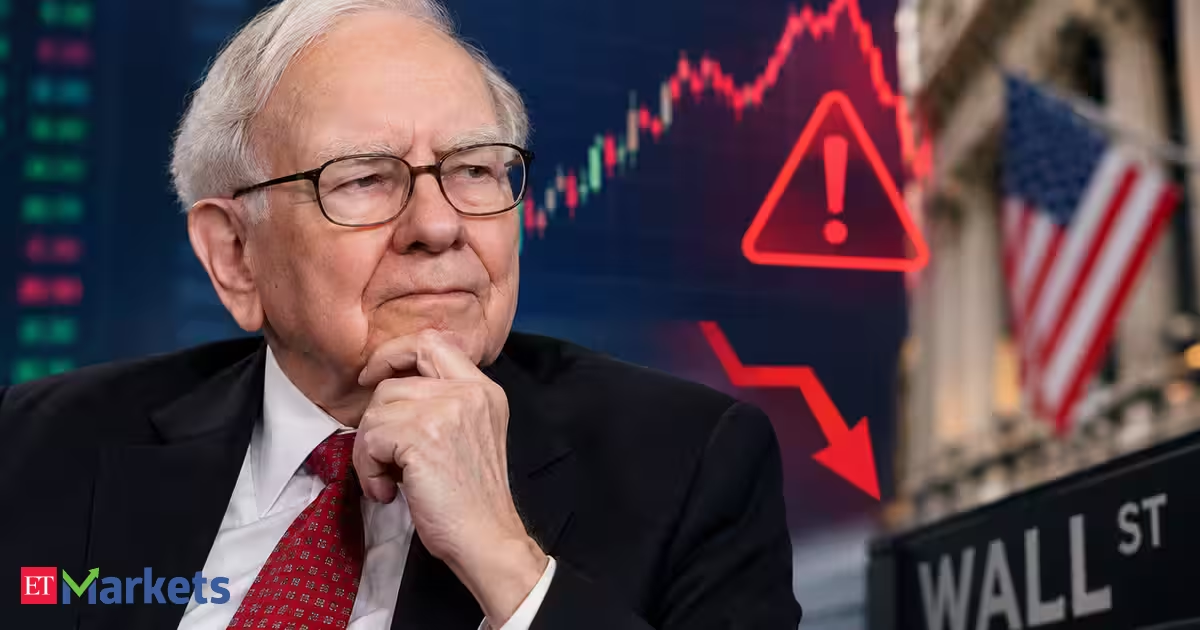
That backdrop comes as Warren Buffett, one of the most closely watched investors in the world, has issued a blunt message about the current market mood. Between 1965 and 2025, Berkshire Hathaway, the company he once led, delivered an annual compound return of about 19.7%, compared with 10.5% for the S&P 500 including dividends.
In a recent conversation with CNBC’s Becky Quick, Buffett said, “It’s tough to find values when everybody is preferring gambling.” The Oracle of Omaha has made a similar point in recent months, describing the market as a church with a casino attached and saying he had never seen people in more of a gambling mood.
Buffets approach
Buffett’s approach to investing has long centred on businesses that can earn more than they spend over an extended period. That is why he places so much emphasis on economic moats and competitive advantages. A moat can come from a strong brand, scale, switching costs or a network that becomes more valuable as more people use it. Such advantages can support durable cash flow, which companies can use to pay dividends, buy back shares or reinvest in their operations. Over long periods, that compounding can drive portfolio returns.
Buffett has also generally preferred buying when investors are less interested or more fearful, rather than when a particular story has taken over the market. Berkshire Hathaway remained relatively cautious on the artificial intelligence (AI) trade for a long time as the frenzy pushed valuations higher. It was only about a year ago that Berkshire initiated a position in Alphabet.
What does that mean for investors?
That does not necessarily mean the current AI boom will follow the same path as the dot-com era. The two periods also have important differences.
A high CAPE ratio remains significant because elevated readings have generally pointed towards more modest future returns. The current level can therefore be viewed as a warning about valuations rather than a signal that a market crash is about to happen. Markets can remain expensive for extended periods, just as inexpensive markets can become even cheaper. The CAPE ratio is therefore more useful for considering the next few years than trying to predict the next few weeks.Buffett’s investment approach has instead focused on owning businesses that can compound through different market cycles, with attention to economic moats, quality management teams and durable cash flows. Those cash flows can either be returned to shareholders or reinvested in the business. Holding such positions over long periods also means that a few difficult years do not necessarily determine the overall investment outcome.
Buffett steps down as chairman
Buffett, 96, is stepping down as chairman of Berkshire Hathaway after more than six decades at the helm of the company. He will become chairman emeritus with immediate effect and will remain a director.
His oldest son, Howard Buffett, will succeed him as chairman, marking another step in Berkshire’s long-planned succession. Howard has been a member of Berkshire’s board since 1993.
As he moves into the chairman emeritus role, Buffett said he remains confident about Berkshire’s future and will continue as a shareholder. “The company is in excellent hands, and I look forward to remaining a shareholder alongside you.”
(Disclaimer: Recommendations, suggestions, views and opinions given by the experts are their own. These do not represent the views of The Economic Times)

PagerDuty: Dirt Cheap And AI Is Creating A Great New Opportunity

Archer Aviation: Buying Revenue Instead Of Certifying It – Hold
Business
Millions More Amazon Prime Refunds Are Coming as FTC Expands Eligibility to $200 Payouts Under Settlement

Amazon is accelerating and widening consumer refund payouts tied to a $2.5 billion settlement with the Federal Trade Commission, expanding eligibility for millions of additional customers who could now receive payments of up to $200 each.
The refunds stem from a historic settlement reached in September 2025, in which Amazon agreed to pay up to $1.5 billion in redress to consumers the FTC said were harmed by the company’s deceptive Prime enrollment and cancellation practices, in addition to a separate $1 billion civil penalty. As of September 2026, Amazon has issued more than $845 million in redress payments to affected consumers under that settlement.
Under an expanded federal court order, the eligibility criteria for those refunds is now broadening considerably. Previously focused on low-use Prime subscribers, the program will now also include millions of customers who used between 11 and 20 Prime benefits over a one-year period, a significantly larger pool of subscribers than the settlement initially targeted. Alongside that expanded eligibility, the maximum individual payment amount is increasing sharply, jumping from a previous cap of $51 to as much as $200 total per eligible consumer.
Consumers who have already received and cashed earlier refund checks under the original settlement terms are not being left out of the expanded program. Those individuals could receive an additional, automatic supplemental payment of up to $149, with that second round of payments expected to begin rolling out by April 2027.
Christopher Mufarrige, director of the FTC’s Bureau of Consumer Protection, framed the expanded order as a direct effort to ensure the settlement’s benefits reach a broader share of affected customers. “The revised order will ensure more consumers who were harmed by Amazon’s deceptive enrollment and cancellation practices benefit from the FTC’s historic settlement,” Mufarrige said.
The new round of payments is designed to require no action from eligible consumers. All new payments will be distributed automatically starting October 1, 2026, through PayPal, Venmo or a mailed paper check, depending on the payment information the FTC has on file or is able to obtain for each eligible consumer. Customers do not need to file any claims, complete any forms, or take any other proactive steps to receive their payment if they qualify under the expanded criteria.
That automatic, no-claim structure has also created an opening for potential fraud, prompting the FTC to issue a direct warning to consumers. The agency said anyone who contacts a consumer claiming to represent the FTC and asks for money, personal information or banking details in order to “claim” a refund is very likely running a scam. Because legitimate payments under the settlement are issued automatically without any request for personal or financial information, the FTC has emphasized that consumers should be highly skeptical of any unsolicited outreach asking them to take action, provide sensitive information, or pay a fee in order to receive a payment connected to the Amazon settlement.
The underlying case traces back to FTC allegations that Amazon made it deceptively easy for consumers to sign up for Prime subscriptions while making the cancellation process unreasonably difficult, a pattern regulators said resulted in many consumers being charged for a service they did not intend to continue using or, in some cases, did not realize they had signed up for in the first place. The $2.5 billion total settlement, combining the $1.5 billion consumer redress fund with the $1 billion civil penalty, ranked among the largest consumer protection settlements in FTC history when it was first announced in September 2025.
The expansion of eligibility criteria and the increase in maximum payment amounts reflect an acknowledgment by regulators that the original settlement terms may not have adequately captured the full scope of consumers affected by Amazon’s enrollment and cancellation practices. By extending eligibility to consumers who used a moderate number of Prime benefits, rather than limiting redress strictly to the lowest-use subscribers, the revised order is expected to bring a considerably larger share of Amazon’s Prime customer base within reach of some form of compensation under the settlement.
For consumers wondering whether they qualify for either the newly expanded initial payment or the supplemental payment tied to previously cashed checks, no application process exists, meaning eligible individuals should expect to be contacted or to simply receive payment directly through the channels described in the settlement, PayPal, Venmo, or a mailed check, without needing to search for or submit any documentation on their own behalf.
With payments set to begin rolling out automatically starting next month and the supplemental round for earlier claimants following by April 2027, the expanded settlement is expected to continue delivering compensation to Amazon Prime subscribers well into next year, as the FTC works through the process of identifying and distributing funds to the full population of consumers now covered under the revised order.
U.S. to Launch AI-Powered Tool for Air-Traffic Control

Michael Saylor responds to venture capitalist’s bitcoin obituary

Morten Hjulmand Backs Atletico’s Experience Ahead Of Real Madrid Derby



![No Money [ DJ BEN RMX ]](https://wordupnews.com/wp-content/uploads/2026/02/1770218101_maxresdefault-80x80.jpg)


-

 Tech6 days ago
The Latest Weird Thing to Play Doom Is the Mapped-Out Brain of a Fruit Fly
-

 Fashion19 hours ago
Weekend Open Thread: Talbots – Corporette.com
-

 Crypto World4 days ago
Kraken Lets xStocks Holders Earn Yield Through DeFi
-

 Crypto World3 days ago
US Charges Robinhood Engineers Over Crypto Listing Trades
-

 Crypto World3 days ago
What Is the Status of the U.S.-Iran Peace Talks? Here's What Both Sides Are Saying
-

 Crypto World7 days ago
Can AI Build a Startup in 72 Hours? Elon Musk's Team Will Livestream the Test
-

 Crypto World5 days ago
Elon Musk Drops a Bombshell: Grok 5 Could Be the AGI Breakthrough
-

 Crypto World5 days ago
Revolut Attackers Warn of Ongoing Daily Customer Data Leaks
-

 Business6 days ago
Rivals Sam Altman and Elon Musk Rally Behind Dario Amodei’s Call for a Slowdown in AI Development
-

 Crypto World6 days ago
New Tesla Roadster Uses SpaceX Tech. Will It Impact the Stock Price?
-
 NewsBeat5 days ago
‘Sick conspiracy’: Trump says only guardrails AI needs is ‘a strong and smart (High IQ!) president’ in all-caps rant
-

 Crypto World4 days ago
NVIDIA Analysis: Attempted Rising Wedge Breakout Amid Pressure on the AI Sector
-
Business5 days ago
SK Hynix ADRs Fall More Than 6% as Memory Rally Breaks on Fears of Slower AI Spending
-

 Crypto World5 days ago
DOJ Seeks to Seize $61M in Iran Oil Funds From Binance Accounts It Vouched For
-

 Crypto World4 days ago
Robinhood engineers charged over $50K crypto scheme
-
Crypto World5 days ago
Can Circle’s Arc Repeat Robinhood Chain’s Meme Coin Boom?
-
 NewsBeat6 days ago
Last Night of the Proms pays moving tribute to Dolly Parton as Sheridan Smith wears a gold sequin jumpsuit in memory of the Queen of Country
-

 Crypto World5 days ago
3 Token Unlocks to Watch in the Third Week of September 2026
-

 Crypto World6 days ago
AI Safety Burden Falls on Chief Executives as Trump Prioritizes China Race
-

 Crypto World6 days ago
Goldman Sachs backs 25bp Fed hike after CPI
You must be logged in to post a comment Login