
Business
Barclays reiterates Overweight on BridgeBio stock, cites Attruby strength




Consulting firms play a critical role in leading enterprises. While some offer advisory alone, the most effective partners drive tangible change through execution.
In the financial sector, operating more effectively, managing constantly evolving regulations, and streamlining processes are becoming increasingly critical.
For that reason, financial consulting services are vital. Learn more at P&C Global to understand how to sharpen your competitive edge. Streamlined processes, informed decision-making, and the right expertise can materially elevate performance across large, complex organizations.
Corporate Performance
At scale, complexity compounds. As organizations grow, fragmentation across systems, processes, and teams often erodes efficiency and obscures accountability. For that reason, financial services consulting can be truly beneficial for improving institutional performance, creating cost and capital efficiency, and providing improved risk management.
Every step of the process can be refined, including implementing AI-powered fraud detection, refining process engineering, or creating capital optimization strategies. Truly expert consulting services will break down the business and find the most logical methods for improvement.
Innovation and Strategy
The most successful businesses find a way to stay ahead of the curve. They track the latest trends and create innovative growth strategies within the institutional space. Working with skilled, experienced consultants means being able to achieve the same for your business without the growing pains.
Optimize current financial products, improve customer experience, identify potential acquisition opportunities, and a host of other improvements that can truly benefit the business. Unique expertise related to things like expansion strategies and market entry can be too much to handle without the proper level of experience and expertise, facilitating the need for a truly professional touch.
Utilizing AI and Data Sciences
Information is king in this day and age. We have access to more data than at any point in human history, but so few businesses know how to effectively utilize that data. Data holds the key to more effectively reaching your target audience while maximizing the effectiveness of your business. That is where expert consulting can truly make a difference.
Working with financial services consultants means being able to more effectively utilize that data. Gain insight into customer behavior, create a more intelligent risk management model, enhance overall client service, and improve things like asset management and real-time decision making. Each of these is important for business but can be overlooked or mismanaged without proper guidance.
Organizational Services
Though technology continues to grow and play a pivotal role in nearly every facet of life, there is still the human element. Organizations all face very human challenges, and a guiding expert hand can help effectively manage those human resources.
Efficient financial services means being able to foster leadership, create an innovative culture, establish employer brands, find the right talent, upskill teams, engage employees, and create a high-performance culture. Consulting services will work to refine every level of the business from the human side of things.
That means creating executive coaching and leadership development, talent acquisition, succession planning, workforce development and planning, retention strategies, HR information systems, benefits programs, and all of the other complex systems tied to the average business in this day and age.
Fine Tune Your Business with Financial Consulting
The vast majority of businesses could use a bit of tweaking. With the help of financial services consulting, you can give your business a greater sense of direction while improving communication, efficiency, and overall productivity.
By enhancing operational efficiency, strengthening communication, and aligning strategy with execution, organizations gain not just direction—but momentum.
Shares of the company extended gains to trade up nearly 7%.
U.S. tech giants are under pressure to prove their massive AI outlays will pay off. The stakes are especially high for Meta after it hired Scale AI CEO Alex Wang last year under a $14.3 billion deal and offered some engineers pay packages of hundreds of millions of dollars to staff a new superintelligence team.
Superintelligence refers to AI machines that could outthink humans. Muse Spark is the first in a new series of models from that team, and is part of a family of models known internally as Avocado.
The model will initially be available only on the lightly-used Meta AI app and website, and in the coming weeks, replace the existing Llama models powering chatbots on WhatsApp, Instagram, Facebook and Meta’s collection of smart glasses.

“This initial model is small and fast by design, yet capable enough to reason through complex questions in science, math, and health. It is a powerful foundation, and the next generation is already in development,” the company said in a blog post.
It did not disclose the model’s size, a key measure typically used to compare an AI system’s computing power with rivals. Meta CEO Mark Zuckerberg had tempered expectations for performance, telling investors in January that he thought the team’s first models “will be good but, more importantly, will show the rapid trajectory that we’re on.”
“I expect us to steadily push the frontier over the course of the year as we continue to release new models,” he had said.
FOCUS ON EVERYDAY TASKS
Muse Spark can help users with tasks such as estimating the calories in a meal from a photo or superimposing an image of a mug on a shelf to see how it looks.
Meta also released Contemplating mode, which runs multiple AI agents in parallel to boost reasoning power, allowing Muse Spark to take on the extended thinking modes of Google’s Gemini Deep Think and OpenAI’s GPT Pro.
The company is betting that applying superintelligence to everyday personal tasks will help it tap its more than 3.5 billion users across its social media platforms, potentially giving it an edge over rivals with a smaller reach.


James Foord is an economist by trade and has been analyzing global markets for the past decade. He leads the investing group The Pragmatic Investor where the focus is on building robust and truly diversified portfolios that will continually preserve and increase wealth.
The Pragmatic Investor covers global macro, international equities, commodities, tech and cryptocurrencies and is designed to guide investors of all levels in their journey. Features include a The Pragmatic Investor Portfolio, weekly market update newsletter, actionable trades, technical analysis, and a chat room. Learn more.
Analyst’s Disclosure: I/we have a beneficial long position in the shares of NVDA, AMD either through stock ownership, options, or other derivatives. I wrote this article myself, and it expresses my own opinions. I am not receiving compensation for it (other than from Seeking Alpha). I have no business relationship with any company whose stock is mentioned in this article.
Seeking Alpha’s Disclosure: Past performance is no guarantee of future results. No recommendation or advice is being given as to whether any investment is suitable for a particular investor. Any views or opinions expressed above may not reflect those of Seeking Alpha as a whole. Seeking Alpha is not a licensed securities dealer, broker or US investment adviser or investment bank. Our analysts are third party authors that include both professional investors and individual investors who may not be licensed or certified by any institute or regulatory body.
At the January meeting a smaller group of “several” officials were willing to open the door to possible rate hikes, but by March and the outbreak of the war “many participants pointed to the risk of inflation remaining elevated for longer than expected amid a persistent increase in oil prices.”
Stocks appeared unfazed by the minutes’ hawkish tone, with major indexes higher on hopes of a lasting settlement of the Iran war. Interest rate futures traders slightly pared earlier bets on the Fed easing later this year, though bets on any Fed rate hike remained negligible. The Fed in March held its benchmark overnight interest rate steady in the 3.50%-3.75% range while nodding to the fresh uncertainty the war had introduced to the economic outlook.
Despite the inflation risks, however, “many participants” still saw rate cuts as part of their baseline outlook, with “most participants” judging that an extended conflict in the Middle East would do enough damage to economic growth that even more cuts would be warranted.
“Most participants raised the concern that a protracted conflict in the Middle East could lead to a further softening in labor market conditions, which could warrant additional rate cuts, as substantially higher oil prices could reduce households’ purchasing power, tighten financial conditions, and reduce growth abroad,” the minutes said.
WAR DISRUPTED OUTLOOK The minutes were released on Wednesday, a day after the U.S. and Iran agreed to a two-week ceasefire. The news caused oil prices to drop more than 15% to around $92 a barrel. The back-and-forth among policymakers at the meeting last month highlighted how the conflict in the Middle East, which disrupted global shipping and caused the price of oil to jump more than 50%, was pulling the Fed in conflicting directions, threatening both its inflation goal and full employment mandate.
At the meeting, the Fed signaled it was unlikely to change its policy rate until it was clearer whether the impact on inflation or the job market seemed to be the greater risk. In new economic projections issued alongside its policy statement, officials penciled in higher inflation for the year, but little change in the unemployment rate.In presentations at the meeting, Fed staff saw risks that economic and job growth would be weaker and inflation higher than expected in their January outlook, given “the potential economic effects of developments in the Middle East, government policy changes, and the adoption of AI.”
Given inflation above target since 2021, “a salient risk was that inflation could prove to be more persistent than the staff anticipated.”


Matcha, mango and Middle Eastern flavors are all trending in the snack space.

Modelo beer is displayed on a shelf at a Safeway store on Oct. 6, 2025 in San Anselmo, California.
Justin Sullivan | Getty Images
Modelo maker Constellation Brands withdrew its previously issued fiscal 2028 outlook on Wednesday and reported slightly weaker demand as consumers navigate a rapidly evolving macroenvironment.
The company said it was encouraged by the momentum in the fourth quarter across its beer and wine and spirits businesses, but the larger environment indicates lingering uncertainty. Constellation Brands also previously appointed Nicholas Fink as its new CEO, effective April 13.
“We expect the operating environment to remain dynamic given the evolving socioeconomic backdrop and limited near-term visibility,” the company said in a statement.
Shares of Constellation Brands were down slightly in extended trading.
Still, the company beat Wall Street expectations for its fourth quarter and full fiscal-year results.
Here’s how the company performed in the fourth quarter, compared with what Wall Street was expecting based on a survey of analysts by LSEG:
- Earnings per share: $1.90 per share adjusted vs. $1.72 per share expected
- Revenue: $1.92 billion vs. $1.88 billion expected
For the fourth quarter, the company reported net income of $224.7 million, up from a loss of $370.6 million a year prior.
The company said its beer business continues to be one of its biggest sources of growth, though its overall net sales for fiscal 2026 decreased by 3%.
For fiscal 2027, the company said it expects adjusted EPS of between $11.20 and $11.90 compared with estimates of $12.36 per share. Constellation Brands said that spending behavior across alcohol categories became more “deliberate” because of broader economic uncertainty, with overall demand across its categories remaining “subdued” for most of the year.
“Despite the dynamic operating environment in fiscal 2026, we remained focused on the factors within our control and executed with discipline,” CEO Bill Newlands said in a statement.
Business
Craig Melvin Accidentally Reveals Jenna Bush Hager’s ‘Devil Wears Prada 2’ Cameo on Live ‘Today’ Show

NBC’s “Today” show delivered another memorable live television moment Wednesday when co-anchor Craig Melvin inadvertently spoiled Jenna Bush Hager’s upcoming cameo in the highly anticipated sequel “The Devil Wears Prada 2,” prompting playful ribbing from his colleagues and a visibly stunned reaction from Bush Hager herself.

The slip occurred during an April 8, 2026, segment in which the hosts discussed the upcoming film, set for theatrical release on May 1. While chatting about why the movie promised to be a hit, Melvin, 46, casually dropped the news: “By the way, you know how that movie’s going to be good? You know how I can tell? JBH is in it!”
The camera quickly cut to Bush Hager, 44, whose mouth fell open in surprise. “I don’t know that you were supposed to drop that bomb, but if you’re…” she trailed off, clearly caught off guard by the on-air revelation of her Hollywood cameo.
Savannah Guthrie, who had recently returned to the show after an extended absence, jumped in with a laugh: “This is live. You cannot tell Craig anything!” Weatherman Al Roker added dryly, “It is now!” referring to the newly public information.
Melvin attempted to backtrack, saying, “I thought it was common knowledge?” before apologizing directly: “Cut it out for the other feeds! Sorry about that JBH.” He later quipped, “My bad!” when asked if he had any other secrets to share. Guthrie teased him further, suggesting he “read your journal while you’re at it,” a nod to his habit of sharing personal insights.
The lighthearted exchange highlighted the unpredictable nature of live morning television, where unscripted moments often become the most memorable. Bush Hager, daughter of former President George W. Bush and a “Today” staple since joining as a correspondent in 2009, has built a loyal following through her warmth, book club initiatives and family-oriented segments.
Details of her specific role in “The Devil Wears Prada 2” remain under wraps. The sequel reunites original stars Meryl Streep as fashion magazine editor Miranda Priestly, Anne Hathaway as Andy Sachs, Emily Blunt as Emily Charlton and Stanley Tucci as Nigel Kipling. The film has generated buzz since its announcement, with Streep and real-life Vogue editor Anna Wintour — the inspiration for Priestly — appearing together on the May issue of Vogue to promote it.
Bush Hager has a personal connection to the franchise’s fashion world. During the 2025 Halloween episode of “Today,” she dressed as Wintour while Guthrie portrayed Priestly, a costume choice the pair planned together and described as fitting perfectly for their on-air personas.
The cameo represents a small but notable step for Bush Hager into scripted entertainment, adding to her expanding portfolio beyond morning news. In January 2026, she announced a more substantial behind-the-scenes career pivot: executive producing the NBC drama pilot “Protection,” a U.S. Marshals-themed project created by “Quantico” showrunner Josh Safran. She joined Safran and producer Ben Spector as an executive producer under her first-look deal with Universal Television.
Bush Hager described the producing opportunity as an exciting new challenge during an on-air segment with co-host Sheinelle Jones, saying, “Who knew I would ever do something like this?” The pilot order marked her first major foray into scripted television after more than 16 years focused primarily on hosting and contributing to “Today.”
The fourth hour of the program, now titled “Today with Jenna & Sheinelle,” has undergone significant changes since Hoda Kotb’s departure in January 2025. Bush Hager initially helmed the slot solo with rotating celebrity guests before Jones was named her permanent co-host in December 2025, with the new format launching in January 2026.
Melvin, who anchors the first two hours alongside Guthrie and frequently appears across the show, is known for his affable style and occasional on-air gaffes that endear him to viewers. His podcast “Glass Half Full with Craig Melvin,” launched earlier in 2026, has further showcased his storytelling abilities through candid conversations with guests.
Wednesday’s moment quickly spread across social media, with clips of the exchange circulating widely. Fans reacted with amusement, many praising the genuine camaraderie among the “Today” family. Comments ranged from “Classic Craig!” to expressions of excitement about seeing Bush Hager on the big screen in the fashion satire sequel.
The incident underscores the delicate balance live television hosts must strike between preparation and spontaneity. While producers often work to keep certain announcements under wraps for strategic reveals, the fast-paced environment of a morning show — broadcast in real time to millions — leaves little room for error.
Bush Hager has maintained a relatively private personal life while sharing glimpses of her family, including husband Henry Hager and their three children, on the show. Her Read With Jenna book club remains a popular feature, and she recently expanded her literary efforts with additional initiatives.
For “The Devil Wears Prada 2,” anticipation has been building since the project was confirmed. The original 2006 film, based on Lauren Weisberger’s novel, became a cultural touchstone for its sharp take on the fashion industry and work-life balance. The sequel promises updated commentary on modern media, social influence and corporate culture.
No official statement has been issued by Bush Hager or NBC regarding the exact nature of her cameo or filming details. Representatives for the film have not commented on the on-air slip.
The “Today” show has a long history of memorable live moments, from surprise announcements to humorous flubs that humanize its anchors. Wednesday’s exchange fits squarely in that tradition, turning a potential spoiler into an entertaining segment that showcased the hosts’ quick wit and close working relationships.
Melvin’s apology and the group’s teasing reflected the supportive dynamic that has helped the program remain a morning staple for decades. Guthrie’s return added another layer of familiarity, with her playful jab at Melvin resonating with longtime viewers.
As “The Devil Wears Prada 2” approaches its release, fans are eager for more details on the plot and new cast members. Bush Hager’s involvement, however minor, adds a layer of intrigue for “Today” audiences who have followed her journey from White House daughter to television personality.
In the broader context of Bush Hager’s career, the cameo and her producing role on “Protection” signal a willingness to explore new creative avenues while remaining committed to “Today.” She has spoken in the past about balancing her professional ambitions with family life and public service interests inherited from her parents.
Industry observers note that such crossovers between news personalities and entertainment projects are increasingly common, allowing hosts to leverage their personal brands in fresh ways. Bush Hager’s executive producing credit on “Protection” — described as a mystery drama with law enforcement elements — positions her as a behind-the-scenes player in NBC’s scripted development.
Wednesday’s broadcast concluded without further spoilers, but the light moment likely boosted engagement for the sequel’s marketing. Social media users shared GIFs of Bush Hager’s shocked expression and quoted the hosts’ banter, turning the slip into viral content.
For the “Today” team, such unscripted exchanges often strengthen viewer connections by revealing authentic personalities. Melvin, Guthrie, Roker and others frequently navigate these situations with humor, maintaining the show’s reputation for warmth amid breaking news and celebrity interviews.
Bush Hager has not yet addressed the reveal in additional statements beyond her on-air reaction. As filming and promotion for “The Devil Wears Prada 2” continue, more information about her contribution may emerge closer to the May 1 release.
The episode serves as a reminder of the challenges inherent in live broadcasting, where information can spread instantly. In an era of tightly controlled entertainment rollouts, a single offhand comment can shift the conversation — especially when delivered by a trusted morning show personality.
As April 8 drew to a close, clips of the segment continued to circulate online, with many expressing anticipation for both the film and any future updates from Bush Hager about her expanding roles. Whether her cameo proves to be a brief scene or something more substantial remains to be seen, but the accidental announcement ensured it became water-cooler conversation nationwide.
In the competitive landscape of morning television, moments like these help “Today” stand out, blending news, entertainment and genuine human interaction. For Jenna Bush Hager, it marked another unexpected chapter in a multifaceted career that continues to evolve from the White House to Hollywood sets.

Leading Hampshire law firm Andrew & Andrew Solicitors has appointed Shikha Datta as Head of its newly established Family Law Department, as the firm continues its growth and expansion of services.
Shikha brings over 25 years of experience in family law, advising clients on achieving the best possible outcomes in both financial and children-related matters.
Her expertise spans complex financial settlements involving trust structures and overseas assets, prenuptial agreements, and jurisdictional disputes. She also has extensive experience in children matters, including residence and contact arrangements, as well as leave to remove applications.
Known for her calm and collaborative approach, Shikha has represented a diverse client base that includes business owners, CEOs, entrepreneurs, actors, musicians, academics, and professionals both in the UK and internationally.
Shikha said: “I’m thrilled to be joining Andrew & Andrew Solicitors. It is a firm where the culture genuinely reflects the values I bring to my practice: considered, client-focused, and committed to achieving the optimal outcome.
“The breakdown of a relationship can be an emotionally difficult and stressful time, with concerns regarding how finances will be divided, how the children of the family will be affected and how to navigate a new phase of life. I feel I am well-placed with my extensive experience to lead this new department and navigate the complexities of family law.”
The introduction of family law services enhances Andrew & Andrew Solicitors’ existing offering, enabling the firm to provide comprehensive legal support to clients across a broader range of personal and professional matters. With offices in Portsmouth, Emsworth and Wickham, the firm serves clients across Hampshire and the surrounding region.
Andrew Wisniewski, Director at Andrew & Andrew Solicitors said: “We are delighted to welcome Shikha as Head of our Family Law Department. Her extensive experience and client focused approach make her an exceptional addition to the practice.
“Shikha’s appointment marks a significant step in our continued growth as we expand our services to include family law.”
For more information about Andrew & Andrew Solicitors, visit a2solicitors.co.uk.
A cascade of major cloud and server outages throughout 2025 exposed the fragility of the world’s digital infrastructure, with analysts estimating that unplanned IT downtime inflicted hundreds of billions of dollars in global economic losses as businesses, governments and consumers grew ever more reliant on always-on services.

While no single event matched the scale of the 2024 CrowdStrike incident — which alone caused an estimated $5 billion to $10 billion in damages — the cumulative toll from repeated disruptions at Amazon Web Services, Microsoft Azure, Cloudflare and other providers underscored a troubling trend: even routine configuration errors or regional failures can ripple worldwide, halting e-commerce, grounding flights, delaying financial transactions and disrupting healthcare operations.
The most disruptive outage of the year struck on Oct. 20 when an AWS DynamoDB failure originating in the US-EAST-1 region propagated globally due to dependencies in services like IAM and DynamoDB Global Tables. The incident, lasting up to 15 hours in some cases, generated more than 17 million reports on Downdetector and affected over 1,000 companies, including Slack, Atlassian and Snapchat. Early estimates placed direct losses from that single event between $38 million and $581 million, though broader productivity and revenue impacts likely pushed the figure far higher.
Just days later, on Oct. 29, a Microsoft Azure Front Door configuration change triggered worldwide HTTP 503 errors and connection timeouts. Additional outages hit Google Cloud, Cloudflare — which saw 3.3 million reports in a November incident lasting nearly five hours — and other providers. Between August 2024 and August 2025, the three largest cloud platforms experienced more than 100 service disruptions of varying durations.
Industry reports painted a sobering picture of the financial stakes. Unplanned downtime averaged $14,000 to $23,750 per minute depending on company size, with high-impact outages costing a median of $2 million per hour according to New Relic’s 2025 Observability Forecast. Organizations reported median annual exposure of $76 million from such incidents. Across the Global 2000, annual downtime costs have hovered around $400 billion in recent analyses, a figure that continued to climb as digital dependency deepened.
Government-imposed internet shutdowns added another layer of loss. In 2025, intentional outages in 28 countries lasting more than 120,000 hours cost the global economy an estimated $19.7 billion — a 156% increase from the previous year — highlighting how both technical failures and policy decisions can exact heavy economic tolls.
The human and operational costs extended beyond dollars. Airlines faced delayed flights and passenger disruptions, hospitals shifted to manual processes that strained staff and risked patient safety, and retailers lost sales during peak periods. E-commerce platforms, SaaS providers, gaming companies and media streamers reported lost revenue, refunds and SLA credits totaling hundreds of millions across incidents.
One analysis of 2025’s major cloud outages attributed roughly $581 million in combined losses to configuration-related failures at AWS, Azure and Cloudflare alone. Indirect costs — including engineering response time, surge staffing for customer support, legal fees and reputational damage — often multiplied the direct hit. Manufacturing firms idled production lines, with some sectors facing daily downtime costs exceeding $1.9 million.
Experts attributed the persistence of outages to several factors. Cloud providers now underpin an estimated 94% of enterprise services, with AWS, Azure and Google Cloud controlling more than 62% of the market. Complex interdependencies mean a single regional glitch can cascade globally. Configuration changes, automation errors and latent race conditions proved especially troublesome, as seen in the AWS and Azure incidents.
“These weren’t sophisticated cyberattacks but routine operational missteps with outsized consequences,” said one infrastructure analyst reviewing the year’s events. Businesses that relied on single-cloud architectures or lacked robust failover mechanisms suffered the most.
The New Relic study found that organizations with full-stack observability reduced high-impact outage costs by half, yet many firms still lacked comprehensive monitoring. Surveys showed 88% of executives expected another major global IT outage on the scale of recent events, underscoring a sense that such disruptions had become the new normal rather than rare anomalies.
Smaller businesses and mid-market companies were not immune. While Fortune 500 firms might absorb multimillion-dollar hourly losses, even brief outages could cripple smaller operations lacking redundancy. Some reports indicated that 51% of organizations experienced monthly losses exceeding $1 million from internet or network degradations, with one in eight facing over $10 million monthly.
In healthcare, where patient portals and electronic records systems went dark, the shift to paper-based workflows not only slowed care but raised safety concerns. Aviation and transportation sectors saw routing and booking systems fail, leading to operational backlogs that took days to clear.
Financial services faced particular scrutiny. Trading platforms, payment processors and banking apps experienced delays that could cascade into market volatility or missed opportunities. One October outage affected critical financial infrastructure, prompting calls for stricter oversight of cloud providers deemed systemically important.
Recovery efforts varied. Cloud giants typically restored services within hours, but downstream impacts lingered as companies restarted systems, reconciled transactions and reassured customers. Legal fallout included lawsuits over SLA breaches, though many contracts limited provider liability.
The year’s events accelerated discussions about multi-cloud strategies, edge computing and improved observability tools. Companies began investing more heavily in redundancy, automated failover and chaos engineering to simulate failures before they occur. Yet building true resilience carries significant upfront costs, creating tension for budget-conscious executives.
Analysts projected that without meaningful improvements in infrastructure resilience, annual global losses from server and cloud outages could continue escalating into the hundreds of billions. The Uptime Institute’s Annual Outage Analysis 2025 emphasized that preventing outages remains a strategic priority for data center operators, with human error and process failures still leading causes.
Broader economic context amplified the pain. With inflation pressures easing but growth uneven, businesses could ill afford unexpected revenue hits. Supply chains, already tested in recent years, faced additional friction when tracking and logistics platforms faltered.
Public reaction mixed frustration with resignation. Social media filled with memes about “the cloud going dark” again, while executives fielded questions from boards and shareholders about risk exposure. Consumer trust eroded in some cases, particularly when outages hit popular services during high-traffic periods.
Looking ahead, 2026 is expected to bring both challenges and innovations. Providers have pledged enhanced safeguards, including better change management and transparency. Regulators in Europe and the U.S. have signaled interest in greater accountability for critical digital infrastructure.
For now, the 2025 tally serves as a cautionary tale. As the world digitizes further — with artificial intelligence, Internet of Things devices and 24/7 online services becoming ubiquitous — the cost of even momentary server or network failures will likely keep rising.
Business leaders are urged to assess their dependency chains, test recovery plans rigorously and consider diversified architectures. For the average company, the message is clear: in an interconnected economy, no server outage is truly isolated.
Government-imposed shutdowns and technical failures together painted a picture of vulnerability that transcends any single provider or region. As one report summarized, “No industry was immune,” from technology and transportation to manufacturing and financial services.
The true global economic loss for 2025 remains difficult to pinpoint with precision, as many impacts — lost productivity, damaged customer relationships and deferred investments — resist easy quantification. Conservative estimates place direct and indirect costs well into the hundreds of billions when aggregating all major incidents and the pervasive drag of frequent smaller disruptions.
In an era when milliseconds can determine competitive advantage, the repeated outages of 2025 reinforced a hard truth: digital infrastructure has become the backbone of the global economy, and its occasional fractures carry consequences that reach far beyond the data center.
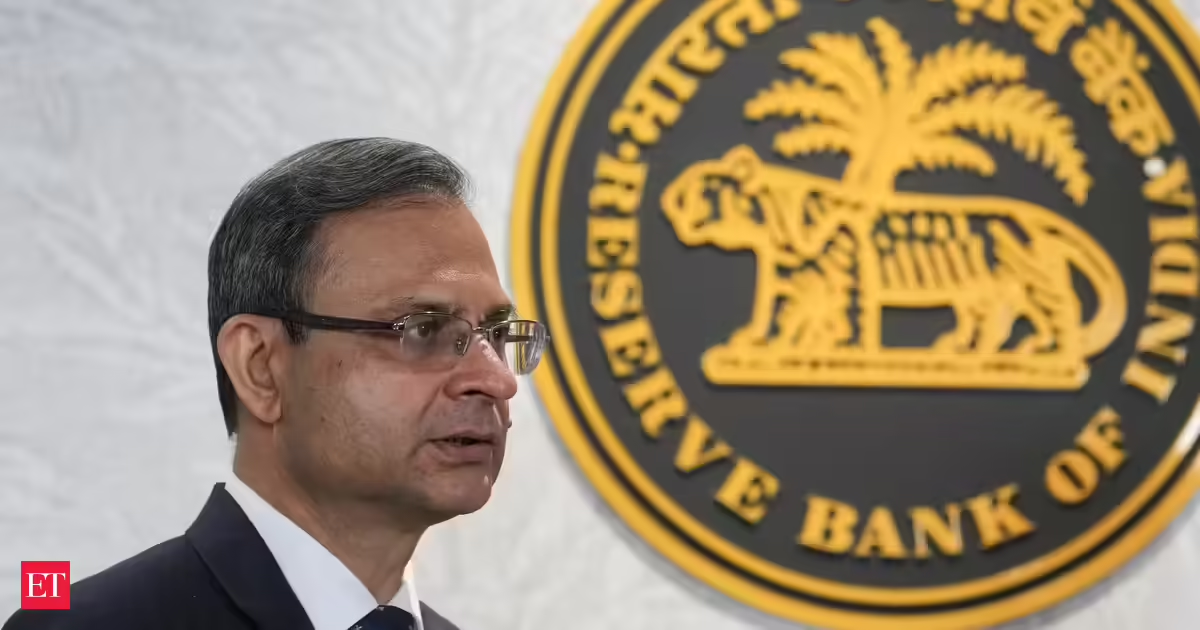
The six-member Monetary Policy Committee (MPC) unanimously voted to keep the repurchase (repo) rate at 5.25%, in line with market expectations, and maintain a neutral stance.
The West Asia conflict and the resulting spike in energy prices weighed heavily on the policy commentary.

Cautious Approach
He said the committee assessed the “intensity and duration of the conflict, and the resultant damage to energy and other infrastructure, add risks to both inflation and growth outlooks,” even as the MPC opted to maintain the status quo.
The RBI projected real GDP growth at 6.9% and headline inflation at 4.6% for FY27, based on a baseline assumption of crude oil prices at $85 per barrel in the current fiscal year and $75 per barrel in the next. For the first time, the central bank also provided a projection for core inflation (excluding food and fuel) at 4.4%.
Both inflation estimates remain within the RBI’s target band of 2-6%, though governor Malhotra said risks to the projections are tilted to the downside amid elevated geopolitical uncertainty.Stocks, rupee advance
Markets reacted positively to the news of the ceasefire, with benchmark bond yields falling 15 basis points to 6.89%, rupee strengthening 40 paise to 92.58 per dollar and Sensex rising 3.95% to close at 77,562.
The governor warned that elevated energy and commodity prices, particularly disruptions related to the Strait of Hormuz, could weigh on growth in 2026-27. He said the conflict could affect the economy through higher crude prices, supply disruptions and global financial spillovers, adding that prolonged supply shocks could eventually translate into weaker demand.
Economists remained cautious on the policy outlook.

How to Use a BA II Plus Calculator For Financial Mathematics | Exam FM | JK Math

Bolton street closed with emergency services in attendance

US SEC Names New Enforcer as Questions Loom over Agency‘s Direction

Why Israel is blocking foreign journalists from entering

Bitcoin: We’re Entering The Most Dangerous Phase

Alan Cumming Brands Baftas Ceremony A ‘Triggering S**tshow’
How to Use a BA II Plus Calculator For Financial Mathematics | Exam FM | JK Math

MAJOR XRP LEAK AT LIVE EVENT! ($33 TRILLION XRP 2026 PLAN!!!)
![Efektif gak sih? [Adira Finance berizin dan diawasi oleh Otoritas Jasa Keuangan] #CobaMoservice](https://wordupnews.com/wp-content/uploads/2026/04/1775683573_maxresdefault-80x80.jpg)
Efektif gak sih? [Adira Finance berizin dan diawasi oleh Otoritas Jasa Keuangan] #CobaMoservice
-

 NewsBeat6 days ago
Steven Gerrard disagrees with Gary Neville over ‘shock’ Chelsea and Arsenal claim | Football
-

 Business6 days ago
No Jackpot Winner and $194 Million Prize Rolls Over
-

 Fashion5 days ago
Weekend Open Thread: Spanx – Corporette.com
-

 Business5 days ago
Expert Picks for Every Need
-

 Business3 days ago
Three Gulf funds agree to back Paramount’s $81 billion takeover of Warner, WSJ reports
-

 Sports4 days ago
India men’s 4x400m and mixed 4x100m relay teams register big progress | Other Sports News
-

 Business7 days ago
Login and Checkout Issues Spark Merchant Frustration
-

 Tech1 day ago
How Long Can You Drive With Expired Registration? What Florida Law Says
-
Business3 days ago
No Jackpot Winner, Prize to Climb to $231 Million
-

 Tech6 days ago
Commonwealth Fusion Systems leans on magnets for near-term revenue
-

 Fashion2 days ago
Massimo Dutti Offers Inspiration for Your Summer Mood Board
-

 Fashion1 day ago
Let’s Discuss: DEI in 2026
-
Politics5 days ago
Wings Over Scotland | The quality of mercy
-

 Business4 days ago
Akebia Therapeutics, Inc. (AKBA) Discusses Pipeline Progress and Strategic Focus on Kidney Disease Treatments at R&D Day – Slideshow
-
 Tech7 days ago
Following Artemis II’s Journey Around The Moon
-

 Fashion6 days ago
Statement Sunglasses: The Accessory Shaping Modern Fashion
-

 Business7 days ago
Investor reactions to Trump’s speech on Iran war
-

 Tech7 days ago
Daily Deal: The Modern No-Code Development Bundle
-

 Politics7 days ago
Trans kids protest the Department of Education
-
Sports6 days ago
Justin Jefferson’s Situation Remains Unchanged after JSN’s Deal
You must be logged in to post a comment Login