

Business
Best Prop Firms in Australia: 2026 Guide

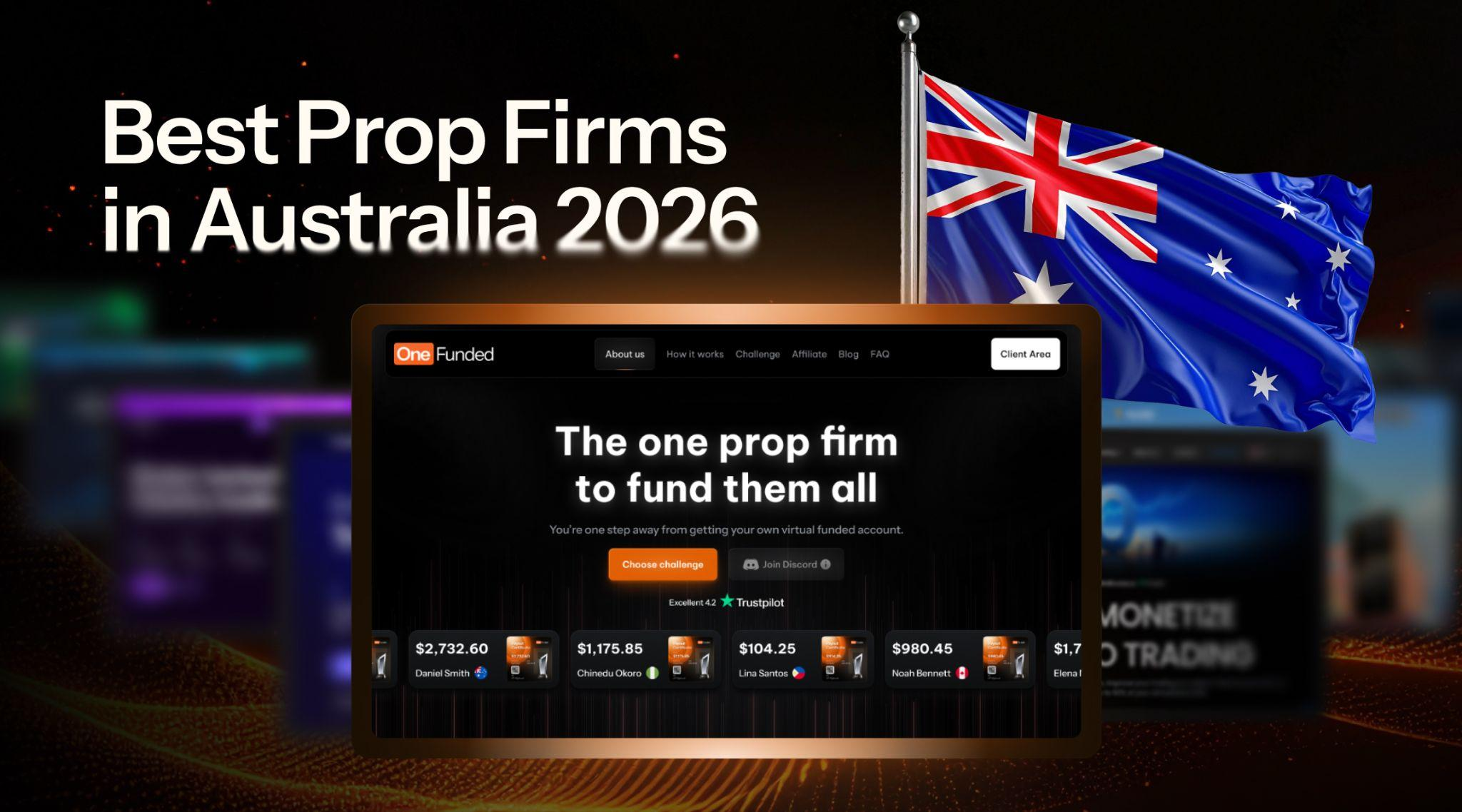
Many of the top global prop firms accept Australian residents. These firms target retail traders who are onboarded via trader challenges, and those who succeed proceed to funded accounts. Some estimates show that 32 prop firms accept traders from Australia, although the real count is likely higher. That volume of options is, on its face, a good thing. But for a trader entering the funded space for the first time, it also creates a problem: how do you know which firm is actually worth your money and your time?
This guide works through that question. We investigated the firms that accept Australian traders and settled on the eight best companies, which we present here.
OneFunded operates under Brynex Tech Limited, registered in the United Kingdom, although it delivers trading services through OneFunded Capital Ltd. based in Saint Lucia. The firm operates on a simulated-trading model, which means that traders pay a one-time evaluation fee, complete a challenge, and upon passing, receive a funded account. This account supports payouts of real profits.
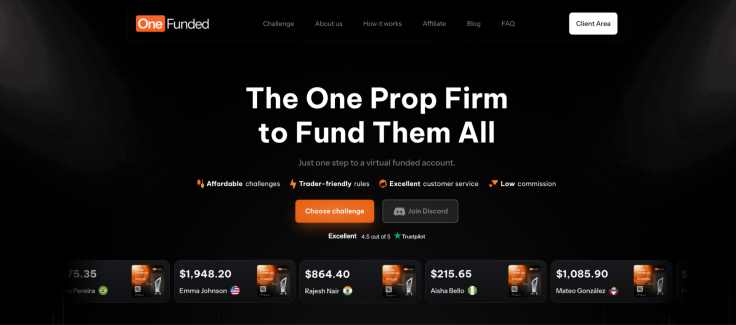
Those who choose OneFunded can trade on cTrader and TradeLocker for now and later on MetaTrader 5 too. They can access these platforms on all devices. But if you are an Australian that wants to trade while abroad, say the United States, cTrader won’t be available to you. This makes TradeLocker the most ideal; it is also the primary platform for most OneFunded traders.
Challenge Structures
OneFunded currently offers four challenge tracks: Flash (1-step), Core (2-step), Value (2-step), and Flex (2-step). You should note from the onset that there are no time constraints across all the tracks. This is an important point to note because it removes the psychological pressure common in evaluations that impose deadlines. This feature allows traders to learn how to set up winning traders without feeling the pressure of deadlines.
Flash (1-Step)
This is the only single-phase evaluation in OneFunded’s line up. So, all you need to do is hit the profit target, meet the minimum trading days, and stay within drawdown limits, and you move directly to a funded account. This makes it the fastest route to funding, though it carries the tightest overall drawdown limit of the four tracks.
Core (2-Step)
The Core challenge uses a two-phase structure with a lower profit target in each phase. The drawdown limits are also wider, making it a more forgiving path for traders who prefer building profit incrementally rather than in a single concentrated push.
Value (2-Step)
The Value challenge is the most affordable entry point among the two-phase tracks. It has identical profit targets across both phases and the lowest fee structure. Our research concluded that this track is suited for traders who want to keep the cost of attempting a funded challenge as low as possible. However, the trade-off is a 35% consistency cap and a non-refundable entry fee.
Flex (2-Step)
Flex is the only challenge that completely disables the consistency rule. This makes it particularly relevant for traders whose strategies are naturally lumpy. That includes swing traders holding for a few large moves, or event-driven traders who generate outsized gains on specific days. It is also the most expensive of the four tracks, and the entry fee is non-refundable.
The table below summarizes the key details across the challenge types:
| Flash | Core (2-Step) | Value (2-Step) | Flex (2-Step) | |
| Account sizes | $5K – $200K | $5K – $200K | $5K – $100K | $5K – $200K |
| Entry fee range | $56 – $899 | $35 – $799 | $29 – $349 | $59 – $959 |
| Phases | 1 | 2 | 2 | 2 |
| Profit target | 10% | 8%/5% | 6%/6% | 7%/4% |
| Minimum trading days | 5 | 3 per phase | 4 per phase | 3 per phase |
| Maximum daily loss | 4% | 5% | 4% | 4% |
| Maximum overall loss | 6% | 10% | 8% | 10% |
| Consistency cap | 50% | 50% | 40% | Off |
| Trading period | Unlimited | Unlimited | Unlimited | Unlimited |
| Inactivity limit | 60 days | 60 days | 60 days | 60 days |
| Profit split | 80% (90% add-on) | 80% (90% add-on) | 80% (90% add-on) | 80% (90% add-on) |
| Fee refundable? | Yes, 100% | Yes, 100% | No | No |
Trading Rules
OneFunded permits news trading across both evaluation and funded phases. Although this may be restricted during what the firm describes as a “News Volatility Period.” This is a five-minute window on either side of a scheduled high-impact release. During this window, traders may still open, modify, and close positions, but activity that appears designed to exploit price spikes may be flagged for compliance review.
You can also engage in overnight and weekend holding, and there are no mandatory stop-loss requirements. Expert Advisors (EAs) are allowed, though automated strategies that rely on latency arbitrage, data freezing, gap billing, or external delayed data feeds are prohibited.
Payouts
Payouts at OneFunded operate on a 14-day cycle. The first request becomes available on the 15th day following the initial trade on the funded account, covering only the profit earned during those first 14 days. Subsequent payout windows follow the same bi-weekly cadence.
Traders who want access to profits on a shorter cycle can purchase the Weekly Payout Add-on, which reduces the window to every 7 days. The minimum payout amount is $100. And the payment method are Crypto and Bank Transfer
Incentives
OneFunded encourages traders to invest in their career in two ways. First, there is a rewards center. Here, traders accumulate points through platform engagement, which includes completing evaluations, achieving payout milestones, and maintaining consistent trading patterns. These points operate on a progressive redemption scale: 15 points unlock a 15% discount on future challenges, scaling to 100 points which confer a complimentary $5,000 evaluation account.
The second approach is the Leaderboard functionality. This displays verified payout distributions across geographic regions through a self-updating carousel on the platform’s landing page. And it serves dual purposes. First, it provides social proof of the firm’s payout reliability and, second, creates performance benchmarking opportunities.
2. RebelsFunding
RebelsFunding is a European prop firm formally registered as RIFM, S.R.O., and headquartered in Bratislava, Slovakia. The firm was founded by Marek Soska, whose background is in retail trading and trader education; the firm grew out of a trading education business that had been operating since 2015.
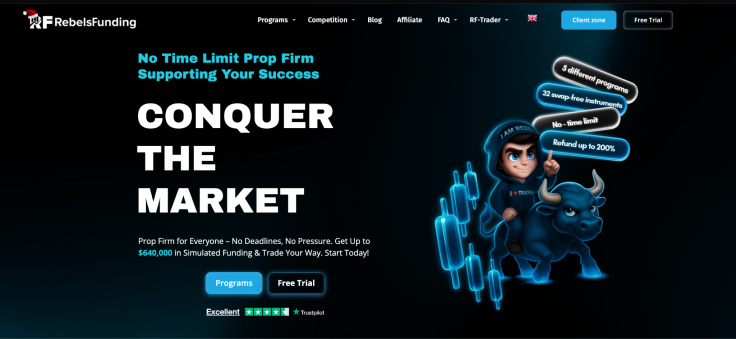
Unlike many competitors in this list, RebelsFunding use their own trading platform called RF-Trader. This platform has TradingView charts as a key feature but keeps execution and risk monitoring within their own system. It is available on web, desktop, and mobile.
Program Structure
The company offers five different evaluation programs ranging from a four-step gradual assessment to instant funding. These programs are named after metals and gemstones in ascending order of complexity: Copper (4-phase), Bronze (3-phase), Silver (2-phase), Gold (1-phase), and Diamond (1-phase, 10-level). Each program targets a different trader profile and carries its own rules, drawdown parameters, leverage caps, and scaling potential.
The table below summarizes the key features for each program:
| Copper | Bronze | Silver | Gold | Diamond | |
| Evaluation Type | 4-Step | 3-Step | 2-Step | 1-Step | Instant Funding |
| Account Sizes | $1K-$320K | $5K-$160K | $2.5K-$80K | $2.5K-$40K | $1K-$20K |
| Phase 1 Target | 5% | 5% | 8% | 10% | 10% (for first payout) |
| Phase 2 Target | 5% | 5% | 5% | N/A | N/A |
| Phase 3 Target | 5% | 5% | N/A | N/A | N/A |
| Phase 4 Target | 5% | N/A | N/A | N/A | N/A |
| Daily Drawdown | 5% | 5% | 5% | 4% | None |
| Max Drawdown | 10% | 10% | 10% | 6% | 6% |
| Min Trading Days | Unlimited time | Unlimited time | Unlimited time | Unlimited time | Unlimited time |
| Min Trades | 4 per phase | 5 per phase | 6 per phase | 8 total | 5 total |
| Leverage (Eval) | 1:200 | 1:200 | 1:100 | 1:50 | 1:50 |
| Leverage (Funded) | 1:100 | 1:100 | 1:50 | 1:50 | 1:50 |
| Profit Split | 80-90% | 80-90% | 75-90% | 75-90% | 75% |
| Fee Range | €9-€812 | €37-€597 | €29-€344 | €41-€230 | €41-€585 |
| Refund Policy | 200% with payout | 150% with payout | 100% with payout | 100% with payout | 100% after passing |
According to our investigation, RebelsFunding’s Copper and Bronze tracks are built for traders who are either newer to the industry or who want to access large capital allocations at the lowest possible entry cost. But the trade-off is more phases, which means more profit targets to hit before reaching the RCF account. The 200% fee refund on Copper is the highest of any program on the list.
The Silver program is the standard two-phase structure, comparable in format to what most prop firms offer. And the Gold track condenses everything into a single phase. This comes with a 10% profit target, tighter drawdown limits, and the lowest leverage ceiling among the multi-account programs at 1:50. It is the most compressed evaluation.
Lastly, Diamond is the most distinctive in terms of structure. It is a 10-level scaling program where the trader completes a short training round (Level 0), earns back 100% of the entry fee upon hitting a 10% profit target, and then progresses through ten increasingly capitalized RCF account levels. The account grows by approximately 60% at each new level. There is no daily drawdown limit on Diamond; only the 6% overall drawdown applies, and the maximum capital a Diamond trader can reach is $530,000. The profit split on Diamond is fixed at 75% across all levels, whereas the other programs start at 75-80% and can progress to 90%.
Trading Rules
RebelsFunding technically allows news trading across all programs. You should note, however, that the firm’s rules strongly advises against holding positions open during high-impact releases such as NFP, GDP, and FOMC events. The language used is advisory rather than prohibitive, but traders should be aware that accounts can be reviewed for compliance after the fact.
Martingale, grid trading, aggressive scalping, and full-margin strategies are all prohibited. Also, a 1.5% maximum risk per trade is specified, with a recommendation to keep individual position risk closer to 0.5%.
Payouts
You can request the first payout on any RCF account no earlier than 14 days from the date of the first trade. And, the minimum withdrawal amount is $50. The firm processes payouts through the client zone, and all positions must be closed before a withdrawal request is submitted.
Scaling Plan
Each program carries a defined growth plan that applies once a trader is on the RCF account. On Copper and Bronze, accounts increase by 25% of the original value for every three consecutive months, where aggregate profit exceeds 15%, with at least two of those months being profitable. After a year of qualified performance, the account can double in size.
Silver and Gold follow a similar structure but require four consecutive qualified months instead of three. This means that progression is slower via these tracks. Diamond’s scaling is automatic and built directly into the program structure. That is, each time a trader hits 10% profit on their current level, the account size increases to the next level, without requiring a separate request or review process.
What RebelsFunding Gets Right, and Where to Look Closely
The breadth of program options is genuinely useful. A trader who is new to the space and wants to minimize entry cost while building a track record can start with Copper at €9 for a $1K account. On the other hand, a trader with a consistent but slow approach who wants maximum scaling potential has Diamond. The range is wider than most firms on this list.
The areas that deserve attention are the expert advisor (EA) restriction and the news trading advisory. Traders who rely on automated systems will need to look elsewhere. And traders whose edge involves holding positions through major macro events should read the rules documentation carefully before committing, since “advisory” language can translate into practical consequences at payout time.
3. FTMO
FTMO is the benchmark against which most other prop firms are measured, especially because it is one of the established companies in the industry. The firm was founded in 2014 under the Czech name Získej účet, or Get an Account in English, operating only in the Czech Republic and Slovakia, before rebranding to FTMO in 2017 when it expanded internationally.

The company has built a massive infrastructure around trader education and analytics. It operates the FTMO Academy and the Account MetriX dashboard for performance tracking. This educational overlay is a notable investment in trader development beyond the basic challenge-passing model.
The firm supports four trading platforms: MetaTrader 4, MetaTrader 5, cTrader, and DXtrade. FTMO also distinguishes between account types through “Normal” and “Aggressive” risk profiles. The latter doubles both profit targets and drawdown allowances for traders seeking accelerated evaluation.
Challenge Structure
FTMO recently introduced a 1-Step challenge alongside its legacy 2-Step process. This move, the company said, gives traders more paths to join the most established prop firm in the prop trading sector.
Both paths operate with unlimited time to complete, though they differ significantly in fee refundability and profit-split structures. The table below summarizes the key features:
FTMO 2-Step Evaluation (Standard Model):
| Account Size | Phase 1 Target | Phase 2 Target | Max Daily Loss | Max Overall Loss | Min Trading Days | Fee |
| $10,000 | 10% | 5% | 5% | 10% | 4 days | €89 |
| $25,000 | 10% | 5% | 5% | 10% | 4 days | €250 |
| $50,000 | 10% | 5% | 5% | 10% | 4 days | €345 |
| $100,000 | 10% | 5% | 5% | 10% | 4 days | €540 |
| $200,000 | 10% | 5% | 5% | 10% | 4 days | €1,080 |
For all 2-Step accounts, the trading period is unlimited and fees are 100% refundable on first reward withdrawal.
FTMO 1-Step Evaluation:
| Trading Objective | FTMO Challenge | FTMO Account |
| Profit Target | 10% | Unlimited |
| Max Daily Loss | 3% | 3% |
| Max Overall Loss | 10% | 10% |
| Profit Split | – | 90% |
| Max Account Size | $200,000 | $200,000 |
The 1-Step Challenge condenses the profit target into a single 10% target but retains the entry fee regardless of outcome. And as it was before, you begin to earn payouts at the FTMO account level.
Trading Rules
FTMO has detailed, published trading rules that apply throughout both the evaluation and the funded phase. The following is the list of permitted tools and strategies:
- Swing trading and overnight holding (on Swing account type)
- EAs/automated strategies, but must remain within server load limits, that is max 2,000 server requests/day.
- Scalping
The prohibited list includes:
- Gap trading, that is, opening positions within two hours of a scheduled major news event or within two hours before a relevant market closes for two or more hours.
- Gap-based news trading, specifically exploiting price gaps around high-impact macro events
- Opposite-position hedging across connected accounts (hedging on a single account is permitted)
- Deliberately managing positions to exploit the firm’s evaluation structure
- Using slow or erroneous price feeds
- High-frequency/ultra-speed tools that give unfair advantages
Payouts
- The base profit split is 80% to the trader, which can climb to 90% after meeting scaling plan criteria.
- Payout frequency is bi-weekly and the average processing time is 8 hours
- 100% of the challenge fee is refunded with the first payout
- Payment methods include Mastercard, Visa, Discover, Diners Club, Apple Pay, Google Pay, Skrill, and cryptocurrency
Pros and Cons
Pros:
- Established track record since 2014 with consistent payout history and substantial processing volumes.
- Entry fee fully refunded on the 2-Step Challenge upon first successful payout
- Comprehensive educational resources
- Choice of four trading platforms including MetaTrader 4, MetaTrader 5, cTrader, and DXtrade.
- No time limits on evaluations, allowing traders to wait for optimal market setups.
Cons:
- 1-Step Challenge offers no fee refund, increasing the cost of unsuccessful attempts.
- News trading restricted within 2-minute windows around high-impact releases, limiting strategy flexibility.
- Fees are charged in euros regardless of account currency
4. The5ers
The5ers is operated by Five Percent Online Ltd., a company registered in Israel, and has been active since 2016. The firm describes its core philosophy as prioritizing fair play, transparency, and genuine trader development over short-term profit extraction. As of 2025, the firm has onboarded over 262,000 funded traders, employs 148 staff across 23 countries, and processes roughly 3,740 payouts monthly.

Program Structure
The5ers offers three CFD evaluation programs, Hyper Growth (1-step), High Stakes (2-step), and Bootcamp (3-step). There is also a Futures track that includes Basecamp and Rebate programs.
All CFD trading is conducted on MetaTrader 5, or MT5 Hedge, and accounts are denominated in USD, EUR, GBP, and INR. The firm’s standout feature is the ability to scale up to $4 million on the Hyper Growth path and $500,000 on the High Stakes path.
The table below summarizes the challenges and their key details:
| Hyper Growth | High Stakes | Bootcamp | |
| Evaluation Steps | 1-Step | 2-Step | 3-Step |
| Account Sizes | $5K-$20K | $2.5K-$100K | $20K-$250K |
| Phase 1 Target | 10% | 8% | 6% |
| Phase 2 Target | N/A | 5% | 6% |
| Phase 3 Target | N/A | N/A | 6% |
| Max Drawdown | 6% | 10% | 5% |
| Daily Limit | 3% | 5% | None (evaluation);3% (funded) |
| Minimum Trading Days | None | 3 profitable days (0.5% min) | None |
| Time Limit | Unlimited | Unlimited | Unlimited |
| Profit Share | Up to 100% in eval and funded | $2 in Step 1;80-100% in funded | Up to 100% in funded account |
The Hyper Growth program offers the fastest path to funding. Traders pay a one-time fee, starting at $260 for a $5K account, and must hit a single 10% profit target with no time cap. The account doubles at each milestone up to a maximum of $4,000,000.
High Stakes is the firm’s most popular program and features the highest leverage of the three plans at 1:100. Phase 1 requires an 8% profit target; Phase 2 requires 5%. Once funded, traders scale every 10% toward a maximum of $500,000. A unique feature is that Phase 1 pays a small cash reward ($2 per step) before the trader is funded.
The5ers positions the Bootcamp program as the most capital-efficient entry. Phases 1 through 3 each require a 6% profit target on progressively larger demo balances before a trader is funded with a live account starting at $20K, $100K, or $250K depending on the track chosen. The Bootcamp path scales on a 5% milestone cadence and can grow to $4 million.
Trading Rules
These differ by program, particularly around news trading and leverage, but several policies apply across all tracks. For example:
- Overnight and weekend holding is permitted across all programs. For indices, weekend holding is allowed but carries high swap costs.
- News trading: For Hyper Growth and Bootcamp, news trading is permitted except for bracket strategies placed around high-impact events. For High Stakes, orders may not be executed within 2 minutes before or after high-impact news releases.
- Accounts with no trading activity for 30 or more consecutive days are automatically expired across all three programs.
- EAs are permitted provided the trader owns the source code
- Prohibited practices include: arbitrage, high-frequency trading, bulk/simultaneous multi-trade execution, one-sided betting, tick scalping, hedge arbitrage, account sharing, account reselling, and pass-your-challenge services.
Payouts
Payout access opens after a trader reaches the first funded level. From that point, withdrawals can be requested on a biweekly basis.
Available withdrawal methods include crypto (2% commission), Rise (2% commission), bank transfer (3% commission), and hub credits (no commission, usable only toward buying new accounts).
Pros and Cons
Pros:
- Scaling potential up to $4 million
- 100% profit split with fixed monthly bonuses at elite High Stakes tiers
- Unlimited trading days on evaluations
- Wide range of educational resources, including blog, academy, and tools
Cons:
- Minimum profitable days requirement
- High Stakes prohibits news trading
- All withdrawal methods carry a processing fee, 2%-3%, with the exception of hub credits, which are non-withdrawable.
5. ThinkCapital
ThinkCapital is legally registered as Think Capital Services UK Ltd., and is headquartered in London, United Kingdom. The firm launched in 2024 as a subsidiary of ThinkMarkets, a multi-regulated global brokerage with over 15 years in the industry. As of 2026, ThinkCapital has attracted over 40,000 traders to its community and has paid out over $5 million to funded traders worldwide.

The broker-backed model is the firm’s most standout structural feature. All trading infrastructure, execution, and liquidity are powered by ThinkMarkets. The broker holds licenses from multiple tier-1 regulators including the FCA (UK) and ASIC (Australia). This distinguishes ThinkCapital from the majority of prop firms that operate on white-labeled retail platforms with no underlying regulatory oversight. Traders also benefit from a proprietary platform, ThinkTrader, as well as direct TradingView integration and Platform 5.
Challenge Structure
ThinkCapital offers three evaluation paths: Lightning (1-step), Dual Step (2-step, with Intraday and Swing sub-variants), and Nexus (3-step). And account sizes range from $5,000 to $100,000 at the challenge level, and the maximum funded allocation reaches $1,000,000.
The table below provides a summary of the accounts and key features:
| Lightning (1-Step) | Dual Step Intraday (2-Step) | Dual Step Swing (2-Step) | Nexus (3-Step) | |
| Account Sizes | $5K-$100K | $5K-$100K | $5K-$100K | $5K-$100K |
| Phase 1 Profit Target | 10% | 9% | 9% | 7% |
| Phase 2 Profit Target | — | 5% | 5% | 6% |
| Phase 3 Profit Target | — | — | — | 5% |
| Max Loss Limit | 6% | 7% | 7% | 8% |
| Daily Loss Limit | 3% (Balance-based) | 4% (Equity-based) | 4% (Balance-based) | 4% (Balance-based) |
| Min. Trading Days | 3 | 3 | 3 days | 3 days |
| Leverage | 1:30 | Dynamic up to 1:100 | Dynamic up to 1:100 | 1:100 |
| News Trading | Not allowed (4-min window) | Not allowed (4-min window) | Allowed | Not allowed (add-on available) |
| Weekend Holding | Allowed | Not allowed | Allowed | Allowed |
| Entry Fee range | $59 ($5K);$499 ($100K) | $59-$499 | $82-$698 | $59-$499 |
The Lightning program is ThinkCapital’s fastest evaluation path. However, the Dual Step program is the most structurally flexible program due to its two sub-variants tailored for different styles. The Intraday variant uses an equity-based daily loss and prohibits news trading and weekend holding. This makes it ideal for traders who enter and exit within a session. The Swing variant uses a balance-based daily loss, and it permits news trading without restriction, and allows weekend holding. This is a great option for traders who hold positions across multiple sessions.
Trading Rules
- All three programs require at least three profitable trading days before a challenge phase can be completed.
- There is no maximum trading period on any of the three programs
- An account is subject to closure if no trades are placed for 30 or more consecutive days across all programs.
- EAs are permitted across all programs without restriction on whether the trader owns the source code.
- No consistency rule is enforced on any of the three programs
Payouts and Profit Split
The base profit split across all programs starts at 80%. You can escalate the share to 90% through scaling or using an addon. And there is no consistency rule requirement before requesting a payout.
The standard payout cycle is biweekly, although traders can access weekly payouts by purchasing an addon. Before the first withdrawal, funded traders must achieve three separate profitable trading days where the account balance is above the starting balance, with each of those days generating at least 0.5% profit. This consistency metric is specifically tied to payout qualification, not to challenge phase completion.
Withdrawal methods include cryptocurrency, USDT (TRC20/ERC20) and USDC, which is generally the fastest option, Rise; with a $50 monthly flat fee for processing, and ThinkMarkets Live Account.
Pros and Cons
Pros
- Being broker-backed provides a level of execution quality, financial stability, and counterparty credibility rarely found in standalone prop firms.
- The ability to transfer profits directly into a personal ThinkMarkets brokerage account.
- No consistency rule on any program
- Dual Step Swing variant gives news traders and swing traders a purpose-built path without requiring any add-on purchase.
Cons
- News trading restricted by default on Lightning and Nexus
- Payout 0.5% consistency requirement before first withdrawal
- Rise payout method carries a recurring $50 flat fee per month
6. BrightFunded
BrightFunded, like OneFunded, is a new company, launched in late 2023, that is coming up quickly, especially in Australia. The company is headquartered in Dubai and has satellite offices in Amsterdam, Netherlands and Warsaw, Poland. Despite its age, the firm claims to have already paid out more than $11.5 million to funded traders and counts over 27,500 active participants globally.
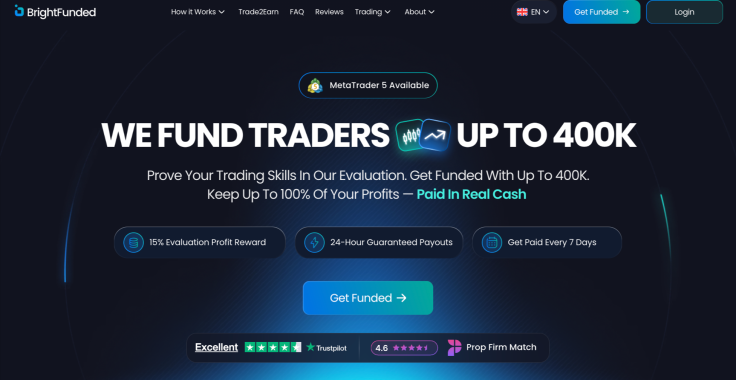
The prop firm describes its model as a “modern prop trading firm,” that emphases fast payouts, transparent rules, and a proprietary loyalty rewards program it calls Trade2Earn. Australians can access all of BrightFunded programs and services without any restrictions.
Challenge Structures
BrightFunded offers a single evaluation program, which it has structured into two phases. The challenge is available across six account sizes, with entry fees scaling proportionally from smaller to larger allocations.
The structure is straightforward. Traders must hit an 8% profit target in Phase 1 and 5% in Phase 2. While at it, they must keep daily drawdown below 5% and total drawdown below 10% at all times. Both phases have unlimited trading periods and a minimum of 5 trading days per phase.
See the table below for details:
| Account Sizes | $5K/$10K/$25K/$50K/$100K/$200K |
| Phase 1 Target | 8% |
| Phase 2 Target | 5% |
| Daily Drawdown | 5% |
| Maximum Drawdown | 10% (static from initial balance) |
| Minimum Trading Days | 5 per phase |
| Time Limit | Unlimited |
| Leverage | Up to 1:100 |
| Entry Fee Range | €55-€975 |
| Fee Refund | Yes (with first payout) |
| Profit Split Start | 80% |
| Maximum Profit Split | 100% (via scaling) |
Trading Rules
One of the key rules is the drawdown style, where the firm enforces a static EOD high-watermark drawdown. It measures the limit against the highest balance or equity recorded at the close of the previous trading day. This means drawdown limits do not trail intraday price peaks, which is notably trader-friendly compared to firms using trailing drawdowns.
On news trading, the rules vary by account phase. In phase one and two of the challenge stage, news trading is unrestricted. Traders may open, close, or adjust positions around any economic event without limitation.
But when it gets to the Funded Star Account, a 10-minute window applies to targeted instruments. Opening or closing trades, or triggering stop loss or take profit orders within this window, constitutes a “soft breach.” That is, profits from the affected trade are deducted, but the account is not terminated. Trades held for more than 48 hours prior to the event and closed during the window are exempt.
The firm also prohibits certain strategies across all phases, including:
- Hedging across multiple accounts
- Exploiting platform delays, data feed lags, or technical errors
- Coordinated multi-account manipulation
- Grid trading, arbitrage, tick scalping, and high-frequency trading
- Use of AI or automated tools designed for superhuman execution speed
- Overleveraging, overexposure, or account rolling
Payouts
Once a trader passes the second phase and signs their Funded Star Account contract, they may request their first payout after 30 days from placing the first trade on the funded account. Subsequent payouts can be requested every bi-weekly by default.
The company supports payouts via bank transfer, processed in Euros, and USDC via ERC-20 network. It processes payouts within 24 hours of request.
Pros and Cons
Pros
- No consistency rules or profit caps
- Fixed drawdown, not trailing
- Unlimited trading period for the evaluation phase
- 24-hour payouts with a minimum threshold of $0.01
- Trade2Earn loyalty program rewards trading volume with redeemable tokens for free evaluations, discounts, and higher profit splits.
Cons
- Headquartered in Dubai with no regional presence in Australia or the Asia-Pacific
- Payouts are denominated in Euros or USDC
- Scaling is not automatic; traders must proactively request it through support
7. City Traders Imperium
City Traders Imperium, or CTI, launched in 2018 in London, the UK, but operates from Dubai. The firm describes itself as a unique organization because it has two distinct offerings under one roof: a trading academy and a funding division. These programs run concurrently. The academy side, CTI Academy, is included free with every funding program purchase, meaning Australian traders are not just getting capital access but an accompanying educational environment built by practicing traders.
But the company’s most defining feature must be the VIP Program. This is a loyalty tier system that rewards consistent funded traders with progressively better conditions. It culminates at the Gold level where a potential one-year monthly salary is available.
Challenge Structures
If you choose CTI, you can join via two evaluation paths or two instant funding tracks. The second instant funding path is a VIP program that operates differently from the other three.
The table below summarizes the key details of the paths:
| 1-Step Challenge | 2-Step Challenge | Instant Funding | Instant Funding Pro | |
| Account Sizes | $2.5K-$100K | $2.5K-$100K | $2.5K-$80K | $5K-$80K |
| Phase 1 Profit Target | 8% | 10% | 10% per level to scale | 10% per level to scale |
| Phase 2 Profit Target | N/A | 5% | N/A | N/A |
| Max Daily Drawdown | None | 5% of initial balance | None | None |
| Max Overall Drawdown | 5% trailing | 10% static | 6% static | 6% static |
| Min Profitable Days | 3 | 3 per phase | Based on Consistency Score (20%) | Based on Consistency Score (20%) |
| Profit Share | 80%-100% for CTI Trader (Funded) | 80%-100% for CTI Trader (Funded) | Up to 100% | Up to 100% |
| Entry fee range | $27-$412 | $34-$482 | $62-$1,315 | $263-$4,223 |
The firm also operates a VIP Program that rewards consistent performance with escalating benefits. Some of its key features include:
- Funded Account: 80% profit split, monthly payouts
- Bronze Tier: 90% profit split, weekly payouts
- Silver Tier: 100% profit split, on-demand payouts
- Gold Tier: 100% profit split, on-demand payouts, plus one-year salary opportunity
Scaling occurs when traders achieve 10% profit targets in the funded account. This doubles account sizes up to a maximum of $4 million in total buying power. The firm permits up to three accounts simultaneously, with specific combination rules, for example, one $250,000 account plus two $100,000 accounts.
Trading Rules
CTI’s rules are quite permissive by industry standards. They include:
- The 1-Step Challenge uses a maximum trailing drawdown of 5%
- The 2-Step Challenge uses a balance-based daily drawdown, 5%, and a static overall drawdown, 10%. Both are calculated from the initial balance rather than floating equity.
- The Instant Funding programs use a static drawdown of 6% of the initial balance with no daily cap and no trailing component.
- Permitted strategies include: News trading, Weekend and overnight trade holding, Third-party EAs are permitted on the 1-Step Challenge, provided they are not used for copy trading.
Payouts
CTI, like most prop firms, supports payouts at the funded stage. The first payout is on demand once the trader has at least seven profitable trading days and a minimum of 2% net profit, or $100, whichever is greater. Subsequent payouts are monthly, during the last five business days of each month. And after the trader’s first 10% cumulative profit is achieved, payouts become bi-weekly.
If you achieve funded status via the instant funding track, you get 50% profit share at level 1, but after you hit the 10% profit target. From Level 2 onwards, and all Instant Pro levels, the first payout is on demand, but only once you reach five profitable trading days and 2% net profit. The firm supports withdrawals via bank cards, bank transfers, Wise, PayPal, Revolut, and crypto.
Pros and Cons
Pros:
- Monthly salary program provides steady income for funded traders regardless of monthly performance.
- All challenge types allow unlimited time to complete
- News trading, weekend holding, and automated strategies permitted without restrictions.
- Fast payout processing within 24 hours via cryptocurrency or bank transfer
- Profit splits scale up to 100% through the VIP Program
Cons:
- CTI is not regulated by ASIC
- First payout requires seven profitable trading days plus 2% profit
- Instant Funding option starts with only 50% profit split, lower than industry standard entry levels.
8. FXIFY
FXIFY launched in 2023 and is operated by FXIFY Solutions Limited, a UK-registered company based in London. It has a separate licensed entity, FXIFY Markets Ltd., that holds a money broker license in Labuan, Malaysia. According to its founders, David Bhidey and Peter Brown, FXIFY was built on the foundation of a group of fintech and FX companies. They describe themselves as carrying over 20 years of brokerage industry experience. The firm uses FXPIG, a licensed broker, as its partner for execution.
Challenges Structure
FXIFY’s range of programs is the widest available across the firms in this list. There are five distinct products within the FX/CFD division alone, and one crypto-focused path. The following table summarizes the key details of the non-crypto tracks:
| One Phase | Two Phase | Three Phase | Instant Funding | Lightning Challenge | |
| Evaluation Phases | 1 | 2 | 3 | None | 1 |
| Account Sizes | $5K-$400K | $5K-$100K | $5K-$400K | $1K-$100K | $10K-$100K |
| Phase 1 Profit Target | 10% | 5% | 5% | No target | 5% |
| Phase 2 Profit Target | N/A | 10% | 5% | N/A | N/A |
| Phase 3 Profit Target | N/A | N/A | 5% | N/A | N/A |
| Max Daily Drawdown | 3% | 4% | 5% | 8% | 3% |
| Max Overall Drawdown | 6% trailing | 10% static | 5% static | 8% trailing | 8% |
| Min Trading Days | 5 | 5 per phase | 5 per phase | N/A | 3 |
| Time Limit | Unlimited | Unlimited | Unlimited | N/A | 5 days |
| Consistency Rule | None | None | None | None | 30% |
| Profit Split | Up to 90% | Up to 100% | Up to 90% | Up to 90% | Up to 90% |
| News Trading | Allowed | Allowed | Allowed | Not allowed | Not allowed |
| Weekend/Overnight Holds | Allowed | Allowed | Allowed | Not allowed | Allowed |
| EAs | Allowed | Allowed | Allowed | Not allowed | Not allowed |
| Entry fee range* | $42.48-$2124 | $42.48-$395.28 | $49.68-$1151.28 | $28.08-$3059.28 | $42.48-$287.28 |
*The entry fees are discounted.
Permitted and Prohibited Strategies
- News trading is fully permitted on One Phase, Two Phase, and Three Phase programs, and proscribed on Instant Funding or Lightning Challenge accounts.
- EAs and algorithmic trading are permitted on evaluation accounts only
- Martingale and grid strategies are listed as permitted addons in FXIFY’s checkout, though the prohibited strategies policy cautions against “doubling down” in a pure loss-recovery context without underlying risk management.
- Reverse hedging, group hedging, account management, and high-frequency trading are all expressly prohibited.
Payouts
Like most firms, payouts are available for funded traders. And FXIFY supports on demand on several account types, although this is only possible after a minimum of five trading days and a $50 minimum account balance. Also, no minimum profit percentage is required for the first payout. Subsequent payouts are allowed monthly, or bi-weekly if you purchase the Bi-Weekly Payouts addon at checkout.
FXIFY processes payouts via Rise, and where this method is unavailable, the firm supports crypto.
Pros and Cons
Pros:
- Fee is 125% refundable upon first payout
- Unlimited time on most challenges
- Broker-backed infrastructure through FXPIG
- First payout is truly on demand after 5 trading days with no minimum profit percentage target.
Cons:
- Lightning and Instant Funding programs prohibit EAs
- News trading is restricted on Instant Funding and Lightning Challenge accounts
- Trailing drawdown on One-Phase and Two-Phase programs tightens risk limits as profits accumulate.
How These 8 Firms Compare at a Glance
| Firm | Max Allocation | Profit Split | Evaluation Steps | Best Feature | Trustpilot Rating |
| OneFunded | $200,000 | 80% (up to 90%) | 1-Step or 2-Step | Rewards Center; Leaderboard; unlimited evaluation time; 100% fee refund on Flash and Core, Clear and Transparent Rules | 4.5/5 |
| RebelsFunding | $320,000 (up to $530,000 via scaling) | 75-90% | 1-Step, 2-Step, 3-Step, 4-Step, or Instant | Five tiered programs (Copper to Diamond); up to 200% fee refund on Copper; proprietary RF-Trader platform | 4.4/5 |
| FTMO | $200,000 | 80% (up to 90%) | 1-Step or 2-Step | Established track record since 2014; FTMO Academy educational resources; Account MetriX analytics; fee refund on 2-Step | 4.8/5 |
| The5ers | $4,000,000 | Up to 100% | 1-Step, 2-Step, or 3-Step | Scaling potential up to $4 million; monthly salary at elite High Stakes tiers ($4,000-$10,000); unlimited time on all programs | 4.8/5 |
| ThinkCapital | $1,000,000 | 80% (up to 90%) | 1-Step, 2-Step, or 3-Step | Broker-backed by regulated ThinkMarkets; direct TradingView integration; Dual Step Swing variant permits news trading | 4.1/5 |
| BrightFunded | $200,000 | 80% (up to 100%) | 2-Step | Trade2Earn loyalty token program; static EOD drawdown (not trailing); no consistency rules | 4.3/5 |
| CTI | $4,000,000 | 80-100% | 1-Step, 2-Step, or Instant Funding | Monthly salary program for funded traders; VIP Program tiers (Bronze/Silver/Gold) with escalating benefits; unlimited time on all challenges | 4.4/5 |
| FXIFY | $400,000 | Up to 90% (up to 100% on Two Phase) | 1-Step, 2-Step, 3-Step, or Instant | 125% fee refund upon first payout; five distinct program paths (One Phase to Lightning); broker-backed via FXPIG | 4.4/5 |
What to Look for When Choosing a Prop Firm in Australia
It doesn’t really matter where you are, in Australia or elsewhere, the rules of choosing a prop firm are the same. In that case, here are a few tips to guide you:
Regulatory Standing and Company Transparency
No prop firm operating in Australia is currently regulated by ASIC; that applies to every firm on this list. But what separates the more trustworthy ones from the rest is transparency about who runs the company, where it is registered, and who holds the trading capital.
So, look for firms that publish their company registration details, have verifiable leadership, or operate through a licensed broker partnership. Beyond registration, check whether the firm has an Australian Privacy Policy, accepts Australian traders explicitly, and has a track record of consistent payouts.
Challenge Rules That Match Your Trading Style
The fine print in a prop firm’s rulebook can end your funded account faster than a losing trade. Before signing up, identify what your trading style actually requires and match it against the firm’s rules. Watch out for:
- Drawdown type: Static drawdowns are more predictable; trailing drawdowns move with your equity, which can catch swing traders off guard
- Consistency rules: Some firms require that no single day account for more than a set percentage of total profits, which restricts aggressive trading days
- News trading: If you trade around RBA rate decisions or US NFP, confirm the firm allows it.
- Weekend holds: Relevant for traders who carry positions over the Sydney open on Monday mornings
Pricing, Fees, and the Fee Refund Policy
Challenge fees vary significantly across firms, and the cheapest option is not always the best value. For instance, a $59 Two Phase challenge sounds attractive, but if it comes with no fee refund, a tighter drawdown, and a lower performance split, then a slightly more expensive program with a 100% refund on the first payout may cost less in practice.
Performance Split and Scaling Potential
The profit split percentage is what most traders focus on, but the scaling plan matters just as much for anyone thinking beyond their first funded account. A firm offering 80% on a $10K account with no scaling path is worth less over time than one offering 75% on a $100K account that can grow to $4M.
Payout Reliability and Methods Available to Australian Traders
A funded account is only as valuable as the firm’s ability to pay you. For Australian traders, the most practical payout routes are bank transfer and cryptocurrency; both are widely supported. The primary platform used by most firms on this list is Rise (RiseWorks), which supports bank withdrawals in AUD once KYC is completed.
Also, check reviews specifically for payout complaints, not just general satisfaction scores. Look at how long payouts typically take, whether there is a minimum withdrawal threshold that suits your trading size, and whether the firm has ever paused or delayed payments without clear communication. Firms with a published payout leaderboard or live proof-of-payment feeds offer an additional layer of confidence.
Customer Support and Community
When something goes wrong, the quality of support determines whether you recover from it or simply lose your account. So, look for firms that offer live chat during hours that overlap with the Australian trading day, maintain an active Discord or community, and respond to support tickets within a reasonable timeframe.


NEW YORK — Shares of United Microelectronics Corporation jumped more than 17% on Tuesday, climbing to $21.34 as investors responded to robust April revenue figures and growing optimism about the company’s position in the expanding artificial intelligence semiconductor market.
The Taiwanese foundry operator, one of the world’s largest contract chipmakers, reported April consolidated sales of NT$22.66 billion, up 10.8% from the same month a year earlier. The strong monthly performance contributed to year-to-date sales of NT$83.70 billion, representing a 6.88% increase over the first four months of 2025.
The surge in UMC stock reflects renewed confidence in the semiconductor sector’s recovery and the company’s ability to benefit from rising demand for advanced chips used in artificial intelligence applications, automotive electronics and consumer devices. UMC has been expanding its capacity in higher-margin segments, including 22-nanometer and 28-nanometer processes, which are seeing strong utilization rates amid global supply constraints.
Analysts noted that UMC’s April results signal improving momentum after a period of softer demand in certain end markets. The company has benefited from increased orders from fabless chip designers seeking capacity outside of leading-edge foundries dominated by TSMC. This diversification strategy has helped UMC maintain stable utilization rates even as the broader industry navigates cyclical pressures.
United Microelectronics reported solid first-quarter 2026 earnings earlier this month, with revenue and earnings per share beating Wall Street expectations. The results were driven by strong performance in specialty technologies and steady contributions from its 12-inch wafer fabs. Management highlighted improving customer demand and disciplined cost management as key factors supporting profitability.
The company’s focus on mature and specialty process nodes has proven advantageous in the current market environment. While leading-edge nodes remain dominated by a few players, UMC’s expertise in 28nm, 22nm and specialty technologies serves a broad base of customers in automotive, industrial and communications sectors. These markets are seeing sustained demand driven by electrification, automation and 5G/6G infrastructure buildouts.
UMC’s strategic partnerships and capacity expansion plans have also drawn positive attention. The company continues investing in its global manufacturing footprint, with ongoing upgrades at facilities in Taiwan and Singapore. These investments are aimed at meeting growing demand for power management, display driver and embedded memory solutions.
Tuesday’s sharp move in UMC shares extended a strong performance for semiconductor stocks tied to AI and specialty applications. The Philadelphia Semiconductor Index has posted solid gains this year, supported by expectations of continued capital spending by technology companies building out artificial intelligence infrastructure.
Investors appear to be rewarding UMC’s conservative approach and focus on profitability rather than chasing leading-edge market share. The company has maintained a disciplined capital expenditure program while generating strong free cash flow, providing flexibility for dividends, share buybacks and strategic investments.
Analysts have generally maintained positive outlooks on UMC. Several firms have raised price targets in recent weeks, citing improving industry fundamentals and UMC’s attractive valuation relative to peers. The stock’s current levels reflect expectations of sustained mid-single-digit revenue growth and margin expansion through 2027.
The semiconductor industry continues navigating a complex environment. Geopolitical tensions, particularly around U.S.-China technology restrictions, have created both challenges and opportunities for foundry operators. UMC has focused on compliance and diversification to mitigate risks while capitalizing on demand from customers seeking stable, non-restricted capacity.
For UMC, the current upcycle in specialty semiconductors provides a favorable backdrop. Automotive and industrial customers are increasing orders for chips used in electric vehicles, renewable energy systems and factory automation. These long-cycle markets offer more predictable demand patterns compared to consumer electronics.
The company’s April sales figures mark the second consecutive month of double-digit year-over-year growth, suggesting the inventory correction that weighed on the industry in 2025 has largely run its course. Management has expressed confidence that utilization rates will continue improving through the remainder of 2026.
United Microelectronics maintains a strong balance sheet with low debt levels and healthy cash reserves. This financial flexibility allows the company to weather cyclical downturns while pursuing growth opportunities. The firm has consistently paid dividends, providing income alongside potential capital appreciation for shareholders.
As the trading day progressed, UMC shares remained among the top performers in the semiconductor sector. The move highlights the market’s rotation toward companies with strong fundamentals and exposure to multiple growth drivers rather than pure AI plays that have commanded premium valuations.
Looking ahead, UMC’s second-quarter results, expected in July, will be closely watched for further confirmation of its guidance and margin trends. Analysts anticipate continued sequential improvement as seasonal demand patterns and new capacity come online.
The broader semiconductor outlook remains constructive. Artificial intelligence, automotive electrification and industrial digitization are creating multi-year demand tailwinds. UMC’s specialty focus positions it well to capture a meaningful share of this growth while avoiding direct competition in the most capital-intensive leading-edge nodes.
For investors, UMC offers exposure to a more stable segment of the semiconductor value chain. While not immune to industry cycles, the company’s diversified customer base and focus on essential technologies provide downside protection compared to more volatile memory or leading-edge logic suppliers.
Tuesday’s trading volume was significantly elevated as the stock broke through recent resistance levels. The move suggests broad participation from both institutional and retail investors drawn to UMC’s improving fundamentals and attractive valuation.
The semiconductor sector’s momentum appears intact, with UMC joining other specialty players in posting strong gains on positive industry data. Investors will continue monitoring global chip demand, inventory levels and geopolitical developments as the year progresses.
United Microelectronics’ performance this year demonstrates the market’s appreciation for consistent execution and strategic focus. As the company advances its capacity expansion and technology roadmap, it remains well-positioned to deliver value for shareholders in an increasingly digital and connected world.


Phoenix is a developer and manufacturer of fragrance and flavor extracts.
Business
Intuitive Machines Shares Surge 15% on Strong Lunar Program Momentum and NASA Contract Wins

NEW YORK — Intuitive Machines Inc. shares climbed more than 15% on Tuesday, reaching $44.17 in morning trading as investors cheered the company’s continued progress on key NASA lunar missions and expanding commercial opportunities in the rapidly growing space infrastructure sector.
The Houston-based space technology company, known for its Odysseus lunar lander and advanced robotic systems, has emerged as a leader in commercial lunar services. Tuesday’s sharp move reflects growing confidence in Intuitive Machines’ ability to execute on its backlog of government and private contracts while positioning itself at the forefront of the U.S. return to the Moon.
Intuitive Machines reported strong first-quarter results earlier this month, with revenue exceeding expectations and significant milestones achieved on its IM-2 and IM-3 missions. The company has secured multiple NASA Commercial Lunar Payload Services contracts and is advancing preparations for crewed lunar operations under the Artemis program.
Analysts have grown increasingly bullish on the company’s outlook. Several firms raised price targets in recent weeks, citing accelerating demand for lunar landing services and Intuitive Machines’ technological edge in precision navigation and payload delivery. The stock’s performance this year has been exceptional, with shares more than tripling as investors rotate into companies benefiting from increased government and commercial space spending.
The latest rally was fueled by positive updates on the company’s upcoming missions and strategic partnerships. Intuitive Machines recently completed critical testing for its next lunar lander, demonstrating improved reliability and payload capacity. The company is also expanding its manufacturing capabilities to meet growing demand from both NASA and private customers seeking lunar surface access.
Intuitive Machines’ success builds on the foundation of its Odysseus mission, which achieved the first U.S. commercial lunar landing in 2024. That milestone established the company as a credible player in a market previously dominated by government agencies. Subsequent missions have refined landing precision and expanded scientific capabilities, strengthening customer relationships and competitive positioning.
The broader space economy continues expanding rapidly. NASA’s Artemis program, commercial satellite deployments and emerging lunar resource initiatives are driving demand for reliable transportation and infrastructure services. Intuitive Machines is well-positioned to capture a meaningful share of this market through its flexible lander designs and end-to-end mission support.
Company executives have expressed confidence in the long-term opportunity. CEO Steve Altemus has highlighted the transition from development to operational cadence, with multiple missions planned annually. This increased flight rate is expected to drive revenue growth and margin expansion as fixed costs are spread across a larger number of launches.
Intuitive Machines reported first-quarter revenue of $41.2 million, up significantly from the prior year. The company maintains a healthy backlog that provides visibility into future quarters. Management has guided for continued revenue growth through 2026 as new contracts are executed and commercial opportunities mature.
The stock’s surge also comes amid broader strength in the aerospace and defense sector. Increased government investment in space technology, combined with private sector interest in lunar commerce, has created favorable conditions for specialized providers like Intuitive Machines. The company’s focus on lunar logistics and surface operations differentiates it from pure launch providers.
Analysts project strong growth for Intuitive Machines over the next several years. Consensus estimates call for revenue to more than double by 2027 as mission cadence increases and new services are introduced. Profitability is expected to improve as scale benefits materialize and higher-margin contracts contribute more significantly to the mix.
For investors, Intuitive Machines represents exposure to one of the most compelling secular growth stories in technology and aerospace. The combination of government contracts, commercial partnerships and expanding lunar economy creates multiple avenues for value creation. However, the stock’s volatility reflects typical risks associated with space companies, including technical challenges and dependence on large government programs.
Tuesday’s trading volume was significantly elevated as the stock broke through recent resistance levels. The move suggests broad participation from both institutional and retail investors drawn to the company’s progress and the expanding space economy narrative.
Intuitive Machines continues investing in research and development to maintain its competitive edge. Recent advancements in autonomous navigation, thermal management and payload integration have strengthened its offering for future missions. The company is also exploring opportunities in space infrastructure, including potential lunar communications and power services.
The space sector’s momentum appears intact, with Intuitive Machines joining other players in posting strong gains on positive operational updates. Investors will continue monitoring mission outcomes, new contract awards and financial performance as the year progresses.
For long-term investors, Intuitive Machines offers exposure to the commercialization of space and the growing lunar economy. The company’s achievements to date demonstrate technical capability and execution strength, positioning it for potential leadership in an industry still in its early stages of development.
As markets digest the latest gains, attention will turn to upcoming mission milestones and earnings reports. Intuitive Machines’ ability to deliver on its ambitious targets will determine whether current enthusiasm translates into sustained shareholder value in the years ahead.
The latest surge adds another chapter to what has been a remarkable period for Intuitive Machines shareholders. The stock’s performance underscores the market’s appetite for high-growth stories in strategically important sectors, even as broader economic uncertainties persist.
With multiple missions planned and expanding commercial opportunities, Intuitive Machines stands at the center of the next phase of space exploration. Its success could play a significant role in shaping humanity’s return to the Moon and beyond.


A long-term investor focused on quality growth stocks at a reasonable price. My investment objective is to identify market asymmetries with positive reward-to-risk. I invest in high-quality, wide-moat companies that generate strong cash flow and trade at a fair price relative to their value. Please feel free to subscribe to my channel to support its development.
Analyst’s Disclosure: I/we have a beneficial long position in the shares of RDDT, META either through stock ownership, options, or other derivatives. I wrote this article myself, and it expresses my own opinions. I am not receiving compensation for it (other than from Seeking Alpha). I have no business relationship with any company whose stock is mentioned in this article.
Seeking Alpha’s Disclosure: Past performance is no guarantee of future results. No recommendation or advice is being given as to whether any investment is suitable for a particular investor. Any views or opinions expressed above may not reflect those of Seeking Alpha as a whole. Seeking Alpha is not a licensed securities dealer, broker or US investment adviser or investment bank. Our analysts are third party authors that include both professional investors and individual investors who may not be licensed or certified by any institute or regulatory body.

Running a children’s home in England means living under a level of scrutiny that most businesses never experience. Ofsted’s oversight is relentless, and rightly so.
The stakes are extraordinarily high. Yet despite how central inspection is to the sector, a surprising number of myths persist about how the process actually works.
These misconceptions aren’t harmless. They lead providers to drop their guard at the wrong moment, misread their compliance obligations, or waste energy preparing for inspections that aren’t coming while being caught off guard by ones that are.
Let’s set the record straight.
Myth 1: “Outstanding homes barely get inspected”
This is perhaps the most dangerous myth in the sector. The logic sounds reasonable – if a home has already proven it’s excellent, surely Ofsted focuses its attention elsewhere?
Not so. Every registered children’s home in England receives at least one full inspection every year, regardless of its previous grade. Outstanding, Good, Requires Improvement, Inadequate – the minimum annual full inspection applies to all. There is no inspection holiday for high performers.
What a strong previous judgement can influence is whether a home also receives an interim inspection within that same regulatory year, but it certainly doesn’t remove the home from Ofsted’s calendar.
Myth 2: “You’ll know when inspectors are coming”
Some providers still operate as though inspection is an event they can prepare for in the weeks before it arrives. This is a fundamental misunderstanding.
All Ofsted inspections of children’s homes are unannounced. There is no notice period. Inspectors prepare internally the day before, but the home itself receives no warning. The first you’ll know about a full inspection is when the inspector arrives at your door.
This is precisely why inspection readiness cannot be a project; it has to be a culture. Homes that perform well under inspection are the ones running to the same standard on a quiet Tuesday in February as they are the week after a previous visit.
Myth 3: “If no one has complained, we won’t get a monitoring visit”
Monitoring visits are often misunderstood as something triggered solely by complaints or serious incidents. In reality, Ofsted uses a much broader range of intelligence to decide when to make an additional visit.
Regulation 44 and Regulation 45 reports are completed by the independent person and typically by a member of the home’s management team respectively. These key monitoring tools feed directly into Ofsted’s risk picture. Notifications of specific incidents, changes in staffing, or patterns in missing episodes can all prompt a monitoring visit without any formal complaint ever being made.
Monitoring visits are also unannounced and, while they don’t produce an overall grade, a standard progress outcome is given and Ofsted’s findings can influence the next full inspection.
Myth 4: “How often does Ofsted inspect depends mainly on your rating”
When people ask how often does Ofsted inspect, the instinct is to assume the answer is a simple sliding scale linked to your grade. In practice, Ofsted’s approach is risk-based, and rating is only one input.
Factors including the profile of children currently placed, how accurately the home identifies and manages individual risks, recent notifications and safeguarding concerns, and intelligence gathered from a range of sources all shape Ofsted’s decisions. A home rated Good that has recently seen a pattern of serious incidents may attract more scrutiny than an Inadequate home that is demonstrably improving.
Understanding this helps providers think about compliance differently – not as a performance put on for inspectors, but as an ongoing discipline in risk management and documentation.
Myth 5: “The inspection framework stays the same year to year”
Given how much operational pressure providers are already under, it’s tempting to assume that once you understand the framework, it stays fixed. It doesn’t.
The Social Care Common Inspection Framework (SCCIF) for children’s homes has evolved significantly in recent years, with substantial changes coming into effect from April 2026. These updates are specifically designed to encourage homes to accept children with higher and multiple needs which has been a long-standing tension in the sector where providers have historically been reluctant to take more complex placements for fear of the impact on their Ofsted rating.
Staying current with framework changes isn’t optional. What inspectors are looking for, how they weigh specific findings, and how interim inspections work can all shift between regulatory years.
What this means in practice
The common thread running through all of these myths is the same: inspection is not a discrete event that happens to you once a year. It is a continuous regulatory relationship.
Providers who understand this build their quality assurance, their supervision practices, their record-keeping, and their risk management around year-round standards rather than inspection preparation. They are the ones who consistently perform well when inspectors do arrive.
The homes that struggle are often not the ones doing bad work. They’re the ones whose good work isn’t visible, documented, or embedded in the way inspectors need to see it.

Ies Holdings stock hits all-time high at 701.51 USD


I analyze securities based on value investing, an owner’s mindset, and a long-term horizon. I don’t write sell articles, as those are considered short theses, and I never recommend shorting.I was initially interested in a career in politics, but after reaching a dead-end in 2019 and seeing the financial drain this posed, I choose a path that would make my money work for me and protect me from more setbacks. This brought me to study value investing, in order to grow wealth with risk management in mind.From 2020 to 2022, I worked in a sales role at a law firm. As the top-grossing salesman, I eventually managed a team and contributed to our sales strategy. I spent much of my free time reading books and annual reports, steadily building my vault of knowledge about public companies. This period has since been useful in helping me assess a company’s prospects by its sales strategy. I particularly get excited when the product seems to sell itself.From 2022 to 2023, I worked as an investment advisory rep with Fidelity, primarily with 401K planning. My personal study before that allowed me to pass my Series exams two weeks ahead of schedule, and I once again found myself excelling at the job. I learned a few useful things from this more formal setting, but my main frustration was that I was still a value investor, and Fidelity’s 401K planning was based on modern portfolio theory. Lacking a way to change positions internally, I chose to walk away after a year.I gave writing for Seeking Alpha a try in November of 2023, and I’ve been here since. As I spent those years saving aggressively and building up my base of capital, I also actively invest now. My articles are how I share the opportunities that I seek for myself, and my readers are effectively walking this road alongside me.
Analyst’s Disclosure: I/we have no stock, option or similar derivative position in any of the companies mentioned, and no plans to initiate any such positions within the next 72 hours. I wrote this article myself, and it expresses my own opinions. I am not receiving compensation for it (other than from Seeking Alpha). I have no business relationship with any company whose stock is mentioned in this article.
Seeking Alpha’s Disclosure: Past performance is no guarantee of future results. No recommendation or advice is being given as to whether any investment is suitable for a particular investor. Any views or opinions expressed above may not reflect those of Seeking Alpha as a whole. Seeking Alpha is not a licensed securities dealer, broker or US investment adviser or investment bank. Our analysts are third party authors that include both professional investors and individual investors who may not be licensed or certified by any institute or regulatory body.

The meaning of home has changed dramatically in recent years. Buyers are no longer looking only for location, size, and price. They are also thinking about comfort, health, efficiency, privacy, flexibility, and how a home supports daily life.
Across major real estate markets, especially in lifestyle-driven cities like Los Angeles, residential demand is increasingly shaped by two powerful forces: smart technology and wellness-focused living.
A modern home is no longer just a place to live. It is a place to work, recharge, entertain, raise a family, protect privacy, and support a better quality of life.
Buyers Want Homes That Support Daily Well-Being
Wellness has become one of the most important lifestyle priorities for many homeowners. This does not always mean luxury spas or dramatic architectural features. Often, it begins with the basics: natural light, clean air, quiet interiors, outdoor space, thoughtful layouts, and a sense of calm.
Homes that feel bright, open, and peaceful can create a stronger emotional response during showings. Buyers may not always describe it in technical terms, but they often know when a property feels healthy and comfortable.
In Los Angeles neighborhoods such as Glendale, Studio City, Sherman Oaks, Encino, Toluca Lake, and Calabasas, buyers often look for properties that offer a balance between city access and personal retreat. A home that provides privacy, greenery, flexible space, and indoor-outdoor flow can stand out quickly.
Smart Home Features Are Becoming Expected
Technology is no longer a bonus in many homes. It is becoming part of the standard buyer expectation.
Features such as smart thermostats, security systems, video doorbells, energy-efficient lighting, automated shades, EV charging readiness, and app-controlled climate systems can add convenience and perceived value.
For some buyers, especially younger professionals and families, smart home features make a property feel more current and easier to manage. For luxury buyers, they can support privacy, comfort, and efficiency.
However, technology alone does not create value. The best smart home features are those that improve daily living without making the home feel complicated. Buyers want convenience, not confusion.
The Rise of Flexible Living Spaces
One of the biggest shifts in residential real estate is the demand for flexible spaces.
Today’s buyers often want rooms that can serve multiple purposes. A guest bedroom may also function as a home office. A garage may become a gym or creative studio. A formal dining room may be used as a workspace, playroom, or media area.
This flexibility matters because modern lifestyles are less predictable than before. People work from home, run businesses remotely, host guests, care for family members, and spend more time inside their homes.
In competitive real estate markets, properties that offer adaptable layouts often appeal to a wider range of buyers.
Indoor-Outdoor Living Remains a Major Advantage
In Southern California, indoor-outdoor living continues to be one of the strongest lifestyle features a home can offer.
Patios, balconies, courtyards, gardens, pools, outdoor kitchens, and shaded seating areas can significantly influence buyer interest. These spaces support wellness, entertaining, relaxation, and the California lifestyle many buyers are seeking.
Even a small outdoor area can become a meaningful selling point if it is presented well. A private patio with thoughtful landscaping may be more memorable than a larger but poorly designed yard.
For sellers, this means outdoor spaces should not be treated as an afterthought. They should be staged and marketed as an extension of the home.
Energy Efficiency Is Becoming More Important
As utility costs and environmental awareness continue to influence buyer decisions, energy-efficient features are becoming increasingly valuable.
Buyers may pay attention to:
- Updated windows
- Solar potential
- Efficient HVAC systems
- Smart thermostats
- Insulation quality
- LED lighting
- Water-conscious landscaping
- EV charger compatibility
While not every buyer prioritizes sustainability equally, many appreciate homes that feel more efficient and future-ready.
In markets where buyers compare multiple properties, these features can help a home feel more practical and responsible.
Local Lifestyle Still Drives the Final Decision
Even with wellness features and technology, location remains central to real estate decisions. The difference is that buyers now evaluate location through a lifestyle lens.
They want to understand how a neighborhood will support their routines. Is it close to parks, cafés, schools, studios, hiking trails, shopping, or major work centers? Does it feel quiet or energetic? Is it better for entertaining, family life, privacy, or convenience?
This is especially important in Los Angeles, where nearby neighborhoods can offer very different lifestyles. Beverly Hills, Burbank, Glendale, Encino, Sherman Oaks, Studio City, and Toluca Lake each attract buyers for different reasons.
For buyers and sellers navigating these lifestyle-driven decisions, local guidance matters. Tooyn Homes provides a boutique real estate experience focused on neighborhood knowledge, thoughtful marketing, and helping clients make confident decisions in the Los Angeles market.
Sellers Should Highlight More Than Features
A common mistake in real estate marketing is listing features without explaining their lifestyle value.
For example, a smart thermostat is not just a device. It represents comfort and energy control. A backyard is not just outdoor space. It represents relaxation, entertaining, and privacy. A home office is not just an extra room. It represents flexibility and productivity.
Successful marketing connects features to benefits.
Instead of simply saying a property has large windows, strong marketing should communicate natural light, openness, warmth, and atmosphere. Instead of only mentioning a remodeled kitchen, it should show how the space supports gathering, hosting, and daily living.
Buyers respond more strongly when they can imagine how a home will improve their life.
Wellness and Technology Work Best Together
The strongest modern homes often combine wellness and technology naturally.
A property with smart climate control, abundant natural light, quiet bedrooms, security features, efficient systems, outdoor space, and flexible rooms can feel both comfortable and future-ready.
This combination appeals to buyers because it supports real daily needs. It offers convenience without sacrificing warmth. It offers modern function without losing emotional appeal.
In many cases, the best homes are not the most complicated or the most heavily upgraded. They are the homes that feel intuitive, balanced, and easy to live in.
The Future of Real Estate Is Human-Centered
Technology will continue to influence residential real estate, but the most important factor will remain human experience.
Buyers want homes that support health, comfort, privacy, productivity, and connection. Sellers who understand this shift can position their properties more effectively. Agents who understand both market data and lifestyle psychology can create stronger outcomes for their clients.
The future of real estate is not only about smarter homes. It is about homes that help people live better.
As buyers become more selective, properties that combine thoughtful design, wellness, technology, and neighborhood lifestyle will continue to stand out in competitive markets.

Through the bonus share, Fredun’s strategic intent is to reward shareholders for their sustained confidence and long-term commitment to the company’s growth vision. The move signals management’s confidence in the structural earnings growth and long-term scalability of the business with multiple high-growth engines firmly in place, the company’s filing to the exchanges said.
This includes branded generic exports to 52 countries, domestic Fredun Gx formulations, an integrated pet healthcare platform (Freossi, Wagr and One Pet Stop), nutraceuticals, and cosmeceuticals (Bird N Beauty) — the Company is well-positioned to sustain its growth trajectory.
The inauguration of its 5th GMP-certified manufacturing facility in April 2026 provides significant capacity headroom to support the next phase of scaling across all verticals.
This move not only aligns with the company’s consistent value creation philosophy but also reinforces its commitment to delivering long-term, inclusive wealth creation for shareholders.

The smallcap pharma company is into pharmaceutical formulation manufacturing, diversified across generics, cosmeceuticals, nutraceuticals, mobility, and animal healthcare products.
The Board of Directors, at its meeting held on May 25, 2026, wherein the audited financial results for Q4 and FY26 were approved, has recommended the issuance of bonus shares in the ratio of 2:1, i.e. In FY26, Fredun reported total revenues of Rs 639.12 crore, with an Earnings Before Interest, Taxes, Depreciation and Amortisation (EBITDA) of Rs 94.79 Cr along with a profit after tax (PAT) of Rs 33.21 crore.Commenting on the development, Managing Director Fredun Medhora said, “The recommendation of a 2:1 bonus issue reflects the strong momentum we have built and our confidence in sustaining this growth trajectory. With robust performance across revenue and profitability, and continued progress in diversifying into higher-value segments such as nutraceuticals, cosmeceuticals and pet healthcare, we are strengthening the quality and scalability of our business”. This bonus is a way of sharing our progress with shareholders while reinforcing our commitment to consistent, long-term value creation, he added.
(Disclaimer: The recommendations, suggestions, views, and opinions given by the experts are their own. These do not represent the views of The Economic Times.)
Business
Innovative Aerosystems: Looks Fairly Priced With Lower Intermediate Growth Ahead (NASDAQ:ISSC)


Investment research, primarily oriented towards uncelebrated/under-covered stocks and ETFs, across North America, Latin America, Europe and Asia. Seeks to combine both fundamental and technical disciplines while making an investment/trading proposition.
Analyst’s Disclosure: I/we have no stock, option or similar derivative position in any of the companies mentioned, and no plans to initiate any such positions within the next 72 hours. I wrote this article myself, and it expresses my own opinions. I am not receiving compensation for it (other than from Seeking Alpha). I have no business relationship with any company whose stock is mentioned in this article.
Seeking Alpha’s Disclosure: Past performance is no guarantee of future results. No recommendation or advice is being given as to whether any investment is suitable for a particular investor. Any views or opinions expressed above may not reflect those of Seeking Alpha as a whole. Seeking Alpha is not a licensed securities dealer, broker or US investment adviser or investment bank. Our analysts are third party authors that include both professional investors and individual investors who may not be licensed or certified by any institute or regulatory body.

This decision rule changes everything #finance #shorts

United Microelectronics Shares Surge 17% on Strong April Sales and AI Chip Demand

CME adds Avalanche and Sui futures as regulated altcoin bets go mainstream

US brings back mandatory military draft registration

Steven Gerrard disagrees with Gary Neville over ‘shock’ Chelsea and Arsenal claim | Football

Register Renaming | Hackaday
This decision rule changes everything #finance #shorts

TRUTH REVEALED About GOLDMAN SACHS DUMPS ALL XRP & SOLANA ETFs! 13F Filing

Tom Lee & Raoul Pal :”Important Warning To All Small Bitcoin & Crypto Investors” (New Prediction)
-

 Crypto World5 days ago
Blockchain.com files with SEC for U.S. IPO
-

 Fashion4 days ago
Holiday Weekend Open Thread – Corporette.com
-

 Business4 days ago
Dell Technologies DELL Stock Surges 15% on AI Server Momentum and Analyst Upgrades in 2026
-

 Crypto World4 days ago
Bitcoin Accumulation Weakens as BTC Realized Losses Hit $600M
-

 Crypto World4 days ago
Space X IPO Is ‘Bad News’ for Tech Stocks: But What About Bitcoin?
-

 Politics4 days ago
Makerfield: a tale of two social-media histories
-

 Crypto World3 days ago
Robinhood crypto COO Tanya Denisova exits
-

 Business2 days ago
NYT Strands Answers May 24 2026 Revealed for Puzzle No. 812 Theme Summer Essentials
-

 Crypto World5 days ago
MicroStrategy’s Saylor Says Miners No Longer Set Bitcoin Price, Another Force Has Taken Over
-

 Crypto World4 days ago
AI infrastructure race heats up as IREN pitches full-stack strategy, WhiteFiber lands $160M deal
-

 Tech5 days ago
WhatsApp ads could make Irish debut after discussions with DPC
-
 Tech4 days ago
A 0.12% parameter add-on gives AI agents the working memory RAG can’t
-

 Tech5 days ago
You Can Now Add ChatGPT To PowerPoint
-

 Business4 days ago
Trump Invests $1M-$5M in Kura Sushi USA Chain With 27 California Locations
-
 NewsBeat5 days ago
Charity run by Reform leader Malcolm Offord accused of ‘law breaking’ over Scottish registration
-

 Sports5 days ago
2026 CJ Cup Byron Nelson leaderboard: Brooks Koepka finds putting stroke in Round 1
-

 Crypto World6 days ago
Exa Labs raises $250 million in funding led by a16z
-
Business4 days ago
Goldman Sachs reinstates Ageas stock coverage with neutral rating
-
 Crypto World4 days ago
Verus Bridge Hacker Returns $8.5M ETH, Keeps $2.8M as Bounty
-

 Tech1 day ago
Microsoft’s quiet Claude Code retreat and the real cost of enterprise AI
You must be logged in to post a comment Login