High Yield Investor‘s Samuel Smith shares his thoughts on energy, gold and silver (0:40) Context on yield (11:00) Context on dividend cuts (16:20) Updated thoughts on private credit and Blue Owl (18:30)
Transcript
Advertisement
Rena Sherbill: Samuel Smith, our friend who runs his investing group, High Yield Investor, welcome back to Investing Experts.
Samuel Smith: Thanks for having me. Always good to be with you, Rena.
Rena Sherbill: Yeah, always great to talk to you. Last time you were on, you were sharing with us your number one pick for the year, which is Blue Owl (OWL), which has done fantastically since then. So easy to see why you picked it. J.K. for all those following along. You know, that’s not true.
So primarily, I wanted to ask your thoughts, your updated thoughts on Blue Owl, but also how you’re thinking about this market a lot to contextualize for sure.
Advertisement
So maybe a brief reintroduction for those who don’t know you. And then if you would share with us your thoughts on this current market, that’d be awesome.
Samuel Smith: Sure. I’m Samuel Smith. I run the High Yield Investor group, as Rena just said. I’ve been an analyst on Seeking Alpha, I believe since 2017 or 2018. So I’ve been here for a good while. It’s my passion. I spend pretty much all day, just about every day doing it.
I love exchanging ideas with members of my investing group. I learned a lot from them. Hopefully they learn some things from me. And I’m just happy to be here to discuss the market today and can dig into anything specifically that you had in mind.
Rena Sherbill: Maybe just broadly speaking, how you would encourage investors to think about investing. There’s obviously with the geopolitical events happening, there’s a lot of questions about the safe haven sectors that haven’t necessarily reacted the way people have thought. A lot of questions about tech. I know that those aren’t the things that you cover, but just generally speaking, how you would encourage investors to think about the market, broadly speaking?
Advertisement
Samuel Smith: Sure. And actually I do cover some areas of tech and I do cover safe haven sectors like gold (XAUUSD:CUR) and precious metals because their income generating opportunities there that we take advantage of. But broadly speaking, okay, first I’ll touch on the kind of the safe havens.
I mean, obviously I guess it depends how you define safe haven at high old investor. We’ve taken kind of a two pronged approach where we have like last year we were loading up heavily on energy. fact, so take it back a few years back in 2022, 2023, I emphasized to my investing group members very strongly that I felt that gold was my highest conviction buy at the time.
And because I could see the geopolitical cloud, storm clouds forming, also we had all that inflation coming out of COVID that hadn’t carried over to gold yet. And gold tends to kind of lag those sorts of things. And so I felt that gold was really high conviction buy. We loaded into it. Obviously that thesis played out really nicely. We also played some of the miners, which further leveraged our returns.
But then silver (XAGUSD:CUR), early last year right around this time last year actually was April of 2025 I then switched and said okay silver is now my highest conviction pick because it has not rallied nearly like gold has even though there was a structural shortage involved.
Advertisement
It has some of the similar somewhat similar monetary and safe haven status is gold though, obviously not quite as prominent and There’s a lot of silver demand due to the electrification AI boom, etc so we poured into silver and then silver took off like a rocket.
And then late last year, I then shifted again and said, hey, I think energy is now the top buy and that whole real asset safe haven type play because of lingering tensions with the Israel Iran conflict. Obviously there was the midnight hammer raid on the nuclear facilities in Iran, but it just seemed like there was unfinished business there.
Energy prices were down. I thought energy stocks were way too cheap, including midstream especially because midstream isn’t even that sensitive in the near term cash flow wise to energy price volatility and fluctuations.
So I actually was pouring into midstream because you get these really high yields, really strong clean balance sheets, good growth potential, especially in the distribution. And then on top of that, some of them have significant exposure to both natural gas and energy exports.
Advertisement
And so with the AI data center boom leading to a strong demand for natural gas, and again, the threats of war in the Middle East and just the ongoing changing of global alignments here, I felt that US energy exports were going to be increasingly valuable moving forward.
So all that made me say, hey, energy, especially midstream is my top pick. And so we were actually very well positioned, even though I didn’t expect necessarily the US and Israel to do what they did in February of this year, I was not making that call at all.
I did view that as a lingering risk along with those other factors. So actually our portfolio has done really well year to day, even though gold has stumbled a bit, which is probably what you’re alluding to and the whole safe havens not performing like safe havens in the event of the Iran war, because obviously we’re already up a lot in those, but our energy stocks, which made up over a third of our portfolio coming into the year have done exceptionally well, obviously.
And gold actually in silver have done fine year to date. They started off with a bang in January and since have come back down.
Advertisement
But I think that gold obviously hasn’t performed quite as many as have expected for multiple reasons. I can get into that if you want. think the biggest reason is simply just that one, it was on such a strong rally to begin with that it made sense for some breather time, but also the reduced chance of Fed rate cuts this year hurt gold a lot because of the inflation fears from oil spiking that hurt gold.
I think China took a little bit of a break for a short period, although they picked up now since it pulled back. And there were some reports of Turkey also selling some gold to prop up their currency in the face of some of the issues.
Also, the gold trade, which largely goes through the Middle East, places like the Emirates, has been disrupted somewhat due to the war in Iran. And so that has probably disrupted gold markets a little bit as well.
So I think all those factors combined to cause gold to underperform somewhat.
Advertisement
But actually, if you look at the long-term fundamentals that have resulted from the war in Iran, namely increased US deficits, US is asking for a lot of money from Congress, the Trump administration is to fund this war, ongoing geopolitical instability, fracturing of the so-called global dollar order, increasingly fracturing along the lines of the China, Russia, Iran, North Korea, and maybe a few others block versus the US and its allies getting fractured and continued stress between the US and Europe over this war, threats to the durability of NATO and other factors there.
All of that adds up to be, I think, a net negative for the dollar over time, which is inevitably going to be a net positive for gold. So this period, actually, I’ve increased my gold holdings. There were some gold miners that oversold in response to some of these factors. I bought the dip and my backup significantly in them.
And then of course gold itself, I think it’s worth buying on any meaningful dips because I’m very bullish in it long term primarily due to my bearishness on the dollar because of some of the factors already mentioned especially the runaway spending by the US and the changing global order landscape.
So to speak all those factors. I think it was a good opportunity, a golden opportunity so to speak to take advantage of and so I trim some of my energy holdings that have gone up a lot in some of the isolated cases where I think they’ve overshot to the upside and reallocated that capital towards part of it towards towards gold and gold miners.
Advertisement
Some of it I’ve also put into private credit plays like Blue Owl Capital, which I’m sure we’ll talk about, to take advantage of what I think has been an overblown market reaction to what’s going on. So happy to dig in any more of that, but hopefully that addressed what you were talking about.
Rena Sherbill: With gold and silver, you mentioned specific miners, is it specific miners and ETFs, or how are you playing the gold and silver angle?
Samuel Smith: I think ETFs are fine. The thing is, it’s kind of like the opposite of how I’m taking with energy right now.
I think individual energy stocks, some of them overshoot and some of them undershoot obviously. So some that overshot to the upside, I sold. Ones that didn’t, I’ve continued to hold because I still have a lot of energy exposure. I think there’s still lot of uncertainty in the Middle East and beyond. I just think energy is a good place to be right now in general from a relatively long-term perspective.
Advertisement
And precious metals, I’ve done the same. I’ve been in individual stocks. I think an ETF is fine for a long-term position or if you want to trade up and down with gold price trends.
But in terms of a value investor, I try to take advantage of disconnect. So I’ve been buying individual gold miners where I felt that they oversold in response to news and changes in their fundamentals, where those are perhaps not, or maybe the other ones were so overvalued to begin with that now they’re just, you know, they just retreated back to a fair value or even still weren’t even fairly valid.
They’re still overvalued, but specific miners that I thought were undervalued or were maybe at fair value, now pulled back sharply, I think are good buying opportunities. So those are the ones I’ve been buying.
And I’ve also been investing in some bullion investment opportunities as well with direct exposure to bullion that are interesting that I detail it for my subscribers at High Yield Investor.
Advertisement
Rena Sherbill: Anything that you would say about the bond market or treasuries?
Samuel Smith: Yeah, I’m not a big fan of bonds.
In general, don’t think the 10-year treasury rate is high enough to compensate for, like I said, the risks to the dollar long term, risks of inflation re-accelerating.
So I just I don’t like treasuries. I do invest occasionally in bonds, usually at the low end of the investment grade or high end of the sub-investment grade area, as well as preferreds in that similar range.
Advertisement
And that’s just, if I feel like the yield on those is good and it’s a specific bond that I feel like, okay, these guys are very likely going to pay back. And the yield is high relative to what I see as a perceived risk.
Other than that, of course, there are a few actively managed bond and preferred ETFs that we invest in a high-end investor, right? The manager’s got a really good strategy and he’s got a proven track record about performing. So we take advantage of those as well.
Treasuries and investment grade bonds,there could be some opportunities there, but I’m not seeing really any right now. Again, this is from someone who values total returns. And if I’m going to invest in fixed income, I want a decent yield and some upside potential to go along with it. I’m just not seeing that because I think interest rates are too low, frankly.
Rena Sherbill: I want to get to the private credit sector and Blue Owl, but if we could spend a minute or two on the yield conversation as a high yield investor, we had Scott Kaufman on from the Dividend Kings and he was encouraging investors to be extra careful when it comes to things like high yielding ETFs or the whole high yielding space in a way to attract investors that might not necessarily be as high value as investors may think it is.
Advertisement
What yield do you target and how do you think about yield, how does it inform your strategy?
Samuel Smith: Sure. So our current, I think both of our portfolios, have a core and we have a retirement portfolio and they both currently yield between seven and 8%.
In terms of my target yield, again, I’m more conscious of that in the retirement portfolio because the primary goal there is maximizing sustainable income while trying to minimize downside risk and volatility. Whereas the core portfolio is focused primarily on maximizing total returns, but in the universe of stocks that in aggregate pay a higher yield.
And so to me, the appeal of high yielding stocks really, especially as a total returns investor, I mean, obviously as an income investor, it’s pretty obvious you get more income.
Advertisement
And then the trick is diversifying and trying to avoid dividend cuts. And if you can do that effectively, you’re all set. But on the total return side, I get asked this a lot, hey, you’re in your mid thirties. Why are you investing in high yield? Why not just chase these high-flying AI tech stocks?
Sure, obviously you can do well with those. People have. I, as a value investor, I like to invest in what I can understand. And it’s much easier to understand a stock that has a high yield and a low growth rate than it is a Palantir (PLTR) that has valuation multiple in the stratosphere and therefore has to grow by an incredible amount to justify that valuation.
Or you have to just hope that you can get lucky, you know, with the greater fool theory and play the sentiment game and hope that someone else will buy it for more than you, even though the fundamentals don’t justify it. So as someone who tries to invest in a logical, rational way, I try to think like a business owner, I’m a Warren Buffett devotee so to speak.
High-yield stocks are generally easy to understand because they generally, again, they pay out high contracted cash flows, at least the sectors I focus on like midstream and other types of infrastructure, whether it utilities or other diversified infrastructure plays, REITs, real estate with long duration leases, contracted cash flows, BDCs, which again, they invest in loans, so they get obviously very contracted cash flows, preferreds, baby bonds, and several other sectors as well, alternative asset managers, and there are others.
Advertisement
And so these sectors all generally pay out very stable cash flows. So it’s pretty easy to build a valuation model. And then when they’re returning the lion’s share of it to shareholders with, I’ll invest occasionally in a 3 to 4 % yielder, but it needs to have very, I need to have very high conviction in both its quality as well as its growth. But generally I like 5 % or higher yields.
And my sweet spot I found is generally five to eight percent, occasionally higher, occasionally lower. But generally most of my investments are five to eight percent because those are often sustainable, especially in the business models I’m talking about.
I look for investment grade balance sheets or at least balance sheets that should be investment grade and, you know, no near term debt maturity cliffs, good control of their interest rate exposure and plenty of cash flow to cover the dividend and also a highly predictable growth profile.
And so then it’s much easier to value those companies. You’re not setting yourself up for this high variance of what is the actual intrinsic value. If a company pays a 7 % yield and is growing between 3 and 5 % a year, you can feel pretty good about, I can build a pretty low variance of what the actual value of this is.
Advertisement
And so then you just let you wait. You identify these companies. You watch them. And you wait for the market to sell them down to a point where you feel pretty good that the valuation multiple compression risk over the long term is quite low unless interest rates just skyrocket. And then you buy them and then you wait for the market to cheer up about them or for interest rates to just fall.
Then they go up when they reach your fair value estimate and you have another replacement while still keeping portfolio diversification and sector and individual stock diversification in mind. You trim or sell, recycle the capital into that other opportunity and you rinse and repeat.
The yield plus growth profile when you’re buying them probably gets you about a 12 % total return in general, but maybe 13, maybe 11, just depending on the individual situation, maybe even 15.
But with the capital recycling, you can turn that low teens annualized rate of return into a high teens or even low 20s. And that’s what we’ve been able to do at High Yield Investor for the five and a half years that we’ve run it. Our annualized rate of return is right around 20 % at a time when the high yield space where we fish has actually returned like 9 something percent.
Advertisement
I think the S&P’s (SP500) return is like 13%. So this strategy works. And it’s something that I understand. I can sleep well at night doing it, even when one of my picks like Owl is going haywire. In aggregate, we’re still up very significantly this year. We’ve significantly outperformed the S&P. So that’s how it’s our approach. That’s how I think about it.
And again, the trick is doing your homework upfront and not reaching for yield. They’re just saying, I’m bored. I’m going to chase this juicy looking yield that’s being very selective only selecting companies that meet your criteria and then being very disciplined about the capital allocation, capital recycling process, not falling in love with a certain stock, but at the same time not panic selling just because it’s going down either.
Rena Sherbill: Doing your homework first, always a fantastic idea. The same question about dividend cuts. How does that inform your strategy or how does your strategy inform how you think about dividend cuts?
Samuel Smith: It depends on the security.
Advertisement
So for example, there’s a lot of people panicking about, BDCs are going to have to cut their dividends because the Fed has been cutting rates, spreads did narrow. Now they’re starting to widen again.
But a lot of some really good BDCs have actually cut their dividends recently and others are barely hanging on. And so there’s all this fear. And you just have to realize when you’re investing in a BDC, you’re effectively investing in a floating rate fund because they invest in loans that are floating rate.
And that’s why they’re being cut. So if that’s why they’re being cut, there’s nothing to worry about if they’re being cut because you know underwriting issues, which some of them have then obviously that’s another matter.
But then other companies like say Realty Income (O) for example, it’s a bond proxy triple net lease rate that has some growth. And they call themselves the monthly dividend company. If they were to cut their dividend, I’m sure that stock would get crushed and rightly so because its primary investor base is people, individuals, institutions who want a very sustainable dividend that’s mid single digits that’s going to grow at a rate roughly that keeps up or maybe slightly exceeds inflation over time. And that’s the investment thesis.
Advertisement
And so if the dividend gets cut, obviously that’s not gonna go over well with a large number of investors who understand that this is supposed to be a sustainable dividend yield.
And so obviously that’s something to avoid. So it really depends on the company. And again, it also depends on the reason for the dividend cut. Again, it just depends on the company. And of course then there are cyclical companies like LyondellBasell (LYB), one that we had invested in.
In the past, they’re very cyclical. They were tumbling with the industry and then with the war in Iran, the sector has rebounded incredibly sharply and it’s skyrocketed higher, even though it just cut its dividend shortly before it skyrocketed higher. But that’s due to cyclical factors.
It’s not due to the company itself making a bad decision or being permanently impaired. so, again, it just depends on the company how you think about a dividend cut. I’m not someone who says all dividend cuts are bad. I’d say most of them are bad, but it really depends on the company and also the reasoning behind the dividend cut that really matters.
Advertisement
Rena Sherbill: Okay, so for Blue Owl and the private credit sector, we’ve heard this talk of the Blue Owl and the coal mine, that that’s the new canary in the coal mine.
George Noble was on this podcast talking about how the whole sector is an unmitigated disaster. What is your answer to people when you’re talking about that sector and Blue Owl specifically?
Samuel Smith: Yeah, I mean, where to start?
I think that it’s a classic case of a self-perpetuating story. It all started last year. And actually, I actually was bearish on BDCs. I wrote some public commentary. I sold several of our BDC holdings at High Yield Investor last summer because I thought the valuations, it was not a sector I was necessarily bullish on to begin with, it was a case where, a lot of the BDCs are trading near NAV.
Advertisement
I didn’t really see the externally managed ones and obviously the publicly, the internally managed ones were at a large premium to NAV. And so I just didn’t see any compelling value there.
It’s not a sector that I want to pay price to NAV for on an externally managed basis or a massive premium for internally managed businesses. I want a large discount to NAV.
But at the same time, I was warning people about it, et cetera. Jamie Dimon was talking about, made the famous cockroach comment because of a, I think, tricolor bankruptcy and some others, which by the way, later were found out to not even be due to private credit.
They were actually bank underwritten loans and there were fraud involved and everything.
Advertisement
So it was a completely false, false accusation or false stain on private credit. But regardless, that started the concern. They started to trade down, I think also, Trump’s rhetoric about wanting to replace Powell, wanting to cut rates more aggressively, all these things, and also just the consensus outcome, OK, all these tariffs came on, but inflation really isn’t spiking higher like many feared.
And so that was one less roadblock and the way more Fed cuts. So all that was saying, OK, I think the BDC’s income is going to come lower because they’re floating rate instruments effectively. And so the sector was going down. Fair enough. That was not news to me. That was what I expected. I was glad I mostly sold out. Great.
But Blue Owl, it’s not a BDC and it’s external, it’s an asset manager and it manages several BDCs of course, but only about a third of its overall AUM is direct lending. It also has some other credit investments that are not indirect lending. has a triple net lease REIT business that has done very well.
They acquired Store Capital, which was a great REIT a number of years ago and they have other real estate assets in there as well. They have an AI infrastructure business that’sliterally award winning and doing very well. And then they also have a GP Stakes business, which is also doing very well.
Advertisement
So it’s more than just direct lending. And again, their public BDCs, OBDC, OTF are doing just fine on a fundamental basis. Low non-accruals, low watch list. They’ve got great track records. Their private BDCs are arguably doing even better. So really no concerns there. It was growing rapidly. And so the thesis was good.
And since then, things have, especially this year, things have reached a fever pitch. Again, it’s hard to know why it’s gotten this way unless there’s some nefarious reasoning behind it. I can conjecture on that all day. I’m not in the business of doing that. So unless you want me to, I won’t go into it.
But bottom line is the private credit space has been stealing a lot of market share from traditional banks, for example. And so there’s a reason why some of those forces, aka Jamie Dimon and others, may want to try to emphasize the perceived flaws of the industry.
And then, of course, this big narrative emerged that this is great financial crisis 2.0, which completely ignores the fact that these BDCs are leveraged around one times. So they have the same amount of debt as they do equity.
Advertisement
And in some cases, like for example, Blue Owl’s two big private BDCs actually have less than one times leverage, whereas the banks during the great financial crisis were leverage at like 30 to 40 times. So completely different. Their balance sheets were subject to margin calls.
In some cases, banks are subject to bank runs. That does not apply here. Blue Owl has like 75 % of its fees come from permanent capital. And even the rest of it is like long dated capital. And they had their, know, from the beginning, and then of course all this stuff about gates on funds. Well, that was from the beginning.
Their funds have always been structured that way to provide up to 5 % liquidity each quarter. And it’s a long duration investment. That’s what private markets are. again, this is all just, I feel like fear mongering. It sounds like I’m being dismissive of the bear thesis, but I’ve done a lot of research.
I just recently published an article to my subscribers, a high-level investor on the private credit space with the actual facts of what’s going on.
Advertisement
And it really is, it’s this thing where it’s like the media stirs up fears from Jamie Dimon’s comment and all this other stuff about private credit is opaque and it’s going to be the next great financial crisis.
All this kind of fear mongering and Blue Owl sells some loans, like 1.4 billions worth of loans around par value to third parties. One of the four parties they sold it to had some affiliation with them, but the other three didn’t. And so then the media spun this narrative that, they’re just playing games.
This must mean they’re in distress that they’re having to sell and they only sold the good assets. All the rest are junk. And all those were rebutted by Blue Owl Capital. Quite clearly, I spoke to them at length about it as well, pressed them with some tough questions, shared all that with my members. bottom line is, it’s a fear mongering tactic from the media that then, of course, I got emails from people who saw my articles on Blue Owl in the public site.
And these are people who have their retail investors, retirees, et cetera, in some of Blue Owl’s private funds. And they emailed me and said, hey, I’m worried that, I read that Blue Owl is about to implode. I’m worried that I’m going to lose all my money. How do I get it all out? What do you think I should do? I’m like, well, I’m not your financial advisor. But this is my understanding of the situation.
Advertisement
But this fear mongering from, frankly, abusive people. And they’re pulling out their money, of course. It’s a bank run type attempt. Fortunately for Blue Owl, and this again was part of my bull thesis, is even in a worst case scenario like that where fears get drummed up, they can only gate up to 5 % per quarter.
And Blue Owl is still raising money. They still have some institutional investors who are very committed to them and realize that the underlying fundamentals are still very strong in their portfolio.
If you look at the shareholder letters for both their private BDCs that had these large withdrawal requests this past quarter, their fundamentals are phenomenal and their AUM basically didn’t change. It only went down very slightly because of the Gates and they’re still raising funds.
I think it’s just a big misrepresentation of what’s going on and it’s, know, fear-mongering. And so it has reduced sentiment. has reduced fundraising and caused, you know, redemptions to go up across the industry.
Advertisement
But again, the underlying fundamentals remain strong across all the major asset managers, whether it’s Blackstone (BX), Apollo (APO), Ares (ARES), (KKR), Blue Owl, et cetera.
But all those names are still good. And some would say, well, they’re just overstating things. They’re hiding things. This is what they did in the great financial crisis. Well, there are a couple, I think, rebuttals to that. First of all, this is not a new industry. This has been around since the great financial crisis.
Blue Owl, for example, has been doing this for over 10 years. They have a very strong track record with very low loss rates. Loss rates is not something you can fake. You can fake your marks. You can play games with your watch lists and all that stuff in the short term. But eventually, those loans get repaid or they go bankrupt. so their loss rate over a decade, especially through a stress period like COVID, you can’t fake that.
It also ignores the fact that Blue Owl, and particularly many of these others do as well, they actually have third parties come in and mark their books quarter to quarter, every quarter. And they take the recommendations of those third parties and that’s what they sign the marks to. So they’re not just made up. Yes, the board could if they wanted to, but they don’t. And again, their track record supports that.
Advertisement
Then third, obviously in the case of Blue Owl, insiders own like 27 % of the stock. Insiders get 100 % of their compensation in the stock. And on top of that, they bought a lot of it at the end of last year. Other companies like Blackstone, KKR, etc. are doing the same thing.
So clearly, they’re well aligned with shareholders. They’re believers in the story. They’re not heading for the gates. then on top of that, even if, let’s say, Blue Owl and Apollo and Ares, ones that are really heavily allocated to private credit, let’s say they’re making it up because they just, we got to be solvent. We got to support our business.
Well, Blackstone has a huge real estate business, a huge infrastructure business, a huge private equity business, a bunch of other businesses outside of private credit.
If things were really so bad, it would behoove them to say, yes, things are bad. Yeah, it hurt them in the short term, but it would at least save their reputation for all their other businesses. So it would make sense for them. All their rivals could sink and they would be the last one standing that at least had a good reputation, but they’re not doing that. No, our book is doing very well. They just released a paper, Myth First Reality on the private credit sector.
Advertisement
Their senior management has actually used their own money to honor redemption requests in some of their funds that are above the 5% gate. So, they’re tripling down probably more than anyone on private credit and they have the least existential reasoning to do so.
So again, I think it’s pretty obvious that the insiders genuinely believe that their books are just fine, that they are not seeing issues at play because otherwise they’re all being completely stupid together and going to completely destroy themselves.
And again, in Blackstone’s case, there’s really no good reason for them to do it. And even again, Blue Owl, only a third of their business is in direct lending. They still have two thirds outside of it, much of which is growing at a strong clip.
Meanwhile, the gating effect is that even their direct lending AUM is staying relatively stable. I we’ll see the numbers here. They report at end of the month.
Advertisement
I think there’s a very strong chance that OWL will report fairly stable AUM for Q1, probably the same for Q2. And I expect in the second half of this year, because they have some big funds going to market and their real estate and digital infrastructure spaces that should raise a lot of money, I expect they’re going to grow AUM at a pretty decent clip in the second half of this year.
And certainly for the full year, I think they’re going to have grown AUM. And I think that’s going to blow up the shorts pretty clearly, because it’s going to show that, you
They’re not going anywhere. And I think the same will be for the other asset managers as well. So again, I think it’s just a case of fear mongering from the media leading to the self-perpetuating cycle where no one wants to be out of step with what everyone’s saying.
The stock prices are going down due to headline driven algorithmic effects. course, the war in Iran doesn’t help. It’s hurt the whole market.
Advertisement
And then of course, there’s also the whole software side of things that I can get into as well. But I’ll stop there and let you chime in.
Rena Sherbill: I would love to hear about the software side of things. I was just going to ask, I assume this has been surprising, the negative trajectory. Has it been surprising for you?
Samuel Smith: I mean, I guess I think so. Again, as a Warren Buffett devotee, I’ve indoctrinated myself. I’ve conditioned my mind to where I have zero expectations for the performance of the stock price over at least a couple of years.
The way I approach it is again, I invest with the expectation that I’m going to hold that stock for at least three to five years. And then I sit back, I focus like crazy on the fundamentals.
Advertisement
And I keep an eye on the stock price, but I don’t let that inform my view of the fundamentals. Rather, I say, okay, does Mr. Market get too moody in one way or the direction of the other? And I let volatility serve me instead of the other way around.
So frankly, I had zero expectations. I didn’t care. I wasn’t looking to sell Blue Owl immediately. I wasn’t looking for, I’m not a one month, this is, and I think I even said in our last podcast, I think both the other gentlemen and myself, both prefaced our picks with, look, we’re not one pick guys, we’re diversified folks.
And again, our diversification served us very well this year, but also I’m not someone to say, this stock is going to be the winner this year. There’s more of a statement as a long-term value oriented investor. I thought the Blue Owl Capital at the time offered one of the best risk reward profiles out there. And I still stand by that statement.
Now, the path from point A to point B, when I ultimately sell it, who knows what’s going to happen along that path.
Advertisement
Actually, most of my big winners at High Yield Investor, I wouldn’t say necessarily most, but a lot of them, maybe most of them, I haven’t run the stats, but I know quite a few of them have gone down a lot before they went up a lot. And that’s just the nature of it.
And that’s why I diversify intelligently so that even when some are going down, others are going up. And in the aggregate, we’ve actually had significantly below market beta in our portfolio across our track record. And that’s proven true this year as well. So again, to your question, it didn’t really surprise me.
I don’t have any expectations. Now, I would be lying if I said it didn’t stress me because if it was just me myself, I wouldn’t really care. I bought more. Great. I could buy more at a cheaper price. I never thought I’d be able to buy Blue Owl at a 10 % plus yield, which I did, which in my opinion is great.
But the stress comes from obviously dealing with members who are panicking. But that’s my job is to help guide them through periods of market chaos. And of course, the troves of trolls that come into the public articles and harass me. And it is what it is.
Advertisement
I know that’s part of the game. It just makes victory feel all the sweeter when it happens. And of course, if it doesn’t, investing is a humbling business and you learn more from your mistakes than your wins. And again, that’s why you diversify. That’s why you need to be humble. That’s why you do learn.
It doesn’t really matter to me too much what happens other than that I got to buy more. Great. Of course, I love it when a stock goes up really fast too, because then can sell it and recycle it quickly and compound my capital even faster. No, I don’t view it as a good or a bad pick based on how the stock performs over a three-month period or even six-month or even a year.
Of course, at a year, if you’re down 50 % after a whole year, there’s a good chance that means that something fundamentally has deteriorated. And it has to a degree just in the sense that, and I have reduced my estimate of fair value although it’s still well above where it was when I was buying when I put the buy rating out in January.
So I still feel good about that call. But, just because the fundraising has slowed down in the direct lending business, which is about a third of their AUM, their private credit as a whole is about 50%, but just the direct lending, which is really the sector in question, the rest of it’s actually doing quite well in fundraising.
Advertisement
They just had an oversubscribed credit fund outside of the direct lending space, but direct lending is only about a third. And there, yes, they have had the elevated redemptions. Yes, they have had slowed fundraising. So yes, that has impaired the growth outlook for the company, which in turn reduces my intrinsic value estimate.
Not enough to make me have any different opinion about it. Then I still would have written the same article in January if I didn’t have any information about the stock price and just said, hey, their fundraising is going to be a little bit weaker out the chute here the first quarter or two. Then, yeah, I would have still written the same article.
Rena Sherbill: I still want you to get into the software factor, but also when do you decide to sell? When will you decide to sell Blue Owl or how do you think about selling in general?
Samuel Smith: Yeah, I’ll touch on the second one first because that kind of feeds off what I was just saying.
Advertisement
So selling in general, one of two reasons for selling one is valuation. So if it’s no longer a compelling buy, it may still be slightly undervalued. Maybe it’s slightly overvalued. Maybe it’s fairly valued depending on the stock and the situation.
But I no longer view it as a high conviction pick. And I also have another place to reallocate it to that I feel much more attracted to from evaluation and otherwise standpoint. And it still honors my diversification principles across my business.
And along with that, sometimes if I have a position, like for example, Blue Owl would be a good example this. I’ve doubled down on it, tripled down on it as it’s dropped and brought down my cost basis a lot in the process, which is great. if it were to recover even back to where it was in January, say $14 a share or whatever it was back then.
That’s 40 % upside from here. My position would be way too large at that point for diversification. So even though I think it has significant further upside, I would likely trim my position some at that point just to keep my diversification in line.
Advertisement
And of course, lock in big gains on what I’ve been buying. I bought a bunch here in the $8 and $9 range in recent weeks. that would be one time. Those would be the two times I’d sell from a valuation or diversification standpoint. And the other reason I would sell is if the investment thesis gets truly broken.
So in the case of Blue Owl, if I saw legitimate concerning signs that, yeah, the fear mongering about private credit is going to go bust and it’s a big fraud and they are not reporting their loans correctly, et cetera.
So if I start seeing non-accruals rising above historical norms and, you know, pick getting up there and some other issues, then yes, I would say, okay, I’m losing confidence here.
I’m going to sell or perhaps even if just their fundraising just completely dried up across the platform if there was evidence that the Blue Owl brand has been permanently impaired at large and not just their direct lending business because of a bunch of negative media hit pieces but truly institutional investors are backing away across the board across all their businesses then that would certainly significantly change how I would assess intrinsic value there and then again depending on where the stock was I would probably at least reduce my position size.
Advertisement
Really it goes either my investment thesis breaks or the valuation becomes too high slash the position size becomes too high.
So for the software side of things, this is an interesting thing. I have a master’s degree in machine learning and computational engineering, so I do have a good bit of exposure to programming and how AI works, et cetera. And I’m not, I won’t call myself some big expert on it, but I do have some familiarity with it.
I think Blue Owl has done a good job, Blackstone has done a good job, Ares and others, of explaining how they invest in these loans. And Blue Owl, for example, they have a large team of just software people. That’s all they do. They focus on the software industry. They look at trends. They’ve been doing this for years. They have actually a net gain, loss rate.
In other words, they haven’t lost. They’ve actually gained money on all their investments in software over the years in terms of like during recoveries. Obviously they’ve made money off of interest, but just in terms of the principle, they’ve actually gained rather than lost just on a principle basis, which is incredible, virtually unheard of, especially in private credit direct lending type area where we’re talking about well below investment grade caliber lending.
Advertisement
And so, they’re clearly good at what they do. And, you know, in Blue Owl’s case, people overlook the fact they have a large stake in SpaceX (SPACE) and their tech portfolios, their software heavy portfolios that they bought a while ago and is way up for them.
And they’ve actually undermarked it in their books relative by a pretty large margin relative to where their recent fundraising rounds have been. That is SpaceX’s fundraising rounds.
And of course the IPO is expected to be at an even higher level. And of course SpaceX and XAI are the same company, so now it’s also an AI company. So, Blue Owl is being penalized if you look at their publicly traded software fund, (OTF), Blue Owl Technology Finance.
They’re trading at like a 30-something percent discount to their NAV. Which, by the way, their NAV is understated at least as far as the SpaceX state goes because, like I said, it’s actually probably going to be worth a lot more.
Advertisement
It’s probably worth a lot more than this being reported. And that’s an AI company now. I’m not just because of XAI, but because they’re trying, their goal is to build data centers in space. And so, I think it’s kind of a bit goofy that they’re being penalized for that.
Not to mention the fact that Blue Owl, the asset manager, which is again, the stock in question here, OWL, they have a large and very rapidly growing business in AI infrastructure investments.
They’ve gotten no credit for that either. In fact, their AUM exposure to that is just about what their AUM exposure is to software loans. So, you know, if you think AI is going to be this dominant force that’s going to completely obliterate the software industry, well, then you’d probably think their AI infrastructure business is going to do pretty well.
But, the market hasn’t given them any credit for that. So, you know, that’s that’s another big inconsistency. But even just looking at the software loans themselves, software is not a monolith. It’s not just software. Software is really not even an industry that that software serves.
Advertisement
Now, obviously, like Palantir, for example, is a very diversified software company. It serves a lot of different industries and companies. So that’s a little bit different. But a lot of the companies that that Blue Owl and other private credit lenders invest in with their loans, they’re companies that are mission critical. They do an exact task that’s very important for a company. So they’re deeply embedded in their operations and their systems.
They generally have fine-tuned that to an industry like finance or healthcare that’s regulated that, know, AI itself, people don’t realize it’s not just some magic voodoo. It’s effectively applied statistics. And so it’s simply just predicting what the most likely answer is to a solution.
But that’s why it sometimes hallucinates. And so when you’re dealing with regulated industries like healthcare or finance, hallucinated answers are not good enough. And that’s one of the reasons, for example, I know Seeking Alpha has a no AI use and research policy and that’s because you don’t want analysts putting out articles that have factually incorrect statements in them that were a product of AI hallucinations. So that’s a no-go. Even if it’s only a 0.1 % chance of it happening, it’s still a no-go in a situation like that. again, yeah, vibe coding is a thing and sure you can use that as it reduces a lot of the costs. You don’t have to hire as big of a team, all this kind of stuff. It speeds the process up.
And I do expect competition to increase for some of these companies. And you know what? If I had to guess, I think they will see an uptick in defaults and non-accruals from their software loans.
Advertisement
Again, I’m not bullish on software loans in a vacuum. But when you’re a BDC and you’re trading at a 35 % discount to NAV, and you have senior secured first lien loans at a 35 % weighted average loan to value, the software companies you’re investing in are currently growing EBITDA at like a 10 % annualized rate.
You have practically no non-accruals, practically no real watch list. You have a net gain loss rate over the long term. A lot is gonna have to go wrong. And again, it’s under levered. think OTF is like 0.6 something percent leverage ratio, weighted average leverage ratio, it’s most recent quarter. The private tech fund is also very under levered.
A lot has to go wrong there for it to really hurt people. And again, with a software loan at the 30 something percent loan to value, the company has to be impaired by like 70 percent before the lender loses a penny. And people go, well, software has nothing backing it. So if it goes bankrupt, you’re losing everything.
People forget that these are software companies with, again, deeply embedded in their counter and their customers working system.
Advertisement
So high switching costs, so barriers to entry, switching costs, et cetera, regulated businesses. And even if they say, hey, this company is no longer able to meet its interest payments, its debt obligations because it’s lost a lot of customers because AI has disrupted it, there’s still going to be recurring revenues that have to run off. And the lender then seizes, Blue Owl, for example, would seize those recurring revenues and get a pretty significant recovery, even if that happens.
Again, I just think the gloom and doom is way overstated. And again, AI is not guaranteed to be a headwind. It just means that, yeah, more competition may be able to come in, barriers to entry may be reduced. But remember, these are the incumbents. They can use AI too to reduce their costs to improve the capabilities of their software. And they’re not standing still.
Blue Owl is very well aware of this. They’re working with their counterparties to help them. And again, they’re under leveraged, so they’re able to make a lot of new investments with all this knowledge already in front of them. So they can, you could say dilute their AI exposure even further if they are sensitivity, I should say, even further if they want.
And I imagine they’re doing that. All this to say, and of course also just the distress in the software space means that their spreads are gonna be even wider on new investments. So they’re gonna make even more profits.
Advertisement
The margin of safety is gonna be even larger. And so again, I think it is a headwind, but I think the fear is way overblown.
And remember, software is only 8% of Al’s AUM, and even if you want to argue that they’re under-representing that, even if it’s say 12%, it’s still very small compared to their overall book.
Rena Sherbill: When you said earlier that you’re in touch with Blue Owl, you’re in touch with management?
Samuel Smith: Yeah, various members of their team at various times. Yes.
Advertisement
Rena Sherbill: Well, first of all, I really appreciate this conversation. You know, if you go to the Blue Owl (OWL) quote page on Seeking Alpha, you’ll see Seeking Alpha analysts have it as a hold, Wall Street analysts have it as a buy, and our quant system has it as a sell.
Samuel Smith: Yeah, well and again, the quant system is a totally different framework from how I look at things.
In fact, the vast majority of my picks are rated as sells in the quant system. that’s probably one of the biggest questions I get from members is, why do you say these are buys and the quant system says they are a big risk?
And that’s because quant is momentum focused primarily. They also look at GAAP earnings, which are not good ways to assess most of the stocks I look at. And they are short term, they chase momentum, they’re short-term focused. That’s fine.
Advertisement
The quant and I can both be right. Quant is right. Obviously, it’s gone down a lot. So short-term momentum chasers who listen to quant have done very well. But someone who’s investing for three to five years, we’ll see. But I think they’ll probably end up doing pretty well too. And again, our track record speaks for itself. We have about a 20 % annualized rate of return and we’ve pretty much gone against the quant system on all of our calls.
There’s more than one way to skin the cat and I’m not here to say the quant system is bad, but at the same time, I think we both could be right on certain stocks. It just depends on your time frame and how you’re looking at things.
Rena Sherbill: Different strokes for different folks in different situations. I know that we’re at the end of our time, but would you give a minute why GAAP is not a good factor for you to use, or a good metric for you to use?
Samuel Smith: I think it is for many companies, but just for different companies, that’s not the way to look at it.
Advertisement
So for example, like REITs, right? They have a lot of real estate depreciation that gets put in there and that’s just an accounting gimmick. The underlying real estate may actually be increasing in value, but because of depreciation rules, their gap earnings are generally way lower than what their actual earnings power is. They use metrics like FFO or AFO, funds from operation, adjusted funds from operation.
Midstream does something similar with distributable cash flow or free cash flow. Blue Owl uses distributable earnings. And especially in Blue Owl’s case, if you look at their GAAP earnings, they’re like super low, their PE is super high. So we were like, why do you like this stock?
Well, it’s because it’s a gimmick. They’ve done a lot of acquisitions recently. And Blue Owl, they used stock, they issued stock in those cases. Of course, the stock was much higher back then, so it was a much more prudent use of their stock then, but that’s why they’re not doing any acquisitions now, at least one reason.
They issued stock to buy the companies and the whole point of that is they want to have an asset like business model so they distribute almost all their earnings to shareholders as dividends, which is great.
Advertisement
But also they do that so that the company that they acquire, the management team just comes and joins them because they obviously want that management team. The asset management business is all about relationships and trust. So they want to keep that existing team. That’s kind of the whole point. And so then they pay them in Owl stock, which aligns their interest with owl as a whole and there’s like a long lockup period on it.
And so it keeps them from just jumping ship and selling their shares. And so they amortize the way their accounting works is they amortize that stock issuance that they used to purchase that company over time. And so that counts as an operating cost cause it’s like stock based compensation is how it comes across.
And so that greatly reduces their GAAP earnings over the short term as they amortize that acquisition even though it’s not really an operating cost, it’s simply the cost of the acquisition. And so it’s just a quirk that temporarily suppresses GAAP earnings.
Rena Sherbill: Really appreciate this conversation, Samuel. Thanks for coming back on. Thanks for sharing so much with us. I know that our audience has been asking for an update. I know that they are appreciative of this as am I. If you would care to have a last word or final thoughts for investors, or if you just want to share where they can get in touch with you, again, the investing group is High Yield Investor. And thank you again.
Advertisement
Samuel Smith: Yeah, thanks, Rena. I would just say to investors, first of all, none of us are omniscient. I could very well be wrong about Blue Owl. Obviously, the market thinks I am. And so I could be wrong.
And that’s where diversification is so important. But second of all, also echo what Warren Buffett has said many times. And that is, if you’re going to count out a stock or judge a stock, and certainly if you’re going to sell a stock simply because it’s gone down in price without actually looking at the fundamentals, you have no business investing in stocks.
You know, go play the lottery, go bet on horse racing, you know, the betting markets are growing. Maybe that’s a better place for you. Because again, true investing is looking at a business or an asset, determining what its value, intrinsic value is, and paying less than that.
And then letting time and the power of compounding do its work. That’s really what investing is. It’s not some game where you read a chart and you make a guess about what’s going to happen. That’s gambling, that’s speculating. And again, you can make money doing that as we’re talking about. The SA Quant has apparently done well, that’s great. But that’s not investing, that’s speculating.
Advertisement
And so just separate the two. But if you’re going to invest in the stock market, you need to divorce yourself from being swung by stock price movements and instead focus on the fundamentals. And I think Blue Owl and really the private credit space as a whole is exhibit A for that. Again, we’ll see what happens. I could be wrong, but those principles are not wrong. I know those principles are right.
It’s just a matter of am I applying them correctly here. And so we’ll see. If you have questions about Blue Owl, you can comment on my public articles. I may or may not go back and look at those. If you send me a direct message, I’ll definitely look at that.
And certainly if you join High Yield Investor, I always prioritize those people. And that’s the people who I give regular updates to. I’ll have an update on there for members right after they report earnings here in a few weeks. And I’m always posting stuff every day in the chat, responding to any question that comes to me within minutes, if not hours. And that’s where you’ll get my latest and so-called greatest thoughts.
Britain’s bond market delivered its sharpest rebuke yet to Sir Keir Starmer’s premiership on Tuesday, with 30-year gilt yields climbing to their highest level this century as the prime minister stared down a growing chorus of Labour MPs demanding he step aside.
The sell-off, which dragged sterling and equities lower in lockstep, wiped out the relief rally that followed Starmer’s defiant intervention last week. Tuesday’s cabinet meeting, at which the prime minister once again refused to countenance resignation, did little to settle nerves. Investors are now openly pricing in the prospect of a leftward lurch in Labour policy, with the attendant risks of looser fiscal rules, higher gilt issuance and a further squeeze on the cost of capital for British business.
For the country’s 5.5 million small and medium-sized enterprises, the implications are far from academic. Higher long-dated gilt yields feed directly into the swap rates that underpin commercial lending, business mortgages and asset finance, raising the prospect of yet another leg up in the borrowing costs faced by Britain’s corporate backbone at a time when many are still nursing the legacy of post-pandemic debt.
The 30-year gilt yield rose 13 basis points to 5.81 per cent, the highest since May 1998. The benchmark 10-year yield gained 10 basis points to 5.1 per cent, within a whisker of breaching the post-2008 peak it set earlier this month. Bond prices move inversely to yields.
“A new Labour leader may face pressure to ease the fiscal rules and raise gilt issuance,” warned Jim Reid, analyst at Deutsche Bank, capturing the City’s central concern that any successor would lean towards higher spending and heavier taxation of the very businesses the Treasury is counting on to drive growth.
Advertisement
Sterling’s slide alongside government bonds will draw uncomfortable parallels with the dark days of Liz Truss’s mini-budget. When a currency weakens in concert with rising borrowing costs, it is the trading pattern of an emerging market that has lost the confidence of foreign capital, not that of a G7 economy. The pound fell 0.64 per cent against the dollar to a two-week low of $1.352, and shed 0.21 per cent against the euro to €1.152, its weakest since mid-April.
Some of the pressure is undeniably imported. Bunds, OATs and BTPs all sold off as President Trump declared the Iran ceasefire was “on life support”, sending Brent crude up 2.8 per cent to $107.17 a barrel and reigniting inflation fears across advanced economies. The Strait of Hormuz, through which a fifth of global oil and gas once flowed, remains largely shut. Germany’s Dax bore the brunt of the European sell-off, falling more than 1 per cent. But gilts underperformed by a substantial margin, marking out Westminster’s political turmoil as a uniquely British risk premium.
Mohit Kumar, chief European economist at Jefferies, urged clients to short sterling, arguing any change in the composition of government “would likely be left-leaning”. Anthony Willis, senior economist at Columbia Threadneedle Investments, cautioned that the bond market was unlikely to settle “until greater clarity emerges”.
Equities followed suit. The FTSE 100 surrendered 0.3 per cent having opened the week with a 0.4 per cent gain, while the more domestically focused FTSE 250 dropped 211 points, or 0.9 per cent, extending its losing streak to a second day. Mid-cap stocks, dominated by UK-facing businesses, are the clearest read on how the City judges Britain’s economic prospects.
Advertisement
The grim verdict from Andrew Goodwin, chief UK economist at Oxford Economics, is that there is little prospect of meaningful relief. He expects 10-year borrowing costs to remain stuck above 5 per cent for the remainder of the year, regardless of who occupies Number 10. “Markets clearly perceive the UK has a bigger inflation problem and that tighter monetary policy will be needed to limit second-round effects from the energy shock, while political uncertainty has added to pressures at the long end,” he said.
Even were Starmer to dig in, Goodwin argued, the bond market would have little to celebrate, with the prime minister’s “attempts to regain popularity, or, more likely, from a successor implementing more costly left-wing economic policies” weighing on sentiment. “If Starmer sets out a timetable to stand down, the uncertainty premium will persist.”
For owner-managers already navigating a punishing cost base, a softening consumer and the fallout from this spring’s National Insurance changes, the message from the bond vigilantes is unambiguous: brace for borrowing to stay dear, and for political risk to remain firmly on the balance sheet.
Jamie Young
Jamie is Senior Reporter at Business Matters, bringing over a decade of experience in UK SME business reporting.
Jamie holds a degree in Business Administration and regularly participates in industry conferences and workshops.
When not reporting on the latest business developments, Jamie is passionate about mentoring up-and-coming journalists and entrepreneurs to inspire the next generation of business leaders.
Novo Nordisk CEO Mike Doustdar details the company’s Amazon partnership, benefits of Ozempic beyond weight loss and more on ‘The Claman Countdown.’
Amazon is rolling out 30-minute delivery across dozens of U.S. cities, marking its fastest shipping option yet as the retail giant continues to accelerate its push into ultra-fast fulfillment.
The new service, called Amazon Now, will deliver thousands of items — including groceries, household essentials and electronics — to customers’ doors in about 30 minutes.
Advertisement
The offering is now available in Seattle, Philadelphia, Dallas-Fort Worth and Atlanta, and is expanding to additional markets such as Austin, Denver, Houston, Minneapolis, Orlando, Oklahoma City and Phoenix.
“Amazon Now is for when you need or want the convenience of getting your Amazon order delivered in 30 minutes or less,” Udit Madan, senior vice president of Amazon Worldwide Operations, said in a statement. “With thousands of items available for ultra-fast delivery, you can get everything from groceries for dinner, to AirPods before a flight, to household essentials like laundry detergent or toothpaste delivered right to your door.
A worker near packages in an Amazon delivery vehicle in San Francisco on Monday, Feb. 2, 2026. (David Paul Morris/Bloomberg via Getty Images / Getty Images)
“Amazon Now complements Amazon’s existing fast-delivery offerings, including 1-hour and 3-hour delivery on more than 90,000 products and Same-Day Delivery on millions of items,” Madan added.
Advertisement
Amazon said the new service relies on a network of smaller fulfillment sites located closer to customers, allowing for faster delivery times and shorter travel distances for drivers.
Prime members will pay $3.99 per order for the service, while non-members will pay $13.99. Additional fees will apply for smaller orders, including $1.99 for Prime members and $3.99 for non-Prime members for orders under $15.
Amazon’s new MK30 Prime Air drone is displayed during Amazon’s “Delivering the Future” event at the company’s BFI1 Fulfillment Center, Robotics Research and Development Hub in Sumner, Washington on October 18, 2023. (Jason Redmond/AFP via Getty Images / Getty Images)
“Amazon Now uses a network of smaller locations designed for efficient order fulfillment, strategically placed close to where customers live and work,” Amazon said. “This approach prioritizes the safety of employees picking and packing orders, reduces the distance delivery partners need to travel, and enables faster delivery times for customers.”
Advertisement
Amazon plans to expand the service to tens of millions of customers by the end of 2026.
Amazon is investing $4 billion to expand Prime delivery services to rural America. (Amazon / Fox News)
The rollout comes as Amazon continues to invest heavily in speeding up deliveries, reporting that U.S. Prime members received more than 8 billion items the same or next day in 2025 — a more than 30% increase from the previous year.
The new offering adds to Amazon’s broader delivery network, which includes Prime Air drone delivery, offering sub-60-minute service in select U.S. locations, as well as one-hour, three-hour and same-day delivery options across thousands of cities and towns.
Advertisement
Amazon said 2025 marked its third consecutive year of record-fast delivery speeds, with more than 13 billion items arriving the same or next day globally. In the U.S., Prime members received over 8 billion of those shipments — up more than 30% year over year — with groceries and everyday essentials making up about half.
The company said Prime members have access to free shipping on more than 300 million items, and saved an average of $550 on fast delivery last year — nearly four times the cost of a membership.
Mr Moulton and GM&C Life Sciences Fund join £4.3m funding round
Infex Therapeutics has secured £4.3m in funding(Image: Infex Therapeutics)
Venture capitalist Jon Moulton has backed a biotech firm that’s looking to tackle the “critical global threat” of infections that are resistant to antibiotics.
Infex Therapeutics, of Alderley Edge, has secured £4.3m in a funding round led by Mr Moulton alongside the GM&C Life Sciences Fund, managed by Catapult Ventures, and existing high net worth investors.
The company will use the funding to develop its pipeline of new anti-infectives targeting antimicrobial resistance (AMR) and other “critical-priority infectious diseases”.
Dr Peter Jackson, CEO of Infex Therapeutics, said: “We are delighted to secure this investment led by Jon Moulton, with support from the Greater Manchester and Cheshire Lifescience Investment Fund and our existing investors.
Advertisement
“This funding represents strong validation of our progress in developing novel anti-infectives to address the critical global threat of antimicrobial resistance.”
Jon Moulton, founder of Better Capital and now chair of Infex Therapeutics, said: “We have supported Infex from the beginning and continue to be impressed by the company’s scientific progress and strategic execution.”
He highlighted Infex’s lead programme RESP-X, which is being trialled as a therapy for non-cystic fibrosis bronchiectasis (NCFB) patients.
And he said: ”This additional investment reflects our strong conviction in both the team and its innovative approach to tackling antimicrobial resistance.
Advertisement
Nick Wright, CEO of Catapult Ventures which manages the GM&C Life Sciences Fund, said: “Infex Therapeutics has made excellent scientific progress since we first invested several years ago. The company has clearly established itself as a world leader in the AMR and related space and the data it is generating is very compelling.”
Gatestone Institute senior fellow Gordon Chang joins ‘Mornings with Maria’ to break down President Donald Trump’s Beijing trip, Iran tensions, and rising concerns over China’s economy and surveillance-linked EVs.
President Donald Trump is slated to visit China this week, and according to a White House official, business figures including Elon Musk, Apple CEO Tim Cook and more than a dozen others will travel to China with the U.S. delegation.
Blackrock CEO Larry Fink, Boeing CEO Kelly Ortberg, and Goldman Sachs CEO David Solomon are some of the other figures listed.
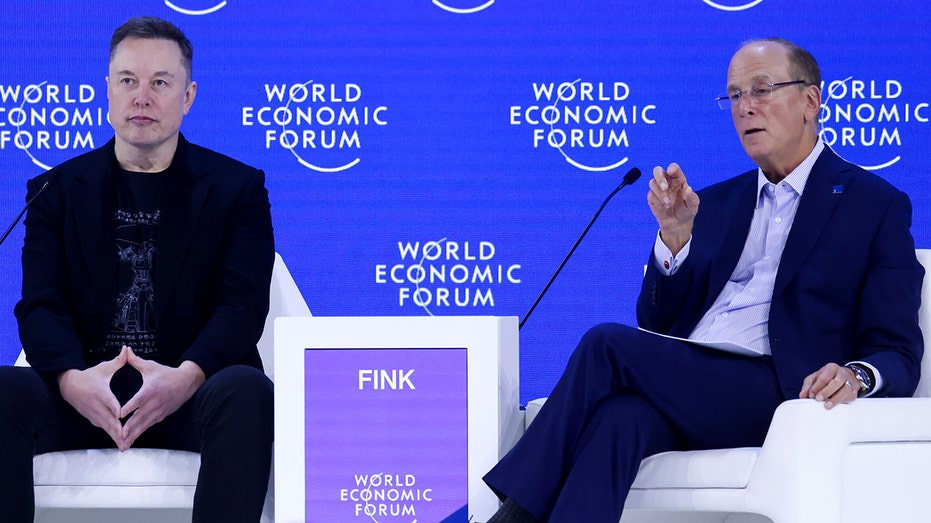
Elon Musk, chief executive officer of Tesla Inc., left, and Larry Fink, chief executive officer of BlackRock Inc., during the World Economic Forum (WEF) in Davos, Switzerland, on Thursday, Jan. 22, 2026. (Krisztian Bocsi/Bloomberg via Getty Images / Getty Images)
Others on the list provided by the White House official include Blackstone Chairman, CEO and co-founder Stephen Schwarzman, Cargill Board Chair and CEO Brian Sikes, Citi Board Chair and CEO Jane Fraser, Coherent CEO Jim Anderson, GE Aerospace chairman and CEO H. Lawrence Culp, Jr., Illumina CEO Jacob Thaysen, Mastercard CEO Michael Miebach, Meta President and Vice Chairman Dina Powell McCormick, Micron Chairman, President and CEO Sanjay Mehrotra, Qualcomm President and CEO Cristiano Amon and Visa CEO Ryan McInerney.
“I am very much looking forward to my trip to China, an amazing Country, with a Leader, President Xi, respected by all,” Trump declared in a Monday Truth Social post.
Apple CEO Tim Cook (R) shakes hands with U.S. President Donald Trump during an event in the Oval Office of the White House on Aug. 6, 2025 in Washington, D.C. (Win McNamee/Getty Images / Getty Images)
“Great things will happen for both Countries!” he added.
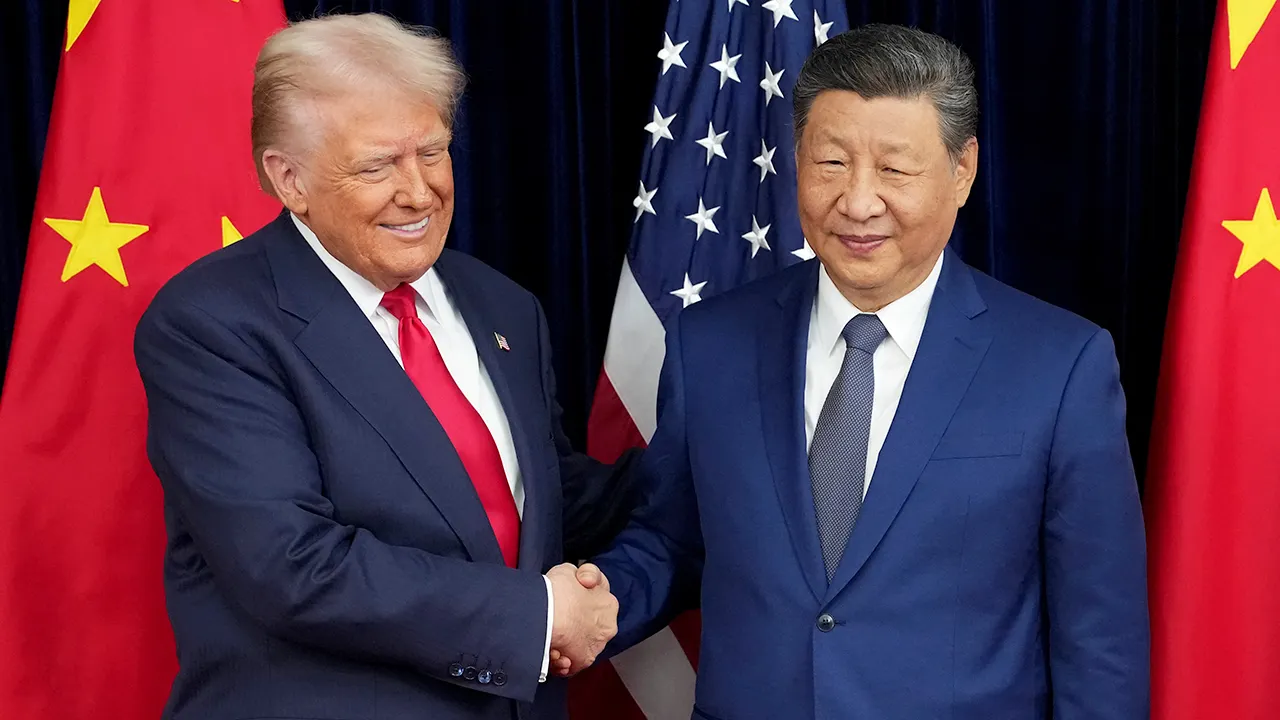
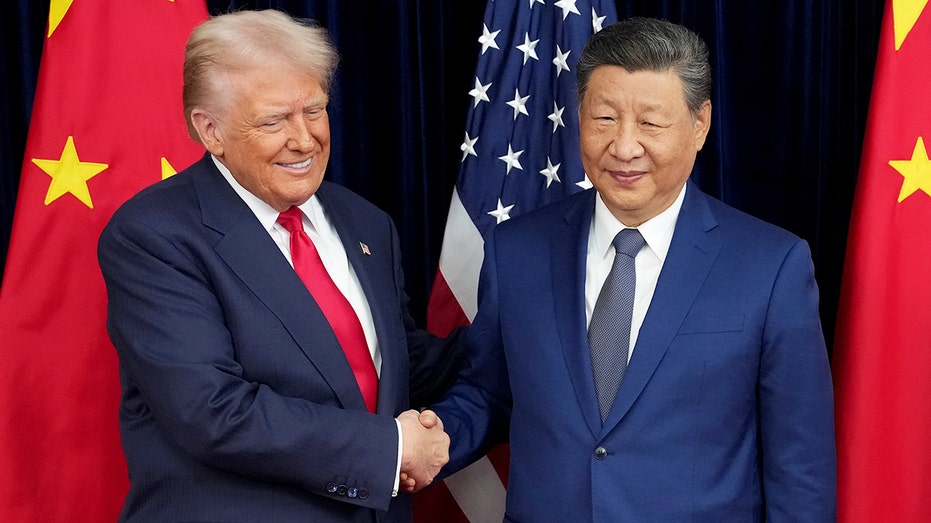
President Donald Trump met with Chinese President Xi Jinping in October in South Korea, according to Reuters.
U.S. President Donald Trump greets Chinese President Xi Jinping ahead of a bilateral meeting at Gimhae Air Base on Oct. 30, 2025 in Busan, South Korea. (Andrew Harnik/Getty Images / Getty Images)
































































You must be logged in to post a comment Login