
Business
Brazil’s Central Bank Cuts Rates, Leaves Next Move Unclear Citing War




Form 13G abrdn Income Credit Strategies Fund For: 1 May
Form 13G Wolfspeed For: 1 May

Microsoft: This Sell-Off Doesn't Make Any Sense

Red Rum Club lead singer Fran Doran spoke to BBC North West ahead of the local elections

Bristol and Edinburgh are emerging as the unlikely engines of Britain’s innovation economy, posting the country’s fastest-growing workforces among technology firms, university spin-outs and patent holders, according to fresh research that lays bare the persistent funding gap with the so-called golden triangle.
Headcount at innovative companies in Bristol jumped 65 per cent between 2019 and 2024, with Edinburgh up 43 per cent over the same period, comfortably outpacing Oxford on 40 per cent and Cambridge on 26 per cent, the analysis of nearly 40,000 businesses reveals.
The study, conducted by the research firm Beauhurst, classifies an “innovative” company as one that is either a university spin-out, the recipient of an innovation grant of £100,000 or more, the holder of a patent, or a technology business that has secured equity investment.
Yet despite the workforce surge in regional hubs, capital remains stubbornly concentrated in the south-east. Some 80 per cent of venture capital invested in the UK still finds its way to London, Oxford or Cambridge, the report finds, a figure that is likely to reignite debate over whether Whitehall’s levelling-up rhetoric is being matched by private-sector reality.
Karim Bahou, head of innovation at Sister, the Manchester-based innovation district that commissioned the study, said the work was designed to shed light on the structural reasons behind the funding gap that continues to dog regional cities.
Manchester itself, Bahou’s analysis found, is punching well above its weight. On a per-capita basis the city is on a par with the capital, with each boasting two innovative companies for every 1,000 residents.
Bahou is now urging cities outside the golden triangle to forge so-called “innovation corridors” between themselves rather than continuing to orbit London. The corridors, established networks linking regions that routinely collaborate on funding and company-building, allow capital, talent and intellectual property to flow more freely across the country.
Scotland’s central belt is leading the way. The Edinburgh-Glasgow corridor has already racked up 448 partnerships, including 378 investments and 70 research grants, making it the most deeply integrated city-to-city innovation network in the UK.
“Up in Scotland we see some really strong links between Glasgow and Edinburgh. This is where we think there is an opportunity to apply a Scottish model to the rest of the country,” Bahou said.
The report goes on to recommend devolving research and development tax incentives to regional authorities, establishing dedicated regional investment funds to unlock deal flow beyond the capital, and developing physical innovation districts, Sister itself is cited as an example, to keep intellectual property and talent rooted locally.
“We’ve got the Northern Powerhouse Fund, and that’s brilliant. We should be doubling down on funds like that, that focus on specific regions and the strength they bring,” Bahou said. “But investors themselves need to come and see what’s happening up in the north, we’ve got some incredible businesses here.”

Jamie Young
Jamie is Senior Reporter at Business Matters, bringing over a decade of experience in UK SME business reporting.
Jamie holds a degree in Business Administration and regularly participates in industry conferences and workshops.
When not reporting on the latest business developments, Jamie is passionate about mentoring up-and-coming journalists and entrepreneurs to inspire the next generation of business leaders.


I’m Jason Ditz and I have 20 years of experience in foreign policy research. My work has appeared in Forbes, Toronto Star, Minneapolis Star-Tribune, Providence Journal, Washington Times and the Detroit Free Press, as well as American Conservative Magazine and the Quincy Institute for Responsible Statecraft. I have been writing investment analysis, with a focus on deep-discount value plays, for over 25 years. I I got my start analyzing securities for a stock-picking contest on the now defunct StockJungle in college. After winning one of the top prizes for quarterly performance, I was hired to write a monthly article about micro-cap stocks, again with a value perspective. After StockJungle went belly-up, with its focus on momentum investing, I started to take a close interest in the contrarian investment philosophy of David Dreman. I began writing for Motley Fool and ultimately Seeking Alpha. My goal is to find underappreciated companies with a focus on returning value to investors.
Analyst’s Disclosure: I/we have a beneficial long position in the shares of HBM either through stock ownership, options, or other derivatives. I wrote this article myself, and it expresses my own opinions. I am not receiving compensation for it (other than from Seeking Alpha). I have no business relationship with any company whose stock is mentioned in this article.
Seeking Alpha’s Disclosure: Past performance is no guarantee of future results. No recommendation or advice is being given as to whether any investment is suitable for a particular investor. Any views or opinions expressed above may not reflect those of Seeking Alpha as a whole. Seeking Alpha is not a licensed securities dealer, broker or US investment adviser or investment bank. Our analysts are third party authors that include both professional investors and individual investors who may not be licensed or certified by any institute or regulatory body.

NEW YORK — California, Texas and Washington are emerging as the top three states experiencing the heaviest job losses from major corporations in 2026, driven by widespread tech sector restructuring, artificial intelligence adoption and broader economic pressures that have prompted thousands of layoffs across Fortune 500 companies.

Data from Worker Adjustment and Retraining Notification filings and industry trackers show these states accounting for a disproportionate share of announced cuts. California leads by a wide margin, followed by Texas and Washington, as companies streamline operations, automate roles and respond to shifting market conditions. The trend reflects a broader national wave of efficiency drives that has seen over a million job cuts announced in recent periods, with technology and related sectors hit hardest.
California: Tech Hub Bears Brunt of Industry Restructuring California continues to lead the nation in corporate job losses, with more than 175,000 positions affected in recent tracking periods. The state’s concentration of technology giants has made it particularly vulnerable to AI-driven changes and cost-cutting measures. Companies like Amazon, Oracle, Meta and Snap have announced significant reductions, contributing to tens of thousands of tech layoffs alone.
High operational costs, including taxes and housing expenses in Silicon Valley and Los Angeles, have accelerated decisions to trim workforces or relocate some functions. Oracle’s cuts in the state, along with Amazon’s corporate reductions, highlight how even profitable firms are prioritizing efficiency. Economists note California’s heavy reliance on the tech sector amplifies national trends, with AI automation and post-pandemic adjustments playing key roles.
State officials have expressed concern about the cumulative impact on local economies. While California remains an innovation powerhouse, the job losses have strained social services and housing markets in affected areas. Community programs and retraining initiatives are expanding to help displaced workers transition to emerging fields like green technology and advanced manufacturing.
Texas: Energy, Tech and Retail Face Combined Pressures Texas ranks among the top states for corporate downsizing, with thousands of jobs impacted across energy, technology and retail sectors. Major employers including Amazon, Albertsons and various manufacturers have announced cuts, contributing to over 5,000 WARN-notified positions in early tracking. The state’s business-friendly reputation has not shielded it from broader industry shifts.
Energy sector volatility, tied to global oil prices and transition pressures, has affected some companies, while tech and e-commerce firms cite efficiency and AI integration. Retail giants facing changing consumer habits have closed locations and reduced staff. Texas’ rapid population growth has increased demand for services but also competition for talent and resources, complicating corporate planning.
Economic development leaders in Texas emphasize the state’s diversification efforts, with investments in semiconductors, biotechnology and renewable energy creating new opportunities. However, short-term pain from layoffs has hit communities reliant on specific employers. Workforce commissions are ramping up support for affected workers through job placement and skills training programs.
Washington: Aerospace, Tech and Retail Reductions Mount Washington state has seen nearly 8,000 jobs impacted by major announcements, with companies like Boeing, Amazon and others trimming workforces amid sector-specific challenges. Aerospace giant Boeing has faced production issues and cost pressures, while tech firms navigate AI transitions and market saturation. Retail and consumer goods companies have also reduced staffing.
The state’s economy, heavily influenced by Seattle-area tech and aerospace, mirrors national patterns of corporate belt-tightening. High living costs in the Puget Sound region have compounded difficulties for employers seeking to retain talent while controlling expenses. Layoffs in pharmaceuticals, healthcare and telecommunications have added to the total.
State leaders highlight resilience through diversification, with strong growth in cloud computing, biotechnology and clean energy. However, immediate job losses have prompted expanded unemployment support and retraining initiatives. Business groups call for policies supporting innovation and workforce development to offset short-term disruptions.
Broader Context and Outlook The job losses reflect multiple converging factors. Artificial intelligence adoption enables efficiency gains that reduce staffing needs in some roles. Economic uncertainty, including inflation concerns and shifting consumer behavior, has prompted caution. Supply chain issues and geopolitical tensions add costs, while regulatory changes influence decisions on where to operate.
Not all impacts are negative. Many companies report healthy profits despite cuts, with funds redirected toward AI infrastructure, research and shareholder returns. New industries are emerging, creating opportunities in areas like renewable energy and advanced manufacturing. The challenge lies in managing transitions to minimize disruption for workers and communities.
Economists expect volatility to continue through 2026 as companies adjust to new realities. States with heavy exposure to affected sectors may face slower recovery, while those investing in future-oriented industries could see gains. Federal and state policies supporting workforce retraining and business incentives will play crucial roles in shaping outcomes.
For workers in impacted states, the situation underscores the importance of adaptable skills and lifelong learning. Community colleges and vocational programs are expanding offerings in high-demand fields. Corporate responsibility initiatives, including severance support and outplacement services, vary widely but are increasingly scrutinized by the public and regulators.
As 2026 progresses, the top three states’ experiences will offer lessons for the broader economy. California’s innovation ecosystem, Texas’ energy and business environment, and Washington’s tech-aerospace strengths each face unique pressures but also opportunities. How leaders, companies and workers respond will influence America’s competitive position in an AI-driven future.
Business
Tenet Healthcare Corporation 2026 Q1 – Results – Earnings Call Presentation (NYSE:THC) 2026-05-01

Q1: 2026-04-30 Earnings Summary
EPS of $4.82 beats by $0.65
| Revenue of $5.37B (2.78% Y/Y) misses by $27.83M

Seeking Alpha’s transcripts team is responsible for the development of all of our transcript-related projects. We currently publish thousands of quarterly earnings calls per quarter on our site and are continuing to grow and expand our coverage. The purpose of this profile is to allow us to share with our readers new transcript-related developments. Thanks, SA Transcripts Team

Britain’s reputation as Europe’s cleantech powerhouse is being undermined by a brutal funding drought at the very bottom of the pipeline, with new figures showing investment in the country’s youngest low-carbon and renewable energy companies has collapsed to its lowest level in five years.
Research published by Cleantech for UK (CTUK) reveals that the value of early-stage deals halved in 2025, while the number of transactions plunged from 188 in 2024 to just 94 last year. The slump comes despite the broader sector pulling in £7.2 billion of investment overall, comfortably outstripping Germany’s £1.7 billion and France’s £1.4 billion.
The headline figure may flatter to deceive. Strip away the late-stage mega-deals and a far more uncomfortable picture emerges of an industry whose seed corn is being eaten before it has chance to germinate.
“If we allow the pipeline to dry up now, it means we’ll have no new innovation in cleantech coming through in five years’ time,” warns Sarah Mackintosh, director of CTUK and a former head of innovation at the Department for Business, Energy and Industrial Strategy. “Funders will be sitting there waiting for scale-ups and none will come.”
CTUK, established in 2023 to bridge the gap between Whitehall and the venture community, attributes the early-stage collapse to what it terms a “triple squeeze”: punishingly high industrial energy prices, the quiet closure last year of the Government’s Net Zero Innovation Portfolio without a successor, and investor caution rooted in higher interest rates.
Westminster’s recent decision to decouple gas and electricity prices, severing the link that has long allowed expensive gas to set the price for cheaper renewables, is expected to deliver what Mackintosh calls a “fairly immediate impact”. Yet it does little to address the underlying reality that British industrial energy costs remain among the dearest in Europe, a particular handicap for the capital-hungry sectors at the heart of the energy transition such as battery manufacturing and carbon capture infrastructure.
To these domestic headwinds has been added a fresh geopolitical shock. The US-Iran conflict and tensions around the Strait of Hormuz have rekindled fears of an oil and gas price spiral, with the International Monetary Fund warning that Britain faces the sharpest growth downgrade in the G7 and one of the highest inflation rates as a consequence.
Mackintosh notes that higher rates and the increase in employers’ national insurance contributions have also dulled the appetite of venture capital firms, whose money, she says, “doesn’t go as far as it used to”.
The picture is rather rosier further up the funding ladder. Total equity investment in cleantech rose by 58 per cent year-on-year to £3.9 billion, though the bulk of that capital flowed to software businesses and proven, late-stage operators. Among the standouts was a £750 million raise by Kraken, the energy technology platform owned by Octopus Energy Group, and a £130 million round for energy infrastructure specialist Highview Power. The total nevertheless sits well shy of the £11.9 billion peak struck in 2023.
CTUK is now urging the National Wealth Fund and the British Business Bank to deploy their firepower more aggressively to help young firms cross the so-called valley of death between a laboratory breakthrough and a commercial factory. The National Wealth Fund signalled in January that it intends to channel up to £5 billion a year of taxpayer money into green energy projects, but the question for SMEs is whether any of that will reach companies still trying to prove their technology at scale.
Mackintosh points to British innovators such as battery-tech firm Anaphite, materials specialist Immaterial and carbon-removal venture Supercritical as the sort of “world-leading” businesses now in jeopardy. “These are the sorts of companies that are going to put the UK on the map,” she says. “It would be a travesty if we didn’t even start the ideas because they haven’t got the backing to scale up.”
For a Government that has staked much of its industrial strategy on green growth, the warning lights are flashing. Without urgent intervention to rekindle early-stage investment, ministers risk presiding over a clean-energy economy that imports tomorrow’s breakthrough technologies rather than exports them.

Amy Ingham
Amy is a newly qualified journalist specialising in business journalism at Business Matters with responsibility for news content for what is now the UK’s largest print and online source of current business news.


Fiscal year kicks off with double-digit sales growth.

Blaiz Fayah X Maureen – Money Pull Up (Lyrics)
Form 13G abrdn Income Credit Strategies Fund For: 1 May
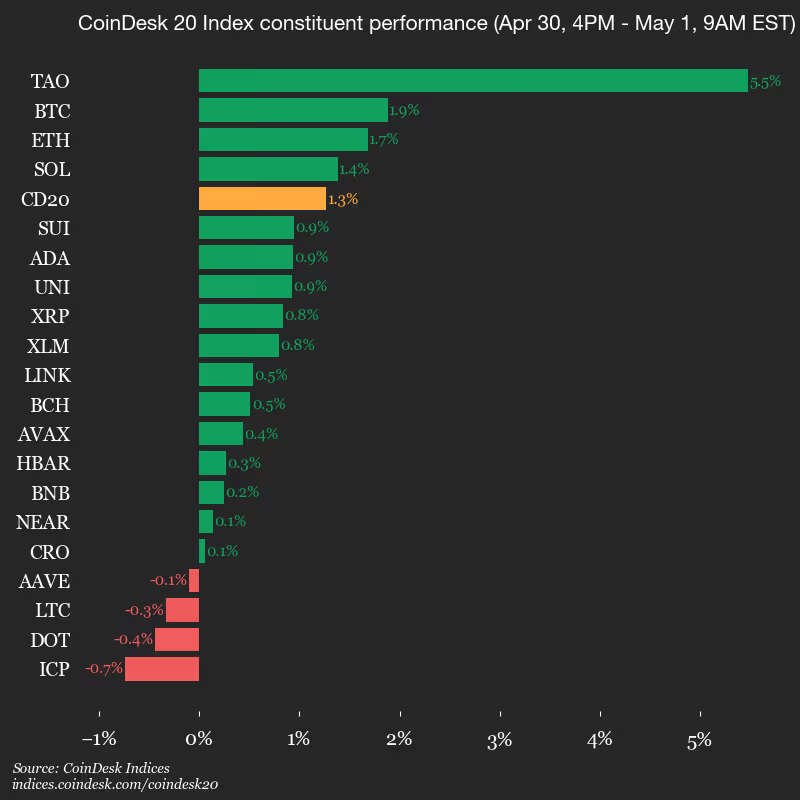
Bittensor (TAO) gains 5.5%, leading index higher

Manchester United reach agreement with Casemiro over contract clause amid transfer speculation

US brings back mandatory military draft registration

Steven Gerrard disagrees with Gary Neville over ‘shock’ Chelsea and Arsenal claim | Football


-

 Tech4 days ago
Register Renaming | Hackaday
-

 Fashion7 days ago
Weekend Open Thread – Corporette.com
-
 Crypto World6 days ago
Hyperliquid $HYPE Rally Builds Momentum as AI Sector Enters Prove-It Phase
-

 Politics4 days ago
Drax board avoid their own AGM, accused of greenwashing & environmental racism
-

 Tech4 days ago
Images of Samsung’s rumored smart glasses have leaked
-
 Sports5 days ago
IPL 2026: Ruturaj Gaikwad registers slowest fifty of the season, enters all-time unwanted list | Cricket News
-

 Tech4 days ago
Why Blue Badges Disappeared From Toyota Hybrids
-

 NewsBeat5 days ago
LK Bennett closes all stores after entering administration
-

 Fashion3 days ago
Kylie Jenner’s KHY Enters a New Era with ‘Born in LA’
-
 Entertainment6 days ago
Mariah Carey Slams Deposition Claims In Brother’s Lawsuit
-

 Business3 days ago
Most Commercial Energy Audits Miss the Real Losses
-

 Business4 days ago
(VIDEO) Charlize Theron Climbs Times Square Billboard to Promote New Netflix Thriller ‘Apex’
-

 Crypto World3 days ago
CFTC’s AI will review U.S. crypto registration applications, chairman tells CoinDesk
-

 Business7 days ago
Jeanine Pirro announces closure of Federal Reserve building cost probe
-

 Tech6 days ago
Microsoft to roll out Entra passkeys on Windows in late April
-
 Crypto World7 days ago
Nvidia (NVDA) Stock Jumps 5% as Intel Earnings Ignite Semiconductor Rally
-

 Tech5 days ago
OpenAI’s Sam Altman apologizes for not reporting ChatGPT account of Tumbler Ridge suspect to police
-

 Business2 days ago
Barclay Brothers Avoid Bankruptcy: HSBC Drops High Court Petitions After IVA Deal
-

 Tech7 days ago
Apple’s Next CEO Has a Different Battle Ahead
-

 Tech3 days ago
Get Ready for More Brain-Scanning Consumer Gadgets
You must be logged in to post a comment Login