




Connect with us

Business

CAR Group Shares Surge Nearly 10% After Carsales Owner Posts 14% Profit Jump And Lifts FY26 Dividend

Published

on

ASX 200 Top Gainers: Telix Pharma Jumps 3.23% on FDA

MELBOURNE — Shares in CAR Group Ltd jumped nearly 10% Monday after the company behind Australia’s largest online car marketplace, carsales.com.au, reported a double-digit rise in annual profit and lifted its dividend, capping a strong finish to the 2026 financial year.

The stock closed at $29.70, up $2.68, or 9.92%, on the Australian Securities Exchange, adding more than $900 million to the company’s market capitalization in a single session. The rally came after CAR Group reported reported net profit after tax of $314 million for the year ended June 30, up 14% from the prior year, alongside proforma revenue of $1.253 billion, a 12% increase in constant currency terms.

Adjusted net profit after tax, the company’s preferred earnings measure, reached $407 million, up 11% on a constant currency basis and 8% in Australian dollar terms after accounting for foreign exchange headwinds. The company said it maintained an EBITDA margin of 56% for the year despite continued investment in artificial intelligence infrastructure and expansion into new product categories, and reported 100% conversion of EBITDA to cash.

CAR Group also raised its final dividend to 43.5 cents per share, up from 41.5 cents a year earlier, extending a track record of dividend growth that has made the stock a consistent presence in Australian income portfolios.

Advertisement

Chief Executive William Elliott, who took over the role in August 2025 after Cameron McIntyre stepped down following 18 years in charge, said the results reflected the company’s push to expand beyond its roots as a classifieds business. “We continued to move beyond traditional classifieds, building connected automotive ecosystems that support customers across more of the vehicle ownership journey,” Elliott told investors.

Elliott pointed to product launches across the group’s international markets as a driver of the year’s performance. In Australia, the company recently rolled out Nexgate, a platform combining dealer workflow tools and data services under a single brand, alongside upgrades to search and personalization features aimed at improving the customer experience. “In Australia, we recently launched Nexgate, bringing together a broader suite of dealer workflow and data solutions,” he said.

The company’s four geographic segments all posted growth in constant currency terms. Australia, anchored by the flagship carsales.com.au marketplace, generated revenue of $519 million, up 7%, with adjusted EBITDA rising 8% as the business benefited from a mix of pricing gains, higher volumes and expanded product depth. North America, where CAR Group operates the Trader Interactive platform, delivered $327 million in revenue, a 12% increase, with earnings growing at the same pace.

Latin America was the standout performer, with the Webmotors platform in Brazil posting the fastest earnings growth in the group, up 23% in constant currency terms. Asia, which includes the Encar marketplace in South Korea, saw earnings climb 14% for the year, helped by the continued rollout of the company’s Guarantee 2.0 vehicle inspection and warranty program and growth in its Encar Home Services and Dealer Direct offerings. “In South Korea, the scaling of Guarantee 2.0 is creating a more seamless experience across the vehicle transaction journey,” Elliott said.

Advertisement

Looking ahead, CAR Group issued guidance for the 2027 financial year, forecasting revenue growth of between 11% and 14% and earnings growth of between 10% and 13%, both on a constant currency basis. The company flagged that foreign exchange remains a headwind, citing a roughly 2% negative impact on FY26 results tied largely to the U.S. dollar and South Korean won, with a similar drag expected in the year ahead. Executives also indicated that margins in North America and Asia could contract slightly in FY27 as the company continues to invest in its marine listings expansion in the United States and the scaling of its Dealer Direct service in South Korea.

The results build on guidance CAR Group issued at the half-year mark, when the company pointed to proforma revenue growth of 12% to 14% and adjusted profit growth of 9% to 13%, both in constant currency terms, based on half-year revenue of roughly $626 million. Monday’s full-year numbers landed within or ahead of that range, reinforcing investor confidence in the company’s ability to sustain growth across its international portfolio.

CAR Group, formerly known as Carsales.com Ltd, listed on the Australian Securities Exchange in September 2009 and has since grown from a single domestic classifieds site into a global operator of vehicle marketplaces spanning Australia, North America, South Korea, Brazil and Chile. The company holds a dominant position in the Australian market, where it has said its flagship platform commands roughly nine times the total time spent by users compared with its nearest competitor.

The stock’s advance Monday outpaced the broader market, with the S&P/ASX 200 Communication Services index, which tracks CAR Group alongside other media and internet companies, posting a more modest gain for the session. The move followed a period of steady but comparatively muted trading for the stock in the weeks leading up to the results, including a 3.54% rise on August 4 and a more modest 0.85% gain on August 6, as investors awaited the full-year figures.

Advertisement

Analysts have generally maintained bullish coverage of the stock heading into the results, with earlier commentary noting the company’s consistent earnings growth and its strategy of expanding into adjacent markets and services beyond core vehicle listings. Monday’s share price reaction suggests investors viewed the FY26 results, along with the accompanying FY27 outlook, as validation of that broader strategy.

CAR Group’s next major investor update is expected to come with its half-year results early in 2027, when the company is likely to provide a progress check against the guidance issued Monday.

Continue Reading
Click to comment

You must be logged in to post a comment Login

Leave a Reply

Business

(VIDEO) MrBeast’s ‘Last To Leave Mansion’ Traps Contestants Who Called Him ‘Too Easy’ In Brutal Challenges

Published

on

Shannon Elizabeth

GREENVILLE, N.C. — YouTube star MrBeast has released a new endurance video that recruited contestants specifically because they had publicly claimed his challenges were too easy, then put that boast to the test inside a sprawling mansion over more than three months.

The video, titled “Last To Leave Mansion, Keeps It,” features roughly 15 contestants competing to be the final person remaining in the house, with the winner keeping the property itself. MrBeast, whose real name is Jimmy Donaldson, has built his channel around elaborate competitions offering cars, islands and cash prizes, but this installment leaned on a specific premise: every participant had previously posted online that his games were not difficult.

According to the video and outside coverage of the shoot, Donaldson directly told the group he had seen their comments before laying out the rules. “You guys all said publicly my videos are easy,” he told contestants early in the challenge, adding that they would now get to experience one for themselves.

Advertisement

The early stretch of the competition, covering the first 12 days, centered on simple survival in the mansion. Several contestants said the isolation and separation from family proved harder than expected, and multiple participants left within the opening days. One contestant, explaining his decision to quit, said he did not expect to be away for as long as the game required, telling producers he was not prepared to stay for an extended stretch. Another contestant, addressing the camera as he packed up, still insisted the game was manageable, saying it was “still pretty easy,” even as he chose to leave.

Around the two-week mark, Donaldson introduced a twist drawn from one of his earlier videos: a handcuff challenge. Contestants were paired off and physically cuffed together for an undisclosed length of time, with elimination for anyone who removed the restraints. The rule immediately complicated basic tasks like eating, sleeping and moving through the house, since each pair had to coordinate every movement. Donaldson told the group they would not be told how long the cuffs would stay on, saying it “could be a day, could be a year,” a line he used to raise the psychological pressure on participants already grappling with close-quarters living.

The handcuff phase ran for roughly four weeks before contestants were freed, at which point Donaldson introduced a second callback challenge modeled on one of his bunker-survival videos. Under the new rules, an alarm would sound at random intervals throughout the house, and contestants had 60 seconds to reach a hand scanner and register their palm or face elimination. Contestants reacted to the announcement with a mix of dread and forced confidence, with one participant shouting “This is too easy!” as the rules were explained — a boast Donaldson appeared to anticipate. “By the end of this video, they won’t be saying things are too easy,” he said.

As the challenge progressed, producers tightened the format further, cutting the response window from 60 seconds to 30. The shortened timer forced contestants to rethink where they slept and spent their time, with several opting to remain near the scanner rather than risk being caught too far away when the alarm sounded. One contestant said he had decided to sleep near the device because the alarm could go off “at any moment” and he was not willing to take the risk.

Advertisement

The video’s production also drew attention beyond its gameplay. A companion piece published by the technology company Insta360, which supplied camera equipment for the shoot, said the format required tracking every contestant’s hand position throughout a house where people were free to move at will, calling it more complicated to film than earlier hand-based challenges despite the simplicity of the underlying rules.

A feature published by Time magazine as part of its 2026 look at Beast Industries described the scene inside the Greenville property during filming, noting visible damage throughout the house, including debris in the yard and stains on interior surfaces, as contestants tested the limits of the competition. The piece noted that the participants were college-age men who had criticized Donaldson’s challenges as insufficiently difficult before being invited to compete, and that Donaldson visited the set personally during filming to check on the chaos his format had produced.

The video, which reached the top of global YouTube trending charts this month, has drawn tens of millions of views in its first days online. Comment sections and reaction videos have focused heavily on contestant behavior inside the house, with viewers criticizing several participants for damaging the property and for conflicts that emerged during the extended stay. Some viewers speculated in comments beneath the video that certain contestants left too easily given the stakes, while others praised the format as among the strongest challenge videos Donaldson has released this year.

Donaldson’s channel has grown into one of the most-watched on YouTube, with subscriber counts in the hundreds of millions, largely on the strength of elaborate, high-cost competitions that blend cash giveaways with survival-style formats. His recent projects have increasingly drawn on his own back catalog, reviving past challenge formats — including bunker isolation and handcuff endurance tests — and applying them to new groups of contestants under tightened rules.

Advertisement

Neither MrBeast’s team nor individual contestants featured in the video have released additional statements beyond what appeared in the release itself. The final outcome of the competition, including which contestant ultimately kept the mansion, was revealed in the video’s concluding segment.

Continue Reading

Business

PayPay Corporation (PAYP) Q1 2026 Earnings Call Transcript

Published

on

OneWater Marine Inc. (ONEW) Q1 2026 Earnings Call Transcript

Kotaro Emae
Head of Investor Relations Department

Good morning, and good evening, everyone, and welcome to PayPay’s earnings call for the first quarter of fiscal 2026. I’m Kotaro Emae, Head of Investor Relations. Joining me on today’s call are Nakayama-san, our President and CEO; Kagechika-san, our CFO; and Motoda-san, Head of Finance and Corporate Strategy.

As a reminder, today’s call is being broadcast live, and a replay will be available on our website at a later date. Before we begin, please note that today’s discussion includes forward-looking statements, non-IFRS financial measures and unaudited financial data. Actual results may differ materially from our expectations. For more details, including risk factors and non-IFRS reconciliations of non-IFRS measures to the most directly comparable IFRS measures, please carefully review the disclaimer on Page 2 of our presentation. We ask for your understanding of these terms as we proceed.

With that, I will now turn the call over to Nakayama-san.

Advertisement

Ichiro Nakayama
President, CEO, Corporate Officer & Representative Director

Hello, everyone. This is Nakayama speaking. So before we begin the presentation, I would like to say a few words in Japanese.

Advertisement
Continue Reading

Business

Pampa Energia: Rincon De Aranda And Fertilizers Add New Legs To The Bull Case

Published

on

Pampa Energia: Rincon De Aranda And Fertilizers Add New Legs To The Bull Case

Pampa Energia: Rincon De Aranda And Fertilizers Add New Legs To The Bull Case

Continue Reading

Business

Elon Musk Says Starlink Will Be in Every Car Calling It the Only Way to Connect Billions of Vehicles

Published

on

SpaceX owner and Tesla CEO Elon Musk at the E3 gaming convention in Los Angeles

AUSTIN, Texas — Elon Musk said all cars will eventually feature Starlink connectivity, describing satellite internet as the only practical method for delivering high-bandwidth service to the global vehicle fleet.

“All cars will have Starlink in the future,” Musk posted on X. “It’s the only way to get super high bandwidth to billions of vehicles.”

The comment came in response to discussion of a Tesla Cybercab prototype spotted in Texas with a flush-mounted Starlink dish on its rear. Photos shared by an account tracking Tesla developments showed the antenna integrated more seamlessly than earlier temporary installations on test vehicles.

Musk, who leads both Tesla and SpaceX, has long argued that traditional cellular networks face inherent limits in providing consistent, high-capacity connections across vast numbers of moving vehicles, especially in rural or remote areas where coverage is sparse. Starlink’s low-Earth-orbit satellite constellation is designed to deliver broadband nearly anywhere with a clear view of the sky.

Advertisement

The vision aligns with Tesla’s work on autonomous vehicles and robotaxis. Continuous high-bandwidth connectivity could support real-time data exchange for full self-driving systems, over-the-air software updates, high-definition mapping, and in-vehicle entertainment or productivity features once cars operate without a driver. For a fleet of robotaxis, reliable connectivity would also enable remote monitoring, fleet management and rapid response to edge cases.

SpaceX has steadily expanded Starlink’s capabilities for mobile use. The service already powers connectivity on aircraft, ships, recreational vehicles and some emergency vehicles. Smaller, more integrated terminals have been under development to suit automotive constraints of size, weight, aerodynamics, vibration and power consumption. A flush-mounted design on the Cybercab suggests progress toward solutions that minimize visual and aerodynamic impact.

Musk has previously projected ambitious long-term figures for Starlink. In related comments, he has indicated the network could eventually carry more than half of global internet traffic and generate substantial revenue for SpaceX, with some estimates from the company and analysts pointing toward potential annual revenue in the hundreds of billions or higher as adoption scales across consumer, enterprise, maritime, aviation and mobility markets.

Integrating Starlink into passenger cars at scale would represent a significant expansion. Billions of vehicles worldwide currently rely primarily on cellular networks, which can face congestion, coverage gaps and capacity constraints as data demand from connected cars rises. Satellite connectivity offers a complementary or alternative layer that is less dependent on ground infrastructure density.

Advertisement

Challenges remain. Automotive-grade hardware must withstand extreme temperatures, vibration, weather exposure and long service lives. Cost per unit will need to decline for mass-market adoption. Regulatory approvals, spectrum coordination and manufacturing scale for millions of terminals would also be required. Power draw and heat management inside a vehicle present additional engineering hurdles.

Tesla has already embedded extensive connectivity and computing hardware in its vehicles for Autopilot and Full Self-Driving features. Adding a dedicated high-bandwidth satellite link would build on that foundation. Other automakers have explored satellite partnerships or hybrid cellular-satellite solutions, but Musk’s statement frames Starlink as a potential industry standard rather than a Tesla-only feature.

The Cybercab, Tesla’s purpose-built robotaxi design, lacks a traditional driver’s cabin and features a minimalist exterior. That architecture may simplify antenna placement compared with conventional passenger cars that have more complex roof lines, glass roofs or aerodynamic requirements. Early test vehicles have carried more conspicuous external antennas; the flush-mounted version indicates ongoing refinement.

Musk’s remarks arrive as SpaceX continues launching batches of Starlink satellites and refining the network’s capacity and latency. Direct-to-cell capabilities, which allow ordinary smartphones to connect via satellite in limited fashion, are progressing in parallel and could complement vehicle-mounted terminals.

Advertisement

For consumers, the practical benefits could include uninterrupted navigation and streaming on long road trips, reliable emergency communications in remote areas, and smoother operation of advanced driver-assistance or autonomous systems that depend on cloud data. For fleet operators, consistent connectivity supports predictive maintenance, route optimization and centralized oversight.

The statement does not include a specific timeline for widespread automotive integration. Musk has a history of setting ambitious targets that sometimes shift based on technical progress and manufacturing realities. Still, the public affirmation that every car will eventually carry Starlink capability signals a strategic priority linking SpaceX’s satellite network with the mobility sector.

Automakers, suppliers and telecommunications companies will likely watch closely as Tesla and SpaceX advance the hardware and service models. If high-bandwidth satellite connectivity becomes standard, it could reshape expectations for vehicle connectivity much as cellular data did in the previous decade.

Musk’s brief post distilled a broader thesis: scaling high-capacity internet to the world’s vehicle fleet requires a network architecture that is not limited by the density of ground-based towers. In his view, Starlink provides that path. The appearance of integrated hardware on a Cybercab prototype offers an early visual of how that future might look on the road.

Advertisement
Continue Reading

Business

Shopping arcade apartments plan ‘best opportunity’ for Preston landmark’s future, councillors told

Published

on

Business Live

Upper floors of Victorian Miller Arcade to become housing

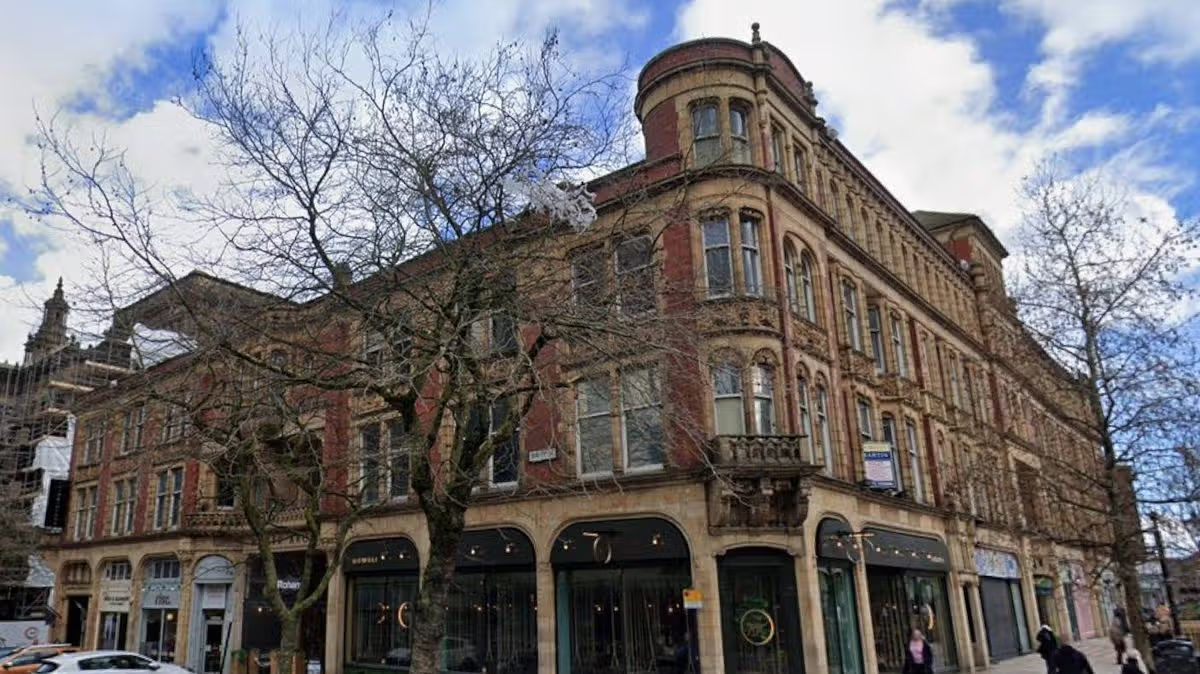
Miller Arcade in Preston.

Miller Arcade in Preston(Image: Google)

Converting most of Preston’s Miller Arcade into apartments is the “best opportunity” to guarantee the building’s future – and ensure it is fully used.

Advertisement

That was the message to councillors as they gave the green light to a revamp that will see the upper floors of the Victorian shopping emporium, off Lancaster Road, become home to 46 residential properties.

Preston City Council’s planning committee unanimously approved the overhaul, which also includes the creation of communal facilities – including a gym, cinema, library and workspace – for future residents.

The top three storeys of the Grade II-listed property were last in use as offices – one of their many original functions – but have been vacant for well over a decade. They were initially also occupied by two hotels, a Turkish baths and a wine lodge.

The redevelopment will not affect the ground floor retail space, which will continue in its current form, having first opened in 1899 – making it Preston’s oldest shopping precinct.

Advertisement

However, the committee heard that bringing the levels above back into use would be financially costly and practically demanding, because of their poor condition in some parts.

Alban Cassidy, the agent for the scheme, told the meeting that it had required “compromise”, both from the firm behind the blueprint – Darwen-based Icon Heritage Ltd. – and the city council’s heritage advisers.

He said discussions had enabled a position to be reached “where everyone is comfortable that [this] is the best…way forward for the site”.

“I think this is the best opportunity the Miller Arcade has ever had to… [secure] a long-term use that respects the heritage of the building, but also brings into use the whole of the structure.

Advertisement

“[That means] it [will] not only be repaired…but it also has…a future – [because] it will then be maintained…and it will continue to be one of the jewels in the crown in our city centre,” Mr. Cassidy added.

Structural and condition surveys laid bare the scale of the challenge in getting the blueprint off the drawing board. Cracking in the terracotta cladding is regarded as an outward sign of “corrosion of [the] steel embedded within the facade” of the building, as a result of it not being watertight.

Committee member Cllr Rob Walsh noted that the problems identified in the two assessments were the result of visual inspections – and so were limited only to those that could be seen with the naked eye.

Raising particular concern about the potential for steel “within the walls” to have rusted, he asked whether there were any plans for “a more detailed review of the structural integrity of the building”.

Advertisement

Alban Cassidy said building surveyors and structural engineers had “gone as far as they can” at the planning application stage, but would “look further into the building” once permission was granted.

However, he told the meeting that the applicant had been put on notice about what to expect – and the “implications” of that for what will be an “expensive” development.

“The detail is to come. It’s not going to be [something that can be determined] in six months…but we’re aware of it, committed to it and we’ll face it as it comes.

“This is a Victorian building that has been neglected for some time – and therefore these things need addressing. No-one is going into it with their eyes shut,” Mr. Cassidy said.

Advertisement

There are no signs of structural damage to the internal elevations of the shopping arcade itself and the condition of the external walls has been deemed “satisfactory”.

Questioned by Cllr Ben Ward about the capacity of the applicant as a “a relatively new company”, -founded just under five years ago – to deliver such a “big” and “important” scheme, Mr. Cassidy said the firm was “well financed” and had assembled a professional team for the purpose.

A report by planning officers concluded that the external works required – including window and masonry repairs, the replacement of the existing flat roof with a new insulated covering, and repairs to the glazed vaulted roof over the arcade – would have a positive impact on the building itself and the Market Place Conservation Area in which it stands.

Against that backdrop, the suitability of the conversion was barely mentioned in the committee discussion, with deputy chair Cllr Sara Holmes welcoming what she described as “a great opportunity to improve and bring back [into use] Miller Arcade”.

Advertisement

A previous apartments proposal for the building which was given the go-ahead back in 2015 never came to fruition – but Mr. Cassidy said that the proposal had been “threadbare”

The much-loved city landmark is renowned for its Victorian Baroque architecture and was modelled on the larger Burlington Arcade in London. When it opened, the arcade would have been a purveyor of luxury goods, aimed at Preston’s most well-heeled residents.

Any original features will be retained “wherever possible” as part of the revamp, planning documents state – but many of the most “ornate” have previously been stripped out.

The committee granted both planning permission and so-called ‘listed building consent’ for the apartments – 24 one-bedroomed, 18 two-bed and four ‘studio’ flats – along with works to be carried out in the basement.

Advertisement

Don’t miss the latest news and analysis with our regular North West newsletters – sign up here for free

Continue Reading

Business

AAON, Inc. (AAON) Q2 2026 Earnings Call Transcript

Published

on

OneWater Marine Inc. (ONEW) Q1 2026 Earnings Call Transcript