BEIJING — China has sharply criticized the U.S. naval blockade of Iranian ports and the Strait of Hormuz as a “dangerous and irresponsible” escalation that threatens global energy security and undermines a fragile ceasefire, even as Chinese-owned tankers continue to transit the vital waterway in apparent defiance of American restrictions.
Strait of Hormuz
The rhetoric from Beijing intensified this week as the United States enforced the blockade ordered by President Donald Trump following the collapse of peace talks with Tehran. Launched around April 13, the operation aims to choke Iran’s oil exports and economic lifeline after Iran attempted to close the strait earlier in the 2026 conflict. The narrow chokepoint carries roughly one-fifth of global oil supplies, with China historically purchasing up to 90-95% of Iran’s seaborne crude.
Chinese Foreign Ministry spokesperson Guo Jiakun described the U.S. action Tuesday as one that would “only aggravate confrontation, escalate tension, undermine the already fragile ceasefire and further jeopardize safe passage through the Strait of Hormuz.” Beijing has repeatedly urged both Washington and Tehran to honor ceasefire arrangements and pursue diplomatic solutions, warning that military measures serve no common international interest.
Despite the strong words, shipping data showed limited immediate disruption. On the first full day of the blockade, at least eight vessels—including a U.S.-sanctioned Chinese-owned tanker operated by Shanghai Xuanrun Shipping Co.—successfully crossed the strait. The tanker, with a Chinese crew, had loaded cargo in the UAE’s Hamriyah port before proceeding. U.S. Central Command claimed several ships were turned around, but industry trackers reported traffic remained far below pre-war levels yet not fully halted.
Analysts noted Iran had earlier signaled it would allow Chinese vessels preferential passage due to Beijing’s longstanding support for Tehran. Reports from March detailed Chinese-flagged or owned ships, such as the bulk carrier Iron Maiden and Sino Ocean, broadcasting their nationality to transit safely. A Hong Kong-flagged oil tanker also passed through this week, testing the limits of the U.S. operation.
Advertisement
The blockade forms part of broader U.S. efforts to pressure Iran economically after a conflict that erupted in late February 2026. Trump administration officials, including Defense Secretary Pete Hegseth and Joint Chiefs Chairman Gen. Dan Caine, have briefed on the operation’s progress, stating it uses less than 10% of U.S. naval power while turning back multiple Iran-linked tankers. Pentagon updates indicated 10 to 13 ships were redirected in initial days.
For China, the stakes are high. Roughly one-third of its crude oil imports flow through the Persian Gulf region, and disruptions compound existing energy pressures from the war. Beijing has drawn on strategic reserves and diversified sourcing, including increased purchases of U.S. crude in some periods, but analysts say prolonged restrictions could strain supplies and raise domestic fuel costs. Queues at gas stations have appeared in parts of China amid the uncertainty.
Yet some observers argue the blockade may inadvertently benefit Beijing strategically. By challenging established maritime norms under the guise of national security, the U.S. action could provide China with precedent for future assertiveness in the South China Sea or around Taiwan. Chinese President Xi Jinping, speaking with UAE officials, warned against reverting to “the law of the jungle,” framing the blockade as destabilizing while positioning China as a defender of international order.
Chinese Defense Minister Admiral Dong Jun has emphasized Beijing’s separate trade and energy agreements with Iran, stating the strait remains open for Chinese shipping and warning others not to interfere. This stance underscores China’s reluctance to fully align with U.S. pressure while avoiding direct military confrontation.
Advertisement
The situation has tested China’s restraint. As Iran’s largest trading partner and a key buyer of its oil, Beijing has influence but limited leverage to force concessions from Tehran. Analysts suggest China prefers a hands-off approach, wary of entanglement in a conflict it did not start and mindful of its own bilateral ties. Diplomatic channels remain active, with China calling for de-escalation and a comprehensive ceasefire.
Global markets have reacted with volatility. Oil prices eased somewhat this week on ceasefire hopes and reports of continued tanker movements, providing relief to airlines, manufacturers and consumers. However, war-risk insurance premiums for vessels in the region remain elevated, with policies reviewed every 48 hours. Broader economic ripple effects include higher shipping costs and potential inflation in energy-dependent economies.
The Strait of Hormuz crisis has also highlighted shifting great-power dynamics. While the U.S. projects naval dominance with a relatively light footprint, China’s economic interdependence with Iran creates a complex web. Some commentators describe the blockade as an indirect energy squeeze on Beijing, executed through Tehran, amid broader U.S.-China tensions including tariff threats.
Traffic data indicates the blockade has reduced but not eliminated flows. Pre-conflict volumes were already impacted by the war; current levels reflect cautious navigation by shippers. Exceptions appear for vessels signaling Chinese ownership or neutral flags, complicating enforcement.
Advertisement
In Washington, officials maintain the operation targets Iran’s ability to fund conflict through oil revenue while allowing neutral commercial traffic. Trump has claimed the move ultimately benefits China and the world by reopening secure passage, though Beijing rejects that framing.
Looking ahead, the fragile ceasefire—now in its second or third week depending on exact timelines—faces tests as both sides maneuver. Diplomatic efforts continue, with potential extensions or talks involving Gulf states, Russia and others. China has joined calls for political resolution, emphasizing that only a lasting ceasefire can restore safe navigation.
For everyday consumers, the standoff translates to uncertainty at the pump and in supply chains. Energy analysts warn that any resumption of full hostilities or stricter enforcement could spike prices again, affecting everything from gasoline to manufactured goods.
China’s response balances criticism with pragmatism. While denouncing the blockade, Beijing has not escalated militarily, focusing instead on rhetoric and quiet facilitation of its own energy flows. This measured approach reflects strategic patience but also highlights limits in its ability—or willingness—to shield Iran fully.
Advertisement
The episode adds another layer to U.S.-China rivalry. With a potential Trump-Xi summit approaching, the Hormuz situation risks becoming a flashpoint, even as both sides appear to prioritize avoiding direct clash in the Gulf.
Shipping experts note the precedent of “tanker diplomacy,” where flagged or owned vessels test boundaries. The successful passages of Chinese-linked ships suggest tacit understandings or calculated risks that keep oil moving despite restrictions.
As the situation evolves, Beijing continues monitoring developments closely. Its foreign ministry has reiterated that disruptions stem from the underlying conflict and that dialogue offers the only sustainable path forward.
The Strait of Hormuz remains a global vulnerability where energy, geopolitics and great-power competition intersect. China’s vocal opposition to the U.S. blockade underscores its stake in stable maritime routes, while its practical navigation of the crisis reveals the complexities of modern alliances and economic realities.
Advertisement
Whether the ceasefire holds and the blockade eases will shape not only Middle East stability but also energy markets and international norms for years to come. For now, Chinese tankers slipping through the strait amid diplomatic fireworks illustrate the high-stakes balancing act underway in one of the world’s most critical waterways.
U.S. stocks retreated from artificial-intelligence-fueled record highs on Friday, as spiking crude prices ignited global inflation fears.
All three major U.S. stock indexes veered lower as a jump in benchmark Treasury yields, reflecting surging energy prices and concerns about long-term inflation, offered an attractive alternative to higher-risk equities.
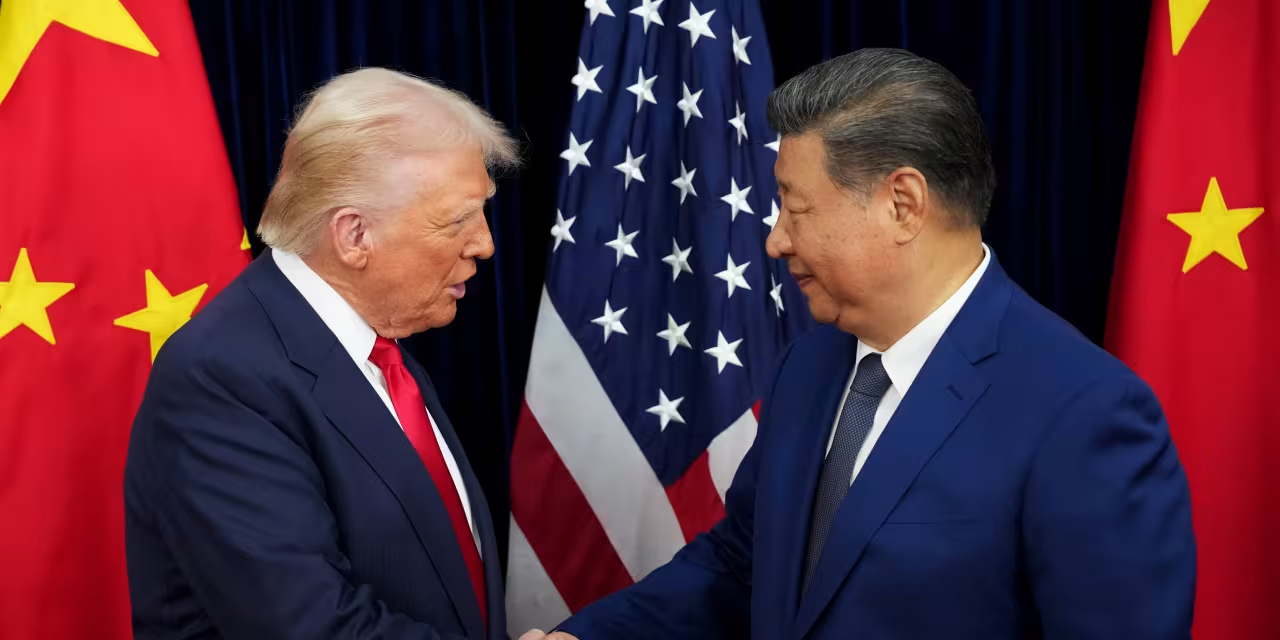
“There’s a realization that the market had gotten way ahead of itself,” said Kenny Polcari, chief market strategist at Slatestone Wealth in Jupiter, Florida. “It wasn’t paying enough attention to what the bond market and economic data is telling it. It was caught up in this momentum AI trade.” Crude prices surged after combative comments from U.S. President Donald Trump and Iran’s Foreign Minister Abbas Araqchi raised doubts as to whether their countries’ fragile truce would hold and dampened hopes that normal traffic through the crucial Strait of Hormuz would soon resume. Trump’s meeting with Chinese President Xi Jinping concluded with few tangible results to show for it, with Beijing offering no clear help toward resolving the U.S.-Iran conflict.
“It certainly was encouraging to see both countries engaging again at the highest level. Historically, these type of events bring about headlines outlining various commitments,” said Matthew Keator, managing partner at the Keator Group, a wealth management firm in Lenox, Massachusetts. “This week’s meeting seemed like more of a reset in relations between the two countries and less short-term, quantifiable results.”
Advertisement
The yield on 10-year Treasury notes, an indicator of global borrowing costs, touched its highest level since May 2025, when markets were reeling from Trump’s “Liberation Day” tariff proclamation. Global bond yields also jumped on growing evidence of the Iran war’s widespread economic damage.
Live Events
END OF POWELL ERA Friday marks Jerome Powell’s last day as U.S. Federal Reserve chair, a position he has held through the pandemic, periods of inflation, and interest rate hiking and cutting cycles.Incoming Chair Kevin Warsh is saddled with the potential need for a rate hike if a protracted Iran war leads to sticky inflation.
“The weakness today is highlighting the concerns that the recent (inflation) numbers aren’t transient, and it’s hard to envision the new chair communicating anything other than a neutral policy stance at best until we see some consistent, meaningful change in the data,” Keator added.
The odds of the Fed hiking interest rates by 25 basis points in December are approaching 40%, up from 13.6% a week ago, according to CME Group’s FedWatch tool.
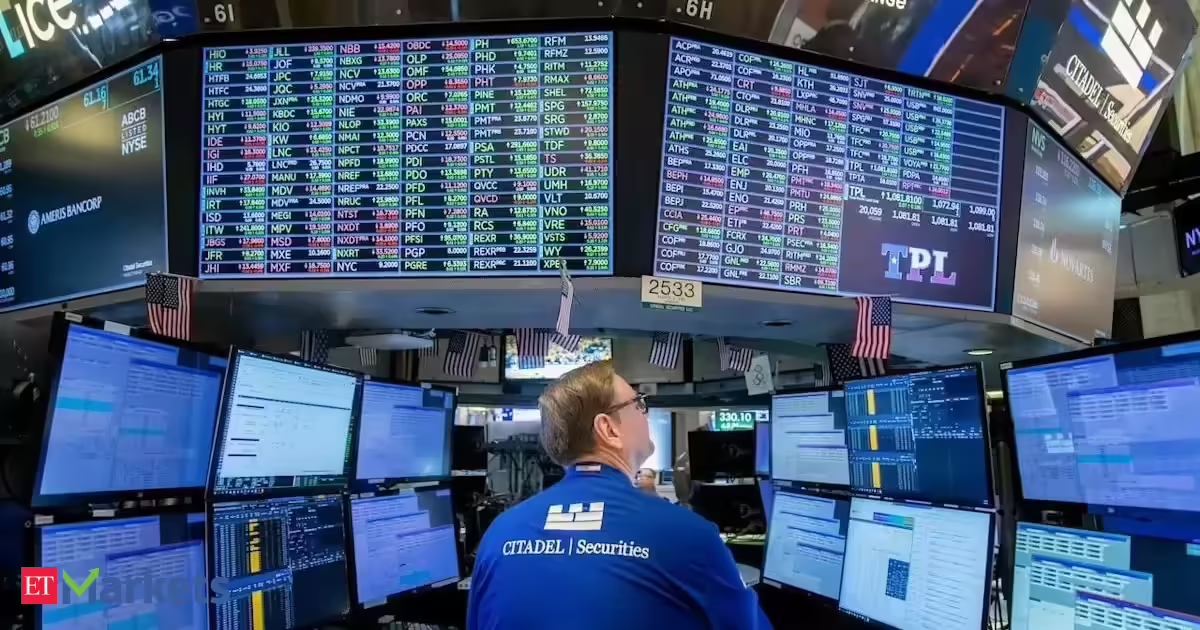
According to preliminary data, the S&P 500 lost 91.62 points, or 1.22%, to end at 7,409.62 points, while the Nasdaq Composite lost 412.61 points, or 1.53%, to 26,226.35. The Dow Jones Industrial Average fell 537.35 points, or 1.06%, to 49,531.70.
Advertisement
The Philadelphia SE Semiconductor Index was dragged lower by stocks that have benefited from the AI hyperscaler phenomenon.
Nvidia, AMD and Intel ended the session sharply lower. Microsoft rose following the disclosure of a new position in the company taken by Bill Ackman’s hedge fund Pershing Square. Dexcom jumped after the medical device maker’s announcement that it will appoint two independent directors and revamp a board committee in collaboration with activist investor Elliott Investment Management.
Ford slid, retreating from a near 21% surge over the last two sessions on optimism over the automaker’s energy storage business.
The Indian government has approved the proposal for the listing and disinvestment of Mahanadi Coalfields Limited (MCL), paving the way for the coal producer’s potential stock market debut through an initial public offering (IPO).
According to an official communication, the Department of Investment and Public Asset Management (DIPAM) and the Ministry of Coal had placed the proposal before the Alternative Mechanism (AM) after securing approvals from the boards of Coal India Limited (CIL) and MCL.
MCL, a wholly owned subsidiary of Coal India, is among India’s largest coal-producing companies with operations concentrated in Odisha. The listing would mark another major divestment initiative by the Centre as it seeks to deepen capital markets participation in state-run enterprises.
The AM has now cleared the proposal, allowing CIL to dilute its stake in MCL through an offer for sale (OFS) as part of the IPO and through additional tranches subsequently. The approval also allows MCL to raise fresh capital through issuance of equity shares during the IPO and later via follow-on public offers (FPOs), qualified institutional placements (QIPs) or other Sebi-approved routes.
Advertisement
The government said the disinvestment and fundraising exercises may be carried out either simultaneously or separately and could take place in multiple tranches. However, the total dilution under these mechanisms will be capped at reducing Coal India’s stake in MCL by up to 25%.
Live Events
The proposed listing will remain subject to prevailing market conditions and completion of statutory and regulatory requirements. One of Coal India’s subsidiaries, Central Mine Planning and Design Institute Ltd (CMPDI) was listed in March 2026 via an IPO route. Its IPO was a book built issue of Rs 1,841.45 crores and the issue is entirely an offer for sale of 10.71 crore shares. The public issue was launched at a price of Rs 172 per share. Its shares are currently trading at Rs 232.95 on the NSE.Meanwhile, Coal India shares ended at Rs 462.20, gaining by Rs 8.15 or 1.79% over the Thursday closing price.
(Disclaimer: The recommendations, suggestions, views, and opinions given by the experts are their own. These do not represent the views of The Economic Times.)
Capital markets regulator Sebi and the Central Board of Direct Taxes have eased several PAN-related compliance requirements for foreign portfolio investors (FPIs) after concerns emerged over difficulties in onboarding under the previously notified income-tax rules.
In a statement issued on Friday, Sebi said CBDT has provided multiple clarifications to simplify the PAN allotment process for FPIs following stakeholder feedback on the new Income-tax Rules, 2026 and revised PAN application forms notified in March this year.
The issue had arisen after the updated PAN forms introduced additional mandatory fields including taxpayer identification number details, representative assessee information and compulsory mobile number disclosure requirements.
Foreign investors and market intermediaries had raised concerns that many of these requirements were difficult to comply with across multiple jurisdictions, potentially complicating the onboarding process for FPIs investing in Indian markets.
Advertisement
Sebi said it actively engaged with CBDT after receiving representations from stakeholders to ensure that the PAN issuance framework remained smooth and investor-friendly.
Live Events
Under the revised clarifications, CBDT said the name of the authorised signatory mentioned in the Common Application Form (CAF) would be sufficient for the representative assessee or authorised representative field in PAN applications. The tax department also clarified that the liability of the authorised signatory would remain limited only to the purpose of applying for PAN and that no supporting documents related to the authorised signatory or representative assessee would be required.CBDT further eased address and contact-related compliance requirements. According to the clarification, if details such as mobile number, landline number or email address of the authorised signatory are unavailable, FPIs may provide their own contact information instead.
In another relief measure, CBDT said that if PAN, Aadhaar or passport details of the authorised signatory are unavailable, the FPI registration number can be furnished in the application.
The tax authority also addressed concerns around taxpayer identification numbers for jurisdictions where such systems do not exist.
CBDT clarified that in cases where TIN or an equivalent number is not applicable, applicants may fill the field using the value “0000000000”. Additionally, if an FPI does not have a mobile number, it may provide a landline number instead while furnishing contact details.
Advertisement
Sebi said the latest measures are aimed at ensuring continued ease of onboarding for foreign portfolio investors.
FPIs currently use a single Common Application Form for multiple regulatory processes including Sebi registration, opening bank and demat accounts and obtaining PAN registration in India.
Lument Finance Trust, Inc. (LFT) Q1 2026 Earnings Call May 15, 2026 1:00 PM EDT
Company Participants
Andrew Tsang James Flynn – CEO & Chairman of the Board James Briggs – Chief Financial Officer Greg Calvert – President
Advertisement
Conference Call Participants
Lee Zulch
Advertisement
Presentation
Operator
Good afternoon, and thank you for joining the Lument Finance Trust First Quarter 2026 Earnings Call. Today’s call is being recorded and will be made available via webcast on the company’s website.
I would now like to turn the call over to Andrew Tsang, with Investor Relations at Lument Investment Management. Please go ahead.
Advertisement
Andrew Tsang
Good afternoon, everyone. Thank you for joining our call to discuss Lument Finance Trust’s First Quarter 2026 Financial Results. With me on the call today are Jim Flynn, our CEO; Jim Briggs, our CFO; Greg Calvert, our President; and Zach Halpern, our Portfolio Manager.
This morning, we issued a press release to provide details on our recent financial results. We also provided a supplemental earnings presentation, which can be found on our website. We intend to file our 10-Q with the SEC this afternoon after market close.
Advertisement
Before handing the call over to Jim Flynn, I’d like to remind everyone that certain statements made during the course of this call are not based on historical information and may constitute forward-looking statements within the meaning of Section 27A of the Securities Act of 1933 and Section 21E of the Securities Exchange Act of 1934. Such forward-looking statements are subject to various risks and uncertainties that could cause actual results to differ materially from those contained in the forward-looking statements. These risks and uncertainties are discussed in the company’s reports filed with the SEC, in particular in the Risk Factors sections of our Form 10-K and Form 10-Qs. It is not possible to predict or identify
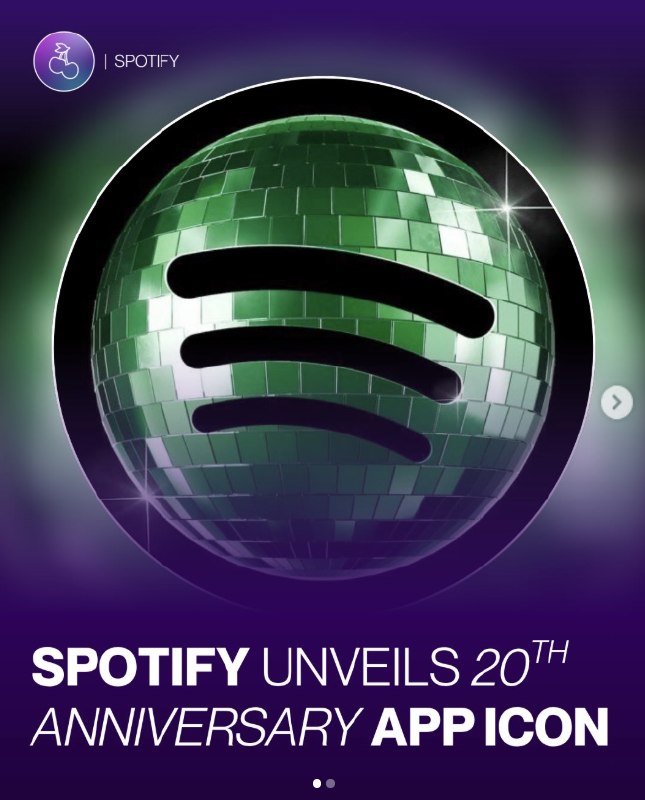
NEW YORK — Spotify has introduced a glittering new app icon featuring a green disco ball design to mark its 20th anniversary, triggering an immediate wave of viral reactions, nostalgia-filled celebrations and sharp criticism from users who prefer the platform’s iconic three-line logo.
The temporary redesign, which rolled out on iOS and is appearing for many Android users, transforms the classic Spotify emblem into a reflective disco ball while retaining the familiar soundwave lines. The change coincides with the launch of “Spotify 20: Your Party of the Year(s),” a major nostalgia campaign that includes personalized lifetime listening recaps, all-time top artists and songs, and 20 days of global music statistics.
Spotify’s design team described the disco ball as a playful celebration of two decades of music discovery and cultural moments. “At key moments, we adapt our logo to become an expression of culture,” the company said in its anniversary design history post. The icon pays homage to dance floors, parties and the joy of shared musical experiences that have defined the streaming era since Spotify’s founding in 2006.
Mixed User Reactions Flood Social Media
The new icon quickly became one of the most discussed topics online. Many users embraced the festive vibe, sharing screenshots alongside nostalgic posts about their first Spotify streams or favorite throwback songs. “This takes me back to the early days of discovering new music,” one user wrote on X. Others connected it to Taylor Swift’s “mirrorball,” Michael Jackson’s Off the Wall era or general 70s disco nostalgia.
Advertisement
However, a significant portion of the Spotify community expressed strong dislike. Comments ranging from “horrific” to “please change it back” flooded Reddit, Threads and the Spotify Community forums. Critics called the disco ball design cluttered, dated or overly gimmicky, arguing it sacrifices the clean minimalism that made the original logo instantly recognizable. Some users reported confusion when trying to locate the app on their home screens.
Design experts offered divided opinions. Supporters praised the temporary icon as a fun, culturally relevant twist that aligns with Spotify’s vibrant brand personality. Detractors argued that altering such a well-established logo risks diluting brand equity, even for a short campaign.
Spotify has not confirmed exactly how long the disco ball icon will remain, but early indications suggest it is tied specifically to the 20th anniversary celebrations and may revert afterward. Some users in iOS beta versions have already seen it switch back.
The Bigger Spotify 20 Campaign
The logo change is just one element of a broader anniversary push. Spotify is rolling out extensive user data features, including:
Advertisement
Lifetime top artists and songs
First song ever streamed
Personalized “Your Party of the Year(s)” playlists
Global all-time most-streamed tracks and artists
Taylor Swift continues to dominate many all-time charts, while the campaign highlights everything from breakup anthems to genre evolution over the past two decades. The initiative aims to strengthen emotional connections with users by turning their personal streaming history into shareable, reflective experiences.
Spotify’s Design Evolution
This is not the first time Spotify has refreshed its visual identity. The company has evolved its logo several times since 2006, moving from a more complex early design to the streamlined three-line icon that became globally recognized. The current anniversary update follows Spotify’s pattern of adapting its visual language for cultural moments, such as artist-specific Wrapped campaigns.
Design leads at Spotify emphasized that the disco ball version maintains core brand elements while injecting celebration. “We wanted something joyful that reflects two decades of parties, discoveries and shared soundtracks,” one designer noted in internal communications.
Business Context and User Engagement
The anniversary campaign arrives as Spotify continues expanding its user base beyond 600 million monthly active users. Features that boost time spent in the app and encourage sharing have proven effective for retention and growth. Early data suggests the new icon and nostalgia tools are driving higher engagement rates.
The move also highlights Spotify’s shift toward becoming more than just a music player — positioning itself as a cultural companion that chronicles users’ lives through sound. By giving subscribers a complete musical autobiography, the company deepens emotional ties in an increasingly competitive streaming landscape.
Advertisement
Industry Implications
Spotify’s bold visual experiment reflects broader trends in tech branding, where companies increasingly use temporary design changes for marketing moments. Similar tactics have been employed by brands like Google with its annual Doodles or Nike with limited-edition logos.
Competitors are watching closely. Apple Music and YouTube Music have ramped up their own personalization features, but none have matched Spotify’s scale of historical data visualization. The success or failure of the disco ball icon could influence how other platforms approach anniversary or milestone campaigns.
For users, the temporary change offers a fun conversation starter and a chance to reflect on how their musical tastes have evolved. Whether they love or loathe the new icon, the strong reactions demonstrate the deep connection people have with the platforms that soundtrack their lives.
As the 20th anniversary celebrations continue through the coming weeks, Spotify is expected to release more personalized insights and possibly additional visual surprises. The disco ball logo, divisive as it may be, has succeeded in one key goal: getting the entire internet talking about Spotify once again.
Advertisement
For better or worse, the green disco ball has become the defining visual of Spotify’s milestone year — a glittering reminder that even the most established brands are willing to take risks to stay culturally relevant. Whether it becomes a beloved temporary artifact or a design regret, it has already secured its place in Spotify’s rich visual history.





















































You must be logged in to post a comment Login