
Business
China’s Robotics Revolution Goes Global, and Thailand Is Already Inside the Supply Chain


- China has become a net exporter of industrial robots, shipping cost-competitive automation hardware to 148 countries. Several leading Chinese robotics firms are now localizing production in Thailand, with a 10 billion baht investment approved in the Eastern Economic Corridor and joint technology development underway with Thai government agencies and manufacturers.
- Chinese industrial robots are priced at roughly a third of competing imports, giving them an advantage in logistics and material-handling automation over higher-end precision applications. Thai suppliers and integrators face practical decisions about entering supplier networks, focusing on application-layer services, and partnering early with Chinese firms as they shift from product exports to full system exports with local infrastructure.
China’s robotics industry crossed a threshold this year that manufacturing economies across Southeast Asia are still absorbing. In April, Chinese firms exported more than 25,000 industrial robots in a single month, up nearly 90 percent from a year earlier, while full-year 2025 export volume had already surged close to 49 percent. China is no longer simply the world’s largest buyer of robots. It has become a net exporter, shipping standardized, cost-competitive automation hardware to 148 countries and regions in the first quarter of this year alone. For Thai manufacturers, the more consequential story is not the export statistic itself but where a meaningful share of that supply chain is now being built.
From exporter to embedded partner
Rather than simply shipping finished machines into Thailand, several of China’s leading robotics firms are localizing production here. The government has approved a 10 billion baht robotics investment inside the Eastern Economic Corridor, led by five Chinese technology companies, which will build a humanoid-robot components cluster in Chachoengsao province and generate more than a thousand high-skilled jobs.
This sits alongside the SMC-Siasun Innovation Center at EECi in Rayong, where Thailand’s National Science and Technology Development Agency is co-developing robotics and automation systems directly with Chinese partners rather than simply importing their hardware. Somboon Advance Technology, one of Thailand’s largest automotive parts suppliers, has already built what it describes as Southeast Asia’s first fully operational 5G smart factory in partnership with Siasun Robot & Automation and Huawei, using 3D vision robots and automated guided vehicles to lift productivity on its production floor. This kind of on-the-ground technology transfer is part of a broader pattern of Chinese innovation reshaping Thailand’s economy, extending well beyond finished-goods trade.
Why the price gap matters
China’s export data reveals something useful for procurement planning. The average unit export price for a Chinese industrial robot is roughly a third of the average unit import price into China, implying that Chinese suppliers are first winning on standardized, high-volume, cost-performance categories such as mobile robots and warehouse automation, rather than the most complex six-axis systems used in precision automotive welding or final assembly. For Thai factory operators, this suggests the clearest near-term opportunity lies in logistics and material-handling automation, where deployment cycles are shorter and payback periods more predictable, while the highest-end automotive and precision-assembly applications remain more contested ground between Chinese, Japanese, and European suppliers.
Where this fits in Thailand’s investment landscape
Robotics and automation sit among the priority sectors the Thai government continues to court through Board of Investment incentives, alongside electric vehicles, intelligent electronics, and digital infrastructure, all part of a wider push to position the kingdom among the top business opportunities in Thailand for 2026. The Eastern Economic Corridor’s role as the delivery mechanism for this strategy is not new. When the EEC’s five-year development plan was approved, automation and robotics were already named among the corridor’s targeted industries, well before the current wave of Chinese humanoid and mobile-robot investment arrived. What has changed is the speed and specificity: Chinese firms are no longer treating Thailand as a market to sell into, but as a base to manufacture from.
What Thai suppliers and integrators should watch
Three practical questions follow for businesses positioned around this shift. First, domestic content and technology-transfer requirements attached to EEC incentives will shape how much of the value from this cluster stays onshore versus flowing back to component suppliers in China, making the fine print of BOI conditions worth close attention for any Thai firm hoping to enter the supplier network. Second, the widening gap between China’s cheap, standardized exports and its higher-value imports suggests the real competitive opening for Thai system integrators is in application-layer work, deployment, calibration, and after-sales service, rather than trying to compete on hardware cost. Third, as Chinese humanoid and mobile robot makers shift from simple product exports toward full system exports, complete with local R&D and service networks, Thai firms partnering early are more likely to become embedded in that ecosystem than those waiting for the technology to mature elsewhere first.
None of this guarantees a smooth outcome. China’s own robotics executives describe the current phase of overseas expansion as closer to the start of a marathon than a finished breakout, with brand trust, after-sales service networks, and compliance with local rules still the deciding factors in whether early deployments turn into durable market positions. For Thailand, the question is no longer whether China’s robotics industry is going global. It already has. The question is how much of that global build-out Thailand can capture as a manufacturing base rather than simply a customer.
Other People are Reading


Post Newspapers has expanded its coverage from western suburbs to the north coast, after an investment in its own printing press led to more opportunities.

Yes. Corporate subscriptions are available for teams and organisations, with discounted rates as user numbers increase. Pricing starts from $1,625 + GST per user.
Get in touch
to discuss the right option for your organisation.
Business News subscriptions are used by executives, investors, consultants and professionals who need to stay informed and make better decisions about the WA market. When you subscribe you’ll get
- Unlimited access to WA’s most trusted business journalism
- Data & Insights — detailed profiles of WA companies, people, projects and deals
- MyBN — a personalised feed based on the companies, people and sectors you follow
- Special publications and industry reports
- Daily and weekly email newsletters
Data & Insights is a research tool built specifically for the WA market. It draws on more than 30 years of Business News reporting, updated regularly to reflect what’s happening now. Use it to:
- Look up detailed profiles of WA companies, including financials, directors and ownership
- Find decision-makers and track their career movements
- Research live and completed projects across WA industries
- Monitor deals, appointments and market activity
- Access industry rankings and league tables
Data & Insights is updated daily by our dedicated research team, which uses the latest announcements, ASX filings and editorial coverage to keep our person, company, list and project records up to date.
Business News welcome all opportunities to make our dataset accurate, complete and current, so if you have an update request, please email the team at
general@businessnews.com.au, and we’d be happy to assist.
MyBN
is part of every subscription. It’s your personalised view of Business News. You can follow the companies, people, sectors and projects that matter to you, and get a news feed and alerts tailored to your interests. You can save articles to read later and retain only what you need.
Only subscribers have full access to all content on the Business News website.
If staying informed about the WA economy is part of your job, and/or you’re looking for networking opportunities in WA, Business News is built for you.
Business News subscribers are:
- Executives and directors tracking competitors, clients and market movements
- Investors and advisers researching companies, deals and industry trends
- Consultants and professionals staying across sectors relevant to their clients
- Business owners looking for leads, context and market intelligence
Most Business News publications cover national or global markets. Business News is focused entirely on Western Australia, which means the journalism, the data and the intelligence are all built around WA companies, people and projects — not adapted from a national feed. Data & Insights, included with every subscription, combines more than 30 years of WA-specific editorial research with live business data. There’s no comparable product for the WA market.
The Morning Digest Email provides a comprehensive wrap of the major headlines, relevant to WA business, and includes with a snapshot of the overnight news covering oil, gold and ASX-listed companies.
The Afternoon Wrap Email focuses on the news covered by our team of journalists during the course of the working day, including exclusive stories and analysis, all of which relates to WA business and the local economy.
The BN Weekender Email contains a wrap of the Business News from the week that was, highlighting the top stories in each area of WA business.
Sign up for free.
We’re happy to help.
Get in touch
and our team will come back to you.

The founder of software firm Track’em has relocated to Dallas to ramp up growth after winning work with engineering, procurement and construction contractors in the US and Middle East.

The evolving public market now features specialised platforms with recurring revenue and institutional backing across co-working, real estate investment trusts, student housing, education infrastructure, logistics parks, and managed development platforms.
Read more: Most active funds beat benchmark indices last year: Motilal Oswal Study
Rather than being dominated by conventional property developers, the next phase of listings is likely to feature specialised real estate platforms with recurring revenue models, institutional ownership and sector-specific growth opportunities.
 Agencies
Market Evolution Co-working operators, REITs and education infra firms seek their growth capital through public listings

“India’s real estate IPO market is entering a new phase, one where institutionally managed platforms and not just conventional developers are stepping into the public markets,” said Lata Pillai, senior MD and head of Capital Markets, India, JLL. “Backed by institutional ownership, transparent governance, predictable cash flows and scalable operating models, these businesses are opening the door to a new breed of listings for investors to explore.”
Flexible workspace operators led the first wave of post-pandemic public listings. Companies like WeWork India, IndiQube, Awfis, and Smartworks have already gone public, while The Executive Centre India recently filed for an IPO and Alta Capital-backed Tablespace is exploring a listing.
“For a long time, private equity was the primary source of growth capital for specialised real estate businesses. As these platforms have scaled and established operating track records, the public markets are emerging as the next logical source of capital,” said Deep Shah, AVP, Unistone, a Merchant Banking firm. “IPOs provide companies with the financial flexibility to fund expansion, pursue acquisitions, strengthen their balance sheets and diversify their sources of capital.”
Institutionally backed residential developers are also exploring the public markets.
Bengaluru-based Assetz has filed draft IPO papers to raise over ₹1,200 crore, while positioning itself as a professionally managed, institutionally backed developer with a focus on governance and design-led residential projects.
Another emerging category is student housing and education infrastructure.
Centres of Learning
Hillhouse-backed Elevate Campuses has proposed a ₹2,550 crore IPO comprising entirely a fresh issue of shares. The company plans to use the proceeds to expand its education infrastructure platform, including student accommodation and K-12 education assets. Among residential developers, Runwal Realty has filed draft papers for a ₹2,000 crore IPO, while Runwal Enterprises has received Sebi approval for its proposed ₹1,000 crore public issue.
According to Pillai, as capital markets deepen and specialised real estate segments mature, we expect a wider range of platforms to tap public capital, unlocking fresh opportunities across realty growth story.

US stocks have finished the trading session lower, pausing after a strong start to the week, as investors digested the latest round of corporate earnings and looked for signs of progress toward a peace deal between the US and Iran.
A robust earnings season, which has tempered some concerns about the massive spending by AI-related companies, and growing optimism over the potential end of hostilities in the Iran war helped propel both the Dow Industrials and S&P 500 to record highs earlier this week.
Oil prices rose, with US crude settling up 2.75 per cent at $US77.29 a barrel and Brent settling at $US82.49 per barrel, up 3.83 per cent.
Iranian news agency Fars reported that a parliamentary committee in Iran is reviewing a preliminary bill that would bar US, Israeli and other “hostile” vessels from transiting the Strait of Hormuz.
“You’re seeing perhaps more muted response to macro news than you would otherwise see, probably due to the fact of the summer and a little bit of fatigue, there’s a little bit of headline fatigue, specifically around Iran,” said Robert Bernstone, head of trading at SummitTX Capital in New York.
“Iran is having less of an impact right now, to be clear, I’m not saying it has no impact … tweets are something, headlines are something, but we really want to see the devil is in the details.”
The Dow Jones Industrial Average fell 464.02 points, or 0.85 per cent, to 53,885.10, the S&P 500 lost 13.52 points, or 0.18 per cent, to 7,710.03 and the Nasdaq Composite lost 15.09 points, or 0.06 per cent, to 26,348.35.
The recent indications of movement toward a peace deal helped push crude prices lower earlier in the week and, in turn, eased inflation worries and expectations for a rate hike from the Federal Reserve, which also served to push US Treasury yields lower.
Data storage company Western Digital tumbled 13 per cent and memory chip maker Sandisk dropped 6.8 per cent following their quarterly results.
Both companies have surged this year, however, with Sandisk up more than 400 per cent and Western Digital up about 160 per cent.
AppLovin plunged 19.7 per cent after the marketing platform missed Wall Street estimates for quarterly revenue while Datadog plummeted 19 per cent after the cloud security firm said it expects revenue growth to slow in the third quarter.
Both stocks were among the biggest drags on the benchmark S&P index.
Of the 382 companies in the S&P 500 that have reported earnings through Wednesday morning, 84.8 per cent have topped analyst expectations, according to LSEG data, well above the 68 per cent average beat rate since 1994.
SpaceX shares erased losses from earlier in the session and closed 6.1 per cent higher, defying expectations that they would be pressured by insider selling, as the lockup period for early investors holding the stock expired.
On the data front, the number of people in the US filing claims for unemployment benefits increased slightly last week.
The report came ahead of closely watched non-farm payrolls figures for July due on Friday, which will shape expectations for the Fed’s path for interest rates at a time when chairman Kevin Warsh has scaled back on forward guidance from the central bank.
Declining issues outnumbered advancers by a 1.57-to-1 ratio on the NYSE and by a 1.38-to-1 ratio on the Nasdaq.
The S&P 500 posted 29 new 52-week highs and four new lows while the Nasdaq Composite recorded 131 new highs and 82 new lows.
Volume on US exchanges was 17.09 billion shares, compared with the 17.42 billion average for the full session over the last 20 trading days.

Shares of SpaceX fell more than 10% premarket to around $111 this morning, even after the rocket company reported a 92% surge in quarterly revenue.
Investors were spooked by the company’s $18.4 billion in capital expenditure in the second quarter alone, which compared with just $2.8 billion in the prior year. “The concern for investors is how fast expenditure growth is outpacing revenue growth,” said Kathleen Brooks, research director at brokerage XTB.
“If the share price stays below $115 on Wednesday, then it opens the door to a steeper fall below last week’s lows of $108, if we see a surge of SpaceX shares hit the market in the next two days,” Brooks said.

Operator
Ladies and gentlemen, thank you for standing by. Hello, and welcome to Perdoceo Education Corporation’s Second Quarter 2026 Earnings Conference Call. [Operator Instructions]
I would now like to turn the conference over to Nick Nelson. Please go ahead.
Nick Nelson
Alpha IR Group LLC
Thank you, operator. Good afternoon, everyone, and thank you for joining us for our second quarter 2026 earnings call. With me on the call today is Todd Nelson, President and Chief Executive Officer; and Ashish Ghia, Chief Financial Officer. This conference call is being webcast live within the Investor Relations section of the company’s website at perdoceoed.com. A webcast replay will also be available on our site for 90 days following the call, and you can always contact the Alpha IR Group for Investor Relations support.
Let me remind you that this afternoon’s earnings release and remarks made today include forward-looking statements as defined in Section 21E of the Securities Exchange Act of 1934 as amended. These statements are based on assumptions made by and information currently available to Perdoceo Education Corporation and involve risks and uncertainties that could cause actual future results, performance, business prospects and opportunities to differ materially from those expressed in or implied by these forward-looking statements.
These risks and uncertainties include, but are not limited to, those factors identified in Perdoceo’s most recent annual report on Form 10-K and subsequent filings with the Securities and Exchange Commission. Except as expressly required by the securities laws, the company undertakes no obligation to update those factors or any forward-looking statements to reflect future

Clinical research moves medicine forward one study at a time. Behind every successful study is a team focused on accuracy, safety, and people. Natasha La Anyane has built her career around that responsibility.
She combines technical knowledge with communication, adaptability, and resilience. Her approach shows that leadership is not only about managing complex work. It is also about staying true to your values while helping others succeed.
“I define success as living according to your values while making progress toward meaningful goals,” Natasha says. “That is what guides me every day.”
How Natasha La Anyane Built a Career in Clinical Research
Natasha La Anyane earned a Bachelor of Science in Psychology. That educational background gave her a deeper understanding of human behavior and communication. Those skills became valuable as she entered the field of clinical research.
She chose a career where every detail matters. Clinical research requires careful planning, strong organization, and teamwork. Every step must follow strict guidelines while keeping patient safety at the center of the process.
Over the years, Natasha has built extensive experience supporting clinical research while remaining committed to professional growth. She is an active member of the Association of Clinical Research Professionals (ACRP) and has earned the Certified Clinical Research Associate (CCRA) credential. These achievements reflect her commitment to maintaining high standards and continuing to grow within the industry.
What Makes Someone Successful in Clinical Research?
Working in clinical research means balancing science with people. Natasha believes technical knowledge is only part of the equation.
“Flexibility, adaptability, interpersonal skills, proactiveness, and communication make the biggest difference,” she explains.
Clinical research rarely follows a perfect path. Timelines shift. Unexpected challenges appear. Teams must respond quickly while maintaining quality and compliance.
Natasha believes successful professionals remain calm and adjust without losing sight of the larger goal. Strong communication helps researchers, sponsors, healthcare professionals, and study teams stay aligned throughout the process.
Her psychology background also supports her ability to understand different perspectives and build productive working relationships.
Why Resilience Matters in Clinical Research
Every career includes setbacks. Clinical research is no exception. Studies change direction. Plans evolve. New challenges appear with little warning.
Natasha has developed a mindset that keeps her moving forward.
“Not getting what I want but being resilient and getting back up and trying again helps me overcome challenges,” she says.
Rather than viewing obstacles as failures, she sees them as opportunities to learn and improve.
This outlook has helped shape her approach to leadership. Instead of reacting emotionally to problems, she focuses on solutions. She believes consistency and perseverance often create better long-term results than chasing quick wins.
Accountability Creates Better Leaders
One lesson Natasha continues to apply throughout her career is personal accountability.
“Keeping myself accountable has made a tremendous difference,” she says.
She believes leadership starts with holding yourself to the same standards you expect from others. That includes preparing thoroughly, communicating clearly, and taking ownership of responsibilities.
Her own standards continue to guide her professional decisions.
“My own set standards keeps me focused on doing my best.”
This personal discipline helps create trust among colleagues and contributes to stronger teamwork across clinical research projects.
Balancing Performance with Health and Well-Being
Clinical research can be demanding. Projects often involve multiple priorities and strict timelines. Natasha believes maintaining personal health is essential for long-term success.
“It contributed tremendously to keep your mental and physical health intact,” she says when discussing the importance of balance.
Outside of work, she enjoys playing tennis, traveling, and spending time at the gym. These activities help her recharge while supporting both physical and mental well-being.
She also draws strength from her faith.
“Faith and prayer help keep me grounded,” Natasha says.
Together, these habits help her maintain perspective while managing the responsibilities that come with a career in clinical research.
Lessons from Natasha La Anyane’s Career Journey
Natasha’s career demonstrates that leadership is built through consistent actions rather than single achievements.
She believes success comes from staying adaptable, communicating effectively, and continuing to grow professionally. Her resilience allows her to move through challenges without losing sight of her goals. Her commitment to accountability helps build trust with those around her.
Most importantly, she continues to define success on her own terms.
“I define success as living according to your values while making progress toward meaningful goals.”
That philosophy continues to shape every stage of her career.
As clinical research continues to evolve with new technologies, treatments, and global collaboration, professionals like Natasha La Anyane remind us that progress depends not only on scientific innovation but also on strong leadership, clear communication, and an unwavering commitment to doing meaningful work with integrity.

Trump orders leak probe over reports on depleted munitions, WSJ reports

- Thailand generates over 10.1 million tonnes of food waste annually, with more than 40% retaining potential value as animal feed, fertiliser, or energy. Despite growing awareness, the absence of dedicated legislation, a lead coordinating agency, and legal protections for food donors leaves surplus food management fragmented and ineffective.
- Current laws focus on consumer safety and sanitation rather than food reuse, while tax rules and liability risks discourage businesses from donating surplus food. Researchers recommend donor protection laws, revised tax incentives, streamlined approval processes, and clearer regulatory standards to align Thailand’s food system with circular economy principles.
Thailand throws away food on a massive scale. Yet much of what ends up in the bin could still feed people, animals, or even produce energy. The real problem is not simply waste but a system that makes reuse difficult.
Each person in Thailand generates about 154 kilograms of food waste a year. In 2024 alone, the country produced more than 10.1 million tonnes, almost one-third of all municipal waste nationwide.
The striking thing is how much of this waste still has value. More than 40% of food waste could still be used. Even food that can no longer be eaten as it is does not have to go to waste. It can still be turned into animal feed, fertiliser or energy.
Food waste is often blamed on households. But the issue runs far deeper than the kitchen. Waste occurs throughout the food system—in the way food is produced, distributed, and consumed. It shows up everywhere: in fresh markets, retail shops, hotels, and large urban communities.
It’s clear. Food waste is not simply about consumer habits. It reflects how the entire food system works.
And when so much food is thrown away despite its potential value, the problem goes beyond eating habits or business practices. It also reveals legal and regulatory barriers that make it harder for Thailand to move towards a genuine circular economy.
The problem is particularly clear in how surplus food and food waste are managed. Together they make up a major share of the country’s waste. Public awareness has begun to grow, and some initiatives now redirect surplus food to people in need through charitable organisations.
Yet a major obstacle remains. Thailand still lacks specific legislation to guide the systematic management of surplus food and food waste. There is also no clear lead agency responsible for the issue. Without coordination, efforts are then scattered and difficult to expand.
Surplus food refers to food produced or supplied in excess of demand but still safe and of good quality. This includes food nearing its expiry date or unsold items left on retail shelves.
At present, the Food Act of 1979 focuses mainly on consumer protection and food safety. These safeguards are essential. But the law has no measures to make use of surplus food.
Another important problem: There is no legal protection for food donors. Even when businesses donate surplus food in good faith, they can still face civil or criminal liability if something goes wrong after the food is eaten.
With that risk hanging over them, many companies choose to destroy surplus food rather than donate it. Legally speaking, throwing it away feels safer.
Tax rules create another layer of difficulty. Under current regulations, donated goods are still taxed. Businesses are required to include the value of donated food when calculating value-added tax.
There are exemptions for certain fresh foods and agricultural products. But they apply only in limited cases and do not reflect the kinds of surplus food commonly generated in the retail and food industries.
Food donations are also treated as charitable expenses. Companies can claim a deduction of no more than 2% of net profit. For businesses with large volumes of surplus food, that cap means the tax benefit often falls far short of the value of what they donate.
Food waste—surplus food that has deteriorated or expired and can no longer be eaten—presents another set of challenges. Laws such as the 1992 Public Health Act and the 1992 Cleanliness and Orderliness Act focus mainly on sanitation and the safe disposal of waste.
Local administrative organisations are responsible for waste management. In many areas, however, their waste separation systems are still lacking. Food waste is often mixed with general waste, making recovery or reuse far more difficult.
Even when businesses want to turn food waste into fertiliser or energy, regulatory hurdles remain. These activities require strict approval from local authorities. Transporting food waste across administrative boundaries can also involve lengthy approval procedures.
Not surprisingly, such obstacles discourage investment and limit opportunities to put food waste to productive use.
To tackle the problem, Thailand needs to bring its rules into line with the principles of a circular economy. That begins with a change in mindset.
Unsold or uneaten food should not automatically be treated as waste. In many cases it is still a resource—one that can be redistributed for people to eat, used as animal feed, processed into new products, or converted into energy. Only a small portion should ultimately need disposal.
Policies, therefore, need to make food donation safe, practical, and economically sensible for businesses. This means combining clear regulatory standards with meaningful incentives so that donating food becomes a better option than destroying it.
On the regulatory side, the government should establish clear standards for food donations, based on levels of risk. These should cover transportation, storage, and handling. Donors and intermediary organisations should also be registered and required to share information with regulators to ensure safety and accountability.
Tax incentives could also help change behaviour. Food donated through government-approved organisations could be treated in ways that reduce the value-added tax burden on businesses. Additional deductions could support activities such as food separation, donation, and redistribution.
Waste collection fees could also reflect how much food is thrown away. The Pay-As-You-Throw system should be used to make those who discard more waste pay more. The environmental costs will be clearer, giving businesses a financial reason to donate or reuse food instead of throwing it away.
Importantly, there should be a law to protect donors who give food in good faith unless gross negligence or intentional misconduct occurs. Many countries already have this legislation. Such legal protection would lower the risks for businesses and make them more willing to share surplus food instead of throwing it away.
Thailand also needs a clear lead agency to take charge of the issue, better data systems, and closer coordination between central and local authorities. Food waste should be separated from the start, with common standards that local administrations across the country can follow.
Approval procedures for collecting, transporting, and processing food waste should also be streamlined and clarified. That would open the door for businesses and communities to play a bigger role in reducing food waste.
Food waste does not lose its value the moment it is thrown away. What disappears instead is the chance to turn it into something useful.
Many countries are already moving in that direction. The question now is whether Thailand will do the same—or continue letting that value slip quietly into the landfill.
Chanisara Dumkum and Theerat Dejitikul are researchers at the Thailand Development and Research Institute (TDRI). Their policy analyses appear in the Bangkok Post on 8 April 2026.
Other People are Reading

FREDDIE BURNS interview: I beat the All Blacks on my England debut – then woke up at the training ground in a pile of my own sick

The Post newspaper expands to north coast suburbs

Coldcard Exploiters Move 64 BTC, 200 ETH Into Crypto Mixers


-

 Fashion6 days ago
Weekend Open Thread: Wit & Wisdom
-

 Politics6 days ago
Meta enters AI-training agreement with far-right ‘propaganda rag’ Newsmax
-

 Politics4 days ago
Zack Polanski: an incitement to murder Nigel Farage?
-

 Crypto World5 days ago
MicroStrategy Post-Earnings CLARITY Act Push Could Add New Catalyst for Its Stock
-

 Crypto World6 days ago
XRP Ledger v3.3.0 brings five institutional features
-

 Crypto World6 days ago
New York sues Kalshi over prediction market gambling
-

 Crypto World5 days ago
Crypto PAC spending tops $2M in Michigan House race
-

 Business4 days ago
DTCR: Deleveraging And A Hedge Fund Collapse Point To A Possible AI Bottom
-

 Business6 days ago
Trump Announces Hamas Disarmament Agreement as Iran Strikes Kuwait Air Base and US Attacks Pause Overnight
-
 Crypto World6 days ago
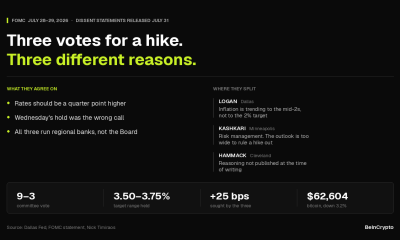
3 Fed Officials Just Explained Their Rate Hike Vote: Is Inflation Winning?
-

 Tech5 days ago
ESET tracks rise in malicious AI skills and adaptable malware
-
Crypto World4 days ago
XRP Ledger urges node upgrade after manifest flood
-

 Tech7 days ago
Gemini Spark can now use Chrome logins and saved passwords to run errands on your behalf
-
 Tech7 days ago
Building A Reproduction PlayStation Motherboard
-

 Sports6 days ago
France Cricket implodes: letters hidden in a drawer and a board at war
-

 Crypto World6 days ago
Moneyflip CEO charged in $40K murder-for-hire plot
-
 Sports6 days ago
Bruno Fernandes decision made as Man United ‘discuss’ striker transfer option
-

 News Videos5 days ago
Financial Crash Expert: The 90-Day Collapse Timeline They Are Desperately Hiding.
-

 NewsBeat7 days ago
Spain sending troops as thousands enter enclave of Ceuta from Morocco
-

 Sports6 days ago
Commonwealth Games 2026 Live Updates | Day 9 CWG 2026: Lovlina Borgohain, Sachin Siwach Enter Final After Indian Judokas Script History
You must be logged in to post a comment Login