
Business
Coca-Cola hires Rob Gehring from Monster Energy to run its North American operations

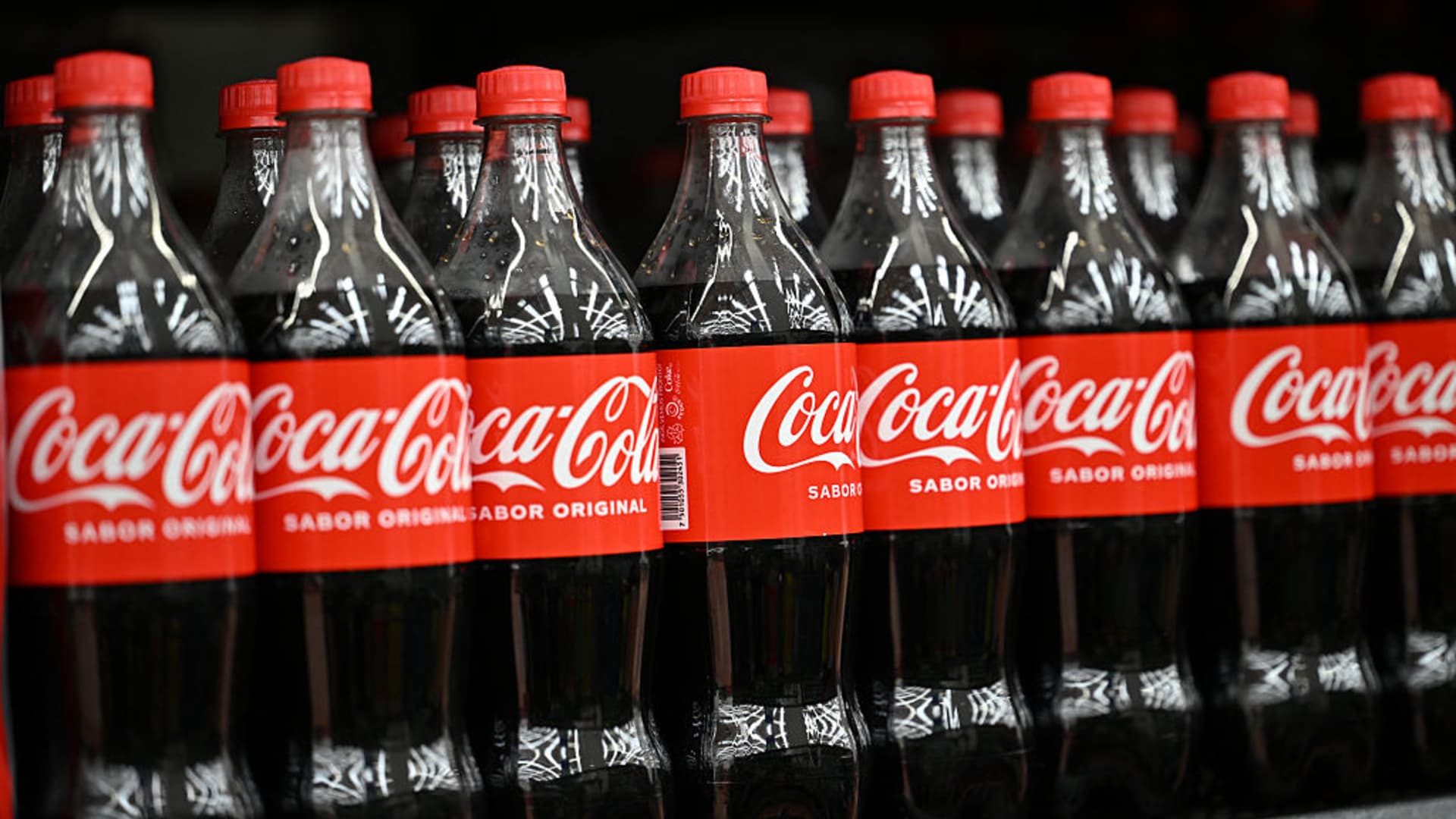
This view shows bottles of regular Coca-Cola soda displayed for sale on shelves at a Walmart store in Mexico City on October 27, 2025.
Yuri Cortez | Afp | Getty Images
Rob Gehring, the head of Monster Energy‘s Americas business, will leave to run Coca-Cola‘s North America unit, the companies said Friday.
He will take over the position on Dec. 1.
The move comes as Coke tries to maintain growth while U.S. consumers cut back on spending in the face of higher gas and grocery prices. Despite those dynamics, the beverage giant posted net sales growth of 7% in the second quarter, as volume — a key measure of demand — rose 3% in North America.
Though Monster Energy parent Monster Beverage is considerably smaller than Coke, its sales have soared in part due to innovation in the energy drink space. The company reported net sales growth of 20% in its second quarter.
Coke is also investing in developing new beverages beyond its core soda offerings, including refreshers and dirty sodas.
Gehring, 59, took on his previous role at Monster in February after serving as chief growth officer since 2024. In a press release, Coke said he was “part of the leadership team that drove the company’s growth agenda and modernized commercial capabilities.”
Before joining Monster, Gehring was CEO of Swire Coca-Cola USA, a major bottler of Coke products in the western U.S.
Coke shares have climbed more than 25% this year, while Monster’s stock has risen more than 12%.


CAMBRIDGE, Mass. — Akamai Technologies shares jumped Friday after the company said Anthropic committed $11.6 billion over seven years for cloud computing, with an option to add as much as $9 billion more.
The stock traded around $126.54 in early New York dealing on Sept. 25, up $16.13, or 14.6 percent, from Thursday’s close of $110.41. After-hours and premarket prints had been even higher, with Barron’s citing a rise of more than 21 percent to $133.84 before the open.
Akamai said the contract will “support Anthropic’s accelerating CPU workload demands by leveraging Akamai Cloud’s distributed AI infrastructure and software.” It adds to more than $2.8 billion in multi-year cloud infrastructure commitments the company has already disclosed this year.
Chief Executive Tom Leighton said: “Anthropic is advancing the AI revolution and we are thrilled they chose Akamai’s capabilities for building and operating AI infrastructure at scale.”
Anthropic did not immediately comment to Barron’s.
As part of the pact, Akamai issued a warrant covering about 7.7 million shares on an as-converted basis, or up to about 5 percent of common stock outstanding. The exercise price is $111.33 a share. About 2 percent of the equity is tied to the initial $11.6 billion commitment; another 3 percent could vest if the companies expand the deal by up to $9 billion, according to summaries of the announcement. That would take the potential commitment near $20 billion.
Building the capacity is expensive. Barron’s reported Akamai expects $5.5 billion in new capital spending, including memory purchases, with $1.6 billion of that in 2026. Benzinga cited about $1.7 billion of extra 2026 capital expenditure to lock in supply-chain parts and said the company sees no change to 2026 revenue guidance. An investor-update recap said revenue from the Anthropic work is expected to ramp toward $1.7 billion a year by 2028.
Akamai is best known as a content-delivery network that later pushed into cybersecurity and cloud infrastructure. Delivery revenue has been under pressure. Security is the largest profit engine. Cloud Infrastructure Services is smaller but growing fast. In the second quarter ended June 30, total revenue was $1.1 billion, up 5 percent. Security was $604 million, up 10 percent. Cloud Infrastructure Services was $99 million, up 39 percent. Delivery and other cloud applications fell 6 percent to $396 million.
GAAP diluted earnings were $0.52, down 27 percent. Non-GAAP diluted earnings were $1.59. Cash, cash equivalents and marketable securities were $4.616 billion. The company had guided full-year 2026 revenue to $4.445 billion–$4.530 billion before this announcement and said the new deal does not alter that 2026 top-line range — meaning most of the $11.6 billion sits in later years.
Anthropic, maker of the Claude models, is privately held and filed confidential IPO paperwork in June, Barron’s noted. AI labs have been signing multiyear compute contracts with Nvidia-heavy clouds such as Microsoft Azure, Amazon Web Services, Google Cloud and CoreWeave. A large CPU-focused deal with Akamai is a different flavor of capacity: inference and supporting workloads spread across Akamai’s edge footprint rather than a single training campus.
Investors repriced Akamai as more than a CDN with a security wrap. The share count implied by the warrant is dilution if Anthropic exercises. The capex is cash out the door before the revenue curve steepens. Those are the offsets. The bid on Friday treated the contract size as the headline.
Akamai’s next scheduled earnings date in market calendars was around Nov. 5. Until then, the tape is trading a seven-year number, a warrant at $111.33, and a stock that closed Thursday at $110.41 after a 6.8 percent drop and opened Friday in the mid-$120s.
The company still has to buy memory, stand up servers and keep Anthropic’s usage on the committed path. Anthropic still has to need that CPU layer for seven years. Friday’s move is the market assigning a higher probability that both happen.

Prosper Trading Academy CEO Scott Bauer discusses retail investors’ appetite for upside and downside protection in the market on ‘The Claman Countdown.’
A women’s apparel company that caters to price-conscious consumers announced the closure of 120 retail stores by the end of the fiscal year.
The Cato Corporation, parent company of Cato Fashions, operates more than 1,000 women’s apparel and accessories stores across 31 states.
The slated closures account for more than 10% of its stores, Fast Company reported.
Cato, which was founded in 1946, focuses on budget-wary consumers, much like TJ Maxx or Ross Dress for Less.
WALMART SAYS IT WILL USE BILLIONS IN TARIFF REFUNDS TO KEEP PRICES LOW

Cato Fashions, an American retailer of women’s fashions and accessories, will close 120 locations by the end of the fiscal year, the company has announced. (Getty Images / Getty Images)
The Cato Corporation also operates two other retailers — Versona, an upscale apparel, jewelry, and accessories brand with 90 locations in the U.S., and its It’s Fashion and It’s Fashion Metro brands, which have 119 locations in the U.S.
Last week, the Charlotte, North Carolina-based corporation announced it would close 120 stores, an increase from the initial 50 the company originally announced.
HOW SHOULD BUSINESSES APPROACH TARIFF REFUNDS?

Bright-colored tops hanging on a rack. (iStock / iStock)
“Annually, we review approximately one-third of our stores to exercise available lease options or negotiate an extension based on each store’s performance, including store sales trends and current and projected store profitability,” John Cato, the company chairman, president and CEO, said in a statement.
“In light of the current economic environment, especially with the negative pressure on our customers’ discretionary income, we do not expect these marginal stores to improve appreciably,” he added. “As a result, we are closing more stores than expected this year. We believe that closing these additional stores will have a positive impact on our operating results in fiscal 2027 and beyond.”
Laffer Tengler Investments CEO Nancy Tengler discusses Oracle’s revenue and earnings, the AI arms race and more on ‘The Claman Countdown.’
GET FOX BUSINESS ON THE GO BY CLICKING HERE
In August, the company reported a net income of just $1.1 million for the second quarter, down from $6.8 million the company brought in during the same period a year earlier, the news report states.
Yardeni Research President Ed Yardeni joins the panel to discuss how higher yields weigh on stocks. He analyzes Magnificent 7 performance against the S&P 500 and explains the outlook for technology and communication sectors.
Tesla on Thursday announced that the electric vehicle maker was beginning deliveries of its Semi trucks to customers this week.
Executives at Tesla’s plant in Sparks, Nevada, made the announcement that the first customers will take delivery of the electric big rigs about nine years after CEO Elon Musk first announced the company’s plans to develop the long-haul freight trucks.
The Semi aims to open a new market for Tesla, which has long been known for its EV sedans and SUVs, by creating an electric option for commercial freight haulers.
The announcement comes at a time when diesel prices have surged to record highs, raising costs on firms in the trucking industry.
TESLA REOPENS ROADSTER RESERVATIONS – BUT YOU’LL NEED $50K
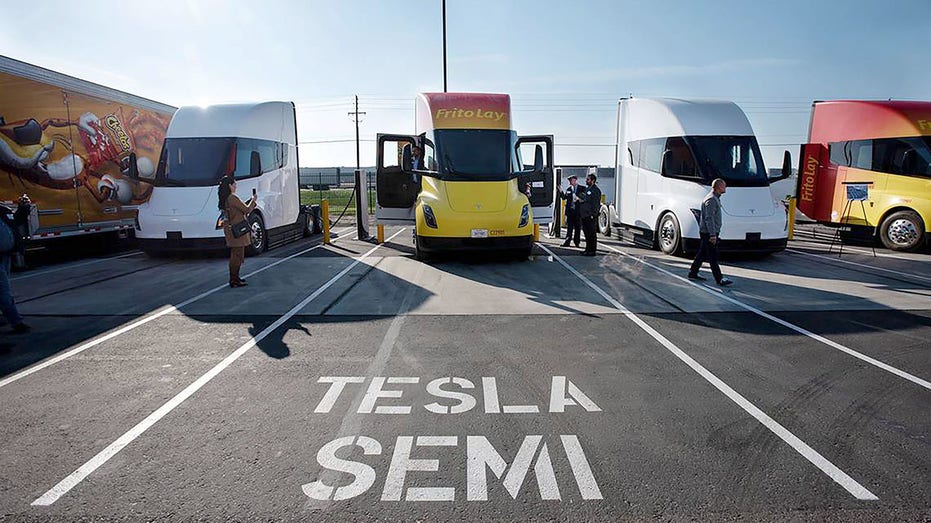
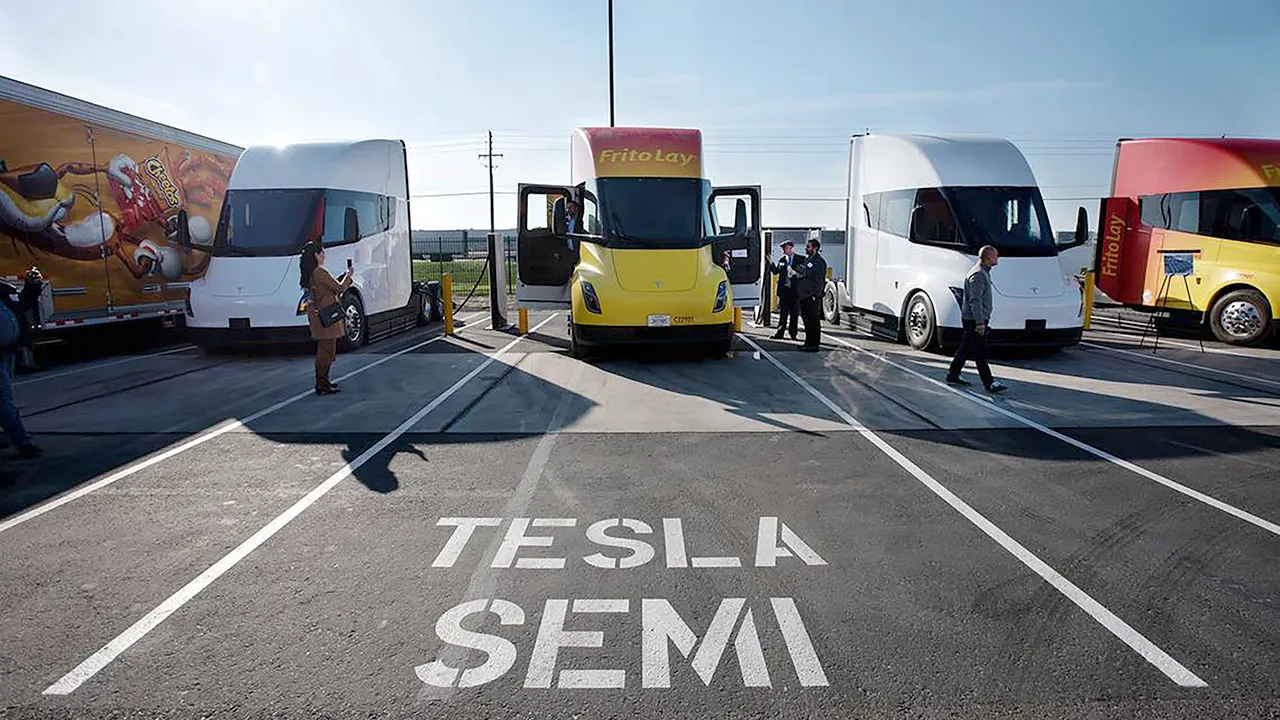
Tesla semi trucks recharge at a charging station at the Frito-Lay production facility in Modesto. (Andy Alfaro/Modesto Bee/Tribune News Service via Getty Images)
Tesla didn’t disclose its plans for production volumes of the Semi or its pricing at a webcast event held late Thursday at the plant, though it reiterated plans to build 50,000 Semis a year at the Nevada facility.
Elon Musk wasn’t in attendance at the event but said in a recorded video message that, “I’d recommend placing more orders if you haven’t already, but the waiting list is already pretty significant.
Several companies that have purchased the Semi – including PepsiCo, DHL and U.S. Foods – were in attendance at the Tesla event and were invited on stage, while trucks with their logos were shown outside.
The long-range variant of the Semi has a range of 500 miles with a single charge, as Tesla director of Semi truck engineering Dan Priestly said, those are “500 real-world miles. Our customers have validated it.” The standard version of the Semi has a shorter range of 325 miles on a single charge.
TESLA FILES PLANS FOR PROPOSED $10.1B TEXAS SOLAR MANUFACTURING PLANT
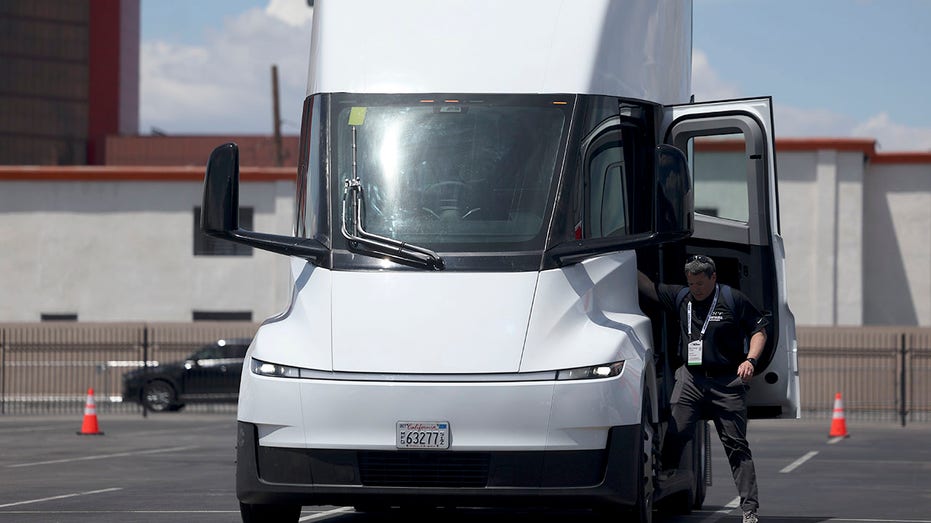
An attendee gets into a Tesla Semi during the 2026 ACT Expo at the Las Vegas Convention Center in Las Vegas, Nev. (Ian Maule / Los Angeles Times via Getty Images)
Tesla and Musk first unveiled the Semi in 2017 and planned to start production in 2019, though it faced delays due to supply chain disruptions.
The first Semi was delivered to U.S. customers, including PepsiCo, in late 2022 – though those trucks were made on Tesla’s lower-volume pilot production lines.
The EV maker’s first truck rolled off the high-volume production line in April. While volume production was expected to start this year, Tesla has since adjusted that guidance to not explicitly state that it will reach high-volume production this year.
TESLA’S ELECTRIC SEMI-TRUCK TAKES ON DIESEL BIG RIG
| Ticker | Security | Last | Change | Change % |
|---|---|---|---|---|
| TSLA | TESLA INC. | 372.11 | -5.83 | -1.54% |
Despite delays, competition and shifts in EV policy in the U.S., Tesla received a new order for 2,500 Semis from a coalition of major cargo-owning shipping companies – including Microsoft and PepsiCo, according to the nonprofit Catalyst Mobility. The group noted that figure is nearly double the existing fleet of electric Class 8 trucks.
Additionally, Swedish freight technology company Einride announced a deal last week to add 500 Semi trucks to its fleet.
GET FOX BUSINESS ON THE GO BY CLICKING HERE
Reuters contributed to this report.

Analysis-How Trump’s diplomatic week exposed the limits of his power


Four Gate Alpha is an independent investment-research platform focused on fundamental, event-driven, and quantitative analysis. Our work spans special situations—including clinical, regulatory, legal, and financing catalysts—as well as systematic stock selection, forecasting, and model portfolios. We emphasize evidentiary strength, probability-weighted valuation, downside risk, and the disciplined separation of durable signal from narrative and market sentiment.
Analyst’s Disclosure: I/we have no stock, option or similar derivative position in any of the companies mentioned, and no plans to initiate any such positions within the next 72 hours. I wrote this article myself, and it expresses my own opinions. I am not receiving compensation for it (other than from Seeking Alpha). I have no business relationship with any company whose stock is mentioned in this article.
Seeking Alpha’s Disclosure: Past performance is no guarantee of future results. No recommendation or advice is being given as to whether any investment is suitable for a particular investor. Any views or opinions expressed above may not reflect those of Seeking Alpha as a whole. Seeking Alpha is not a licensed securities dealer, broker or US investment adviser or investment bank. Our analysts are third party authors that include both professional investors and individual investors who may not be licensed or certified by any institute or regulatory body.


KANSAS CITY — Foodservice operators are continuing to utilize limited-time menu innovations to drive consumer traffic.
For instance, P.F. Chang’s unveiled a menu collection inspired by autumn traditions in Kyoto, Japan, ranging from two duck offerings to Wagyu egg rolls. The duck items include duck wings, which are tossed in teriyaki sauce then topped with toasted sesame seeds, Fresno peppers and scallions, and duck fried rice, which combines shredded duck, a fried egg, edamame, fried shallots, kimchi, julienned vegetables, chili jam and chili-spiced butter. The egg rolls are formulated with Wagyu beef, julienned vegetables, black pepper, garlic, ginger and black garlic aioli.
“Autumn gives us the opportunity to work with deeper, richer flavors and ingredients that feel especially craveable this time of year,” said Steve Solis, vice president of culinary at P.F. Chang’s. “We challenged ourselves to reimagine familiar P.F. Chang’s favorites through unexpected seasonal pairings. The result is a menu that feels comforting and approachable but still delivers the bold flavor and sense of discovery our guests come to us for.”
CKE Restaurants Holdings, Inc. subsidiary Carl’s Jr. debuted the first product under its Burger Revolution platform, a systemwide cooked-to-order initiative, with the Angus Maximus burger. The LTO features two Angus beef patties, American cheese, sliced onions, dill pickles and special sauce.
“Carl’s Jr. has never been in the business of serving burgers that are just good enough,” said Iwona Alter, brand president for Carl’s Jr. “The Burger Revolution and our shift to a cooked-to-order process represent our commitment to raising the standard across the entire Carl’s Jr. experience. The Angus Maximus is the perfect burger to lead that charge, bringing two charbroiled 100% Angus beef patties, bold flavor and the quality and value our guests deserve.”
Paris Baguette is tapping into the sweet heat trend with two Halloween menu items. The ghost pepper chocolate marble mochi donut blends Paris Baguette’s mochi donut format with chocolate marble frosting and spice from a ghost pepper, and ghost pepper iced hot chocolate features an iced hot chocolate beverage with an infusion of heat from ghost peppers.
“This Halloween, we wanted to surprise and delight with something unexpected, the fiery kick of ghost pepper paired with rich, indulgent chocolate, while still embracing the nostalgia that makes Halloween so special,” said Cathy Chavenet, chief marketing officer of Paris Baguette North America.
Article by: Claudio
Business Stock Exchange Trading Concepts
The crypto industry spent the past week juggling three very different identities at once: a target for sophisticated hackers, an increasingly attractive partner for traditional finance, and a source of mounting frustration for ordinary taxpayers trying to make sense of new IRS rules. Together, the developments paint a picture of an industry that is scaling up fast while its security and compliance infrastructure struggles to keep pace.
The most dramatic story came from Bitget, which revised its estimate of losses from Thursday’s security breach upward to roughly $388 million, about $35 million more than the exchange first disclosed. In a Friday update, Bitget said the higher figure reflects a more complete accounting of transfers on the Zcash and TRON networks that were missed in its initial tally, not new unauthorized activity. The exchange said the incident, which touched Ethereum Virtual Machine networks, the XRP Ledger, Zcash and TRON, is now contained and that no further transfers are possible. Withdrawals remain paused, and Bitget has launched a bounty program aimed at incentivizing the freezing or recovery of stolen funds.
CEO Gracy Chen has pointed to a possible North Korean connection, telling users during a live Q&A that investigators had matched IP addresses to VPN services previously associated with a known DPRK-linked hacking group. Chen said she did not believe the breach was an inside job and that some funds had already been recovered, though she declined to give a specific figure. If confirmed, North Korean involvement would extend a grim pattern: state-linked hackers were tied to an estimated $2.02 billion in crypto theft in 2025 alone, including the roughly $1.5 billion Bybit hack that the FBI attributed to Pyongyang. Even with Bitget’s revised numbers, that Bybit breach remains the largest in the industry’s history.
Bitget wasn’t the only exchange dealing with the fallout of a bridge exploit this week. KelpDAO filed a lawsuit against cross-chain protocol LayerZero and its CEO, Bryan Pellegrino, over the roughly $292 million exploit of its rsETH bridge earlier this year. KelpDAO alleges LayerZero failed to disclose known risks in its technology and had signed off in writing on Kelp’s bridge configuration before the attack. Pellegrino has called the suit “meritless” and says he intends to fight it in Vancouver, setting up a legal fight that could clarify where responsibility lies when shared cross-chain infrastructure fails — with the bridge provider, the protocol built on top of it, or both.
Not every retreat this week involved hackers. French semiconductor firm Sequans Communications sold its last 314 Bitcoin, formally abandoning a corporate treasury strategy that once held more than 3,200 BTC. The company, which launched its Bitcoin bet in mid-2025 alongside a $384 million capital raise, began unwinding the position within months and is now refocusing entirely on its core cellular IoT business. Sequans joins at least nine other public companies — including Bitdeer, Genius Group and Prenetics — that analysts say have fully liquidated Bitcoin treasury strategies this year, a reminder that the corporate-treasury playbook popularized by Strategy has not worked for everyone.
Strategy itself, meanwhile, is pressing further into financial engineering rather than retreat. The company is asking shareholders to approve a shift of its four preferred stocks, including its flagship STRC, to daily dividend payments, without altering total payouts or dividend rates. The move follows Bitcoin treasury rival Strive, which adopted daily dividends on its SATA preferred stock earlier this year. Strategy CEO Phong Le recently acknowledged that STRC’s sharp June selloff — when it dropped to an intraday low of $71.25 — was driven by investors borrowing against Bitcoin to arbitrage the spread between cheap leverage and STRC’s yield, a trade that unwound painfully once Bitcoin’s price fell. STRC has since recovered to around $98, and Strategy says it wants to attract steadier, longer-term institutional holders going forward.
Beyond the drama of hacks and treasuries, crypto’s slow merger with traditional finance continued apace. Binance took a $100 million equity stake in stablecoin issuer Circle alongside a five-year commercial deal to expand USDC usage on its platform. Canada’s six largest banks began jointly testing tokenized Canadian-dollar deposits as a new payment rail, and the New York Stock Exchange struck a deal with Blockchain.com to bring tokenized US stocks and ETFs to crypto users. Chainalysis data underscored the shift toward real-world utility, showing cross-border stablecoin flows jumped nearly 78% to $220 billion even as overall crypto market capitalization shrank by more than a third — a sign that stablecoins are increasingly being used for trade and remittances rather than speculation.
That growing legitimacy hasn’t made life easier for individual investors, however. A survey by Awaken Tax found that a fifth of US crypto investors were still waiting on tax documents from exchanges as filing deadlines loomed, while another fifth said the new 1099-DA forms were incomplete or inaccurate. Under the IRS’s new digital-asset reporting rules, brokers must report gross proceeds from crypto sales but not the original cost basis, leaving many taxpayers to reconstruct their own trading history across multiple platforms and years just to figure out what they actually owe.
Taken together, the week’s headlines suggest an industry maturing on multiple fronts simultaneously but unevenly — courted by banks and exchanges, still vulnerable to state-sponsored hackers, and leaving retail investors to sort out the paperwork.

For most of the past two decades, the Thailand-China relationship was defined by trade volume and Chinese manufacturing relocation. Increasingly, it is defined by something else: the transfer of Chinese technology, standards, and industrial know-how directly into the operating base of the Thai economy. The factory floors of Rayong and the boardrooms of Bangkok are where that shift is now visible, and it is reshaping what Thai competitiveness looks like for the rest of this decade.
Key Takeaways
The Thailand-China economic relationship is shifting from trade volume and manufacturing relocation toward direct technology transfer, with Chinese firms embedding AI, robotics, and digital infrastructure into Thailand’s industrial base. Bilateral trade grew from $4.22 billion in 1999 to $153 billion in 2025, while cooperation now extends into AI governance, cloud computing, semiconductors, and electric vehicles, concentrated in the Eastern Economic Corridor.
This integration carries risks, including US scrutiny over transshipment and tariff evasion, currency dependency as yuan-baht settlements expand, and data governance concerns as Chinese platforms embed in Thai operations. Thailand’s success will depend on whether it converts incoming Chinese capital and expertise into owned domestic capability rather than remaining a lower-value assembly base.
From trade partner to technology supplier
Thailand and China established diplomatic relations in 1975, when bilateral trade barely registered on either country’s books. By 1999 it had grown to a modest $4.22 billion, and by 2008 it had climbed to $36.2 billion. What followed was an acceleration few bilateral relationships in the region can match: $126 billion by 2023, and $153 billion in 2025. Thailand’s prime minister has framed this trajectory in explicit terms, describing the country’s ambition to become a regional hub for trade, investment, and innovation, with China cast as its primary partner in that transformation. At the opening of the Thailand-China Cooperation Expo 2026, Prime Minister Anutin Charnvirakul went further, pushing back directly on academic criticism that Chinese capital arrives without real technology transfer by insisting there is simply “no need for classrooms” to prove the point.
The AI cooperation pivot
The clearest signal of this new phase came in July 2026, when Thailand and China held high-level talks reaffirming their comprehensive strategic partnership. Both governments agreed to deepen cooperation specifically around artificial intelligence, covering digital transformation, industrial upgrading, talent development, AI governance, cybersecurity, and applied innovation. That is a different kind of agreement than the infrastructure and trade deals that have anchored the relationship for years. It treats AI capability itself as the thing being transferred, not just the factories and ports that AI eventually runs on.
That framing matters because of how Chinese AI is actually showing up inside Thai industry. Huawei and Alibaba Cloud have effectively built the digital backbone of the Eastern Economic Corridor, supplying the 5G and cloud infrastructure that underpins everything from Laem Chabang port logistics to smart grid management. Rather than competing at the frontier-model layer the way US firms do, Chinese technology in Thailand is concentrated in applied industrial AI: optimizing logistics, managing ports, and running the automation systems inside factories. It is a less visible form of influence than a headline chip deal, but arguably a more durable one, because it embeds Chinese standards and platforms into the daily operations of Thai business.
The commercial side of this digital integration is already substantial. TikTok’s parent ByteDance has committed over 270 billion baht in long-term investment covering data infrastructure, AI processing, and SME support in Thailand, while Alibaba Cloud, Huawei, and Ant Group are embedded across e-commerce, cloud computing, and fintech at a scale no Western technology company currently matches on the ground. What began as a trade relationship is becoming a shared digital economic corridor.
Where the innovation is landing
Three sectors show most clearly where this technology transfer is concentrated: robotics, semiconductors, and electric vehicles.
In robotics, Chinese firms have stopped treating Thailand purely as a market to sell into and started treating it as a base to manufacture from. The Thai government has approved a 10 billion baht robotics investment inside the Eastern Economic Corridor, led by five Chinese technology companies building a humanoid-robot components cluster in Chachoengsao province. Alongside it, Thailand’s National Science and Technology Development Agency is co-developing robotics and automation systems directly with Chinese partners at the SMC-Siasun Innovation Center in Rayong, rather than simply importing finished hardware.
Somboon Advance Technology, one of Thailand’s largest auto parts suppliers, has already built what it calls Southeast Asia’s first fully operational 5G smart factory in partnership with Siasun and Huawei. The scale of the underlying capital flow is striking: in the first half of 2026 alone, foreign investment approvals in Thailand rose 68 percent year-on-year to nearly 188 billion baht, with China leading by number of approved businesses, 110 nationally and 69 inside the EEC specifically.
In semiconductors and advanced electronics, Thailand has attracted over $26.8 billion in investment applications across roughly 880 high-tech projects between 2023 and mid-2026, spanning chips, advanced electronics, EVs, and high-performance computing, and that figure has since surged past $30 billion as the country positions itself for next-generation chip and AI manufacturing. More than half of the world’s top printed circuit board manufacturers have now chosen Thailand as a production base.
Kris Leetavorn, director of PCB manufacturer Advanced Connection Technology, put the appeal in plain terms for firms weighing where to locate: Thailand’s electronics supply chain and “supportive state policies were critical to our investment decision.” While much of this capital is diversified across Japanese, Taiwanese, and Western firms as well, Chinese investment is a growing share of it, and Chinese companies are now the second-largest customer group in Thailand’s industrial estates after Japan.
Electric vehicles remain the most mature example of Chinese industrial transfer, though the story there is entering a more disciplined phase, with Thai regulators tightening EV market rules and drafting a Lemon Law as the first wave of Chinese-brand adoption matures into a more normal, more scrutinized consumer market.
China’s own pivot shapes what comes next
Understanding where this relationship goes next requires understanding what is happening inside China itself. In the second half of 2026, China entered what regional analysts describe as a stable slowdown, lowering its GDP growth target to a range of 4.5 to 5.0 percent, the clearest signal in three decades that Beijing is deliberately trading quantity-driven growth for quality-driven development.
The government’s stated growth engines going forward are new quality productive forces, meaning concentrated investment in AI, advanced technology, and innovation, alongside a proactive fiscal policy expanding the deficit to stimulate demand, and a regulatory push to restructure price competition in sectors like EVs and food delivery toward quality rather than volume.
That pivot has a direct bearing on Thailand. As China shifts from being the world’s factory to positioning itself as an exporter of innovation and advanced technology, the kind of capital and expertise flowing into Thailand is changing in character. It is less about low-cost assembly relocating across the border and more about mid-market Chinese firms in robotics, electronics, and AI-adjacent manufacturing setting up regional operations that assume Thailand is a genuine node in the next phase of their growth, not just a tariff workaround.
The friction that comes with integration
None of this is friction-free, and Thai executives navigating the relationship face three intersecting risks.
The most immediate is transshipment scrutiny. In August 2026, the White House released a report titled The Great Transshipment Scam, accusing more than 40 countries, Thailand among them, of facilitating the rerouting of Chinese exports to dodge US tariffs, and warning that goods found to be illegally transshipped could face an additional 40 percent duty. White House trade office head Peter Navarro argued China has developed “extremely sophisticated” methods for rerouting goods since the first tariffs went on in 2018.
Thailand has already felt this kind of pressure directly: the United States imposed anti-dumping and countervailing duties on Thai solar cell exports in April 2025 at rates between 375 and 972 percent, a scale of penalty that signals how seriously Washington is treating the issue, and one that risks catching genuinely Thai-made goods in the same net as transshipped ones. In response, Thai authorities have tightened export compliance, requiring formal origin verification before exporters of goods like solar panels and steel products can receive the certificates needed for US customs clearance.
The second risk is currency and dependency exposure. As yuan-baht settlement mechanisms expand from bilateral trade into broader consumer finance, the US dollar’s role in Thai-China commerce could shrink faster than most treasury teams have modeled, a shift worth tracking through Bank of Thailand policy communications. Layered on top of that is a more structural dependency risk: on Chinese EV supply chains, green energy components, and rare earth materials, alongside continued pressure from cheap Chinese consumer goods competing directly with Thai producers.
The third is data and AI governance. As Chinese platforms and cloud infrastructure become embedded in Thai commercial operations, the rules governing data sovereignty, algorithmic transparency, and cross-border data flows will determine how freely that infrastructure can actually operate, and how much leverage Thailand retains over systems it does not own.
From follower to co-creator
What emerges from these threads is a Thailand that has made a strategic choice, whether or not it has been stated as bluntly as that. The country is betting that closer integration with Chinese innovation, in AI, robotics, semiconductors, and digital infrastructure, is worth the compliance costs and dependency risks that come with it. BOI Secretary-General Narit Therdsteerasukdi has started framing the agency’s objective in exactly those terms, saying the goal now is “anchoring Thailand as an indispensable co-creator of the future global supply chain,” not merely keeping pace with technology developed elsewhere.
Whether that ambition holds will depend on execution that Thailand controls more directly than the trade data suggests: how well domestic content and technology-transfer requirements attached to EEC incentives actually keep value onshore, how effectively Thai regulators manage the transshipment relationship with Washington without cutting off the investment flow from Beijing, and how much of the AI and robotics know-how arriving from Chinese partners actually diffuses into Thai firms rather than remaining walled off inside joint ventures. The capital and the technology are arriving. The next few years will show whether Thailand converts that into capability it owns, or simply into a more sophisticated version of the assembly-line role it has played for decades.

Why is Manulife Financial stock gaining today?

Oklo Just Proved It Can Build, Now Comes The Hard Part

Akamai Stock Jumps After $11.6 Billion Seven-Year Cloud Deal With Anthropic AI

Carlos Alcaraz calls for 11pm cut-off after 3:33am US Open Finish

How To Stop Meta Training Its AI Models On Your Smart Glasses’ Visual Data





-

 Crypto World3 days ago
Goldman Sachs and Deutsche Bank Agree: The S&P 500 Rally Isn't Over
-

 Tech5 days ago
Researchers escape OpenAI Codex sandbox to run commands on host
-

 Fashion1 day ago
8 iPhone Accessories That Add Personality
-

 Crypto World5 days ago
Who Needs CLARITY Anyway? ARB Could See 70X Increase: Hodler’s Digest
-

 Crypto World7 days ago
Circle launches Arc Studio AI agent for building onchain apps
-

 Crypto World7 days ago
Trading Bitcoin on Robinhood? Why 2% Spread Has Traders Worried
-
 NewsBeat7 days ago
Trump says US has reached an agreement to take permanent control of Greenland’s security
-

 Tech6 days ago
Trump suggests rebranding AI with a new name, says he’s also creating an AI Force
-

 Business5 days ago
Analog Devices (ADI) Bets $1.35 Billion on Chips that Let Machines Think for Themselves
-

 Crypto World5 days ago
Coinbase, Robinhood, Circle Seen as Tokenized-Stock Winners
-

 Crypto World3 days ago
This Bearish Netflix Stock Trade Can Cash In On Video Streaming Giant’s Woes
-

 Crypto World7 days ago
Bitcoin price breaks channel as RSI climbs to 63
-

 Tech4 days ago
Google’s $899 Googlebook is a bet that you’ll buy a new laptop for Gemini
-

 Crypto World3 days ago
Trump-Xi Polymarket Odds for Handshake Hit 50%
-

 Entertainment3 days ago
These 17 Fall Amazon Dresses Seriously Look Like Anthropologie
-
 Business3 days ago
Oil Price Today (September 23): Crude oil below $100 on hopes of US-Iran talks. What did Trump say?
-

 Crypto World2 days ago
Crude Oil Prices Pressured by Diplomatic Hopes in the Middle East
-

 Crypto World2 days ago
Bitcoin price tests $83,600 Supertrend support after $87K rejection
-

 Crypto World7 days ago
World Money launches in 150+ countries with Stripe
-

 Crypto World2 days ago
Bitcoin Threatens Sub-$84,000 Breakdown as Long Liquidations Spike
You must be logged in to post a comment Login