Connect with us

Business

Could this college become Greater Manchester’s next university?

Published

on

Business Live

UK Management College has big plans as it opens new Salford campus

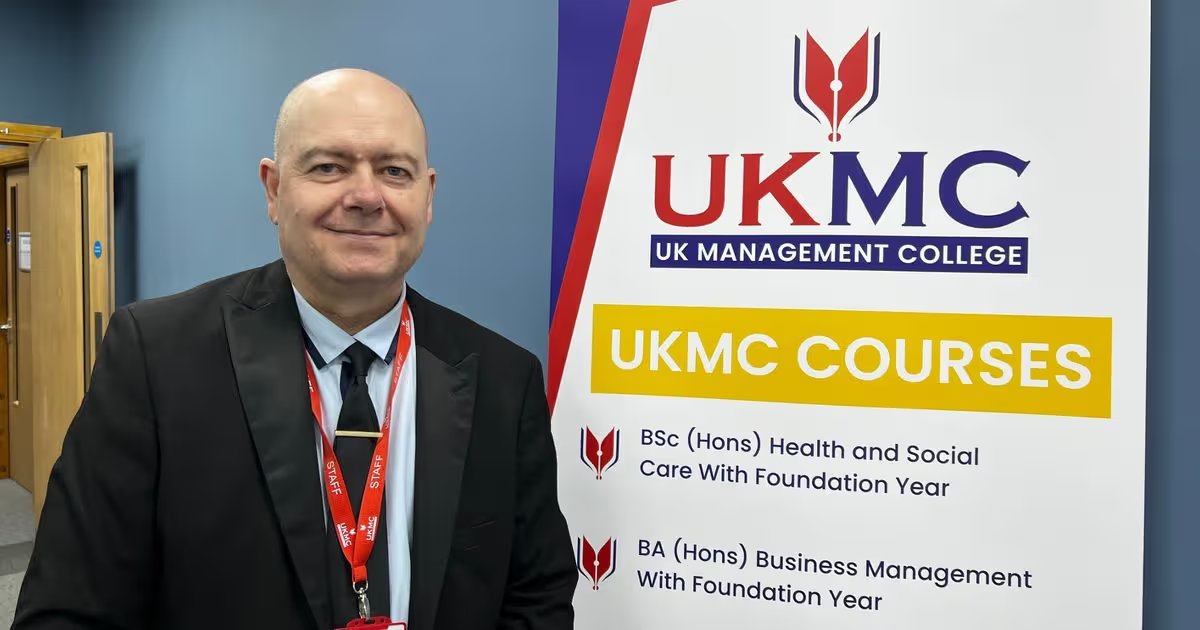
Professor Jason Powell, the provost and chief academic officer of UK Management College, pictured at UKMC's new Salford campus

Professor Jason Powell, the provost and chief academic officer of UK Management College, at UKMC’s new Salford campus(Image: Reach plc)

A college that’s just opened a new campus in Salford and has bases across the country is celebrating its tenth anniversary – and now hopes to become a university in its own right. UK Management College was founded in 2016 by husband and wife Zahidul and Abida Islam to focus on offering education opportunities to members of socially disadvantaged or underrepresented groups, and to older people looking to return to education.

From just a handful of students in 2016, the college has grown to serve 7,000 learners at three sites in Greater Manchester and campuses in Sunderland, Newcastle and Derby. Its offering has gone beyond management courses and it now offers degrees, in partnership with other universities, in subjects including fashion and events management.

Now, its provost Professor Jason Powell says, the college has started planning to become a university in its own right and to be able to offer its own degrees. He said: “Last year, we created what’s called the Transforming Lives Strategic Plan 2025 to 2030. That was written in consultation with students, staff and external stakeholders, not by myself as the provost of the institution.

“And part of that, in terms of the strategic direction of the college, is that we do aspire to be a university in our own right with our own degree-awarding powers. That’s really important and that obviously gives more autonomy for the future.”

Advertisement

Becoming a university is a key long-term goal for UKMC’s management team, which it will work on to 2030 and beyond. Prof Powell said: “That’s important as a marker and shows our ambition and credibility and legitimacy. I’ve worked in higher education for years now with Russell Group universities, post-92 universities, as well as the independent sector. Some of my proudest moments have come from UK Management College.

“One of the fantastic insights that I get from working here is about intergenerational justice and social justice for those groups who traditionally have been denied access to university level education.”

UKMC will continue working with its current university partners, including Canterbury Christ Church University, Arts University Bournemouth, and the University of Wolverhampton.

Prof Powell said: “We very much value the university partnerships that we have and may have in the future.” He added: “These partnerships are not just created overnight, they’re cultivated carefully and it shows us as a quality beacon of excellence in order to attract leading universities to deliver their programmes in the heart of Greater Manchester and across the UK.”

Advertisement

Those degree courses were developed through consulting with local communities as UKMC continued to grow. Prof Powell said: “From 2016 onwards, the college had a number of different types of diploma courses. And in 2023 we decided to actively listen to the communities by which we serve – listening to community-based organisations as well as, say for example, faith based organisations, Jobcentre plus, the NHS – to actually find out what type of programmes were needed.

“What they told us was we needed more HE-orientated programmes to be put in place. The problem that we found was that there were many potential learners who were denied access to education in the university sector. So to that end, we decided to cultivate a number of strategic partnerships with universities in order to provide opportunities for those socially disadvantaged students who may have been out of the education system for a long time, but who wanted that opportunity.”

Prof Powell works closely with founder Zahidul Islam on their vision for the college. He said: “Zahidul is the CEO of UK Management College, and he’s one of the most passionate entrepreneurs that I’ve ever met, and is very student driven. Its fundamental value from the beginning was about active listening to the communities which we serve.

“And that was about looking at the most socially disadvantaged and most underrepresented groups in education who should be given opportunity. We saw it as a human right, a fundamental human right, that no one should be denied access to education irrespective of social identity or social division.

Advertisement
UK Management College's new Salford campus at Carolina Way

UK Management College’s new Salford campus at Carolina Way(Image: Reach plc)

“And we’re a very strong widening participation college. One of the strong pillars and foundations of the college for students has been about enhanced student support.. from their first interaction with the college to plans for when they graduate.”

That mission, Prof Powell says, led the college to open its campuses in the North East and the East Midlands. “Social disadvantage doesn’t just materialise in Greater Manchester, it’s replicated across the UK,” he said. “And we’ve found through very careful demographic analysis in those areas many for example mature students who were denied again access to mainstream education. So to meet a fundamental need in their areas, we cultivated campuses.

“We engaged in the process of active listening. We’re a member of the Chambers of Commerce in these different regions, so we listen to them on the courses that should be cultivated, but for standardisation the student experience is exactly the same as what it would be in Greater Manchester, Derby, Newcastle and Sunderland.”

The Salford campus, 15 minutes or so from MediaCity, opened in January. Prof Powell said: “Salford is an emerging economy and obviously you’ve got MediaCity about a mile away and it’s a hot spot for business, it’s a hot spot of opportunities for learners in order to develop their skills.”

Advertisement

The college also opens itself up to the public and to the private sector through its events and open days, where potential employers and students can find out more about what it has to offer. The next such event is the Careers Fair on Tuesday, February 24, which features exhibitors including NHS England, Manchester City Council, Salford City Council, KPMG, Wellway Rehab Solutions, and Kids Planet Salford.

Olympic medallist Chelsie Giles MBE will join as a guest speaker, while activities designed to help students find work will include mock interviews, CV building workshops and career guidance sessions.

Prof Powell said: “Today’s student is tomorrow’s stakeholder. The opportunities to learn on that day will be immense and the links and the contacts that they’ll cultivate will help them, not just in terms of their careers and their employability, which we have a very strong focus on here, but in terms of their development and growth.”

He added: “We have further other events coming as well, and we just do this consistently, so we want people, students, to come in to see our facilities, speak to our staff, see what courses we do, and come here and get excited about what they can do for the future.”

Advertisement
  • UKMC’s next Careers Fair will be held on Tuesday, February 24, at the college’s Salford campus at 17 Carolina Way from 10am to 4pm. For information, visit https://ukmc.ac.uk/event-details/ukmc-careers-fair-2026

Continue Reading
Click to comment

Leave a Reply

Your email address will not be published. Required fields are marked *

Business

Adding or Modifying Business Activities Post-Incorporation in the Philippines

Published

on

Adding or Modifying Business Activities Post-Incorporation in the Philippines

Philippine corporations operate within their registered purpose; expansion requires amendments, affecting ownership, capital, and regulation. Foreign investment rules specify capital requirements, restrictions, and tax benefits.

Operating Limitations and Expansion Requirements

A Philippine corporation can only operate within the purposes outlined in its Articles of Incorporation, registered with the Securities and Exchange Commission under the Revised Corporation Code. Any expansion into a substantially different activity requires an amendment to the purpose clause. This process involves a thorough review of ownership eligibility, capital classification, and regulatory compliance, as it may affect the company’s legal standing and operational scope.

Capital Requirements for Retail and Domestic Enterprises

Retail trade businesses with foreign involvement generally need a paid-in capital of US$2.5 million, with specific thresholds of US$250,000 per store in certain cases. If the activity falls into a restricted sector, an equity restructuring must be undertaken before amending the purpose clause. For foreign-owned domestic market enterprises, a minimum paid-in capital of US$200,000 is typically required, which can be lowered to US$100,000 upon meeting employment or certified technology criteria. Export-oriented firms are exempt from this threshold.

Foreign Investment Regulations and Tax Incentives

Under the Foreign Investments Act, enterprises registered with the Philippine Economic Zone Authority or the Board of Investments may qualify for income tax holidays lasting four to seven years, and occasionally a 5% tax on gross income. However, income from activities outside the approved scope could be taxed at the standard corporate rate of 25%, or 20% for qualified small domestic corporations, which could impact overall tax obligations within a single legal entity.

Advertisement


Read the original article : How to Add or Amend Business Activities After Incorporation in the Philippines

Continue Reading

Business

BSOL: Solana At The Crossroads

Published

on

BSOL: Solana At The Crossroads

BSOL: Solana At The Crossroads

Continue Reading

Business

At Close of Business podcast February 17 2026

Published

on

At Close of Business podcast February 17 2026

Tom Zaunmayr talks to Sam Jones about why a Gnowangerup family’s investment in export infrastructure is getting attention.

Continue Reading

Business

UK unemployment rises to post-pandemic high as wage growth slows

Published

on

Business Live

The rate of joblessness edged up to 5.2 per cent between October and December

Reeves' policies have been blamed for poor hiring. (WPA Pool/Getty Images)

Reeves’ policies have been blamed for poor hiring(Image: WPA Pool/Getty Images)

The labour market continued to loosen in the final quarter of last year, official figures show, with wage growth easing and unemployment climbing steadily higher. The rate of joblessness edged up to 5.2 per cent between October and December, according to the Office for National Statistics (ONS), the highest level since early 2021 and marginally above market expectations.

The number of workers on company payrolls also fell by 46,000 compared to the previous quarter, with provisional estimates suggesting a further 11,000 jobs were shed in January.

“The number of workers on payroll fell further in the final quarter of the year, reflecting weak hiring activity, although it is largely unchanged in the latest month,” said Liz McKeown, director of economic statistics at the ONS.

Jonathan Raymond, investment manager at Quilter Cheviot, said the labour market was “showing signs of creaking when economic growth is difficult to come by”, as reported by City AM.

Advertisement

The labour market has faced pressure in recent months as businesses wrestle with the additional costs of hiring imposed by the government, including a rise in payroll taxes and an elevated minimum wage.

Businesses are also concerned by the prospect of the Employment Rights Act, with a recent survey indicating that a third of firms would cut back on hiring as a consequence of the measures. The easing labour market also resulted in slower wage growth, increasing the likelihood that the Bank of England will reduce interest rates in March.

Average earnings including bonuses decelerated to 4.2 per cent in the final quarter of the year, down from 4.6 per cent previously. City economists had anticipated it to remain roughly stable.

Excluding bonuses, average wages increased by 4.2 per cent over the period, lower than the previous figure of 4.4 per cent but in line with expectations.

Advertisement

McKeown observed that private sector wage growth was at its lowest rate in five years, whilst public sector figures remained “elevated” as some of last year’s pay awards continue to feed into the statistics.

Yael Selfin, chief economist at KPMG UK, stated the data “raises the prospect” of a March rate cut.

“The MPC will be reassured by further evidence of pay pressures easing, and the labour market continuing to soften. The Bank may also want to minimise downside risks to the labour market and lower rates ahead of the next forecast meeting in April,” she said.

Paul Dales, chief UK economist at Capital Economics, concurred that the chances of a March rate cut had risen.

Advertisement

“The lack of green shoots of recovery in the labour market and further fall in wage growth supports the idea that the Bank of England has at least a couple more interest rate cuts in its locker, with the chances of the next cut happening in March rather than April edging higher,” he said.

Sterling slipped 0.3 per cent versus the dollar after the data release, signalling that markets believe rate reductions are becoming more probable.

Continue Reading

Business

Starbucks drive-thru completes as part of old RAF airbase redevelopment

Published

on

Business Live

The coffee shop will open next month after a fit-out

Left to right: Mark Badham (EG Carter), Thomas Jones (EG Carter), Ben Bond (Magic Bean), Mike Plimmer (Robert Hitchins), Mark Harries (EG Carter), Milo Trickey (EG Carter), Jacob Jenkins (EG Carter)

Left to right: Mark Badham (EG Carter), Thomas Jones (EG Carter), Ben Bond (Magic Bean), Mike Plimmer (Robert Hitchins), Mark Harries (EG Carter), Milo Trickey (EG Carter), Jacob Jenkins (EG Carter)

Work on a new Starbucks drive-thru in Kingsway, Gloucester, has reached practical completion. The coffee shop is part of a huge redevelopment scheme at an old RAF base. The masterplan for the 340-acre site includes 3,300 homes, a 40-acre employment area, community and leisure facilities, retail, sports area and primary school.

Boddington-based property and investment firm Robert Hitchins developed the 1,744 sq ft drive-thru and coffee shop, in partnership with contractors EG Carter, at the entrance to Kingsway in Naas Lane.

Michael Plimmer, senior development manager for Robert Hitchins, said: “This a major milestone for us as the new Starbucks Drive Thru represents the final phase of Kingsway’s commercial centre which Robert Hitchins has developed over recent years.

“It is great to see Starbucks join other big brands that Robert Hitchins has brought to Kingsway – including Asda, Lidl, Pure Gym, B&M, MKM and Greene King – providing excellent sustainable shopping and leisure facilities for local people and businesses in the area.”

Advertisement

The Magic Bean Company – a Starbucks franchisee – has agreed a 20-year lease of the new development. The coffee shop will be fitted out and will open its doors on March 13.

Melissa Allen, central operations manager at The Magic Bean Company, said: “We’re really pleased to be a part of this exciting redevelopment and to bring Starbucks to the busy area of Quedgeley. We’re looking forward to serving the community and creating careers for local people.”

Contractor EG Carter has been working on the site since June 2025. Thomas Jones, construction director at EG Carter, said: “Reaching practical completion is a great milestone for everyone involved. This has been another well-coordinated project delivered in close partnership with our client Robert Hitchins Ltd and the wider team, and we’re proud of the quality of the finished building.

“The new Starbucks creates a strong gateway into Kingsway and will be a valuable addition for the local community. We now look forward to seeing the fit-out progress and the site come to life for customers.”

Advertisement
Continue Reading

Business

FROM THE HILL: A snapshot of today’s politics and parliament

Published

on

FROM THE HILL: A snapshot of today’s politics and parliament

Parliament is back for 2026, and after smuggling a hot honey and lemon drink into the chamber, opposition leader Basil Zempilas began question time with last year’s theme.

Continue Reading

Business

Jefferies initiates Foghorn Therapeutics stock with buy rating

Published

on


Jefferies initiates Foghorn Therapeutics stock with buy rating

Continue Reading

Business

Graduates missing out on jobs due to lack of workplace readiness, recruiters say

Published

on

Graduates missing out on jobs due to lack of workplace readiness, recruiters say

Graduates are increasingly missing out on job offers because they are not considered ready for the workplace, according to new research that suggests a widening gap between academic achievement and professional expectations.

A survey commissioned by Regent’s University London found that 80 per cent of recruiters believe graduates are losing out on roles due to a lack of professional maturity and work readiness. A further fifth described some candidates as “work shy” and lacking self-awareness.

Recruiters said a strong work ethic was the most commonly missing attribute among graduates, followed by communication skills, decision-making ability and accountability. These softer skills are now seen as more important than academic credentials, with 78 per cent of employers saying they prioritise candidates with strong interpersonal skills over those with top grades or technical expertise.

Practical experience is also viewed as critical. Nearly one in five recruiters said graduates fail to secure roles because they lack hands-on, on-the-job experience. As a result, 79 per cent said they favour applicants who have practical work exposure over those without it.

The findings reflect broader concerns about how well traditional university education prepares students for employment. More than 70 per cent of recruiters surveyed said higher education does not adequately equip graduates to thrive in professional environments, suggesting many are struggling not because of academic shortcomings but because of a disconnect between theory and real-world capability.

Advertisement

One in five recruiters said they had rejected candidates directly because of skills gaps they attributed to shortcomings in university preparation.

The pressures are compounded by rising competition for graduate roles and a softening labour market. Data from Jisc show graduate unemployment increased from 5.6 per cent to 6.2 per cent between 2021/22 and 2022/23, while the proportion in full-time employment fell from 59 per cent to 56.4 per cent.

Even when graduates do secure roles, employers report longer periods before they are deemed fully effective. Seventy-one per cent of recruiters said they have extended probation periods for graduate hires because of misaligned expectations around work ethic and softer skills.

Professor Geoff Smith, vice-chancellor and chief executive of Regent’s University London, said the findings highlighted the need for reform in higher education.

Advertisement

“It’s increasingly clear that traditional approaches to higher education are no longer preparing students for the realities of employment,” he said. “Universities must evolve to ensure students can communicate effectively and thrive in professional settings.”

He said Regent’s prioritises experiential learning, collaborative projects and practical engagement with businesses to bridge the gap between academic study and workplace expectations.

The research underscores growing employer concerns that academic success alone is no longer sufficient in a competitive labour market where adaptability, resilience and interpersonal capability are increasingly prized.


Jamie Young

Jamie Young

Jamie is Senior Reporter at Business Matters, bringing over a decade of experience in UK SME business reporting.
Jamie holds a degree in Business Administration and regularly participates in industry conferences and workshops.

When not reporting on the latest business developments, Jamie is passionate about mentoring up-and-coming journalists and entrepreneurs to inspire the next generation of business leaders.

Advertisement

Continue Reading

Business

Teesside windfarm manufacturer SeAH Wind loses first major contract after ‘factory readiness’ concerns

Published

on

Business Live

South Korean steel specialist SeAH Wind and offshore wind developer Ørsted have mutually agreed to discontinue monopile production on Teesside

SeAH Wind photographed in August 2025

SeAH Wind photographed in August 2025 (Image: TVCA)

Teesside windfarm manufacturer SeAH Wind has lost work on a significant UK windfarm with offshore developer Ørsted – the first contract it was awarded – after agreeing to cease production.

The South Korean steel expert, which launched construction on its £900m factory on the Teesworks site in 2022, and the Danish developer released a joint statement announcing a mutual agreement had been reached to suspend work on the production of monopiles for Ørsted’s Hornsea 3 offshore wind farm.

This decision follows “a shared assessment of factory readiness against the programme requirements of Hornsea 3”. The statement indicates that halting production on the Hornsea 3 deal allows SeAH Wind to concentrate on completing the backlog of orders it has pending, and to progress its future pipeline. Ørsted, on the other hand, stated that the Hornsea 3 project has not been impacted by the production stoppage at SeAH.

The Ørsted’ deal was the first contract that the SeAH Wind Teesside factory secured, but other work includes the construction of monopiles for RWE’s Norfolk Vanguard project this year. It remains unclear whether jobs will be lost due to the contract’s termination, reports Teesside Live.

Advertisement

The statement read: “SeAH Wind and Ørsted confirm that they have mutually agreed to discontinue monopile production for the Hornsea 3 offshore wind project. This decision reflects a shared assessment of factory readiness against the programme requirements of Hornsea 3.

“It ensures that the project schedule for the world’s largest offshore wind farm remains protected and uncompromised. The agreement allows SeAH Wind to focus on the safe and reliable delivery of its secured order backlog through to 2027, whilst continuing to progress a strong pipeline of opportunities beyond that period. This underlines confidence in SeAH Wind’s technical capability, manufacturing scale, and long-term role in the UK and European offshore wind supply chain.”

The development represents a significant setback for the North East and Britain’s green energy sector, arriving more than three years after Ørsted signed the ‘industry first’ contracts. Under the original arrangement, SeAH Steel Holdings was to manufacture the enormous seabed-piercing structures, alongside Spanish partner Haizea Wind Group.

The Danish energy giant finalised the agreement with SeAH Wind in September 2022, shortly after construction commenced at SeAH’s XXL monopile facility at the Teesworks site. Workers at the vast Teesworks plant began the maiden project last July, commemorating the occasion with a ceremony featuring the cutting of the first steel plates.

Advertisement

When the agreement was finalised, business leaders praised Ørsted for becoming the first major client for the developing facility in the North East. The two companies stated the partnership would “contribute significantly to the UK’s ambitious goal of achieving 50GW of operational offshore wind capacity by 2030”, describing it as representing “represents not only a significant leap forward in the right direction for the development of offshore wind in the United Kingdom, but acts as a benchmark for the future scale of the industry at a global level”.

Tees Valley Combined Authority declined to comment on the suspension of the contract. Ben Houchen wrote in a Facebook post last Friday: “One year ago today, it was an honour to welcome His Majesty The King to Teesside and to visit the SeAH Wind factory. It was a huge moment for everyone involved, from the apprentices just starting out to the experienced engineers helping build the future of offshore wind. His Majesty’s visit shone a spotlight on the scale of what’s happening here.

“World-class manufacturing. Serious investment. And real, well-paid jobs for local families. Twelve months on, production is progressing, skills are being developed, and this site is playing a key role in powering Britain’s clean energy future.”

The announcement follows Ørsted’s receipt of six monopiles for Hornsea 3 – produced by Haizea Wind at their Bilbao facility in Spain – which arrived at the Teesworks location.

Advertisement
Continue Reading

Business

Antofagasta reports in-line 2025 EBITDA and keeps 2026 output outlook; shares dip

Published

on


Antofagasta reports in-line 2025 EBITDA and keeps 2026 output outlook; shares dip

Continue Reading

Trending

Copyright © 2025