
Business
Coupang Stock: User Recovery And Taiwan Point To Attractive Upside (NYSE:CPNG)


Astrada Advisors delivers actionable recommendations that enhance portfolio performance and uncover alpha opportunities, supported by a strong track record in investment research at leading global investment banks. With expertise spanning technology, media, internet, and consumer sectors in North America and Asia, Astrada Advisors excels in identifying high-potential investments and navigating complex industries.Leveraging extensive local and global experience, Astrada Advisors offers a unique perspective on market developments, regulatory changes, and emerging risks. The research integrates rigorous fundamental analysis with data-driven insights, providing a nuanced understanding of key trends, growth drivers, and competitive landscapes.The focus is empowering investors with timely research and a comprehensive view of industry dynamics. Whether navigating volatile markets or exploring new trends, Astrada Advisors remains committed to delivering superior insights to drive informed investment decisions.
Analyst’s Disclosure: I/we have no stock, option or similar derivative position in any of the companies mentioned, and no plans to initiate any such positions within the next 72 hours. I wrote this article myself, and it expresses my own opinions. I am not receiving compensation for it (other than from Seeking Alpha). I have no business relationship with any company whose stock is mentioned in this article.
Seeking Alpha’s Disclosure: Past performance is no guarantee of future results. No recommendation or advice is being given as to whether any investment is suitable for a particular investor. Any views or opinions expressed above may not reflect those of Seeking Alpha as a whole. Seeking Alpha is not a licensed securities dealer, broker or US investment adviser or investment bank. Our analysts are third party authors that include both professional investors and individual investors who may not be licensed or certified by any institute or regulatory body.

The cleaning services industry in the United States employs more than 3 million people and generates over $100 billion a year, and it doesn’t ask for a fraction of that revenue as an entry fee. A laptop for scheduling, a car, and a few hundred dollars in supplies is enough to start taking on clients. That low barrier to entry is exactly why the industry attracts so many first-time business owners, and exactly why so many of them plateau within the first year: it’s easy to start cleaning, and much harder to build a business around it.
The difference between the two usually comes down to whether you treat the early decisions, your niche, your pricing, your legal setup, as an afterthought or as the foundation. This guide walks through both, in order.
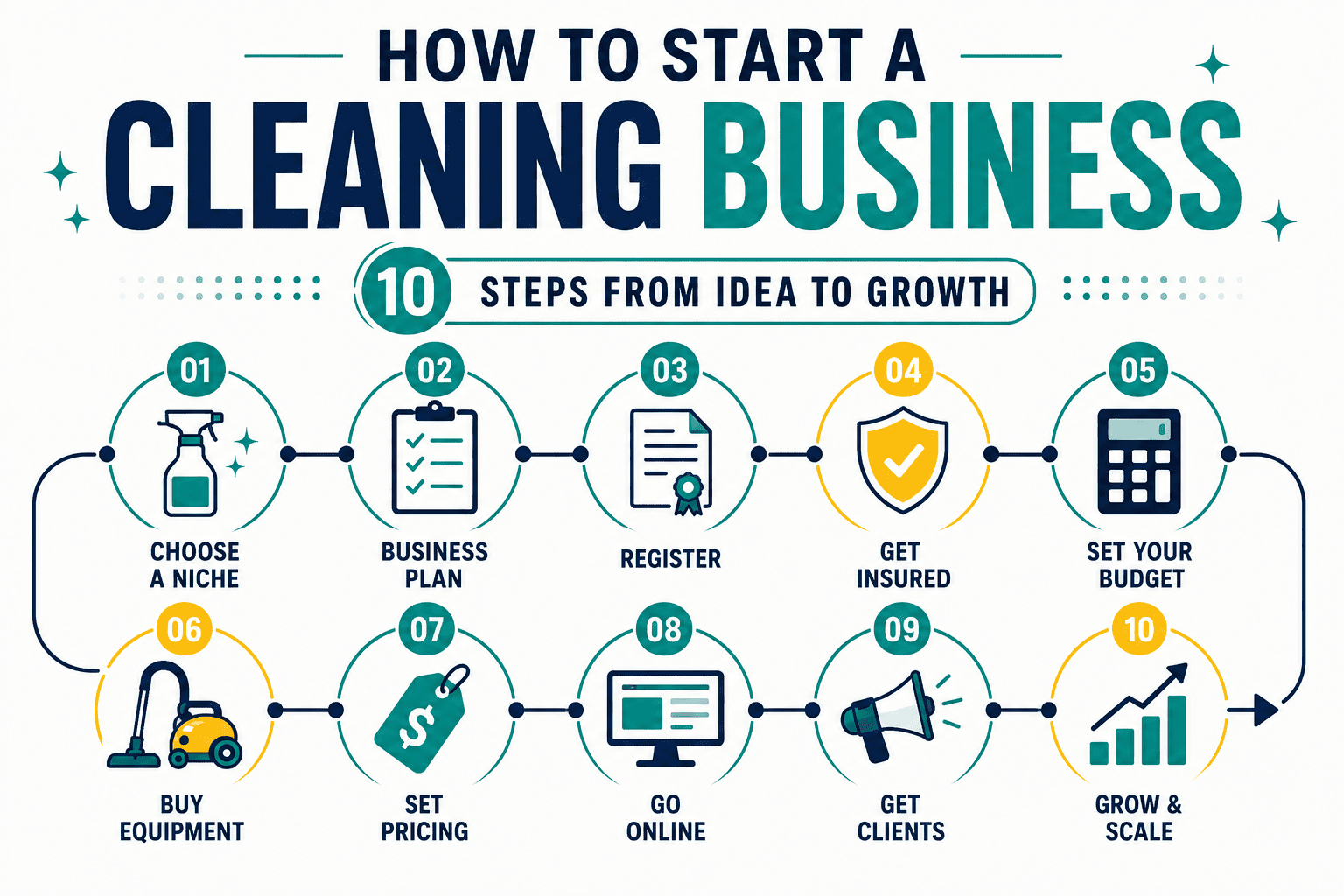
Step 1: Choose Your Cleaning Niche
“Cleaning business” covers a wider range of work than it sounds like, and picking a lane early shapes almost every decision that follows, from the equipment you buy to the clients you market to.
The broad categories worth considering:
- Residential cleaning: Recurring home cleaning for individual clients. Lower startup costs, shorter sales cycles, and the easiest entry point for a solo operator.
- Commercial and janitorial cleaning: Offices, retail spaces, and other business properties, typically cleaned after hours under longer contracts. Bigger accounts, but a longer sales cycle (often 30 to 90 days) and more equipment.
- Specialized cleaning: Carpet and upholstery cleaning, post-construction cleanup, move-in/move-out cleaning, short-term rental turnover (Airbnb-style properties), and biohazard or medical facility sanitation. These command premium rates precisely because fewer competitors offer them.
- Eco-friendly cleaning: Not a separate service so much as a positioning choice, using green-certified products as your differentiator in a market where most competitors don’t.
Residential is the most common starting point because it requires the least capital and the fastest path to your first paid job. Many owners start there and add commercial or specialized services once they have consistent revenue.
Step 2: Write a Simple Business Plan
You don’t need a 40-page document to start a cleaning business, but skipping this step entirely tends to catch up with owners around month six, usually as a pricing problem or a cash flow problem that a plan would have caught earlier.
At minimum, put in writing:
- The services you’ll offer, and specifically which niche from Step 1 you’re targeting first
- Your target market: who they are, where they’re located, and how many potential clients realistically exist in your service area
- Your competition: who else is operating in your niche and area, and what they charge
- Your pricing model (covered in detail in Step 7)
- A basic financial projection: expected monthly revenue, fixed costs, and the point at which the business covers its own expenses
This is also the point to decide whether you’re building a side income or a company you intend to hire into. That decision affects your legal structure, your insurance needs, and your pricing, so it’s worth answering honestly now rather than backing into it later.
Step 3: Choose a Business Structure and Register Your Business
Most new cleaning businesses choose between two structures:
Sole proprietorship: The simplest option. No separate legal entity, no formation paperwork, and your business income passes through to your personal tax return. The tradeoff is personal liability: if the business is sued or can’t pay a debt, your personal assets aren’t protected.
Limited liability company (LLC): A registered business entity that separates your personal assets from business liabilities. Costs more to set up (typically a few hundred dollars in state filing fees) and requires some ongoing paperwork, but it’s the more common choice once you start hiring or taking on commercial clients, since it limits your personal exposure if something goes wrong on a job.
Once you’ve picked a structure, registering typically involves:
- Filing your business name with your state (and a DBA, or “doing business as” registration, if you operate under a name different from your own or your LLC’s legal name)
- Applying for an EIN (Employer Identification Number) [a federal tax ID that functions like a Social Security number for your business] from the IRS, which you’ll need to open a business bank account and, eventually, to hire employees
- Checking whether your city or county requires a local business license, since requirements vary significantly by location and only a handful of states mandate one statewide
Step 4: Get Licensed, Bonded, and Insured
Most U.S. states don’t require a specialized cleaning license, but nearly every serious client, and every commercial contract, will expect proof of insurance before letting you in the door.
General liability insurance covers property damage and client injuries that happen on the job, a client’s flooring gets damaged, someone slips on a wet floor, and it typically runs $500 to $1,500 a year for a small operation. Most residential and virtually all commercial clients will decline to hire an uninsured cleaner, so treat this as a startup cost rather than an optional add-on.
A surety bond (often called a janitorial bond in this industry) [a policy that reimburses a client if an employee steals from them or causes intentional damage] costs somewhere between $100 and $500 a year and does double duty: it protects your clients, and it signals credibility to prospects who’ve never worked with you before.
Workers’ compensation insurance becomes a legal requirement in most states the moment you hire your first employee, with costs varying by state and payroll size.
Commercial auto insurance is worth adding once you’re driving to job sites regularly, since a personal auto policy typically won’t cover accidents that happen while conducting business.
Two more compliance areas are easy to overlook because they don’t come with a fee or a form, but they carry real liability. If your team handles cleaning chemicals, OSHA (the Occupational Safety and Health Administration) [the federal agency that sets workplace safety standards] expects proper labeling, safe storage, and basic safety training, even for a two-person operation. And if your marketing makes specific claims, “100% eco-friendly,” “satisfaction guaranteed”, those claims need to hold up. Truth-in-advertising rules apply to a solo cleaner exactly the same way they apply to a national chain.
Budget roughly $1,000 to $3,000 a year for a solo operator’s full insurance and bonding package, more once you add employees and vehicles.
Step 5: Budget for Your Startup Costs
Total startup costs for a cleaning business vary enormously depending on your niche and whether you’re hiring from day one:
Cost Category
Solo / Home-Based
Small Team / Commercial
Business registration & licenses
$50–$400
$200–$800
Insurance & bonding (first year)
$1,000–$2,300
$3,000–$6,000
Equipment & supplies
$500–$1,500
$2,000–$10,000+
Marketing & branding
$200–$1,000
$1,000–$5,000
Software (scheduling/CRM)
$0–$50/month
$100–$300/month
Typical total to launch
$2,000–$5,000
$10,000–$50,000+
A useful way to sanity-check your own number: total startup cost is roughly your one-time setup costs, plus your first month of recurring expenses, plus a cushion of one to three months of expenses in case client acquisition takes longer than expected. Commercial and franchise operations sit at the high end of this range; a solo, home-based residential operation can realistically launch closer to the low end.
Step 6: Buy Your Equipment and Supplies
What you need depends on the niche from Step 1, but a solo residential operation typically starts with the following, organized by category:
Cleaning products: An all-purpose cleaner, a streak-free glass cleaner, a degreaser for kitchens, a bathroom cleaner for soap scum and hard water stains, a wood- or tile-safe floor cleaner, and furniture polish. Stock eco-friendly versions of each if that’s part of your positioning.
Tools: Microfiber cloths in multiple colors (color-coding by room prevents cross-contamination), a mix of sponges and scrubbers for different surfaces, a spray mop for small jobs and a bucket mop for larger ones, a commercial-grade vacuum (HEPA-filtered if you’ll be working in allergy-sensitive homes), and an extendable duster for ceiling fans and high shelves.
Storage and transport: A cleaning caddy for moving supplies room to room, a rolling cart for bigger jobs, and a way to keep your vehicle organized so supplies don’t leak or shift in transit.
Safety gear: Disposable nitrile gloves, masks or respirators for dusty or heavily chemical jobs, an apron or uniform, heavy-duty trash bags, and a basic first aid kit.
Admin and marketing tools: Business cards, scheduling and invoicing software (more on this in Step 10), and branded shirts or aprons, which do quiet work toward looking established on day one.
Specialized niches add their own equipment on top of this baseline: carpet cleaning requires an extractor, post-construction work often calls for industrial-grade vacuums and heavier protective gear, and commercial contracts may require floor buffers or pressure washers. Buying equipment costs more upfront; leasing lowers the initial outlay but adds a recurring monthly cost, worth weighing against how confident you are in steady, near-term revenue.
Step 7: Set Your Pricing
Pricing is where a lot of new cleaning businesses either underprice out of nervousness or guess too high and lose bids, and both mistakes are avoidable if you start from your own numbers rather than a competitor’s website.
Before picking a model, calculate your baseline cost per hour of cleaning: your own labor (or your team’s wages, plus taxes and any benefits), the supplies used per job, transportation (gas and vehicle wear), and a share of your fixed overhead, insurance, licensing, software, marketing. Add your target profit margin on top of that number, and you have a floor you shouldn’t price below, whatever model you choose.
From there, four pricing models cover most of the industry:
| Pricing Model | How It Works | Best For |
|---|---|---|
| Hourly rate | Charge for time worked, typically $25–$50/hour per cleaner | New businesses still learning how long jobs actually take |
| Flat rate | A fixed price per job regardless of time spent | Established businesses with a clear sense of job duration and value-based positioning |
| Room rate | A set price per room | Simple, predictable jobs with consistent room sizes |
| Square footage rate | Priced per square foot of the space | Larger commercial jobs where footage is the clearest cost driver |
Hourly pricing is the safer starting point precisely because you don’t yet know your average job duration. Once you’ve completed enough jobs to estimate time accurately, flat-rate pricing tends to be more profitable, since efficient work no longer costs you money the way it does under an hourly model. Whichever model you use, check what comparable cleaners in your area actually charge, and be transparent in your quotes about what’s included, laundry, dishwashing, and inside-appliance cleaning are common gray areas, so a client isn’t surprised by an add-on fee mid-job.
Step 8: Build a Professional Online Presence
Before you actively market anything, get the basics in place. Over 80% of people research a cleaning service online before hiring one, and a missing or thin online presence is one of the fastest ways to lose a job to a competitor who simply looks more established.
At minimum:
- A Google Business Profile [a free Google listing that shows your business in local search and maps results], fully filled out with services, service area, and photos
- A simple website with your services, service area, and a way to request a quote or book directly
- A consistent visual identity: a name, logo, and color scheme used across your website, vehicle, and materials, since a professional look is doing real work to build trust before a client has any other reason to believe you’re reliable
Step 9: Market Your Business and Land Your First Clients
Once the foundation is in place, the highest-return marketing tactics for a new cleaning business tend to be the ones that cost the least:
- Referrals from friends, family, and early clients. Offer a discount or credit for referrals; it’s consistently one of the cheapest ways to acquire a new client.
- Google Business Profile optimization, since it’s free and typically starts driving calls within weeks of being set up properly.
- Neighborhood platforms like Nextdoor and local Facebook groups, especially for residential cleaning.
- Google Local Services Ads, which show up when someone is actively searching to hire a cleaner, making them more efficient than general display advertising.
- An introductory offer (a percentage off the first cleaning, for example) to lower the barrier for a first-time client to say yes.
For commercial and specialized niches, direct outreach tends to outperform digital marketing: contacting property managers, real estate agents, and local businesses directly, and joining your local chamber of commerce to build the relationships that lead to referrals and contracts.
Whichever channels you use, track where each client actually came from. It’s the only way to know which dollar of marketing spend is doing the work.
Step 10: Choose Software and Plan for Growth
Even a solo operation benefits from scheduling and invoicing software rather than a paper calendar, both for your own organization and because clients expect the convenience of online booking. Tools built specifically for the industry (options like Jobber, Housecall Pro, and ZenMaid come up often) typically bundle scheduling, invoicing, and client communication in one place.
As the business grows, the same questions come up for most owners: when to hire your first employee, whether to expand into a second niche or a wider service area, and how to keep quality consistent once you’re no longer the one holding the vacuum. None of that needs to be solved on day one, but it’s worth revisiting once you have a handful of steady clients and a clearer sense of what’s actually working.
The Bottom Line
Starting a cleaning business doesn’t require much capital, but it does require getting the unglamorous parts right early: the right legal structure, real insurance, a pricing model you can actually defend, and a plan for finding clients that doesn’t rely on luck. Get those in place, and the industry’s biggest advantage, low overhead and genuinely recurring revenue, starts working in your favor instead of exposing you to risk you didn’t plan for.

Matthew Philippe
Executive VP & Head of Investor Relations
All right. Good morning, everybody. Thank you for joining us today for our Annual Investor Day. I’m pleased to have Michael Davidson, our CEO; John Kastelein, our Chief Scientific Officer; and BJ Jones, our Chief Commercial Officer, here with us today speaking, along with many members of our team. Ian Somaiya will also be available for questions afterwards for the presentation.
Before we get started, the fun part, we will be making forward-looking statements today. I would advise everyone to please read our forward-looking statement page, either here in the room or also available online at this time. As we mentioned, today we’ll have Michael being going through a general corporate update and introduction. We’ll have John presenting the science, then we’ll go back to Michael for an update on PREVAIL as well as some of the updates on AD, and then BJ will be going through commercial.
At this time, I’d like to have Michael come up and join us. Michael?
Michael Davidson
CEO, President & Executive Director
Thank you, Matt, and thanks, everyone, for being here. We’re very


I spent 30 years in the institutional trenches as a trader, analyst, and portfolio manager, eventually running the equity trading desk at Northern Trust in Chicago. Those decades shaped my approach: stay disciplined, trust the data, and keep emotion out of the way. Since 2009, when I began publishing my stock selections, my portfolio has delivered solid long term results—compounding in the mid teens annually through 2025. Today I’m a private investor and investing coach, with a rules based framework that helps people build better portfolios. My work focuses on systematic thinking, behavioral awareness, and evidence over opinion. For my market outlook and model portfolio updates, visit zeninvestor.org. .
Analyst’s Disclosure: I/we have a beneficial long position in the shares of NVDA, AVGO, GOOGL either through stock ownership, options, or other derivatives. I wrote this article myself, and it expresses my own opinions. I am not receiving compensation for it (other than from Seeking Alpha). I have no business relationship with any company whose stock is mentioned in this article.
Seeking Alpha’s Disclosure: Past performance is no guarantee of future results. No recommendation or advice is being given as to whether any investment is suitable for a particular investor. Any views or opinions expressed above may not reflect those of Seeking Alpha as a whole. Seeking Alpha is not a licensed securities dealer, broker or US investment adviser or investment bank. Our analysts are third party authors that include both professional investors and individual investors who may not be licensed or certified by any institute or regulatory body.

AdvanSix: Challenges Persist, My Downgrade Was Correct


ADS Analytics is a team of analysts with experience in research and trading departments at several industry-leading global investment banks. They focus on generating income ideas from a range of security types including: CEFs, ETFs and mutual funds, BDCs as well as individual preferred stocks and baby bonds.ADS Analytics runs the investing group Systematic Income which features 3 different portfolios for a range of yield targets as well interactive tools for investors, daily updates and a vibrant community.
Analyst’s Disclosure: I/we have no stock, option or similar derivative position in any of the companies mentioned, and no plans to initiate any such positions within the next 72 hours. I wrote this article myself, and it expresses my own opinions. I am not receiving compensation for it. I have no business relationship with any company whose stock is mentioned in this article.
Seeking Alpha’s Disclosure: Past performance is no guarantee of future results. No recommendation or advice is being given as to whether any investment is suitable for a particular investor. Any views or opinions expressed above may not reflect those of Seeking Alpha as a whole. Seeking Alpha is not a licensed securities dealer, broker or US investment adviser or investment bank. Our analysts are third party authors that include both professional investors and individual investors who may not be licensed or certified by any institute or regulatory body.

China factory-gate inflation slows more than expected in July

More workers join strike at BHP’s Port Hedland iron ore operations

China’s producer inflation eases in July, below expectations
Paramount offers cinema chains written pledge for 30 annual movie releases

South Korea stock volatility eases as leveraged trades unwind
![New Drops | Financial Performance | Scams and Bans Warning | AQ Issue Update | EQ Farm ASAP [MCN]](https://wordupnews.com/wp-content/uploads/2026/08/1786246690_maxresdefault-80x80.jpg)
New Drops | Financial Performance | Scams and Bans Warning | AQ Issue Update | EQ Farm ASAP [MCN]

How to Start a Cleaning Business: A Step-by-Step Guide

Sandy Alcantara sets club innings record as Marlins blank Angels

Renter of Home in Anne Heche Crash Denies Settlement With Son

No Jackpot Winner as $257 Million Prize Rolls Over to $269 Million Monday Draw

Weekend Open Thread: Staud – Corporette.com
New Drops | Financial Performance | Scams and Bans Warning | AQ Issue Update | EQ Farm ASAP [MCN]

XRP Price, Carry Trade, Japan Yen Intervention, Uphold 17% Layoff, SBI Eyes Ripple Trillion Value

Financial Bubbles Explained with Bananas
-

 Politics6 days ago
Zack Polanski: an incitement to murder Nigel Farage?
-

 Fashion2 days ago
Frugal Friday’s Workwear Report: Cap-Sleeve Pointelle Crewneck Sweater
-

 Crypto World7 days ago
Crypto PAC spending tops $2M in Michigan House race
-

 Business6 days ago
DTCR: Deleveraging And A Hedge Fund Collapse Point To A Possible AI Bottom
-

 Fashion1 day ago
Weekend Open Thread: Mattifying Sunscreen
-

 Tech7 days ago
ESET tracks rise in malicious AI skills and adaptable malware
-

 Crypto World6 days ago
XRP Ledger urges node upgrade after manifest flood
-

 Sports3 days ago
Jordan Coyle & Cordiamo take Laya Arena Stakes at RDS
-

 News Videos17 hours ago
Can Astrology Help Find Gold and Silver Trends? A Financial Astrology Guide
-

 Crypto World5 days ago
US Tech Stocks See Largest 5-Week Inflow in History: Can Nasdaq Break Its Downtrend?
-
 Business3 days ago
US stocks: Dow closes at record on Mideast optimism; SpaceX, AMD drag Nasdaq
-

 Tech7 days ago
Page Not Found | WIRED
-

 Politics3 days ago
Reform UK And Greens Sink To Lowest Favourability Ratings To Date
-

 Business4 days ago
Nvidia Stock Climbs 2.5% as Chip Sector Rally Builds Ahead of AMD Earnings, Nvidia’s Own Report Looms
-

 Crypto World4 days ago
Polymarket targets $20 billion valuation as competition heats up in prediction market sector
-

 Tech4 days ago
OpenAI, Anthropic AI agents targeted real people and systems in cyber tests
-

 Tech6 days ago
OpenAI teases Astra, its next major AI model, after it solves 10 long-standing math problems
-

 NewsBeat7 days ago
Tourist plane crash at Peru’s Nazca Lines kills all 13 on board | News World
-
 Business6 days ago
Myspace owners announce plans to relaunch the once-popular platform
-

 Business3 days ago
Supply chain issues impact Ingredion
You must be logged in to post a comment Login