
Business
Crowd Connected founder James Cobb


James Cobb founded Crowd Connected at the Surrey Technology Centre in Guildford in 2013, after years as a tour manager and event safety specialist. The company now has more than 400 deployments across 30 countries, working with Informa, Live Nation, Coachella, CES and PCMA. He tells Business Matters why he still hoovers the office on a Friday.
What do you currently do at Crowd Connected?
I am the founder and CEO of Crowd Connected, a location intelligence company I started in Guildford in 2013. At its simplest, we help organisations understand what people are actually doing in physical spaces.
The digital world measures everything. Every click, search and transaction leaves a trail of data. Yet a surprising amount of the physical world is still managed using assumptions, rules of thumb, booking systems and somebody’s best guess.
Our technology measures things such as movement, occupancy and dwell time across events, venues, university campuses and other complex spaces. The platform handles indoor positioning, wayfinding, occupancy counting and asset tracking, and it self-calibrates rather than requiring anyone to walk a site fingerprinting it first, so it goes live in hours. We have now supported more than 400 deployments across 30 countries, including Informa events and conferences and music festivals such as Coachella and BST Hyde Park, and tracked more than 250,000 delegates.
My role has changed considerably as the company has grown, but I still spend a lot of time sitting in the gap between the technology and the customer problem. I like understanding why something works, why it does not and whether what we are building genuinely creates value.
We have deliberately remained a fairly small team. There was a time when I was slightly embarrassed about that, because startup culture can encourage you to measure success by headcount. I am not anymore. A small team forces discipline. You have to automate, build products properly and be very clear about what actually creates value. Scaling without locking into fixed costs is a live question for a lot of owner-managers, and headcount is the biggest fixed cost most of them take on.
What was the inspiration behind your business?
Before Crowd Connected I spent many years working in live events, initially as a tour and production manager and later specialising in event safety.
Festivals are effectively temporary cities. You plan everything in extraordinary detail, from how many people can fit into an area, to how quickly a crowd can move through an entrance, to how long it will take to empty a car park. What struck me was how little real measurement sat behind some of those plans.
I remember being challenged at a licensing hearing about where some traffic-flow figures had come from. The honest answer was that I had stood on a corner in a hi-vis jacket and counted how many cars could turn left out of a car park onto a single carriageway in ten minutes.
I simply thought there had to be a better way, so I started experimenting with technology, initially with early GPS equipment and previous-generation Bluetooth devices. At one Wembley Stadium show I strapped a Bluetooth transmitter to a handrail to see whether I could use it to estimate crowd density. That question, how do people really move through physical spaces, has effectively been my career ever since.
Crowd Connected grew out of that frustration with the gap between the plan and reality. Our early breakthrough was an Innovate UK backed proof of concept with Live Nation at Wireless Festival. The technology has changed enormously since then, but the underlying problem is much the same.
Who do you admire?
I admire people who are prepared to discover that they are wrong. One of our company values is “I seek to be corrected, not just validated”, and I increasingly think it is one of the hardest things to do well in business. We are all very good at collecting evidence for what we already want to believe.
I studied history and philosophy of science, so my examples are often historical. Darwin had a rule that any observation contradicting his theory had to be written down immediately, because he knew inconvenient facts fade from memory faster than convenient ones. If you do not admire him for the theory of evolution, you can admire him for that.
Closer to home, I admire people who change their position in a meeting. It is a small thing but I notice it every time.
Looking back, is there anything you would have done differently?
When I was at university, Procter and Gamble contacted me and invited me to an event to learn about its graduate programme. I could not, or more accurately would not, make the date they suggested, and rather arrogantly assumed that if they really wanted me they would work around me. They quite reasonably explained that it did not work like that, so I did not go.
It sounds like an incredibly small decision, because it was. I was not turning down a job. I was turning down lunch. But looking back, it was absolutely the wrong decision, made for the wrong reasons.
What I failed to understand was that an opportunity does not have to be something you want to do for the rest of your life to be worth taking. A few years inside an organisation like P and G could have taught me an enormous amount about management, strategy, finance and leadership, a lot of which I have had to learn the hard way.
What defines your way of doing business?
In live events, you very quickly learn that the plan and reality are not necessarily the same thing. In business I try to apply the same discipline: ask questions, look for evidence and pay particular attention to information that suggests you might be wrong.
I also believe quite strongly in autonomy. Earlier in my career I liked the feeling of being the person with the radio whom everybody needed in order to make a decision. I now realise that is usually evidence of a badly designed organisation. If everything has to come through one person, you have created a bottleneck, not a leader.
Good leadership is about creating systems, giving people responsibility and then letting them get on with it.
What advice would you give to someone starting out?
Treat opportunities as opportunities to learn rather than permanent decisions. When you are young, it is very easy to imagine that every choice closes off all the alternatives. Usually it does not. If an opportunity is going to expose you to interesting people, problems or skills for a couple of years, that can be enormously valuable even if you eventually decide it is not what you want to do.
I would also say that founding a business is considerably less glamorous than people sometimes imagine. I still hoover our office on a Friday. If you calculated my hourly rate you could probably make a convincing argument that this is economically irrational, but that slightly misses the point. In a small company nobody should think a job is beneath them.
And finally, learn to stop as well as start. Once we invest time and emotion in an idea, it becomes surprisingly difficult to walk away from it. Being willing to stop something that is not working can be every bit as important as having the confidence to begin.


Maye Musk joins Stuart Varney to discuss her son Elon Musk’s AI ventures, including his Grok platform. She also shares personal family stories, including sleeping in his Starbase garage and her new book on reinvention.
Long before Elon Musk was running multiple companies at once, his mother, Maye Musk, had a much simpler recommendation: pick one.
Elon Musk’s mother, Maye Musk, joined FOX Business’ Stuart Varney on “Varney & Co.” to discuss her son’s ambitions, his childhood and the advice he ignored before taking on some of his biggest ventures.

Maye Musk reflects on her son Elon Musks’ ambitions and the advice he chose not to follow. (Tyler Boye/WWD/Penske Media / Getty Images)
Maye recalled a conversation with Elon after PayPal, when he was weighing what to pursue next.
“And that…came later after PayPal, when he said to me, should I do electric cars, or rockets, or solar energy? And I say, you’ve just worked so hard, just do one. So you see, he doesn’t listen to me,” Musk said.
SPACEX MAKES HISTORIC DEBUT; MUSK SOLIDIFIES STATUS AS WORLD’S FIRST TRILLIONAIRE
Instead, she said, her son went on to pursue several companies despite widespread doubts about whether they would succeed.
Tom Hayes analyzes Tesla stock and discusses why the company is priced for perfection. Despite calling Elon Musk the Thomas Edison of our day, Hayes warns investors about the potential downside of the high-flying stock.
“And then he did six companies, and they were all going to fail. Remember? Everybody’s fail, fail, fail and now I’m so proud of him,” she said.
Maye said she noticed her son thought differently from an early age, recalling how he would become absorbed in deep thought as a young child before making observations that surprised her.
SPACEX UNVEILS $100B LOUISIANA LAUNCH SITE EXPECTED TO CREATE THOUSANDS OF JOBS
“He was different because he would go into deep thoughts,” she said, adding that he was making profound observations as young as three years old.
Tenacity Venture Capital founder Ben Narasin discusses speculation over a potential Tesla-SpaceX merger on ‘Barron’s Roundtable.’
Looking back, Maye said her son’s ability to recognize, describe and figure things out was apparent when he was a child.
“He could recognize things, and he can describe it, and I was saying, ‘that’s three-year-old, you know. He can figure out things,’” she said.

This Stock Is Up 146% in 2026. It’s Still a Buy.
Business
Advance Residence Investment Corporation (ADZZF) Q2 2027 Earnings Call Prepared Remarks Transcript

Isao Kudo
GM of Investment & Asset Management Division I
My name is Kudo, and I’m from ITOCHU REIT Management. Thank you very much for watching this video on the financial results of Advance Residence Investment Corporation. I would also like to take this opportunity to extend my sincere appreciation to unitholders and all other stakeholders for your continued and invaluable support.
With that, I will now present the financial results for the fiscal period ended July 2026. Today, we will cover 6 themes in the following order: strategy and financial highlights, cash allocation and distribution outlook, internal growth, property acquisitions and dispositions, finance and sustainability. First, let’s look at strategy and financial highlights. There are no changes in management policy going forward. Through the 3 main pillars of internal growth, external growth and financial and capital strategy, the Investment Corporation will continue pursuing stable and sustainable distributions.
First is internal growth. We aim to achieve ongoing enhancements to the Corporation’s earnings power, primarily centered on rent growth. A key driver of this growth is the living room remodeling project. In addition to generating added value through remodeling, we also promote asset value enhancement initiatives that incorporate ESG perspectives. Next is external growth. We promote selective acquisitions through asset replacement. With an eye toward medium- to long-term growth, we will enhance the overall quality of the Corporation’s portfolio through asset replacement while steadily returning value to unitholders through gains on sales.
Now let’s look at the financial and capital strategy. The Corporation will maintain a solid foundation by balancing financial stability and financing flexibility while containing increases in financial costs. We will also

Stock investors looking for value alongside an impressive 5.6% yield may want to take a look at Verizon Communications (VZ). The largest wireless carrier in the United States, Verizon provides service to roughly 147 million customers nationwide. Verizon’s telecommunications business is mature, with steady cash flows that support distributions. At a 5.6% yield, Verizon ranks as a top dividend stock,…
Copyright ©2026 Investor’s Business Daily, LLC. All rights reserved. 87990cbe856818d5eddac44c7b1cdeb8

Macklemore’s removal from Ed Sheeran’s tour is having ripple effects on the ticket market.
Ticket prices for an upcoming Macklemore performance are climbing after the rapper was dropped from the remainder of Sheeran’s Loop tour for making pro-Palestine comments onstage earlier this month. Meanwhile, secondary market prices for the remainder of Sheeran’s concerts have dipped.
Resale prices for Macklemore’s October concert at Red Rocks in Colorado are increasing this week, even though the performance was announced in March.
“The get-in price [or the price for the cheapest available ticket] for that show is up 45% in the past 3 days, from $108 to $157,” Keith Pagello, founder of price tracking company TicketData, said in a statement to CNBC on Thursday. “That’s a surge we can say with confidence would not have happened absent this week’s events.”
Macklemore said on social media on Monday that he was removed from the tour after stadium owners threatened to cancel shows following his pro-Palestinian remarks during a performance at MetLife Stadium in New Jersey on Sept. 4. He announced on Thursday that he will donate his $1 million in earnings from the tour to Palestinian aid organizations.
All of Sheeran’s other supporting acts, Finneas, Aaron Rowe, Beoga and Lukas Graham, said they would leave the tour after Macklemore’s removal. It is unclear who will replace the performers.
Following the Macklemore headlines, ticket prices for Sheeran’s tour have decreased at nine of the ten remaining venues, according to TicketData which aggregates statistics from platforms including SeatGeek, Vivid Seats, Gametime, and StubHub.
However, Pagello said the drops are normal and may not be related to the controversy.
“Across the whole universe of concerts, more shows decline in price as the date approaches than rise,” Pagello said.
Ticket prices to Sheeran’s North American concerts this summer dropped by an average of 22% in the final two weeks leading up to the show, according to Pagello.
Pagello sees the amount of ticket resales to Sheeran’s upcoming concerts as more significant.
“There has been a clear uptick in resale volume: since Monday, tickets have been selling at a slight to moderately increased pace compared to earlier tour stops at the same distance out, even with prices trending down,” Pagello said.
While more tickets are changing hands, it’s unclear how much of the trend relates to opposition to Sheeran, support of him or other factors.
Sheeran maintained that Macklemore’s removal was the promoter’s decision and not his own in an Instagram post Wednesday. He also justified his decision to not speak publicly about his personal beliefs.
“I have always used my platform and music to bring people from all backgrounds and cultures together and this won’t ever change,” he wrote. “There is a reason I do not use my professional platform for politics – my audience includes young people, often children, of all backgrounds. Those who come to my shows do not expect a political forum.”
The concert promoting Sheeran’s eighth album “Play” kicked off late last year in New Zealand. The February leg in Australia was the high-grossing tour in the world that month, bringing in $70.8 million, according to Billboard.
Sheeran has historically led some of the biggest tours in the world. His most recent tour, which wrapped last year, grossed $875.7 million and sold 8.8 million tickets, according to Billboard.

Accenture partners with Anthropic on AI safety evaluation
Check out what’s clicking on FoxBusiness.com.
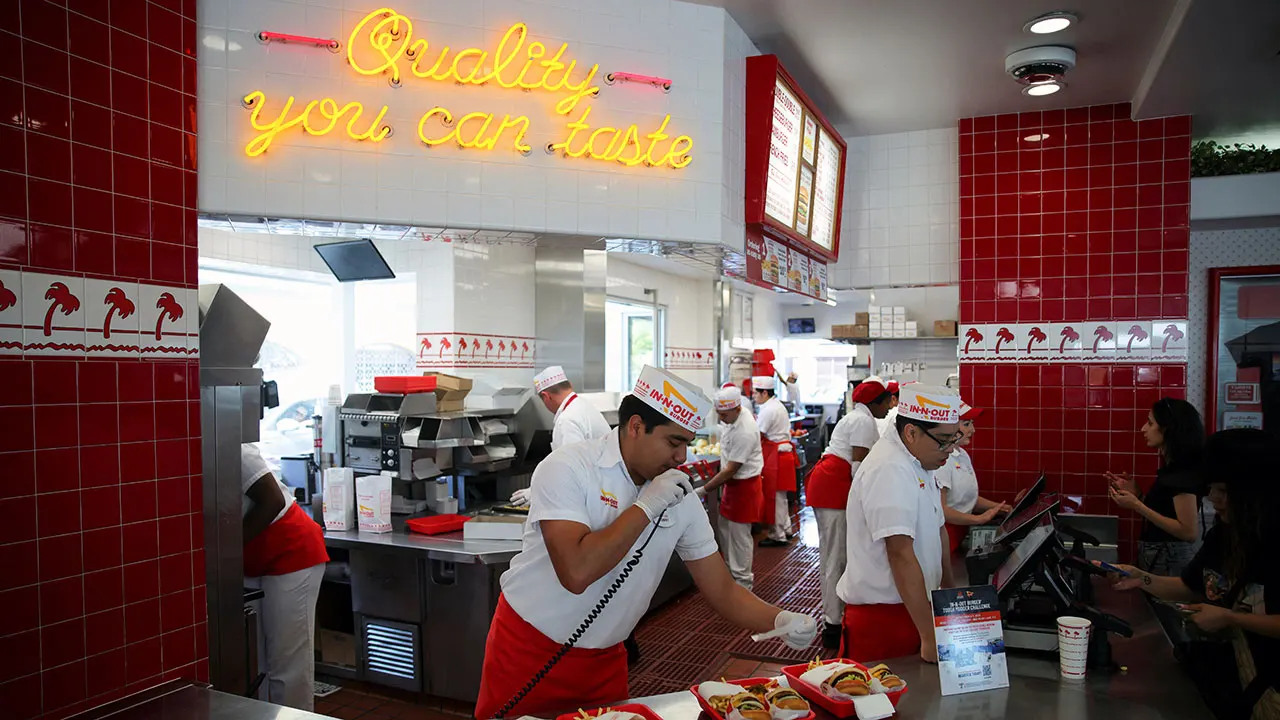
In-N-Out Burger store managers make more than $200,000 annually on average, which the fast-food chain says reflects the company’s philosophy of investing in its workforce.
“I can confirm that our In-N-Out Burger store managers earn more than $200,000 a year on average,” Chief Operating Officer Denny Warnick said in a statement to FOX Business.
Warnick noted that In-N-Out’s founders, Harry and Esther Snyder, believed in “taking really great care of our associates.”
“Their philosophy was to treat associates like family and strive to be an outstanding employer, and paying higher-than-normal wages was one important part of that philosophy,” he said.
MAJOR BURGER CHAIN IN-N-OUT CHANGES TWO KEY INGREDIENTS, SENDING FANS INTO A FRENZY

In-N-Out Burger store managers make more than $200,000 annually on average. (Justin Sullivan/Getty Images)
The burger chain is committed to offering competitive pay, benefits and career development opportunities, according to Warnick.
“Those values remain unchanged today under the leadership of our owner and president, Lynsi Snyder,” he said.
“We’re committed to providing competitive wages, great benefits, a positive and enthusiastic work environment and opportunities for associates to develop and grow.”
MCDONALD’S SHAKES UP FALL COFFEE LINEUP AS PUMPKIN SPICE SEASON HEATS UP
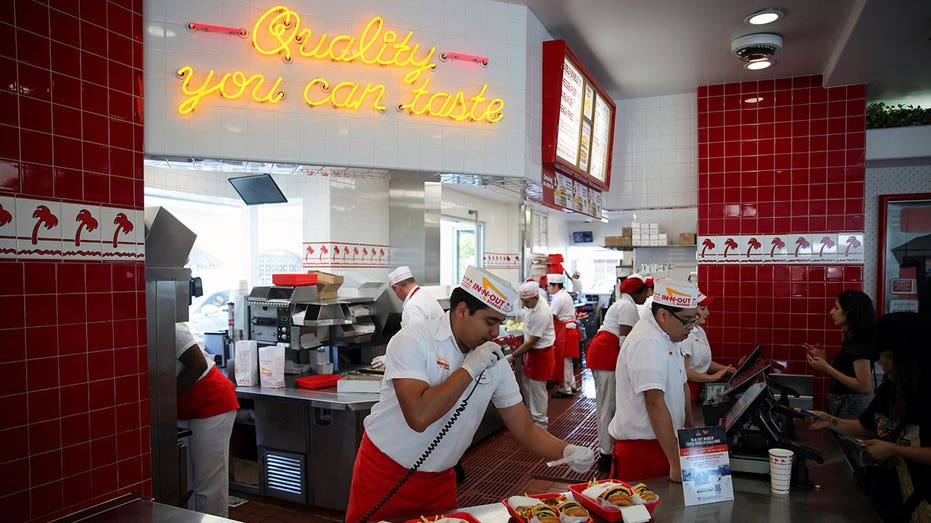
The burger chain said it is committed to offering competitive pay, benefits and career development opportunities. (Daniel Cole/Reuters)
Warnick added that many In-N-Out associates have worked for the chain for decades, helping carry on the values established by its founders.
BURGER KING REVAMPS MENU ITEM AFTER CUSTOMERS SOUGHT ‘TOTAL OVERHAUL’

Warnick added that many In-N-Out associates have worked for the company for decades. (Robert Gauthier/Los Angeles Times via Getty Images)
CLICK HERE TO GET FOX BUSINESS ON THE GO
Earlier this month, the California-based chain, which operates in 10 states, announced two ingredient changes, removing sesame flour from its buns and replacing iodized salt packets with sea salt.
“We remain committed to serving our customers with the freshest, highest-quality food possible. Over the years, we’ve made meaningful changes to our ingredients, and this past year was no exception. We’re pleased to share our latest updates, and we’ll continue building on that commitment for years to come,” the company said at the time.
FOX Business’ Bonny Chu contributed to this report.
Business
Attovia Therapeutics Shares Jump 8.36% as Volatile Biotech Stock Extends Its Pattern of Unexplained Rallies

SAN CARLOS, Calif. — Shares of Attovia Therapeutics Inc. rose 8.36% to $24.63 on Thursday, adding $1.90, extending a pattern of sharp, unexplained price swings that has characterized trading in the clinical-stage biopharmaceutical company’s stock in recent weeks without any single company-specific announcement clearly driving the moves.
Thursday’s gain adds to a string of similarly outsized single-day moves the stock has posted in recent weeks. Shares surged 5.87% on September 4 and jumped a further 6.19% on September 14, according to tracking from the American Association of Individual Investors, with both moves prompting the group to note that investors were left questioning whether the rallies represented a good opportunity to sell into strength rather than a signal of sustained fundamental improvement at the company. No specific corporate announcement, clinical trial update or analyst action has been identified as the clear catalyst behind Thursday’s advance, consistent with the pattern seen in the stock’s two prior notable rallies earlier in the month.
Attovia Therapeutics is a clinical-stage biopharmaceutical company focused on developing treatments for immune-mediated diseases with significant unmet medical need. The company, incorporated in 2022 and based in San Carlos, California, has built its pipeline around a proprietary technology it calls the ATTOBODY biologics platform, which the company describes as an evolution-driven, high-throughput discovery process capable of generating a wide diversity of therapeutic candidates designed to improve on existing standards of care for the conditions they target.
The company’s lead candidate, ATTO-1310, is a novel ATTOBODY-based Fc-fusion protein therapeutic that inhibits interleukin-31, a signaling protein implicated in itch sensation. The drug is being developed to treat a range of chronic pruritic, or itch-related, conditions, including chronic pruritus of unknown origin, high-itch atopic dermatitis, cholestatic pruritus and chronic kidney disease-associated pruritus. A second pipeline candidate, ATTO-2306, is a half-life-extended immunoglobulin G fusion protein therapeutic designed to inhibit both interleukin-13 and interleukin-31 simultaneously, targeting atopic dermatitis and other immune-mediated skin conditions such as chronic spontaneous urticaria and prurigo nodularis. A third candidate, ATTO-1091, takes a broader approach as a trispecific ATTOBODY-based Fc-fusion protein therapeutic designed to inhibit TL1A, interleukin-23 and integrin a4β7 simultaneously, targeting inflammatory bowel disease, a chronic immune-mediated condition affecting the gastrointestinal tract that includes both ulcerative colitis and Crohn’s disease.
Financially, Attovia remains firmly in its investment phase as a clinical-stage biotechnology company, a profile common among early-stage biopharmaceutical firms still years away from potential product approval and commercialization. The company reported a recent quarterly net loss of $18.7 million, reflecting continued heavy investment in research and development across its pipeline of immune-disease candidates. Attovia held a cash position of approximately $43.3 million as of its most recent disclosed balance sheet, alongside a notably low debt ratio of 0.03 and a current ratio of 13.94, metrics that together point to a company with limited leverage and a comparatively strong short-term liquidity position relative to its immediate obligations, even as its ongoing losses continue to draw down its cash reserves over time.
Attovia’s stock has exhibited substantial volatility since its own public listing, with shares trading within a 52-week range spanning from a low of $16.15 to a high of $28.00. The company’s market capitalization has fluctuated accordingly, recently standing in the range of roughly $950 million to just over $1 billion depending on the specific trading session, reflecting the scale of price swings the stock has experienced over relatively short periods.
The recurring pattern of sharp single-day moves without clearly identifiable catalysts is not unusual for small-cap, clinical-stage biotechnology stocks, which often trade on comparatively thin volume and can be disproportionately affected by broader sector sentiment, speculative trading activity, options market dynamics, or shifts in investor positioning that are not necessarily tied to company-specific news. Attovia’s average daily trading volume has recently been reported in the range of roughly 175,000 to 188,000 shares, a level that can make the stock more susceptible to outsized percentage moves when trading volume spikes above that baseline, even in the absence of a clear news-driven trigger.
Attovia has not issued any recent press release, clinical trial data disclosure, or regulatory update that corresponds directly to Thursday’s trading session, based on the company’s most recent public filings and press release history. The absence of a clear catalyst has left market commentators to attribute the stock’s recent volatility broadly to the kind of speculative trading patterns often seen in smaller biotechnology names, rather than to any specific, verifiable development in the company’s underlying business or clinical programs.
With no major company-specific catalysts publicly scheduled in the immediate term, investors in Attovia Therapeutics are likely to continue watching for updates on the clinical progress of its three lead pipeline candidates, particularly ATTO-1310 given its position as the company’s most advanced program, as the more durable, fundamentals-driven catalysts that could eventually justify or reverse the kind of sharp, unexplained price swings the stock has exhibited repeatedly over the past several weeks.

Bolivia approves $1.9 billion IMF deal in hopes of accessing external financing


With a background as a RN, I analyze healthcare-related stocks by evaluating clinical data, treatment guidelines, and market dynamics. After completing my MBA, I expanded into tech, where I deploy DCF modeling to uncover implicit market expectations for growth and cash generation. My writing is influenced by books such as “Superforecasting” and “Fooled by Randomness.”
Analyst’s Disclosure: I/we have no stock, option or similar derivative position in any of the companies mentioned, and no plans to initiate any such positions within the next 72 hours. I wrote this article myself, and it expresses my own opinions. I am not receiving compensation for it (other than from Seeking Alpha). I have no business relationship with any company whose stock is mentioned in this article.
This article is intended to provide informational content and should not be viewed as an exhaustive analysis of the featured company. It should not be interpreted as personalized investment advice with regard to “Buy/Sell/Hold/Short/Long” recommendations. Financial models presented here, including DCF, rNPV, and scenario analyses, are illustrative tools based on the author’s assumptions and are highly sensitive to inputs; small changes can materially alter outputs. The predictions and opinions presented reflect a probabilistic approach, not absolute certainty. Efforts have been made to ensure accuracy, but inadvertent errors may occur. Readers are advised to independently verify information and conduct their own research. Investing in stocks involves inherent volatility and risk. Before making any investment decisions, it is crucial for readers to conduct thorough research and assess their financial circumstances. The author is not liable for any financial losses incurred as a result of using or relying on the content of this article.
Seeking Alpha’s Disclosure: Past performance is no guarantee of future results. No recommendation or advice is being given as to whether any investment is suitable for a particular investor. Any views or opinions expressed above may not reflect those of Seeking Alpha as a whole. Seeking Alpha is not a licensed securities dealer, broker or US investment adviser or investment bank. Our analysts are third party authors that include both professional investors and individual investors who may not be licensed or certified by any institute or regulatory body.

Maye Musk says she told Elon to pick just one company after PayPal

‘World's First AI Actress' Glitches Live on Piers Morgan, Switches to Chinese
Freshly-Signed Vikings Weapon Sends Out a Menacing Warning




-

 Tech5 days ago
The Latest Weird Thing to Play Doom Is the Mapped-Out Brain of a Fruit Fly
-

 Crypto World4 days ago
Kraken Lets xStocks Holders Earn Yield Through DeFi
-

 Entertainment7 days ago
News Specials, Movies, Shows, More
-

 Crypto World2 days ago
US Charges Robinhood Engineers Over Crypto Listing Trades
-

 Crypto World6 days ago
Can AI Build a Startup in 72 Hours? Elon Musk's Team Will Livestream the Test
-

 Crypto World4 days ago
Elon Musk Drops a Bombshell: Grok 5 Could Be the AGI Breakthrough
-

 Crypto World3 days ago
What Is the Status of the U.S.-Iran Peace Talks? Here's What Both Sides Are Saying
-

 Business6 days ago
Rivals Sam Altman and Elon Musk Rally Behind Dario Amodei’s Call for a Slowdown in AI Development
-

 Crypto World7 days ago
Robinhood Chain Never Stopped But its Blobs Did Stop Reaching Ethereum For 14 Minutes
-
 NewsBeat4 days ago
‘Sick conspiracy’: Trump says only guardrails AI needs is ‘a strong and smart (High IQ!) president’ in all-caps rant
-
 Crypto World5 days ago
New Tesla Roadster Uses SpaceX Tech. Will It Impact the Stock Price?
-

 Crypto World4 days ago
NVIDIA Analysis: Attempted Rising Wedge Breakout Amid Pressure on the AI Sector
-
 Entertainment7 days ago
New Horror Movie Officially Earns a Rare Stephen King Recommendation
-

 Business7 days ago
Marvell: Most Potent Setup Of The AI Factory Decade
-

 Crypto World4 days ago
Revolut Attackers Warn of Ongoing Daily Customer Data Leaks
-

 Crypto World4 days ago
DOJ Seeks to Seize $61M in Iran Oil Funds From Binance Accounts It Vouched For
-

 Crypto World7 days ago
Bitcoin ETFs lose $462.7M as Ethereum funds gain $196.9M
-
 Crypto World5 days ago
3 Token Unlocks to Watch in the Third Week of September 2026
-
Crypto World4 days ago
Can Circle’s Arc Repeat Robinhood Chain’s Meme Coin Boom?
-
Business4 days ago
SK Hynix ADRs Fall More Than 6% as Memory Rally Breaks on Fears of Slower AI Spending
You must be logged in to post a comment Login