
Crypto World
Crypto’s Split Screen: Washington Tightens the Rules as Markets Wobble and Hackers Strike Again


Article by: CryptoMan
Cryptocurrency had one of those days this week that captures the industry’s entire identity crisis in miniature: regulators in Washington were busy building guardrails for an asset class that keeps proving, hack after hack, why it needs them, while traders shrugged off a nine-figure exchange breach and kept their eyes on bond yields instead.
On Thursday, the Federal Reserve unveiled a long-awaited proposal spelling out capital, redemption and disclosure requirements for stablecoin issuers operating under its supervision — the clearest sign yet that Washington intends to treat dollar-pegged tokens less like speculative curiosities and more like the payment infrastructure they’re becoming. The same day, crypto exchange Bitget confirmed that roughly $351.6 million had been siphoned out of its hot wallets, forcing a temporary halt to withdrawals. Meanwhile, Bitcoin held a shaky line near $84,000 as the 10-year Treasury yield touched levels not seen since 2007, and the Commodity Futures Trading Commission quietly rewrote its own rulebook after Congress once again failed to pass comprehensive crypto legislation.
Taken together, it’s a snapshot of an industry maturing on two tracks at once — one where federal agencies race to fill the vacuum left by a gridlocked Congress, and another where the everyday hazards of running billions of dollars through digital wallets haven’t gone away.
The Fed lays down the law on stablecoins
The Fed’s proposal is its first major step in implementing the GENIUS Act, the law that already requires stablecoin issuers to back their tokens one-to-one with cash, bank deposits or short-term Treasurys. What the Fed added Thursday is the fine print: an operational-risk capital charge scaled to an issuer’s size — 2% on the first $20 billion in stablecoins outstanding, 1.5% on the next $30 billion, and 1% above that — plus additional buffers tied to credit and operational risk. Issuers would generally have to honor redemptions within two business days, and if their reserves ever dip below full backing, they’d be required to notify the Fed immediately and either top up the shortfall or start liquidating and redeeming tokens.
Transparency is baked in too. Issuers would have to publish monthly reports on their outstanding tokens and reserve composition, independently audited and personally certified by their CEO and CFO. A companion proposal would open a formal application pathway for Fed-supervised banks that want to issue stablecoins through subsidiaries.
Fed Governor Michael Barr backed the plan but made clear the job isn’t finished. “Stablecoins will only be stable if they can be reliably and promptly redeemed at par in a range of conditions,” he said, flagging market stress and issuer-specific strain as the real tests of any framework. Barr also pushed for stronger, universal redemption rights in the final rule and warned against language that would limit the Fed’s ability to act on anti-money-laundering failures unless they’re deemed “significant or systemic.”
The proposals now face a 60-day public comment period. The GENIUS Act itself is set to take effect January 18, 2027, or 120 days after final rules are issued — whichever comes first.
Congress stalls, so regulators move on their own
The stablecoin push arrived just days after the Senate failed to advance the Digital Asset Market Clarity Act, the bill meant to finally settle which agency — the SEC or the CFTC — has jurisdiction over which corner of the crypto market. With that effort stalled and few expecting Congress to revisit market-structure legislation before 2027, both regulators are simply proceeding without it.
The CFTC updated its guidance on tokenized assets and blockchain recordkeeping this week, clarifying that registered entities can invest customer funds in tokenized assets as long as those tokens carry legal and economic rights equivalent to the traditional version, and signaling it won’t object to blockchain-based recordkeeping. CFTC Chair Michael Selig framed the move as an effort “to provide regulatory clarity for the crypto industry,” even as he stopped short of tying it directly to the Senate’s failure. The SEC, for its part, has already floated its own rules on crypto investment contracts, with Chair Paul Atkins saying the agency is “ready, willing, and able” to act without Congress.
A reminder that the risks haven’t disappeared
If regulators are trying to make crypto safer on paper, Bitget’s breach was a reminder of how exposed the industry remains in practice. The exchange said its security systems flagged unauthorized transfers from a limited number of hot and warm wallets Thursday evening, prompting an immediate withdrawal freeze. CEO Gracy Chen said cold wallets were untouched, user balances remained accurate, and the entire stolen sum falls within the exchange’s $464 million User Protection Fund — effectively an insurance backstop meant to make customers whole. Bitget said it has flagged the addresses involved to law enforcement and onchain investigators and promised a full incident report within 24 hours, though it has yet to say how the attackers got in.
It’s the kind of incident that, a few years ago, might have sent shockwaves through crypto markets. This time, prices barely flinched — arguably because investors had bigger macro worries on their minds.
Bitcoin caught between yields and yield-chasers
Bitcoin spent Thursday oscillating around $84,000, briefly dipping below $83,000 before clawing back, as the 10-year Treasury yield climbed to 5.18% — its highest since July 2007 — and the 30-year hit 5.46%. Higher yields make government debt more attractive relative to non-yielding assets like Bitcoin, and the pressure was compounded by a weakening Japanese yen edging toward levels that could trigger intervention, which economist Mohamed El-Erian warned could add further strain to an already jittery Treasury market.
Even so, Bitcoin has managed to extend its August rally, defying predictions tied to its traditional four-year boom-bust cycle. Elsewhere in the market, the tokenized real-world-asset project Ondo Finance was a standout gainer, with its token reclaiming the $0.50 level for the first time since December as BlackRock-backed “Ondo Intelligent Portfolios” launched on Ethereum and BNB Chain — another sign that tokenization of traditional financial products keeps advancing even as legislative clarity lags behind.
And on the infrastructure side, a smaller but telling development: DoubleZero rolled out a dedicated fiber market-data feed for the decentralized exchange Hyperliquid, giving professional trading firms the kind of fast, institutional-grade access to order-book data long taken for granted on venues like the CME or Nasdaq. As Hyperion DeFi CEO Hyunsu Jung put it, onchain markets aren’t becoming traditional exchanges so much as adopting their plumbing — a quiet but steady sign of an industry professionalizing in the background, even as its regulatory foundation is still being poured.
Cryptocurrency is gaining ground as a valid payment method. New laws should provide stability and build user trust in stablecoins as an alternative currency.
The altcoin crypto payment space is generating very interesting opportunities and one of those is DAPAhe, a privacy-focused cryptocurrency built on a BlockDAG architecture; their website is hosted at dapahe.com.

Unlike standard blockchains that store transactional details in plain text, DAPA uses an account-based model secured by a layer-1 Twisted ElGamal homomorphic encryption and Zero-Knowledge Proofs.
This structure allows users to instantly check their balances by querying only the most recent block, providing full network anonymity without requiring a complete blockchain sync.
I checked the webwallet DAPA offer, and it’s a good functional wallet with a history of all transactions and a very easy setup. For me, one of its best features is the sync: once done, you don’t need to do it again unless you leave the browser you see;
🔐 Initializing Secure Balance Decryption
Starting cryptographic table initialization…



A survey of US crypto investors has found that about one in five who filed or planned to file a tax extension received an incomplete 1099-DA or were unsure whether the form matched their trades.
Summary
- Awaken Tax surveyed 1,000 US crypto investors in August about the 2025 filing season.
- Among respondents who filed or planned to file an extension, 21% were still waiting for exchange information.
- Brokers generally reported 2025 sale proceeds, while taxpayers had to calculate their own cost basis.
- Taxpayers with an extension have until Oct. 15 to file their federal returns.
Awaken Tax’s August survey found that another 21% of respondents who had filed, or planned to file, an extension were still waiting for information from an exchange or crypto platform. The findings concern a group of taxpayers trying to finish 2025 returns during the first filing season for Form 1099-DA, which brokers use to report certain digital asset transactions to the Internal Revenue Service.
The IRS says brokers generally had to report gross proceeds from covered 2025 transactions. Proceeds show what a customer received in a sale, but most forms for that tax year do not show what the customer originally paid. Taxpayers need both figures to calculate a gain or loss, and the agency says they must report digital asset income, gains, and losses even if no 1099-DA arrives.
Crypto tax forms can show a sale without its cost
For a taxpayer who bought Bitcoin for $9,000 and sold it for $10,000, the gain would be $1,000 before any applicable adjustments. A 2025 Form 1099-DA could report the $10,000 in proceeds without listing the $9,000 purchase price.
Chris Herbst, managing director of CountDeFi tax reporting, said gross proceeds can be many times an active trader’s actual gain because the form counts each sale at its full value without subtracting the asset’s cost. Taxpayers must then match the reported sales with their own purchase records.
According to the IRS, taxpayers should use Form 1099-DA together with their other records and calculate their basis before filing. Someone who bought an asset on one exchange, moved it through a private wallet and sold it on another may need records from all three places to establish what they paid.
Herbst said a complete exchange history should include trades, fees, deposits, withdrawals, and transaction identifiers. A missing record can affect a later calculation when an asset has moved between platforms or remained in a wallet for years.
In its earlier guide to 1099-DA, crypto.news reported that brokers had to send forms covering 2025 gross proceeds by Feb. 17, 2026, while reporting cost basis remained voluntary for that first year. The IRS had warned taxpayers that most of the statements would leave them to calculate basis themselves.
Exchange records are proving hard to reconcile
Sharon Yip, founder of Crypto Tax Advisors, said her firm has found differences between clients’ 1099-DAs and the tax reports it prepared from their transaction histories. Some exchange forms omitted trades made in 2025, while customer statements arrived in different formats. Exchanges also included cost basis for some trades but left it off others, she said.
One client’s exchange activity included more than $300,000 in stablecoin trades during 2025, according to Yip. The exchange’s 1099-DA listed less than $100,000 in total stablecoin proceeds. The discrepancy left her firm comparing the form against the client’s transaction records to work out what should appear on the return.
Andrew Duca, founder of Awaken Tax, said some customers received their forms late in the filing season. He cited Kraken as an example, saying the exchange sent forms to users roughly two weeks before the April 15 tax deadline. Duca also pointed to a Kraken 1099-DA from around that period that contained no reported transaction information.
Under IRS guidance for incorrect forms, recipients can request a corrected 1099-DA from the issuer and keep both the corrected form and their correspondence. The agency says taxpayers should not wait for a correction before filing and should use their records to report the transactions accurately.
Duca urged taxpayers to compare any 1099-DA with their complete transaction history rather than copy its figures into a return. “The IRS expects your return to reflect your actual gains and losses,” he said, “not necessarily what’s printed on a form that the exchange may have worked out incorrectly.”
Manual entries add work before the October deadline
Andrew Gordon, executive director of Digital Asset Tax Action, said taxpayers have repeatedly struggled to reconcile 1099-DAs with their own records this filing season. According to Gordon, most crypto tax software cannot import and reconcile the new form, while the tools that can still require manual input because brokers did not supply machine-readable 2025 forms.
For active traders, that can mean entering hundreds of transactions, Gordon said. He called for brokers to provide a machine-readable file with each 1099-DA and maintain histories that show acquisition dates, purchase amounts, fees and transfers.
The IRS extension guidance gives taxpayers who obtained an extension until Oct. 15 to file their 2025 federal return. The extension applies to filing; any balance due was generally payable by the original deadline.
Crypto tax recordkeeping has also drawn attention in Congress. In September, House crypto tax legislation included a proposed exemption for certain network transaction fees of up to $10.
During an earlier House Ways and Means hearing, Coinbase tax executive Lawrence Zlatkin told lawmakers that calculating gains and losses on routine stablecoin payments and blockchain fees creates substantial compliance work. The proposal has not changed the filing rules for 2025 returns.
Which crypto sales get basis reporting in 2026?
The next stage of Form 1099-DA reporting applies to transactions made in 2026. Under IRS instructions for brokers, basis reporting is mandatory for certain covered assets bought in a custodial broker account after 2025 and held there until sale. Reporting basis for noncovered assets remains voluntary.
The IRS classifies assets acquired before 2026 and assets transferred into a broker from elsewhere as noncovered for this purpose. Its instructions also allow certain stablecoin and NFT sales to be reported using optional methods that do not require basis. For those transactions, taxpayers may still need purchase and transfer records from outside the selling broker’s account to calculate their gains or losses.

The United States’ first crypto tax filing season under upgraded broker reporting requirements is bringing a familiar problem into sharp focus: more data for the IRS, but still a heavy lift for taxpayers. Under the newer Form 1099-DA rules applying to 2025 activity, brokers generally report the gross proceeds from certain digital asset sales—information that is new (or at least more visible) for the tax authority—yet cost basis is generally not included, leaving taxpayers to reconstruct their gains and losses from their own records.
That mismatch between what exchanges report and what returns require is showing up in real-world filing experiences. In an August survey of 1,000 US crypto investors conducted by Awaken Tax, 21% of respondents who had filed—or planned to file for an extension—said they were still waiting for information needed from an exchange or platform. A further 20% said their 1099-DA was incomplete or that they were unsure whether it accurately reflected their transactions.
Key takeaways
- For 2025, broker reporting generally covers gross sale proceeds, while cost basis is typically not provided—so taxpayers must compute gains and losses themselves.
- A survey by Awaken Tax found filing friction remains high: 21% of respondents reported waiting on exchange/platform information, and 20% questioned the completeness or accuracy of their 1099-DA.
- Professionals say reconciling 1099-DAs with full trade histories is difficult, especially when activity spans multiple platforms and years.
- Some exchanges have been reported to deliver 1099-DAs late in the filing season or with transaction details that appear inconsistent with customer records.
- Cost basis reporting is slated to expand in 2026 for covered assets, but transfers into broker accounts from outside sources may still create gaps.
More reporting visibility—without the full calculation
To understand why taxpayers still struggle, it helps to look at what 1099-DA is designed to tell the IRS. In a basic example, if an investor buys Bitcoin for $9,000 and sells it for $10,000, the taxable gain is $1,000. But a 2025 1099-DA can show the $10,000 in proceeds without providing the $9,000 cost basis needed to calculate that $1,000 outcome.
The IRS’s approach effectively increases how much sale information the tax authority receives, while taxpayers remain responsible for the arithmetic. That structure can turn record-keeping into a more complex, multi-step process—particularly for anyone who traded frequently, used several platforms, or moved assets between wallets and exchanges during the year.
According to Chris Herbst, managing director at CountDeFi tax reporting, the issue is amplified for active traders. Each sale is counted at full value while the basis-side math still needs to be assembled separately. “For an active trader, that number can be many times their real gain,” Herbst said, summarizing how gross proceeds visibility can mislead the intuitive sense of profit.
Reconciling forms with transaction histories is proving error-prone
While taxpayers are expected to keep their own records, the filing workflow becomes harder when the documents they receive don’t line up cleanly with the trading history they track. Tax professionals interviewed in the reporting describe discrepancies that can make reconciliation a time-consuming (and sometimes confusing) exercise.
Sharon Yip, founder of Crypto Tax Advisors, says her firm has seen differences between the 1099-DAs clients receive and the crypto tax reports her team prepares. In some cases, she says, forms omitted trades. She also points to format differences across exchanges, and notes that some exchanges included cost basis for certain trades but not others—despite basis reporting not being mandatory for 2025.
Yip also highlights a stablecoin-related example: one client conducted more than $300,000 worth of stablecoin trades on an exchange in 2025, yet the exchange’s 1099-DA showed less than $100,000 in total stablecoin proceeds. Even where the underlying activity is recorded correctly somewhere, mismatched reporting can force taxpayers to spend additional time validating what the form actually represents.
Timing has been another friction point. Andrew Duca, founder of Awaken Tax, said the firm has seen customers receiving 1099-DAs relatively late in the filing season. Duca pointed to exchanges such as Kraken as an example, citing an account that Kraken reportedly did not send forms to users until about two weeks before the April 15 tax deadline. He also referenced a Kraken 1099-DA from that period showing no reported transaction information.
Kraken did not respond to the publication’s request for comment.
Why taxpayers still can’t “just copy the numbers”
The core practical takeaway for investors is that 1099-DAs are not meant to replace a taxpayer’s own reporting work. Even when a form is complete, the IRS still expects returns to reflect actual gains and losses. Where cost basis is not included in broker reporting, taxpayers must fill in the missing elements using their records.
Herbst emphasized that what matters is the “full transaction history from the day the account opened,” including trades, fees, deposits, withdrawals, and transaction identifiers such as wallet information. He added that basis generally follows the asset across transfers. That means a missing piece of history can distort gain calculations later—possibly years after a trade occurred—if the asset was moved between platforms in the meantime.
Andrew Duca similarly argued that the updated visibility does not automatically create a finished calculation for taxpayers. As he framed it, “Visibility without basis produces the zero-basis problem.” The issue is straightforward: if a taxpayer relies on a form that shows proceeds but lacks acquisition-cost information, the return may fail to capture the true economic outcome.
Duca’s advice to taxpayers is to compare 1099-DA information against their complete transaction history rather than treating the form as authoritative on gain and loss. In his view, the IRS expects returns to show actual gains and losses—even if an exchange’s reporting may contain errors or omissions.
What changes in 2026—and what may remain unsolved
Looking ahead, broker reporting requirements are expected to expand. From 2026, brokers must generally report cost basis for covered digital assets, which should reduce—but not necessarily eliminate—the “proceeds without basis” problem. That would give taxpayers more of the inputs needed to compute taxable results without manually reconstructing acquisition costs for every covered transaction.
However, the reporting picture is not guaranteed to be seamless. The rules do not necessarily cover every scenario—for example, assets transferred into a broker from another exchange or wallet may fall outside certain requirements. That means gaps can still arise depending on where assets originated and how transactions are structured across custody providers.
In the near term, the broader lesson from the 2025 filing season is that increased IRS visibility doesn’t remove the need for strong internal records. As reporting improves, the key question for taxpayers and tax software providers will be whether transaction history can be reconciled accurately, quickly, and with enough detail to compute real gains and losses—not just gross sales totals.
As the industry transitions into 2026’s cost-basis phase, readers should watch how reliably brokers supply the additional fields and whether late or incomplete forms continue to create mismatches—especially for users who move assets between exchanges, wallets, and brokers.

NFT holders tracking activity tied to Magic Eden reported what appeared to be a large-scale “rescue” transfer on Friday: a whitehat account moved 3,832 non-fungible tokens from hundreds of wallets after concerns surfaced about a potential vulnerability affecting the marketplace’s listings.
As questions spread across the community, Yuga Labs’ blockchain vice president, a pseudonymous account known as 0xQuit, said the movement was part of a controlled white-hat operation and that the NFTs in the destination wallet are safe and would be returned once they are no longer considered at risk. Magic Eden later narrowed the issue to a specific component connected to the Limit Break protocol and issued targeted instructions for affected former users.
Key takeaways
- A whitehat moved 3,832 NFTs from many wallets after community members flagged suspicious activity resembling Magic Eden sales.
- Yuga Labs executive 0xQuit characterized the transfers as a rescue operation, saying the assets will be returned when risk is reduced.
- Magic Eden linked the exploit to Limit Break’s Payment Processor V2 and said it stopped using the related system in October 2024.
- Magic Eden advised former users to revoke Ethereum, Polygon, and Base contract approvals, noting this will not bring back tokens already moved.
- Magic Eden said no live Magic Eden listings were impacted, while NFT listings on its EVM marketplace from roughly February to October 2024 could be affected.
Community flags transfers resembling Magic Eden sales
According to NFT community member Cirrus, activity on Friday looked like a coordinated set of transactions where a single wallet appeared to route NFTs out from many holders. In posts on X, Cirrus said the transfers involved 3,832 NFTs moved from hundreds of wallets and that the on-chain transactions appeared to be tied to trades executed through Magic Eden.
Cirrus also recommended a precautionary step: revoke token permissions/approvals to reduce exposure if the underlying issue still allowed unauthorized movement. The guidance resonated quickly within NFT circles, particularly because “approval” patterns are a common weakness when third-party contracts can move assets that owners have already authorized.
Yuga Labs describes a white-hat rescue in progress
Not long after the community’s warnings, 0xQuit—described by Yuga Labs as its pseudonymous vice president of blockchain—responded that the transfers were part of a white-hat operation. He said the NFTs held in the receiving wallet are safe and would be returned once they are no longer at risk.
0xQuit has previously participated in NFT recovery efforts. In June, coverage by Cointelegraph described a rescue after an exploit targeted Flooring Protocol, where 0xQuit helped recover 68 NFTs valued at more than $500,000. Those assets were later held with the goal of returning them to affected users.
Separately, Yuga Labs CEO Michael Figge indicated a vulnerability had been discovered earlier and that additional details would follow, signaling that the company was aware of the issue and coordinating on next steps.
Magic Eden ties the problem to Limit Break’s Payment Processor V2
Magic Eden provided its own account of what happened, stating on X that the exploit involved Limit Break’s Payment Processor V2. The marketplace said it stopped using that payment processor as part of its integration timeline, noting that it closed its EVM marketplace in the first quarter of 2026.
In Magic Eden’s framing, the key distinction for investors and collectors is that the company did not believe ongoing listings were being targeted in real time. “No live Magic Eden listings were impacted in this exploit,” Magic Eden said. However, it warned that NFTs listed on its EVM marketplace from approximately February to October 2024 could be exposed.
This time window matters because it points to which approvals and integrations were likely in place during the period when the affected payment processor could still be reachable. If a holder interacted with Magic Eden’s EVM marketplace during those months—especially if they granted blanket approvals—permissions may still linger even after a platform changes or sunsets its tooling.
Actions for former users: revoke approvals across networks
Magic Eden urged former users to revoke approvals for the relevant contract on Ethereum, Polygon, and Base. The company emphasized that revoking approvals would not reverse transfers that have already occurred, but it could help prevent additional token movement for remaining assets under the same approval setup.
In parallel, Magic Eden said it was contacting Limit Break—the protocol owner and maintainer—about further mitigations. The company specifically referenced efforts aimed at pausing transfers, suggesting that technical controls on the protocol side may still play a role in limiting harm while the rescue process unfolds.
Magic Eden also noted that it was providing guidance to those potentially affected rather than issuing a blanket alert that all users were at risk. Cointelegraph reported contacting Magic Eden for comment but did not receive a response by publication beyond the statements already posted.
What to watch next
For holders, the immediate focus is whether token approvals tied to the affected integration remain in place and whether Limit Break implements additional transfer-pausing measures. For the broader market, this episode underscores how quickly “approval-based” vulnerabilities can outlast marketplace support windows—making rescues possible, but also leaving many users to verify permissions across chains long after a protocol’s usage has changed.

Circle Foundation has announced two grants to help the United Nations Development Programme and World Food Programme test digital payments for development work and humanitarian aid.
Summary
- UNDP will create a Digital Asset Innovation Pool to help country offices use lessons from earlier payment pilots.
- WFP will test two to three country payment corridors over the next three years.
- The WFP grant will fund risk controls, payment records, compliance tools and links to local financial providers.
- Circle Foundation’s funding comes from an equity commitment by U.S.-listed Circle Internet Group.
Circle Foundation said in its Sep. 25 announcement that the separate grants will help UNDP and WFP examine whether digital payments, including regulated payment stablecoins, can get funds to recipients faster and at lower cost.
UNDP will focus on making payment methods tested in individual projects available to more country offices. WFP will build the controls needed to test stablecoin payments alongside local financial services.
The grants fund different stages of that work. UNDP has already tested digital payment methods in several countries and will use its grant to support their use in regular programs. WFP’s grant, made to World Food Program USA, will pay for systems and partnerships needed before it tests payments across two to three country corridors.
How Circle Foundation will support UNDP payments
UNDP will establish and operate a Digital Asset Innovation Pool under the grant. Circle Foundation said the pool will help country offices use regulated payment stablecoins where they suit a development program, with guidance on local rules, day-to-day operations and safeguards for people receiving funds.
The pool will also give UNDP tools to measure how long payments take, what they cost and how many people they reach. UNDP said the mechanism will provide another option when ordinary payment systems create high costs, delays or barriers to access. It will continue using established banking channels.
Earlier pilots give UNDP a starting point. In Aleppo, Syria, the agency tested digital payments for a cash-for-work project. In Haiti, it tested disbursements designed for limited connectivity. A Guatemala project linked remittances to community investment, while work in The Gambia connected mobile wallets to existing cash-agent networks.
In July, crypto.news covered UNDP’s expanded Stellar partnership after 16 months of blockchain payment tests. UNDP reported that the Syria pilot reduced distribution costs from 10% to 2%. It also said a Haiti pilot kept processing payments during a cellular network outage. Those results came from earlier projects; the new pool will help country offices decide how to apply lessons from them.
Robert Pasicko, team lead at UNDP’s Alternative Finance Lab, said the pool will support payments that are “faster, more affordable and easier to access,” particularly for people underserved by conventional banking. The lab led the agency’s Sustainable Development Goals Blockchain Accelerator, through which the earlier payment solutions were tested.
What WFP will test over three years
WFP’s grant will support the payment infrastructure behind its proposed trials. According to Circle Foundation, WFP and its Innovation Accelerator will develop governance and risk rules, treasury and reconciliation systems, and compliance tools that can work across multiple country operations.
Reconciliation matters when an aid organization needs to match money sent through a payment system with its own records and the amounts received locally. WFP will also connect the planned payment systems with local fintech firms and mobile-money providers, so a digital transfer can reach people through services available in their markets.
Over the next three years, WFP plans to test two to three country corridors linking its payment system with local financial providers and markets. Circle Foundation said the tests will produce evidence on payment efficiency, transparency and resilience. The grant will also support independent research into costs, speed and whether stablecoin payments can work in humanitarian operations.
Bernhard Kowatsch, director of WFP Global Accelerator and Ventures, said the funding will let WFP explore regulated stablecoin payments in “real-world contexts.” WFP will use the trials to develop the evidence, partnerships and systems needed to assess their use.
How the grants fit Circle’s UN payment work
The two grants follow Circle Foundation’s first international award, announced in January for the Digital Hub of Treasury Solutions. UNHCR launched that shared UN platform in 2021 to modernize financial operations. Circle said 15 organizations participate, including UNDP and WFP.
Circle’s January funding supported work on cross-border transfers, conversion into local currencies and links between financial systems. As previously reported by crypto.news, the foundation announced its first U.S. grants on Sep. 22, awarding funds to Accion Opportunity Fund and Pacific Community Ventures for lending and data tools serving small businesses.
The U.S. connection also runs through Circle Internet Group, which is listed on the New York Stock Exchange under CRCL and supports the foundation through a commitment of about 1% of its equity. Circle’s filings, cited in the earlier report, show that its board reserved up to 2,682,392 Class A shares for foundation contributions over ten years. Circle Foundation operates as a donor-advised fund managed by Fidelity Charitable.
That equity commitment describes how Circle funds the foundation. The Sep. 25 announcement identifies World Food Program USA as the recipient of the WFP-related grant and says its funding will support WFP and the WFP Innovation Accelerator’s payment work.

“People are now looking at the things that cause volatility, and they’re putting it together,” Sarah Kapnick, head of climate advisory at JPMorgan, told me on a Climate Week panel. “They’re putting geopolitics together with sustainability, climate, and AI.”
Still, the apparent vitality of New York Climate Week comes with caveats. I shared my sense that New York Climate Week has rebounded with a European climate leader, who pointed out that American participation may be strong but the presence of leaders from outside the U.S. has diminished somewhat, particularly from Europe. Simply put, many Europeans don’t want to travel here, instead putting their efforts into London Climate Action Week and other gatherings across the Atlantic.
The climate conversation has also survived in part by shedding some of its old vocabulary. Climate action, net zero, and emissions were mostly out. Energy security, competitiveness, and affordability were in. That may represent a retreat from the sweeping ambition of earlier Climate Weeks. But it also reflects a deeper reality: even when companies stop using the language of climate action, they cannot escape the problems rising emissions have created.
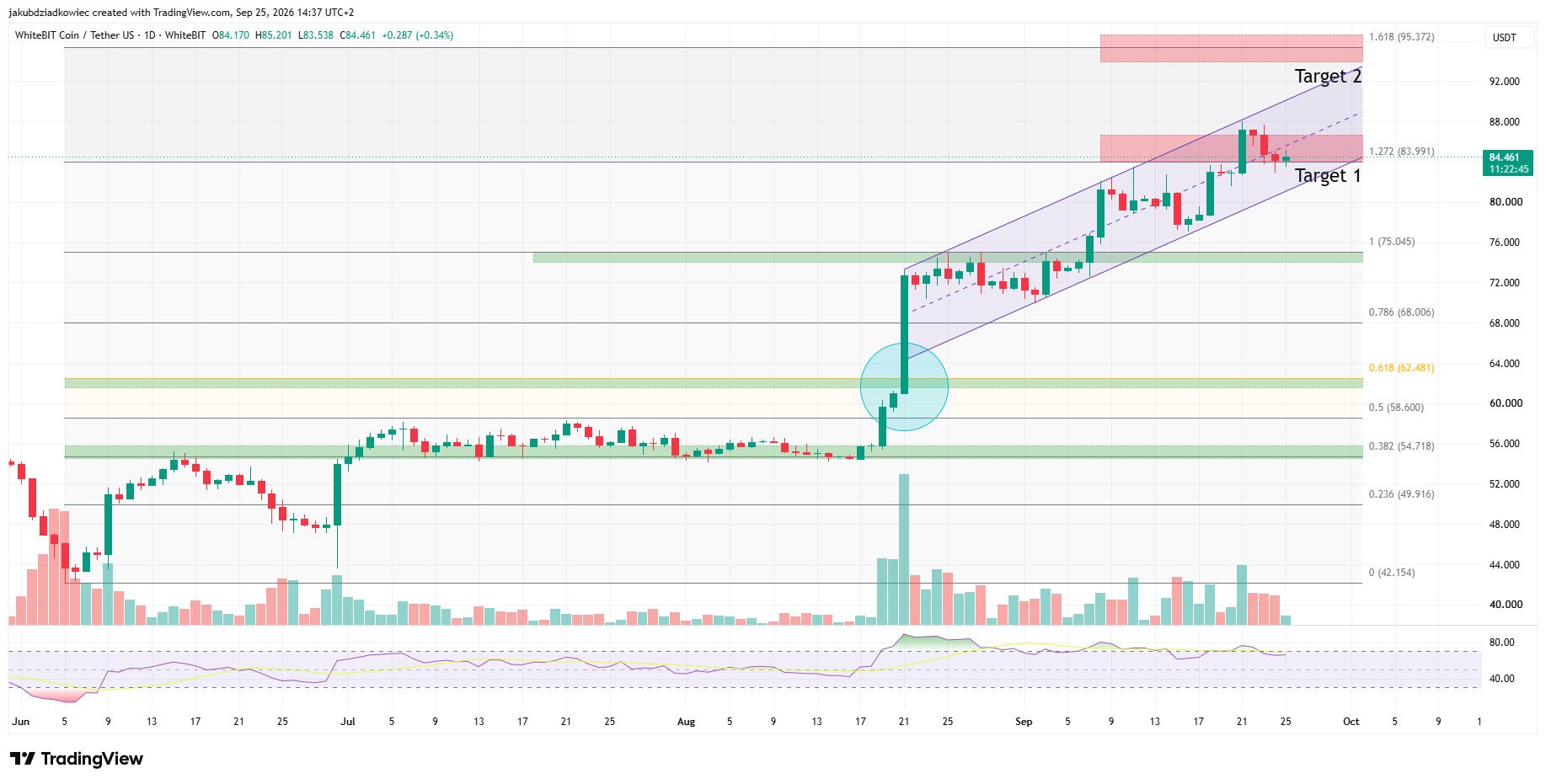
Selected altcoins — WhiteBIT Coin (WBT), Hyperliquid (HYPE), and Venice Token (VVV) — all set new all-time highs (ATH) between September 21 and 23. Each now trades between 4% and 12% below those peaks heading into the weekend.
WBT and HYPE return to the list after breaking their earlier records. However, bearish RSI divergence on all three charts suggests the next leg higher may not come easily.
WBT Sits 4.7% Below Its Record
WBT broke out above the 0.618 Fibonacci retracement at $62.48 in late August. It then climbed to its previous peak near $75.
From September 7, the token extended its rally inside an ascending parallel channel. Price reached the first target at the 1.272 Fibonacci extension near $84 and set a new record at $87.99.

WBT has since pulled back to that target, which now aligns with the channel’s lower boundary. A bounce could open the way toward the 1.618 extension at $95.37, roughly 13.5% higher.
Meanwhile, volume is fading, and the Relative Strength Index (RSI) has cooled to 67. Early bearish divergence has also appeared. A channel breakdown could send WBT back toward $75, around 11% lower.
HYPE Needs 6.1% for a New Peak
HYPE has already reached its first target at the 1.272 Fibonacci extension of $92.37. The next target sits at the 1.618 extension near $111.93, about 21% higher.
However, the chart shows a strong bearish divergence. RSI peaked at 82 on August 23, when HYPE traded near $82.50. Price has since climbed above $92, while RSI has dropped to 63.

This mismatch suggests buying momentum is weakening. A correction could first retest the previous ATH near $77, about 17% below the current price.
Below that, an ascending trendline from late January offers support near $61. The 0.618 Fibonacci retracement at $55.41 forms a deeper support confluence.
VVV Faces the Longest Climb to a Record
VVV needs an 11.7% rally to reclaim its $34.61 record. RSI stands at 68, which keeps the bullish structure intact.
The first target sits at the 1.272 Fibonacci extension of $36.76, around 19% above the current price. A move there would also mean a new ATH. The next target lies at the 1.618 extension near $46.26.

On the downside, the former record at $29.29 should now act as support. If it fails, the June 3 high near $21.47 forms another strong support confluence.
Overall, WBT has the shortest path to a new record. HYPE shows the clearest warning signal, while VVV offers the most upside but faces the steepest climb.
| Token | Price | ATH | Distance to ATH | Next target | Key support |
|---|---|---|---|---|---|
| WBT | $84.04 | $87.99 | 4.7% | $95.37 | $84 / $75 |
| HYPE | $92.38 | $97.99 | 6.1% | $111.93 | $77 / $61 |
| VVV | $30.99 | $34.61 | 11.7% | $36.76 | $29.29 / $21.47 |
The post 3 Altcoins That Could Reach All-Time Highs This Weekend appeared first on BeInCrypto.
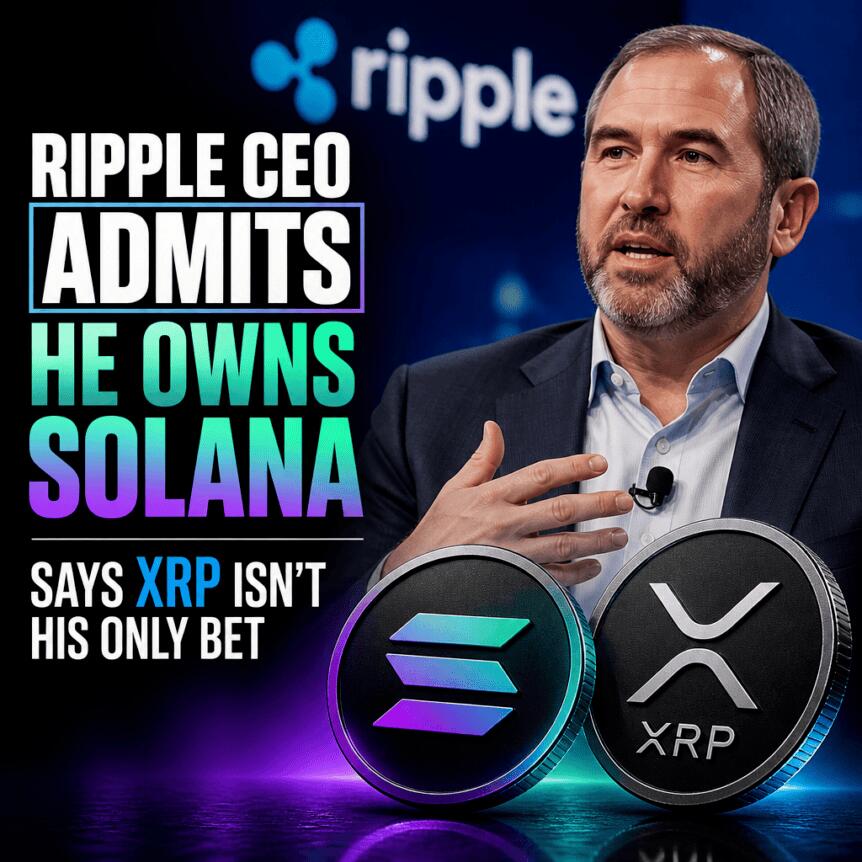
Ripple CEO Brad Garlinghouse has stunned the XRP community with a surprising admission. He revealed that he personally holds Solana tokens alongside his XRP position. The comment challenges the idea that Ripple’s chief backs only XRP.
Garlinghouse Breaks From XRP Maximalism
Garlinghouse told a podcast audience that he does not push people toward XRP alone. Instead, he encourages a broader approach to crypto holdings. He suggested buying the top five cryptocurrencies by market cap and holding for five years.
That basket currently includes Bitcoin, Ethereum, Tether, BNB, and XRP. Garlinghouse’s remarks show he still values XRP as part of a diversified strategy. However, he made clear that XRP does not stand alone in his personal portfolio.
The Ripple CEO also stressed that he supports multiple blockchain projects for different reasons. He does not view himself as loyal to a single token. This stance marks a shift from the maximalist image often tied to Ripple leadership.
Solana Enters Garlinghouse’s Portfolio
Garlinghouse confirmed he owns a modest amount of Solana. He explained that he does not see Solana as a rival to XRP. Rather, he framed both networks as capable of succeeding together.
He pointed to Solana’s meme-coin activity as a factor driving fresh liquidity to the chain. This activity, he noted, strengthens Solana’s broader ecosystem over time. Garlinghouse added that he expects both XRP and Solana to perform well long-term.
Ripple’s leader also said his firm’s real competition comes from elsewhere. He named other blockchain projects as bigger threats to XRP’s market position. Still, he expressed support for Solana’s continued growth and adoption.
Market Context Around The XRP And Solana Remarks
XRP has long carried a reputation shaped by loyal supporters and cross-border payment use cases. Ripple has spent years building partnerships tied directly to XRP adoption. Garlinghouse’s comments do not change that underlying business focus.
Solana, meanwhile, has grown through fast transaction speeds and a thriving meme-coin culture. The network has attracted developers and traders seeking lower fees. Garlinghouse’s disclosure adds a notable voice to Solana’s growing credibility.
For XRP holders, the statement signals that diversification does not equal disloyalty. Garlinghouse continues to back XRP as part of his five-year basket strategy. His comments simply widen the conversation beyond XRP alone.
Ultimately, the remarks reflect a broader shift toward multi-asset crypto strategies among industry leaders. XRP remains central to Garlinghouse’s outlook, even as his portfolio expands. The market now watches how this balanced stance shapes future XRP and Solana sentiment.


IBIT’s expected volatility sits near the bottom of its 12-month range, according to Saxo Bank’s analysis of options data from Sept. 23.
Aave has announced a Base equities market designed to accept seven Coinbase-issued tokenized stocks as collateral for USDC loans, with an initial borrowing cap of $21 million.
Summary
- Seven tokens tied to U.S. technology stocks are included in Aave’s Equities Hub.
- Borrowers can pledge the stocks for USDC, while lenders supply the market’s dollar liquidity.
- AAVE traded near $146.80, up 2.4% over 24 hours, according to CoinGecko.
- Coinbase’s stock tokens remain restricted to eligible users outside the United States.
According to a Sep. 25 X post, the Equities Hub covers tokens tied to Apple, Amazon, Alphabet, Meta, Microsoft, Nvidia and Tesla. Eligible holders can deposit the tokens and borrow USDC against them without selling their stock exposure. Aave’s published Base deployment proposal lists the same seven assets, but still sets out governance votes as steps before deployment.
Aave V4 sets separate limits for each stock
Within the proposed market, the seven stocks serve only as collateral. Users cannot borrow the equity tokens or borrow one stock token against another, according to Aave’s governance materials. USDC is the sole borrowable asset.
Aave has set a $32 million limit on USDC supplied to the main lending market and a $21 million limit on USDC borrowed. Its risk provider, LlamaRisk, put the combined initial stock collateral cap at roughly $29 million. The limits describe how large positions can become; they do not measure deposits or loans already made.
Each stock also has its own borrowing limit relative to its collateral value. Aave’s published factors range from 65% for Meta and Tesla to 79% for Microsoft, with Apple at 78%, Alphabet at 76%, Amazon at 73%, and Nvidia at 70%. The amount a user can borrow therefore depends on which tokens they deposit, even when several stocks sit in the same position.
Aave’s V4 design places the equity positions in a dedicated Equities Hub with a shared USDC reserve. Suppliers who put USDC into that hub take exposure to loans backed by the seven stock tokens, while the equity market’s risks remain separate from Aave’s other Base markets. A separate supply-only route is intended for USDC vaults and aggregators.
Stani Kulechov, founder and CEO of Aave Labs, described the lending use:
“Until now a tokenized stock was something you could hold or trade. Today it becomes something you can borrow against.”
Aave’s governance materials describe the Base deployment as a proposal requiring an offchain Snapshot vote followed by an onchain vote.
Chainlink feeds price the collateral around U.S. stock hours
Chainlink supplies the feeds Aave plans to use when valuing each stock token. LlamaRisk says the initial feeds publish from Sunday evening through Friday evening Eastern time and retain their last published value over weekends and market holidays.
Loans can operate around the clock, but the shares behind the tokens trade during U.S. market sessions. According to LlamaRisk, information released while the stock market is closed may appear in the feed as a single price change when publication resumes. The risk provider says that gap matters when setting collateral factors and liquidation terms, because a borrower’s position may have less room to absorb a sharp reopening move.
Chainlink expects to provide continuous feeds for the tokens later, LlamaRisk said. The risk provider plans to review market settings once those feeds are operating. For now, its published design uses the existing schedule and monitors the equity tokens and external markets.
Coinbase’s stock products reached Base before the Aave announcement. In August, the exchange introduced four tokens tied to Apple, Alphabet, Meta and Nvidia; September additions brought its lineup to 10. The seven selected for Aave’s market are all tied to publicly traded U.S. technology companies. As crypto.news reported on the initial rollout, Coinbase describes the tokens as beneficial interests backed by underlying shares, rather than products that only track stock prices.
U.S. investors remain outside Coinbase’s current offering
Coinbase issues the products through an Abu Dhabi-based entity, while Alpaca Securities acts as broker and custodian for the underlying public shares, according to the token prospectus reviewed in the earlier report. The tokens are offered to eligible non-U.S. users and are not registered under the U.S. Securities Act. Their connection to Apple, Nvidia, and other American stocks does not make the products available to U.S. investors.
The distinction also applies to the new borrowing use. Base Head of Growth Antonio García-Martínez said eligible customers outside the United States can use the tokens to borrow USDC, while suppliers of USDC can earn interest. The Equities Hub announcement does not change Coinbase’s stated geographic restrictions.
The Securities and Exchange Commission has separately opened a conditional, five-year route for certain tokenized U.S. stocks to trade on qualifying permissioned venues. In coverage of the SEC relief, analysts identified Coinbase as a company that could seek to use the route, while noting that its existing offshore products would need to meet the applicable U.S. conditions. The Aave announcement concerns lending against Coinbase’s current tokens on Base, not authorization for those tokens to be offered to U.S. persons.
Aave is also pursuing another tokenized-asset lending market. On Sep. 16, it outlined an Avalanche credit hub where institutions would borrow Tether’s USA₮ against tokenized assets. The Base proposal instead names seven Coinbase stock tokens as collateral and USDC as the loan asset.
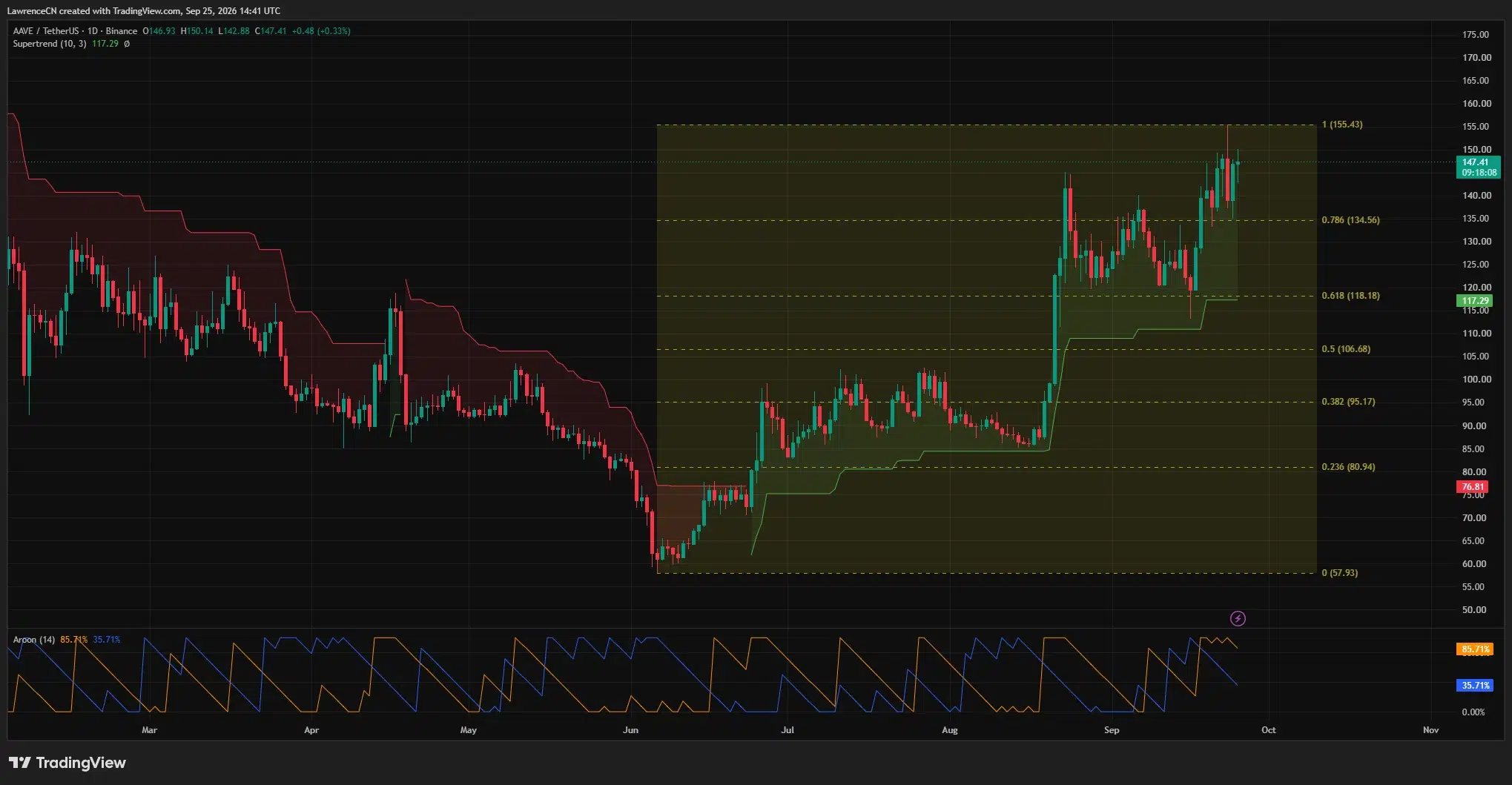
AAVE price approaches $155 resistance
On the daily chart, AAVE rose slightly to $147.41 after reaching $150.14 during the session. The token traded above its Supertrend line at $117.29, while the Aroon Up reading of 85.71% exceeded Aroon Down at 35.71%, pointing to a stronger upward trend. AAVE now faces resistance at $155.43; the nearest marked support is $134.56.
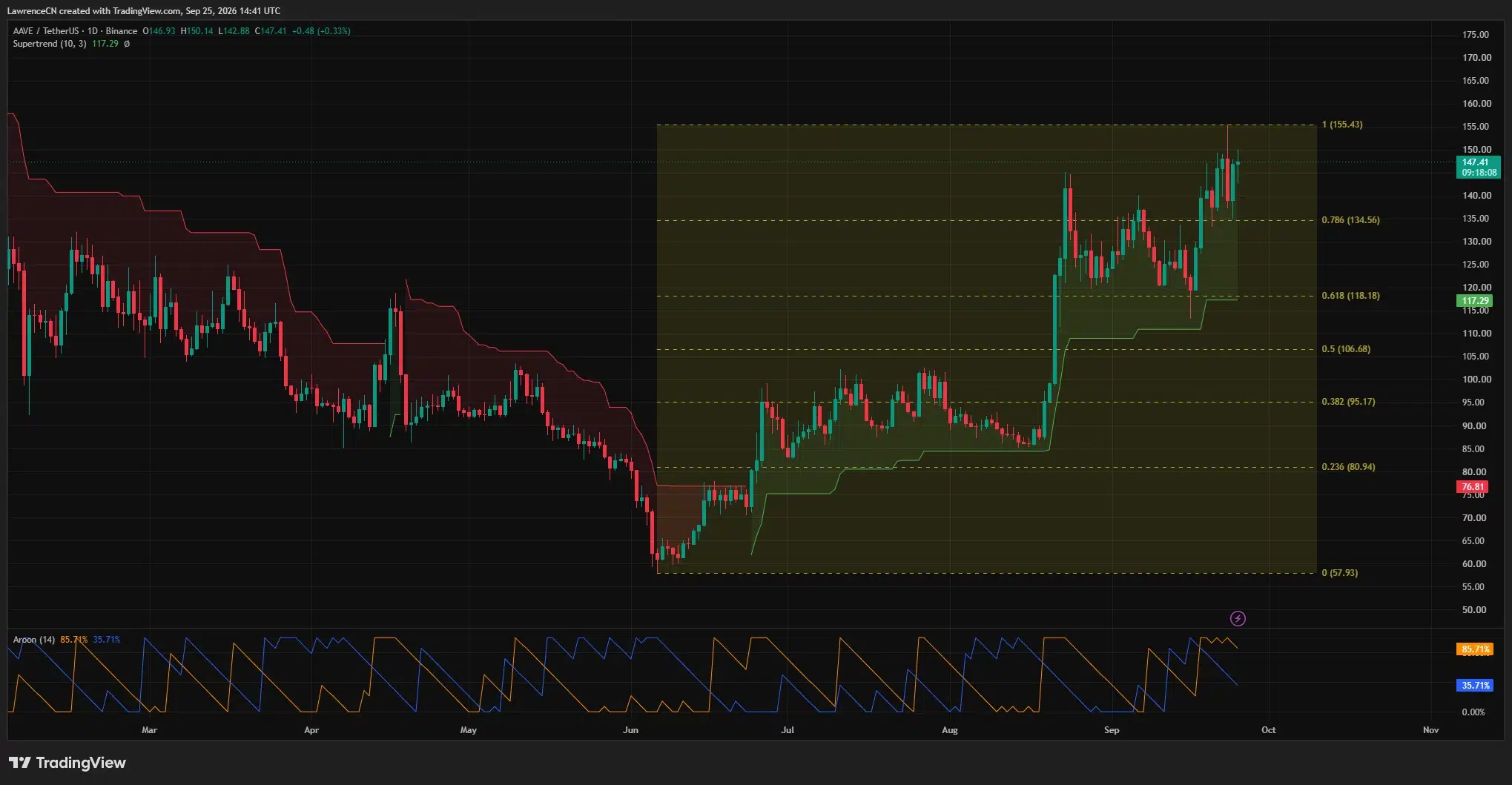
The next marked level above the price is $155.43. A daily close above it would put AAVE beyond the upper boundary shown on the chart. If the price pulls back instead, the marked levels below are $134.56 and $118.18, with the Supertrend line near the latter.
Disclosure: This article does not represent investment advice. The content and materials featured on this page are for educational purposes only.
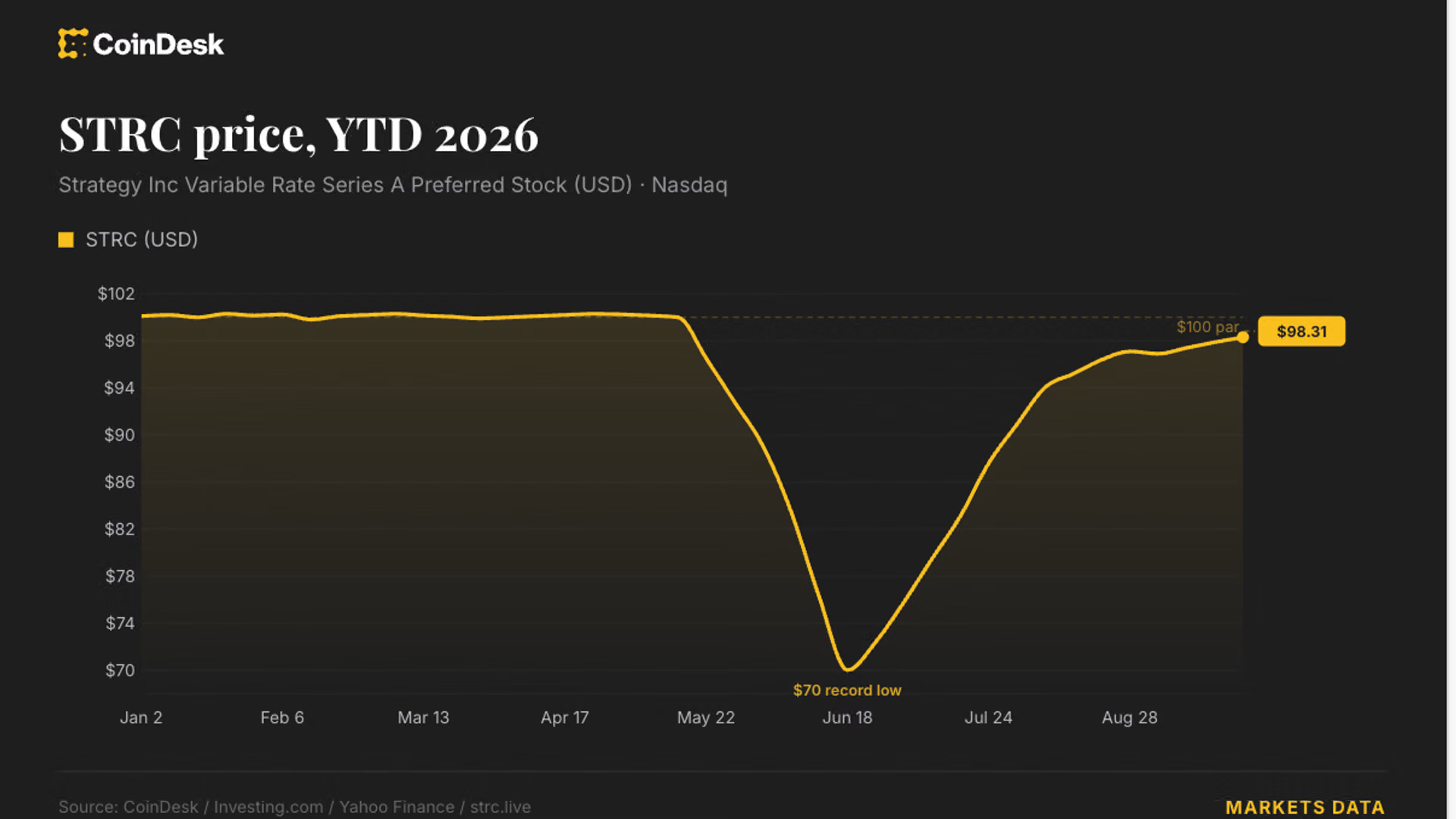
Strategy is asking shareholders to approve daily dividends across its four U.S. listed preferred stocks, STRF, STRC, STRK and STRD.
The largest corporate holder of bitcoin proposed that dividends would accrue every calendar day, including weekends and holidays, and be paid on the next business day.
The proposal changes payment timing, but leaves dividend rates and total regular dividend amounts unchanged. Shareholders are due to vote on Oct. 28. If approved, STRC’s first daily dividend would be paid on Nov. 2.
This move to daily dividends would be primarily targeted at STRC, which went from monthly to bi-monthly payments in June. STRC has still struggled to return to its $100 stated value since May, and fell to as low as $71 during bitcoin’s selloff back in June. Its annual dividend rate is currently 12%.
Daily payments could make STRC more attractive to income investors by reducing the wait to receive and reinvest dividends, while smoothing price moves around payment dates. Strategy says supporting a trading price close to $100 is the aim of the change.

Crypto tax forms leave 1 in 5 US investors unsure of accuracy

Andy Burnham Says Next General Election Will Be 2029

Peyton Manning will make special ‘College GameDay’ appearance at Tennessee

Weekend Open Thread – Corporette.com

Weekend Open Thread: Talbots – Corporette.com

Memory prices are slowing because buyers ran out of money

‘Up is down’: Trump is the direct cause of Americans’ jaded financial outlook, economist says

XRP CLARITY It’s GO TIME!!! XRP Will Appreciate FAST!!

I AM A MONEY MAGNET ~ Sleep Programming Affirmations For Abundance And Wealth ~ Millionaire Mindset!
-
 Fashion7 days ago
Weekend Open Thread: Talbots – Corporette.com
-

 Crypto World3 days ago
Goldman Sachs and Deutsche Bank Agree: The S&P 500 Rally Isn't Over
-

 Tech5 days ago
Researchers escape OpenAI Codex sandbox to run commands on host
-

 Fashion1 day ago
8 iPhone Accessories That Add Personality
-

 Crypto World5 days ago
Who Needs CLARITY Anyway? ARB Could See 70X Increase: Hodler’s Digest
-

 Crypto World7 days ago
Circle launches Arc Studio AI agent for building onchain apps
-

 Crypto World7 days ago
Trading Bitcoin on Robinhood? Why 2% Spread Has Traders Worried
-
 NewsBeat7 days ago
Trump says US has reached an agreement to take permanent control of Greenland’s security
-

 Tech6 days ago
Trump suggests rebranding AI with a new name, says he’s also creating an AI Force
-

 Business5 days ago
Analog Devices (ADI) Bets $1.35 Billion on Chips that Let Machines Think for Themselves
-

 Crypto World7 days ago
Bitcoin price breaks channel as RSI climbs to 63
-

 Crypto World3 days ago
Trump-Xi Polymarket Odds for Handshake Hit 50%
-

 Crypto World5 days ago
Coinbase, Robinhood, Circle Seen as Tokenized-Stock Winners
-

 Tech4 days ago
Google’s $899 Googlebook is a bet that you’ll buy a new laptop for Gemini
-

 Crypto World3 days ago
This Bearish Netflix Stock Trade Can Cash In On Video Streaming Giant’s Woes
-
 Business3 days ago
Oil Price Today (September 23): Crude oil below $100 on hopes of US-Iran talks. What did Trump say?
-

 Crypto World2 days ago
Crude Oil Prices Pressured by Diplomatic Hopes in the Middle East
-

 Entertainment2 days ago
These 17 Fall Amazon Dresses Seriously Look Like Anthropologie
-

 Crypto World7 days ago
World Money launches in 150+ countries with Stripe
-

 Crypto World2 days ago
Bitcoin Threatens Sub-$84,000 Breakdown as Long Liquidations Spike
You must be logged in to post a comment Login