Steve Jobs and Ron Johnson were mocked by business and finance press over the Apple Store, and in an interview with AppleInsider, Johnson reveals that if they hadn’t opened them, Apple itself would not have survived.
You’ve been in an Apple Store, or at least if you haven’t, the odds are that there is one near you. These stores are everywhere, they are an unquestioned and unparalleled success, plus Apple has enough money that if a store fails, it isn’t the end of the world.
Back in the late 1990s, though, Apple was only slowly climbing back away from what had seemed like a death spiral. It was close to bankruptcy when Steve Jobs returned to the company, and the stories that the iMac and the iPod saved Apple are true.
Yet as great as those devices were, Apple could not get customers to buy them. At that point, they were only really sold in big box retailers alongside PCs that couldn’t match what the Mac could do, but invariably beat it on price.
What Jobs saw then was that Apple Stores could be the answer. It was a gamble costing many millions of dollars at a time when Apple couldn’t really afford to lose that much.
So the story of the Apple Store is fantastic. It’s a slice of Apple history, it’s an example of invention and risk taking saving the day. And it’s as much the story of how Apple makes products as any account of the iPhone or Mac is.
This is why Ron Johnson’s new book, “Shop Different,” is significant. There’s so much to this story that you will be left wanting more, but the book is the inside man’s account of what went right, and what went wrong.
Johnson spoke with William Gallagher for the AppleInsider podcast. Here’s A lightly edited and condensed transcript of their conversation.
Speaking with Ron Johnson
WILLIAM GALLAGHER: Actually, I would like, if you don’t mind, to just forget everything you’ve done and leap forward to write now because just as your book is coming out, Apple has had this massive launch, yet we’re not going to have queues outside Apple stores anymore. Do you think we’re missing out on something now? Have we lost something?
RON JOHNSON: Well, I do. [But] I do think when the iPhone Duo comes out, the stores will be as busy as they’ve been in years. Because it’s been since 2015, really when Apple Watch was announced, that you had a dramatically different form factor for people to check out.
But everyone uses an iPhone. And whether you’re gonna buy this new duo or not, you’re gonna want to check it out. And the stores will be packed.
Apple’s done such a fabulous job since I left. But I loved lines, you know, and Apple got to a point where they just didn’t like the idea of having lines outside, but, you know, customers chose to line up. They didn’t have to. [It] was an event for them.
We used to see families gather outside and fathers and sons and grandparents and grandsons, and they would stay overnight and we’d bring them water and it was a beautiful thing. It was a beautiful thing, I thought, and the employees loved it. It got energy.
I remember line at our Ginza store in Tokyo went 10 subway stations long – in a typhoon warning. You know, those were the days. Those were the days.
WG: I know from your book that you saw queues, but did you ever actually join the line to see what it was like?
RJ: Oh, I would walk. I love to go out in the lines. Every day when I was at an opening, I would go out and talk to people in the line, just to get to know them, to understand why they came. Right before the launch, I just walked the line with a couple of other employees to see how long it was and to thank people for coming.
I’ll never forget, we opened a store at Shibuya-ku in Tokyo, and we went out. It was a super hot summer day. We walked the line, and then we realised we couldn’t get back in time for the opening. So we had to run back by the time I got there, I was sweating from just being outside in the warm heat. But those were moments that you never forget.
WG: You say in your book that Apple reached out to you, that Steve Jobs’s recruiter was the first one to contact you. But as a retail man at that moment, did it seem sensible to you that Apple would want stores?
RJ: Well, I understood why Apple would want stores. In 2000 when I joined Apple, Apple had been a company for 25 years, and the perspective was that Microsoft had won. Microsoft had 95% market share.
And arguably, Apple had beautiful products and great software and they were a little overpriced or higher price than the PCs, but the market here was way too [small]. And so if you looked at the go to market strategy where you could buy Max.
Well, in the US, you couldn’t buy them at Best Buy or Circuit City, they didn’t carry the Mac, and they are the two most popular consumer electronics stores.
So if Apple was going to win, Steve concluded that it had to take the experience directly to the customer. So it had to do its own stores. And I believed it because I was a retail guy and I just brought design to all at Target.
I had this dream. Why does good design have to be expensive? And we did this big design initiative that a lot of people thought was kind of crazy in its own right. But it succeeded. It was fabulous. Customers loved it.
And I figured if we could bring design to Target, we could figure out how to sell a great product like a Mac to customers.
WG: Yes, but Target is a more familiar, more typical retailer with shelves and shelves of products. As you say in the book, Apple had four products or something. So a lot of empty space to fit.
RJ: I was surprised, I honestly was surprised. The night I met Steve, that first interview, after about two hours of chatting, he said, well, do you want to see the product line? And I said, sure. And we walked down to another room, actually the boardroom.
And there were four products on a little credenza. Two [Mac] portables and two desktops. And we were going to build these big, beautiful stores.

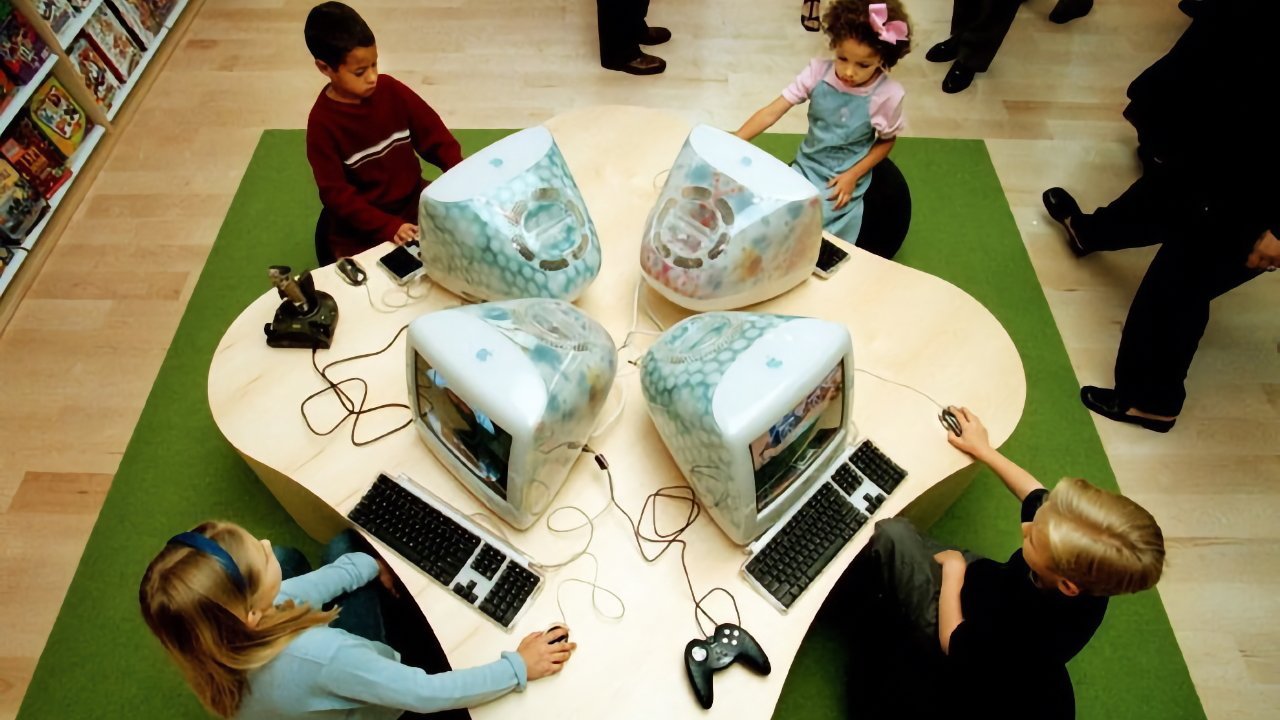
Children playing on iMacs in the first Apple Store on the first day. They will now be 25 years old but it’s not recorded whether they ever bought a Mac.
But it actually was the opportunity. Because most retail stores back then were just packed with products, and they were almost overwhelming to a customer, right?
And because we had all that space, we could get a lot of products for people to try, [and] we could create all these other services that became important to getting someone to decide to buy a Mac. Theaters and Genius Bars and things like that that ultimately became the support the stores became famous for.
WG: It took a while to get the name Genius Bar, though, I’ve just learned from your book. What were the other ones you went through?
RJ: Well, Steve wanted to call it the Geek Bar. Because he said, you’ve been to a bar before, [it can be] kind of fun to go up to a bar. Bartenders are conversational and they can make any drink you want. It’s kind of fun. We thought, what if you could get advice for technology, like you’re going up to a bar?
That would demystify the fear that a lot of people had of having to talk to someone about technology because it’s over people’s heads. I told Steve, we’re going to get these people who are really good at technology, but they love people in their conversational.
And he said, they don’t exist. Everyone who knows technology is kind of geeky. Maybe you call it the geek bar.
But then I’d seen Apple’s genius campaign, and I felt like if we called a Genius Bar, People would come out of the woodwork wanting that job. Because who wouldn’t want to be the smartest Apple person in every city?

The queues are not completely gone. This is a Shanghai Apple Store so busy that this is the queue just to get in — image credit: Apple
After a minute, Steve, yeah, after a minute, basically called up our general counsel, and said, hey, could you trademark the name Genius Bar? So I knew we had a chance to go do it.
WG: You opened two stores at the same time, but before then, you had this famous warehouse where you were trying things out. It’s often been reported that there was a massive change right towards the end, but in your book, you specified that it was around the iMac and that basically it was your fault.
RJ: Well, it was all what happened was we were ready to open our first store and we had spent a lot of time designing it.
Then I had this interesting conversation with Steve because Steve, you know, had been positioning the iMac as one, two, three, you’re on the internet. It was the easy getting on the internet.
But we were starting to make these apps, like iMovie, an iPhoto, and I told Steve that this is so interesting. I was still commuting back to Minneapolis on the weekends and [there] I’m in an analogue world. Then in Cupertino. I’m in a digital world all day long and I kind of go between these two things.
And I said, you know, if the Mac’s success, it’ll be the center of your digital life. And he came into the executive team meeting the next Monday, and I’m not saying it was solely that conversation, he probably had a lot of conversations about similar things, but he got all excited and stood at the whiteboard and drew a picture.
He goes, “I figured out the future of the Mac, we’re going to call it the digital hub. And the Mac will be at the centre of your devices and our software will bring it together and that’s how we’ll market the Mac.”
After I heard that, that night I was thinking about it, I woke up and I thought, well, if Steve’s going to market the Mac as the digital hub, our store’s [need to do that]. Our store was like any retail store, it was is built around products. We had portables and desktops.
I told Steve, well, maybe we ought to organize a store on movies and music and photos and the things you do. And he got really upset. I mean, it we’re going to the warehouse for our weekly design meeting.
And he said, “Ron, do you know how much time I put into the store?” And “I don’t know if I had the energy to do another one. So you might be right, but don’t bring it up today.”
I said, okay. And we would drive together and we rode over in the car and it’s perfectly quiet. And we walked into the warehouse and the store was pretty much done. Everything’s laid out and Steve looked, everyone’s standing there, about 15 people, and he’s looking around.
Then he goes, “you know, Ron thinks we’ve got this store all wrong, and he’s right. So I’m going to leave now and you guys can figure it out how.”
But then he told a story before he left about everything great he had done, especially with the Pixar movies. He said, “I had to hit the rewind button at some point when I knew it could be better. And it often involved a delay, but you get one chance to do something, so you’ve got to do it right.
So it took us about six extra months to get the store ready. But we launched and it was a much better store.
The front half of the store [was] about the products. So iBook was here, the PowerBook pro computer was there. We had it spread out like that, with the iMac was in a bay. But we said, no, let’s not do that.
Let’s have a bay for photography where we put together digital cameras with a Mac, digital cameras with an iBook with each of our products to show how you would do digital photography on a Mac.
And it actually is really interesting because that’s what got people to want to buy Macs. Because it was pretty easy to communicate.
They could buy online, but nobody understood how the product could really allow you to do great things with movies and photography and music. And so it became a much more inviting store
WG: Retail space is expensive. Had you already bought the Tyson’s corner site before you delayed six months?
RJ: We had already hired all the store leaders, so we had a lot of cost to carry. We had to carry the leases, but it opened up a great opportunity because the Ritz Carlton, who we were inspired by because they delivered the best service in the world in hospitality, invited our first store leaders to go help them open Ritz Carlton hotels.
And so we sent half of the group down to a hotel in Dallas, another half to a hotel, I think, was in Washington, DC, and they spent better part of a week just learning how to launch a hotel. And a lot of the things that the Ritz did from a service perspective, we incorporated into our service strategy.
If you look at the Apple stores, what they’re really famous for is the experience you have from an employee [and], how these really smart, nice people take care of things for you. We learned a lot of that from Ritz.

The way to tell that this is a Microsoft promotional photo for its stores is to count the people. There were never this many in real Microsoft Stores – image credit: Microsoft.
So if we had opened on time, not only would we have had an inferior store design, we wouldn’t have had the culture ready to go the way we did six months later. So it turned out to be a great delay.
WG: Why did you start by opening two stores? Wouldn’t it have been better to try one first and see if it worked?
RJ: The reality is, Steve and I both believed Apple wouldn’t work without stores. I had this conviction that a great Apple store in a high traffic location would get traffic and people would buy products.
Then Apple is a global company. At that time, Apple was big in Japan, big in France, big in many of the countries in continental Europe, big in the United States, big in the Canada. And we had to get on with this, you know? So we concluded that we would open 25 stores a year every year.
After four years, you know, it was interesting after 4 years, we had around 100 stores. That’s when we opened our Fifth Avenue store.
They were getting bigger and better, but we had the footprint that when Apple launched a great product, wow, everyone could experience that, you know, because we did a really good job.
Our real estate team found all these great sites and we used to get packed stores with these new product launches.
WG: Today, if someone didn’t know any of this, they would shrug: 25 stores a year is easy for Apple with its trillions of dollars. But back then, it was a huge and expensive gamble.
RJ: When Steve came back three years before the stores, we had 30 days of cash. And, you know, Tim [Cook] did a lot of things on inventory management to generate cash and Bill Gates wrote a $100 million check, as you recall, you know, to help Apple stay afloat.
Steve understood how important cash was. Steve never delivered a dividend during his time as CEO, he never bought back stock. He had been too close to the edge [so] he wanted to protect all the money Apple had.
When Tim came in, Tim had a different approach to the balance sheet and a big part of one of his good financial moves was buying back stock all the time, you know, which helped the stock price did a lot of benefits.
But Steve was [always saying] let’s protect our cash, you never know where you need it. We might have a rainy day. You just never know. So it was a big bet, but it was the only bet Apple could make.
WG: You mentioned the Fifth Avenue store, it’s an amazing store, and a fantastic location, except it isn’t on Fifth Avenue. It’s underground. Who’s made idea was that?
RJ: It’s one of my favorite chapters in the book. George Blankenship [who found Apple Store locations] had a site right in the heart of Fifth Avenue, closer to Rockefeller Plaza. You only get one chance to open a star on Fifth Avenue as a retailer, it’s a a dream.
It’s the world’s most famous shopping street. You want to get it right.
But that [first site considered] was like most Fifth Avenue stores in a tall 55-story building filled with columns. You couldn’t do anything special. You could just put a store in and have traffic.
But we had this other site that was where we ended up putting this door underground, which was basically taking over a parking garage in the General Motors building. The space hadn’t been leased for 7 years because nobody wanted to put a store there.

Apple uses its Fifth Avenue glass cube to promote new launches, here with the Apple Vision Pro – image credit: Apple
So much is about thinking different, though, that’s what I loved about Steve. Even though it wasn’t in the heart of the retail district and Fifth Avenue, it would always be the first store on Fifth because it was right by Central Park
That’s kind of a nice spot to be, and if we could put a store underground, that would be super low cost. Because we’re paying the rent of a parking garage, not of an above ground retail store.
And so all we do is figure out how to design something that people would find inspiring. And Peter Bohlin, our architect, came up with, he said, you know, well, we could do something like I. M. Pei did at the Louvre.
We’ll just figure out a different shape and he came up with a cube. And then we realized we could create a plaza for city of New York because we’re leasing the whole space underground.
We created the first Wi-Fi public plaza, was a gift to the city of New York. We opened that store and people came, and we ended up opening it 24 hours a day.
We were so excited about it.
WG: You mentioned Bill Gates earlier, and Microsoft famously launched stores, which were, shall we say, a homage to the Apple Store design. But I would walk by some and there’d be nobody but staff in there. What did they not get?
RJ: Retail’s really hard. Like, you’ll see, you go by restaurants, and one packed, you can’t get in, and the next five are empty. They’re in the same location, they’re serving you dinner, they’re open the same hours.
They have staff, but some are really popular and some aren’t. And it usually comes down to the secret sauce. And I’m not talking about a recipe, but there’s a recipe for a store.
It’s a combination of the store design, mainly the people that work there, and the type of services you offer. Things like a Genius Bar really connected.
Microsoft didn’t have a genius bar. It’s hard to know why things don’t work. But the big lesson I got from that is [that] it’s never good to copy, because customers pick that up.

Apple now preserves architecturally significant buildings, such as this almost 150-year-old one that houses Apple Birmingham in the UK.
Yeah, Microsoft not only built a store about the same size with the same layout as ours, they located them right next to us. Well, people saw the original and then they saw the copy. And I think they expected more, quite honestly, they expected more from Microsoft, you know, and I think it was a letdown to people.
WG: Eventually you famously quit Apple to join JCPenney. What made you take that leap?
RJ: In hindsight, I kind of regret it [because] Apple was the best job I had in my life. I had been there 12 years and we were designing our 400th store around the world.
They were getting bigger and better, they were all working, and I had such a good team. I felt like a parent who used to coach his young kid. As the kid grew up, you watched him from the sidelines.
You know, I enjoyed my work, but it was like a hobby. And I kind of missed the days like when I was with a team, a small group trying to invent the Apple Store or being a target, or how to compete with Walmart when they had lower costs.
And I just figured I was turning 50 at that time. If I’m going to do something different, it’ll take a good decade, you know, I should probably think about making that move.
I wanted to be in retail, though. I’ve always loved stores. And so I wanted another retail challenge, and the opportunity to go try to transform the department store came along, so I took it.
But that’s a long story. I spent a lot of time in the book talking about that. It was a very difficult time for me personally. It didn’t work well, I made a lot of mistakes, that hadn’t at Apple and elsewhere.

Apple also now designs incredibly impressive new stores, such as this one in Singapore.
I just wanted one more challenge and it was probably, in hindsight, not the right decision.
WG: Apple Stores have changed a lot, perhaps most noticeably in how staff used to sometimes tell you no, we don’t have what you need, but that store over there does.
RJ: We always said to our teams, when I was there, never sell the customer more than they need. We spent a lot of time asking customers, what are you going to use your product for, and we get them to the right memory configure it, the right model for them.
We didn’t want people to spend more than they had to to solve the problem they were trying to solve. That’s just good human decency.
When I left, other leaders came in who put their own imprint on the store and a lot of that’s been very good. But I think the stores today, and I’m talking about right now, are kind of back to where they were when we launched the stores, from a culture perspective.
I have had amazing experiences over the last three months in a variety of stores around the world, and that energy’s back, that love of the customers back. I really feel a huge difference [and] I am really proud of what the stores are doing right now.
WG: About an hour after the iPhone Duo launch, I noticed that the video on YouTube had been watched by 26 million people. But with that reach, does Apple actually need any stores at all anymore?

Ron Johnson and his book “Shop Different”
RJ: Absolutely. It’s really important to have stores and it’s going to become really important for this iPhone Duo because everyone will be able to check it out.
You can go read about it online. That’s going to be nothing like holding that in your hand and seeing if it fits in your pocket and seeing the magic of opening that display. Right?
And so these stores are going to help that product flourish.
The reality is, every retailer in the world, except Amazon. has an omni-channel strategy where they have stores and online and they bring it together. And that’s how everyone goes to the market.
This idea that stores are dying is just not true. You know, stores have never been more important to a go-to-market strategy.
Learn more
You can see the whole Ron Johnson interview on the AppleInsider Podcast. Plus his book, “Shop Different,” co-written with Zander Nethercutt, is available on Amazon for $32.

































































You must be logged in to post a comment Login