





Welsh Labour’s Senedd manifesto shows that it finally wants to act like a government that has realised the importance of the economy.

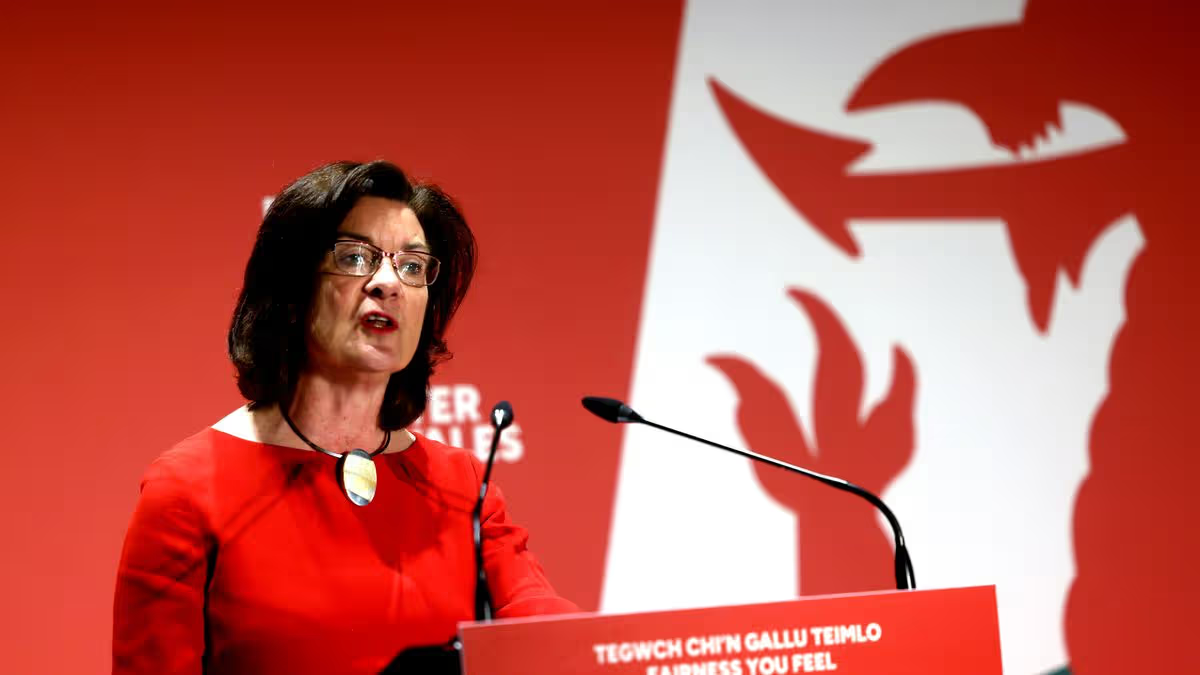
Welsh Labour leader Eluned Morgan launches their manifesto at Swansea Arena (Image: John Myers)
Over the coming weeks, I will review the promises made by Welsh political parties in their manifestos concerning Wales’s economy, starting with the party currently in government in Cardiff Bay.
Despite all the talk of a “new chapter”, the real question raised by Welsh Labour’s 2026 manifesto is simple: why should anyone believe this time will be different for the Welsh economy?
On paper, it clearly recognises that it can no longer treat economic growth as a secondary issue, and after years of weak productivity, poor levels of private investment, and persistent regional inequality, it understands that stronger public services ultimately depend on a stronger economy.
READ MORE: Former FT editor Lionel Barber warning on the UK economyREAD MORE: Cost of South Wales Metro rail electrification project to reach £1.3bn
But recognition is not the same as action because if we remove the new language, much of this still seems less like a genuine break with the past and more like a better-packaged version of the approach that previous Welsh Governments have used for years – more strategies, more boards, and more reviews.
For example, the manifesto includes a new industrial strategy, a national jobs council, a vocational education and training strategy, a rural economic development plan, a Valleys economic board, a review of business rates, streamlined business support, planning reform, and more. This involves many people sitting around a table discussing, but Wales has rarely lacked reviews and committees – instead, it has lacked focus, urgency, and effective delivery.
That is why the central weakness of the manifesto is not its ambition, but its credibility. Welsh Labour now aims to present itself as the party of economic growth, yet its record over the last five years suggests a government that has too often been more comfortable managing economic underperformance than taking steps to address it.
Aside from its investment summit last December and the usual list of support programmes, there is little in its recent record to suggest the kind of hard-edged, pro-growth approach that Wales truly needs. For too long, Welsh Labour’s instinct has been bureaucratic rather than transformative, and the result is that the same structural weaknesses persist: too few growing Welsh firms, too little private-sector dynamism, and too many communities still waiting for opportunity to arrive.
That is not to say there aren’t good ideas within the list of priorities, and the strongest part of the manifesto is its attempt to build an economic story around energy.
In fact, Labour’s idea of an “energy independent Wales” is the closest the document gets to a genuinely strategic growth plan as it links Wales’s future to lower bills, renewable expansion, clean energy, and major projects such as the new nuclear plant at Wylfa. It also states Wales should retain more of the benefits from its natural resources, and if ministers were serious about turning energy into an economic platform, there could be something meaningful here.
But again, that depends on whether Welsh Labour is willing to do more than just tell a compelling story. Many of the most important levers still lie outside Cardiff Bay, and there is little sign here of the institutional boldness needed to turn energy into a genuine Welsh development model. Without faster delivery and stronger economic machinery, “energy independent Wales” risks sounding less like a strategy and more like a slogan in search of substance.
The same applies to planning, and the pledge to make Wales the fastest nation in the UK to secure planning permission is one of the boldest promises in the manifesto. It is also among the most revealing because it acknowledges that slow planning has hindered investment for years. If Welsh Labour finally recognises this, it also admits that one of the barriers to growth has existed during its own time in office.
What is equally notable is what the manifesto omits. Considering that Eluned Morgan recently discussed the need for stronger economic powers and, in comments at a CBI event last month, mentioned further empowering the Development Bank of Wales instead of recreating the old Welsh Development Agency, it is remarkable that this is not reflected in the document intended to define Labour’s economic stance.
There is a similar weakness regarding the role of universities, and despite their importance to Wales’s skills pipeline, research base, and wider economy, the manifesto says remarkably little about their future, even though there is clear evidence that they remain in financial difficulties.
There is also no mention of Wales receiving its fair share of research funding, which suggests that the UK Government may have discouraged the First Minister from pursuing that promise, given its general reluctance to grant Wales more powers.
However, the deeper philosophical issue is that Welsh Labour still appears more comfortable discussing the conditions under which growth happens rather than growth itself. The manifesto emphasises fair work, social partnership, and conditions for firms receiving government support, including paying the Real Living Wage and ending exploitative zero-hours contracts.
These may be justifiable and noble objectives, but they also reinforce a broader impression that Welsh Labour remains more instinctively comfortable regulating the economy than unleashing it. They also seem fixated on dealing with the small minority that abuses the system rather than the majority of hardworking entrepreneurs who are trying to generate wealth and jobs.
That does not mean the manifesto lacks merit, and it is more coherent than a collection of disconnected promises. It identifies the right broad areas, including skills, energy, manufacturing, digital, and place-based development, and recognises the needs of rural Wales, the Valleys, and North Wales. It also reiterates that Welsh Labour will not raise Welsh income tax rates over the next Senedd term, which makes the success of its growth strategy even more clear vital.
Therefore, it is fair to say that Welsh Labour’s manifesto shows that it finally wants to act like a government that has realised the importance of the economy. However, the question is why it has taken so long to do so and whether, if it wins the Senedd election, it is finally ready to govern as one.
















































You must be logged in to post a comment Login