Connect with us

Business

Defence tech company OpenWorks expands into US with plans for Michigan factory

Published

on

Business Live

The Northumberland firm’s team has recently been training FBI officers to use its drone capturing kit

The SkyWall counter drone technology, made by OpenWorks in Northumberland

The SkyWall counter drone technology, made by OpenWorks in Northumberland

Counter-drone tech maker OpenWorks has announced its expansion into the US with plans to set up a factory there.

The Prudhoe-based maker of optical sensors and drone capture equipment has opened a new regional American headquarters in Ashburn, Virginia, and has talked of a future factory in Detroit, Michigan. The decade-old firm – which was recognised with a King’s Awards for Enterprise for its exporting activity – says the move is part of its ongoing mission to protect the airspace and territories of NATO and allied countries.

Chris Bigwood has been appointed as the company’s new executive vice president, responsible for business development and corporate strategy in North America. He comes with more than 30 years’ experience in the defence industry and will spearhead the launch of the Detroit factory which is expected to open later this year.

OpenWorks’ products are already widely used in the US with its team having recently training FBI ‘elite operators’.

Advertisement

News of the stateside expansion follows growth of OpenWorks’ home base last year, when it outline plans to create 20 jobs amid a ramping up of production. The firm has also invested more than £2m in research and development over the past year alone, including work with the North East Space Communications Accelerator (NESCA) at Northumbria University, funding two PhD programs in autonomous vision systems development and providing support to post-doctoral research, and supporting university final year projects.

Significant investment has also gone into leading-edge artificial intelligence to boost its precision detection, tracking, identification and targeting capability against threats.

OpenWorks was launched by friends in the back room of a rented office in Northumberland more than 10 years ago. Soon after it launched SkyWall Patrol – a handheld drone net capture system which is said to have protected numerous EU heads of state as well as US presidents Donald Trump, Joe Biden and Barack Obama.

Its system has been used all over the world, by governments, militaries and private security organisations to protect the likes of airports, major infrastructure and the Pentagon. The company has grown its workforce four fold since 2024 and now employs 125 people.

Advertisement

Chris Down, CEO, said: “We pride ourselves on never forgetting how we started in North East England. The five original founders were friends who came up in the region’s rich engineering and manufacturing sector together and are proud of our heritage and what we’ve learned, and continue to learn, on our home soil.

“Our shared passion for engineering excellence is what took us from that small office in Northumberland, all the way to this expansion into the United States. This milestone is not only a point of pride for our company’s growth, but a great show of what the North East’s talent has to offer on the global stage.”

Continue Reading
Click to comment

You must be logged in to post a comment Login

Leave a Reply

Business

Flights at major US airports delayed after cable cut by construction workers

Published

on

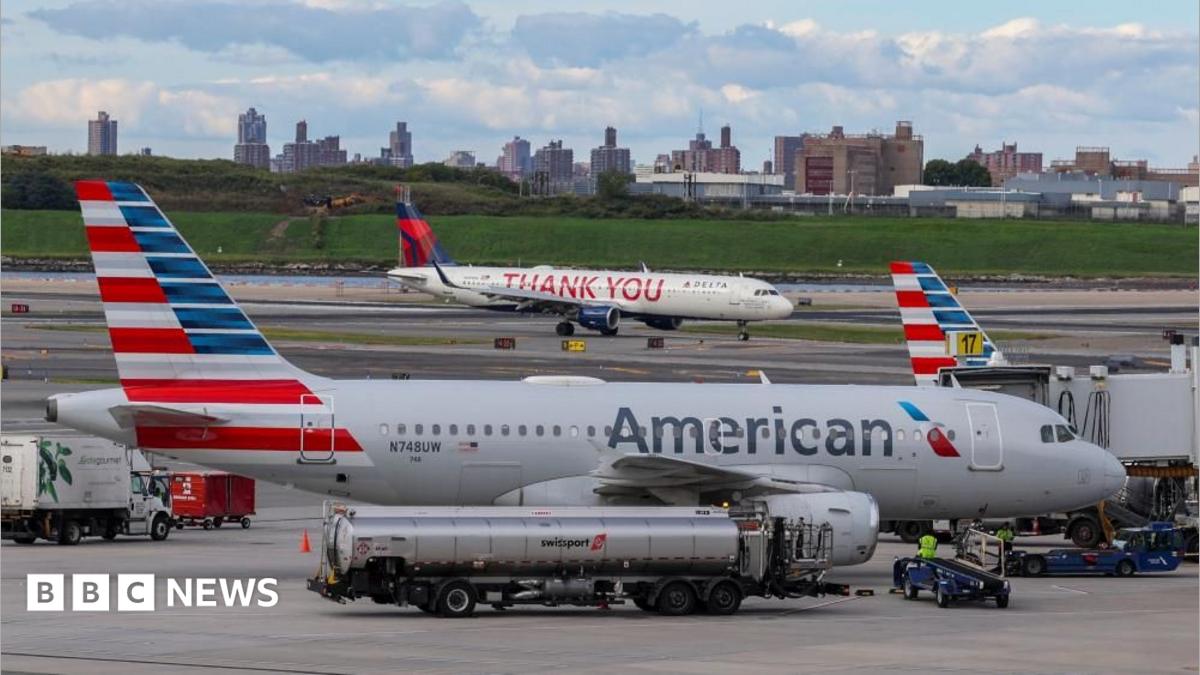
A view of the tarmac at LaGuardia Airport in New York City

Hundreds of flights have been delayed at major airports in the US after construction workers accidentally cut a cable needed for air traffic control.

Ground stops and delays were issued on Monday afternoon for airports in New York, Pennsylvania, New Jersey and Massachusetts.

Hours later, US Transportation Secretary Sean Duffy said the cable had been repaired and airports would resume normal operations, though delays were still expected.

The major east coast disruption came ahead of the UN General Assembly (UNGA) in New York City on Tuesday, which is expected to be attended by scores of world leaders arriving into New York-area airports.

Advertisement

That includes UK Prime Minister Andy Burnham, who managed to board his flight before the delays began and was expected to arrive on time.

The delays happened after the damaged cable impacted the Terminal Radar Approach Control system, which is used to guide planes during takeoff and landing, transport officials said.

New Jersey public transportation agency NJ Transit told CBS News, the BBC’s US partner, that its construction workers had accidentally severed the line and that markers had been wrongly placed at the digging site.

The BBC has reached out to NJ Transit for comment.

Advertisement

Duffy earlier said the damage was caused by workers from Amtrak, the US national operator of intercity railroad service, who were doing the construction work. This “caused a telecom outage” which forced the Federal Aviation Administration (FAA) to ground flights, Duffy posted on X.

An Amtrak spokesperson said in a statement, reported by US media, that the incident involved a NJ Transit contractor. Telecommunications company Verizon, which owns the cable, also said it was not responsible.

The severed cable was actually a backup network, and the error was only discovered after the primary circuit failed, according to the head of the FAA, Bryan Bedford.

Newark Liberty International Airport in New Jersey – one of the three major airports that services New York City – was the most heavily impacted by today’s air traffic control disruptions, according to flight-tracking website FlightAware.

Advertisement

It reported that 267 departing flights were delayed today, while a further 257 flights destined for Newark were also delayed.

John F Kennedy International Airport and LaGuardia Airport, both in New York, were also affected, as was Philadelphia International Airport.

One passenger, Douglas Tewnion, said he boarded a flight to New York from Edinburgh and that his plane had been diverted to Boston, Massachusetts instead.

He told the BBC that, two hours after his flight was due into New York, he and the other passengers were still “sitting on the same plane, on the tarmac at Boston with no information”.

Advertisement

Though “everyone is in good spirits”, Tewnion said “it’s just a pain” to see two more hours waiting added onto a lengthy flight.

Additional reporting by Ione Wells

Continue Reading

Business

Wall Street closes higher as AI optimism reignites

Published

on

Wall Street closes higher as AI optimism reignites

The Nasdaq has surged to a record-high close, lifted by gains in Advanced Micro Devices and other AI heavyweights, while Treasury yields retreated from recent highs and crude prices tumbled ‌to an 11-day low.

Continue Reading

Business

Meta announces AI shopping partnership with Spotify

Published

on


Meta announces AI shopping partnership with Spotify

Continue Reading

Business

TriplePoint Private Venture Credit announces leadership changes and board reduction

Published

on


TriplePoint Private Venture Credit announces leadership changes and board reduction

Continue Reading

Business

The Hanover Insurance Group, Inc. (THG) Analyst/Investor Day – Slideshow

Published

on

OneWater Marine Inc. (ONEW) Q1 2026 Earnings Call Transcript

The Hanover Insurance Group, Inc. (THG) Analyst/Investor Day – Slideshow

Continue Reading

Business

FAA resumes Northeast airport operations after telecom outage

Published

on

Equipment outage grounds flights at Newark, JFK and LaGuardia airports

Transportation Secretary Sean Duffy said Monday evening that telecommunications lines have been repaired and airport operations across the Northeast are resuming, though travelers should continue to expect delays.

“The telecom lines have been repaired, and all airport operations in the Northeast are resuming. It will take some time to clear all existing delays, so please check with your airline for the latest information,” Duffy wrote on X.

Advertisement

Earlier Monday, Duffy said a severed fiber-optic line in New Jersey triggered a telecommunications outage that forced the Federal Aviation Administration (FAA) to pause flights across parts of the Northeast.

“An Amtrak construction crew accidentally cut into a fiber line in New Jersey which caused a telecom outage and forced FAA to pause flights in the Northeast,” Duffy wrote earlier in the day.

LAGUARDIA SHUTS DOWN RUNWAY FOR SECOND TIME IN WEEKS AFTER PAVEMENT ISSUE RESURFACES

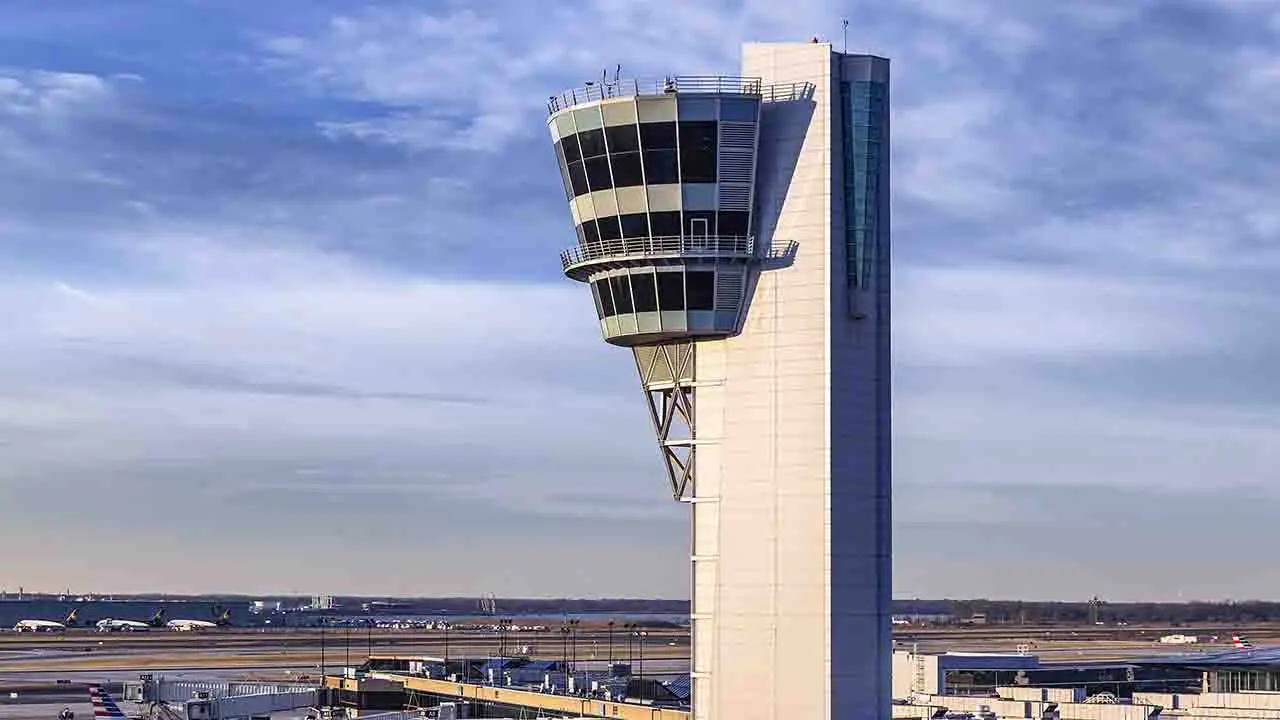
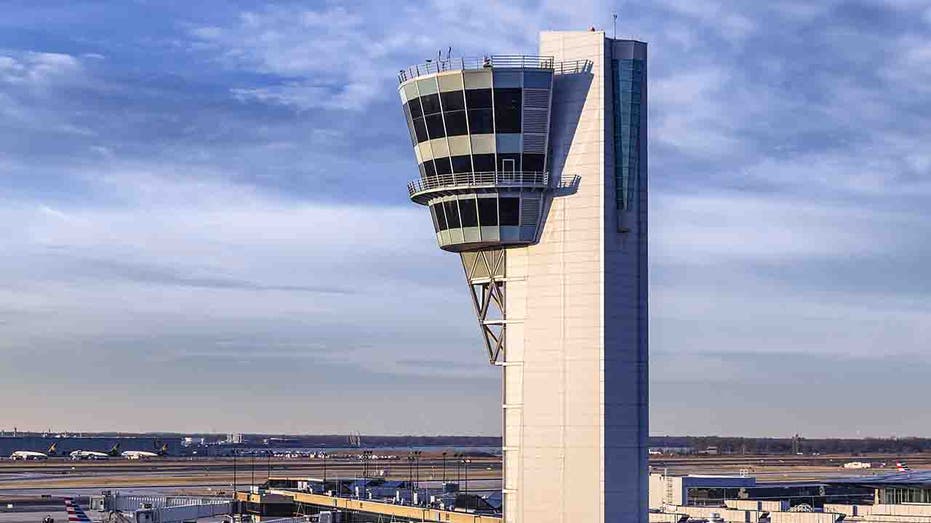
air traffic control tower

An air traffic control tower at Philadelphia International Airport in Philadelphia, Pennsylvania. (John Greim/Loop Images/Universal Images Group via Getty Images)

“This incident underscores the need for additional funding to modernize aging infrastructure and prevent disruptions like this in the future,” he added.

Advertisement

As of about 6:40 p.m. ET, Newark Liberty International Airport (EWR) was reporting average delays of 306 minutes because of the equipment outage, according to the FAA. Philadelphia International Airport (PHL) was reporting average delays of 212 minutes.

Teterboro Airport (TEB) was reporting average delays of 159 minutes, while John F. Kennedy International Airport (JFK) and LaGuardia Airport (LGA) were reporting average delays of 72 minutes and 67 minutes, respectively.

Earlier Monday, the FAA told Fox News it had paused flights into PHL, TEB and EWR due to “issues with some frequencies at Philadelphia TRACON.”

MAJOR AIRLINES CUT FLIGHTS AS HIGHER JET FUEL PRICES HIT CARRIERS

Advertisement
JetBlue Airlines at Newark Liberty International Airport

A JetBlue Airways Airbus A320 sits at Newark Liberty International Airport (EWR) with the Lower Manhattan skyline and One World Trade Center in the background on Jan. 15, 2026, in Newark, New Jersey. (Al Drago/Getty Images)

FAA Administrator Bryan Bedford said Philadelphia TRACON lost its primary communications circuit. When controllers switched to a backup system, they discovered a broken fiber-optic cable.

Speaking to reporters earlier Monday, Duffy said “these are issues that aren’t new to us.”

“We know these problems can happen. We know these cuts can happen,” Duffy said, adding that the department has been working to upgrade FAA equipment and its telecom architecture. 

Advertisement

“As we work through all the new equipment, all the new architecture of our telecom, which is fans, it all takes money. That’s why we have a holistic view of everything, including how we rework our telecom,” Duffy said.

AVELO CEO WARNS AIRFARES MAY RISE AS FUEL PRICES HIT ‘UNCOMFORTABLY HIGH’ LEVELS

united airlines plane on tarmac during cloudy day with city background seen

A United Airlines Airbus A320 passenger jet taxis on the tarmac at LaGuardia Airport in the New York City borough of Queens on Sept. 7, 2016.  (Robert Alexander/Getty Images)

Duffy said the work is being done before the department has secured all the necessary money, adding that “when we get the cash” the department will be able to hasten progress. 

GET FOX BUSINESS ON THE GO BY CLICKING HERE

Advertisement

“But this is not shocking,” Duffy said of the equipment outage.

Amtrak later disputed Duffy’s description of what caused the disruption, telling FOX Business that the fiber cut did not involve one of its crews.

“This incident occurred on New Jersey Transit property and involved a New Jersey Transit contractor. Questions regarding the outage and related work should be directed to New Jersey Transit,” a spokesperson said.

The FAA and New Jersey Transit did not immediately respond to FOX Business’ requests for comment.

Advertisement
Continue Reading

Business

Meet the pensioners spending the kids’ inheritance

Published

on

Sarah and Geoff Moorhouse with their daughter Poppy

Happily retired, Sarah Moorhouse is using her private pension “to go places and do nice things at the drop of a hat”.

While other retirees with a decent monthly pension income may choose to build up an inheritance for their children, Sarah, 64, and her husband Geoff are opting to spend their money on living life to the max.

“We like going to Scotland,” says Sarah, a retired school administrator. “We’ve been down to Cambridgeshire, which was lovely. We go up to the Lake District quite regularly to a holiday cottage, and we’re planning to go to Norfolk.”

The couple, who live in the Yorkshire Dales, go on holiday four or five times a year, spending hundreds of pounds each time because, in Sarah’s view, “you only have one opportunity at life”.

Advertisement

They did recently sell their vintage Sunbeam Alpine sports car. But only so they could replace it with a more modern, sporty two-seater convertible, a Mazda MX-5.

“I’m of an age where I’m going to friends’ and acquaintances’ funerals, and I think you just need to live life and enjoy it while you can, because it’s a very precious commodity,” says Sarah.

Sarah and Geoff are part of a global personal finance phenomenon that has been dubbed “skiing”, which stands for spending the kids’ inheritance. It is challenging the notion that assets will get handed down to the next generation.

One in seven UK parents of children of all ages (15%) now plan to prioritise enjoying their money in their retirement over leaving an inheritance, according to a March report, external by pension provider Standard Life.

Advertisement

And in the US, the number of people expecting to get an inheritance from their parents dropped to 20% last year, from 25% in 2024, according to a study, external by financial services firm Northwestern Mutual.

Continue Reading

Business

Valeura Energy Inc. (VLE:CA) Presents at Annual GCFF Wealth Conference – Slideshow

Published

on

OneWater Marine Inc. (ONEW) Q1 2026 Earnings Call Transcript

Valeura Energy Inc. (VLE:CA) Presents at Annual GCFF Wealth Conference – Slideshow

Continue Reading

Business

The S&P 500 Just Lost Its Favorite Engine (Rating Reiteration)

Published

on

S&P 500 Snapshot: Index Inches Closer To Correction Territory

The S&P 500 Just Lost Its Favorite Engine (Rating Reiteration)

Continue Reading

Business

Crypto outlook: Why RWA utilization may matter more than issuance, Binance Research explains

Published

on

Crypto outlook: Why RWA utilization may matter more than issuance, Binance Research explains
The tokenization of real-world assets is moving beyond the question of how much capital can be brought on-chain, with Binance Research pointing to the growing importance of what holders can do with those assets after issuance.

According to Binance Research, total real-world asset (RWA) assets under management reached $34.18 billion, up 85.2% year-to-date through September 15, 2026. Bond and money-market funds remained the largest category at $18.29 billion, while equities recorded the fastest growth, rising 390.4% YTD.

Together, bond and money-market funds and equities accounted for more than three-quarters of the market’s additional value this year. Bond and money-market funds contributed 54.7% of the increase in on-chain AUM, while equities contributed another 22.4%.Other asset classes also recorded growth, with gold and commodities rising 46.6% YTD, private credit increasing 43.6% and real estate gaining 17.9%, according to the report.

Binance Research describes the shift as the “RWA Activation Era”, where a growing range of tokenized assets become usable across lending, exchanges and collateral markets.

Advertisement


The report uses two measures to track this development: the Programmable Asset Ratio (PAR), which measures tokenized assets against their underlying markets, and the Capital Activation Rate (CAR), which measures how much of the tokenized asset base is deployed in verified on-chain financial applications.
Tokenization remains a small part of underlying marketsDespite the growth in RWA AUM, tokenization remains a very small share of the underlying markets.

The principal asset categories addressable by tokenization exceed $300 trillion globally, while more than $34 billion is currently on-chain. This translates into an overall PAR of approximately 0.01%, according to Binance Research.

Equities highlight the gap between growth and penetration. Tokenized equities grew 390.4% YTD, reaching $4.43 billion, but that represents only 0.0029% of the $151.9 trillion listed-equity reference market.

At the same time, equities’ share of tracked RWA AUM increased from 4.9% to 13.0%.

Bond and money-market funds, meanwhile, had $18.29 billion on-chain and an indicative PAR of 0.0171%. Binance Research said their larger existing asset base provides a pool of interest-bearing assets for on-chain applications, while equities are expanding faster through broader distribution and access.

Advertisement

Utilization becomes the next measure

The report argues that the growth of tokenized supply needs to be considered alongside how much of that supply is actually being used.

CAR measures the share of qualifying tokenized assets deployed in applications such as liquidity pools, lending and collateral markets. The overall CAR stands at approximately 12%, meaning around US12ofeveryUS100 in tracked tokenized asset value is currently deployed.

Binance Research said this leaves scope for utilization to grow “without requiring additional issuance.”

Advertisement

CAR varies significantly by asset class. Private credit has the highest CAR at 49.67%, while equities recorded one of the largest increases, with their CAR rising from 1.95% to 7.54% YTD.

For tokenized equities, utilization is currently concentrated in market infrastructure. Liquidity pools account for 65.4% of equity DeFi TVL, while lending accounts for another 28.1%. Together, the two categories represent 93.5% of deployed equity value.

Binance Research said current adoption therefore points primarily to “trading liquidity and collateral use” rather than broad utilization across every potential tokenization application.

Equity tokenization shows the gap between adoption and activation

Advertisement

Binance Research uses tokenized equities as a case study because adoption remains low relative to the underlying market, while utilization is increasing.

The report’s 2030 scenarios, based on forecasts from its earlier Tokenization’s Trillion-Dollar Runway report, put tokenized equities at approximately US61billion,US349 billion and $987 billion under its Conservative, Base and Bull cases respectively. From the current $4.43 billion market, those scenarios would correspond to roughly 0.04%, 0.23% and 0.65% PAR by 2030.

The report notes that higher AUM should generally translate into higher PAR, while CAR can develop independently depending on whether liquidity, lending and collateral applications scale alongside issuance.

Under the Base PAR case of 0.23%, approximately $349 billion of equities would be programmable. If CAR increased from 10% to 20%, deployed capital would rise from US34.94billiontoUS69.87 billion, without any additional tokenized supply.

Advertisement

“This shows how asset growth and utilization can compound,” Binance Research said, adding that “activation can become as important as issuance.”

What comes next for RWA markets?

According to Binance Research, distribution can increase PAR by bringing more assets and users on-chain, while liquidity, lending and collateral integrations can increase CAR by providing holders with additional ways to use tokenized assets after purchase.

The report said platforms with integrated distribution and trading infrastructure can connect the two.

Advertisement

Earlier research cited by Binance Research found that 58.5% of early bStocks users also used perpetuals or direct equities, suggesting that distribution can build on existing user relationships. The next opportunity, according to the report, is to translate that access into recurring liquidity and financing activity.

Binance Research also said PAR and CAR can reinforce each other, with higher PAR creating a larger asset base for financial applications and higher CAR increasing the utility of tokenized ownership.

“The stronger signal for the industry is therefore not AUM growth alone, but PAR and CAR rising together,” the report said. “That would indicate tokenization is progressing from asset issuance toward repeat financial use.”

Disclosure: This article has been written by Kumar Gaurav, who is not a SEBI-registered Research Analyst or an investment advisor. Gaurav does not hold any financial interest in the company as of the date of publication. The views/recommendations mentioned in this article, wherever applicable, are those of the respective SEBI-registered Research Analyst/brokerage and have been reproduced/reported with due attribution. They should not be construed as the views or recommendations of the EconomicTimes Digital or the journalist. Readers are advised to consider the original research report and make their investment decisions based on their own assessment.

Advertisement
Continue Reading

Trending

Copyright © 2025