Connect with us

Business

Developing our economy from the town upwards rather than the region downwards

Published

on

Business Live

The median Welsh built-up area has a population of only around 1,260.

Pwllheli.(Image: Channel 4)

Every now and again, a statistic makes you see a familiar problem differently, and I had one of those moments earlier this month after reading an excellent American article entitled Most of America is a Small Town.

Its author had examined population data for nearly 20,000 incorporated places in the United States and discovered that the median community has just 1,153 residents.

Advertisement

Three-quarters have populations below 5,000, and almost half have fewer than 1,000; the argument wasn’t that America’s great cities don’t matter, but that much of the thinking around economic development was created for relatively large places when most communities are actually very small. As someone brought up in Pwllheli in North Wales, it resonated with me, especially given how the town has been neglected in recent years.

That got me wondering what the equivalent figure would be for Wales, and according to the Office for National Statistics, Wales has 579 built-up areas. These are useful because they represent actual settlements (the cities, towns and villages where people live) rather than artificial administrative boundaries and together they account for 88% of the Welsh population.

When those settlements are examined, the result is striking and the median Welsh built-up area has a population of only around 1,260. Some 252 have fewer than 1,000 residents and more than four out of five have fewer than 5,000. At the other end of the scale, only a handful of Welsh settlements have populations greater than 50,000. Cardiff, with 348,535 residents in the 2021 census, is in a completely different league from most of the country.

In other words, most of Wales really is a small town and that may sound like nothing more than an interesting statistical observation, but I think it raises an important question about how we have organised economic development.

Advertisement

For the last two decades, there has been a steady movement towards ever larger economic geographies, and we have city regions, growth deals, regional economic frameworks and, more recently, corporate joint committees. There are perfectly sensible reasons for this, as transport systems, labour markets, universities and major industrial clusters do not fit neatly within council boundaries.

If Wales wants to attract major international investment or develop industries such as compound semiconductors and renewable energy, then regional and national approaches are essential.

But in doing so, have we moved too far away from the places where economic activity actually happens? A business does not expand in an economic region but in a town. When a manufacturer runs out of factory space, it needs another building somewhere close enough to retain its workforce and if a company employing 50 people closes in a community of 5,000, that is a major economic shock regardless of how insignificant those jobs might appear within the larger region.

We spend money bringing empty buildings back into use, improving town centres and creating better public spaces, but those things are not the same as developing the local economy. Real economic development means knowing which businesses in a town are growing, which are thinking about expanding, which are struggling to recruit and which may be considering leaving.

Advertisement

Above all, it means regularly talking to the firms already employing people and this was one of the most persuasive arguments in the American article. For most small communities, the biggest economic-development victory will not be attracting a huge company from somewhere else. It will be helping an existing business employing 20 people become one employing 30 or preventing another established employer from leaving because it cannot find suitable premises.

That should resonate strongly in Wales as we have tens of thousands of small firms spread across the country, and while individually they may not generate ministerial visits or headline-grabbing announcements, collectively they form the foundation of local prosperity.

What would happen if every significant Welsh town had somebody whose responsibility was simply to know its economy properly? Not another bureaucracy and certainly not another strategy, and in smaller areas, several towns could share the resource. Their job would be to speak regularly to local employers, understand which businesses had growth potential, maintain a live picture of available property and land and connect companies with finance, colleges, universities and business support.

It is hardly revolutionary and indeed, that is perhaps the point. We have created an increasingly complicated economic-development system in Wales, but sometimes the most useful interventions are remarkably straightforward.

Advertisement

A local manufacturer tells somebody it needs six skilled workers so that person speaks to the college, a growing company says it will have to leave because there is nowhere to expand so somebody identifies a suitable building nearby, and a 65-year-old business owner admits they are thinking about closing so somebody starts a conversation about succession before the redundancy notices appear.

Nor would this require a huge new pot of money as Wales has £546.5m available through the Local Growth Fund over the next three years, including more than £156m for innovation and business competitiveness. A network of 50 town business growth managers would cost around £3m a year or less than 2% of the overall Fund and could cover roughly 125 of our larger towns.

For that relatively modest sum, virtually every significant Welsh community could have someone whose job was not to write another strategy, but to know its businesses, identify those capable of growth and help remove the obstacles holding them back.

Of course, Wales should be developing globally competitive industries, attracting investment and supporting businesses capable of rapid growth but that does not mean ignoring the economic geography of the country we actually have.

Advertisement

Most of Wales is a small town, andEvery now and again, a statistic makes you see a familiar problem differently, and I had one of those moments earlier this month after reading an excellent American article entitled Most of America is a Small Town.

Its author had examined population data for nearly 20,000 incorporated places in the United States and discovered that the median community has just 1,153 residents.

Three-quarters have populations below 5,000, and almost half have fewer than 1,000; the argument wasn’t that America’s great cities don’t matter, but that much of the thinking around economic development was created for relatively large places when most communities are actually very small. As someone brought up in Pwllheli in North Wales, it resonated with me, especially given how the town has been neglected in recent years.

That got me wondering what the equivalent figure would be for Wales, and according to the Office for National Statistics, Wales has 579 built-up areas. These are useful because they represent actual settlements (the cities, towns and villages where people live) rather than artificial administrative boundaries and together they account for 88% of the Welsh population.

Advertisement

When those settlements are examined, the result is striking and the median Welsh built-up area has a population of only around 1,260. Some 252 have fewer than 1,000 residents and more than four out of five have fewer than 5,000. At the other end of the scale, only a handful of Welsh settlements have populations greater than 50,000. Cardiff, with 348,535 residents in the 2021 census, is in a completely different league from most of the country.

In other words, most of Wales really is a small town and that may sound like nothing more than an interesting statistical observation, but I think it raises an important question about how we have organised economic development.

For the last two decades, there has been a steady movement towards ever larger economic geographies, and we have city regions, growth deals, regional economic frameworks and, more recently, corporate joint committees. There are perfectly sensible reasons for this, as transport systems, labour markets, universities and major industrial clusters do not fit neatly within council boundaries.

If Wales wants to attract major international investment or develop industries such as compound semiconductors and renewable energy, then regional and national approaches are essential.

Advertisement

But in doing so, have we moved too far away from the places where economic activity actually happens? A business does not expand in an economic region but in a town. When a manufacturer runs out of factory space, it needs another building somewhere close enough to retain its workforce and if a company employing 50 people closes in a community of 5,000, that is a major economic shock regardless of how insignificant those jobs might appear within the larger region.

We spend money bringing empty buildings back into use, improving town centres and creating better public spaces, but those things are not the same as developing the local economy. Real economic development means knowing which businesses in a town are growing, which are thinking about expanding, which are struggling to recruit and which may be considering leaving.

Above all, it means regularly talking to the firms already employing people and this was one of the most persuasive arguments in the American article. For most small communities, the biggest economic-development victory will not be attracting a huge company from somewhere else. It will be helping an existing business employing 20 people become one employing 30 or preventing another established employer from leaving because it cannot find suitable premises.

That should resonate strongly in Wales as we have tens of thousands of small firms spread across the country, and while individually they may not generate ministerial visits or headline-grabbing announcements, collectively they form the foundation of local prosperity.

Advertisement

What would happen if every significant Welsh town had somebody whose responsibility was simply to know its economy properly? Not another bureaucracy and certainly not another strategy, and in smaller areas, several towns could share the resource. Their job would be to speak regularly to local employers, understand which businesses had growth potential, maintain a live picture of available property and land and connect companies with finance, colleges, universities and business support.

It is hardly revolutionary and indeed, that is perhaps the point. We have created an increasingly complicated economic-development system in Wales, but sometimes the most useful interventions are remarkably straightforward. A local manufacturer tells somebody it needs six skilled workers so that person speaks to the college, a growing company says it will have to leave because there is nowhere to expand so somebody identifies a suitable building nearby, and a 65-year-old business owner admits they are thinking about closing so somebody starts a conversation about succession before the redundancy notices appear.

Nor would this require a huge new pot of money as Wales has £546.5m available through the Local Growth Fund over the next three years, including more than £156m for innovation and business competitiveness. A network of 50 town business growth managers would cost around £3m a year or less than 2% of the overall Fund and could cover roughly 125 of our larger towns.

For that relatively modest sum, virtually every significant Welsh community could have someone whose job was not to write another strategy, but to know its businesses, identify those capable of growth and help remove the obstacles holding them back.

Advertisement

Of course, Wales should be developing globally competitive industries, attracting investment and supporting businesses capable of rapid growth but that does not mean ignoring the economic geography of the country we actually have. Most of Wales is a small town, and it might be time we started developing our economy from the town upwards rather than always from the region downwards.

Continue Reading
Click to comment

You must be logged in to post a comment Login

Leave a Reply

Business

Wales has an abundance of firms that are productivity heroes

Published

on

Business Live

A new report from Economic Intelligence Wales show there are more than 1,700 productivity heroes across numerous sectors.

Wales has more than 1,700 so called ‘productivity hero’ firms that are driving both productivity gains and job creation, although their number has fallen shows new research.

A report from Economic Intelligence Wales (EIW) identified 1,732 productivity heroes across Wales and drawn from numerous sectors, in 2024-25. Together, these businesses generated £6.04bn in turnover and created more than 5,200 jobs, demonstrating that businesses can improve productivity while continuing to grow employment. The findings offer practical insight for policymakers and delivery partners seeking to target support where it can have the greatest impact.

While the number of productivity heroes has fallen since a peak in 2022-23, the businesses that remain are becoming increasingly productive, the report shows.

Advertisement

Labour productivity increased by some 24%, rising from approximately £133,000 per employee to almost £165,000. The report highlights that productivity heroes are not confined to high-tech or knowledge-intensive industries. These businesses are found across manufacturing, construction, professional services, wholesale, hospitality and other sectors. Regardless of sector, the report finds that the most successful businesses consistently invest in three areas: a strong customer focus; developing people through leadership and skills; and embracing innovation and digital adoption.

The research also argues that identifying businesses through a productivity hero framework provides a more meaningful understanding of economic performance than measuring turnover or employment growth in isolation.

By identifying firms that are simultaneously growing turnover, employment and productivity, it offers a stronger evidence base to help inform future policy, investment and business support in Wales.

The report concludes that Wales can create more productivity heroes through targeted support focused on leadership, skills, finance, innovation and infrastructure, helping more businesses improve productivity while continuing to create jobs.

Advertisement

Swansea-based Zeal Innovation, which trades as Litelok is one example of the productivity-led growth highlighted in the report.

The company designs and manufactures possibly the most secure, high-security, grinder-resistant locks for bicycles and motorcycles. Since 2017, it has grown turnover per full-time employee from around £45,000 to around £350,000, with annual revenues now approaching £10m. Its growth demonstrates how innovation, investment and a strong product focus can help Welsh businesses scale while becoming more productive.

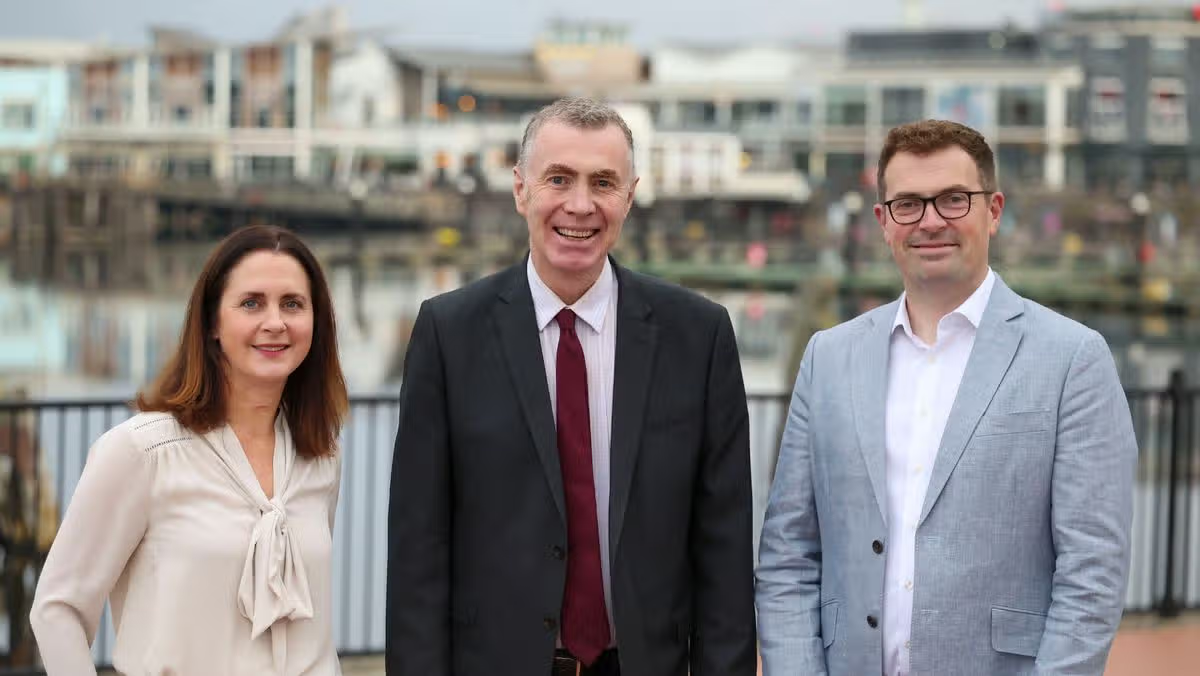
Adam Price, Cabinet Minister for Enterprise, Connectivity and Energy, said: “This research shows that Wales already has the businesses, ideas and ambition needed to build a stronger, more productive economy. Our national productivity mission is about backing that potential and turning it into higher pay, stronger firms and better opportunities in every part of Wales.

“The message from these businesses is clear: with the right support for skills, leadership and innovation, more Welsh firms can grow, create jobs and become more productive. Our new national development agency will be central to making that support simpler, sharper and more effective.”

Advertisement

Professor Melanie Jones, Professor of economics at Cardiff Business School and academic lead for the Wales Productivity Forum said: “Productivity growth is critical to improving the things people care about including real wage growth, business profitability, and public service delivery. Narrowing the existing and persistent 15% productivity gap between Wales and the rest of the UK will require a step change in Wales’ productivity growth.

Professor Mark Hart, deputy director of the Enterprise Research Centre, and lead author of the report, said: “Productivity Heroes demonstrate that businesses do not have to choose between creating jobs and improving productivity. These firms are successfully achieving both, making them important to Wales’ long-term economic performance. Better understanding what they are doing well can help create more of them.

“Our research shows that the strongest-performing businesses invest just as much in leadership, workforce development and organisational culture as they do in innovation. By understanding what sets these firms apart, we can better identify the practical support that enables more businesses to grow, improve productivity and create sustainable employment.”

Giles Thorley, chief executive of the Development Bank of Wales, said: “This research provides valuable evidence about the businesses helping to strengthen Wales’ economy and, crucially, what enables them to succeed.

Advertisement

“As a trusted delivery partner, our role is to turn that evidence into practical support. Working alongside Welsh Government, we can help ensure ambitious businesses have access to the finance, leadership support and investment they need to improve productivity, retain value in Wales and create long-term economic impact.

“The productivity hero framework gives us a clearer understanding of where support can have the greatest impact, helping us translate evidence into practical action that builds a stronger, more productive Welsh economy.”

John Hurst, chair of FSB Wales said: “As small business owners, action on productivity needs to be practical, accessible and reflect the day-to-day realities of starting and growing a business. Real progress means creating an environment that supports investment and giving founders the know-how to unlock extra value from what we already have, whether that’s adopting new tech, rethinking how we use skills within the business, or making better use of our space.

“Proposals for a new development agency offer a vital chance to cut through a fragmented system and deliver the direct, grounded support that delivers successful Welsh firms.”

Advertisement

EIW is a collaboration between the Development Bank of Wales, the Enterprise Research Centre at Warwick Business School, Cardiff Business School, Bangor Business School and the Office for National Statistics. It provides independent economic intelligence to help improve understanding of the Welsh economy and support evidence-led decision making.

Continue Reading

Business

Intuit: PEG At ~0.5x Is A Clear Buying Signal

Published

on

Intuit's Selloff Creates A Better Setup Heading Into Q4 Earnings

Intuit: PEG At ~0.5x Is A Clear Buying Signal

Continue Reading

Business

US Market: Fed proposes new rules for stablecoin issuers under GENIUS Act

Published

on

US Market: Fed proposes new rules for stablecoin issuers under GENIUS Act
The US Federal Reserve on Thursday proposed new rules for issuers of dollar-backed cryptocurrency tokens known as stablecoins, taking another step towards implementing the regulatory framework established by last year’s GENIUS Act, according to Reuters.

The proposals would establish requirements for payment stablecoin issuers that are supervised by the Federal Reserve, including rules on reserves, capital and risk management. The Fed said the framework is intended to carry out responsibilities assigned to it under the GENIUS Act.

Also Read | Why bond yields are rising and why everyone should care

Stablecoins to be fully backed by reserves

Under the proposed rules, Fed-supervised payment stablecoin issuers would be required to fully back their tokens with permitted reserve assets. These would include short-term US Treasury bills and other high-quality, liquid assets, according to the Federal Reserve.
The requirement is designed to ensure that issuers maintain sufficient assets to support the value of stablecoins issued under the federal framework.

Advertisement

Capital requirements for issuers

The proposal would also introduce standardized capital requirements for stablecoin activities. The requirements are intended to address credit and operational risks associated with payment stablecoin issuance.
Also Read | US stocks: S&P 500 ends nearly flat as US-Iran talks help stocks pare lossesThe Fed would additionally establish risk-management standards for supervised firms involved in stablecoin activities.

Rules for banks holding stablecoin reserves

The proposed framework would extend beyond stablecoin issuers to Fed-supervised banks that safeguard assets backing the tokens.

The rules would establish requirements for banks that provide custody services for stablecoin reserves and clarify which stablecoin-related activities Fed-supervised banks would be permitted to conduct.

Path for banks to issue stablecoins

The Fed is also proposing a separate application process for Board-supervised banks seeking approval to issue their own payment stablecoins.

Advertisement

Banks applying under the framework would have to provide information including a business plan and financial details. The proposal would also establish procedures covering appeals, hearings and final decisions on applications, according to a report by Reuters.

60-day public comment period

The Federal Reserve will accept public comments on the proposed rules for 60 days after their publication in the Federal Register.

The proposals represent a key step in putting the GENIUS Act’s federal stablecoin framework into practice and defining how banks and other supervised institutions can participate in the growing digital-asset payments market.

(Disclaimer: Recommendations, suggestions, views and opinions given by the experts are their own. These do not represent the views of The Economic Times)

Advertisement
Continue Reading

Business

Adani group entities swap 86 lakh shares of Adani Enterprises in Rs 2,498 cr block deal

Published

on

Adani group entities swap 86 lakh shares of Adani Enterprises in Rs 2,498 cr block deal
Around 86 lakh shares changed hands between promoter group entities of Adani Group‘s flagship firm Adani Enterprises in a deal worth Rs 2,498 crore through separate block deals on Friday.

The shares, representing a 0.63 per cent stake in the Ahmedabad-based conglomerate, were picked up by Adani Infra (India) Ltd and Adani Properties, according to data on the National Stock Exchange (NSE).

Adani Properties bought 51.50 lakh shares, while Adani Infra (India) acquired 34.50 lakh shares in the group’s flagship company.

The shares changed hands at an average price of Rs 2,905 apiece, taking the combined deal value to Rs 2,498.30 crore.

Advertisement

On the other side of the trades, promoter group entity Infinite Trade And Investment Ltd sold an equal number of shares at the same price, the data showed.


Following the sale, Infinite Trade And Investment’s holding in Adani Enterprises has dropped to 1.38 per cent from 2.01 per cent.
However, the transactions will not alter the combined shareholding of the promoters and promoter group entities in the company.

Shares of Adani Enterprises rose 0.57 per cent to close at Rs 2,916.50 apiece on the NSE.

Continue Reading

Business

NYC Issues Travel Advisory as Nor’easter Track Shifts Closer, Mamdani Warns of Coastal Flooding Risk

Published

on

New York City Mayor Zohran Mamdani

NEW YORK — New York City officials issued a travel advisory Friday as a nor’easter approaches the region, with the storm’s forecast track shifting closer to the city and expected to bring heavy rain, strong winds and coastal flooding through Sunday morning.

Mayor Zohran Mamdani and New York City Emergency Management announced the advisory would take effect beginning at 2 p.m. Friday and remain in place through Sunday, after the National Weather Service updated the storm’s projected path closer to the city. Mamdani addressed the shifting forecast directly. “The forecast path of this storm has moved closer to our city, and it is bringing more rain and stronger winds with it,” Mamdani said. “City workers are clearing catch basins, preparing for downed trees and positioning emergency resources in areas that could see coastal flooding.”

Forecasters expect the storm to deliver 2 to 3 inches of rain citywide, with some localized areas potentially seeing 4 to 5 inches where heavy rain repeatedly moves over the same locations. The heaviest rainfall is expected to arrive Saturday, potentially beginning early in the day and continuing through the remainder of the weekend.

Wind gusts of 40 to 50 mph are forecast from Friday night through Saturday night, with a wind advisory taking effect at 2 p.m. Friday alongside the travel advisory. City officials warned that already-saturated ground, combined with trees still carrying their full canopy of leaves this time of year, could increase the likelihood of downed branches and power lines during the height of the storm.

Advertisement

Coastal flooding represents a significant concern tied to the storm’s timing around this weekend’s high tides. The city identified two specific windows of heightened risk: Friday evening between roughly 7:30 and 8:30 p.m., and Saturday morning between approximately 7:30 and 8:40 a.m. Southern Queens, including the Rockaways and the Jamaica Bay area, along with portions of Staten Island and Brooklyn’s shorelines, face the highest risk of moderate coastal flooding during those periods.

New York City Emergency Management Commissioner Christina Farrell detailed the specific areas of greatest concern and urged residents to take precautions ahead of the storm. “We are particularly watching the Friday evening and Saturday morning high tides, especially in the Rockaways, around Jamaica Bay and along the Staten Island and Brooklyn shorelines,” Farrell said. “Move your car away from streets that regularly flood, secure anything outside that could become airborne and never drive or walk through floodwater.”

The city has activated its flash flood emergency plan in response to the storm and is coordinating directly with the National Weather Service, state agencies and utility providers as the storm approaches. Officials are urging residents to allow extra time for travel throughout the weekend and to check the status of transit, ferry and flight schedules before heading out. Residents living in basement or ground-floor apartments located in flood-prone areas were specifically advised to identify multiple exit routes from their homes in advance and be prepared to move to higher floors if conditions worsen during the storm.

City beaches, which officially closed for the season on September 13, remain closed with no lifeguards on duty during the storm. Forecasters are warning of a high risk of rip currents and dangerous surf conditions through the weekend, and swimming remains prohibited at city beaches during this period.

Advertisement

Beyond the flooding and wind concerns, officials are advising residents to take general storm preparation steps, including securing loose outdoor items that could be blown around by the strong winds, fully charging electronic devices ahead of potential power outages, and checking in on neighbors who may need additional assistance during the storm.

City officials reiterated standard emergency reporting guidance amid the storm preparations: residents facing an immediate danger should call 911, while non-emergency issues, including reports of downed trees or minor flooding, can be reported to the city’s 311 information line. New Yorkers can also sign up to receive official city emergency alerts directly by texting NOTIFYNYC to 692692 or visiting the city’s NotifyNYC website.

The advisory comes as New York City continues to face increasingly frequent severe weather events, with coastal flooding and heavy rainfall events becoming a recurring seasonal concern for low-lying neighborhoods across the five boroughs. With the storm’s heaviest impacts expected to arrive Saturday and continue through Sunday morning, city officials are urging residents throughout the affected areas to remain alert to updated forecasts and follow any additional guidance issued by New York City Emergency Management as the storm develops over the coming days.

Advertisement
Continue Reading

Business

Fidelity Investment Grade Bond Fund Q2 2026 Commentary (FBNDX)

Published

on

Bonds yield curve with world economic and money bank note.business and financial management.investment and asset location concepts.

Fidelity’s mission is to strengthen the financial well-being of our customers and deliver better outcomes for the clients and businesses it serves. With assets under administration of $12.6 trillion, including discretionary assets of $4.9 trillion as of December 31, 2023, Fidelity focuses on meeting the unique needs of a broad and growing customer base. Privately held for 77 years, Fidelity employs more than 74,000 associates with its headquarters in Boston and a global presence spanning nine countries across North America, Europe, Asia and Australia. Note: This account is not managed or monitored by Fidelity, and any messages sent via Seeking Alpha will not receive a response. For inquiries or communication, please use Fidelity’s official channels.

Continue Reading

Business

Iran will make no nuclear concessions, Iranian official says

Published

on


Iran will make no nuclear concessions, Iranian official says

Continue Reading

Business

Select Water Solutions, Inc. (WTTR) M&A Call Transcript

Published

on

OneWater Marine Inc. (ONEW) Q1 2026 Earnings Call Transcript

Operator

Greetings, and welcome to the Select Water Solutions Conference Call. [Operator Instructions] As a reminder, this conference is being recorded. I’d now like to turn the call over to your host, Garrett Williams, Vice President, Corporate Finance and Investor Relations. Please go ahead, sir.

Garrett Williams
Vice President of Corporate Finance & Investor Relations

Advertisement

Thank you, operator, and good morning, everyone. We appreciate you joining us for Select Water Solutions conference call to discuss our announced acquisition of Pilot Water Solutions. With me today are John Schmitz, our Founder, Chairman, President and Chief Executive Officer; Chris George, Executive Vice President and Chief Financial Officer; Michael Skarke, Executive Vice President and Chief Commercial Officer; and Mike Lyons, Executive Vice President and Chief Strategy and Technology Officer.

Before I turn the call over to John, I have a few housekeeping items to cover. A replay of today’s call will be available by webcast and accessible from our website at selectwater.com. There will also be a recorded telephonic replay until October 9, 2026. The access information for this replay was also included in the acquisition press release. Please note that the information reported on this call speaks only as of today, September 25, 2026, and therefore, time-sensitive information may no longer be accurate as of

Advertisement
Continue Reading

Business

Sebi bans Omaxe, 5 others for violating minimum public shareholding norms

Published

on

Sebi bans Omaxe, 5 others for violating minimum public shareholding norms
Market regulator Sebi has barred realty firm Omaxe and five others from accessing the securities market for up to one year and imposed a fine totalling Rs 1.92 crore for allegedly creating an artificial public shareholding structure to meet minimum public shareholding requirements.

Omaxe has been restrained from accessing the securities market for three months, while promoters — Rohtas Goel, Jai Bhagwan Goel — group companies — Dream Home Developers Pvt Ltd and Guild Builders Pvt Ltd– have been barred for one year.

Sunil Goel, former Joint Managing Director of Omaxe, has also been prohibited from the securities market for one year, the order noted.

In its order passed on Thursday, Sebi said Omaxe failed to achieve the prescribed 25 per cent minimum public shareholding (MPS) through independent public shareholders, as certain entities had acquired the company’s shares using funds originating from Omaxe and its group entities.

Advertisement

Sebi noted that “minimum public shareholding requirements were artificially met through funding of certain entities to acquire shares of the company and such entities were thereafter disclosed as public shareholders”.


The regulator said that funds originating from Omaxe and group entities were routed through multiple entities and used to acquire its shares in the names of entities shown as public shareholders.
Omaxe and its group entities routed Rs 46.50 crore through DVM Realtors Pvt Ltd (DRPL), Garv Buildtech Pvt Ltd, and Jeet Builders Pvt Ltd (JBPL) to ultimately fund the acquisition of its own shares during the Offer for Sale (OFS) windows on June 3, 2013, and October 29, 2013, the regulator noted.”These transactions cannot, therefore, be viewed as isolated fund transfers or independent share acquisitions.

“The scheme and artifice lay in creating the appearance of independent public shareholding through entities whose acquisition of Omaxe shares had been financed through funds originating from Omaxe/group entities and thereafter using such holdings for representing regulatory compliance,” Sebi said in its 91-page order.

The regulator said the arrangement created the appearance of independent public shareholding, while the underlying fund trail showed otherwise.

After the June 3, 2013, offer for sale (OFS), exclusion of the funded holdings would have reduced Omaxe’s public shareholding from 16.21 per cent to around 14.57 per cent, the order said.

Advertisement

Similarly, after the October 29, 2013, OFS, public shareholding would have been around 19.04 per cent instead of the reported 20.97 per cent. Even after a subsequent bonus issue, excluding the funded holdings and the consequential bonus entitlement would have reduced the reported public shareholding from 25.01 per cent to around 22.71 per cent, Sebi said.

The regulator held that the arrangement constituted a “fraudulent and deceptive scheme and artifice” in connection with dealing in securities and found violations of provisions of the Sebi Act and Prevention of Fraudulent and Unfair Trade Practices Regulations.

Sebi also found Omaxe and the concerned noticees liable for violations relating to minimum public shareholding and disclosure of shareholding patterns.

Accordingly, the entities have been “restrained from accessing the securities market and further prohibited from buying, selling or otherwise dealing in securities (including units of mutual funds), directly or indirectly, or being associated with the securities market in any manner, whatsoever” for up to one year.

Advertisement

Also, the regulator imposed a fine of Rs 1.92 crore on them. Individually, the regulator levied a fine of Rs 27 lakh each on Omaxe, Dream Home Developers, and Guild Builders, as well as Rs 37 lakh each on Rohtas Goel, Sunil Goel, and Jai Bhagwan Goel.

Continue Reading

Business

US Federal Reserve plans to raise bank oversight thresholds, sources say

Published

on

US Federal Reserve plans to raise bank oversight thresholds, sources say
The US Federal Reserve is working on a plan to raise the asset thresholds that trigger stricter oversight of big banks, four people with knowledge of the matter said, which would allow some lenders to avoid costly additional regulation and potentially spur consolidation.

The central bank is expected to soon propose reindexing the thresholds where banks become subject to stress tests of their balance sheets, liquidity, capital and other more stringent rules, to account for inflation and economic growth, the people said. Three of the people said they expect the Fed to propose the changes later this year.

Current rules impose stricter requirements when a bank reaches $100 billion in assets, stepping up at $250 billion and again at $700 billion. Lenders say those thresholds, set in 2019, haven’t kept pace with the economy, subjecting banks to increasingly stringent oversight that exceeds the risks they pose.

Banks say crossing the $100 billion threshold typically requires major investment in compliance staff, risk management systems, stress-testing capabilities and regulatory reporting infrastructure that can run into tens of millions of dollars annually.

Advertisement

The Fed is considering reindexing the highest threshold closer to $1 trillion and some of the requirements triggered by the lower threshold closer to $150 billion, said the people, who declined to be named as they were discussing sensitive regulatory issues.


Banks that stand to benefit include U.S. Bancorp, Capital One, PNC Financial and Truist, which are closest to the $700 billion threshold, giving them more room to grow without incurring some of the toughest Fed oversight, including aspects of new incoming capital rules and daily reporting requirements to supervisors.
Western Alliance, Zions and several others, meanwhile, could grow beyond $100 billion without incurring all the requirements currently imposed on lenders in that category. Pinnacle Financial Partners and one or two other lenders sitting between $100 billion and $150 billion could even shed some requirements.A Fed spokesperson declined to comment. In January, Fed Vice Chair for Supervision Michelle Bowman said the central bank would consider reindexing the thresholds and suggested using nominal GDP, but the Fed has not commented since then.

“The US economy has grown significantly over the past seven years, and it makes sense to have rules for all banks that will help consumers and small businesses through increased bank lending capacity and more competition,” a U.S. Bancorp spokesperson said.

The other banks either declined to comment or did not respond to requests for comment.

CHANGES COULD SPUR MID-SIZE BANK DEALS

Advertisement

The plan is part of a broader effort by the Trump administration to reform bank oversight which officials say is stifling lending and the economy. Bowman is also overhauling capital rules and other aspects of the Fed’s supervisory regime.

The changes could lead consolidation among mid-size lenders which have been holding off for fear of breaching the thresholds, the people said.

“Revised thresholds can reduce downsides of growth and change relative costs/benefits of acquisitions,” analysts at Truist wrote on Friday in response to Reuters’ story.

Banks with $50 billion to $700 billion of assets announced just 33 bank and thrift acquisitions over the past decade, according to S&P Global Market Intelligence, with just seven such deals last year, including Fifth Third’s $10.9 billion acquisition of Comerica.

Advertisement

“We would expect this to unlock M&A activity among mid-cap and regional banks that have been in a holding pattern,” said James Stevens, partner at law firm Troutman Pepper Locke, adding bank boards would be able to assess deals on merit “rather than on the regulatory math.”

One banking industry executive said raising the $700 billion threshold would allow larger lenders to more effectively compete with the country’s four biggest consumer banks.

Critics of bank consolidation argue it harms consumers by reducing competition and services, while increasing systemic risks.

BANKS HAVE LONG ARGUED THRESHOLDS ARE ARBITRARY

Advertisement

Following the US financial crisis, the 2010 Dodd-Frank Act set supervisory thresholds, which Congress softened in 2018. That law mandates some requirements that only Congress can change, including stress tests for banks in the $100 billion bucket and “enhanced prudential standards” for those above $250 billion.

But the law also gave the Fed broad discretion, and the central bank imposed additional capital planning, liquidity and reporting requirements for the $100 billion category. It also created the $700 billion category to ensure sufficient oversight for big banks not deemed globally systemically important banks, which are subject to a separate regime.

Banks have long said the thresholds are arbitrary and can distort business decisions by encouraging banks to stay below them.

Reindexing using nominal GDP would incorporate inflation and economic growth. It could push the highest threshold to around $960 billion and the lower threshold for the additional Fed requirements to roughly $150 billion.

Advertisement

Democrats say Congress already watered down the rules in 2018, and asset thresholds, though imperfect, offer a simple way to calibrate requirements.

Continue Reading

Trending

Copyright © 2025