

Plans were initially refused by the local council but a government inspector has overturned the decision

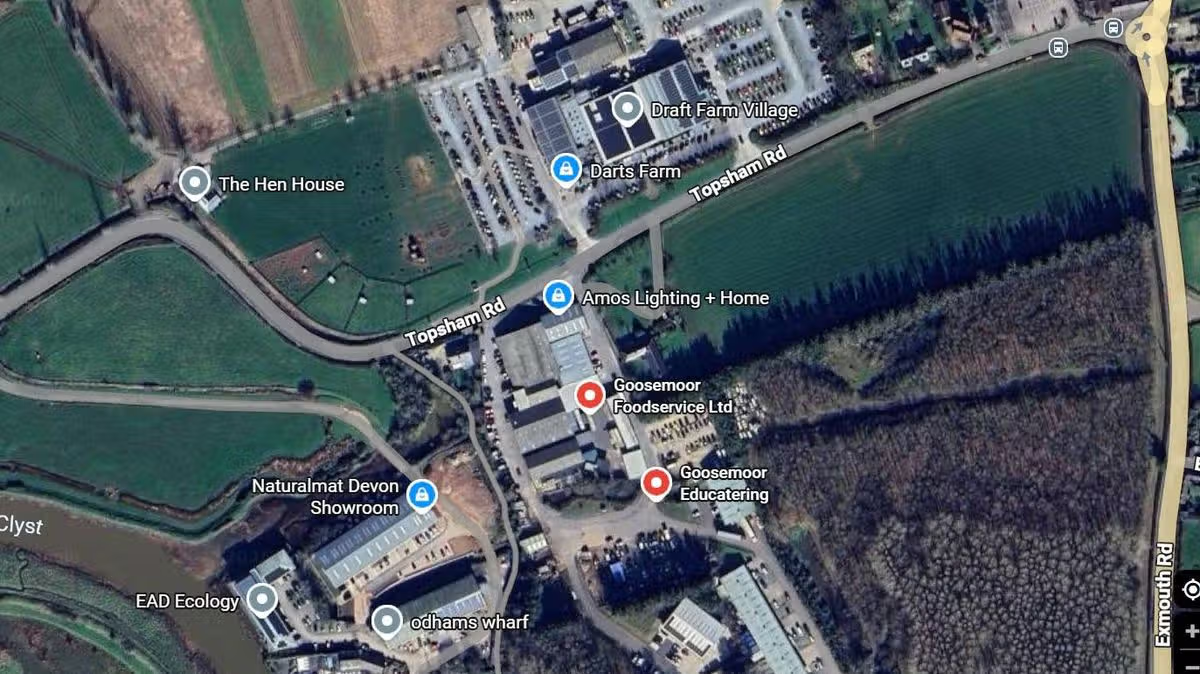
The current location of Goosemoor, near Dart’s Farm(Image: Google Maps)
A Devon business will be permitted to build an ‘educatering’ facility after successfully appealing a decision that initially rejected its proposals.
Goosemoor, which has been owned by the Pritchard family for nearly 70 years, sought permission to build a site in East Devon that would primarily house a food distribution centre for its school meals operation.
While this is expected to run round-the-clock for six days a week, the business also envisaged the development, in the parish of Woodbury, would have a classroom where pupils could discover the origins of their food and prepare meals, alongside open areas where crops would be cultivated to supply ingredients.
Local planning authorities declined to approve the scheme earlier this year, citing concerns about its effect on the surrounding countryside – the majority of which carries some form of protected status – and the view it would almost certainly require car access, which could itself prove troublesome for others using the narrow rural lane which lacks pavements or street lighting.
East Devon District Council’s planning committee also raised concerns about the possible impact on neighbouring properties, which include Grade II listed North Lodge, Nutwell Cottages and Nutwell Lodge Hotel.

A drawing of a possible layout of the proposed Goosemoor ‘educatering’ facility (Image: Local Democracy Reporting Service / EDDC)
However, a government planning inspector has reversed the decision – though with 26 conditions attached to the approval. Goosemoor has welcomed the ruling, while a council spokesperson said it was “disappointed” given its “clear concerns” about the proposal.
Although inspector Laura Cuthbert acknowledged several of the issues raised by the council, she assigned most of them only ‘limited’ or ‘moderate’ weight, while affording “significant weight” to the potential employment benefits the scheme could deliver and its broader economic impact.
Within her report, the inspector indicated the development could generate as many as 75 new jobs.
Citing the council’s own economic development officer, Ms Cuthbert noted the authority had recently acknowledged a “critical and well-established shortage of available employment land” in East Devon, which was “constraining inward investment, local business growth and forcing some employers to leave the district”.
Ms Cuthbert said: “These comments indicate that concerns regarding the availability of employment land and commercial premises remain significant and ongoing.
“Consequently, notwithstanding the council’s emerging strategy to address this matter, there remains an acknowledged and substantial shortfall in employment land across the district.
“Whilst future allocations may assist in meeting that need, their delivery remains uncertain at present. Having regard to the evidence before me, I conclude that the proposal would make a meaningful contribution towards addressing the current shortage of employment land and premises.”
Jamie Walsh, the founder and director of Goosemoor Educatering, welcomed the decision.
“The appeal has gone our way, and I think the process was pretty considered,” he said.
“It was back and forth from both sides, but what was pleasing is that in the appeal format, we could answer any queries, statements or questions and so it felt a lot more like our voice was heard [than at the planning committee].
“The inspector kept mentioning the planning balance and it came down more in our favour with the potential negatives not being enough to block the application.”
Mr Walsh said he hoped construction on the site would get under way in spring next year, once the firm has met the planning conditions attached to the scheme.
A spokesperson for East Devon District Council said the authority was “disappointed” the appeal had been allowed.
“Our position was that the site conflicted with countryside protection policies, was in an unsustainable location with very limited access to public transport, walking and cycling routes, and would cause harm to the landscape and to the setting of nearby listed buildings,” the spokesperson said.
“While the inspector agreed with all of these concerns, they concluded that the economic benefits of the scheme outweighed the harm identified, in the absence of a suitable alternative site.
“We respect the inspector’s decision, but our position remains that development in the countryside must be carefully managed and located where it can be properly supported by sustainable transport and infrastructure.”





















































You must be logged in to post a comment Login