




Connect with us
DAPA Banner
DAPA Coin
DAPA
COIN PAYMENT ASSET
PRIVACY · BLOCKDAG · HOMOMORPHIC ENCRYPTION · RUST
ElGamal Encrypted MINE DAPA
🚫 GENESIS SOLD OUT
DAPAPAY COMING

Business

DiDi Global: Domestic Cash Cow Funds Global Expansion; Reiterate Bullish View

Published

on

DiDi Global: Domestic Cash Cow Funds Global Expansion; Reiterate Bullish View

This article was written by

Astrada Advisors delivers actionable recommendations that enhance portfolio performance and uncover alpha opportunities, supported by a strong track record in investment research at leading global investment banks. With expertise spanning technology, media, internet, and consumer sectors in North America and Asia, Astrada Advisors excels in identifying high-potential investments and navigating complex industries.Leveraging extensive local and global experience, Astrada Advisors offers a unique perspective on market developments, regulatory changes, and emerging risks. The research integrates rigorous fundamental analysis with data-driven insights, providing a nuanced understanding of key trends, growth drivers, and competitive landscapes.The focus is empowering investors with timely research and a comprehensive view of industry dynamics. Whether navigating volatile markets or exploring new trends, Astrada Advisors remains committed to delivering superior insights to drive informed investment decisions.

Analyst’s Disclosure: I/we have no stock, option or similar derivative position in any of the companies mentioned, and no plans to initiate any such positions within the next 72 hours. I wrote this article myself, and it expresses my own opinions. I am not receiving compensation for it (other than from Seeking Alpha). I have no business relationship with any company whose stock is mentioned in this article.

Seeking Alpha’s Disclosure: Past performance is no guarantee of future results. No recommendation or advice is being given as to whether any investment is suitable for a particular investor. Any views or opinions expressed above may not reflect those of Seeking Alpha as a whole. Seeking Alpha is not a licensed securities dealer, broker or US investment adviser or investment bank. Our analysts are third party authors that include both professional investors and individual investors who may not be licensed or certified by any institute or regulatory body.

Advertisement
Continue Reading
Click to comment

You must be logged in to post a comment Login

Leave a Reply

Business

S&P cuts Bangladesh outlook to negative on growth concerns

Published

on


S&P cuts Bangladesh outlook to negative on growth concerns

Continue Reading

Business

In 1943, US built an entire city, and it didn’t exist on a single map

Published

on

In 1943, US built an entire city, and it didn't exist on a single map
Picture a city with 75,000 people, its own grocery stores, movie theatres, and swimming pools. Now imagine that city was invisible. No road signs pointed to it. No state map showed it. If you asked a local where it was, they legally couldn’t tell you, because most of them didn’t fully know either. This isn’t fiction. It’s Oak Ridge, Tennessee, and it was one of the strangest, most audacious secrets the U.S. government has ever pulled off.

A City That “Didn’t Exist”

When Japan attacked Pearl Harbor in December 1941, Oak Ridge didn’t exist at all. There was no city, no name, nothing but quiet farmland tucked into the valleys of East Tennessee.

Also Read: Gray Hair Reason Found: A Japanese study explains why people get grey hair and it may be linked to cancer
Then, in 1942, the US government quietly began buying up roughly 60,000 acres of that farmland ‘on land framed by the foothills of the Appalachian Mountains’. Families who had lived there for generations were told to pack up and leave, often with only a few weeks’ notice, no explanation given, and no say in the matter.

By July 1943, the takeover became official. An army captain handed Tennessee’s governor a proclamation, straight from President Franklin Roosevelt, declaring the land a total exclusion area no longer under state control. The governor reportedly tore it up on the spot. It didn’t matter. The federal government now controlled the land, no questions asked.

Why This Sleepy Valley?

The location wasn’t chosen by accident. Oak Ridge sat far from either coast, making it an unlikely bombing target, and its valleys offered natural cover, plus room to separate massive industrial plants in case something went catastrophically wrong.
It was also cheap and remote, sparsely populated, which meant fewer people to notice, and fewer people to ask questions. Within months, this “nowhere” spot became one of three secret sites, alongside Los Alamos, New Mexico, and Hanford, Washington, chosen to build the world’s first atomic bomb as part of the Manhattan Project.

Advertisement

Life Behind the Fence

What rose out of that Tennessee mud was almost unbelievable. By its peak, Oak Ridge was home to ‘75,000 people, making it the fifth-largest city in Tennessee’, bigger than many cities that actually appeared on maps.

Also Read: ‘Honey helps wounds, burns to heal faster’: Study finds that it has anti-bacterial and anti-inflammatory properties

And yet, officially, it was blank space. Guards stood at every entrance. Every resident wore a badge at all times. Access required special approval, and visitors were essentially banned. Locals in nearby Knoxville reportedly knew something odd was happening, Oak Ridge workers were recognizable by their mud-caked shoes, a giveaway of the town no one was supposed to talk about.

Inside the fence, life looked almost normal, grocery stores, dances, churches, swimming pools. But almost nobody living there understood the true purpose of their own jobs. Workers were given fragments of tasks with zero context, deliberately kept in the dark so that even if information leaked, it wouldn’t add up to anything useful. One young chemist who arrived in 1943 later recalled being warned never to say the word “uranium” again after his very first day.

Advertisement

Some estimates suggest Oak Ridge briefly used more electricity than New York City, largely to power the massive uranium enrichment plants humming day and night behind the checkpoints.

When the Secret Finally Came Out

The truth broke in August 1945, when the U.S. dropped atomic bombs on Hiroshima and Nagasaki. Only then did the outside world, and most of Oak Ridge’s own residents, learn what they’d actually built: the enriched uranium used in the first atomic weapon ever deployed in war.

Also Read: Humans have a ‘third eye’ in the brain: Study links it to a 600-million-year-old Cyclops ancestor

Even after that, Oak Ridge stayed a closed, gated city for years. It wasn’t until March 1949 that its roads finally opened to the public, ending seven years of total secrecy.

Advertisement

What’s Left Today

Oak Ridge is no longer hidden, it’s a real, mapped city near Knoxville, and part of it is now preserved as the Manhattan Project National Historical Park. Visitors can tour surviving facilities, ride a scenic train along old supply routes, and see remnants of the plants that once ran around the clock behind armed checkpoints.

It remains one of the most remarkable facts of American history: for seven years, tens of thousands of people lived, worked, and raised families in a city the federal government built from nothing, and then simply erased from every map in the country.

Continue Reading

Business

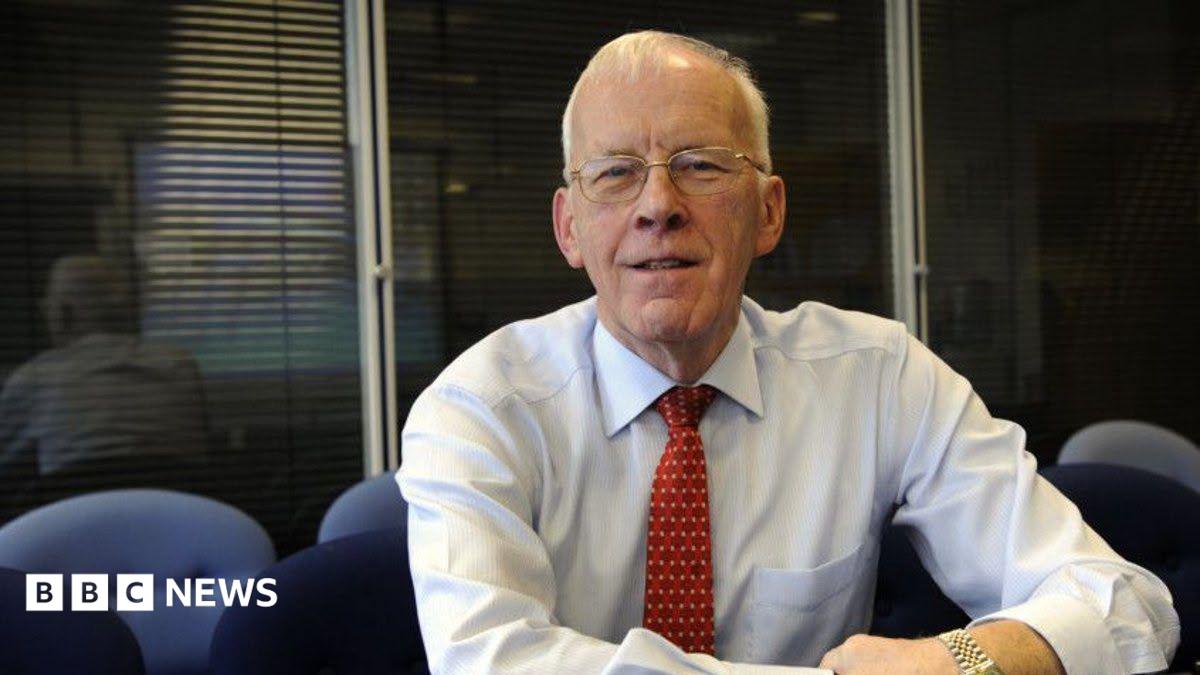
Businessman and philanthropist Sir Ian Wood dies aged 84

Published

on

A woman with short brown hair looks directly into the camera with a slight smiling expression. She is wearing a pink top and a silver necklace with a heart charm.

The Aberdeen-based businessman and philanthropist Sir Ian Wood has died aged 84, his family has announced.

Sir Ian was one of the UK oil and gas industry’s most respected leaders, who turned his family’s fishing boat repair yard into a global engineering player in the North Sea and internationally.

He retired as chief executive in 2006 and a year later began concentrating on his charitable work, creating The Wood Foundation, which works on social and economic inequality, especially in Scotland and sub-Saharan Africa

His family said he died peacefully at home and they would remember his “kindness, generosity, determination and unwavering commitment to his family.”

Advertisement

Sir Ian was one of Scotland’s wealthiest people, with a personal worth estimated at £1.8bn.

Wood Group started as a family fishing business before Sir Ian took over in 1967.

Over the next decades, he formed a separate engineering company servicing the rapidly-growing North Sea oil business.

At its height, the Wood Group was valued at more than £5bn, carrying out work in the energy industry around the world. It went public in 2002 and was sold to a Dubai company last year.

Advertisement

Sir Ian, who retired as chairman of the group in 2012, was knighted in 1994 for services to the oil and gas industry and was later made a member of the Order of the Thistle, Scotland’s highest order of chivalry.

Continue Reading

Business

ASEAN News Roundup – Thailand Business News

Published

on

Timor-Leste's Path to ASEAN Membership: A Hard-Won and Heartfelt Victory

Southeast Asian news roundup covering Malaysia’s political controversies, Singapore incidents, Indonesia-China relations, Thailand’s heritage sites, Philippines security issues, Vietnam rescue operations, Myanmar disputes, Cambodia’s wildlife conservation, Laos tourism growth, Brunei-China diplomacy, plus regional/global stories on typhoons, sports, entertainment, and international affairs.

Key Points

  • Malaysia: Political leaders rebuke Sanusi’s “Tanah Melayu” remarks; Deputy IGP Ayob Khan retires after 35 years; probes into land scam, extortion case, and kidnapping; ringgit and Bursa Malaysia brace for Fed decision amid El Nino warnings.
  • Region: Typhoon Noul disrupts flights across Singapore, Hong Kong, and China; Vietnam and Cambodia address maritime rescues and cybercrime; Philippines, Japan, US conduct joint South China Sea exercises amid rising tensions.
  • Asean: Indonesia strengthens China ties and defense deals; Thailand’s heritage site listed by UNESCO; Cambodia’s durian exports surge; entertainment and sports highlights include F1’s Sepang return buzz and Commonwealth Games golds.

Political Tensions and Security Concerns in Malaysia

Malaysia’s political scene faced significant turmoil this week. Top leaders rebuked Sanusi’s controversial “Tanah Melayu” remarks, with Zambry emphasizing that racial rhetoric has no place in nation-building. Deputy Prime Minister Khaled Nordin clarified that the BN-PH federal unity government arrangement is not binding, while Perikatan’s information chief defended Sanusi’s comments as taken out of context.

Security concerns also dominated headlines, including a RM7 million kidnapping case in Petaling Jaya with six suspects facing charges, an alleged RM2 million extortion case involving 12 police officers, and a land scam investigation in Keningau. Deputy IGP Ayob Khan retired after 35 years of service, emphasizing integrity in policing.

Natural Disasters and Regional Cooperation Across ASEAN

Typhoon Noul caused widespread disruption, cancelling over 20 flights between Singapore and southern China, forcing Malaysia Airlines to suspend KL-Shenzhen-Hong Kong routes, and prompting the evacuation of 20,000 people in China. Meanwhile, Malaysia was urged to prepare for a potential Super El Niño, and severe flooding spread across Punjab as rivers swelled.

Regional diplomacy remained active, with China and Brunei highlighting model bilateral relations, and Brunei pledging stronger ASEAN judicial cooperation. Vietnam thanked China for rescuing 39 crew members from a sunken vessel, though 17 remain missing in the South China Sea. Indonesia reaffirmed its long-term partnership with China, while Cambodia’s durian exports to China surged dramatically.

Advertisement

Sports Achievements and Broader Regional Developments

Sporting highlights included Malaysia’s Alif Rakib winning a historic One Championship world title, congratulated by PM Anwar, alongside Aniq’s Commonwealth Games record-breaking gold medal in Glasgow. Malaysia is also set to host the Bahrain Grand Prix in October, sparking excitement about F1’s potential return to Sepang. In football, Thailand and Malaysia secured wins in the ASEAN Hyundai Cup.

Elsewhere, geopolitical tensions escalated with joint Philippines-Japan-US exercises in the South China Sea met by Chinese patrols, while Iran claimed to have halted Middle East attacks after weeks of conflict. Entertainment news featured Spider-Man star Tom Holland’s viral “Hot Ones” appearance and Taiwan’s Tien-chen claiming a historic China Open badminton title.

Advertisement
Continue Reading

Business

The huge social impact of Cardiff City’s community foundation

Published

on

Business Live

New research shows the impact of the Cardiff City FC Community Foundation over the last two seasons

(Image: Getty Images)

The community foundation of Cardiff City FC has generated more than £66m in social value over the last two seasons, new independent analysis has found.

The official charity of the football club delivered £32.9m in social value in 2024/25 alone, with every £1 invested in its work returning £19 in benefits for people and communities across Cardiff and South Wales more widely.

Advertisement

The findings show the value of the community foundation’s work in improving people’s health and wellbeing, building stronger communities, helping young people gain confidence and skills, and creating routes into education, training and employment.

Cardiff City FC Community Foundation’s social value was independently assessed using the UEFA social return on investment model by social impact specialists Substance.

The calculations are benchmarked against HM Treasury Green Book guidance and academic research for outcomes associated with sport, physical activity, education, health, wellbeing and community engagement.

The 2024/25 impact included £17.4m generated through improvements in health and wellbeing, including physical health, mental health and life satisfaction. A further £10.2m came from social and community outcomes, including stronger relationships, greater community cohesion and an increased sense of belonging.

Advertisement

Education and employment outcomes contributed £4.9m, reflecting the value of participants gaining qualifications, confidence, transferable skills and pathways towards work. Additional social value, including support such as volunteering, donations, in-kind help and facilities, added over £329,000.

The charity’s own participant data for 2024/25 show that 93% of people engaged reported an improved sense of belonging in their community. Nine in ten said their mental, emotional or physical well-being had improved.

Nine in ten also reported stronger peer relationships, a better attitude towards learning and improved transferable skills such as confidence, problem-solving and teamwork. Moreover, 88% said they had a better understanding of the benefits of an active lifestyle.

The foundation delivers targeted programmes for young people at risk of disengagement, exploitation and long-term disadvantage, including work delivered with the South Wales Police and Crime Commissioner’s Violence Prevention Unit.

Advertisement

Zac Lyndon-Jones, chief executive of Cardiff City FC Community Foundation, said: “Generating more than £66m of social value over the last two seasons is a remarkable achievement, and every £1 spent delivering £19 in return is a powerful reflection of the commitment of our staff, volunteers and partners.

“These figures represent real people whose lives have been positively changed through improved wellbeing, greater confidence, stronger connections and new opportunities.

“We are proud of the impact being delivered across Cardiff and South Wales, but we also know there is more to do. We remain committed to working alongside our partners and communities to ensure this support reaches the people who need it most.”

Ken Choo, Cardiff City FC executive director and chief executive said: “Football has a unique power to bring people together and change lives, and these figures show the true scale of that impact across Cardiff and South Wales. We are incredibly proud of the work of Cardiff City FC Community Foundation and the way it uses the reach of the football club to support children, young people and families. The £66m figure is hugely impressive, but what matters most is what sits behind it: people feeling healthier, more confident, more connected and better able to fulfil their potential.”


Advertisement
Continue Reading

Business

Rocket Lab stock rises on $266M Space Force contract win

Published

on


Rocket Lab stock rises on $266M Space Force contract win

Continue Reading

Business

Kinder Morgan: Not The Best Midstream Stock, Still A Buy

Published

on

Kinder Morgan: Not The Best Midstream Stock, Still A Buy

Kinder Morgan: Not The Best Midstream Stock, Still A Buy

Continue Reading

Business

Chip Maker Soars 466% on Debut to Become No. 1 in China Stock Market

Published

on

Chip Maker Soars 466% on Debut to Become No. 1 in China Stock Market

SINGAPORE—Memory-chip maker CXMT 688825 soared in its stock-market debut to become the most valuable company listed in mainland China, capping the rise of an upstart whose products are sought by Apple

The company, founded just a decade ago, sported a market capitalization equivalent to $484 billion after its opening day of trading in Shanghai, topping Industrial and Commercial Bank of China to become the most valuable company listed in a mainland Chinese market. CXMT’s market value was just short of China-based internet company Tencent, which is listed in Hong Kong and is the most valuable company in that market. 

Copyright ©2026 Dow Jones & Company, Inc. All Rights Reserved. 87990cbe856818d5eddac44c7b1cdeb8

Continue Reading

Business

Lakeland Financial beats earnings but misses on revenue

Published

on


Lakeland Financial beats earnings but misses on revenue

Continue Reading

Business

East of England business confidence dips to 83%, KPMG finds

Published

on

East of England business confidence dips to 83%, KPMG finds

Confidence in growth prospects among privately owned businesses in the East of England has fallen to 83 per cent from 86 per cent at the start of the year, according to the mid-year update to KPMG UK’s Private Enterprise Barometer.

KPMG surveyed 1,500 privately owned businesses across the UK at the start of 2026, including 125 in the East of England, spanning sectors including life sciences, hospitality, food and drink and technology. It returned to the same businesses six months later to test how conditions had changed their outlook.

The regional figure remains above the UK average of 80 per cent. Nationally, confidence fell from 87 per cent when the same businesses were surveyed earlier in the year, KPMG said.

Technology was the leading investment priority among East of England firms, with 67 per cent naming artificial intelligence, cyber security or wider digital transformation. That is one percentage point above the UK average and 30 percentage points higher than at the start of the year.

Diversification was cited by 65 per cent, who said they were looking to expand their service offerings and broaden their client base, up from 64 per cent in January and two points above the national figure.

Advertisement

On funding, 53 per cent said they were using their own balance sheets to support growth plans. Among businesses considering how to pay for capital expenditure and expansion, 46 per cent said they were open to private equity investment, against a UK average of 45 per cent.

Asked about short-term risks, 48 per cent of East of England respondents named inflation and ongoing cost pressures, alongside global disruption affecting UK supply chains and trade, as the two biggest facing their organisations.

Looking to the Autumn Budget, 52 per cent of East of England firms said they wanted technology and digital capability prioritised by the incoming Chancellor. The same proportion pointed to the UK economic outlook and productivity growth as the biggest external factor shaping decisions on investment, growth and exit planning.

Joe Faulkner, East Anglia office senior partner at KPMG UK, said: “It’s encouraging to see businesses across the East of England maintaining confidence despite the challenges they’re facing. There’s a real sense that businesses here aren’t standing still but continuing to invest, particularly in technology, because they know it’s critical to staying competitive.

Advertisement

“What’s equally clear is that businesses can’t do it alone. They’re looking for government to match that ambition by prioritising digital investment and creating the right environment for innovation to thrive.”

Faulkner added: “The East of England has all the ingredients to remain one of the UK’s leading growth regions, particularly with the opportunities the Oxford-Cambridge Growth Corridor presents. If we continue to invest in the infrastructure and digital capability that businesses need, there’s a real opportunity to unlock even greater growth across the region.”

The corridor accounts for more than 7 per cent of UK GDP and over £40bn of economic output, according to the government’s Oxford-Cambridge Growth Corridor investment prospectus, which states that realising its potential could add a further £78bn by 2035.

Separate research by Beauhurst, published in May, found that 80 per cent of venture capital invested in the UK goes to London, Oxford or Cambridge, with headcount at innovative companies in Cambridge up 26 per cent between 2019 and 2024.

Advertisement

Nationally, KPMG said private businesses identified faster adoption of new technology and stronger digital capability, growth-focused investment and a renewed industrial strategy as the areas most in need of attention at the Autumn Budget.

Euan West, head of KPMG Private Enterprise in the UK and EMA, said: “2026 has continued to present private businesses with a challenging operating environment, shaped by uncertainty both at home and abroad.

“Against that backdrop, it is encouraging that eight in 10 business leaders remain confident about their growth prospects. While confidence has eased since the end of last year, the overall picture remains one of resilience and determination.

“What stands out most is how private businesses are responding. Rather than pulling back, they are investing in skills, technology and the capabilities that will help them remain competitive and unlock future growth.

Advertisement

“Private enterprise leaders are entrepreneurial, action-oriented and focused on what they can control. They are not waiting for conditions to improve; they are getting on with the job of creating growth.”


Jamie Young

Jamie Young

Jamie Young is Senior Reporter at Business Matters, covering SME finance, employment law and Westminster policy since 2016. He has reported on every Budget and Autumn Statement since 2018, helped make sense of the ‘covid era’ and the bounce-back loan scheme from launch through the fraud investigations, and broke the magazine’s coverage of the 2024 late-payment reforms. He joined Business Matters straight from completing his BA in Administration from Exeter University and is NCTJ-qualified. Reach him at jyoung@cbmeg.co.uk

Advertisement
Continue Reading

Trending

Copyright © 2025