

Business
Earnings call transcript: NeoVolta’s Q3 2026 results miss forecasts



NEW YORK — The Dow Jones Industrial Average tumbled nearly 400 points Thursday, closing at 49,667.97 as a sharp sell-off in technology shares and renewed concerns over interest rates weighed on investor sentiment and triggered a broad retreat across Wall Street.
The blue-chip index dropped 395.49 points, or 0.79 percent, marking its largest one-day point decline in several weeks. The S&P 500 fell 0.65 percent while the Nasdaq Composite, heavily weighted toward technology, posted a steeper 1.12 percent loss as mega-cap names came under pressure.
Trading volume remained elevated throughout the session as investors digested mixed economic signals and repositioned portfolios amid uncertainty about the Federal Reserve’s next moves. The decline erased gains from earlier in the week and highlighted the market’s vulnerability to shifts in risk appetite.
Tech Sector Leads the Decline
Technology stocks bore the brunt of the selling. Nvidia, Apple, Microsoft and other heavyweights in the Dow and broader indices retreated as traders took profits following a strong run driven by artificial intelligence enthusiasm. Concerns about valuation levels in the sector, combined with reports of potential regulatory scrutiny on big tech, added to the downward pressure.
Energy and financial shares offered some relative stability. Oil prices held firm amid ongoing Middle East tensions, supporting energy names, while select banks benefited from expectations of steady interest rates. However, these pockets of strength were not enough to offset losses in more growth-oriented areas of the market.
Economic Data and Fed Outlook in Focus
The pullback came as investors parsed the latest inflation readings and labor market data. While recent figures have shown some cooling in price pressures, persistent strength in certain areas has kept the Federal Reserve on hold. Market participants are now pricing in fewer rate cuts for the remainder of 2026 than previously expected, a shift that has weighed on equities sensitive to borrowing costs.
Economists note that the economy remains resilient overall, with consumer spending and corporate earnings holding up better than feared. Yet the combination of geopolitical risks, including developments in the Middle East, and domestic policy uncertainty continues to create a cautious backdrop for investors.
Analyst Perspectives
Market strategists described Thursday’s move as a healthy correction rather than the start of a deeper downturn. “We’ve had a strong run, and some profit-taking was inevitable,” said Sarah Chen, chief investment strategist at a major New York-based firm. “The Dow had been hovering near all-time highs, and today’s decline reflects rotation out of some of the more extended names.”
Others pointed to technical factors. The Dow had been trading in a relatively narrow range recently, building tension that finally released with today’s move. Support levels near 49,200-49,300 could provide a floor if selling intensifies, while resistance sits around the recent highs above 50,000.
Broader Market Context
The Dow’s performance stands in contrast to its remarkable climb over the past several years. From post-pandemic lows, the index has more than doubled, driven by strong corporate earnings, technological innovation and accommodative monetary policy. Yet periodic pullbacks like Thursday’s serve as reminders that markets do not move in straight lines.
Smaller companies, tracked by the Russell 2000, also felt pressure but held up better than large-cap tech names. International markets showed mixed results, with European indices modestly lower and Asian markets closing mostly in positive territory overnight.
Bond yields edged higher as investors reassessed the path for rates, with the 10-year Treasury yield rising several basis points. The U.S. dollar strengthened modestly against major currencies, reflecting its safe-haven appeal during periods of equity market volatility.
Corporate Earnings Season in Focus
With the earnings reporting season well underway, company-specific news continued to drive individual stock movements. Several major Dow components reported results this week that met or exceeded expectations, yet the broader tone remained cautious as guidance for the rest of the year incorporated economic uncertainties.
Analysts expect second-quarter earnings growth to remain solid but slower than the robust pace seen in 2025. Sectors tied to consumer discretionary spending and technology face closer scrutiny as investors look for signs of sustained demand.
Investor Sentiment and Outlook
Retail investors, tracked through various sentiment surveys, remain largely optimistic about the long-term direction of the market but have grown more tactical in the short term. Many have been adding to defensive positions in healthcare, consumer staples and utilities while trimming exposure to high-valuation growth stocks.
Looking ahead, the market will closely watch upcoming inflation data, the Federal Reserve’s policy signals and developments in global trade negotiations. Any signs of cooling in the labor market could revive expectations for rate cuts later this year, potentially providing support for equities.
For now, Thursday’s decline serves as a reminder of the market’s sensitivity to shifts in momentum. While the Dow remains well above levels from just a year ago, the path forward will likely feature continued volatility as investors balance optimism about innovation and economic resilience against concerns over valuations and policy uncertainty.
The Dow closed the session at 49,667.97. Whether today’s move marks the start of a deeper correction or simply a pause in an ongoing uptrend will depend on how the market digests upcoming data and corporate reports in the days ahead. Investors will be watching closely as Wall Street navigates the delicate balance between risk and reward in an environment full of both opportunity and potential pitfalls.

The metal major posted a revenue uptick of 13% to Rs 63,270 crore in Q4FY26 versus Rs 56,218 crore posted in the corresponding quarter of the previous financial year.
While the profit after tax (PAT) was lower than Street’s estimates of Rs 3,065 crore, topline beat estimates of Rs 62,440 crore.
The company recommended a dividend of Rs 4 per equity share for the financial year 2025-26 which will be paid subject to shareholders’ approval at the Annual General Meeting (AGM) scheduled on July 2, 2026. It will be paid on and from July 6, 2026, the company’s filing to the exchanges said.
The PAT grew 9% sequentially versus 2,730 crore in Q3FY26 while revenue increased 11% from Rs 57,002 crore posted in the October-December quarter of FY26.

Company’s Earnings Before Interest, Taxes, Depreciation and Amortisation (EBITDA) stood at Rs 9,953 crore in Q4FY26 versus Rs 6,762 crore n Q4FY25, recording a 47% growth.
The company ended the year with a bang, reporting a PAT of Rs 10,886 crore, which more than trebled from Rs 3,174 crore in the year ago. The turnover in the same period stood at Rs 2.32 lakh crore compared to Rs 2.18 lakh crore, posting a 6.4% increase.
Segment revenue
India revenues were at Rs 38,654 crores in Q4 and EBITDA was Rs 9,841 crores, which translates to a margin of 25%. Crude steel production was up 14% YoY to 6.22 million tons and led to ‘best ever quarterly’ deliveries of 6.19 million tons. For FY26, it stood at Rs 1.40 lakh crores and EBITDA was Rs 34,272 crores, which translates to an EBITDA margin of 24%. EBITDA improved by 17% YoY. Performance was aided by ‘best ever’ crude steel production of 23.4 million tons and deliveries of 22.5 million tons.
Netherlands revenues were €1,605 million and EBITDA was €58 million. Liquid steel production was 1.63 million tons and deliveries were 1.70 million tons. For FY26, its stood at €6,028 million and EBITDA was €267 million. EBITDA had almost tripled on YoY basis.
UK revenues were £470 million and EBITDA loss stood at £48 million. Deliveries stood at 0.52 million tons and were impacted by subdued demand dynamics. UK revenues were £1,978 million and EBITDA loss almost halved to £217 million.
Capex
The company has spent Rs 3,655 crores on capital expenditure during the quarter and Rs 14,026 crores for the full year.
Net debt declined by Rs 2,285 crores YoY to Rs 80,144 crores.
Management commentary
T. V. Narendran said FY2026 was marked by heightened global economic uncertainty and tariff-led trade disruptions, but Tata Steel continued to deliver steady operational performance through cost optimisation and disciplined execution. He highlighted that Tata Steel India achieved its highest-ever deliveries of around 22.5 million tonnes, supported by growth in downstream businesses such as tubes, tinplate, wires and branded products.
Narendran added that the company strengthened its position in the automotive segment through rapid customer approvals at Kalinganagar and expanded the reach of Tata Tiscon across nearly all districts in India. He also noted strong growth in the company’s digital commerce platforms and engineering segment volumes, alongside continued investments in expansion projects including the new electric arc furnace at Ludhiana and the proposed NINL expansion.
On the overseas business, he said the UK market could benefit from revised import quotas, while the Netherlands operations continue to face regulatory challenges despite improving pricing conditions in Europe. Narendran further cautioned that geopolitical developments in West Asia have started impacting supply chains and input costs, with the pressures expected to continue into FY2027, prompting the company to undertake calibrated mitigation measures.

NEW YORK — SolarEdge Technologies shares skyrocketed more than 13 percent Thursday, trading at $56.84 midday as investors cheered the company’s better-than-expected first-quarter results and raised guidance amid signs of recovery in the global solar energy market.
The Israeli-American company, a leading provider of solar power optimizers and inverters, reported adjusted earnings of 45 cents per share, easily topping Wall Street expectations of 28 cents. Revenue reached $312 million, beating forecasts and marking a significant improvement from the challenging conditions that weighed on the stock throughout much of 2025.
SolarEdge CEO Zvi Lando highlighted improving demand in key European and U.S. markets, noting that inventory levels have normalized and new residential and commercial projects are accelerating. “We are seeing clear green shoots across our major territories,” Lando said on the earnings call. “The combination of lower interest rates, policy support and technological advancements is driving renewed momentum in solar adoption.”
The strong report triggered a wave of analyst upgrades and price target increases. Several major firms raised their targets on SolarEdge, with some citing the company’s improved margin profile and leadership position in next-generation inverter technology. The stock’s surge pushed its market capitalization above $3.3 billion, recovering some of the ground lost during last year’s sector-wide downturn.
Market Recovery Boosts Renewable Stocks
SolarEdge’s rally comes as broader renewable energy stocks show signs of stabilization. Falling Treasury yields have eased financing costs for solar projects, while new incentives under updated U.S. energy policies have improved project economics. European markets, which had slowed dramatically in 2025 due to high energy prices and supply chain issues, are also showing renewed strength.
Industry analysts note that SolarEdge’s performance may signal a broader turnaround for the solar sector after a difficult period of oversupply and margin compression. The company’s focus on high-efficiency optimizers — which maximize energy production from individual panels — continues to differentiate it from pure inverter competitors.
“We believe SolarEdge is well positioned to capture market share as demand rebounds,” wrote JPMorgan analysts in a note to clients Thursday. “The combination of new product launches and operational improvements should drive sustainable margin expansion through 2027.”
Challenges and Risks Remain
Despite the positive momentum, SolarEdge faces ongoing challenges. The company still operates in a highly competitive environment, with Chinese manufacturers exerting pricing pressure across the supply chain. Trade tensions and potential tariffs on imported components could also affect costs in coming quarters.
Supply chain normalization has helped, but any resurgence of geopolitical risks in key manufacturing regions remains a concern. SolarEdge has been diversifying its production footprint, with new facilities in the United States and Europe helping to mitigate risks, though these moves come with higher initial costs.
Analysts also caution that the stock’s valuation, while more reasonable after last year’s decline, still incorporates optimistic growth assumptions. Any slowdown in global solar installations or delay in major policy implementations could pressure results.
Company Background and Strategic Shift
Founded in 2006, SolarEdge revolutionized the solar industry with its DC optimized inverter systems that increase energy yield and provide module-level monitoring. The technology has become standard in many residential and commercial installations worldwide.
After experiencing explosive growth during the early 2020s renewable boom, the company faced headwinds in 2024 and 2025 as high interest rates slowed project financing and European demand softened. SolarEdge responded by cutting costs, streamlining operations and investing in new technologies, including integrated energy storage solutions and smart home energy management systems.
The company’s latest results suggest these efforts are beginning to bear fruit. Management raised full-year guidance, projecting revenue between $1.45 billion and $1.55 billion with improving gross margins. The upbeat outlook helped fuel Thursday’s sharp rally as investors priced in a faster recovery.
Broader Sector Implications
SolarEdge’s performance is being watched closely by competitors and partners across the renewable energy ecosystem. Companies like Enphase Energy, First Solar and SunPower have seen related moves in their shares, reflecting the interconnected nature of the solar supply chain.
The rally also highlights growing investor confidence in the long-term transition toward renewable energy despite short-term volatility. With global governments maintaining ambitious climate targets and corporate demand for clean energy increasing, analysts expect the sector to deliver strong growth over the coming decade.
Institutional investors appear to be returning to solar names after a period of caution. Several large funds increased positions in SolarEdge following the earnings report, according to regulatory filings.
What Investors Should Watch Next
SolarEdge is scheduled to host an investor day in September where management will provide more details on its strategic roadmap, including new product launches and expansion plans. The event could serve as a catalyst for further movement in the stock.
Near-term focus will remain on quarterly execution and any updates regarding European demand trends. Macro factors, particularly interest rate decisions by the Federal Reserve and European Central Bank, will also influence sentiment toward renewable stocks.
For long-term investors, SolarEdge offers exposure to both the core solar inverter market and adjacent growth areas such as energy storage and smart grids. While volatility remains a feature of the sector, the company’s technology leadership and improving financial position make it an attractive play for those bullish on the energy transition.
Thursday’s surge demonstrates the market’s willingness to reward positive surprises in the renewable space. As SolarEdge continues executing on its turnaround plan, investors will be closely watching whether the company can sustain this momentum through the remainder of 2026 and into 2027.
The stock closed the regular session strongly, with continued buying interest in after-hours trading. Whether this marks the beginning of a sustained recovery or a temporary bounce will depend on SolarEdge’s ability to deliver consistent results in a recovering but still competitive market.

Form 13G First Watch Restaurant Group For: 15 May
NEW YORK — The S&P 500 fell sharply Thursday, closing at 7,426.99 as a broad tech sell-off combined with hotter-than-expected inflation data and persistent geopolitical tensions from the Middle East conflict triggered a cautious retreat across Wall Street.
The benchmark index dropped 74.25 points, or 0.99 percent, in a session marked by heavy profit-taking in artificial intelligence-related names and renewed worries about the Federal Reserve’s path on interest rates. The Dow Jones Industrial Average declined more modestly, while the Nasdaq Composite posted the steepest losses among major indices as technology giants came under pressure.
Trading volume spiked as investors digested April inflation figures showing consumer prices rising 3.8 percent year-over-year — the highest reading since May 2023 — and producer prices jumping 6 percent. Oil prices remained elevated near $107 per barrel amid ongoing disruptions in the Strait of Hormuz, adding to inflationary concerns and reducing expectations for near-term rate cuts under the new Fed leadership.
Tech Sector Bears Brunt of Selling
Technology shares led the decline, with several mega-cap names giving back recent gains. Investors appeared to take profits after a strong run fueled by AI enthusiasm, while fresh worries about the sustainability of massive capital spending on artificial intelligence infrastructure added to the pressure. The sector’s heavy weighting in the S&P 500 amplified the index’s drop.
Energy stocks provided some offset as oil prices held firm, but broader market sentiment remained defensive. Financials traded mixed amid shifting rate expectations, while defensive sectors like consumer staples and utilities outperformed relatively.
Inflation and Geopolitics Fuel Uncertainty
The hotter inflation print reinforced concerns that the Federal Reserve may keep rates higher for longer. Traders now see fewer rate cuts priced in for the remainder of 2026, pressuring growth-oriented stocks sensitive to borrowing costs. The 10-year Treasury yield climbed above 4.48 percent, its highest level since July 2025, reflecting the shift in expectations.
Geopolitical risks continued to loom large. The ongoing U.S.-Iran conflict has kept energy prices elevated and created uncertainty around global supply chains. Analysts warn that prolonged disruption could further complicate the inflation picture and weigh on corporate margins.
Analyst Views on the Pullback
Market strategists described the move as a healthy correction within a broader uptrend rather than the start of a major downturn. “We’ve seen strong gains driven by AI optimism, so some consolidation was expected,” said one New York-based portfolio manager. “The inflation data simply provided a catalyst for profit-taking in the more extended parts of the market.”
Technical analysts noted the S&P 500 had been testing resistance levels near recent highs. Support sits around the 7,300 level, with further downside possible if inflation readings continue surprising to the upside. However, many remain constructive on the longer-term outlook, citing resilient corporate earnings and ongoing innovation in technology sectors.
Corporate Earnings Provide Mixed Signals
Earnings season has delivered mostly solid results, but guidance from some high-profile names has introduced caution. Companies exposed to consumer spending and discretionary sectors have highlighted margin pressures from higher input costs, while technology firms continue to emphasize long-term AI investments despite near-term volatility.
The divergence between sectors underscores a market in transition — rewarding companies with strong pricing power and durable growth stories while punishing those more exposed to cyclical or inflationary headwinds.
Investor Sentiment and Strategy Shifts
Retail and institutional investors alike have grown more tactical. Many have rotated toward defensive areas or increased cash holdings while monitoring upcoming economic data. The VIX, Wall Street’s fear gauge, ticked higher but remained below levels typically associated with major panic.
Longer-term investors view the pullback as a potential buying opportunity, particularly in quality names that have been caught in the broader sell-off. “Volatility creates entry points,” said one wealth manager. “The underlying trends — innovation, productivity gains from AI, and a resilient economy — remain intact.”
Global Markets Reflect Caution
International markets showed similar caution. European indices closed modestly lower, while Asian markets had a mixed session overnight. The U.S. dollar strengthened modestly as a safe-haven currency, and gold prices edged higher amid uncertainty.
Looking ahead, investors will focus on upcoming inflation readings, consumer confidence data, and further corporate earnings. Any signs of cooling in the labor market or easing price pressures could revive hopes for rate relief later in the year.
Broader Economic Picture
Despite the market volatility, the U.S. economy has shown resilience. Consumer spending remains steady, and corporate balance sheets are generally healthy. However, higher-for-longer interest rates, elevated energy costs, and geopolitical risks create a challenging backdrop that requires careful navigation by both policymakers and investors.
The S&P 500’s performance this year has been marked by periodic sharp moves, reflecting the tug-of-war between optimism around technological progress and concerns over macroeconomic headwinds. Thursday’s decline fits this pattern — a reminder that even in a fundamentally supportive environment, markets can experience meaningful corrections.
The index closed the session at 7,426.99. Whether this represents a short-term pause or the beginning of a deeper consolidation will depend on how incoming data and corporate results influence sentiment in the days ahead. For now, caution prevails as investors await clearer signals on the inflation trajectory and the Fed’s response.
The market’s reaction underscores the sensitivity of equities to inflation surprises and geopolitical developments. As summer approaches, participants will continue balancing growth expectations with risk management in an environment that remains full of both opportunity and uncertainty.

The US securities regulator had accused the Adanis of paying bribes and misleading investors, which they denied.
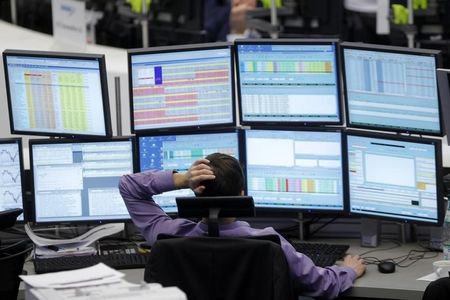
China’s UN envoy criticizes US-Bahrain Strait of Hormuz resolution
Form 8K National Healthcare Properties For: 15 May
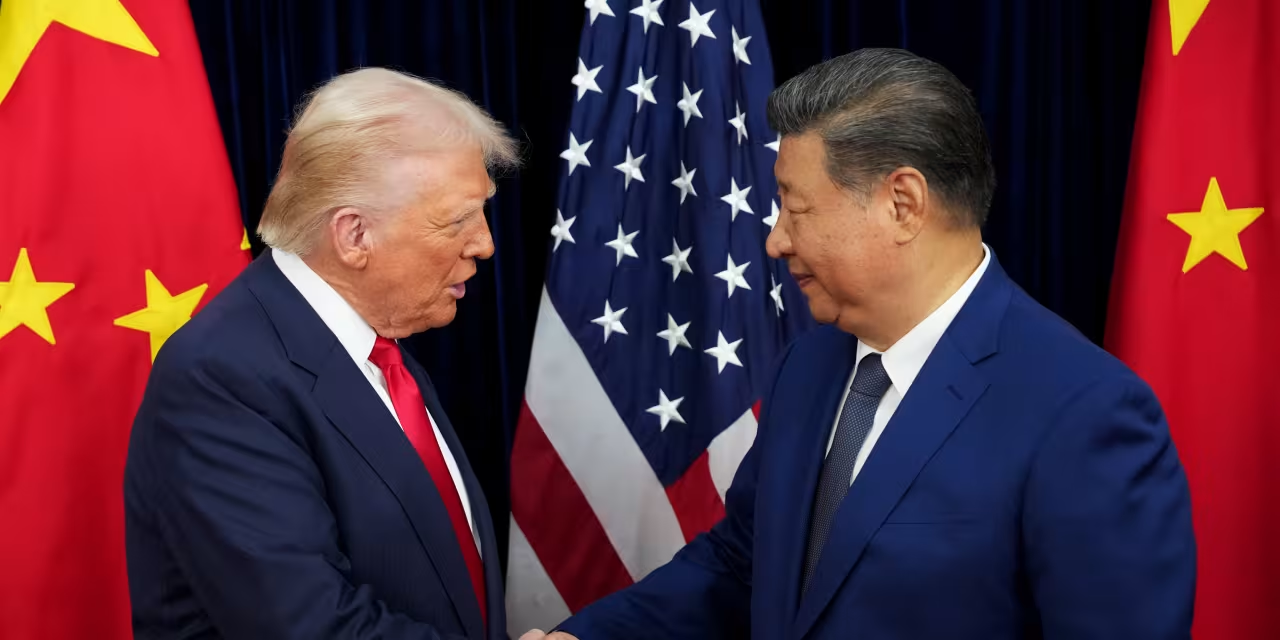
Trump’s China Summit Could Mean Big Things for Boeing, Tesla and Nvidia
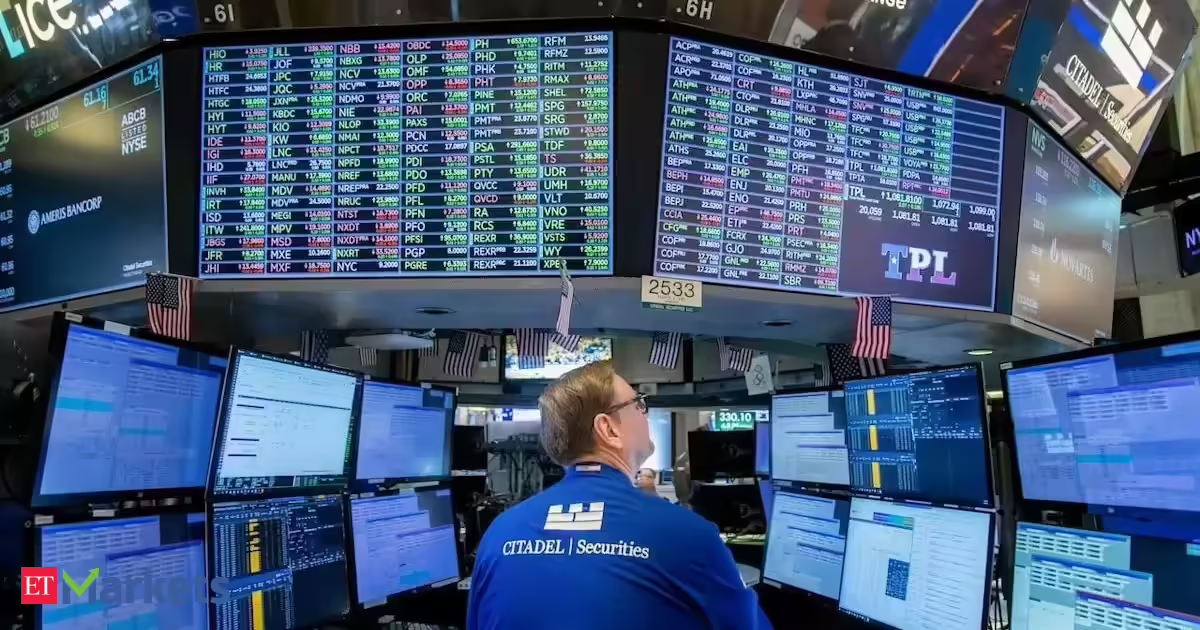
All three major U.S. stock indexes veered lower as a jump in benchmark Treasury yields, reflecting surging energy prices and concerns about long-term inflation, offered an attractive alternative to higher-risk equities.
“There’s a realization that the market had gotten way ahead of itself,” said Kenny Polcari, chief market strategist at Slatestone Wealth in Jupiter, Florida. “It wasn’t paying enough attention to what the bond market and economic data is telling it. It was caught up in this momentum AI trade.” Crude prices surged after combative comments from U.S. President Donald Trump and Iran’s Foreign Minister Abbas Araqchi raised doubts as to whether their countries’ fragile truce would hold and dampened hopes that normal traffic through the crucial Strait of Hormuz would soon resume. Trump’s meeting with Chinese President Xi Jinping concluded with few tangible results to show for it, with Beijing offering no clear help toward resolving the U.S.-Iran conflict.
“It certainly was encouraging to see both countries engaging again at the highest level. Historically, these type of events bring about headlines outlining various commitments,” said Matthew Keator, managing partner at the Keator Group, a wealth management firm in Lenox, Massachusetts. “This week’s meeting seemed like more of a reset in relations between the two countries and less short-term, quantifiable results.”
The yield on 10-year Treasury notes, an indicator of global borrowing costs, touched its highest level since May 2025, when markets were reeling from Trump’s “Liberation Day” tariff proclamation. Global bond yields also jumped on growing evidence of the Iran war’s widespread economic damage.
END OF POWELL ERA
Friday marks Jerome Powell’s last day as U.S. Federal Reserve chair, a position he has held through the pandemic, periods of inflation, and interest rate hiking and cutting cycles.Incoming Chair Kevin Warsh is saddled with the potential need for a rate hike if a protracted Iran war leads to sticky inflation.
“The weakness today is highlighting the concerns that the recent (inflation) numbers aren’t transient, and it’s hard to envision the new chair communicating anything other than a neutral policy stance at best until we see some consistent, meaningful change in the data,” Keator added.
The odds of the Fed hiking interest rates by 25 basis points in December are approaching 40%, up from 13.6% a week ago, according to CME Group’s FedWatch tool.
According to preliminary data, the S&P 500 lost 91.62 points, or 1.22%, to end at 7,409.62 points, while the Nasdaq Composite lost 412.61 points, or 1.53%, to 26,226.35. The Dow Jones Industrial Average fell 537.35 points, or 1.06%, to 49,531.70.
The Philadelphia SE Semiconductor Index was dragged lower by stocks that have benefited from the AI hyperscaler phenomenon.
Nvidia, AMD and Intel ended the session sharply lower. Microsoft rose following the disclosure of a new position in the company taken by Bill Ackman’s hedge fund Pershing Square. Dexcom jumped after the medical device maker’s announcement that it will appoint two independent directors and revamp a board committee in collaboration with activist investor Elliott Investment Management.
Ford slid, retreating from a near 21% surge over the last two sessions on optimism over the automaker’s energy storage business.

why climate change will become a more pressing economic problem for UK households

Dow Plunges 395 Points to 49,667 as Tech Sell-Off Triggers Broad Market Pullback

Connex releases 17.95m in CONX tokens today

Manchester United reach agreement with Casemiro over contract clause amid transfer speculation

US brings back mandatory military draft registration

Steven Gerrard disagrees with Gary Neville over ‘shock’ Chelsea and Arsenal claim | Football


-

 Fashion4 days ago
Coffee Break: Travel Steam Iron
-

 Politics7 days ago
Politics Home Article | Starmer Enters The Danger Zone
-

 Fashion5 days ago
What to Know Before Buying a Curling Wand or Curling Iron
-

 Politics4 days ago
What to expect when you’re expecting a budget
-

 Tech6 days ago
Auto Enthusiast Carves Functional Two-Stroke Engine from Solid Metal
-
 Business6 days ago
Ignore market noise, India’s long-term story intact, say D-Street bulls Ramesh Damani and Sunil Singhania
-

 Tech5 days ago
GM Agrees To Pay $12.75 Million To Settle California Lawsuit Over Misuse Of Customers’ Driving Data
-

 Fashion3 hours ago
Weekend Open Thread: Theory – Corporette.com
-

 Crypto World6 days ago
CZ says US crypto rivals tried to block Trump pardon
-

 Crypto World6 days ago
PROS explodes 48% as Upbit and Bithumb listings ignite demand
-

 Tech4 days ago
GM agrees to $12.75M California settlement over sale of drivers’ data
-

 Crypto World7 days ago
Kraken Parent Seeks OCC Charter, Signaling Regulated Banking Access
-
Crypto World3 days ago
Bitcoin Suisse expands with Digital Asset License and Investment Business Act Registration Approval in Bermuda
-

 Crypto World3 hours ago
E-Estate Announces 1 Year Live: Washington DC Summit as Real Estate Tokenization Enters Its Next Phase
-

 Entertainment7 days ago
Bethenny Frankel Says She Loves ‘Torturing’ Men
-
 Crypto World7 days ago
Solana UFO Meme Coins Surge After Pentagon Reveals Alien Files
-

 Politics3 days ago
Pakistan to enter Chinese capital market as war inflation bites
-
 Crypto World7 days ago
Pi Network Hits 421K Mainnet Nodes Ahead of Protocol 23 Smart Contract Launch
-
 Crypto World1 day ago
Google’s Gemini AI Predicts Incredible Solana Price by the End of 2026
-
Crypto World7 days ago
Crypto Price Analysis May-08: ETH, XRP, ADA, BNB, and HYPE
You must be logged in to post a comment Login