Connect with us
DAPA Banner
DAPA Coin
DAPA
COIN PAYMENT ASSET
PRIVACY · BLOCKDAG · HOMOMORPHIC ENCRYPTION · RUST
ElGamal Encrypted MINE DAPA
🚫 GENESIS SOLD OUT
DAPAPAY COMING

Business

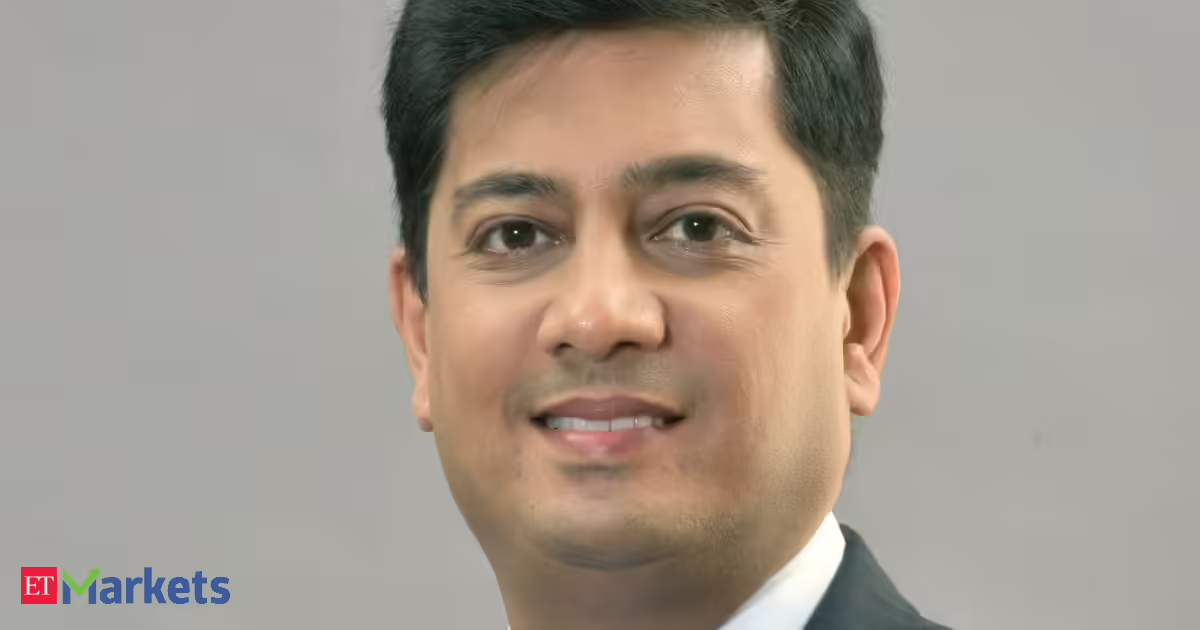
Earnings stay resilient, but Q1 FY27 could test markets: Harsha Upadhyaya

Published

on

Earnings stay resilient, but Q1 FY27 could test markets: Harsha Upadhyaya
Indian equities may have weathered a turbulent global environment with surprising resilience in the March quarter, but investors should brace for possible earnings disappointments in the first quarter of FY27 as geopolitical tensions and energy disruptions threaten to weigh on supply chains and corporate profitability.

Speaking to ET Now, Harsha Upadhyaya, CIO, Kotak Mahindra AMC said that the recently concluded quarter delivered stronger-than-expected earnings despite multiple macro challenges. However, he cautioned that the coming quarters could face pressure if energy-related disruptions persist.

“It has been a very decent quarter from an earnings growth perspective, maybe with a slight positive bias with regard to the numbers. On the basis of what we saw in Q1, Q2, as well as Q3, Q4 has been surprisingly strong,” said Upadhyaya.

He attributed the resilience largely to companies that managed inventories and operational pipelines efficiently through periods of uncertainty. Still, he warned that the June quarter may not be as smooth.

Advertisement

“Clearly, as you mentioned, Q4 has been quite resilient as far as the numbers are concerned which have come out up until now. Most of those results have come from companies which managed their inventory levels or their pipelines quite nicely even through the crisis. However, there could be a little more disruption when you look at Q1 of financial year 27. So, we do expect some disappointments in Q1 FY27,” he said.


Markets Watching Energy Disruptions Closely
According to Upadhyaya, the trajectory of energy supply disruptions will determine whether markets treat weak quarterly earnings as temporary noise or a deeper structural concern.
“If the energy disruption ends before the earnings season starts, then I do not think that markets would really worry about Q1. They will look at it more as an aberration and move on from there and look at how the rest of financial year 27 and financial year 28 would pan out,” he said.
However, he added that an extended disruption could raise concerns beyond just one quarter.

“If the energy disruption continues, then of course there will be worries not only about Q1 numbers, but people may also worry about Q2 becoming a weaker quarter again,” Upadhyaya noted.

Despite ongoing tensions between the United States and Iran, he believes Indian markets have remained remarkably stable.

“We do not see more volatility coming into the market because of the current standoff between the US and Iran. However, if this escalates once again, of course nobody knows, and to that extent there could be more volatility,” he said.

Advertisement

He added that markets are likely to remain range-bound until there is greater clarity on geopolitical developments.

“If not, markets would move broadly sideways and wait for the resolution to happen, and then probably you will see a clear direction from the market,” he said.

Banking, Hospitals, and Power Remain Key Bets
On portfolio positioning, Upadhyaya said his investment strategy continues to favour sectors less exposed to immediate geopolitical and energy-related disruptions.

“Banking and financials, hospitals, and the power sector are some of the areas where we do not see an immediate impact of the war or any disruptions in the energy market. So, that is where most of our overweight stance has been across our portfolios,” he said.

Advertisement

He also reiterated his positive outlook on the broader power ecosystem, including ancillary businesses linked to generation and transmission infrastructure.

“We have been positive on the entire power sector and the value chain, including some of the ancillaries which cater to the power sector in one way or the other,” he said.

While acknowledging that valuations in several power-related counters have risen sharply, he maintained that the long-term growth story remains intact.

“India remains a power-deficient country and, to that extent, the entire value chain should do well from a growth perspective,” he said.

Advertisement

At the same time, he cautioned investors against ignoring short-term overheating in select pockets of the sector.

“There have been certain stocks which have run up quite fast and maybe in some cases ahead of fundamentals as well,” he added.

Renewed Preference for Private Banks
Upadhyaya also highlighted a noticeable shift in portfolio allocation towards private sector banks over the last few quarters after previously favouring NBFCs and public sector lenders.

“Over the last six to eight months, we have once again built private sector banking exposure,” he said.

Advertisement

According to him, many of the concerns that had weighed on private banks earlier — including margin pressure from interest rate cuts — are now fading.

“We do not expect interest rates to go down at this point in time. There are no asset quality issues at this point in time,” he said.

He also pointed to improved valuations and stronger credit growth expectations as factors supporting the sector’s outlook.

“Some of the expensive public sector banks may be trading at valuations similar to the most inexpensive private sector banks,” he noted.

Advertisement

With inflation expectations inching up and nominal GDP growth looking stronger than earlier estimates, Upadhyaya believes credit demand should remain healthy.

“Rest of financial year 27 and 28 should be much better for private sector banks and hence we have built our positions in that segment as well over the last couple of quarters,” he said.

Power Theme Broadens Beyond Utilities
Within the power ecosystem, Upadhyaya said his portfolios are diversified across multiple sub-segments rather than focused on a single theme.

“We do have power producers. We have transmission and distribution companies. We also have capital goods companies which are part of the value chain. We do have cables and wires which cater to increased power demand,” he said.

Advertisement

He added that the sector’s strong recent performance has also been driven by investors seeking relatively stable growth opportunities amid geopolitical uncertainty.

“Given the lack of options for the market in times of conflict, especially in the last couple of months, this sector has done quite well,” he said.

Still, he warned that short-term volatility cannot be ruled out after the recent rally.

“It is not that their medium- to long-term growth trajectory is impacted, but in the very short term, of course, some of these stocks have done exceedingly well,” Upadhyaya said.

Advertisement
Continue Reading
Click to comment

You must be logged in to post a comment Login

Leave a Reply

Business

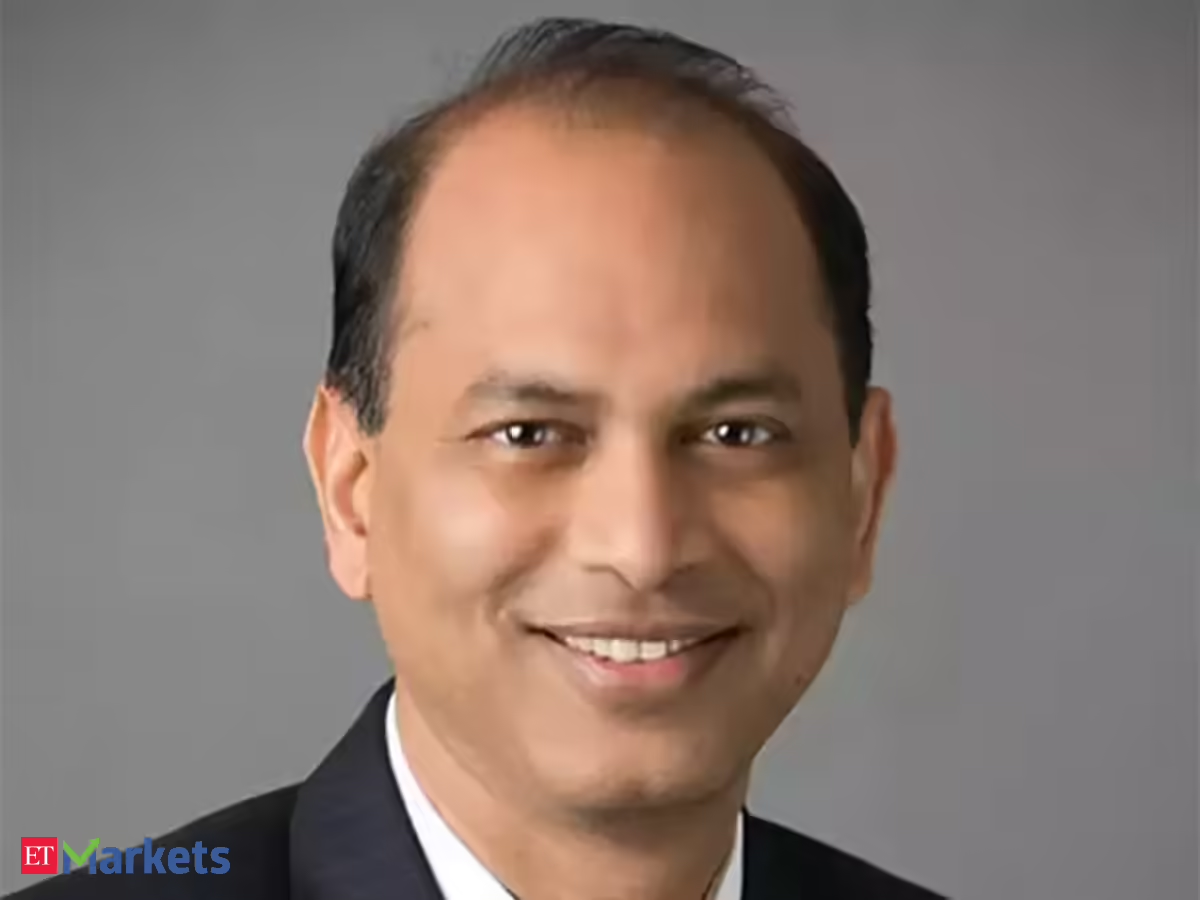
Sunil Singhania’s Abakkus Portfolio: 6 stocks rally up to 75% in CY26; 5 new buys added in Q4 – Abakkus Portfolio Snapshot

Published

on

Sunil Singhania’s Abakkus Portfolio: 6 stocks rally up to 75% in CY26; 5 new buys added in Q4 - Abakkus Portfolio Snapshot

Investors closely track the portfolios of leading market participants on Dalal Street. In this context, ETMarkets analysed the investment holdings of veteran investor Sunil Singhania’s Abakkus Asset Manager, a prominent Indian investment firm. Based on the latest shareholding data for the March 2026 quarter, Abakkus holds stakes in nearly 32 listed companies, with a combined portfolio value of around Rs 2,742 crore as of May 29, 2026. This represents an increase of approximately 6% from Rs 2,577 crore reported at the end of December 2025. The analysis includes only those companies in which the investor holds more than a 1% stake and may not represent the entirety of the portfolio.

A closer look at the portfolio’s CY26 performance reveals that a majority of the stocks have delivered negative returns. Among them, seven stocks have declined by more than 20% in the first five months of the year. On the other hand, a handful of holdings have emerged as strong performers. We highlight the top six gainers in the portfolio, which have rallied between 20% and 75% so far in CY26. The portfolio also witnessed six new additions during the March 2026 quarter. (Data Source: ACE Equity, Trendlyne).

Continue Reading

Business

Demand Conditions Improve In Chemicals Sector In April 2026

Published

on

Demand Conditions Improve In Chemicals Sector In April 2026

Demand Conditions Improve In Chemicals Sector In April 2026

Continue Reading

Business

Moderna, Inc. (MRNA) Presents at Bernstein 42nd Annual Strategic Decisions Conference Transcript

Published

on

OneWater Marine Inc. (ONEW) Q1 2026 Earnings Call Transcript

Moderna, Inc. (MRNA) Bernstein 42nd Annual Strategic Decisions Conference May 28, 2026 10:00 AM EDT

Company Participants

Stéphane Bancel – CEO & Director

Advertisement

Conference Call Participants

Courtney Breen – Bernstein Institutional Services LLC, Research Division

Presentation

Advertisement

Courtney Breen
Bernstein Institutional Services LLC, Research Division

Welcome, everyone. Thank you so much for joining us for this conversation about Moderna. My name is Courtney Breen. I am the U.S. pharma analyst here at Bernstein. And it is my privilege to have Stephane Bancel here with me, the CEO and Chairman of Moderna. He’s been in this role for a decent amount of time as well and has seen Moderna through the ages and through the different eras of the company. So I’m really excited to kind of have an opportunity to dive into kind of Moderna today, where Moderna has come from and where Moderna might be going in the future.

I also know that AI is a super important topic for all investors these days. So we’ll be hoping to touch on kind of the impact and potential of AI and drug discovery and kind of in operating some of these businesses. But I do also want to remind you that if there are other topics that I’m not planning on covering that you’d love to have covered in this conversation, please do send them through the Pigeonhole app. You’ll find a QR code to be able to send them through. I’ll receive them up here and can integrate them into the conversation. So we want to make this as relevant and as impactful for everyone that’s here.

Advertisement

Question-and-Answer Session

Courtney Breen
Bernstein Institutional Services LLC, Research Division

But without further ado, Stephane, again, thank you so much for joining us here today. As I mentioned, you’ve been leading Moderna for a while, I think, since 2011. It

Advertisement
Continue Reading

Business

Discipline, Football and Moving Forward

Published

on

Discipline, Football and Moving Forward

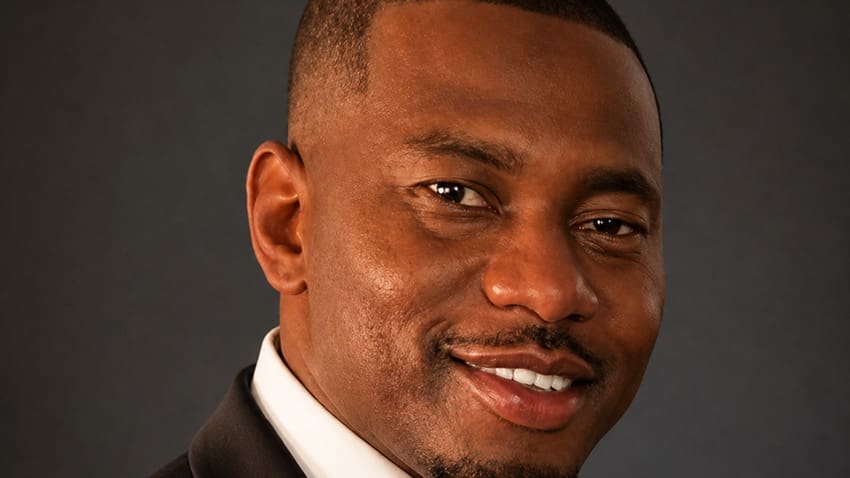
Therrian Fontenot is a former football athlete whose career has been built on discipline, resilience, and leadership.

Born in Louisiana and raised in Los Angeles, California, he developed a strong competitive mindset at an early age through sport. He attended Leuzinger High School, where he became known for his performance on the football field and graduated in 2000.

His success in high school earned him a full scholarship to Fresno State, where he competed at the collegiate level against some of the top athletes in the country. During his time there, Fontenot learned the importance of consistency, preparation, and accountability. He later made the decision to leave college early to pursue a professional football career, gaining experience in a highly competitive environment that demanded focus and mental toughness.

Throughout his journey, football remained more than just a career path. It became the foundation for the way he approaches life, leadership, and personal growth. Today, Fontenot continues to apply those lessons through fitness, discipline, and community involvement.

He is currently focused on developing Help2Others, an emerging charitable initiative centred on encouragement, personal growth, and giving back to others. Alongside his work in the community, he remains active through weight training and golf.

Advertisement

Fontenot’s story reflects perseverance, structure, and the belief that consistent effort creates long-term opportunities.

Q&A With Former Football Athlete Therrian Fontenot

Q: Let’s start at the beginning. What was life like growing up?

Therrian Fontenot:
I was born in Louisiana, but moving to Los Angeles really shaped my life. Growing up there taught me how competitive the world could be. Football became a major part of my identity early on. It gave me structure and something positive to focus on.

Q: When did you realise football could take you further?

Therrian Fontenot:
Probably during high school at Leuzinger. That’s when things became more serious. I started understanding that football could create opportunities for me beyond just playing the game. I worked hard every day because I knew scholarships were possible.

Q: What do you remember most about your time at Leuzinger High School?

Therrian Fontenot:
The discipline. The coaches expected a lot from us. You had to show up prepared. It wasn’t only about talent. It was about consistency and effort. Those lessons stayed with me long after high school ended.

Advertisement

Q: You earned a full scholarship to Fresno State. What did that achievement mean to you?

Therrian Fontenot:
It meant everything. Coming from where I came from, earning a full scholarship showed me that hard work really matters. Fresno State gave me the chance to compete at a high level and challenge myself against great athletes.

Q: How did college football change your mindset?

Therrian Fontenot:
College football teaches you accountability very quickly. Everybody was talented, so the difference came down to discipline and preparation. You learn how to manage pressure and expectations. That environment helped me mature.

Q: You eventually left college early to pursue professional football. What went into that decision?

Therrian Fontenot:
I believed I was ready for the next level. It was a difficult decision, but I wanted to pursue the opportunity while I had the chance. Playing professionally, even for a short time, taught me a lot about focus and resilience.

Q: What lessons from football still apply to your life today?

Therrian Fontenot:
The biggest one is consistency. Success doesn’t happen overnight. Football taught me that showing up every day matters, even when things get difficult. It also taught me how important teamwork is. Nobody succeeds alone.

Advertisement

Q: How would you describe your approach to leadership?

Therrian Fontenot:
Leadership starts with example. People pay attention to actions more than words. Whether it’s fitness, work ethic or helping others, I believe you have to stay disciplined yourself before you can guide anybody else.

Q: You remain very focused on fitness. Why is that important to you?

Therrian Fontenot:
Fitness keeps me mentally sharp and grounded. Weight training has always been part of my life. It helps me stay focused and maintain structure in my daily routine. Golf has also become something I enjoy because it teaches patience and concentration in a completely different way.

Q: Tell us about Help2Others.

Therrian Fontenot:
Help2Others is something I’m building because I want to give back. It’s still early, but the idea is simple. I want to encourage people, especially younger people, to stay disciplined, believe in themselves and keep pushing forward no matter what challenges they face.

Q: Why is mentorship and guidance important to you now?

Therrian Fontenot:
Because I know how much influence the right environment can have. Sports gave me direction. Not everybody has that structure in their life. If I can help somebody stay motivated or focused, that matters to me.

Advertisement

Q: What do you want people to take away from your story?

Therrian Fontenot:
I want people to understand that growth takes effort. There will always be setbacks, but discipline and consistency can carry you a long way. You have to keep moving forward and keep working on yourself.

Advertisement
Continue Reading

Business

Consumers Flash Some Warning Signs

Published

on

Consumers Flash Some Warning Signs

Consumers Flash Some Warning Signs

Continue Reading

Business

The Hidden Cost of Spreadsheet-Based HR Management for Growing UK Businesses

Published

on

Poorly designed and inadequately maintained workplaces are draining the UK economy of more than £71 billion a year, according to new research from facilities and security services company Mitie.

For many UK growing businesses, using spreadsheets is such an integral part of running a company is like using that noisy kettle that still works.

It’s what we always did, so why change? They are trusted, inexpensive (in the short term), and simple. You can fit everything onto one doc, with employee info on one tab, sick leave on another, expenses in a third, and their hours and salary on tabs beginning after “Sheet 1” (usually only fully understandable by one super user).

For a while, it seems like a perfect system. Then the business hires 10 more employees. One employee works from another location. A boss forgets to fill in a vacation planner. Unbeknownst to everyone, the once thought-up efficient plan is slowly doubling, as well as tripling, to add to time, money, and irritation.

The issue is not the spreadsheet, per se. The problem is that the company grows so big, spreadsheets are just too small on their own to contain it.

The Productivity Drain Nobody Notices

Manual HR doesn’t really fall over. It just slowly pours away your company’s margin every day.

Advertisement

Managers hunting down signed documents, updating the 5 locations where they keep employee records, and checking whether the “latest” version of a spreadsheet is actually the latest. HR admins are doing the same weekly manual tasks: copying data, approving leave requests from chain emails, and calculating absence values in a spreadsheet.

On their own, these little tasks don’t seem like much. Added up, they’re a tidy sum.

A growing company might be burning through dozens of hours every month on tasks like maintaining manual processes that should long since have been automated. All that time could be spent by managers on developing their staff, operational improvements, growth, or really anything other than knowing how to track down that contract the vendor sent a while ago that is almost definitely in the Generally Important Stuff 2019_Q3 folder titled “FINAL_v2_UPDATED” on the general drive.

But, most notably, as companies scale, inefficient manual processes compound. When a team is eight, maintaining a process may work fine, but by the time a company gets to 50 employees, it’s a frustrating mess.

Advertisement

Human Error Becomes a Business Risk

Spreadsheets are labour-intensive and are therefore prone to human error.

An out-of-date phone number may not seem serious until you need an emergency contact. A double entry in the payroll may provide uncomfortable conversations and headaches for the accountants. An incorrect holiday day entered in a spreadsheet can damage employee trust much faster than you may think.

The biggest problem is that unconnected systems introduce inconsistencies. A spreadsheet says an employee has completed the required training. Another sheet says they haven’t. One manager updates a record while the other keeps using the file they saved to their desktop three weeks ago.

This isn’t due to carelessness. This is what happens when there’s too much room for error.

Advertisement

Compliance Problems Can Escalate Quickly

Problems can grow quickly from bad to worse

Storing a few contracts in a shared drive just isn’t good enough.

You also need to keep on top of your employee files, manage right-to-work checks, make sure you’re tracking absence procedures, and keep sensitive data safe. If this information is spread out over a few spreadsheets, emails, and a couple of random systems, maintaining good compliance practices is going to be confusing at best.

Where documents are missing or records aren’t being generated, businesses open themselves up to unnecessary legal and financial risks. Even the smallest oversight can expand to cause real issues during audits, claims or disputes.

Advertisement

It’s another reason why businesses reach a point when manual processes quickly get out of hand, and they decide to look for dedicated UK HR software to manage.

That solution allows firms to centralise their records, automate reminders, and ensure that important documents aren’t getting buried in the depths of a filing cabinet.

Employees Notice More Than Businesses Think

Old, paper-based HR systems have a bigger impact on the employee experience than many leaders believe.

They see that their leave request has taken two days to approve because the right spreadsheet was buried three tabs down. They see when others’ induction processes are ad-hoc. They see themselves waiting three days for a response from HR. They see managers asking for information they already supplied for the second time.

Advertisement

These may sound like minor complaints, but they reflect the way employees perceive their employers. A company that isn’t buttoned up in its operational processes will have a hard time projecting external credibility.

In markets with healthy competition for talent, the operational efficiency of an organisation plays a significant role in effective employer branding. Workers now have an expectation that things will operate smoothly in a workplace, especially as many workplaces tout themselves as forward-thinking, corporate-minded or on a very aggressive growth trajectory.

Technology Creates Room for Growth

HR software is seen as a grudge purchase that businesses can get by without for now, but it’s an outlay that pays off in terms of efficiency and future growth.

Modern platforms cut out the busywork, reduce human error, ensure compliance with automatically enforced policies and shared digital records, and remove time-consuming HR headaches when you scale.

Advertisement

Spreadsheets have value, but relying on them entirely for HR often leads to creeping costs that go unnoticed for far too long.

Advertisement
Continue Reading

Business

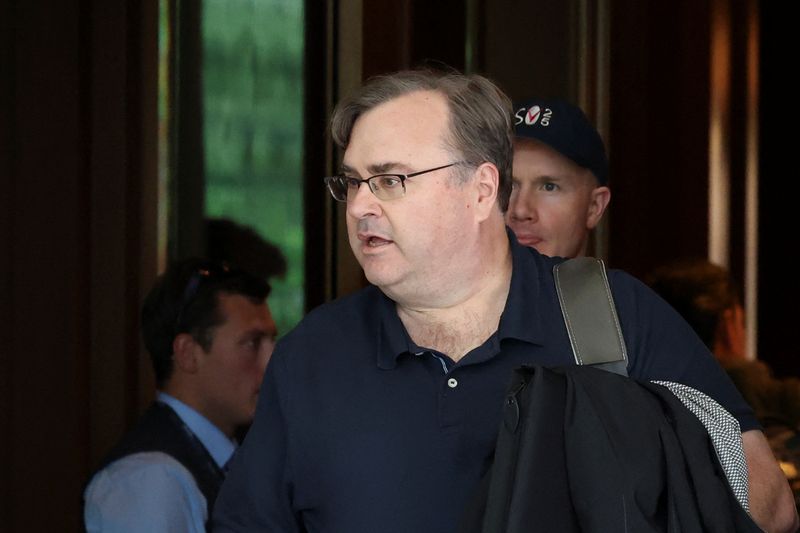
US probes Reid Hoffman group over funding lawsuits against Trump, source says

Published

on

US probes Reid Hoffman group over funding lawsuits against Trump, source says


US probes Reid Hoffman group over funding lawsuits against Trump, source says

Continue Reading

Business

California eases carbon market rules amid affordability concerns

Published

on


California eases carbon market rules amid affordability concerns

Continue Reading

Business

Marvell Technology: AI Growth Catalyst Is Kicking Off

Published

on

Marvell: Marvelous Return After Seven Months, Here Is My Strategy Going Forward (Rating Downgrade)

Marvell Technology: AI Growth Catalyst Is Kicking Off

Continue Reading

Business

ET Alpha Wealth Summit: Learn the secrets of finding alpha & what it takes to build a Rs 100 crore portfolio

Published

on

ET Alpha Wealth Summit: Learn the secrets of finding alpha & what it takes to build a Rs 100 crore portfolio
The ET Alpha Wealth Summit is set to take place on June 4 in Mumbai, where investors, market experts, and analysts will gather to discuss economic implications, opportunities, and market strategies, as well as the do’s and don’ts of market trading, in this one-of-a-kind event.

In a rapidly evolving financial markets landscape, the opportunities for market outperformance seem to be disappearing. However, the Alpha isn’t dead just yet, but is in fact, hiding in fewer, harder-to-find places.

In a market environment where it is becoming increasingly difficult to identify the Alpha, there is a need for careful evaluation of the conditions and pre-requisite factors that influence the decision-making process behind the right investment.

The session, ‘Is Alpha Dead? Or Just Harder to Find?’ will explore how one can identify where real outperformance still exists. The discussion will also focus on how to identify and avoid crowded, low-return trades, in retrospect of generating consistent excess value.

Advertisement

This panel will consist of leading industry experts such as Vikas Khemani, Devina Mehra, Prateek Agrawal and Kalpen Parekh, who will share their views and opinions regarding the subject. The Alpha isn’t gone; it’s just hiding in harder-to-find places, and through this insightful panel discussion, these ‘places’ will become clearer to identify.


Following this discussion will be a fireside chat with Radhika Gupta, MD & CEO, Edelweiss Mutual Fund. The session, ‘How to Build a ₹100 Cr Portfolio in a 10–12% World’, breaks down how to realistically build and compound a Rs 100 crore portfolio, through sharper allocation, disciplined risk, and avoiding the crowded trades that dilute returns.
In a market where easy gains are gone, it takes a broader mindset to understand the intricacies in building a portfolio that could compound to Rs 100 crore. The session will explore strategies for building long-term wealth and scaling one’s portfolio towards the Rs 100 crore milestone.These sessions will include practical takeaways on uncovering hidden sources of alpha, navigating crowded trades, and positioning portfolios for sustainable long-term returns in an increasingly complex investment landscape.

Continue Reading

Trending

Copyright © 2025