





Connect with us

Business

Fair Isaac Corporation: A Flawless Moat, But The 35x PE Leaves Little Margin For Error

Published

on

Fair Isaac Corporation: A Flawless Moat, But The 35x PE Leaves Little Margin For Error

Fair Isaac Corporation: A Flawless Moat, But The 35x PE Leaves Little Margin For Error

Continue Reading
Click to comment

You must be logged in to post a comment Login

Leave a Reply

Business

Calling ‘time’ the toughest of decisions

Published

on

Calling ‘time’ the toughest of decisions

Yes. Corporate subscriptions are available for teams and organisations, with discounted rates as user numbers increase. Pricing starts from $1,625 + GST per user.
Get in touch
to discuss the right option for your organisation.

Business News subscriptions are used by executives, investors, consultants and professionals who need to stay informed and make better decisions about the WA market. When you subscribe you’ll get

  • Unlimited access to WA’s most trusted business journalism
  • Data & Insights — detailed profiles of WA companies, people, projects and deals
  • MyBN — a personalised feed based on the companies, people and sectors you follow
  • Special publications and industry reports
  • Daily and weekly email newsletters

Data & Insights is a research tool built specifically for the WA market. It draws on more than 30 years of Business News reporting, updated regularly to reflect what’s happening now. Use it to:

  • Look up detailed profiles of WA companies, including financials, directors and ownership
  • Find decision-makers and track their career movements
  • Research live and completed projects across WA industries
  • Monitor deals, appointments and market activity
  • Access industry rankings and league tables

Data & Insights is updated daily by our dedicated research team, which uses the latest announcements, ASX filings and editorial coverage to keep our person, company, list and project records up to date.

Business News welcome all opportunities to make our dataset accurate, complete and current, so if you have an update request, please email the team at
general@businessnews.com.au, and we’d be happy to assist.

Advertisement

MyBN
is part of every subscription. It’s your personalised view of Business News. You can follow the companies, people, sectors and projects that matter to you, and get a news feed and alerts tailored to your interests. You can save articles to read later and retain only what you need.

Only subscribers have full access to all content on the Business News website.

Advertisement

If staying informed about the WA economy is part of your job, and/or you’re looking for networking opportunities in WA, Business News is built for you.

Business News subscribers are:

  • Executives and directors tracking competitors, clients and market movements
  • Investors and advisers researching companies, deals and industry trends
  • Consultants and professionals staying across sectors relevant to their clients
  • Business owners looking for leads, context and market intelligence

Most Business News publications cover national or global markets. Business News is focused entirely on Western Australia, which means the journalism, the data and the intelligence are all built around WA companies, people and projects — not adapted from a national feed. Data & Insights, included with every subscription, combines more than 30 years of WA-specific editorial research with live business data. There’s no comparable product for the WA market.

Advertisement

The Morning Digest Email provides a comprehensive wrap of the major headlines, relevant to WA business, and includes with a snapshot of the overnight news covering oil, gold and ASX-listed companies.

The Afternoon Wrap Email focuses on the news covered by our team of journalists during the course of the working day, including exclusive stories and analysis, all of which relates to WA business and the local economy.

The BN Weekender Email contains a wrap of the Business News from the week that was, highlighting the top stories in each area of WA business.
Sign up for free.

Advertisement

We’re happy to help.
Get in touch
and our team will come back to you.

Advertisement
Continue Reading

Business

Hospital parking hike in Essex only adds stress, patients say

Published

on

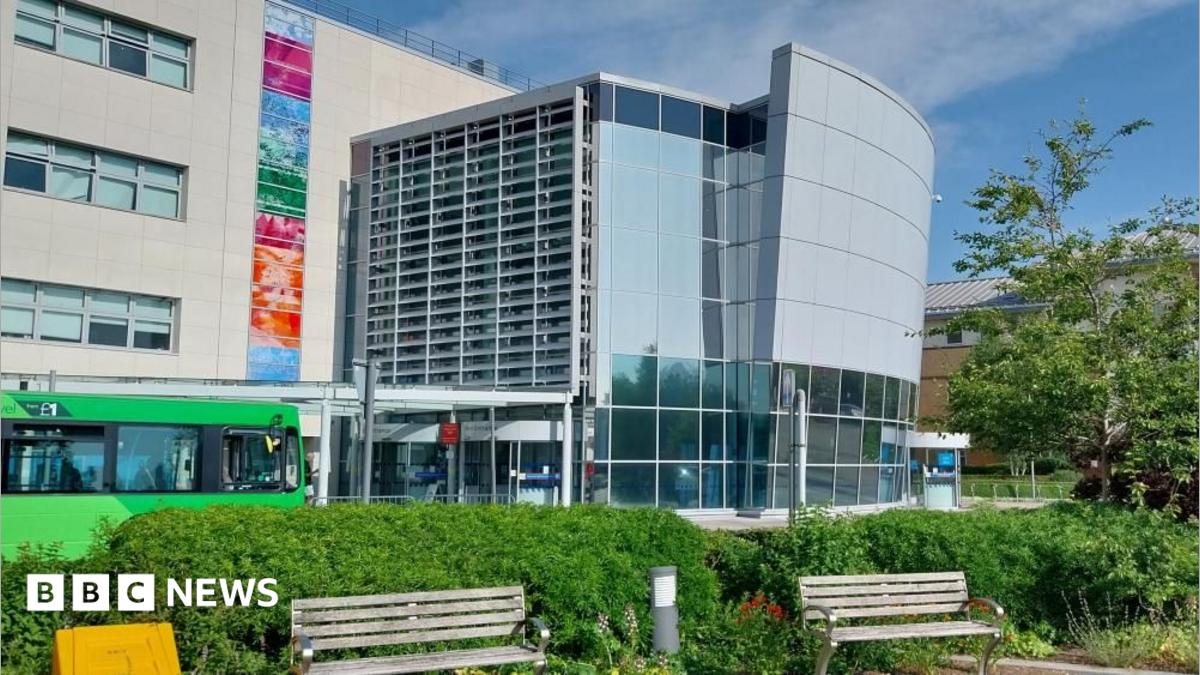
A large glass-fronted building with two park benches at its front. There is a green bus driving pass the entrance of the hospital.

Rosalind Wright has had two children at Broomfield Hospital and said parking was already a “nightmare” without the cost increase.

She estimated she had about 10 appointments for scans, vaccinations and blood tests, and spent between £50 to £100 to park the car.

The 39-year-old described the 20 minutes of free parking “pointless”.

“I think you’d be hard-pressed to find anybody that ever got in and out of Broomfield Hospital in 30 minutes, so it always seems like a bit of a pointless kind of advertisement,” she said.

Advertisement

“Your appointment’s never on time… I typically would pay three hours for what would probably be a five-minute appointment,” she said.

Some people living nearby the hospitals rent out their driveways to visitors.

JustPark is one platform that provides this service and it told the BBC that 35 spaces were listed within 2km (1.24 miles) of Broomfield Hospital, including six within 500m.

The spaces cost a daily rate of £6.15 on average, compared with £4.52 average daily rate to park elsewhere in Chelmsford.

Advertisement

Natasha Kerrigan, the chief estates and infrastructure officer for the MSENFT, said it was the first increase in three years and some visitors would not have to pay for parking.

She added patients and visitors could also apply for a weekly parking concession ticket.

“[Including] patients receiving chemotherapy, people visiting patients at the end of their life, birthing partners, carers supporting patients with dementia and disabled parking for Blue Badge holders.

“We recognise that any increase in charges is unwelcome, but the costs associated with operating and maintaining our car parks have increased,” she said.

Advertisement

Do you have a story suggestion for Essex? Contact us below.

Continue Reading

Business

Trump announces a deal for Hamas to disarm in Gaza, but many hurdles and uncertainty remain

Published

on

Trump announces a deal for Hamas to disarm in Gaza, but many hurdles and uncertainty remain
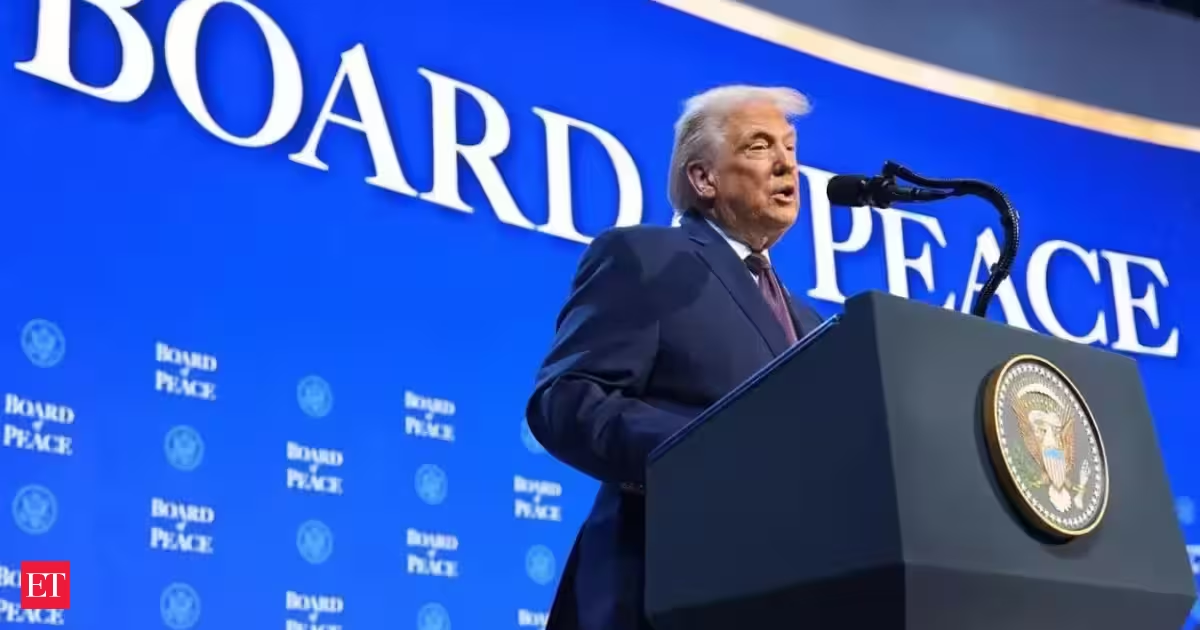
WASHINGTON – President Donald Trump said Thursday that a deal has been reached for Hamas to disarm and Israel to withdraw its forces from Gaza, but many hurdles, conditions and long timelines remained to wind down the war in the Palestinian territory. Neither Hamas nor Israel gave immediate indication that they had agreed.

The White House announcement comes nine months after a U.S.-brokered ceasefire was signed. Negotiations between Israel and Hamas had largely deadlocked over the implementation of its second phase, including the disarmament of Hamas and the reconstruction of Gaza.

“The agreement will be carried out in carefully structured phases,” Trump said on social media. “As disarmament is completed, Israeli forces will withdraw, and the International Stabilization Force will work with a new Palestinian police force to take responsibility for Gaza being safe for its residents and its neighbors.”

Trump’s 20-point ceasefire plan calls on the Iran-backed militant group to surrender its weapons and destroy its vast network of tunnels. It also envisions Israeli forces withdrawing from Gaza, the arrival of a new technocratic Palestinian government, deployment of an international security force and the rebuilding of the battered Palestinian enclave after more than two years of war.

But Hamas had insisted on implementing the first phase before moving to discuss its weapons. The group’s founding charter calls for armed resistance against Israel, and it has been reluctant to give up an arsenal, including rockets, anti-tank missiles and explosives, that lies at the heart of its identity.

Advertisement


Hamas announced earlier this month that it had dissolved its government in Gaza and was preparing to transfer power to a technical committee backed by the United Nations as part of the ceasefire deal.
U.S. and Board of Peace officials, describing the deal to reporters on condition of anonymity under guidelines set by the White House, gave an extremely optimistic assessment of the agreement that laid out a scenario very similar to the one described by Trump and his top aides when the Board of Peace, an international body established by Trump to oversee the ceasefire in Gaza, was first formed.The officials were unable to offer specific timelines for the disarmament of Hamas or other groups that operate in Gaza such as Palestinian Islamic Jihad, but said the Gaza police force would turn over weapons to the technocratic Board of Peace-backed Gaza administration in the next two weeks.

The Gaza police force, however, does not include the vast majority of Hamas militants and heavy weaponry is not included in that part of the agreement, according to the officials.

Instead, the surrender of heavy weapons and the decommissioning of Hamas tunnels and other infrastructure are to come later in a process that could take between 200 and 350 days, a Board of Peace official said.

A U.S. official said that Israel, which has been deeply skeptical about Hamas’ willingness to give up its guns or relinquish at least behind-the-scenes control of Gaza, had been consulted at every step of the negotiation.

However, the official said Israel was not being asked to do anything more than what it had initially committed to when it agreed to Trump’s 20-point plan, which essentially involves withdrawing its forces from Gaza and committing to ending airstrikes on the territory.

Advertisement

Israel’s U.N. Mission said it had no immediate comment.

The official added that Hamas sponsor Iran remains a wildcard in the equation because although it counseled Hamas members not to accept a deal, it is also not in a position to offer the group much support because it is preoccupied with the conflict with the United States.

The war in Gaza began after the Hamas-led attack on southern Israel on Oct. 7, 2023, killed around 1,200 people and saw 251 taken hostage. Israel’s retaliatory offensive in Gaza has killed more than 73,000 Palestinians, including those killed since the ceasefire, Gaza’s Health Ministry said.

Israel’s military now controls more than half of Gaza, leaving Palestinians confined to squalid tent camps and heavily damaged urban neighborhoods.

Advertisement
Continue Reading

Business

South Korea’s Kospi index jumps more than 16% on a surge of chipmaking stocks

Published

on

South Korea’s Kospi index jumps more than 16% on a surge of chipmaking stocks
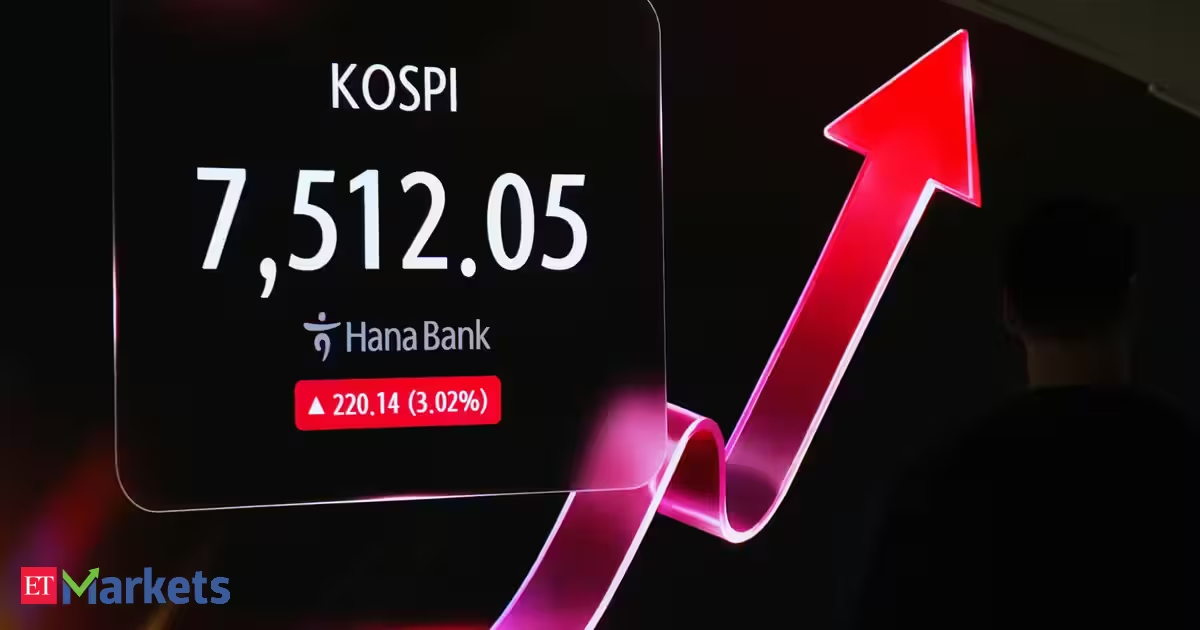
South Korea’s Kospi index jumped more than 16% on Friday, tracking gains on Wall Street as artificial intelligence-related stocks bounced back after losses earlier this week.

U.S. futures edged higher and oil prices slipped.

In early Asian trading, the Kospi surged at the open and ratcheted up, trading 16.5% higher before giving up some of those gains. By midday it was up 14% at 6,376.68. Shares of South Korean technology giant Samsung Electronics surged 21%, while memory chipmaker SK Hynix soared 24.6%.

The Kospi index had sunk more than 17% in the previous three days as investors dumped technology stocks in part over worries about an AI bubble and rising competition from chipmaking and AI rivals in China.

Advertisement

The rebound followed Microsoft’s report Thursday of stronger than expected profits for the last quarter. Microsoft’s shares soared 15.5% for its best day in nearly 18 years. The strong earnings were taken as a signal that big spending on AI is translating into profits.


Traders flooded back into the market to snap up shares in tech companies that had recently swooned over doubts that the huge investments will yield adequate returns.
Despite the big jump Friday, the Kospi remains well below the peak of over 9,000 that it hit in June.Tokyo’s Nikkei 225 climbed 4.4% in early Friday trading, to 64,572.25. Multinational investment holding company and OpenAI-investor SoftBank Group jumped 15%, while chip equipment maker Tokyo Electron rose nearly 11%.

“The market went from throwing AI stocks overboard to fighting for the remaining seats before most traders had finished writing the obituary,” Stephen Innes of SPI Asset Management said in a commentary.

The dollar fell sharply against the Japanese yen overnight due to suspected intervention in the market after weeks of it trading above 160 yen, near 40-year highs.

Japan’s Nikkei financial newspaper said the intervention was coordinated, with the Federal Reserve Bank of New York conduction what is known as a “rate check” in which it asks various banks to provide exchange-rate quotes for currency trades.

Advertisement

The Treasury Department did not respond to requests for comment. Japanese Finance Minister Satsuki Katayama also declined to comment.

After dropping more than 2.4%, the dollar bounced back early Friday, gaining 0.6% to 160.61 yen.

The Bank of Japan opted to keep interest rates unchanged Friday as it wrapped up a policymaking meeting. That was expected. Analysts said the suspected intervention may have been timed to pre-empt speculative moves linked to the central bank’s decisions.

“Intervention in support of the yen may not work any better now than it has previously, but the persistence of the Japanese authorities suggests to us that the yen will remain around the 160 level this year before staging a more sustained rebound next year,” Jonas Golterman of Capital Economics said in a commentary.

Advertisement

The Federal Reserve likewise kept its benchmark rate unchanged at its policy meeting this week. A gap between interest rate levels in Japan and the U.S. has been a key factor behind the yen’s weakness.

The euro fell to $1.1513 from $1.1524.

Elsewhere in Asian share trading, Taiwan’s Taiex surged more than 7%. Australia’s S&P/ASX 200 added 0.4%, to 8,997.50.

Hong Kong’s Hang Seng edged 0.1% higher, to 25,894,21, while the Shanghai Composite index advanced 0.6% to 3,828.00.

Advertisement

Oil prices traded lower as tensions between the U.S. and Iran keep the Strait of Hormuz, a key waterway for oil transport, largely closed.

Brent crude, the international standard, was down 1.3% to $85.76 per barrel. It was trading near $72 a barrel before the Iran war began in late February.

Benchmark U.S. crude was down 1.5% to $82.32 a barrel.

ING commodities analysts said Friday that there were signs of increased oil flows through the Strait of Hormuz, which helped ease the pressure on oil supply, with ship tracking data showing tanker crossings grew slightly, though the numbers were still limited.

Advertisement

On Thursday, Wall Street’s benchmark S&P 500 gained 1.7% to 7,437.63. The Dow Jones Industrial Average added 1.2% to 52,208.06. The technology-heavy Nasdaq composite rose 2.8% to 25,122.18.

Continue Reading

Business

South Korean shares surge after chip stock rout

Published

on

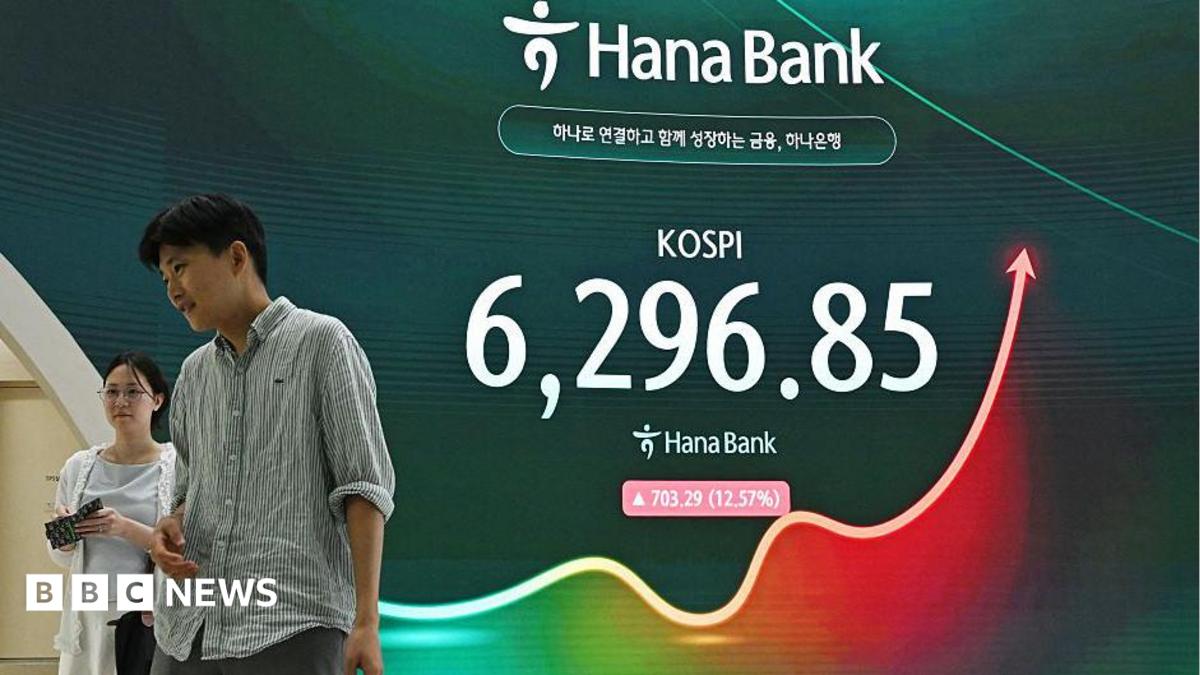
A man and a woman walk past an electronic screen showing 31 July's Kospi trading figures

Share prices jumped in South Korea on Friday, partly reversing a three-day rout that wiped hundreds of billions of dollars off the value of the country’s stock market.

The benchmark Kospi index was almost 17% higher in afternoon trading, driven by chip makers SK Hynix and Samsung Electronics.

It came after earnings updates from US technology giants Amazon and Microsoft helped boost optimism over the huge amounts of money being invested in artificial intelligence (AI). South Korean regulators have also announced measures aimed at curbing this week’s sell-off.

Surging chip stocks also helped push markets in Japan and Taiwan higher.

Advertisement

SK Hynix, which is a major supplier to leading AI chip firm Nvidia, saw its shares gain more than 17%, while Samsung was up by 23%.

Both firms had seen their stock market value slump this week as a sell-off in artificial intelligence-related stocks deepened.

Investors had become concerned over the hundreds of billions of dollars being invested in AI by big technology firms.

In recent months stock market trading has been particularly volatile in South Korea as it has attracted large numbers of retail investors.

Advertisement

South Korea’s tech-heavy Kospi has been halted multiple times this year under a stock market mechanism known as a circuit breaker, which is designed to calm panic selling.

The index had more than doubled in value this year and despite a series of big falls since hitting a record high in mid-June it is still 50% higher than it was at the end of 2025.

Continue Reading

Business

FMC Corporation (FMC) Q2 2026 Earnings Call Transcript

Published

on

OneWater Marine Inc. (ONEW) Q1 2026 Earnings Call Transcript

Operator

Ladies and gentlemen, thank you for joining us, and welcome to the Second Quarter 2026 Earnings Call for FMC Corporation. This event is being recorded. [Operator Instructions] I will now hand the conference over to Mr. Curt Brooks, Director of Investor Relations for FMC Corporation. Please go ahead.

Curt Brooks
Director of Investor Relations

Advertisement

Good morning, and welcome to FMC Corporation’s 2026 Second Quarter Earnings Call. Today’s prepared remarks will be provided by Pierre Brondeau, Chairman, Chief Executive Officer and President; and Andrew Sandifer, Executive Vice President and Chief Financial Officer.

After prepared comments, we will take questions. Our earnings release and today’s slide presentation are available on the FMC Investor Relations website, and the prepared remarks from today’s discussion will be made available after the call.

Let me remind you that today’s presentation and discussion will include forward-looking statements that are subject to various risks and uncertainties concerning specific factors, including, but not limited to, those factors identified in our earnings release and in our filings with the Securities and Exchange Commission. Information presented represents our best judgment based on today’s understanding. Actual results may vary based on these risks and uncertainties.

Today’s discussion and the supporting materials will include

Advertisement
Continue Reading

Business

Metro Mining Limited (MMILF) Q2 2026 Earnings Call Transcript

Published

on

OneWater Marine Inc. (ONEW) Q1 2026 Earnings Call Transcript

Peter Taylor
NWR Communications Pty Ltd

Good morning, everybody. Thank you for joining us. We have the June quarter webinar report delivered by CEO of Metro Mining, Mr. Simon Wensley; and the CFO, Nathan Quinlin.

Simon will go into a discussion of the activities of the quarter and the outlook, and we’ll have time for some Q&A at the end. This video will be recorded and available for distribution.

I’ll hand it over to you, Simon.

Advertisement

Simon Wensley
CEO, MD & Director

Thank you, Peter, and hello to everybody. Good morning, afternoon, wherever you are. Thank you for joining as ever and support your support of Metro Mining.

So, look, I will, as usual, sort of share on the screen the release that we put out this morning, and I hope we can see that. Yes. So, I’ll walk through this. And as Peter said, if there are any questions, put them through the chat function, and we’ll try and get to them at the end.

Advertisement

So, look, a record quarter from a tonnage point of view. I’m pleased with that outcome given that we had mobilized in March to try and get an early start, and then that was — that effort was stymied by a large cyclone which came across the Cape. We didn’t get much damage or any damage on the site at all. But obviously, the shipping channel was affected by what were quite significant waves.

And so, we were able, though, I think, to come back online in April quickly and address — I think we learned a lot from last

Advertisement
Continue Reading

Business

Holcim upgrades 2026 outlook after strong Q2 profit growth

Published

on


Holcim upgrades 2026 outlook after strong Q2 profit growth

Continue Reading

Business

Rain the key as WA looks to another record crop

Published

on

Rain the key as WA looks to another record crop

Western Australia could be on track for another record crop this year, though achieving that will depend heavily on better rainfall in August.

Continue Reading

Business

Optimism injection across North East companies as capital investment intentions revealed

Published

on

Business Live

Two well regarded pieces of research published this week point to positive signs among North East businesses

The Lloyds Business Barometer for April shows an increase in business confidence across the North East.

The latest Lloyds Business Barometer indicates that North East firms’ confidence is outstripping those in other regions.

North East firms reported increased confidence this month thanks to feelings about their own trading and the wider economy’s performance.

Research from Lloyds Business Barometer showed North East sentiment rose 21 points to 75%, compared with 54% in June. Companies experienced significantly higher confidence in their own trading outlook month-on-month, up eight points at 80% and optimism in the economy was up 34 points to 70%.

Improved outlook on the economy was said to have been driven by better economic data or news (52%) and improving inflation or cost measures (44%). Meanwhile confidence in their own trading outlook was driven by increased investment in capacity or technology (53%) along with improved economic conditions (43%).

A net balance of 50% of businesses in the region also said they expect to increase staff levels over the next 12 months – up four points on June. Looking ahead, respondents to the longstanding survey, said the top target areas for growth were technology, including AI and automation (55%); entering new markets (45%) and evolving their offering, including launching new products or services (37%).

Advertisement

Business confidence in the North East now sits above the 12-month average of 58%, with this month seeing its highest figure of 75%. Nationally, UK business confidence was up five points in July to 49% – a four-month high – driven by increased optimism about the economy thanks to falling global energy prices, the Bank of England holding interest rates and the announcement of an interim peace agreement in the Middle East at the time of the survey.

Martyn Kendrick, regional director for North East at Lloyds, said: “It is fantastic to see North East business confidence reach such a high, underlining the strength, ambition and resilience of firms across the region. Even more encouragingly, that optimism is being matched by clear plans for growth. Businesses are looking to invest in AI and automation, explore new markets and expand their teams over the year ahead.

“This record level of confidence reflects the real momentum building across the North East, and we will continue to support businesses as they invest, grow and seize the opportunities ahead.”

The Business Barometer findings come shortly after a separate piece of Lloyds research, which suggests more than half of North East firms plan to increase capital investment over the next year. That put the region above the 47% UK average, and on a similar level to London and the South East, with just 7% of firms expecting a decrease.

Advertisement

Amanda Murphy, CEO for Lloyds Business and Commercial Banking, said: “Despite heightened geopolitical uncertainty, it’s encouraging to see businesses planning to increase their capital investment. Firms need the right conditions to invest – whether that’s investing in AI, new technology, upgrading equipment or expanding capacity. It’s interesting that, while many businesses have already secured funding for investment, a significant proportion have yet to deploy it.

“Investment drives productivity, competitiveness, and long-term growth. Ensuring businesses have the confidence, funding and support to move forward will be critical. By helping firms unlock investment, we can support growth, boost productivity and strengthen the UK’s economic outlook.”

Continue Reading

Trending

Copyright © 2025



















