Connect with us

Business

Football club could be forced to leave home of more than 100 years

Published

on

Business Live

Prescot Cables FC says there are concerns over Valerie Park main stand

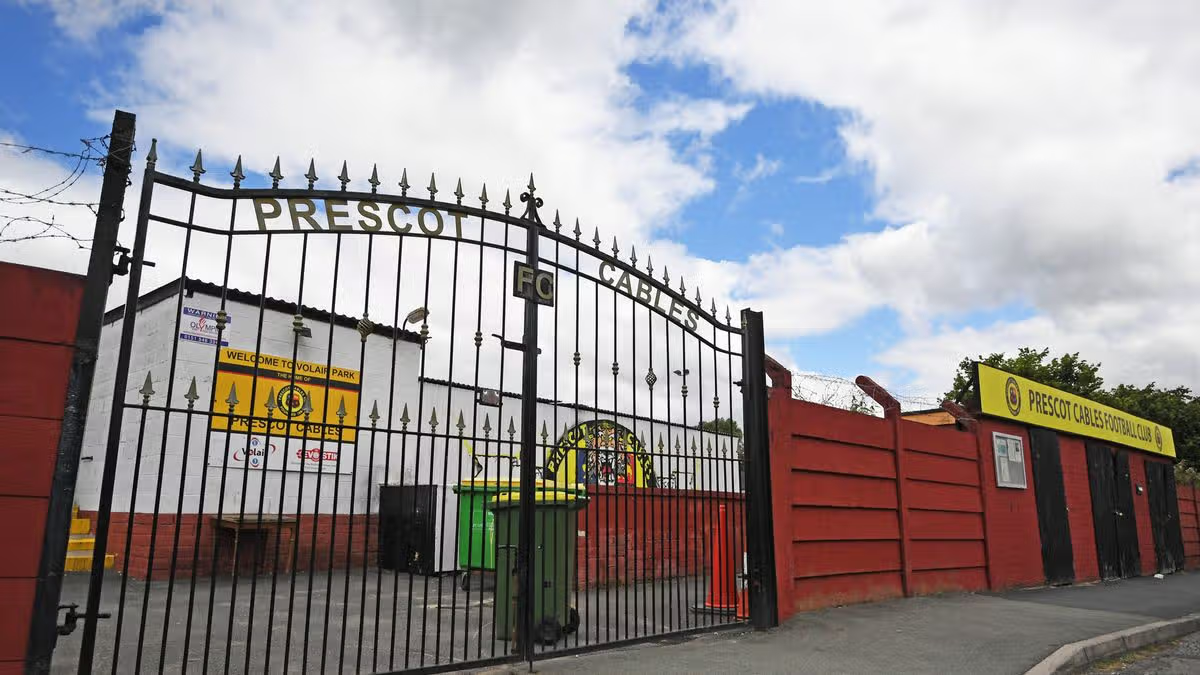
Prescot Cables FC in Prescot

Prescot Cables FC in Prescot(Image: Photo by Colin Lane)

A Merseyside non-league football club could be forced to relocate as soon as next season after it was revealed its main stand must be rebuilt or replaced within the next three years. Prescot Cables FC, who play in the Northern Premier League West, released a statement on Monday evening revealing how the board of directors may need to consider moving out of the town amid concerns around the sustainability of its main stand at Valerie Park.

Advertisement

The 142-year-old club said any long-term solution is likely to require substantial investment, either to undertake a major refurbishment of the existing structure or, alternatively, to consider a complete rebuild. As a result, Cables are now in discussions with Knowsley Council and the club’s landlord regarding the possibility of relocating from the area it has called home for 116 years.

Knowsley Council has now confirmed to the LDRS the main stand, which envelopes the club house at the ground, will need to be rebuilt or replaced within the next three years as it is “nearing the end of its life.” Cllr Graham Morgan, council leader, said the club has no funding plan in place for required works.

In a statement released on Monday evening, the fan-owned club’s board said it was now faced with “an important decision regarding the future of the stand.” It added: “Given the scale of the challenge, the club is exploring all available options to ensure a sustainable future for Prescot Cables.

“As part of this process, we are in discussions with the local authority and the club’s landlord regarding the possibility of relocating the club to an alternative venue. Such a move could potentially be on a temporary or permanent basis, depending on the options available and the outcome of the discussions.

Advertisement

“While no final decision has been made, it is important that supporters are aware that a relocation could potentially take place as soon as next season.” The club – who sit seventh in the table following their relegation last season – said the directors appreciated the news of a possible move “may raise questions and concerns among our supporters” and any decisions would be made “with the long-term interests and sustainability of Prescot Cables Football Club firmly at heart.”

The board added: “Prescot Cables has a proud history and an important place within the local community. Our priority is to find a solution that allows the club to continue to grow, develop and provide a sustainable future for generations of supporters to come.”

Knowsley Council stepped in to secure the future of Cables in 2018 when it bought the ground for £300,000 from private ownership and granted the club a 99 year lease. Cllr Morgan confirmed talks were underway over the club’s future.

He said: “Since then, we have supported the club in making improvements to Valerie Park and bring the ground up to the standards required by the Football League. This has included providing the club with a loan of £63,000 to enable them to secure funding for £200,000 of ground improvements – via the Premier League Stadium Fund.

Advertisement

“This has funded work at the ground to meet the grading requirements associated with playing Step 3 of the Non-League System. Following a recent independent assessment, it is clear that the main stand is nearing the end of its life.

“Within the next three years it will need replacing/rebuilding at a significant cost and currently the club has no funding plan in place to cover this. We are working closely with the club to support them in identifying funding sources and developing a future plan for Valerie Park.

“While this does regrettably mean some uncertainty in the short term what is absolutely clear is that both the club and the council – and the wider community too – want to see Prescot Cables remain in the town for now, and for generations to come.”

Advertisement
Continue Reading
Click to comment

You must be logged in to post a comment Login

Leave a Reply

Business

UK’s third-biggest taxpayer to leave for Greece

Published

on

UK's third-biggest taxpayer to leave for Greece

Chris Rokos, the hedge fund billionaire ranked third on The Sunday Times list of Britain’s top taxpayers after paying £330m last year, has decided to leave the UK for Greece and plans to open an office in Athens, according to reports first published by Bloomberg.

His representatives declined to comment, and his reasons for the move are not publicly known.

Greece allows foreigners who meet certain criteria to pay a flat annual tax of €100,000 (£86,000) on all overseas income, however much they earn.

Rokos’s departure follows that of the steel magnate Lakshmi Mittal, who moved his tax residency to Switzerland after the abolition of non-dom status, as Business Matters has reported.

Advertisement

A government spokesperson said: “The UK remains an attractive destination for talent and investment.” The spokesperson added that “the chancellor has made wealth creation one of his top priorities” and that the UK has “a competitive and stable tax system, deep capital markets, world-class universities and a highly skilled workforce”.

Dan Neidle, the founder of the think tank Tax Policy Associates, told the BBC’s Today programme that the £330m in tax revenue the UK could lose was “quite a lot of money”. “It is enough to fund 4,500 teachers… we have entire taxes that raise less than £330m,” he said. “He will probably pay almost nothing in Greece, and we can’t compete with that.”

Neidle said there were “no easy answers and no good statistics” on the question of ultra-wealthy taxpayers leaving the UK. The Treasury has some estimates of the number of wealthy people departing, he said, but otherwise there are few facts about the true scale of the revenue loss. “We have lots of anecdotes… what we don’t really have is data,” he said.

He said the government needed to “give certainty” to ultra-wealthy people living in the UK, arguing that repeated changes to the non-dom regime, which was abolished and replaced with a residence-based system from 6 April 2025, and reports of a possible wealth tax did not help. “Stop rumours, stop tinkering,” he said.

Advertisement

Rokos’s decision comes ahead of the chancellor John Healey’s first budget on 28 October. In an interview with the BBC on 7 September, Healey did not rule out tax increases, with a recent rise in government borrowing costs adding pressure on the public finances.

He refused to comment on any decisions about tax, promising only to “balance the books” and “control public spending”.

In March 2026, Rokos said he would donate £190m to the University of Cambridge, which described the sum as “the largest single donation made to a British university in modern times”. The money will be used to create a school of government named after him, with the aim of training leaders of the future, and it is set to open in autumn 2026.

Announcing the gift on 31 March, the university said Rokos had agreed an initial £130m, with further gifts of up to £60m to be matched by Cambridge. Its announcement described him as the founder of Rokos Capital Management, which manages more than $22bn, and a founding partner of Brevan Howard Asset Management.

Advertisement

Despite the donation to Cambridge, Rokos is an Oxford graduate, having studied mathematics at Pembroke College. He attended a state primary school before winning a scholarship to Eton College.


Amy Ingham

Amy Ingham

Amy Ingham is a reporter at Business Matters, covering UK business news with a focus on breaking news, business policy, late payments and insolvency. She joined the magazine in 2026 after completing the NCTJ Diploma in Journalism at Harlow College’s journalism school. Her recent reporting includes British Steel’s nationalisation and its impact on SME suppliers, the decline in late payments by large firms, and Insolvency Service director disqualifications. Reach her at aingham@cbmeg.co.uk.

Advertisement
Continue Reading

Business

The Easy Home Buyer Builds a Homeowner First Culture Through Trust and Accountability

Published

on

The Easy Home Buyer Builds a Homeowner First Culture Through Trust and Accountability

The Easy Home Buyer has grown in a business where speed often gets the most attention. Cash offers, fast closings, and as-is sales are usually the visible parts of the company’s work. Chad Young has tried to build something less visible but more lasting: a culture that teaches its team to understand the homeowner first.

That distinction matters. Many sellers who contact a direct home buyer are not simply comparing numbers. They may be facing an inherited property, divorce, foreclosure, costly repairs, a tenant problem, or a family transition. Some need someone to explain whether a cash sale is even the right option.

Young’s view is direct. The Easy Home Buyer should be “advisors first and house buyers secondly.” That idea has shaped hiring, training, leadership development, vendor relationships, and the way the team communicates with sellers across the Spokane and Coeur d’Alene area.

A Business Built Around Listening

Advertisement

The Easy Home Buyer began with Chad and Bree Young after years of operating Young’s Quality Cleaning. That earlier business taught them the satisfaction of improving neglected spaces and seeing a finished result. In 2020, they bought their first home to renovate and resell. The process gave them a new way to apply the same instinct: solve a practical problem, improve a property, and leave something better behind.

Company materials describe the first seller, Penny, as an important part of that origin story. She needed to move back to Seattle after a difficult season, and she wanted a simple way to leave her house behind. The transaction mattered, but the conversation mattered more. Chad listened, asked what would help, and came away with a deeper understanding of what the company could become.

The lesson was straightforward: sellers often need relief before they need a sales pitch. They need someone to ask the right questions, explain the tradeoffs, and respect the decision that follows. That lesson became one of the quiet building blocks of the company’s operating culture for its team as it grew locally.

Advisors First, Home Buyers Second

Advertisement

Young does not believe every homeowner needs a cash offer. That principle is central to the company’s culture because it changes the starting point of every conversation.

Instead of leading with a purchase price, the team is trained to ask questions. What is the seller’s timeline? What condition is the home in? Is the homeowner trying to avoid repairs, settle an estate, resolve a title issue, or move quickly because of a life change? Could listing the home make more sense? Would another option produce a better outcome?

Young has said the company wants homeowners to have enough information to make a qualified decision. That includes explaining when an as-is cash sale may produce a similar net result to a traditional listing after repairs, commissions, closing costs, taxes, and other fees are considered. It also includes acknowledging when a direct sale is not the best path.

That approach places education before conversion. It also requires discipline. A company cannot claim to be homeowner-first if every conversation is treated as a transaction to be won. The Easy Home Buyer has built its reputation around the belief that the right recommendation may sometimes be the one that does not lead to a purchase.

Advertisement

Hiring For Character Before Skill

For Young, culture starts before a person is hired. He believes skill sets can be trained, but character cannot be manufactured after the fact.

That belief affects the interview process. The company looks for emotional intelligence, steadiness, and the ability to communicate with people who may be under pressure. Experience in real estate can help, but it is not treated as the only measure of fit. In a business built around sensitive conversations, the wrong temperament can create problems no script can fix.

The Easy Home Buyer’s team often enters situations where people are overwhelmed, frustrated, embarrassed, or unsure whom to trust. A seller may be dealing with deferred maintenance. Another may be sorting through a family estate. Another may be managing foreclosure or divorce. The employee sitting at the kitchen table has to know more than numbers.

Advertisement

That is why Young places such weight on character. A person can learn how to estimate repairs, review comparable sales, or explain a closing timeline. It is harder to teach patience, tact, and judgment to know when a seller needs space to talk before decisions are made.

Training People For Hard Conversations

The Easy Home Buyer also supports its team through leadership coaching. Young has brought in coaches to speak with staff about emotional intelligence, difficult conversations, empathy, and tact. The goal is not to make employees sound polished. It is to help them communicate in the way each homeowner needs to be addressed.

This matters because direct home buying can involve high-stakes conversations. The seller is often making a decision tied to memory, family, money, and pressure. A rushed answer can make the process feel impersonal. A vague answer can create mistrust. A defensive response can turn a difficult moment into a worse one.

Advertisement

Leadership coaching gives the team a shared language for those moments. It reinforces company values and gives managers a way to develop people beyond technical ability. Over time, that training helps create a more consistent customer experience.

Technology That Protects The Human Element

Young sees technology as useful, but not as a substitute for human contact. The Easy Home Buyer uses AI and other tools to improve response times, prepare documents, check for errors, and keep internal processes moving. In that sense, technology helps the company become more organized and responsive.

Yet Young’s view is that technology should create more room for people, not less. If software reduces administrative work, team members can spend more time understanding a seller’s needs. If documents are reviewed faster and more accurately, the team can focus on the conversation rather than the paperwork.

Advertisement

The company’s business still depends on the face-to-face element. Young has described sitting across from homeowners at their dinner table as part of the foundation of the company. Technology can support the process, but it cannot replace trust built in person.

Accountability As A Service Standard

When asked what makes a successful real estate investment company from the homeowner’s perspective, Young gave a simple answer: do what you say you are going to do when you say you are going to do it.

The Easy Home Buyer’s core value of “Full Ownership” connects with that idea. Accountability is not only about fixing mistakes after they happen. It is about taking responsibility for the process from the beginning. It means being clear about what the company can do, what it cannot do, and what the homeowner should expect next.

Advertisement

The company’s other values support the same direction. “You Matter More” keeps the seller at the center. “Everyone Wins” pushes the team toward fair outcomes. “Continual Improvement” creates room to listen and adjust. “Be a Blessing” reflects the company’s intent to leave a positive mark on each interaction.

Problem Solving Beyond The Cash Offer

Young describes problem solving as the definition of what the company does each day. Few properties come with identical circumstances. Some homes need major repairs. Others involve squatters, messy title issues, difficult timelines, or family members who complicate the sale.

After hundreds of local transactions, The Easy Home Buyer has learned that solving the homeowner’s problem may require more than buying the house. One recent example involved a seller whose relative was living in the property and would not leave. The team helped move the relative into another company-owned home on a short-term lease, provided moving assistance, and connected him with a property management company to help find a longer-term rental.

Advertisement

Local Relationships With A Purpose

The Easy Home Buyer’s relationships with attorneys, contractors, title companies, and other local professionals also serve homeowners. Young has said the company’s volume and vendor relationships can help it close faster and keep renovation budgets lower. Those savings can affect the strength of the offer and the certainty of the process.

Local experience matters, too. The company presents itself as family owned and locally operated, with roots in the Coeur d’Alene and Spokane area. That local identity shapes how Young talks about the work. These are not distant markets on a spreadsheet. They are neighborhoods where team members live, raise families, and plan to stay.

A Culture Built To Serve Homeowners

Advertisement

The Easy Home Buyer’s growth has not moved it away from its original mission. Chad Young has built a company that hires for character, trains for empathy, uses technology with restraint, and measures service through accountability. The model still involves buying and renovating houses, but the larger culture is built around helping homeowners make informed choices. That is the point Young continues to reinforce: the company can grow, handle more complex projects, and serve more people without losing the human standard that made the work matter in the first place.

Continue Reading

Business

NSE IPO likely to open on September 18, list on September 25: Sources

Published

on

NSE IPO likely to open on September 18, list on September 25: Sources
The nearly Rs 30,000-crore initial public offering (IPO) of the National Stock Exchange is likely to open for public subscription on September 18, and list on September 25, sources said on Tuesday.

The price band for the IPO is expected to be announced on September 15, followed by the anchor book on September 17, they said.

The public issue is likely to remain open on September 18, September 21 and September 22.

There is no official announcement on this issue calendar by the bourse.

The issue, which could raise around Rs 30,000 crore, is set to surpass Hyundai Motor India‘s Rs 27,870-crore offering in 2024 to become India’s largest IPO, the sources said.

The IPO will comprise an offer for sale (OFS) of up to 148.9 million equity shares of face value Rs 1 each, representing nearly 6 per cent of NSE’s paid-up equity capital.
There will be no fresh issue of shares, meaning the exchange itself will not receive any proceeds from the offering, they said.
The proposed timeline has so been fixed to ensure that NSE shares debut before the 16-day lunar period ‘Pitru Paksha’ begins on September 26, they said.

The IPO has been in the works for nearly a decade and received crucial regulatory clearance from Sebi earlier this month, paving the way for the exchange’s long-awaited market debut, the sources said.

Advertisement

NSE is India’s largest stock exchange by trading activity and operates the benchmark Nifty 50 index. It is also the world’s most active derivatives exchange in terms of the number of contracts traded.

According to reports, Bank of Baroda is likely to divest 35% of its holding in NSE or 76,90,375 shares via the IPO.

Continue Reading

Business

Cencora, Inc. (COR) Presents at Wells Fargo 21st Annual Healthcare Conference Transcript

Published

on

OneWater Marine Inc. (ONEW) Q1 2026 Earnings Call Transcript