Australia’s Gen X and baby boomers are rewriting the rules of luxury spending, with a surge in high-value diamond purchases as older Australians prioritise enjoyment, legacy and personal reward over saving.
Leading jeweller Nick Ireland, founder of Nick Ireland Jewellery, a world leading premium custom jewellery maker with a presence in Australia and the UK said the shift is unmistakable and is reshaping how diamonds are bought and valued across the country.
“We are seeing a very clear and consistent increase in demand from Gen X and baby boomers who are now choosing to invest in high-quality, rare diamonds, particularly Argyle pinks and large white stones, as a way to enjoy their success while also securing something tangible and lasting for the future,” Ireland said.
A generational shift in spending
Advertisement
Ireland said today’s premium jewellery buyers are far more confident in spending on luxury items than previous generations, driven by decades of asset growth and changing attitudes towards wealth.
“These generations have worked incredibly hard over many years to build their financial position and, rather than holding onto everything, they are now making conscious decisions to enjoy it through meaningful purchases that bring both personal satisfaction and long-term value,” he said.
He said diamonds are increasingly being viewed as both wearable luxury and a store of value.
“They are selecting pieces that they can wear and enjoy in the present, while also knowing they hold intrinsic value and can be passed down to future generations, which adds another layer of meaning to the purchase,” he said.
Advertisement
“Ultimately they are a good investment as the pieces not only showcase style they also grow in value and this is something that sophisticated buyers are looking for.”
Nick Ireland: Forget The Grandkids, Gen X And Baby Boomers Are Splurging On Diamonds Like Never Before
The rise of ‘self-gifting’
One of the most notable shifts is the rise in self-purchasing among older Australians, particularly women.
“We are seeing more clients in their 50s and 60s, especially professional women, who are financially independent and confident in their decisions, choosing to purchase significant diamond pieces for themselves as a reflection of their achievements and personal milestones,” Ireland said.
“This is no longer about waiting for someone else to buy you something special, it is about recognising your own success and choosing to celebrate it in a way that feels authentic and rewarding.”
Advertisement
Rare diamonds driving demand
Ireland said demand is particularly strong for rare and investment-grade stones, especially following the closure of the Argyle diamond mine.
“With the Argyle mine now closed, the supply of pink diamonds is permanently limited, which is creating a strong sense of urgency and long-term value among buyers who understand that these stones are not only beautiful but increasingly scarce,” he said.
“Our collection has been built over many years through careful sourcing and strong global relationships, and we are seeing significant interest from clients who are specifically looking for something rare and enduring.”
Advertisement
A move away from fast fashion luxury
Ireland said Gen X and boomers are deliberately moving away from mass-produced jewellery in favour of craftsmanship and quality.
“There is a very clear preference for pieces that are made properly, with attention to detail and a focus on longevity, rather than something that is produced quickly and lacks individuality or substance,” he said.
“At our studio, every piece is crafted in-house, which allows clients to be involved in the design process and ensures the final product reflects both quality and personal meaning. It also ensures exclusivity enabling clients to participate in the design process and create a piece that is stunningly unique.”
Advertisement
Family, legacy and the next generation
Ireland said many purchases are driven by a desire to create something that lasts beyond the individual.
“These are not just purchases for today, they are often made with the intention of becoming heirloom pieces that can be passed down, carrying both financial and emotional value for the next generation,” he said.
Working alongside his son Zac, who now designs many of the studio’s pieces, Ireland said the business itself reflects that generational mindset.
Advertisement
“It is incredibly meaningful to be building something alongside my son and creating pieces that will outlast us both, which is exactly what many of our clients are looking to achieve through their own purchases,” he said.
A powerful market force
While younger buyers continue to dominate engagement ring sales, Ireland said Gen X and boomers are now one of the most influential segments in the luxury jewellery market.
“They have the financial capacity, the confidence to spend and a very clear understanding of value, which makes them a powerful force in shaping demand, particularly in the high-end and investment-grade space,” he said.
Advertisement
“As more Australians enter retirement with significant assets, we expect this trend to continue to strengthen rather than slow down.”
A new era for diamonds
Ireland said the evolving behaviour of Gen X and boomers is fundamentally changing how diamonds are perceived.
“Diamonds are no longer seen purely as symbols of engagement or romance, they are increasingly being recognised as markers of success, personal achievement and long-term legacy, which broadens their relevance significantly,” he said.
Advertisement
“If you have spent decades working hard to build a life and create wealth, it makes complete sense to enjoy that success through something that is both beautiful and enduring.” About Nick Ireland Jewellery
Nick Ireland is a master jeweller with more than 40 years’ experience in the global jewellery trade. Originally trained in the UK, he established his business in Australia in the early 1990s and now operates a boutique, appointment-only studio in Brisbane, with offices in Sydney and Melbourne.
Known for bespoke, high-quality craftsmanship and strong global relationships with diamond and gemstone suppliers, the business specialises in engagement rings, rare diamonds and one-off luxury pieces.
The studio holds an extensive collection of Argyle pink diamonds and offers access to thousands of internationally sourced stones, positioning it as a leading destination for premium and investment-grade jewellery in Australia.
Boeing CEO Kelly Ortberg said Wednesday that the company has met requirements set by the Federal Aviation Administration to increase its production of 737 Max aircraft to 47 jets per month.
The company is currently rolling out aircraft at a rate of 42 per month, Ortberg said at a Bernstein conference.
“We’ve passed the capstone review for rate 47, so we are now in the process of running the line at the 47-a-month rate,” Ortberg said. “It’ll probably take us a few months of stabilization there. … My guess is we continue to go up in rate. It may take a little bit longer, but we’re off and rolling now for the 47-a-month rate, and we should be there in the next couple months.”
In Boeing’s most recent earnings report last month, Ortberg said he expected the company to ramp up the production of its best-selling aircraft to 47 a month this summer. On Wednesday, he said Boeing is “highly confident” that it’s ready to meet that rate.
Advertisement
While Boeing has previously seen production as high as 57 aircraft a month, Ortberg said he doesn’t believe the company can currently sustain that rate with its safety and quality processes.
“We’d like to get someday to a 63-a-month rate, and so we’re looking forward to that,” Ortberg said. “The market will support those higher rates.”
Still, he acknowledged Boeing has “work to do” to get to a point where the company can further ramp up its production rates of the 737 Max aircraft. As the company looks toward reaching a 52-per-month production rate, Ortberg said that process could take at least six months, if not longer, if the newly approved rate goes into effect in July or August.
“I think the whole world’s watching to make sure we make 47 and 52,” he added.
Advertisement
— CNBC’s Meghan Reeder contributed to this report.
‘I said in January that I expected a busy first full year as CEO and that has certainly been the case so far’
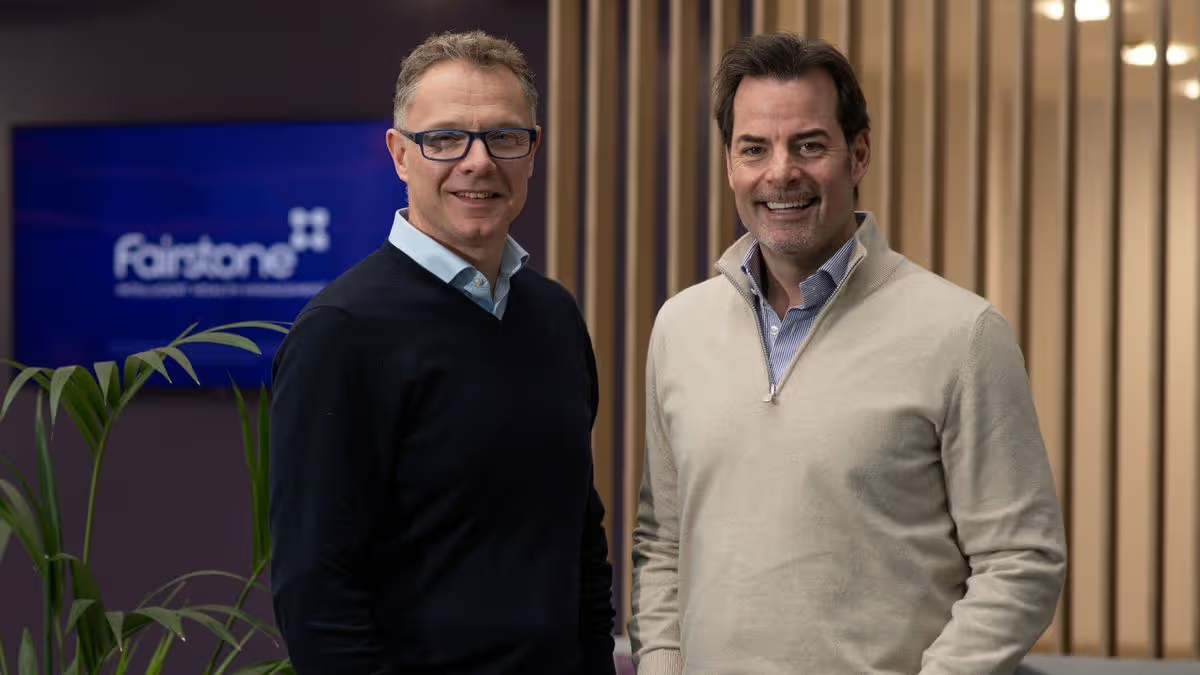
Steve McNicol and Steven Cooper at Fairstone Group.(Image: Fairstone Group)
A North East wealth manager expects to have acquired more than 20 companies into the group by the end of the year, as a result of its established buy-out model.
Directors at Sunderland-based Fairstone Group have hailed a busy year in which it added “substantially” to the business, acquiring eight companies in Northern Scotland, Northern Ireland, the South of England, the West Country, the East Midlands and the North East. It said the acquisitions expand and strengthen its geographic footprint across the UK.
The transactions included Fairstone’s largest purchase to date, the acquisition of West Midlands wealth management and corporate financial planning specialist Prosperity Wealth in February.
All eight firms acquired in the first quarter came into Fairstone, based in Doxford International Business Park in Sunderland, via the Downstream Buy-Out (DBO) model. They have collectively pumped more than £2bn of client assets under management into the group.
Advertisement
And directors revealed 13 more full acquisitions will be made later this year. Fairstone’s DBO model sees the business act as an investment partner, providing the centralised resource, technology, and capital to support the ongoing growth of ambitious financial firms ahead of a future sale. Once fully integrated, partner firms are then able to sell to Fairstone.
Fairstone CEO Steven Cooper said: “I said in January that I expected a busy first full year as CEO and that has certainly been the case so far. In just the first quarter of the year, we have added substantially to the business, not only in terms of the bare figures of client assets under management, but also in terms of our strategic presence and the depth and breadth of the services which we can offer our clients.
“For example, bringing Prosperity on board has added substantially to our expertise in areas such as corporate financial planning and employee benefits. These are things which not only benefit those clients who Prosperity have brought with them to Fairstone, but also to our existing and future clients right across the country.
“Every one of the eight firms who became part of Fairstone during Q1 brings something new to the business and strengthens the group as we look to help many more people achieve their financial goals and face the future with confidence.”
Advertisement
The eight firms acquired so far this year initially joined the DBO programme between two and four years ago, enabling staff and processes to become fully integrated into Fairstone before becoming part of the group.
Fairstone now operates from more than 50 locations, employing over 1,350 operational staff and regulated advisers. It oversees £23bn in assets under management on behalf of over 125,000 clients.
Like this story? For more deals news you can visit our dedicated page for the latest news and analysishere.
NEW YORK — Alphabet Inc. Class C shares advanced 0.62 percent to $387.22 in morning trading on Wednesday, extending recent gains as investors continued to reward the Google parent’s strong positioning in artificial intelligence and robust cloud performance following its impressive first-quarter results.
The modest uptick reflected ongoing positive sentiment around Alphabet’s AI investments, accelerating Google Cloud growth and resilient advertising revenue. The stock has shown notable strength in 2026, with analysts highlighting its full-stack AI approach and expanding enterprise opportunities as key drivers.
Alphabet’s market capitalization remains near record levels, approaching or surpassing major milestones amid broader enthusiasm for technology companies demonstrating clear AI monetization paths. Wednesday’s trading occurred against a backdrop of steady broader market gains, with technology shares generally favored on continued innovation narratives.
Strong Q1 2026 Performance Sets Positive Tone
The company reported first-quarter revenue of $109.9 billion, up 22 percent year-over-year, beating expectations and marking the 11th consecutive quarter of double-digit growth. Google Cloud revenue surged 63 percent to $20 billion, driven by enterprise AI solutions and infrastructure demand.
Advertisement
Google Services revenue increased 16 percent to $89.6 billion, supported by 19 percent growth in Search and strong performance in subscriptions. Operating income rose 30 percent with margin expansion to 36.1 percent, while net income jumped 81 percent to $62.6 billion. Earnings per share reached $5.11.
CEO Sundar Pichai described the quarter as a “terrific start,” noting AI experiences driving record query volumes in Search and significant backlog growth in Cloud. Paid subscriptions reached 350 million, with Gemini Enterprise users growing 40 percent quarter-over-quarter.
AI and Cloud as Core Growth Engines
Alphabet has aggressively invested in AI infrastructure and models, particularly through Gemini. The company’s full-stack approach — combining first-party models, cloud infrastructure and consumer applications — has differentiated it in a competitive landscape. Google Cloud Platform backlog nearly doubled to over $460 billion.
Recent developments, including expanded partnerships and infrastructure commitments, have reinforced investor optimism. Reports of substantial cloud commitments from major AI players have supported share price momentum.
Advertisement
The company continues heavy capital expenditures to build AI-optimized data centers, with 2026 guidance reflecting significant investment. While elevated spending has raised margin concerns in the past, strong revenue conversion has helped alleviate those worries.
Analyst Optimism and Valuation
Wall Street has responded favorably to Alphabet’s execution. Multiple firms have raised price targets in recent weeks, with some forecasting $425 to $445 per share. Consensus leans toward Buy ratings, citing AI leadership, advertising resilience and cloud acceleration.
The stock’s valuation reflects its growth profile, though some analysts argue it remains attractive relative to long-term AI opportunities. Year-to-date performance in 2026 has outpaced several Magnificent Seven peers, underscoring Alphabet’s comeback narrative.
Regulatory and Competitive Landscape
Alphabet continues navigating regulatory challenges, including antitrust matters. Recent court decisions have provided some relief, with rulings against more severe remedies supporting investor sentiment. The company maintains strong legal defenses while advancing product innovation.
Advertisement
Competition in AI remains intense, with rivals investing heavily in models and infrastructure. Alphabet’s integration of Gemini across Search, Cloud and consumer apps has helped maintain relevance and drive usage growth. Waymo’s autonomous driving progress, surpassing 500,000 weekly rides, adds another growth vector.
Broader Market Context
Technology shares have benefited from sustained AI enthusiasm and expectations of stable monetary policy. Alphabet’s performance contributes to sector strength, with its advertising and cloud businesses providing diversified exposure compared to pure-play AI hardware companies.
Global economic conditions, consumer spending trends and geopolitical factors remain watchpoints. However, Alphabet’s diversified revenue streams — spanning digital ads, cloud, subscriptions and emerging technologies — provide relative stability.
Outlook and Strategic Priorities
Management has expressed confidence in sustained momentum. Key focus areas include further AI integration, cloud market share gains and international expansion. The dividend increase to $0.22 per share underscores commitment to shareholder returns.
Advertisement
As the year progresses, investors will monitor Q2 results for continued cloud acceleration and AI monetization evidence. Capital expenditure levels and margin trends will remain closely watched amid heavy AI infrastructure spending.
Alphabet’s ability to balance innovation investment with profitability has been a strength. The company’s vast data resources, distribution reach and engineering talent position it favorably for long-term AI leadership.
Wednesday’s trading continues a pattern of measured gains supported by fundamental progress. As one of the world’s most valuable companies, Alphabet remains central to technology sector performance and broader market sentiment. Its ongoing transformation into an AI powerhouse will likely shape its trajectory through the remainder of 2026 and beyond.
Shares of Jaiprakash Power Ventures (JP Power) rallied as much as 20% to their day’s high of Rs 22.95 on the NSE on Wednesday to extend gains for a fifth consecutive session and rally over 25% during the same period.
Volumes were high in today’s session as more than 87 crore shares worth Rs 1,904 crore changed hands, stock exchange data showed.
Last week, Adani Power said it has signed definitive agreements with Jaiprakash Associates Limited (JAL) to acquire a 24% stake in Jaiprakash Power Ventures Limited (JPVL) along with the 180 MW Churk thermal power plant in Uttar Pradesh under the NCLT-approved resolution plan for JAL.
The company said it has entered into a Share Purchase Agreement to acquire JAL’s 24% stake in JPVL for nearly Rs 2,993.6 crore. In addition, it has signed a Business Transfer Agreement to acquire the Churk thermal power plant and associated assets, including JAL’s 11.49% stake in Prayagraj Power Generation Company Limited, for Rs 1,200 crore.
Advertisement
According to Adani Power, the acquisitions will strengthen its generation portfolio and expand its footprint in the thermal power sector, while also providing strategic exposure to JPVL’s diversified energy and mining businesses. The transaction is part of the broader Adani Group-led resolution plan for debt-laden JAL and is aligned with Adani Power’s core power generation business.
Live Events
Adani Power said the acquisitions will be completed through cash consideration and are expected to close on the “Effective Date” under the approved resolution plan, which is scheduled to occur within 90 days from the NCLT approval granted on March 17, 2026. The development comes at a time when power stocks have staged a strong rally. India is currently reeling under heatwave conditions amid the exceptionally strong El Niño year. In this background, power demand soared, boosting the power stocks. Adani Power shares were no exception. The stock jumped around 3% on Wednesday to hit a fresh 52-week high of Rs 252 apiece on NSE. The stock surged over 13% in one week and delivered 126% returns over one year.
(Disclaimer: Recommendations, suggestions, views and opinions given by the experts are their own. These do not represent the views of The Economic Times)
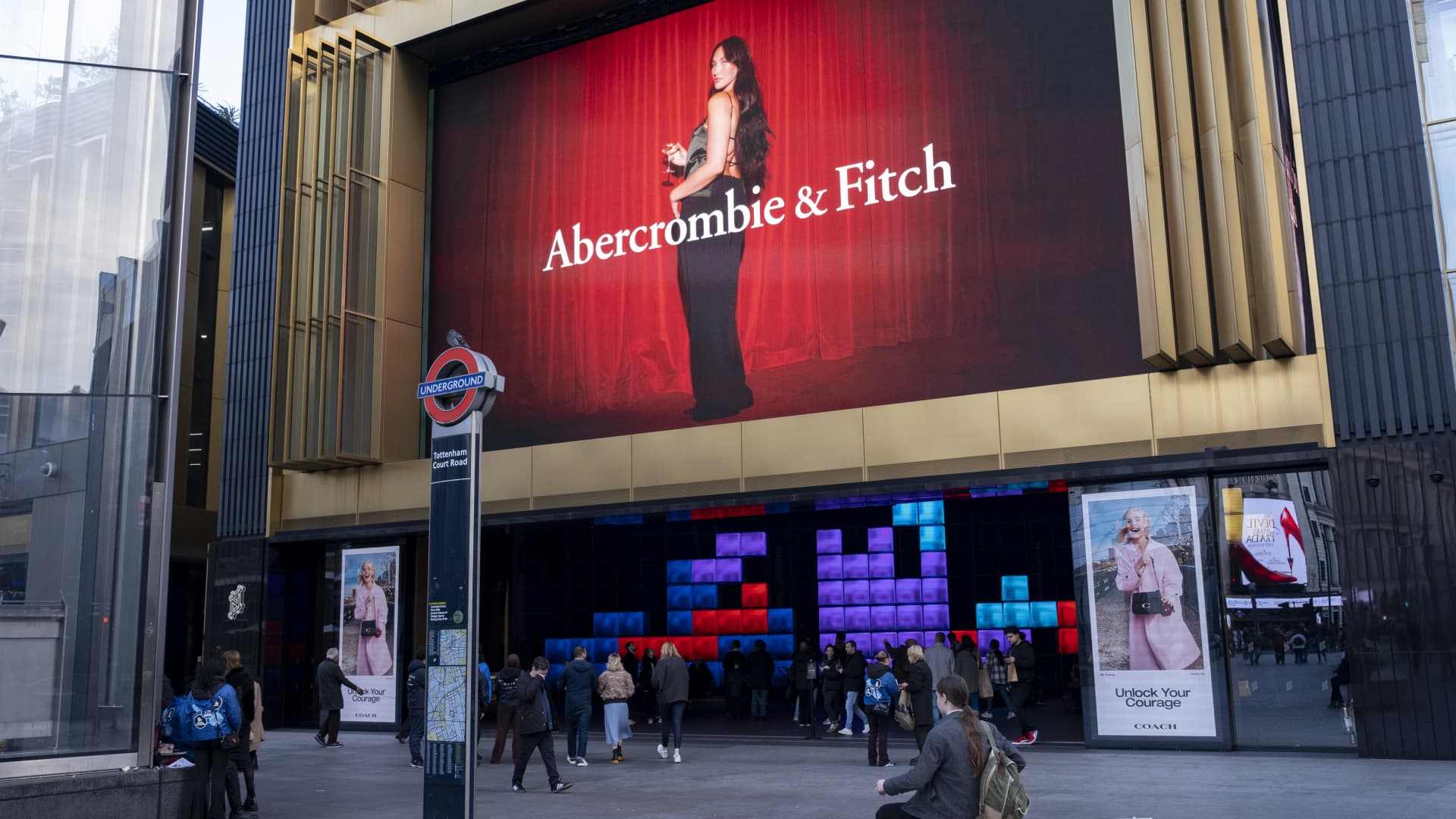
Abercrombie & Fitch posted mixed first-quarter results on Wednesday and weaker-than-expected guidance after the conflict in the Middle East “directly impacted” sales, the company said.
Despite those challenges, shares jumped about 13% in morning trading as the company easily topped Wall Street’s earnings estimates.
Sales in Abercrombie’s Europe, Middle East and Africa region fell 10% during the quarter, driven by a slowdown in demand at the brand’s Hollister banner that came as the conflict ramped up, finance chief Robert Ball said on a call with analysts.
Overall, it reduced first-quarter total company net sales growth by more than 0.5 percentage points relative to the retailer’s outlook, he said.
Advertisement
“We’re focused on what we can control, including our inventory levels and marketing investments, ensuring we can respond to what’s happening in real-time,” CEO Fran Horowitz added on the call. “Despite these EMEA headwinds, we expect total sales growth for the second quarter, along with full-year 2026, which would be our fourth consecutive year of net sales growth.”
In the current quarter, Abercrombie expects earnings per share to be between $1.80 and $2, well behind estimates of $2.54, according to LSEG.
Though the company’s outlook for the current quarter was worth than analysts expected, it reaffirmed its full-year guidance. Abercrombie anticipates net sales will rise 3% to 5% for the fiscal year, with earnings per share of $10.20 to $11.
Despite the slowdown in EMEA, which represents about 15% of total company sales, Abercrombie’s companywide sales climbed 2%. Still, that growth didn’t come from organic consumer demand and was instead driven by new store openings and favorable foreign exchange rates, Ball said.
Advertisement
Here’s how the apparel company did in its first fiscal quarter compared with what Wall Street was anticipating, based on a survey of analysts by LSEG:
Earnings per share: $1.47 vs. $1.28 expected
Revenue: $1.11 billion vs. $1.12 billion expected
The company’s reported net income for the three-month period that ended May 2 was $67.13 million, or $1.47 per share, compared with $80.41 million, or $1.59 per share, a year earlier.
Sales rose to $1.11 billion, up about 2% from $1.10 billion a year earlier.
When asked about its current quarter outlook, and what it expects to change in the back half of the year, Ball mentioned easier comparisons to last year’s results and lower marketing spending, among other facors, not an expected improvement in demand.
“It is a balanced story here. Tariffs and freight, by the time we get to year-end, will be just slight headwinds year-over-year,” Ball explained. Aside from the challenges its seeing in the Middle East and the EMEA region, the company is seeing modest growth in average unit retail, which is funding the investments its making and keeping it in line with a 12% to 12.5% operating margin, Ball said.
Advertisement
Unlike many of its peers, Abercrombie is factoring in recent reductions in tariff rates after the U.S. Supreme Court ruled President Donald Trump’s so-called reciprocal tariffs are illegal, which helped its financial outlook.
It’s now expecting tariffs to impact profitability by 0.2 percentage points in fiscal 2026, compared to previous expectations of around 0.7 percentage points. It said it has applied for a tariff refund of around $100 million but didn’t factor that potential influx into its outlook.
ClearBridge is a leading global asset manager committed to active management. Research-based stock selection guides our investment approach, with our strategies reflecting the highest-conviction ideas of our portfolio managers. We convey these ideas to investors on a frequent basis through investment commentaries and thought leadership and look forward to sharing the latest insights from our white papers, blog posts as well as videos and podcasts.
Analyst’s Disclosure: I/we have a beneficial long position in the shares of LMT, KTOS, KRMN, RBC, TDY, YES, RKLB either through stock ownership, options, or other derivatives. I wrote this article myself, and it expresses my own opinions. I am not receiving compensation for it. I have no business relationship with any company whose stock is mentioned in this article.
Seeking Alpha’s Disclosure: Past performance is no guarantee of future results. No recommendation or advice is being given as to whether any investment is suitable for a particular investor. Any views or opinions expressed above may not reflect those of Seeking Alpha as a whole. Seeking Alpha is not a licensed securities dealer, broker or US investment adviser or investment bank. Our analysts are third party authors that include both professional investors and individual investors who may not be licensed or certified by any institute or regulatory body.






















































You must be logged in to post a comment Login