Connect with us
DAPA Banner

Business

Form 13G TYRA BIOSCIENCES INC For: 7 April

Published

on

Continue Reading
Click to comment

You must be logged in to post a comment Login

Leave a Reply

Business

Form 144 Nano Dimension Ltd. For: 28 April

Published

on


Form 144 Nano Dimension Ltd. For: 28 April

Continue Reading

Business

(VIDEO) Russian Superyacht Linked to Putin Ally Sails Through Blockaded Strait of Hormuz

Published

on

Strait of Hormuz Traffic Near Standstill Despite US-Iran Ceasefire: Only

DUBAI — A $500 million Russian superyacht linked to sanctioned billionaire Alexey Mordashov, a close ally of President Vladimir Putin, successfully transited the heavily restricted Strait of Hormuz over the weekend, becoming one of the few private vessels to navigate the critical waterway amid an ongoing U.S.-Iran blockade that has crippled global oil shipping.

Strait of Hormuz Traffic Near Standstill Despite US-Iran Ceasefire: Only
Strait of Hormuz

The 142-meter (465-foot) luxury yacht Nord departed a marina in Dubai on Friday evening, April 24, 2026, crossed the strait on Saturday morning and arrived at Al Mouj Marina in Muscat, Oman, early Sunday, according to marine tracking data from MarineTraffic and VesselFinder. The vessel’s passage through one of the world’s most tense maritime chokepoints has raised questions about selective enforcement of restrictions and highlighted Russia-Iran ties during the conflict.

  • Nord*, one of the largest superyachts in the world, features 20 staterooms, a swimming pool, helipad and even a submarine. It flies the Russian flag and was re-registered in Russia after Western sanctions following Moscow’s invasion of Ukraine. While Mordashov is not the officially listed owner, corporate records and widespread reporting link the vessel to the steel magnate, whose fortune exceeds $20 billion and who has faced U.S. and European sanctions for years.

The transit comes as commercial shipping through the Strait of Hormuz — which normally carries about one-fifth of global oil and liquefied natural gas — has plummeted to a fraction of normal levels since February. Iran has imposed severe restrictions in response to U.S. and Israeli military actions, while the United States has enforced a blockade on Iranian ports. U.S. Central Command has redirected dozens of vessels, and private shipping largely avoids the route due to security risks.

It remains unclear exactly how Nord obtained permission to pass. Iran’s ambassador to Moscow stated days earlier that Tehran would grant exceptions for Russian ships without charging duties, signaling deepening bilateral cooperation. Some analysts suggest the yacht may have used lanes closer to Iranian waters patrolled by the Islamic Revolutionary Guard Corps, effectively bypassing the main U.S.-enforced blockade zone.

Mordashov, the majority shareholder of Russian steel giant Severstal, maintains a low public profile but ranks among Putin’s inner circle of trusted oligarchs. His yacht’s bold journey has drawn sharp commentary online, with some calling it a symbol of elite privilege amid global disruption and others viewing it as a diplomatic signal between Moscow and Tehran.

Advertisement

The incident underscores the selective nature of enforcement in the region. While commercial tankers and cargo ships face detours around Africa or long delays, luxury vessels with powerful backers appear able to thread the needle. Maritime security experts note that superyachts often operate with enhanced private security and diplomatic clearances that ordinary shipping lacks.

Broader implications for energy markets are significant. The restricted flow through Hormuz has already driven world oil prices above $110 per barrel, contributing to inflationary pressures and supply concerns worldwide. Australia, heavily dependent on imported fuel, continues to grapple with its own diesel shortages partly linked to these disruptions.

U.S. officials have not publicly commented on the Nord‘s passage. The Biden administration, now succeeded by the Trump administration in this scenario, had vowed to maintain pressure on Iran while keeping the strait open for international commerce. Critics argue the yacht’s successful transit exposes gaps in the blockade’s effectiveness.

Russia has maintained relatively warm relations with Iran throughout the conflict, supplying drones and other military technology while benefiting from discounted Iranian oil. The superyacht episode may represent a small but visible gesture of reciprocity. Iranian state media has remained silent on the crossing, consistent with its general opacity on maritime exceptions.

Advertisement

For Mordashov, the voyage highlights the resilience of sanctioned Russian elites. Despite travel bans and asset freezes in the West, his yacht continues to operate in international waters, often berthing in friendly ports across the Middle East and Asia. Similar vessels owned by other oligarchs have faced seizures in Europe, but Nord has largely evaded such fates by staying clear of Western jurisdictions.

Maritime tracking platforms showed minimal other traffic in the strait during the same period. Most commercial operators continue rerouting via the Cape of Good Hope, adding thousands of nautical miles and weeks to journeys. Insurance premiums for vessels attempting Hormuz have skyrocketed, making the route economically unviable for all but the most determined or protected operators.

The event has sparked heated discussion on social media and in geopolitical circles. Some commentators frame it as a propaganda win for Russia and Iran, demonstrating that the blockade is not absolute. Others see it as a practical reminder that luxury and connections can trump geopolitics even in wartime.

As tensions in the Gulf persist, shipping analysts expect continued volatility. Diplomatic efforts for de-escalation remain stalled, with no immediate breakthrough in sight. For now, the safe arrival of Nord in Oman serves as a striking anomaly in an otherwise paralyzed strategic waterway — a $500 million reminder that in the world of superyachts and sanctions, some rules still bend for the connected.

Advertisement

The superyacht’s journey adds another layer to the complex web of alliances, sanctions and maritime power plays defining the 2026 Middle East crisis. While global commerce suffers, symbols of elite mobility continue to move, testing the limits of blockades and international resolve.

Continue Reading

Business

'Emergency handbrake' needed on sickness benefits, Blair think tank says

Published

on

'Emergency handbrake' needed on sickness benefits, Blair think tank says

The Tony Blair Institute says people with conditions like anxiety should get employment support instead of cash benefits.

Continue Reading

Business

ASML: Potential Bull Trap As AI Super Cycle Continues – Reiterate Hold

Published

on

EchoStar: Potential Bull Trap At Play - Take Gains Off The Table

ASML: Potential Bull Trap As AI Super Cycle Continues – Reiterate Hold

Continue Reading

Business

Premier, gas chiefs blast 'superficially attractive' export levy

Published

on

Premier and gas chiefs blast 'superficially attractive' export levy

Woodside and Inpex joined Roger Cook in lambasting a proposed LNG windfall tax today, warning it could kill major projects and destroy Australia’s reputation as a stable investment destination.

Continue Reading

Business

Vedanta demerger can create value in the long term

Published

on

Vedanta demerger can create value in the long term
ET Intelligence Group: Shares of Vedanta have fallen over 4% since April 20 when the company announced May 1 as the record date for demerger. The proposed split into five listed entities is expected to reduce the conglomerate discount by enabling each business to be valued independently and benchmarked against sector peers. The stock may remain volatile around the record date and the listing of new entities.

Analysts believe investors would benefit from staying invested over the long term, as clear business structures, improved transparency on debt allocation, and better price discovery could enhance overall shareholder value. The last date to buy the stock to avail the demerger benefits is April 29.

The demerger will result in the separation of Vedanta into five listed entities-Vedanta Aluminium, Vedanta Power, Vedanta Oil & Gas, Vedanta Iron & Steel, and a residual Vedanta, which will retain zinc, copper and other base-metal businesses. Under the scheme, shareholders will receive one share each in the four newly-listed companies for every one Vedanta share held, while the residual Vedanta entity will continue to remain listed.

Vedanta Demerger can Create Value If You Stay InvestedAgencies

Volatility seen around record date of may 1

The demerger is expected to unlock meaningful valuation upside for Vedanta shareholders. Before the demerger, after applying holding-company discounts and adjusting for consolidated debt, Axis Securities values Vedanta as a whole at about ₹572 per share. Post-demerger, the combined valuation is expected to rise by 14% to ₹650 per share.
The value goes up after demerger because businesses like aluminium, and oil & gas will be listed separately, making it easier for investors to judge their true worth and compare them with similar companies. At the same time, the remaining Vedanta company will still have steady income and regular dividend potential from its stake in Hindustan Zinc, which helps support its valuation.

Advertisement


ICICI Direct expects the demerger to be a value unlocking event for the company with its high growth aluminium & power businesses expected to fetch better valuations compared with the current structure of being part of a listed conglomerate entity.
On April 30, Vedanta’s stock price is expected to adjust for the demerger and trade in the range of around ₹300-325 per share. The remaining demerged entities are likely to be listed within 1-2 months following the record date.One of the key points of the demerger is the sharp reduction in debt for Vedanta since it will be distributed across the demerged entities. After the demerger, Axis Securities estimates Vedanta to have net debt of ₹13,892 crore, 24% of total net debt. The aluminium business is expected to carry the largest portion of net debt of around ₹29,246 crore, accounting for more than 50% ₹57,358 crore of group net debt as of December 2024. Vedanta Power will carry 12% of net debt, Vedanta Iron & Steel 7% and Vedanta Oil & Gas 6%.

Continue Reading

Business

Australia Fuel Crisis Deepens as Diesel Prices Soar and Reserves Dwindle in 2026

Published

on

Prince Harry (left) and his wife Meghan Markle (right) stunned the monarchy by announcing they were quitting royal duties and moving to the United States in early 2020

SYDNEY — Australia’s fuel crisis intensified this week as diesel prices remained near record highs and national reserves hovered at precarious levels, forcing the government to scramble for alternative supplies amid ongoing disruptions from the Middle East conflict that has choked global oil shipments through the Strait of Hormuz.

Petrol Station
Australia Fuel Crisis Deepens as Diesel Prices Soar and Reserves Dwindle in 2026
engin akyurt / Unsplash

As of late April 2026, Australia holds approximately 46 days of petrol reserves — an improvement of about 10 days since the crisis began in late February — but diesel stocks remain more strained due to heavy reliance on the fuel for trucking, mining, farming and freight. Energy Minister Chris Bowen confirmed contracted shipments are secure through mid-May, yet experts warn of a potential “long tail” of shortages and price pressure extending into June and beyond if tensions persist.

The crisis traces directly to the escalation in the Iran conflict, which severely restricted tanker traffic through the Strait of Hormuz — a chokepoint carrying roughly 20% of global oil. Australia, which imports about 90% of its refined fuel, primarily from Asian refineries dependent on Middle Eastern crude, felt the ripple effects rapidly. Diesel prices have more than doubled in some regions, averaging around 275-312 cents per litre nationally, while unleaded petrol has climbed above 190 cents despite partial relief from halved fuel excise taxes.

Prime Minister Anthony Albanese’s government activated elements of its four-phase National Fuel Security Plan, currently sitting at Level 2 — “Keep Australia Moving.” Measures include releasing portions of emergency stockpiles (up to 20% in earlier phases), underwriting refinery purchases of costlier shipments from the United States, Mexico, Argentina, Algeria and Asian neighbors, and securing additional cargoes such as 200 million litres of diesel from South Korea, Brunei and Malaysia expected in late May or early June.

Rural and regional areas have borne the brunt. Hundreds of service stations have reported running dry on diesel or unleaded at times, prompting panic buying and informal rationing at pumps. Farmers in Victoria and New South Wales have guarded fuel tanks overnight against theft, while trucking operators report costs doubling, threatening freight viability and pushing up prices for everyday goods. Some analysts warn up to 70% of truck drivers could face viability issues within months if diesel remains elevated.

Advertisement

The government has explored longer-term fixes. Discussions are underway for a potential new $10 billion refinery to rebuild domestic refining capacity, which has shrunk dramatically over the past decade with most facilities closed or converted. Opposition figures have criticized past policy decisions that left Australia vulnerable, while unions point to “just-in-time” supply chains and offshoring as root causes.

Economists forecast significant impacts. EY-Parthenon modelling suggests a prolonged disruption could shave up to $42 billion from Australia’s 2026 GDP, with investment falling $54 billion and up to 160,000 workers temporarily idled in a worst-case scenario. Inflation has spiked, outpacing many developed nations, as higher transport costs flow through to food, construction and consumer goods.

Motorists have altered behavior. Easter travel plans were scaled back or canceled in some cases, and carpooling has increased in cities. Aviation fuel concerns briefly affected operations, including Anzac Day commemorations. The government reduced heavy vehicle road user charges to ease pressure on the freight sector.

International Energy Agency-aligned reserves have provided a buffer, but Australia’s holdings remain lower than many comparable countries. Pre-crisis warnings about thin stockpiles — sometimes as low as 20-30 days — proved prescient. The government has eased fuel quality standards temporarily to divert export-bound stocks to the domestic market.

Advertisement

Diesel’s outsized role in the economy amplifies the pain. Australia consumes more than twice as much diesel as petrol, powering essential services from mining exports to supermarket deliveries. A hidden diesel crunch could still emerge even as petrol prices ease slightly toward pre-crisis levels.

Public and political debate has sharpened. Treasurer Jim Chalmers described “extreme uncertainty,” while calls grow for greater sovereign fuel capacity. The opposition has accused the government of mismanagement, including forcing refineries to export during shortages.

Globally, the crisis highlights vulnerabilities in just-in-time energy systems. Australia is diversifying aggressively, but rebuilding reserves and infrastructure will take years. A fragile Middle East ceasefire offers hope, yet renewed disruptions could trigger Level 3 or even Level 4 measures — including formal rationing.

For ordinary Australians, the crisis means higher living costs and lifestyle adjustments. Businesses are hedging where possible, and households are urged to conserve fuel. As April ends, the government insists supplies remain secure in the short term, but the episode serves as a stark reminder of energy dependence in an unstable world.

Advertisement

Analysts expect volatility to continue. While new shipments provide breathing room, diesel prices and freight impacts could linger, feeding into broader cost-of-living pressures ahead of key economic data releases. Long-term, the crisis may accelerate investment in renewables, domestic refining and strategic stockpiles to safeguard against future shocks.

Australia’s fuel emergency, born from distant geopolitical conflict, has become a defining domestic challenge of 2026 — testing resilience, policy responses and the nation’s ability to keep moving when global supply chains falter.

Continue Reading

Business

ARC Raiders Riven Tides Update Reclaims Coast with New Map, Flying ARC Turbine and Beachcombing

Published

on

ARC Raiders

STOCKHOLM — Embark Studios rolled out the highly anticipated Riven Tides update for ARC Raiders on April 28, 2026, delivering the game’s biggest content drop since launch with a sprawling new coastal map, a formidable airborne enemy and fresh gameplay mechanics that transform exploration and combat in the post-apocalyptic Rust Belt.

ARC Raiders
ARC Raiders

Titled “Reclaim the Coast,” Patch 1.26.0 introduces Riven Tides, a deserted shoreline on the western edge of the Rust Belt abandoned twice — first during the Exodus and later by First Wave survivors unable to hold the exposed settlement against relentless ARC threats. Players can now explore an atmospheric mix of sun-bleached beaches, the faded luxury of the Panorama Azzurro resort hotel, an industrial Exodus-era port with cranes and container stacks, and flooded dockyard zones that create dynamic vertical and horizontal combat opportunities.

The new map shifts the pace from previous inland locations, offering more open sightlines across water and sand alongside tight interior spaces in the abandoned resort. Rising tides and environmental hazards add tension, while new points of interest encourage careful scouting and risk-reward decision-making during expeditions.

A major highlight is the introduction of the ARC Turbine, a large airborne enemy that drifts menacingly across the coastline. Described as almost beautiful when silhouetted against the sunset, the Turbine becomes far more dangerous up close, forcing Raiders to master new anti-air tactics, positioning and coordinated fire. Early player reports describe intense, skill-testing encounters that demand patience and nerves of steel.

Riven Tides also debuts Beachcombing, a new minor map condition exclusive to the coastal zone. Raiders can locate the Dockmaster’s Detector tool to sweep the sands for buried loot and unexpected discoveries. This mechanic rewards thorough exploration and adds a fresh layer of interactivity to the environment, turning passive beach traversal into an active treasure hunt with potential high-value rewards.

Advertisement

New equipment supports the updated playstyle. The Crash Mat helps mitigate fall damage during vertical drops common around the resort and sea walls, while the Powered Descender enables controlled rappelling and quicker navigation of cliffs and structures. Additional gear, including the White Flag for tactical retreats, expands loadout options.

Beyond the new map and enemies, the update overhauls weapon economy and durability systems. Common weapons now lose durability faster, while Legendary items degrade more slowly, creating clearer tier distinctions. Upgrades restore 25% durability, and average spawn durability dropped from 50 to 30 to increase tension. Trigger ‘Nade spam received balancing adjustments, and the Bettina weapon received a significant buff with increased damage, reduced dispersion and improved performance against ARC armor.

Other balance changes include repairs tweaks, a Photoelectric Cloak power consumption increase, and numerous quality-of-life improvements. Voice communication received noise suppression enhancements, performance optimizations landed across platforms, and various interaction and navigation bugs were fixed.

The update coincides with the launch of the “Last Resort” limited-time event, offering new cosmetics and progression rewards, including the Junior Outfit unlocked through staged challenges. Trials Season 4 also begins April 29, promising fresh challenges and rewards.

Advertisement

Community reaction has been overwhelmingly positive in the first hours, with players praising the atmospheric new map and the fresh verticality introduced by coastal terrain. Social media and Reddit threads buzz with early footage of ARC Turbine fights and successful Beachcombing hauls. Some veterans note the update feels like a “fresh start,” addressing long-requested variety while maintaining the core extraction-shooter tension that built ARC Raiders’ dedicated following.

Embark Studios positioned Riven Tides as the culmination of the January-April 2026 roadmap, signaling continued aggressive content support. The Swedish developer has emphasized player feedback throughout development, incorporating scout report lore drops and community testing to refine the new features.

For newcomers and returning players alike, the update lowers some barriers while raising the skill ceiling. Improved tutorials, clearer UI elements and adjusted weapon progression aim to welcome fresh Raiders without alienating veterans chasing high-stakes expeditions. Cross-platform play ensures friends can team up regardless of system.

Analysts following the extraction shooter genre view Riven Tides as a pivotal moment for ARC Raiders. After a strong launch and steady updates, the coastal expansion demonstrates Embark’s commitment to evolving the world and gameplay loop. Successful adoption could solidify the title’s position alongside competitors while carving out a distinct identity through environmental storytelling and dynamic map conditions.

Advertisement

As servers buzz with activity on launch day, early metrics suggest strong concurrent player numbers. Streamers and content creators are already producing guides for optimal Beachcombing routes, Turbine takedown strategies and best loadouts for the new map. Official patch notes detail hundreds of smaller fixes and improvements that polish the overall experience.

The Riven Tides update reinforces ARC Raiders’ core fantasy — brave Raiders venturing into dangerous, beautiful, forgotten places to reclaim resources and push back against the ARC invasion. With its sun-drenched yet perilous coastline, innovative new mechanics and formidable flying threat, the latest chapter invites players to reclaim not just loot, but a sense of adventure along the shores of the Rust Belt.

Whether diving into solo expeditions or coordinating squad assaults on the ARC Turbine, April 28 marks a significant milestone for the game. Embark Studios has promised more roadmap reveals soon, with further seasons and content planned throughout 2026. For now, Raiders have a stunning new coastline to explore, new threats to overcome and buried treasures waiting beneath the sand.

Advertisement
Continue Reading

Business

Update on ambitious plans to turn landmark building into unique home

Published

on

Business Live

‘I’m proposing to keep it in use, in a different way, so that it can be properly restored and last forever’

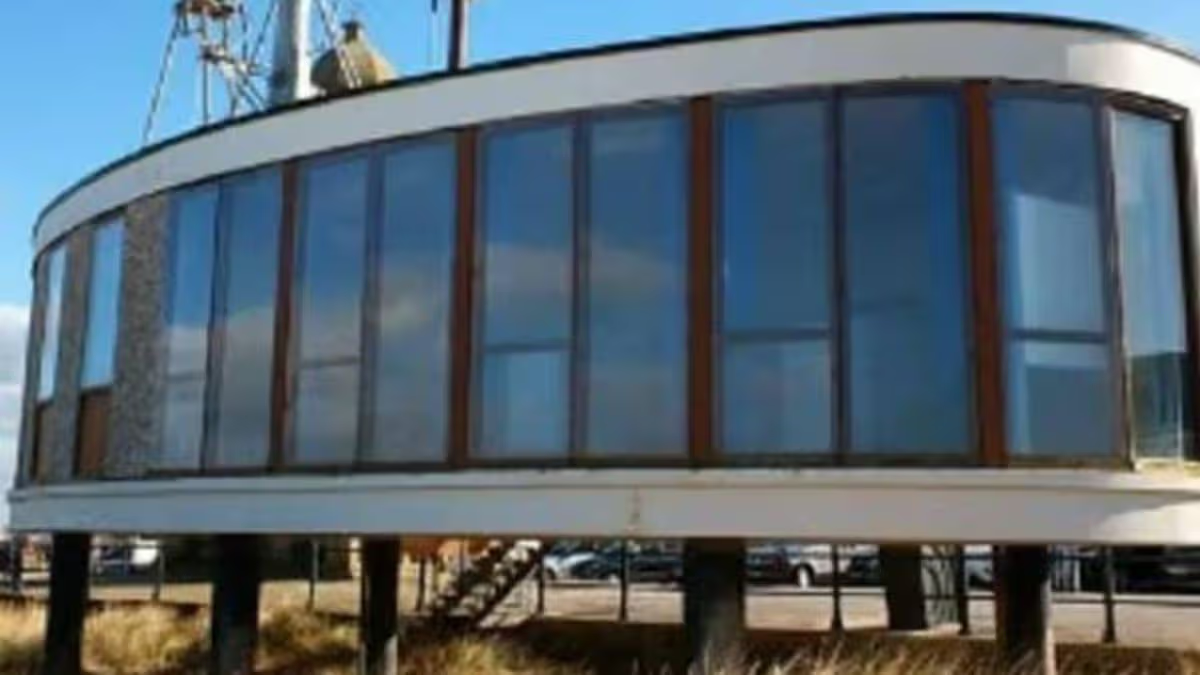
 Fleetwood's Grade II listed former radar station

Fleetwood’s Grade II listed former radar station(Image: Local Democracy Reporting Service)

Specialist contractors are being brought in to help ensure that one of the Fylde coast’s most distinctive buildings can successfully be turned into a unique house with amazing sea views.

Advertisement

Businessman Iain Garnell submitted ambitious plans to Wyre Council to transform Fleetwood’s Grade II listed former radar station into a quirky home.

But when the application went before Wyre’s planning committee last October it was thrown out.

Councillors agreed with the planning officer, who raised concerns about the scheme’s sewage system, which was felt to be in the wrong position and would lead to unacceptable odours for the occupants

Fleetwood Civic Society, who attended the meeting, also raised concerns that it was an inappropriate use for a Grade II listed building.

Advertisement

Mr Garnell, a Leicester based architect, had snapped up the distinctive oval-shaped property, on The Esplanade, for £97,000 early last year.

Despite the setback, he still aims to restore it to its former glory as a ‘mega one bedroomed live-work apartment.’

He said this week: “The project is still on and I’m bringing in specialist drainage and sewage contractors to set up a sewage system which is acceptable to planners.

“That was the main reason the application was refused and those concerns will be addressed.

Advertisement

“The fact is, this building cannot be returned to its old role as a radar station, that history is over.

“I’m proposing to keep it in use, in a different way, so that it can be properly restored and last forever. If it is just left, it will deteriorate and be lost forever.”

Architects’ plans showed a modern home with incredible views over Fleetwood beach, as the building is one of the few to be located on the beach side of the promenade.

Built from reinforced concrete, the building sits on stilted columns which lift it off the ground, protecting it from incoming tides.

Advertisement
How the interior of Fleetwood's Grade II listed former radar station would look under the conversion plans.

How the interior of Fleetwood’s Grade II listed former radar station would look(Image: Local Democracy Reporting Service)

Mr Garnell submitted an application to Wyre Council planners for a change of use of a former naval radar station to residential dwelling and installation of a sewage treatment plant in the ground beneath the centre of the building. He also applied for Listed Building consent for the work.

But the planning meeting heard that the sewage system would be located directly under the building and there would be concerns about unacceptable odour, which would be an issue not only for Mr Garnell but anyone who wanted to rent or buy the property.

It would also potentially be an issue for the operators of a nearby ice cream and coffee kiosk.

However, Mr Garnell added: “With this project, the building will be restored and people will be able to stay in it and enjoy it, once the sewage issue has been addressed.”

Advertisement

To find all the planning applications, traffic diversions, road layout changes, alcohol licence applications and more in your community, visit the Public Notices Portal.

Continue Reading

Business

ETMarkets PMS Talk | 70% in debt & gold helped cut downside risk in FY26: Ametra PMS CIO explains strategy

Published

on

ETMarkets PMS Talk | 70% in debt & gold helped cut downside risk in FY26: Ametra PMS CIO explains strategy
In a year marked by sharp volatility, stretched valuations, and cross-asset turbulence, protecting downside risk became as critical as generating returns.

In this edition of ETMarkets PMS Talk, Karan Aggarwal, Co-founder and CIO of Ametra PMS, explains how a tactical allocation strategy—with nearly 70% exposure to debt and gold—helped cushion portfolios during FY26.

He discusses the role of asset allocation and factor rotation in navigating uncertain markets, the importance of reducing timing risk in equities, and how a rule-based, multi-asset approach can deliver more consistent outcomes across market cycles. Edited Excerpts –

Advertisement

Q) Thanks for taking the time out. The strategy delivered around 10% return in the last 1 year (FY26). How do you interpret this performance in the context of a volatile market environment?

A) Last 12 months have been quite volatile across asset classes. While midcap and largecap remained time correction mode till Feb 2026, oil shock in March 2025 triggered broke patience of investors and triggered a 10% correction across benchmarks.

Deadly cocktail of faltering EPS growth (5%-10%) and high valuations (22-23x for largecaps and 32x for midcaps) ensured all attempts at breakouts above Sep 2024 failed amidst positive policy action such as repo rate cuts, GST moderation and US-India deal.

Things have been worse in smallcaps and microcap space with benchmarks spending most of year at drawdowns of 10%-20% against all-time time highs of Dec 2024.

Advertisement

Even in fixed-income space, yield rose sharply in last 9 months, leading to negative returns in long-term fixed-income securities. On the other hand, gold and silver delivered a one-dimensional one-in-a-generation rally with triple-digit returns in 2nd half of 2025.
If we look back at history of Indian financial markets, these kinds of trend-neutral periods marked by rich equity valuations, EPS stress, yield risk, violent moves in commodities and high geoeconomic risk has happened before as well as seen in 2011-2013 and 2017-2019.
Factor income has been tested for delivering double-digit returns in such trend-neutral market regime with tactical exposure to equities, debt and gold. In this context, 10% returns from strategy were on expected lines in times when most hybrid schemes are struggling to deliver low single-digit returns.
Q) Compared to the benchmark, the 1-year performance appears relatively resilient. What worked in FY26—asset allocation, factor rotation, or risk management?
A) Asset allocation and factor rotation decision for strategy are taken about a proprietary tactical model which provide a medium-to-long term leading indication about market volatility.

Based on tactical model, our view was cautious with nearly 70% allocation to debt and gold while 30% allocation was towards low-risk equities concentrated in largecap and midcap stock scoring high on low volatility, dividend and quality factors.

While for first 11 months, both asset allocation and factor rotation worked in our favor with gold rally and low-risk equity delivered outperformance over equity/hybrid funds, heavy debt allocation in cut down downside by nearly 50% during a period marked by oil shock in March 2026, accounting for 100% outperformance in the month.

Q) Would you classify FY26 as a year of defensive outperformance or missed upside, given the strategy’s diversified nature?
A) FY26 was a year marked by diversification-led defensive outperformance when benefits of asset diversification and negative correlation among gold, equity and debt protected the gains made in good months against market volatility during bad months.

As FY 2026 was marked by failed breakouts and eventual break down at end of year, defensive posturing helped in protecting returns in last 2 months of the year.

Advertisement

Having said that, our rule-based approach restricted our gold exposure at some pre-defined levels which restricted our upside to a significant extent. However, these are the opportunity costs that comes with risk management.

Q) Your strategy combines asset diversification and factor investing. What makes this combination more effective than traditional equity-heavy portfolios?
A) Factor investing technique revolves around identification of fundamental and technical attributes (referred as factors in technical parlance) which explain outperformance of winning stocks over broader market with value, dividend, low volatility, quality, Momentum, Alpha and Size are identified as common factors.

Interestingly, each factor comes with its own unique market cycle and risk-return trade-off. For example, factors such as low volatility, dividend and defensive quality maximize their outperformance during bearish phase and more suitable for low-risk investors while high-risk factors such as Momentum, Smallcap and Jenson’s Alpha maximize outperformance during bullish phase which create opportunity to generate ‘alternate beta’ which is missing in traditional equity products.

By tactically rotating into suitable factor in line with market conditions, investors can create all-season outperformance for 3-5 year holding period across market conditions.

Advertisement

For example, during 2008 crash, most equity-heavy portfolios delivered losses of 60%-80% while a concentration in low-risk equity factors reduce the losses by 50% to around 30%. Here, asset diversification actually sweetens the deal even more.

As debt, gold and equities have either negative or near-zero correlation, their additional to the mix can make ‘alternate beta’ even more attractive. For example, asset diversification towards gold and debt further cut the downside to mere 15% during 2008 crash.

Continuing our example, as markets turned the tide in 2009, not only weight of equities was increased to capitalize on bullish trend but equity slice risk was also increased with bias towards high-risk factors Momentum and smallcap.

This mix of Asset rotation and factor rotation deliver all-season alpha neutralizing timing risk associated with traditional equity strategies.

Advertisement

To further build on example, while most equity-heavy portfolios delivered negative to zero returns over 6-year period of Dec 2007-Dec 2013, strategy model delivered double-digit returns of 17.26% over the same period.

Q) You highlight “timing risk” in equities. How does your model specifically mitigate this risk across market cycles?

A) Our tactical model provides us with a medium-to-long term market volatility signal which triggered asset rotation and factor rotation for the strategy. For example, if volatility signal predict spike in volatility, allocation to debt and gold is increased while introducing heavy bias towards low-risk factors in equity slice.

On the other hand, if model indicate a volatility moderation in future, equity allocation is raised with bias towards high-risk factors.

Strategy plays on both end of spectrum by reducing the risk in bad times and increasing the risk in good times, ensuring outperformance across market conditions and neutralizing the timing risk.

Q) The portfolio allocates across equities, debt, commodities, and international exposure. How do you decide the optimal mix at different points in the cycle?
A) Traditionally, cross-asset correlations between debt, gold, equities and internation equities is negative or less than 0.40 – means assets rarely move together.

Advertisement

Going by the track record of last 20 years, equities as long-term investment has been a winner with nearly 12% annualized returns over long-term holding period with even worst 10-year holding period has delivered around inflation beating returns around 7%.

However, these inflation-beating returns comes with substantial risk of short-term drawdowns. Over the last 20 years, there have 3 instances where Nifty 500 went down by more than 30% from all-time highs. In these cases, investors starting their journey at peak have to wait for many years to see gains on their portfolio.

Strategy is heavily biased towards equity in bullish phase with 60%80% allocation to domestic and international equities most of the time.

However, based on tactical model signal, strategy increase debt and gold allocation to 70% during the bad times or period expected to deliver underwhelming equity returns, protecting against the losses and take the ‘timing risk’ out of equation.

Advertisement

Q) Your model uses tactical signals and factor rotation. Can you explain how these signals are generated and how frequently they lead to portfolio changes?
A) Strategy used a proprietary rule-based tactical model to generate signals which trigger asset rotation and factor rotation. Model used multiple market and economic parameters such as US VIX, India VIX, Nifty 50 line Regression premium, GoI bond yields, Nifty 50 P/E ratio, gold prices, Nifty broad benchmark levels to generate an output which provide insight about market direction in medium-to-long-term.

Though, signals are generated on daily basis but portfolio changes are triggered on an average in 6-18 months. For example, model has been tested over last 20 years and model has generated change only 15 times.

Q) The strategy shows relatively moderate volatility and controlled drawdowns. What are the key levers you use to manage downside risk?

A) Strategy has multiple protection shields in form of low-cross-asset correction among asset classes, asset rotation and factor rotation, which work on sync to keep with risk at 50% of traditional equity products while delivering almost similar or sometimes, even better returns.

Though multi-asset offerings come with lower risk on account of low corrections, strategy improves on return/risk trade-off by moving to risk extremes – high risk in good times (high equity allocation and high equity beta) and low risk in bad times (low equity exposure and low equity beta) – through tactical asset rotation.

These levers allow strategy to reduce drawdowns to 10%-15% when Nifty 50 was down by 40%-70% during 2008 and 2020 bear markets.

Q) The strategy has delivered over 20% CAGR since inception (back-tested). How should investors interpret these numbers given the role of back-tested data?

A) Strategy follows a rule-based approach during back testing around asset class exposure, tactical shifts and security selection mechanism with rules been tested across 20 years covering 3 bear markets, multiple bull markets, interest rate cycles, inflation cycles and geopolitical events.

Advertisement

In a country like India, 20 years provide a reliable dataset on capability of these rules in delivering outperformance across market conditions.

These same rules have been casted into rules and leverage in portfolio construction and management with the perception that strategy would continue to deliver similar performance over in 10-15 years as market cycles tend to repeat themselves over time.

Ideally, investors are advised to look at numbers to evaluation efficiency of model in its tactical calls around asset rotation and factor rotation.

Having said that, there is always a risk that some economic megatrend might not be covered in the model, but that risk comes with every investment vehicle as ‘past performance is not an indicator of future returns.

Q) The strategy aims to deliver regular income with inflation-beating compounding. How do you balance income generation with long-term capital growth?

A) Strategy is designed to deliver 18%-22% CAGR for 10-year holding period without participation in downside risk during bear market with investor having an option to withdraw 1% of principle in form of income every month – translating to 12% annual income for investors.

Advertisement

As most products delivering >12% returns come with substantial downside risk, income withdrawals are often unsustainable if you are starting at peak of market as corpus is burned out.

However, capability of strategy is delivering similar returns while restricting downside allow it to service income needs of investors without ‘timing risk’.

For example, even an investor investing at peak of 2007 would have continued to get regular income and ending with CAGR of 18% after 10 years.

Q) You follow a rules-based approach for security selection, weighting, and rebalancing. How much human discretion is involved versus model-driven decisions?
A) 90%-100% of portfolio construction including asset allocation, security selection, weighing and rebalancing are driven by rule-based tactical and factor models as back testing around these rules form the core of the strategy.

Advertisement

At times, around 5%-10% of funds are diverted in line with manager’s discretion on some high-conviction trades.

(Disclaimer: Recommendations, suggestions, views, and opinions given by experts are their own. These do not represent the views of the Economic Times)

Continue Reading

Trending

Copyright © 2025