Parc Dewi Sant has attracted 60 new occupiers since being acquired from Carmarthenshire County Council two years ago
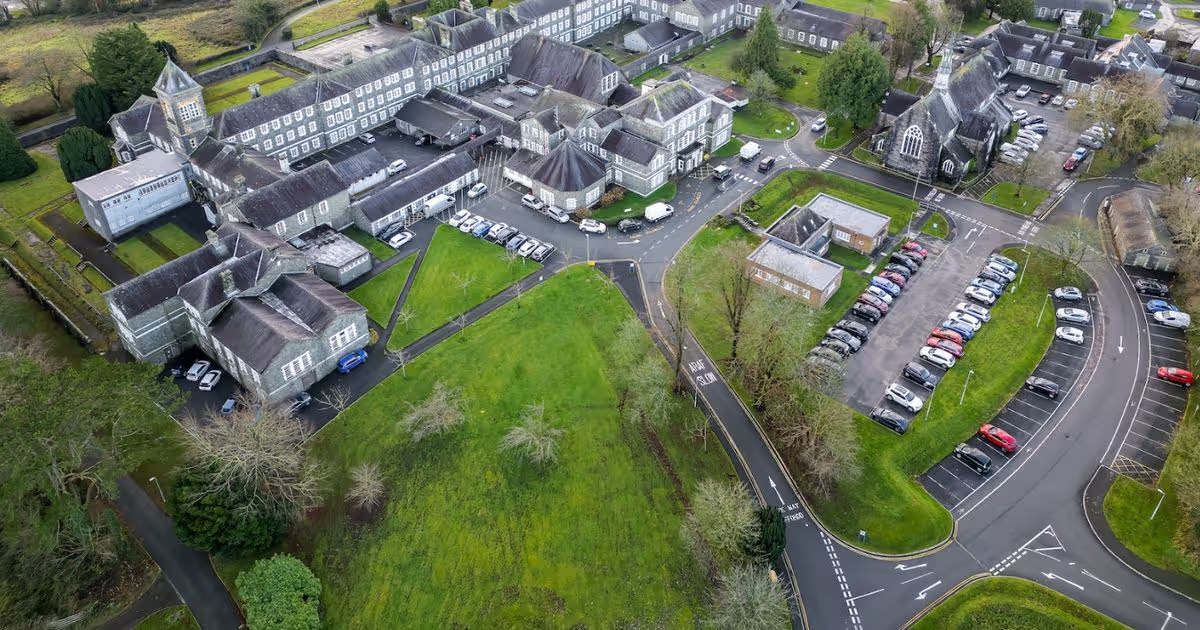
Parc Dewi Sant.
The site of a former psychiatric hospital in Carmarthenshire has been transformed into a health and wellbeing campus after being acquired two years ago.
Parc Dewi Sant in Carmarthen, which extends to 38 acres and which housed the former St David’s psychiatric hospital, is now home to 80 occupiers. Originally developed in the 19th century as a county asylum and later used for NHS mental health services until 2001, the estate has been repurposed into a modern campus focused on prevention, education and community wellbeing.
It brings together a diverse range of services in one location. These include GP provision alongside NHS services such as diabetic eye screening, antenatal clinics, weight management and smoking cessation programmes.
When acquired from Carmarthen County Council by Parc Dewi Sant Ltd, the site had 22 tenants. It had been put on the market with a £2.5m price tag.
Demand for space across the main buildings has been strong, with the majority now occupied. Attention is now turning to two remaining buildings on the estate which require significant restoration and are expected to form the next phase of development. The site currently provides around 120,000 sq ft of office space.
Parc Dewi Sant Ltd, which are viewing the site as a long-term investment hold, are in discussions with organisations exploring how the buildings could be repurposed to support additional healthcare, rehabilitation and community services.
Parc Dewi Sant serves a strategic catchment of around 187,000 people across Carmarthenshire and is close to Glangwili Hospital, providing complementary services that support prevention, rehabilitation and community wellbeing.
Advertisement
Mark Andrews owner of Parc Dewi Sant Ltd.
Mark Andrews, director, Parc Dewi San Ltd, said:“It has been a privilege to become custodians of such a historic and important estate in the heart of Carmarthen.
“From the outset we believed the site had enormous potential and it is incredibly rewarding to see such a vibrant community of organisations now operating here.
“To have 80 occupiers on site, including 60 who have joined us in the past two years, is a fantastic milestone and a real testament to the vision for Parc Dewi Sant.
“As the main buildings reach capacity, our focus now turns to the remaining buildings and how they can be brought back into productive use.
Advertisement
“We would welcome conversations with organisations that can bring complementary services and ideas to the site and help us continue building a campus that supports health, wellbeing and community life across Carmarthenshire.”
Meddygfa Parc is a NHS GP surgery on the campus, having relocated from the town centre last month. Jodi Bateman from the surgery said: “We feel incredibly fortunate to have moved to the beautiful surroundings of Parc Dewi Sant. This exciting new chapter allows us to continue providing high-quality care in a welcoming and modern environment.
The Investment Doctor is a financial writer, highlighting European small-caps with a 5-7 year investment horizon. He strongly believes a portfolio should consist of a mixture of dividend and growth stocks.
He is the leader of the investment group European Small Cap Ideas which offers exclusive access to actionable research on appealing Europe-focused investment opportunities not found elsewhere. The a focus is on high-quality ideas in the small-cap space, with emphasis on capital gains and dividend income for continuous cash flow. Features include: two model portfolios – the European Small Cap Ideas portfolio and the European REIT Portfolio, weekly updates, educational content to learn more about the European investing opportunities, and an active chat room to discuss the latest developments of the portfolio holdings. Learn more.
Analyst’s Disclosure: I/we have no stock, option or similar derivative position in any of the companies mentioned, and no plans to initiate any such positions within the next 72 hours. I wrote this article myself, and it expresses my own opinions. I am not receiving compensation for it (other than from Seeking Alpha). I have no business relationship with any company whose stock is mentioned in this article.
Seeking Alpha’s Disclosure: Past performance is no guarantee of future results. No recommendation or advice is being given as to whether any investment is suitable for a particular investor. Any views or opinions expressed above may not reflect those of Seeking Alpha as a whole. Seeking Alpha is not a licensed securities dealer, broker or US investment adviser or investment bank. Our analysts are third party authors that include both professional investors and individual investors who may not be licensed or certified by any institute or regulatory body.
SYDNEY — Australia has secured a strong fifth-place position in the latest 2026 global average IQ rankings, posting a national score of 104.45 according to data compiled from more than 1.2 million participants in standardized online intelligence tests conducted throughout 2025.
Australia Ranks Fifth Globally in 2026 Average IQ Rankings with Score of 104.45, Trailing East Asian Leaders
The ranking, released at the start of 2026 by the International IQ Test platform and mirrored across sites including World Population Review, places the country behind only South Korea, China, Japan and Iran. It marks a notable improvement from Australia’s previous showing of 102.57 in 2025 updates, reflecting a gain of nearly two points and underscoring the nation’s consistent high performance in cognitive assessments.
South Korea topped the list with 106.97, followed closely by China at 106.48 and Japan at 106.30. Iran rounded out the top five with 104.80. Russia placed sixth at 103.78, with Singapore, Mongolia, New Zealand and Vietnam completing the top 10. The global mean across tested populations remained standardized at 100, with a standard deviation of 15.
Experts caution that such rankings, while drawing widespread online attention, stem from self-selected online test-takers rather than nationally representative samples. The International IQ Test site requires a minimum of 100 participants per country for inclusion, with Australia contributing 4,245 test results in the latest dataset — a substantial sample that showed an upward shift from prior years’ 9,626 or more in some comparative figures.
Critics of national IQ compilations, including those tracing back to earlier datasets by researchers like Richard Lynn and David Becker, argue that methodological issues persist. These include cultural biases in test questions, varying access to education and technology, and the challenge of ensuring truly random sampling across diverse populations. Some academics have called for greater scrutiny of aggregated “national IQ” figures, noting they often blend online tests, student assessments like PISA and older proxy data.
Advertisement
Despite the debates, Australia’s high placement aligns with its strong results in international student assessments. The country routinely performs well in the OECD’s Programme for International Student Assessment, or PISA, which measures 15-year-olds’ abilities in reading, mathematics and science — skills closely correlated with broader cognitive measures. Recent PISA cycles have highlighted Australia’s emphasis on critical thinking, problem-solving and equitable education access as key drivers.
Education Minister Jason Clare welcomed the ranking as validation of ongoing investments in schooling and skills development. “These results reflect the hard work of Australian teachers, students and families,” Clare said in a statement. “Our focus on high-quality education from early childhood through university continues to pay dividends in building a smart, innovative workforce.”
Australia’s education system features a mix of public and private institutions, with significant federal and state funding. Compulsory schooling runs through age 15 or 16 depending on the jurisdiction, followed by strong vocational and higher education pathways. Universities such as the University of Melbourne, Australian National University and University of Sydney consistently rank among the world’s best, attracting international students and fostering research in fields from artificial intelligence to climate science.
Demographic factors also play a role. Australia is a highly urbanized, multicultural society with a large immigrant population from high-achieving regions, including East and South Asia. Skilled migration policies prioritize educated workers, potentially contributing to elevated average cognitive scores. The nation’s high standard of living, nutrition, healthcare and low rates of extreme poverty are frequently cited by researchers as environmental boosters for cognitive development — elements that align with the “Flynn effect,” where IQ scores rise over generations as living conditions improve.
Advertisement
Yet challenges remain. Socioeconomic disparities affect outcomes, with Indigenous Australian communities often recording lower average scores on standardized tests due to historical disadvantages, remote location barriers and health factors. Government initiatives aim to close these gaps through targeted programs in literacy, numeracy and early intervention. Urban-rural divides also influence access to advanced educational resources.
The 2026 ranking has sparked discussion in Australian media and policy circles. Outlets like Time Out Australia previously highlighted the country’s top-10 finish in 2025 data, noting a nearly one-point gain year-over-year and a position well above many Western peers, including the United States, which scored around 101 in recent compilations.
Psychologists emphasize that individual IQ variation far exceeds national averages. Within any country, scores form a bell curve, and a difference of a few points between nations carries limited practical meaning for policy or personal potential. “IQ is one measure of cognitive ability, but it doesn’t capture creativity, emotional intelligence, resilience or cultural knowledge,” said Dr. Emma Thompson, a cognitive psychologist at the University of Sydney. “Australia’s strength lies in its adaptable, collaborative workforce.”
Innovation metrics bolster the narrative of Australian cognitive capital. The country ranks highly in global innovation indexes, with strengths in mining technology, renewable energy, biotechnology and digital services. Companies like Atlassian and Canva exemplify homegrown tech success, while research institutions contribute to breakthroughs recognized worldwide.
Advertisement
Economists link higher average cognitive skills to productivity and GDP growth. Studies have explored correlations between national IQ estimates and economic outcomes, though causation remains hotly debated. Factors like governance quality, rule of law and investment in human capital often explain more variance than raw test scores. Australia’s stable democratic institutions, resource wealth and trade ties with Asia position it favorably regardless of precise IQ figures.
Comparisons with close neighbors are instructive. New Zealand, with a 2026 score of 102.35, also performs strongly, reflecting similar Anglo-Celtic and multicultural foundations plus robust education systems. The United Kingdom and Canada, fellow Commonwealth nations, typically land in the 99-101 range in various datasets, while the U.S. hovers near 101.
East Asian dominance in the rankings — South Korea, China and Japan — is often attributed to rigorous education cultures, cultural emphasis on discipline and high-stakes testing, alongside genetic and nutritional factors still under study. Iran’s strong showing has surprised some observers and prompted analysis of its educational priorities despite geopolitical challenges.
Online IQ tests, while accessible, introduce self-selection bias: motivated, tech-savvy individuals are more likely to participate. Language proficiency, familiarity with digital interfaces and test-taking experience can influence results. The International IQ Test platform standardizes its instrument to a mean of 100, allowing cross-country comparisons, but experts stress the need for caution when extrapolating to entire populations.
Advertisement
Broader critiques target the very concept of ranking nations by IQ. Some researchers argue that historical datasets suffered from small, unrepresentative samples and potential ideological biases. Recent calls have emerged to re-evaluate or retract studies relying on contested national IQ compilations. Proponents counter that large-scale aggregated data from millions of test-takers provide useful directional insights when viewed alongside PISA, TIMSS and other metrics.
In Australia, the ranking has fueled calls for continued education reform. Stakeholders urge more focus on STEM subjects, digital literacy and equitable access amid concerns over declining PISA scores in some areas over the past decade. Others highlight the importance of holistic development, including arts, sports and social-emotional learning.
Public reaction has been largely positive but tempered. Social media commentary praised the result as evidence of national capability, while others dismissed it as pseudoscience or irrelevant in an era of artificial intelligence that augments human cognition.
As the world grapples with rapid technological change, cognitive skills remain vital. Australia’s high ranking, whether from online tests or traditional measures, signals a population well-equipped for future challenges in automation, climate adaptation and global competition.
Advertisement
For now, the 104.45 score cements Australia’s reputation as one of the world’s sharper nations intellectually. Policymakers, educators and citizens alike see it as encouragement to sustain investments that nurture talent across all backgrounds.
The full 2026 dataset, based primarily on 2025 test results, continues to circulate widely online, prompting fresh debates about what intelligence truly means in the 21st century and how best to measure and cultivate it on a national scale.
I have over 15 years of experience investing and have provided research services to mid-sized hedge funds with assets under management between $100 and $500 million. I also have had a brief stint as a sell-side analyst. I am now focusing primarily on managing my own money and my purpose here is to share my views and benefit from the insights of the Seeking Alpha user community. Feel free to provide your feedback on my thesis in the comment section and I would love to have a discussion even if you have a variant view. My strategy is medium-term investing in ideas where there is a catalyst to unlock value and drive upside or short selling in case there is a downside catalyst. I also like to invest in growth stories available at a reasonable price. In terms of sector preferences, I am a generalist. However, I had spent most of my professional career analyzing industrial, consumer, and technology sectors. So, this is where I usually have higher conviction while investing.
Analyst’s Disclosure: I/we have no stock, option or similar derivative position in any of the companies mentioned, and no plans to initiate any such positions within the next 72 hours. I wrote this article myself, and it expresses my own opinions. I am not receiving compensation for it (other than from Seeking Alpha). I have no business relationship with any company whose stock is mentioned in this article.
Seeking Alpha’s Disclosure: Past performance is no guarantee of future results. No recommendation or advice is being given as to whether any investment is suitable for a particular investor. Any views or opinions expressed above may not reflect those of Seeking Alpha as a whole. Seeking Alpha is not a licensed securities dealer, broker or US investment adviser or investment bank. Our analysts are third party authors that include both professional investors and individual investors who may not be licensed or certified by any institute or regulatory body.
Get ahead of the market by subscribing to Seeking Alpha’s Wall Street Week Ahead, a preview of key events scheduled for the coming week. The newsletter keeps you informed of the biggest stories set to make headlines, including upcoming IPOs, investor days, earnings reports, and conference presentations.
Wall Street’s major market averages ended mixed on Thursday as markets assessed President Donald Trump’s address to the nation and the latest developments in the Middle East conflict. Trump said the U.S. will strike Iran “extremely hard” over the next two to three weeks, warning the country would be pushed “back to the stone ages,” though he indicated talks with Tehran remain ongoing. On a sector-by-sector basis, five of the 11 S&P segments concluded in the red, with consumer discretionary at the bottom. At the other end of the spectrum, real estate was the strongest performer.
The next week will feature a slew of important economic data, beginning with ISM Non-Manufacturing PMI, business activity data for March on Monday. The FOMC’s minutes of the meeting will be released on Wednesday, with Fed Governor Philip Jefferson’s speech scheduled for the same day. The quarterly GDP data, PCR price index data, and jobless claims data are due on Thursday. Inflation numbers along with the Fed’s balance sheet will be released on Friday.
Delta Air Lines (DAL), Applied Digital (APLD), and BlackBerry (BB) are among the companies reporting their results next week.
Volatility watch: CoreWeave (CRWV) and Cytokinetics (CYTK) are set up for a volatile week of trading based on options volume. The most overbought stocks per their 14-day
Maria Guardiola, the eldest daughter of Manchester City manager Pep Guardiola, has stepped into the spotlight in recent years as a fashion influencer while maintaining a close bond with her famous father, most recently captured in an emotional embrace on the Wembley pitch after City’s Carabao Cup final victory in March 2026.
As of April 2026, Maria, 25, continues to draw attention for her stylish social media presence, her career moves in the fashion world and her supportive role within the Guardiola family amid personal changes. Here are five essential things to know about Pep Guardiola’s daughter.
1. She is Pep Guardiola’s eldest child and has two younger siblings
Maria Guardiola was born on Dec. 28, 2000, in Manresa, Catalonia, Spain, making her 25 years old in 2026. She is the oldest of three children Pep Guardiola shares with his former wife, Cristina Serra. Her younger brother, Marius (sometimes spelled Màrius), is 22, and her sister, Valentina, is 17. The family has navigated significant changes since Pep and Cristina announced their separation in January 2025 after more than 30 years together. Cristina has since returned to Barcelona to focus on her business, while the children maintain strong relationships with both parents.
Advertisement
Maria has often spoken warmly about her family dynamics in interviews. In her first public comments following the split, she joked about inheriting her father’s “stubbornness” and her mother’s “confidence and sense of independence.” The siblings grew up moving between cities as Pep’s coaching career took the family from Barcelona to Rome, New York, Munich and eventually Manchester. Despite the nomadic lifestyle, Maria has described a close-knit bond that persists today.
2. She has built a successful career as a fashion influencer and content creator
With nearly 900,000 followers on Instagram under the handle @maria.guardiola, Maria has established herself as a rising style icon and influencer. She frequently shares fashion looks, travel moments, restaurant visits and glimpses of her glamorous lifestyle, including appearances at events such as the Brit Awards. Her content often features high-end outfits, mirror selfies and stylish outings that resonate with her audience.
Maria previously worked in fashion retail and licensing, including a role as a retail and licensing coordinator at Manchester City. She has also been employed by Victoria Beckham’s brand, adding high-profile experience to her resume. Her growing platform has led to brand collaborations and modeling opportunities, positioning her as more than simply “Pep Guardiola’s daughter.” In early 2026, she continued posting photo dumps from luxury settings and stylish events, showcasing her independent identity in the fashion world.
Advertisement
3. She had a brief romance with former England footballer Dele Alli
Maria’s personal life has occasionally made headlines due to her past relationship with former Tottenham and England midfielder Dele Alli. The brief romance drew media interest given the intersection of football and celebrity circles. While details remained private, the connection added another layer to her public profile in the sports-adjacent world.
She has generally kept romantic matters low-key, focusing instead on her career and family. As of 2026, there have been no widely reported new relationships, with Maria appearing to prioritize her professional growth and family ties.
4. She shares touching family moments with her father, including recent emotional embraces
Advertisement
One of the most heartwarming recent stories involving Maria came after Manchester City’s 2-0 victory over Arsenal in the Carabao Cup final on March 23, 2026. Following the win — which marked Pep Guardiola’s record fifth triumph in the competition — cameras captured an emotional father-daughter moment on the Wembley pitch. Maria joined her father for a warm, lingering embrace away from the main celebrations, with images and video quickly going viral.
Fans and commentators described the scene as touching, especially given the family’s recent challenges following the parental separation. Maria has been a visible supporter at City matches and events, providing a glimpse of the softer side of the often intensely focused manager. Similar moments over the years, including celebrations with trophies, have shown the strong bond between father and daughter despite the demands of Pep’s high-pressure job.
5. She maintains privacy while navigating life in the public eye
Despite her growing influencer status and her father’s global fame, Maria has largely avoided deep dives into personal or family controversies. She has spoken sparingly in interviews but has emphasized family unity and resilience. Living primarily in London while her father resides in Manchester, she balances her independent life with frequent visits and support for her dad’s career.
Advertisement
Maria’s social media presence remains curated and positive, focusing on fashion, travel and lifestyle rather than football drama or family matters. She has been praised for handling public attention gracefully, especially during the period surrounding her parents’ split. Her approach reflects a desire to carve out her own path while cherishing her connection to the Guardiola name.
As Pep Guardiola weighs his future at Manchester City amid speculation about his tenure, moments like the Wembley embrace with Maria highlight the personal stakes behind the tactical genius. The family continues to support one another across cities and life changes, with Maria serving as a visible link between Pep’s professional world and their private lives.
In 2026, Maria Guardiola stands out as a young woman successfully blending fashion ambition with family loyalty. Her story offers a humanizing glimpse into the life of one of football’s most successful managers, reminding fans that even the most intense figures on the touchline share tender moments with loved ones off the pitch.
Whether sharing stylish Instagram posts or celebrating her father’s achievements, Maria continues to navigate fame on her own terms. As both her influencer career and her family’s story evolve, she remains one of the more intriguing figures connected to the Premier League spotlight.























































You must be logged in to post a comment Login