
Business
Frasers Group builds 6% stake in Puma as Mike Ashley targets turnaround at struggling sportswear brand


Mike Ashley’s retail empire has added another high-profile investment to its portfolio after Frasers Group quietly built a near 6 per cent stake in the German sportswear brand Puma.
Regulatory filings on the German stock exchange revealed that the owner of Sports Direct, Flannels and House of Fraser now controls a 5.77 per cent holding in Puma. The disclosure triggered an immediate reaction in the market, sending Puma’s shares up almost 10 per cent as investors interpreted the move as a potential vote of confidence in the struggling brand.
The investment makes Frasers Group the second-largest shareholder in Puma, just weeks after the Chinese sportswear giant Anta Sports agreed to acquire a 29.1 per cent stake in the business for €1.5 billion from the French billionaire Pinault family.
Frasers’ position has reportedly been assembled through a series of put option agreements linked to Puma shares, a financial strategy that allows the group to build exposure to the company without immediately purchasing large blocks of stock in the open market.
The move highlights Frasers’ increasingly active role as a strategic investor in global fashion and retail brands. Founded by Mike Ashley in 1982, the group has built a reputation for taking minority stakes in companies and using its influence to push for operational or strategic changes.
Although Ashley stepped down from day-to-day leadership in 2022, the business is now run by his son-in-law, Michael Murray, who has continued the strategy of investing in key partners and competitors across the retail sector.
Puma is already a major supplier of trainers and sportswear to Sports Direct, Frasers’ flagship retail chain. Strengthening its shareholding could give the British retailer additional influence in the brand’s future strategy and product development.
The investment comes at a turbulent moment for Puma, which has struggled to keep pace with rivals such as Nike and Adidas.
The company issued several profit warnings last year and has been undergoing a restructuring programme aimed at restoring profitability and rebuilding its brand position in the global sportswear market.
Earlier this year, Puma reported a record annual loss of €645.5 million and declining sales, forcing the company to scrap its dividend and announce plans to cut around 900 jobs as part of its turnaround effort.
The restructuring is being led by the company’s new chief executive, Arthur Hoeld, who has signalled that the brand needs to fundamentally rethink its product strategy and global positioning.
Hoeld has acknowledged that demand for Puma footwear has weakened significantly in recent years and said the company must take a “hard look at ourselves” as it attempts to recover market share.
Like many consumer brands, Puma has also been hit by broader macroeconomic pressures. Slowing consumer demand in the United States, geopolitical uncertainty and trade tensions have all contributed to a challenging environment for global retail companies.
Tariffs introduced during the presidency of Donald Trump have added additional costs to international supply chains, while weakening consumer confidence has weighed on discretionary spending.
Despite these pressures, Puma’s share price has begun to recover after falling to a near ten-year low of around €15 late last year. The stock recently closed at €22.62, helped by renewed investor interest following the Anta investment and Frasers’ latest move.
Frasers’ stake in Puma is the latest example of the group’s aggressive investment strategy across the retail and fashion sector.
In recent years the company has accumulated significant stakes in several major brands and retailers, including Hugo Boss, where it holds roughly a 25 per cent stake, Asos, Boohoo Group and Mulberry.
The group has frequently used these stakes to exert pressure on management teams and influence strategic decisions.
A long-running dispute with Boohoo, for example, saw Frasers attempt to install Mike Ashley as chief executive and block the company’s efforts to rebrand its holding entity as Debenhams.
Similarly, Frasers has recently increased its position in Asos and voted against all board resolutions at the online retailer’s annual general meeting, signalling dissatisfaction with its performance and strategy.
The new investment by Frasers comes shortly after Anta Sports’ landmark purchase of a 29.1 per cent stake in Puma from the Pinault family, which had been the sportswear company’s largest shareholder for many years.
Anta said the deal was part of its broader strategy to expand its portfolio of international brands and strengthen its position in the global sportswear market.
The company described the acquisition as a “major step forward in our single-focus, multi-brand globalisation strategy”, although it said it had no immediate plans to launch a full takeover bid for Puma.
Founded in 1991, Anta has grown rapidly into one of the world’s largest sportswear groups and already owns several global brands, including outdoor apparel company Jack Wolfskin.
With Anta and Frasers now holding significant stakes, analysts expect the ownership structure of Puma to come under increasing scrutiny.
The presence of two powerful strategic shareholders could reshape the company’s direction, particularly if they push for changes to product development, distribution strategies or management structures.
For Frasers, the investment reinforces its broader strategy of building influence across the global retail ecosystem, strengthening relationships with key brands while positioning itself to benefit from any recovery in the sportswear market.
Whether the stake leads to deeper collaboration with Puma or more active shareholder involvement remains to be seen, but the move signals that Mike Ashley’s retail empire is continuing to expand its influence well beyond Britain’s high street.

Jamie Young
Jamie is Senior Reporter at Business Matters, bringing over a decade of experience in UK SME business reporting.
Jamie holds a degree in Business Administration and regularly participates in industry conferences and workshops.
When not reporting on the latest business developments, Jamie is passionate about mentoring up-and-coming journalists and entrepreneurs to inspire the next generation of business leaders.


The Reserve Bank of India’s defense of a record-low rupee has constrained its ability to inject liquidity, tightening financial conditions that are likely to weigh on banks over the coming quarters. A prolonged conflict in the Middle East also risks derailing India’s nascent credit recovery, threatening loan growth as the broader economy cools.
Global investors withdrew a record 327 billion rupees ($3.5 billion) from shares of financial services companies in the first fortnight of March, according to National Securities Depository Ltd. data. The Nifty Bank Index has lost $95 billion in market value since the start of March, narrowly avoiding a bear market — defined as a 20% drop from a recent high.
“There could be further pressure on these stocks in the short-to-medium term as monetary policy can remain tight,” Kranthi Bathini, an equity strategist at WealthMills Securities, said, adding that valuations are becoming attractive after the correction.
 Agencies
At stake is the outlook for India’s $4.5 trillion stock market, given banks account for nearly a third of the benchmark index. A sustained weakness in shares of lenders could undermine a broader market that is already among the worst performers in the region, down 13% for the year.

Bulls point to improving valuation multiples for bank stocks and India’s long-term economic growth, which remains among the fastest globally. The Nifty Bank Index trades at 1.5 times one-year forward price-to-book, its cheapest level since 2020, signaling an attractive risk-reward profile.
Citibank Inc. is already prioritizing private-sector banks over state-run lenders, betting that the former can better absorb the macroeconomic stress that is now the prime concern for investors.Still, Jefferies estimates banks could face as much as 50 billion rupees from unwinding their currency trades due to diktats of the central bank. Fitch Ratings sees net interest margins of lenders shrinking 20-30 basis points in the year ending March 2027 — potentially undershooting the credit rating agency’s 3.1% forecast — as tighter financial conditions weigh.
“Banks will definitely take some hit on their investment book,” said Rajat Agarwal, an Asia strategist at Societe Generale SA. “We recently saw a pickup in credit growth — what remains to be seen is how much of that gets pushed back” by the war, he said.

Among the top gainers were electric bikes maker Ather Energy (139% return), auto ancillary manufacturer Belrise Industries (98%), and Aditya Infotech (78%), which provides video surveillance solutions.
Instead of listing price, if offer price is considered, then the proportion of companies improves – 37 IPOs generated returns while 31 yielded double-digit returns. The same three companies made it to the top three slots. Aditya Infotech took the lead with 168% return over the offer price while Ather Energy and Belrise gained 143% and 116%.
AgenciesIn a volatile market, just 16 IPOs yielded double-digit returns over listing price
It was also the year when majority of the large IPOs based on the issue size or money raised failed to generate returns. Only a quarter of the top 12 IPOs – four to be precise – earned returns. These include Lenskart and Groww generating 26% return each, followed by 11% return by ICICI Prudential AMC and 8% by Tenneco Clean Air India.
Among the worst performing IPOs of FY26 were steel products maker VMS TMT, which fell 62% from the listing price followed by construction company Highway Infrastructure and renewable energy equipment provider Solarworld Energy Solutions which lost 60% each.

CHANDAN TAPARIA
HEAD – DERIVATIVES & TECHNICALS, MOTILAL OSWAL FINANCIAL SERVICES
Where is Nifty headed?
Nifty has been forming lower highs and lower lows on weekly chart, signalling a sustained downtrend. Despite this weak structure, the index staged a sharp 500-point intraday recovery on Thursday, forming a bullish candle on both daily and weekly charts. The index is now deeply oversold pointing to the possibility of a near-term pullback or relief rally. Holding above 22,100 is critical. A sustained move above 23,000–23,333 could trigger short covering, while failure to do so may keep the downtrend intact, with the index at risk of slipping below 21,750.
Trading Strategies : Recommended strategy for Nifty Option for 13 April expiry is a Bear Put Spread, ideal for a slight negative bias. Traders are advised to buy one lot of 22,700 strike Put Option and simultaneously sell one lot of 22,400 strike Put Option. Maximum risk in the strategy is 115 points (Rs 7,475), and a maximum potential Profit is 285 Points (Rs 18,525) per lot if the index expires below 22,400 zones towards next weekly expiry.
TOP STOCKS FOR THE WEEK
Adani Power: Buy. CMP Rs 160, Stop Loss: Rs 154, Target: Rs 172
Stock has broken out from a consolidation zone on daily chart after 100 trading sessions with a strong-bodied bullish candle. It has given the recent highest daily close with rising traded volumes along with holding above key moving averages.
Tech Mahindra: Buy. CMP Rs 1441, Stop Loss: Rs 1400, Target: Rs 1510
Stock started to form a higher top – higher bottom on weekly scale after the sharp corrective move in February. It has seen a consolidation breakout of the last 25 trading sessions and formed a Rounding Bottom pattern on daily chart.
HITESH TAILOR
TECHNICAL ANALYST, CHOICE EQUITY BROKING
Where is Nifty headed?
Nifty is likely to trade in a broad range of 22,150–23,500 with a sideways to bearish bias. While oversold indicators may trigger short-covering rallies, sustainability above 23,500 will be critical to shift sentiment. Until then, any pullback towards resistance zones is likely to face selling pressure. A decisive break below 22,150 could open the door for further downside towards 21,900-21,700 levels. Weekly RSI at 27.88 signals that market is in a deeply oversold zone, increasing the probability of a short-term relief rally or consolidation.
Trading Strategies: Nifty traders may consider a ‘sell on rise’ strategy in the 22,900-23,200 zone, with a stop loss at 23,500 and potential targets of 22,150-21,900. Fresh longs should be considered only if Nifty sustains above 23,500 on a closing basis.
AgenciesTOP STOCKS FOR THE WEEK
Adani Power: Buy at CMP Rs 159, Stop Loss at Rs 150, Target: Rs 177
Price structure has improved following a decisive breakout above a key horizontal resistance zone. The move is backed by a strong close and a clear uptick in volumes, signalling renewed buying interest and stronger participation.
Marico: Buy at CMP Rs 761, Stop Loss: Rs 724, Target: Rs 824
Marico’s structure remains positive, with a consistent formation of higher highs and higher lows pattern across timeframes. A pullback from its all-time high held near the 200-day EMA and saw a rebound, underscoring demand at lower levels and keeping the bullish undertone intact.
SACCHITANAND UTTEKAR
VP- RESEARCH (TECHNICAL & DERIVATIVES), TRADEBULLS SECURITIES
Where is Nifty headed?
The broader trend remains bearish unless a clear weekly reversal emerges. For the week, upside appears capped near 23,000, with 23,430 zone acting as a strong supply area, backed by the confluence of the 20-DEMA and prior gap resistance. On the downside, 22,000 is a crucial support; a decisive break could accelerate selling towards 21,630 (50-MEMA), exposing the index to deeper downside risk. The strategy remains ‘sell on rise’.
Trading Strategies: Traders should stay tactically flexible. In case a pullback unfolds driven by the 3-point Price–RSI divergence on the daily chart, a conditional ‘Buy’ above 23,000 should be deployed with a stop loss at 23,860 for a target of 23,430. However, since the broader bias remains cautious, a breakdown below 22,530 would signal continued weakness, potentially dragging the index towards sub-22,000 levels and reinforcing the prevailing downtrend to extend towards 21,630. In that case, sell below 22,530 with a stop loss at 22,610 for a target of 22,000.
TOP STOCKS FOR THE WEEK
Trent: Buy at Rs 3550, Stop Loss: Rs 3490, Target: Rs 3760.
Weekly ‘Bullish Engulfing’ pattern with RSI crossover signals a strong possibility of reversal. Also on its 30-minute chart, an ‘Inverse head and shoulders’ pattern breakout above Rs 3,550 confirms a bullish setup, with a projected move towards Rs 3,800.
Eicher Motors: Sell at Rs 6684, Stop Loss: Rs 6840, Target: Rs 6068.
Stock has broken its 12-month trend structure, closing below its prior month’s low for the first time, signalling a shift in long-term momentum. Last week’s sustained trade below its 200-DEMA (6780) and 50-WEMA (6630) confirms persistent supply pressure.
The six-member monetary policy committee meets April 6-8 for the first time since the war broke out on February 28.
Assessment of War’s Impact
While a policy pause is widely anticipated, economists said the RBI’s communication, particularly on the rupee and bond yields, will be closely scrutinised. Several respondents also expect the central bank to consider additional steps to shore up the currency amid persistent capital outflows.
“Further policy changes by the RBI and the India government to manage INR weakness could be likely,” said Michael Wan, senior currency analyst at MUFG Bank.
“These could include restrictions and higher import duties on gold and non-essential imports and a dedicated facility or FX swap window by the RBI so that oil marketing companies can tap dollars instead of going to the market.”
Most economists expect the central bank will avoid an aggressive response for now, preferring to assess the impact of the war and higher oil prices on the economy.“After two back-to-back circulars on the rupee, people are reminded of the 2013 playbook, but I think the story ends there,” said Abhishek Upadhyay, senior economist at ICICI Securities Primary Dealership, referring to moves by the RBI to rein in the Indian currency’s decline.
“It’s not 2013 and we don’t have a situation of a run on the currency.” Highlighting risks without committing to a policy trajectory is a good template to follow, said Sakshi Gupta, principal economist at HDFC Bank.
“If there is a hawkish commentary, it is likely to be balanced by stating that inflation is expected to remain within the comfort zone,” she said.
Gaurav Kapur, chief economist at IndusInd Bank, expects that the governor is likely to acknowledge rising risks to inflation, growth and the exchange rate, while highlighting macroeconomic and financial stability backed by adequate external buffers to absorb supply shocks.
Markets will focus on the RBI’s assumed crude oil price, which underpins its growth and inflation projections. India’s retail inflation stood at 3.21% in February.
In the last policy announcement on February 6, the RBI projected inflation for the first two quarters of FY27 at 4% and 4.2%, while GDP growth was seen at 6.9% and 7%, respectively.

BULLISH BETS
TITAN COMPANY
Change in Open Interest in April Series: 0.8% Change in price in April Series: 3.7% RATIONALE: Strong rollover into the April series, along with a lower roll cost of 0.31% (from 0.68%), shows traders are willing to pay to stay bullish, said Rajesh Palviya, head of technical and derivatives research at Axis Securities.
“As the Akshaya Tritiya festival nears, the market is bullish that the upcoming Q4 earnings will validate Titan’s ability to turn elevated gold prices into superior margins and footfalls,” he said. Palviya suggests buying on dips for a target of Rs 4,270-4,300, with a stop loss in futures at Rs 4,020-4,030.
ADANI POWER
Change in Open Interest in April Series: 98.95% (newly inducted in the futures segment) Change in price in April Series: 1.67% RATIONALE: The stock has witnessed a bullish breakout from a congestion zone of more than fi ve months with a signifi cant rise in volumes, said Vipin Kumar, AVP – derivatives and technical research at Globe Capital Market.
“The breakout is well supported by long buildup in the fi rst two trading sessions after its induction in the derivatives segment,” he said. Kumar said traders can buy its April Futures in the Rs 159-156 range for a target of Rs 170-175, with a stop loss at Rs 147.
NATIONAL ALUMINIUM
Change in Open Interest in April Series: -14.55% Change in price in April Series: 4%
RATIONALE: The stock has witnessed a close at the highest level on a weekly basis, said Sudeep Shah, head – technical and derivative research, SBI Securities. The fall in open interest and rise in share price point to short-covering. The stock is expected to move towards Rs 419-427 and can be bought with a stop loss at Rs 388, said Shah.
ABB INDIA
Change in Open Interest in April Series: 0.3% Change in price in April Series: 3.4%
RATIONALE: ABB’s higher-than-average rollover confi rms structural bullishness, said Palviya of Axis. “This transition from a high cost to a ‘discount’ during a price upswing suggests that long positions are being rolled with high conviction and effi ciency,” he said. “Investors are clearly looking past minor regulatory hurdles, positioning aggressively for a Q4 print expected to showcase scalable margins from massive greenfield infrastructure orders,” Palviya suggests buying on dips for a target of Rs 6,550-6,600, with a stop loss at Rs 5,950 (Futures rates).
JINDAL STEEL
Change in Open Interest in April Series: 0.67% Change in price in April Series: -1%
RATIONALE: Profit-taking in Jindal Steel from its all-time highs has halted near its previous breakout levels, which also coincide with the six-month exponential moving average, said Globe’s Kumar. “Considering its current chart positioning, we expect it to continue its prevailing uptrend, potentially reaching Rs 1220 in the immediate near term,” he said. Kumar advises buying its April Futures in the Rs 1,125-1,105 range, for a target of Rs 1,220, and stop loss at Rs 1,070
HINDALCO INDUSTRIES
Change in Open Interest in April Series: -1.8% Change in price in April Series: 3.6%
RATIONALE: The share surge, along with a decrease in open interest, suggests short covering. Fundamentally, the rally is underpinned by global supply shocks at EGA and Alba, which have bolstered LME aluminium benchmarks, said Palviya of Axis.
“Market focus now shifts to the Q4 earnings print, where these elevated benchmark realisations are expected to translate into sustainable margin expansion for both domestic operations and Novelis,” he said. Palviya suggests buying the stock on any dips for a target of Rs 980- Rs 1,000, and stop loss at Rs 875
BEARISH BET
PG ELECTROPLAST
Change in Open Interest in April Series: 17.8% Change in price in April Series: -3.3%
RATIONALE: The stock hit a fresh 52-week low of Rs 443.05 on Thursday. It has broken down from a consolidation, forming a lower high–lower low pattern on weekly charts, said SBI’s Shah. “It is trading below its short- and long-term moving averages, and we expect the stock to test lower levels,” he said. Shah recommends selling PGEL between Rs 438-443 with a stop loss at Rs 452 for a target of Rs 417.


Samsung Elec likely to report stupendous surge in quarterly profit to record level

A Market Driven by Noise, Not Always Value
Global equities today are influenced as much by sentiment as by fundamentals. Short-term movements are often erratic, driven by interest rate expectations, geopolitical tensions, and capital flows. As Joel Greenblatt highlighted in his bestselling book “The Little Book That Beats the Market.”, stock prices can fluctuate wildly in the short run without a corresponding change in the underlying business value .
This disconnect is particularly visible in current global markets:
US markets remain sensitive to monetary policy shifts and inflation data.
European equities face energy price volatility and growth concerns.
Emerging markets, including India, are navigating capital inflows alongside currency pressures.
Such conditions reinforce the idea that markets behave irrationally in the short term but tend toward efficiency over the long term.
The Rise of Factor-Based and Value Investing
In an environment where macro signals dominate headlines, investors are increasingly turning toward systematic strategies. Greenblatt’s Magic Formula, built on earnings yield (value) and return on capital (quality), offers a disciplined approach to stock selection.This framework aligns well with the current global scenario:
Earnings yield helps identify stocks that are undervalued relative to their earnings potential.
As global markets oscillate between growth and value cycles, such factor-based investing has gained traction among institutional and retail investors alike.
Mispricing Opportunities in a Fragmented Market
One of the defining characteristics of today’s global market is dispersion, while some sectors are richly valued, others remain overlooked. Greenblatt’s philosophy is rooted in identifying these inefficiencies.
Markets often misprice stocks due to emotional reactions and short-term narratives. This creates opportunities to buy good businesses at bargain prices, a principle also echoed by Warren Buffett.
In the current cycle:
Technology and AI-driven stocks may appear expensive but continue to command premium valuations.
Cyclical sectors like metals, energy, and financials often swing between undervaluation and sharp rallies.
Mid- and small-cap stocks globally present pockets of mispricing due to liquidity constraints and risk aversion.
Patience and Time Horizon: The Missing Edge
A key takeaway from Greenblatt’s approach is that even the best strategies can underperform in the short term. He emphasizes that lack of patience is one of the primary reasons investors fail to benefit from sound investment frameworks .
This insight is particularly relevant today:
Markets are reacting quickly to news, leading to frequent corrections and rallies.
Investors often chase momentum, abandoning long-term strategies prematurely.
In contrast, disciplined investors who stay invested across cycles are better positioned to capture long-term alpha.
Diversification and Risk Management in a Global Context
Global investing today demands diversification, not just across stocks, but across geographies and sectors. Greenblatt underscores diversification as essential to withstand adverse periods and allow a sound process to deliver results over time .
Given current uncertainties:
A diversified portfolio can balance developed and emerging market exposure.
Sectoral diversification helps mitigate risks from commodity cycles or policy changes.
India in the Global Equation
India continues to stand out as a relatively resilient market, supported by domestic demand, structural reforms, and earnings visibility. However, it is not immune to global shocks:
Foreign institutional flows remain sensitive to global liquidity.
Valuations in certain segments appear stretched, increasing the importance of selective investing.
Applying a disciplined approach can help Indian investors navigate this environment by focusing on quality businesses available at reasonable valuations.
Back to Basics in a Complex World
The global stock market may be entering a phase where macro uncertainties persist, but the core principles of investing remain unchanged. Greenblatt’s Magic Formula reinforces a simple yet powerful idea:
Successful investing lies in systematically identifying strong businesses trading at attractive prices, and having the patience to stay invested.
In a world dominated by noise, algorithms, and rapid capital flows, returning to such fundamental, value-driven frameworks may well be the most effective way to generate consistent long-term returns.
Data from the Clearing Corporation of India showed CSB Bank offered the highest rate at 8.32% for 91 days, followed by Ujjivan Small Finance Bank and Equitas Small Finance Bank, which raised funds at 8.25% for 366 days and 356 days, respectively. Other lenders such as HDFC Bank and IDBI Bank paid 7.6% for 33-day funds.
“While some firming is typical at year-end as banks shore up their balance sheets, this spike goes beyond seasonality,” said VRC Reddy of Karur Vysya Bank. “CD rates have moved to elevated levels, signalling deeper funding pressures rather than just a year-end phenomenon.”
HDFC Bank, the country’s most valuable lender, which has been under investor scrutiny following the sudden exit of chairman Atanu Chakraborty, raised funds at 7.6% for 33 days on March 27, mobilising ₹4,300 crore. Punjab National Bank raised ₹1,175 crore at 7.5% for the same tenor. These rates are well above the 3.25% banks typically pay retail depositors for 30- to 45-day deposits. Most banks pay around 6.25% to 7% for one-year deposits.
“The CD rates do appear high when compared with retail deposit rates or the card rates published by banks, largely because deposit growth has lagged credit growth,” said Anil Gupta, co-group head for financial sector ratings at ICRA.
Overall, HDFC Bank raised ₹23,090 crore during the last fortnight across tenors ranging from 33 to 327 days, paying interest rates between 7.3% and 7.6%. Data showed Axis Bank raised ₹3,500 crore at 7.6% for 92 days, IndusInd Bank raised ₹2,075 crore at around 7.5% for tenors ranging from 91 to 94 days, while Bandhan Bank paid 7.85% for 186 days on a ₹125 crore CD.During the fortnight ended March 31, banks issued ₹1.07 lakh crore of CDs, broadly in line with issuance in the corresponding fortnight last year.
CD rates had earlier climbed sharply during periods of tight liquidity, peaking at about 8.15% between February and March 2024, according to historical data.
Reddy said elevated CD rates reflect a combination of tight systemic liquidity, pressures linked to liquidity coverage ratio requirements, and tactical balance-sheet management amid weak deposit mobilisation.
“In this backdrop, banks have prioritised certainty over cost, relying on CDs and other bulk funding to secure immediate and assured resources,” he said.
ICRA’s Gupta said while CD rates are high, such issuances are typically used to plug short-term mismatches in asset-liability flows. “Certificates of deposit account for only 2.6% of overall bank deposits and do not materially increase the overall cost of deposits,” he said.
Union Bank of India raised ₹24,060 crore, while Punjab National Bank mobilised ₹12,450 crore in the last fortnight of March, offering rates ranging between 6.9% and 7.5%, the data showed.
Banks paid higher rates for shorter-tenor CDs than for longer maturities.
Reddy said CD rates may ease from the March-end spike but are unlikely to soften meaningfully in FY27. “The underlying drivers – tight liquidity conditions, a persistent credit-deposit mismatch and pressure on deposit mobilisation – are structural rather than transient,” he said.


Three Gulf funds agree to back Paramount’s $81 billion takeover of Warner, WSJ reports
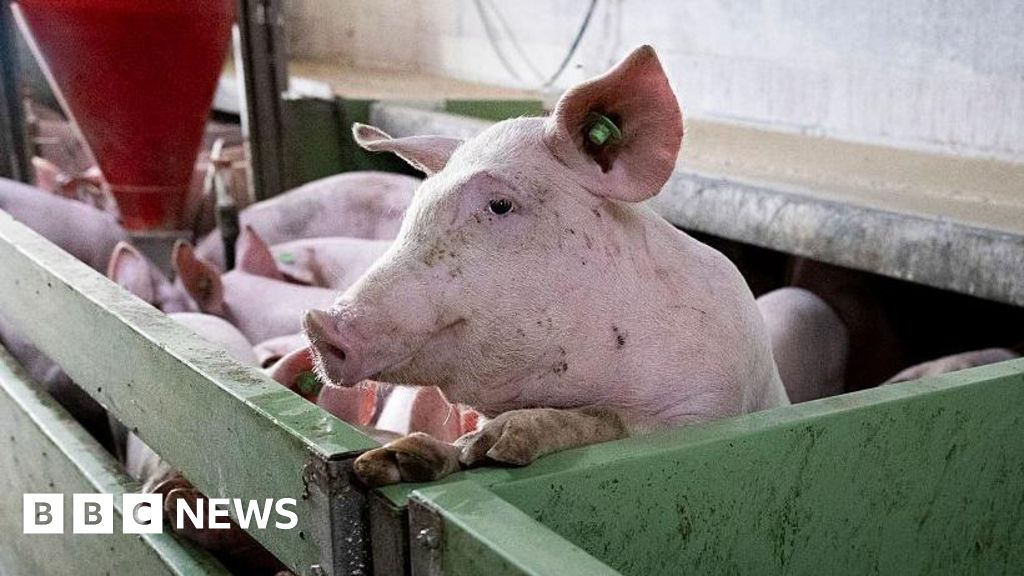
Brazil, Japan, Mexico, South Africa and the US have stopped importing Spanish pork. Other countries, such as EU members, China and the UK, have taken a more localised approach, only banning pork that originates in the affected area of north-eastern Spain.

Drift Incident Could Constitute Civil Negligence

‘Marshals’ Digs Deeper Into Taylor Sheridan’s Past by Channelling ‘Sons of Anarchy’ in the Latest Episode

Live Crypto And Gold Scalping Trading | 05 April 2026 #cryptoscalping #xauusdlive


-

 NewsBeat3 days ago
Steven Gerrard disagrees with Gary Neville over ‘shock’ Chelsea and Arsenal claim | Football
-

 Business3 days ago
No Jackpot Winner and $194 Million Prize Rolls Over
-

 Fashion2 days ago
Weekend Open Thread: Spanx – Corporette.com
-
Entertainment6 days ago
Fans slam 'heartbreaking' Barbie Dream Fest convention debacle with 'cardboard cutout' experience
-

 Crypto World4 days ago
Gold Price Prediction: Worst Month in 17 Years fo Save Haven Rock
-

 Tech7 days ago
The Pixel 10a doesn’t have a camera bump, and it’s great
-

 Tech7 days ago
Avatar Legends: The Fighting Game comes out in July and it looks pretty slick
-
Crypto World6 days ago
Dems press CFTC, ethics board on prediction-market insider trades
-

 Sports1 day ago
India men’s 4x400m and mixed 4x100m relay teams register big progress | Other Sports News
-

 Business1 hour ago
Three Gulf funds agree to back Paramount’s $81 billion takeover of Warner, WSJ reports
-

 Business4 days ago
Login and Checkout Issues Spark Merchant Frustration
-

 Tech6 days ago
Apple will hide your email address from apps and websites, but not cops
-

 Tech6 days ago
EE TV is using AI to help you find something to watch
-

 Sports5 days ago
Tallest college basketball player ever, standing at 7-foot-9, entering transfer portal
-

 Politics6 days ago
Should Trump Be Scared Strait?
-

 Tech6 days ago
Flipsnack and the shift toward motion-first business content with living visuals
-
Tech6 days ago
Daily Deal: StackSkills Premium Annual Pass
-

 Fashion7 days ago
The Best Spring Trends of 2026
-

 Sports6 days ago
Women’s hockey camp eyes fitness boost, tactics ahead of WC 2026 campaign | Other Sports News
-

 Crypto World6 days ago
U.S. rule change may open trillions in 401(k) funds to crypto
You must be logged in to post a comment Login