

Business
Frasers Group builds 6% stake in Puma as Mike Ashley targets turnaround at struggling sportswear brand

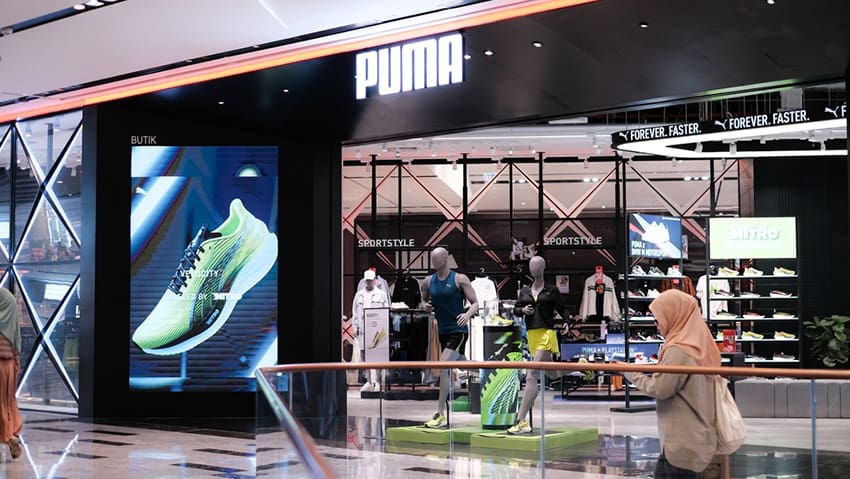
Mike Ashley’s retail empire has added another high-profile investment to its portfolio after Frasers Group quietly built a near 6 per cent stake in the German sportswear brand Puma.
Regulatory filings on the German stock exchange revealed that the owner of Sports Direct, Flannels and House of Fraser now controls a 5.77 per cent holding in Puma. The disclosure triggered an immediate reaction in the market, sending Puma’s shares up almost 10 per cent as investors interpreted the move as a potential vote of confidence in the struggling brand.
The investment makes Frasers Group the second-largest shareholder in Puma, just weeks after the Chinese sportswear giant Anta Sports agreed to acquire a 29.1 per cent stake in the business for €1.5 billion from the French billionaire Pinault family.
Frasers’ position has reportedly been assembled through a series of put option agreements linked to Puma shares, a financial strategy that allows the group to build exposure to the company without immediately purchasing large blocks of stock in the open market.
The move highlights Frasers’ increasingly active role as a strategic investor in global fashion and retail brands. Founded by Mike Ashley in 1982, the group has built a reputation for taking minority stakes in companies and using its influence to push for operational or strategic changes.
Although Ashley stepped down from day-to-day leadership in 2022, the business is now run by his son-in-law, Michael Murray, who has continued the strategy of investing in key partners and competitors across the retail sector.
Puma is already a major supplier of trainers and sportswear to Sports Direct, Frasers’ flagship retail chain. Strengthening its shareholding could give the British retailer additional influence in the brand’s future strategy and product development.
The investment comes at a turbulent moment for Puma, which has struggled to keep pace with rivals such as Nike and Adidas.
The company issued several profit warnings last year and has been undergoing a restructuring programme aimed at restoring profitability and rebuilding its brand position in the global sportswear market.
Earlier this year, Puma reported a record annual loss of €645.5 million and declining sales, forcing the company to scrap its dividend and announce plans to cut around 900 jobs as part of its turnaround effort.
The restructuring is being led by the company’s new chief executive, Arthur Hoeld, who has signalled that the brand needs to fundamentally rethink its product strategy and global positioning.
Hoeld has acknowledged that demand for Puma footwear has weakened significantly in recent years and said the company must take a “hard look at ourselves” as it attempts to recover market share.
Like many consumer brands, Puma has also been hit by broader macroeconomic pressures. Slowing consumer demand in the United States, geopolitical uncertainty and trade tensions have all contributed to a challenging environment for global retail companies.
Tariffs introduced during the presidency of Donald Trump have added additional costs to international supply chains, while weakening consumer confidence has weighed on discretionary spending.
Despite these pressures, Puma’s share price has begun to recover after falling to a near ten-year low of around €15 late last year. The stock recently closed at €22.62, helped by renewed investor interest following the Anta investment and Frasers’ latest move.
Frasers’ stake in Puma is the latest example of the group’s aggressive investment strategy across the retail and fashion sector.
In recent years the company has accumulated significant stakes in several major brands and retailers, including Hugo Boss, where it holds roughly a 25 per cent stake, Asos, Boohoo Group and Mulberry.
The group has frequently used these stakes to exert pressure on management teams and influence strategic decisions.
A long-running dispute with Boohoo, for example, saw Frasers attempt to install Mike Ashley as chief executive and block the company’s efforts to rebrand its holding entity as Debenhams.
Similarly, Frasers has recently increased its position in Asos and voted against all board resolutions at the online retailer’s annual general meeting, signalling dissatisfaction with its performance and strategy.
The new investment by Frasers comes shortly after Anta Sports’ landmark purchase of a 29.1 per cent stake in Puma from the Pinault family, which had been the sportswear company’s largest shareholder for many years.
Anta said the deal was part of its broader strategy to expand its portfolio of international brands and strengthen its position in the global sportswear market.
The company described the acquisition as a “major step forward in our single-focus, multi-brand globalisation strategy”, although it said it had no immediate plans to launch a full takeover bid for Puma.
Founded in 1991, Anta has grown rapidly into one of the world’s largest sportswear groups and already owns several global brands, including outdoor apparel company Jack Wolfskin.
With Anta and Frasers now holding significant stakes, analysts expect the ownership structure of Puma to come under increasing scrutiny.
The presence of two powerful strategic shareholders could reshape the company’s direction, particularly if they push for changes to product development, distribution strategies or management structures.
For Frasers, the investment reinforces its broader strategy of building influence across the global retail ecosystem, strengthening relationships with key brands while positioning itself to benefit from any recovery in the sportswear market.
Whether the stake leads to deeper collaboration with Puma or more active shareholder involvement remains to be seen, but the move signals that Mike Ashley’s retail empire is continuing to expand its influence well beyond Britain’s high street.

Jamie Young
Jamie is Senior Reporter at Business Matters, bringing over a decade of experience in UK SME business reporting.
Jamie holds a degree in Business Administration and regularly participates in industry conferences and workshops.
When not reporting on the latest business developments, Jamie is passionate about mentoring up-and-coming journalists and entrepreneurs to inspire the next generation of business leaders.


Form 4 Crisp Momentum Inc For: 6 March

FDA approves Sotyktu for active psoriatic arthritis treatment

The Dow Industrials slid 1.6%, nearly 800 points, while U.S. crude jumped 8.5% to $81.01 a barrel, its highest price since July 2024 and its biggest one-day jump since 2020. Brent crude, the global benchmark, climbed above $85.

The Dow dropped 785 points, or 1.6%. A late rebound lifted the index from an 1,100-point hole. The S&P 500 fell 0.6%. The Nasdaq Composite dropped 0.3%.
West Texas Intermediate crude oil futures spiked 8.5% to $81.01 a barrel, which is its biggest one-day percentage gain since May 14, 2020, and its highest settlement since July 18, 2024, according to Dow Jones Market Data. Brent crude oil futures, the international benchmark, rose 4.9% to $85.41 a barrel.

“It all depends on how long this war will last. If it is long drawn, there will be an impact on growth because of issues linked to supply, then there will also be an impact on the external trade and exports,” said Madan Sabnavis, chief economist at Bank of Baroda.
The bank still expects the rupee to trade in the Rs 91 per dollar to Rs 92 per dollar band.
On Friday, the rupee ended at 91.74/$1, down 14 paise from its previous close of 91.60/$1, despite strong intervention by the Reserve Bank of India in both the spot market as well as the offshore non deliverable forwards market. It had sunk to a record low of 92.30/$1 on Wednesday due to heightened pressures from geopolitical crisis. For India, which imports more than 89% of its crude, the supply disruption could impact the financial markets and real economy, as 60% of India’s crude passes through the Gulf of Hormuz.
Crude futures rise to their highest settle level since July 2024 as the armed conflict in the Persian Gulf disrupts supply and raises concerns it will lead to production shut-ins as regional storage facilities fill up.
WTI settles up 8.5% at $81.01 a barrel, its sharpest single-day gain in almost six years. Brent rises 4.9% to $85.41 a barrel.
“With an end to the conflict not in sight, additional crude price strength would appear to lie ahead and should this conflict extend through next week, a WTI advance in the $95 area is certainly within realm of possibility,” Ritterbusch and Associates says in a note.

Astera Labs Stock Initiated at Buy. Why It Can Still Be an AI Winner.

“While significant uncertainty remains about the path forward, from a markets perspective, we believe developments in the Middle East remain in an escalation phase and warrant ongoing caution,” said Morgan Stanley’s strategists, including Jonathan Garner, in a note to clients.
The brokerage said India’s improved macroeconomic stability position leaves it less exposed to higher oil prices than historically, but concerns around the fallout of the AI-related disruptions remain. “With uncertainty also still swirling around AI disruption and absolute valuations still expensive, we expect it will take some time – and potentially a peak in the tech cycle for Korea and Taiwan -before international investors reposition towards India,” said Morgan Stanley.
The brokerage said India, Thailand, Korea and Taiwan would be more exposed to growth risks on account of their wider oil and gas balances, while the Philippines, Indonesia and India may face some pressures from wider current account deficits.
“Asia/ EM equities stand at a crucial juncture here, with a baseline of multi-week shipping disruption and uncertainty, and risks of an escalation scenario featuring disruptions more acute than 2022 (which were more concentrated in European energy markets),” said Morgan Stanley. The brokerage said MSCI Asia Pacific fell by 16% between March and July 2022 in the wake of the Russia-Ukraine conflict and energy market impacts, before stabilising briefly, and then falling further amid a global equity correction and tech down-cycle.

Check out what’s clicking on FoxBusiness.com.
Frito-Lay is pulling select bags of potato chips from store shelves after discovering they may contain an undeclared allergen.
The recall covers certain 8-ounce bags of Miss Vickie’s Spicy Dill Pickle Potato Chips that may have mistakenly included jalapeno-flavored chips containing milk, according to a notice Wednesday from the U.S. Food and Drug Administration (FDA).
“Those with an allergy or severe sensitivity to milk run the risk of a serious or life-threatening allergic reaction if they consume the recalled product,” the notice said.
MAJOR FROZEN FOOD RECALL EXPANDS TO 37M POUNDS OF TRADER JOE’S, KROGER PRODUCTS OVER GLASS CONCERNS
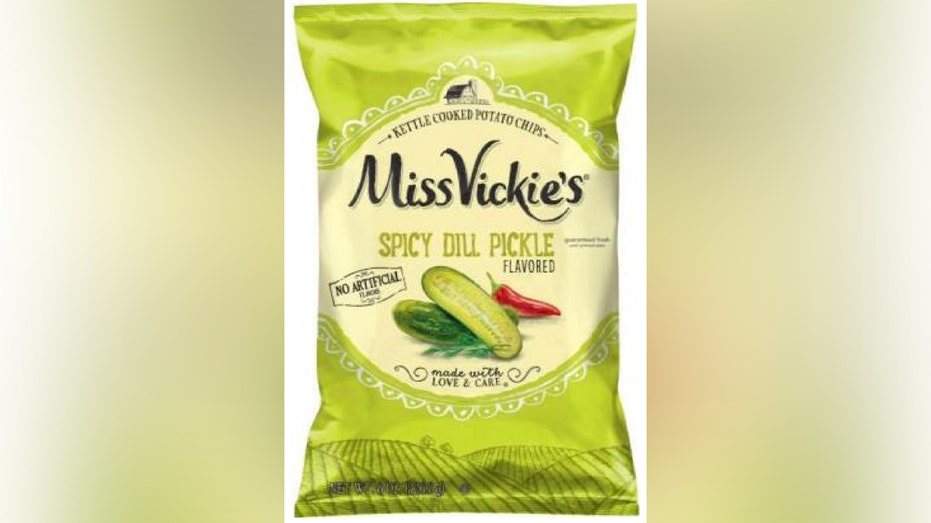
Frito-Lay is pulling select bags of Miss Vickie’s Spicy Dill Pickle Potato Chips from store shelves after discovering some may contain an undeclared allergen. (U.S. Food and Drug Administration)
The affected bags were distributed as early as Jan. 15 to grocery, convenience and drug stores — as well as online retailers — in Arkansas, Louisiana, Mississippi, New Mexico, Oklahoma and Texas.
No other Miss Vickie’s flavors, sizes or variety packs are included in the recall.
OVER 650,000 BOTTLES OF WATER RECALLED AFTER BEING PACKAGED IN ‘INSANITARY CONDITIONS’
Affected bags were distributed as early as Jan. 15 to stores in Arkansas, Louisiana, Mississippi, New Mexico, Oklahoma and Texas. (iStock / iStock)
Consumers should check for 8-ounce bags of Miss Vickie’s Spicy Dill Pickle chips with a UPC of 0 28400 761772, a “Guaranteed Fresh” date of April 21, 2026 and one of two manufacturing codes — 38U301414 or 48U101514.
The codes appear on the front of the bag along the right side.
“If consumers have an allergy or sensitivity to milk, they should not consume the product and discard it immediately,” the notice said.
CHEESE SOLD AT WALMART RECALLED IN 24 STATES OVER POTENTIAL HEALTH RISK
A close-up of the Frito-Lay logo on a box in Lafayette, Calif., Jan. 19, 2026. (Smith Collection/Gado/Getty Images / Getty Images)
Frito-Lay said the issue came to light after a customer reached out to the company.
No allergic reactions have been reported to date.
GET FOX BUSINESS ON THE GO BY CLICKING HERE
“Unless a consumer has a dairy allergy or sensitivity to milk, this product is safe to consume,” Frito-Lay told FOX Business in an email.
Business
Coca-Cola Stock Dips 1.4% to $77 as Shares Pull Back from Recent Highs Amid Consumer Caution
Shares of The Coca-Cola Company (NYSE: KO) declined modestly Friday, March 6, 2026, trading around $76.75 to $77.03 midday, down approximately 0.3% to 1.4% from Thursday’s close of $77.03 to $78.10 in recent sessions, reflecting a broader pullback from February’s all-time highs near $82 amid ongoing consumer budget pressures and geopolitical volatility.

The Atlanta-based beverage giant opened near $76.80 to $77.68, with intraday ranges from lows around $76.35-$76.50 to highs of $76.90-$77.72. Volume remained elevated at over 3-23 million shares in early trading, consistent with recent activity. The stock has now retreated about 6% from its February 27 peak of $81.56-$82.00, its highest close in recent history, but remains up roughly 10% year-to-date in 2026 and about 10-12% over the past year.
The dip follows a strong but volatile start to the year, with KO hitting record territory in late February before softening. Analysts attribute the recent weakness to macro headwinds, including higher energy costs from Middle East tensions and cautious consumer spending in key markets like North America and Asia. Despite these pressures, Coca-Cola’s defensive profile — bolstered by pricing power, brand strength and consistent dividends — continues to attract income-focused investors.
The company reported fourth-quarter and full-year 2025 results on February 10, 2026, showing resilience amid softer soda demand in developed markets. Net revenues grew 2% to $11.82 billion in Q4, missing some estimates of over $12 billion, while organic revenues (non-GAAP) rose 5%, driven by 4% price/mix growth and 1% volume increase. Comparable EPS grew 6% to $0.58, with full-year comparable EPS up 4% to $3.00 and reported EPS surging 23% to $3.04 due to one-time factors.
For 2026, management guided organic revenue growth of 4%-5%, in line with or slightly below 2025’s 5% pace, alongside expected EPS growth of 7%-8%. The outlook reflects confidence in pricing strategies to offset input costs, though executives noted challenges from inflation-squeezed budgets pushing consumers toward cheaper alternatives. Rival PepsiCo’s recent price cuts on snacks highlighted competitive dynamics in the broader consumer packaged goods space.
Coca-Cola’s dividend remains a cornerstone appeal. The company announced its 64th consecutive annual increase in early 2026, with the forward yield around 2.67% at current levels (quarterly dividend $0.515, annualized $2.06). The ex-dividend date is March 13, 2026, drawing income investors amid market uncertainty. The low payout ratio provides room for future hikes, supporting its Dividend King status.
Analyst sentiment stays positive, with a consensus Buy rating from 13-16 firms. Average 12-month price targets range from $80.58 to $84.33, implying 4-10% upside from current levels, with highs up to $87. Firms like Citi maintain Buy calls, citing durable brand equity and digital transformation efforts. Some models suggest potential for $95 in optimistic scenarios, driven by sustained mid-single-digit growth.
Market capitalization hovers around $330-335 billion. The stock trades at a forward P/E in the mid-20s, reasonable for a stable consumer staple with predictable cash flows. Year-to-date performance of about 10% outpaces the S&P 500’s modest gains, underscoring KO’s defensive appeal in volatile times.
Broader influences include participation in the Citi 2026 Global Consumer & Retail Conference on March 9, where CFO John Murphy is scheduled to present, potentially offering fresh insights on strategy. The company continues emphasizing innovation in low- and no-sugar options, ready-to-drink teas and sustainability initiatives to adapt to shifting preferences.
Despite the pullback, Coca-Cola’s fundamentals remain solid: global reach, pricing discipline and a fortress balance sheet position it well for economic uncertainty. With earnings due April 28, 2026, investors will watch for signs of volume stabilization and margin resilience.
As trading continues, the stock’s modest decline reflects short-term caution rather than fundamental concerns. Long-term holders value its reliability, while new buyers may see the dip as an entry point for a blue-chip dividend play.

Harry Kane-Less Bayern Munich Brush Aside Borussia Moenchengladbach To Continue Title March

There’s a sneaky way to watch Outlander 2026 for free
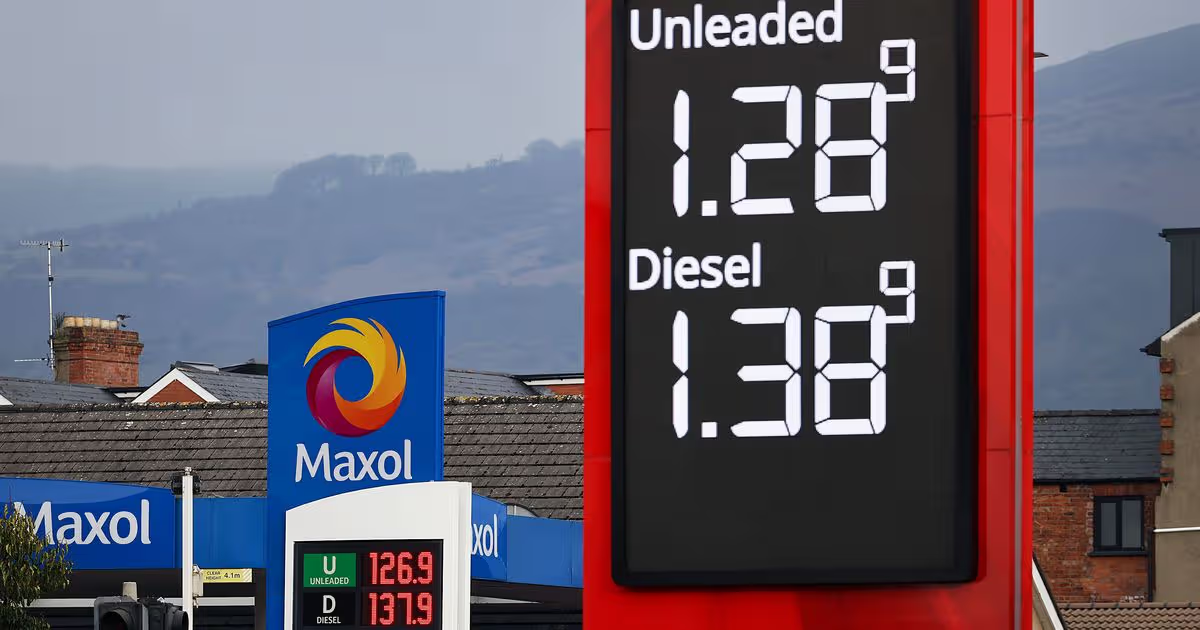
The cheapest petrol and diesel in Northern Ireland as Middle East conflict causes price rise


-

 Politics4 days ago
Alan Cumming Brands Baftas Ceremony A ‘Triggering S**tshow’
-

 Tech6 days ago
Unihertz’s Titan 2 Elite Arrives Just as Physical Keyboards Refuse to Fade Away
-

 NewsBeat6 days ago
Abusive parents will now be treated like sex offenders and placed on a ‘child cruelty register’ | News UK
-
Business12 hours ago
Form 8K Entergy Mississippi LLC For: 6 March
-
 NewsBeat6 days ago
Dubai flights cancelled as Brit told airspace closed ’10 minutes after boarding’
-

 Fashion9 hours ago
Weekend Open Thread: Ann Taylor
-
Sports7 days ago
The Vikings Need a Duck
-
 NewsBeat7 days ago
The empty pub on busy Cambridge road that has been boarded up for years
-

 NewsBeat6 days ago
‘Significant’ damage to boarded-up Horden house after fire
-

 Tech2 days ago
Bitwarden adds support for passkey login on Windows 11
-

 Entertainment5 days ago
Baby Gear Guide: Strollers, Car Seats
-
 Sports1 day ago
499 runs and 34 sixes later, India beat England to enter T20 World Cup final | Cricket News
-
 NewsBeat6 days ago
Emirates confirms when flights will resume amid Dubai airport chaos
-
Politics6 days ago
FIFA hypocrisy after Israel murder over 400 Palestinian footballers
-

 NewsBeat5 days ago
Is it acceptable to comment on the appearance of strangers in public? Readers discuss
-

 Tech6 days ago
Viral ad shows aged Musk, Altman, and Bezos using jobless humans to power AI
-

 Video5 days ago
How to Build Finance Dashboards With AI in Minutes
-

 Fashion5 days ago
On the Scene at the 57th Annual NAACP Image Awards: Teyana Taylor in Black Ashi Studio, Colman Domingo in Yellow Sergio Hudson, Chloe Bailey in Christian Siriano, and More!
-

 Business3 days ago
Guthrie Disappearance Enters Fifth Week as Family Visits Memorial
-
 NewsBeat5 days ago
Ukraine-Russia war latest: Belgium releases video showing forces boarding Russian shadow fleet oil tanker