
Business
From Tables to Rooms – What Restaurant Operators Can Learn from Hotel PMS Thinking


Restaurant owners have spent years refining the customer journey through booking tools, POS platforms, kitchen display systems, loyalty apps and payment technology.
Yet many hospitality businesses are now looking beyond the dining room for inspiration, and a practical PMS system guide for hotels can be surprisingly useful for understanding how accommodation-led businesses connect reservations, payments, guest profiles, and daily operations into a clearer commercial picture.
That matters because restaurants are no longer judged only on food and service. Guests expect accuracy, speed, personalisation and consistency across every touchpoint. The same customer who books a boutique hotel online also expects a restaurant to remember dietary preferences, process payments smoothly and handle last-minute changes without confusion.
Why Restaurant Operators Should Care About PMS Thinking
A Property Management System, or PMS, is traditionally associated with hotels. It helps manage room bookings, guest records, housekeeping, billing and availability. At first glance, that may seem far removed from a restaurant POS system. But the underlying business logic is very familiar.
Both restaurants and hotels depend on:
- Accurate availability
- Fast service delivery
- Clean customer data
- Efficient staff workflows
- Clear reporting
- Reliable payment handling
For restaurant owners, the lesson is not that they need to run hotel software. It is that the best hospitality systems are built around the full guest journey rather than isolated transactions.
A modern PMS system in a hotel environment gives managers a joined-up view of guests, bookings, charges, and service requirements. Restaurants can apply the same principle by connecting table reservations, POS data, stock usage, marketing preferences and customer history.
The Shift from Transactional Systems to Guest-Centred Operations
Many restaurants still think of software in separate boxes. The POS handles sales. The booking platform manages reservations. The stock system monitors ingredients. The loyalty tool sends offers. Each product may work well on its own, but the business can still feel fragmented.
Hotels faced this problem years ago. A guest might book online, request an early check-in, order room service, visit the bar and pay at reception. Without connected systems, the experience becomes clumsy for both staff and guests.
Restaurants face similar challenges when:
- A regular guest books online but is not recognised by the front-of-house staff
- A POS system records spend but does not inform marketing
- A kitchen runs out of an item that is still available on digital menus
- A private dining enquiry is managed outside normal reporting
- A loyalty reward is missed because customer data is incomplete
The value of PMS-style thinking is that it encourages operators to view software as an operational ecosystem rather than a collection of tools.
Lessons from Hotels That Restaurants Can Apply
1. Treat customer data as an operational asset
Hotels depend on guest profiles. Preferences, previous stays, spending patterns and special requests all influence service quality. Restaurants can benefit from the same mindset.
A guest who regularly orders vegetarian dishes, prefers a quiet table, or books for business lunches is giving the business useful information. When handled responsibly, this data can improve service without feeling intrusive.
The goal is not to over-personalise. It is to help staff make better decisions.
2. Make availability visible and accurate
Hotel teams live and die by availability. Rooms cannot be sold twice, and poor availability management damages revenue. Restaurants deal with the same issue through table capacity, kitchen load, staff coverage and event space.
The discipline used in PMS systems for small hotels can be useful here. Smaller hotels often need lean, practical systems that prevent overbooking without creating unnecessary administration. Restaurants, especially independents and small groups, need similar clarity around covers, sittings and peak-time capacity.
3. Connect payments to the customer journey
In hotels, charges may come from the room, restaurant, spa, minibar or event space. A good PMS keeps billing coherent. Restaurants can learn from that approach, particularly those offering deposits, delivery, catering, events, memberships or gift cards.
Payment should not be treated as the final step only. It is part of the experience. A slow bill split, a missing deposit, or an unclear service charge can weaken an otherwise excellent meal.
Why This Matters for B2B Restaurant Software Buyers
Restaurant software buyers are becoming more commercially mature. They are not simply asking, “Does this POS take payments?” They are asking whether technology can reduce labour pressure, improve margins and support better decision-making.
For B2B restaurant software clients, the bigger questions are:
- Does the system reduce duplication of work?
- Can managers see useful reporting without exporting spreadsheets?
- Does it integrate with booking and payment platforms?
- Can staff learn it quickly?
- Does it improve the guest experience?
- Will it scale as the business grows?
These are the same questions that hotel operators ask when assessing PMS for small hotels. The scale may differ, but the buying logic is similar: the software must make the business easier to run.
Small Hospitality Businesses Need Practical, Not Overbuilt, Systems
There is a temptation in hospitality technology to add features because they sound impressive. In reality, many operators need fewer features that work better together.
PMS systems for small hotels are often judged on usability, affordability and operational clarity. The same should apply to restaurant technology. A small restaurant group does not need enterprise complexity if the team cannot use it confidently during service.
The most valuable software usually supports everyday work:
- Taking bookings accurately
- Managing walk-ins fairly
- Processing orders quickly
- Updating menus easily
- Tracking stock sensibly
- Reporting sales clearly
- Supporting repeat customers
- Reducing manual admin
Technology should remove friction. It should not become another operational burden.
The POS Is Still Central, But It Should Not Stand Alone
For restaurants, the POS remains the heart of daily operations. It captures revenue, drives kitchen communication, supports payments and provides sales reporting. But the POS becomes far more powerful when it sits within a connected hospitality stack.
A standalone POS can tell you what sold yesterday. A connected system can help explain why it sold, who bought it, whether the margin was strong and what action should follow.
That is where PMS thinking becomes useful. Hotels have long understood that operational data is only valuable when it supports decisions. Restaurants can use that same approach to improve rota planning, menu engineering, customer retention and event sales.
What Restaurant Owners Should Look For Next
Restaurant operators do not need to copy hotels directly. A restaurant is not a bedroom inventory business, and the service rhythm is different. But the best hospitality technology shares common qualities.
Owners should look for systems that are:
- Simple enough for staff to use under pressure
- Flexible enough to support different revenue streams
- Clear enough to inform management decisions
- Open enough to integrate with other tools
- Secure enough to protect customer and payment data
- Scalable enough to grow with the business
The strongest technology choices are rarely the flashiest. They are the ones that fit the operation, improve consistency and help the team serve guests better.
Final Thoughts: Hospitality Software Is Moving Towards One Guest View
The future of restaurant technology is not about replacing people with systems. It is about giving people better information at the right moment.
Hotels, especially those using modern PMS platforms, have already shown the value of joined-up guest management. Restaurants can take the same strategic lesson and apply it to tables, orders, payments, loyalty and events.
For restaurant owners, POS buyers and B2B software clients, the opportunity is clear: stop thinking only in terms of transactions and start thinking in terms of relationships. A better-connected system does not just make reporting cleaner. It helps create smoother service, smarter decisions and more resilient hospitality businesses.


Sturm, Ruger said it has entered a strategic cooperation agreement with Beretta, following a months-long and at times contentious dispute over governance, strategy and board control.
The agreement marks a de-escalation between two of the world’s most storied gun makers.
Copyright ©2026 Dow Jones & Company, Inc. All Rights Reserved. 87990cbe856818d5eddac44c7b1cdeb8

The S&P 500 and Nasdaq have notched record high closes, lifted by Intel and other AI-related stocks, as a US-Iran ceasefire held firm and investors focused on strong quarterly earnings.

Form 144 Andersons For: 5 May

Spear Invest founder and CIO Ivana Delevska discusses how Amazons investment in Anthropic is supporting the AI trade on Making Money.
An investment banker is offering up about $8 million in Bay Area real estate, including a nearly $5 million house, in exchange for stock options for AI giant Anthropic ahead of the company’s potential initial public offering (IPO).
Storm Duncan, the founder of tech investment bank Ignatious, is proposing a deal that would see him exchange a four-bedroom, five-bath estate in Mill Valley in exchange for Anthropic shares, as the company reportedly explores an IPO this year, Realtor.com reported.
Duncan’s 4,372-square-foot home was built in 2005 and has views across San Francisco Bay as well as of the surrounding, while also featuring an infinity pool and chef’s kitchen area. Realtor.com’s automated valuation models put a $4.8 million price tag on the home, while Duncan says his 11-acre property next door is worth about $4 million and would be included in a deal.
Anthropic, the creator of AI assistant Claude, is looking to secure financing based on a valuation of close to $1 trillion, according to reports, though Duncan is basing his proposed deal on an $800 billion valuation for the tech startup.
NYC LOST MORE RESIDENTS ACROSS ALL INCOME LEVELS IN 2025 AS AMERICANS FLEE HIGH-COST BLUE CITIES

A Bay Area tech investor is looking to swap about $8 million in real estate for Anthropic stock ahead of a possible IPO. (Brandon Sloter/Getty Images / Getty Images)
Duncan is hoping to make a deal with an Anthropic employee who has a large number of shares in the company that are currently illiquid, as the company hasn’t gone public and transfers of shares are subject to restrictions. While he already holds about $1 million in Anthropic shares, he wants to increase his exposure to the company.
He told Realtor.com that he sees the deal as potentially appealing to a younger Anthropic employee who could be on track to have a large amount of valuable stock in the AI company that they want to diversify out of, adding that ahead of the IPO it would allow them to lower their tax basis.
CALIFORNIA BUILT MORE HOMES THAN PEOPLE OVER SIX YEARS – SO WHY IS HOUSING STILL SO TIGHT?

Anthropic is the creator of the Claude AI assistant. (Jaque Silva/NurPhoto via Getty Images)
Duncan told the outlet that it’s a “diversification play for me, too. Less exposure to real estate, more exposure to AI. And I think Anthropic is demonstrating that it will have the most fundamental value.”
The property hasn’t been listed with agencies or the multiple listing service, according to the report, but launched a LinkedIn page for it and has received some genuine inquiries so far that haven’t led to a sale.
THESE 8 US HOUSING MARKETS FAVOR BUYERS

Duncan’s multi-million dollar property he’s offering in the swap is located in the Bay Area. (Justin Sullivan/Getty Images)
Duncan said in the report that he would structure the deal so that shares would be transferred after the lockup period concludes.
He said that he’s realistic about the possibility of finding the right buyer who has Anthropic shares worth millions of dollars, but he thought it’s worth a shot, explaining that he thinks “it’s a less than 50% chance that something happens,” in part because a “home is a very emotional purchase.”

Running With Thieves is preparing to open its third planned hospitality venue in Henderson, ahead of its Port Hedland site, as it looks to capitalise on the growing defence precinct workforce.

Pershing Square USA’s Poor Debut Highlights the Risks of Closed-End Funds

Axsome Therapeutics COO Mark Jacobson sells $1.08m in stock
Business
Upstart Holdings, Inc. 2026 Q1 – Results – Earnings Call Presentation (NASDAQ:UPST) 2026-05-05


Seeking Alpha’s transcripts team is responsible for the development of all of our transcript-related projects. We currently publish thousands of quarterly earnings calls per quarter on our site and are continuing to grow and expand our coverage. The purpose of this profile is to allow us to share with our readers new transcript-related developments. Thanks, SA Transcripts Team

NEW YORK — DigitalOcean Holdings Inc. (NYSE: DOCN) shares exploded more than 35% Tuesday morning, surging to around $147.61 after the cloud infrastructure company reported blockbuster first-quarter 2026 results that far exceeded Wall Street expectations and highlighted accelerating AI-driven growth.

The stock, which closed Monday at roughly $108, jumped as much as 38.55% intraday on heavy volume as investors cheered record revenue, strong customer expansion and upbeat guidance tied to its expanding “agentic inference cloud” platform. The move added billions to the company’s market capitalization in a single session.
DigitalOcean reported first-quarter revenue of $257.9 million, up 22% year-over-year and well above analyst estimates of approximately $249.8 million. Non-GAAP earnings per share reached $0.44, crushing consensus forecasts of $0.27. The company also posted robust growth in key metrics, including million-dollar customer ARR surging 179% and AI customer ARR jumping 221%.
AI and Inference Cloud Driving Surge
Management highlighted strong traction in its AI-native offerings, including the recently launched Inference Engine. The company noted that AI workloads are becoming a significant growth driver, with customers reporting substantial cost savings and performance improvements compared to larger cloud providers.
Annual run-rate revenue reached $1.032 billion, up 22% year-over-year. Net income attributable to common stockholders stood at $16 million. Executives expressed confidence in continued momentum, citing demand from startups and enterprises building AI applications on the platform.
Raised Guidance Fuels Optimism
DigitalOcean also provided optimistic forward-looking commentary, reinforcing investor enthusiasm. The strong beat and positive tone on AI opportunities triggered widespread analyst upgrades and price target increases in recent weeks, setting the stage for Tuesday’s breakout.
Company Transformation and Strategy
DigitalOcean has evolved from a developer-friendly VPS provider into a specialized cloud platform focused on simplicity, affordability and high-performance AI inference. Its agentic inference cloud targets workloads that require fast, cost-effective model deployment — a sweet spot as AI adoption accelerates among smaller companies and startups.
The company operates a global network optimized for low-latency applications and has been winning business from customers seeking alternatives to hyperscale providers like AWS, Azure and Google Cloud. Recent product launches and acquisitions have strengthened its position in the fast-growing inference market.
Analyst and Market Reaction
Wall Street responded positively to the results. Multiple firms raised price targets following the report, with several highlighting DigitalOcean’s ability to capture AI market share while maintaining disciplined growth. The stock’s dramatic move reflects both the earnings surprise and broader enthusiasm for AI infrastructure plays.
Volume surged as retail and institutional investors piled in. The rally marks one of the largest single-day percentage gains for the stock in recent memory and pushes it to fresh all-time highs.
Valuation and Outlook
Even after today’s surge, analysts see further upside potential given the company’s growth trajectory. However, the rapid move also raises questions about near-term valuation and the risk of profit-taking. DigitalOcean trades at a premium multiple, reflecting expectations of sustained high growth in the AI cloud sector.
For the remainder of 2026, the company expects continued expansion in its core business and AI offerings. Investors will watch upcoming quarters for evidence of sustained momentum and margin trends as the company invests in capacity.
Broader Context
DigitalOcean’s performance comes amid a strong period for select cloud and AI infrastructure names. While larger hyperscalers dominate headlines, smaller, specialized providers like DigitalOcean are carving out niches with better economics for certain workloads. Tuesday’s reaction underscores investor appetite for companies delivering tangible AI growth.
As the earnings season progresses, DigitalOcean’s results provide a positive data point for the broader technology sector. The company’s focus on developer experience and cost efficiency continues to resonate in a market seeking practical AI solutions.
The stock’s explosive move on Tuesday highlights the market’s reward for companies that execute well in high-growth areas. Whether this momentum sustains will depend on future delivery, but the Q1 report has clearly energized investors and reaffirmed DigitalOcean’s position as a rising player in the cloud and AI infrastructure landscape.

U.S. stocks moved lower in premarket trading Monday, challenging last week’s record run for the S&P 500 that powered by the best pace of earnings gains in five years, amid reports from Iran’s Fars news agency that two Iranian missiles struck a U.S. warship near Jask Island near the Strait of Hormuz.
Gun Makers Reach Cooperation Pact After Months of Tense Proxy Battle
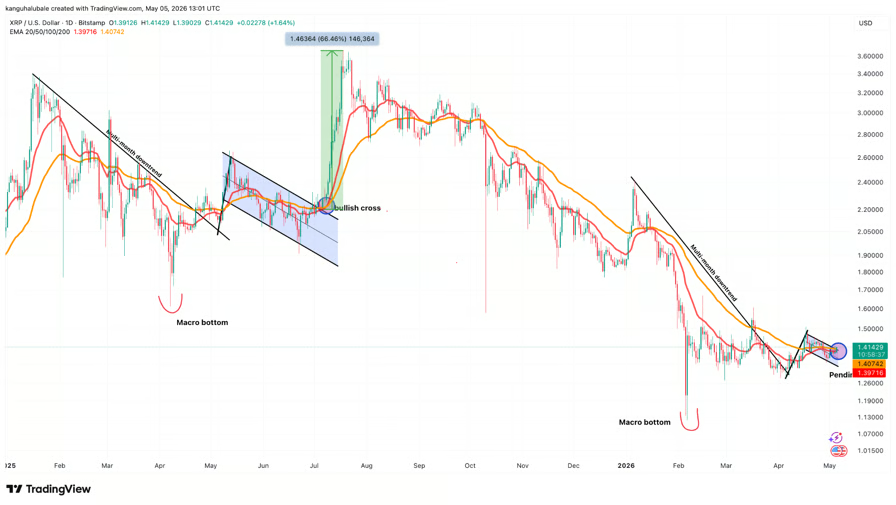
XRP’s 2025 Chart Fractal May Repeat Another 66% Price Rally to $2.35

Netflix’s 10/10 Crime Series Officially Takes Down the Streamer’s New ‘Reacher’ Replacement

Manchester United reach agreement with Casemiro over contract clause amid transfer speculation

US brings back mandatory military draft registration

Steven Gerrard disagrees with Gary Neville over ‘shock’ Chelsea and Arsenal claim | Football


-

 NewsBeat2 days ago
Channel 5 – All Creatures Great and Small series 7 new post
-
 Business6 days ago
Tesla Officially Registers Elon Musk’s Stock: What Investors Need to Know
-
 Tech4 days ago
Trump’s 25% EU auto tariff breaches Turnberry Agreement that also covers semiconductors and digital trade
-
 Sports4 days ago
Paul Scholes issues Marcus Rashford reality check as agreement emerges over Man United star
-

 Business7 days ago
Barclay Brothers Avoid Bankruptcy: HSBC Drops High Court Petitions After IVA Deal
-

 Entertainment4 days ago
Met Gala 2026 Rumored Guest List Is Turning Heads
-

 Entertainment6 days ago
Insider Claims Reason Behind Key & Peele Split
-

 Entertainment6 days ago
Celebrities Who Are Attending the 2026 Met Gala Event
-

 Crypto World6 days ago
Meta (META) starts stablecoin payout to creators in Circle’s USDC on Polygon, Solana via Stripe
-

 Tech6 days ago
Texas Instruments made a new flagship graphing calculator: the TI-84 Evo
-

 Business6 days ago
Strait of Hormuz Remains Heavily Restricted on April 29 Amid Iran Conflict
-

 Business5 days ago
Two Powerball Tickets Split $143 Million Jackpot in Indiana and Kansas
-
Business5 days ago
Strait of Hormuz Blockade Persists Amid US-Iran Standoff, Sending Oil Prices Soaring
-

 Entertainment4 days ago
Kylie Jenner Hit With Second Lawsuit From Ex-Housekeeper
-
Business3 days ago
Winning Numbers Drawn as Jackpot Resets to $20 Million
-

 Sports6 days ago
Saudi Arabia set to withdraw LIV Golf funding after 2026 season, per reports
-

 Sports4 days ago
Cavaliers vs. Raptors Game 6 live score, updates, highlights from 2026 NBA playoffs first-round series
-
 Sports4 days ago
David Benavidez responds to team Canelo saying the fight will never happen
-
 Crypto World5 days ago
CoreWeave (CRWV) Stock Climbs 8% Despite $45M Insider Share Dump
-
 Crypto World6 days ago
Securitize and Computershare Enable Tokenized Equity Issuance for Over 25,000 U.S.-Listed Stocks
You must be logged in to post a comment Login