
Business
Future Cotswolds Neighbors Reportedly Wary of Harry and Meghans Move, Told Dont Bring the Circus


Prince Harry and Meghan Markle’s decision to relocate to the Cotswolds is drawing a cautious reception from prospective neighbors in the English countryside region, according to a royal commentator, who said residents are more wary than welcoming as the couple begins house hunting in the area.
Kinsey Schofield, host of the “Kinsey Schofield Unfiltered” podcast, told Page Six Monday that the “chattering class” of the North Cotswolds is “not overly excited” about the Duke and Duchess of Sussex moving into the area. “The Cotswolds can be incredibly welcoming to high-profile people because there’s an unwritten agreement: ‘You don’t make a spectacle of yourself, and neither will we,’” Schofield explained.
According to Schofield, the region’s relationship with celebrity residents typically depends on those residents keeping a low profile once they arrive, a dynamic she said makes Harry and Meghan’s situation somewhat unusual given the level of media attention that has followed the couple throughout their post-royal life. “The irony is that Harry and Meghan are moving to a place that is accustomed to famous people… but completely unimpressed by fame,” Schofield said. “You can bump into Liam Gallagher at the local pub and nobody cares.”
Schofield said she had heard from an insider that other celebrities already living in the area, including David Beckham and Ellen DeGeneres, have settled comfortably into the community precisely because locals do not “bat an eyelid” at their presence, a pattern she suggested Harry and Meghan may struggle to replicate given the scale of press attention that has historically accompanied their movements.
The advice being passed along through local channels has been direct, according to Schofield. “The advice from locals is essentially that Harry should keep a low profile and allow the family to settle quietly into the community,” she said. “One source put it rather colorfully: ‘Shut up for at least eight months!’ and ‘Harry needs to respect the community.’” She summarized the broader local sentiment more bluntly still, saying, “There’s a sense of, ‘Please don’t bring the circus here.’ These people are used to celebrities. Harry and Meghan are different because wherever they go, the headlines tend to follow.”
Despite the guarded reception, Schofield said she believes the couple still has an opportunity to shift local perception over time, though she cautioned that doing so would require genuine discretion. “But that requires restraint,” she said, according to a report from Jingletree. “You cannot ask a community to protect your privacy while simultaneously generating headlines that bring attention to their doorstep.”
Page Six had previously reported that Harry and Meghan were actively house hunting in the Cotswolds, with royal commentator Tom Sykes telling the outlet last week that a friend of Harry’s had indicated earlier this year that the prince was considering the region, potentially near King Charles III’s Highgrove estate. The couple has been linked to a roughly 16.2 million dollar property, though multiple sources have said no formal deal has yet been finalized. In the interim, the family has reportedly been staying in a spare house belonging to a wealthy friend on the outskirts of the Cotswolds since arriving in the UK on Aug. 26.
This is not the first time Harry and Meghan’s presence has generated friction with neighbors in an affluent residential community. Schofield made similar comments about the couple’s Montecito, California, neighborhood in a January 2025 interview with Fox News Digital, saying at the time that some residents there felt Harry and Meghan’s various business ventures “come off as desperation” and struggled to understand why the couple would trade “tiaras in pursuit of Tupperware.” That characterization followed a Vanity Fair report describing the couple as being viewed as “local villains” by some Montecito neighbors, though other sources close to the couple have pushed back on that framing, telling outlets including AOL that Harry and Meghan maintain a “great relationship” with their California community and genuinely care about it.
A representative for the Duke and Duchess of Sussex did not immediately respond to requests for comment regarding the reported reception in the Cotswolds. With the couple’s children expected to begin school in the region this month, Harry and Meghan appear likely to remain under close local and media scrutiny as they work to establish their new base in the English countryside.


Going back to work after a summer holiday can be tricky – here are a few tips to make it easier.

Octopus Energy has acquired BD Energy, a Danish startup whose algorithms buy and sell electricity almost entirely without human traders, as the British group looks to deepen the technology behind its power trading operation.
The deal, announced on Tuesday, brings the Aarhus-based company into Octopus Energy Trading, the division of Octopus Energy Group that buys and sells electricity and helps manage the changing supply of renewable power. The transaction takes effect immediately, with BD Energy’s founding team, leadership and staff continuing to operate from Denmark.
Founded in 2022, BD Energy concentrates exclusively on short-term power markets, the window running from 24 hours ahead of delivery down to the moment electricity flows into the grid. Its platform crunches large volumes of data, from electricity prices and supply and demand to weather forecasts, and uses machine learning to spot opportunities and make trades automatically. Around 99 per cent of its trades are algorithmic.
That approach has carried the 31-person company a long way in four years. Since launching in Denmark it has grown rapidly and now operates across 25 electricity pricing zones in 15 countries, including Germany, the Netherlands and the United States.
Under its new owner, BD Energy will draw on Octopus’s capital and technology to increase the amount of electricity it trades and expand into new markets around the world.
Frederik Vinkler, co-founder of BD Energy, said the business was built on the idea that technology should be the core of an energy trading company rather than an accessory to it. “We founded BD Energy with the ambition of building a new generation of energy trading company, one where technology is the foundation of the business, rather than simply a tool used by traders,” he said.
“What made Octopus the ideal partner for us was our shared green mindset, coupled with their entrepreneurial culture and scale. With Octopus’s backing, we can deploy our proprietary algorithms across larger volumes and bring our automated trading infrastructure to new markets worldwide.”
Matt Bunney, managing director at Octopus Energy Trading, said: “What BD Energy has achieved in just a few years is remarkable. By bringing their tech under the Octopus Energy Trading umbrella, we’re combining two highly entrepreneurial, tech-first teams.
“Their capabilities in short-term markets will significantly boost our power trading infrastructure and supercharge how we optimise flexibility in key markets worldwide.”
The purchase is the latest in a series of technology-led moves by the London-based group, which was named Britain’s Most Admired Company in 2025, the youngest business ever to take the title. Octopus recently spun out its Kraken software arm as an independent company at an $8.65 billion valuation, and its trading business has been expanding overseas, including through a joint venture to trade renewable electricity in China’s spot power markets that aims to handle 140 TWh a year by 2030.
For Octopus Energy Trading, the appeal of BD Energy lies in those final hours before delivery, where the output of wind and solar can shift quickly and trading decisions have to be made at speed. Bunney said the Danish team’s short-term capabilities would strengthen how the group optimises flexibility in its key markets, while Vinkler pointed to the scale Octopus brings as the platform moves into larger volumes and new territories.

Jamie Young
Jamie Young is Senior Reporter at Business Matters, covering SME finance, employment law and Westminster policy since 2016. He has reported on every Budget and Autumn Statement since 2018, helped make sense of the ‘covid era’ and the bounce-back loan scheme from launch through the fraud investigations, and broke the magazine’s coverage of the 2024 late-payment reforms. He joined Business Matters straight from completing his BA in Administration from Exeter University and is NCTJ-qualified. Reach him at jyoung@cbmeg.co.uk
Business
William and Kate Stay Cautious of Drama as Harry and Meghan Settle Back Into Life in Britain Once Again

LONDON — Six years after stepping back from royal life, Prince Harry and Meghan Markle have returned to Britain, but their relationship with Prince William and Catherine, Princess of Wales, is believed to remain strained, with William and Catherine said to be keen to avoid any public drama surrounding the couple’s homecoming.
Harry and Meghan arrived back in Britain last week and are reported to have found a private, non-royal home outside London, with their children, Prince Archie and Princess Lilibet, already enrolled in school and set to begin classes in the coming weeks. The couple had been based in Montecito, California, since stepping back from senior royal duties in 2020, a period during which they produced the Netflix series “Harry & Meghan” and Harry published his memoir “Spare,” in which he alleged he had been knocked into a dog bowl by William during an argument over his relationship with Meghan. The couple also gave a series of high-profile television interviews during their time in the U.S. detailing their experiences within the monarchy.
Relations between the brothers are reported to have been tense well before the Sussexes’ 2020 departure, and William and Catherine are said to be determined to avoid any drama surrounding the family’s return to the UK. According to sources cited by the Daily Star, friends of the Prince and Princess of Wales say that while the couple “cannot forgive” Harry and Meghan for the allegations made against the royal family during their years in America, they remain determined to “look forward to the future.” William and his father, King Charles, are believed to have been informed of Harry and Meghan’s return plans simultaneously and remain in “complete agreement” that there can be no “half in, half out” arrangement for the Duke of Sussex, who is not expected to resume any official royal duties.
The roots of the strain between the brothers have been traced in detail by Mirror royal editor Russell Myers in his book “William and Catherine: The Intimate Inside Story,” which reports that tensions escalated significantly following Harry’s 2018 marriage to Meghan. A source who knew both couples at the time told Myers that William and Catherine believed the Sussexes’ behavior stemmed from something more than simple difficulty adjusting to royal life. “They definitely thought the Sussexes’ behaviour stemmed from something more than being difficult. The whole atmosphere between them was pretty toxic,” the source said, according to Myers’ book.
The same source described a broader dynamic within the relationship at the time, saying, “Meghan was being bullish, Kate found her abrasive. There was definitely a hope from her side [Catherine’s] that William could try and talk to Harry and settle things but that didn’t exactly happen… and at the end of the day, she had three young children, who were her focus and if anything she saw the inevitability of the parting of ways, although perhaps not to the extent of what eventually happened.”
Myers’ book also details William’s reaction to Harry and Meghan’s 2019 documentary interview with filmmaker Tom Bradby, during which Meghan publicly acknowledged she had been struggling, and Harry said he and his brother were on “different paths.” According to Myers, that interview crystallized for William just how much had changed in his relationship with Harry, and William reportedly came to feel his brother had grown “paranoid” despite William’s own efforts to support him. A source close to the future king told Myers, “He [William] felt as though somewhere down the line, perhaps it is impossible to even say when, that he lost his brother. He became paranoid, angry, obsessive and firmly rooted in the past. There’s no doubt, at that time at least, there was a lot of love and support available for Harry.”
Myers’ reporting also revisits William’s early caution toward Meghan, noting that William had reportedly urged Harry to take things slowly with her when the relationship began, a fact Harry has himself acknowledged publicly. Still, an insider told Myers that William’s initial feelings toward Meghan were more positive than later strain would suggest. “It’s easy to forget now, given everything that has gone on,” the insider said. “But William did find Meghan quite refreshing at first. He was genuinely happy for Harry and only wanted the best for him.”
According to Myers, it was ultimately Catherine, long regarded as a steadying influence during the brothers’ disagreements, who reached a breaking point. “Catherine has always favoured reason over conflict. It was how she had been brought up, in a household that resolved differences with dialogue rather than by bearing grudges,” a source told Myers, adding that Catherine had initially viewed the brothers’ conflicts as rooted in mutual immaturity or stubbornness, before Harry and Meghan’s treatment of palace staff, whom both she and William cared about, ultimately set the two couples on what the source described as “an entirely different course.”
Neither Kensington Palace nor representatives for the Duke and Duchess of Sussex have issued public comment on the current state of the relationship between the two couples following Harry and Meghan’s return to Britain.

The first minister said he had been “appalled” by the number of cases involving violence against women and girls over the summer months.
“This has been a long-running issue within Scottish society,” he said.
“The government has taken many measures to tackle this, but I think events over the summer have said to me that I’ve got to exercise the strongest possible personal leadership as first minister to make sure that we tackle these issues.”
He said violence against women and girls could not be tolerated “in any way, shape or form in our society” and added that “making sure that we change the behaviour of men and boys in our society will be central to that programme”.
One of the government’s proposals to tackle the cost of living issue was to introduce a price cap on some food and drink items in large supermarkets.
Twenty-three organisations have since written a joint letter to Swinney urging him to scrap the plan.
Signatories include groups representing retail, food and drink production, manufacturing and distribution businesses in Scotland.
In response, Swinney said: “Many members of the public are struggling with the price of their shopping and I want to try to do something practical to address that and that’s about bringing forward a proposal for an affordable price cap on a limited number of items within our supermarkets.
“We’ve got to consult about this and make sure the legislation can have the effect that we want it to have and that’s exactly what the government is going to do.”
Business
ITC shares rise 5%; Happiest Minds falls 8% after FMCG major acquires IT firm. What shareholders must know

As per a stock exchange filing, ITC Infotech will first acquire a 22.1% stake in Happiest Minds from founder and promoter Ashok Soota for Rs 1,330 crore, with the purchase split across two tranches. The initial transaction will then be followed by a share swap between the two companies, under which shareholders will receive 25 ITC Infotech shares for every 81 Happiest Minds shares held.
Following the completion of the merger, ITC Infotech will be listed on the stock exchanges through a backdoor listing. ITC Ltd will hold a 73.4% stake in the merged entity, while Soota and his promoter entities will own 7.6%. Public shareholders will hold the remaining 19%.
Happiest Minds has been assigned an equity value of Rs 6,167 crore for the transaction, while ITC Infotech has been valued at Rs 11,920 crore. Together, the two companies have a combined valuation of more than Rs 18,000 crore.
Ashok Soota, who founded Happiest Minds in 2011, said he was delighted that, after the completion of the legal formalities, the company would become an important part of a larger organisation through its amalgamation with ITC Infotech. He said the two organisations were aligned in their values and shared vision for the future, while their business portfolios had significant complementarity that would ensure synergies.

ITC and ITC Infotech chairman Sanjiv Puri said the combination of the companies’ complementary strengths, deep domain expertise and future-ready capabilities would further strengthen their ability to deliver cutting-edge solutions across geographies.
ET had first reported on March 20 that ITC Infotech could potentially acquire a stake in Happiest Minds. On August 29, ET reported details of the proposed transaction, including the merger through a share swap that would effectively result in the backdoor listing of ITC Infotech.According to Happiest Minds, the combined company will bring together its capabilities in AI, digital engineering, cloud, data, analytics and cybersecurity with ITC Infotech’s expertise in enterprise transformation, SAP, product lifecycle management (PLM), cloud, Industry 4.0 and industry-specific technology solutions.
The company said the transaction would make the merged entity India’s 11th-largest IT services company, with aggregate annual revenue of Rs 7,033 crore in fiscal 2026.
(Disclaimer: Recommendations, suggestions, views and opinions given by the experts are their own. These do not represent the views of The Economic Times)

Yes. Corporate subscriptions are available for teams and organisations, with discounted rates as user numbers increase. Pricing starts from $1,625 + GST per user.
Get in touch
to discuss the right option for your organisation.
Business News subscriptions are used by executives, investors, consultants and professionals who need to stay informed and make better decisions about the WA market. When you subscribe you’ll get
- Unlimited access to WA’s most trusted business journalism
- Data & Insights — detailed profiles of WA companies, people, projects and deals
- MyBN — a personalised feed based on the companies, people and sectors you follow
- Special publications and industry reports
- Daily and weekly email newsletters
Data & Insights is a research tool built specifically for the WA market. It draws on more than 30 years of Business News reporting, updated regularly to reflect what’s happening now. Use it to:
- Look up detailed profiles of WA companies, including financials, directors and ownership
- Find decision-makers and track their career movements
- Research live and completed projects across WA industries
- Monitor deals, appointments and market activity
- Access industry rankings and league tables
Data & Insights is updated daily by our dedicated research team, which uses the latest announcements, ASX filings and editorial coverage to keep our person, company, list and project records up to date.
Business News welcome all opportunities to make our dataset accurate, complete and current, so if you have an update request, please email the team at
general@businessnews.com.au, and we’d be happy to assist.
MyBN
is part of every subscription. It’s your personalised view of Business News. You can follow the companies, people, sectors and projects that matter to you, and get a news feed and alerts tailored to your interests. You can save articles to read later and retain only what you need.
Only subscribers have full access to all content on the Business News website.
If staying informed about the WA economy is part of your job, and/or you’re looking for networking opportunities in WA, Business News is built for you.
Business News subscribers are:
- Executives and directors tracking competitors, clients and market movements
- Investors and advisers researching companies, deals and industry trends
- Consultants and professionals staying across sectors relevant to their clients
- Business owners looking for leads, context and market intelligence
Most Business News publications cover national or global markets. Business News is focused entirely on Western Australia, which means the journalism, the data and the intelligence are all built around WA companies, people and projects — not adapted from a national feed. Data & Insights, included with every subscription, combines more than 30 years of WA-specific editorial research with live business data. There’s no comparable product for the WA market.
The Morning Digest Email provides a comprehensive wrap of the major headlines, relevant to WA business, and includes with a snapshot of the overnight news covering oil, gold and ASX-listed companies.
The Afternoon Wrap Email focuses on the news covered by our team of journalists during the course of the working day, including exclusive stories and analysis, all of which relates to WA business and the local economy.
The BN Weekender Email contains a wrap of the Business News from the week that was, highlighting the top stories in each area of WA business.
Sign up for free.
We’re happy to help.
Get in touch
and our team will come back to you.


The equity market is a powerful mechanism as daily fluctuations in price get aggregated to incredible wealth creation or destruction over the long term. Pacifica Yield aims to pursue long-term wealth creation with a focus on undervalued yet high-growth companies, high-dividend tickers, REITs, and green energy firms.
Analyst’s Disclosure: I/we have no stock, option or similar derivative position in any of the companies mentioned, and no plans to initiate any such positions within the next 72 hours. I wrote this article myself, and it expresses my own opinions. I am not receiving compensation for it (other than from Seeking Alpha). I have no business relationship with any company whose stock is mentioned in this article.
Seeking Alpha’s Disclosure: Past performance is no guarantee of future results. No recommendation or advice is being given as to whether any investment is suitable for a particular investor. Any views or opinions expressed above may not reflect those of Seeking Alpha as a whole. Seeking Alpha is not a licensed securities dealer, broker or US investment adviser or investment bank. Our analysts are third party authors that include both professional investors and individual investors who may not be licensed or certified by any institute or regulatory body.

The stock’s upward move followed Bajaj Auto’s report of a 28% year-on-year jump in total sales, with exports emerging as a key growth engine. The strong monthly numbers also come as the stock continues its recent upward momentum.
Bajaj Auto sold a total of 5,35,764 units in August 2026, compared with 4,17,616 units in the same month last year, marking a 28% year-on-year increase.
Two-wheeler sales were particularly strong, rising 30% to 4,43,748 units from 3,41,887 units in August 2025.
The key highlight was the sharp rise in exports. While domestic two-wheeler sales increased 10% to 2,01,898 units, exports surged 53% to 2,41,850 units, underscoring the growing contribution of overseas markets to Bajaj Auto’s overall sales performance.
The company’s commercial vehicle segment also maintained healthy momentum. Commercial vehicle sales rose 22% to 92,016 units, supported by an 11% increase in domestic sales and a stronger 39% growth in exports.
Bajaj Auto’s strong performance was not limited to August. For the April-August 2026 period, the company sold 24,48,692 units, compared with 18,94,853 units during the corresponding period last year.This represents a robust 29% year-on-year increase in year-to-date sales, indicating sustained demand across both domestic and international markets.
Bajaj Auto Share Price, Valuation and Technical Indicators
Bajaj Auto shares have already delivered a strong run in recent months, gaining around 20% over the past three months. The stock touched its 52-week high of Rs 12,470 during Tuesday’s session. Bajaj Auto currently commands a market capitalisation of approximately Rs 3,43,503 crore.
From a valuation perspective, the stock is trading at a P/E ratio of 28.31, while its Price-to-Sales ratio stands at 3.9 and Price-to-Book ratio at 8.28.
On the technical front, Bajaj Auto’s 14-day RSI stands at 69.1. An RSI reading below 30 is generally considered to indicate oversold conditions, while a reading above 70 is typically viewed as overbought. With the RSI now approaching the 70 mark, investors may keep a close watch on the stock’s near-term momentum.
The technical setup remains positive, with Bajaj Auto trading above all 8 monitored simple moving averages (SMAs), indicating a broadly bullish trend.
During the June 2026 quarter, Foreign Institutional Investors (FIIs) increased their stake in Bajaj Auto from 8.82% to 9.01%. Meanwhile, Mutual Fund holdings declined from 7.17% to 6.01% during the same quarter.
(Disclaimer: Recommendations, suggestions, views and opinions given by the experts are their own. These do not represent the views of Economic Times)

Flexible pouches can protect products, reduce storage volume, and create a broad printable surface, but the term “Mylar bag” is often used too loosely in commercial conversations.
Mylar is a polyester film brand name, while many retail pouches are actually engineered laminates that combine different layers for specific functions. A responsible buyer should therefore compare the complete material structure, not rely only on a familiar product label.
For ingredient brands, laboratory-supply sellers, electronics accessory businesses, emergency-preparedness suppliers, and specialty dry-goods companies, packaging must work through filling, sealing, storage, shipping, retail display, and customer use. A visually impressive pouch is not successful if its seal fails, its barrier is unsuitable, or its instructions encourage improper storage. This guide explains how vacuum storage for dry and sensitive products should be planned as a measurable packaging system for the U.S. market.
Start With the Product and Its Real Sensitivities
Define what can damage the product before choosing a pouch. Moisture, oxygen, light, aroma transfer, static, grease, sharp edges, temperature, and repeated opening can require very different solutions. Record the product’s dimensions, weight, water activity when relevant, fill temperature, oil content, headspace, and expected distribution conditions. For nonfood products, add chemical compatibility, abrasion, electrostatic sensitivity, and any required warning or child-resistant features.
The most appropriate starting point is a sealable high-barrier pouch selected for product chemistry, dryness, edges, expected storage period, and the verified capabilities of the sealing equipment. When evaluating mylar vacuum seal bags, request a written specification that identifies the material layers or performance values, intended use, seal range, closure type, and any relevant compliance documentation. Avoid approving a structure solely from thickness because two films with the same measured thickness can have very different barrier and puncture performance.
Understand What Barrier Packaging Can and Cannot Do
Barrier layers slow the movement of gases, vapor, aroma, or light, but they do not make a product stable forever. Actual protection depends on film structure, seal quality, package size, residual air, storage temperature, handling, and the product itself. Shelf-life targets should be validated through suitable testing under realistic conditions rather than copied from another brand or inferred from the pouch appearance.
For food applications, every material that contacts the product—including films, inks in applicable constructions, adhesives, coatings, and closures—must be suitable for the intended use. The FDA treats packaging and its components as food-contact substances and evaluates authorized uses in context. Ask the supplier for documentation applicable to the actual product, temperature, and contact conditions; do not assume that every flexible pouch sold online is appropriate for direct food contact.
Engineer the Seal Before Finalizing Artwork
Most flexible-package failures begin at the seal. Powder, crumbs, oil, folds, wrinkles, and trapped product can prevent a continuous bond. The filling line needs enough clean seal area, stable temperature, appropriate pressure, and dwell time. A zipper improves convenience but does not necessarily replace the production heat seal required for tamper evidence or barrier continuity.
Run trials on the actual equipment at realistic speed. Inspect seals visually, flex the package, perform appropriate leak or burst checks, and test after shipping simulation. If the contents have sharp corners, assess puncture risk around the vacuum or compressed product. Artwork should leave clear zones around heat seals, tear notches, hang holes, valves, windows, and registration-sensitive features so decoration never interferes with package function.
Create a Clear Brand and Information Hierarchy
A flexible pouch gives brands multiple panels, but every panel should have a job. The recommended direction is plain-language handling instructions, traceability fields, hazard or sensitivity labeling where required, and simple product identification. The front must identify the brand and product quickly, while the back or side can carry instructions, warnings, ingredients, disposal guidance, contact details, and traceability information where applicable.
Keep essential text away from gusset folds, curved edges, seals, and areas that distort after filling. Test typography on a filled sample because a flat digital proof can hide readability problems. Barcodes should be placed on a reasonably flat, high-contrast area and verified at production scale. Use variant colors and plain-language names together so customers and warehouse staff are not forced to identify products by color alone.
Design Around Filling, Packing, and Distribution
A pouch is handled many times before it reaches the customer. Map the sequence from empty-pack receipt to filling, sealing, coding, case packing, palletizing, storage, shipment, shelf display, and opening. Confirm whether the pouch must stand, hang, lie flat, tolerate vacuum, or fit a specific carton. Small changes to gusset depth, zipper position, tear notch, or fill volume can materially affect line speed and pack appearance.
Order production-representative samples and fill them with the real product. Test the heaviest allowed fill and the most difficult product shape. Stack cases for the expected period, expose samples to normal temperature changes, and check for abrasion or ink transfer. Operational testing prevents a brand from discovering after delivery that a beautiful pouch will not open on the filling equipment or fit the planned shipping case.
Place the Second Keyword Naturally, Not as Stuffing
SEO language should never force the article or packaging decision into awkward claims. A useful product phrase belongs where it helps the reader compare structures, quantities, or features. When considering customized mylar bags, buyers should still ask for the same technical evidence: material specification, intended use, closure details, print limitations, tolerance, sampling plan, and quality expectations.
Use one clear phrase rather than repeating near-identical keywords in every heading. Search visibility is supported by topic coverage, useful explanations, natural language, and accurate answers—not by making the text difficult to read. The packaging itself follows the same principle: focused communication is more persuasive than covering every inch with claims, icons, and decorative effects.
Avoid Common Cost and Quality Mistakes
The main risks include assuming reduced oxygen makes every product safe, sealing damp goods, undetected pinholes, unsuitable oxygen absorbers, and unclear storage conditions. Unit price can hide the cost of rejected packs, slow filling, leaks, product loss, customer service, obsolete inventory, and emergency reorders. Compare quotes using the same dimensions, material structure, thickness, printing method, closure, finish, quantity, packing method, tolerance, freight, and quality requirements.
Low quantity may reduce inventory risk but increase cost per piece. High quantity may improve unit economics but create storage pressure and artwork exposure. Build a total-cost model that includes setup, plates or cylinders if applicable, proofing, freight, inspection, filling labor, waste, and expected sell-through. The lowest quoted price is not the lowest business cost when a meaningful percentage of pouches cannot be used.
Set a Repeatable Quality-Control Standard
Document approved dimensions, film structure, thickness tolerance, seal width, zipper position, tear notch, gusset, finish, print colors, artwork version, winding or packing orientation, and case count. Keep an approved production sample and photograph critical details. On receipt, inspect multiple cases rather than only the first pouch at the top of one carton.
Quality checks may include dimensions, appearance, odor, print registration, scuff resistance, closure function, seal continuity, leak performance, code readability, and fill compatibility. Define what constitutes a critical, major, or minor defect before production. A clear acceptance standard helps the buyer and supplier resolve variation using evidence instead of subjective descriptions such as “looks wrong.”
Measure Performance After Launch
Useful measures for this project include seal integrity, moisture change, inventory loss, customer misuse questions, rework, and storage-condition compliance. Establish a baseline with the current package, then compare the new format over a defined quantity or period. Track failures by production lot, product variant, filling shift, storage location, and distribution route so patterns can be identified.
Customer comments are valuable, but operational data adds context. If people report difficult opening, determine whether the issue involves tear-notch position, film toughness, seal width, or instructions. If freshness complaints rise, inspect the entire system: product condition at fill, seal contamination, barrier specification, storage temperature, and time in distribution. Packaging improvement works best as a controlled cycle of testing, measurement, and revision.Use Accurate Environmental Communication
Flexible multilayer packaging can be difficult to recycle through ordinary curbside systems, and acceptance varies by material and local program. Do not label a pouch recyclable simply because one layer could be recycled on its own. Ask the supplier for the complete structure and any supported collection pathway, then give customers specific disposal guidance that matches the finished package.
Source reduction, correct sizing, fewer failed packages, and accurate inventory planning can still reduce waste. Avoid broad claims such as “eco-friendly,” “zero waste,” or “fully recyclable” unless they are precisely defined and substantiated. Honest wording protects customer trust and is more useful than a green symbol without instructions.
Conclusion
Effective flexible packaging begins with product science and operating reality. Define the required barrier, confirm food-contact or other use suitability, validate the seal, test the filled pack, review print on a physical sample, and document the approved specification. A pouch should be judged by the saleable product it delivers, not by the empty sample alone.
For U.S. brands, vacuum storage for dry and sensitive products can support stronger presentation and more consistent storage when it is matched to the product and verified through real trials. Start with a controlled pilot, measure results, correct weak points, and scale only after the packaging performs across filling, distribution, display, and customer use.

Why is Ashtead Technology stock sliding today?
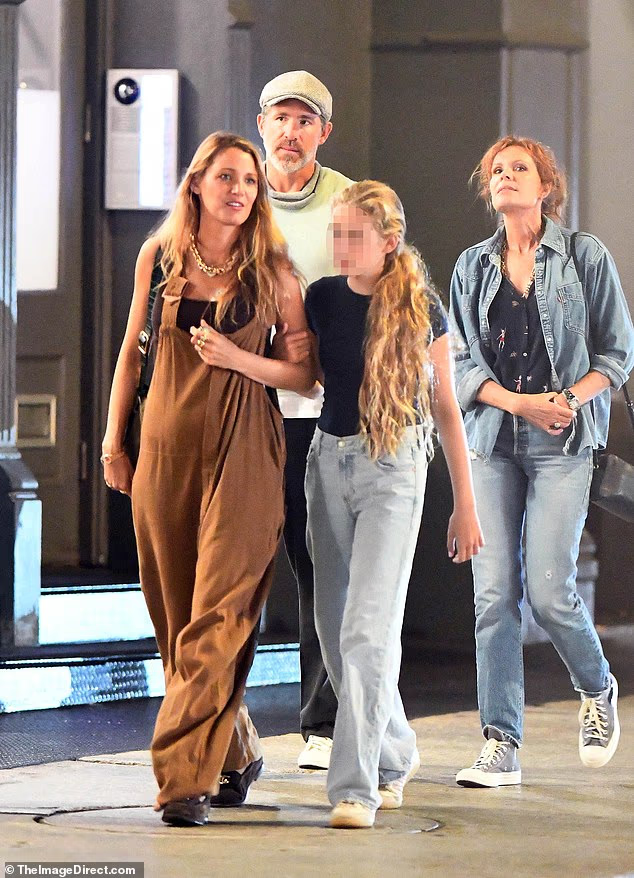
Blake Lively and Ryan Reynolds put on a united front as they step out in NYC for first time since humiliating payout from Justin Baldoni

Feeling nostalgic for summer? How to beat the back-to-work blues

EUR/GBP: Two Weeks of Compression Reach Their Breaking Point





-

 Crypto World6 days ago
SpaceX stock could rise 75% to $240, JPMorgan says
-

 Fashion4 days ago
Weekend Open Thread: Maeve – Corporette.com
-

 Crypto World4 days ago
Bitcoin’s 22% rally now needs real demand to outlast Treasury liquidity boost
-

 Crypto World6 days ago
Warsh Jackson Hole keynote puts financial innovation first
-

 Business4 days ago
Salesforce Stock Soars 19% as Blowout Earnings and Agentforce AI Growth Silence Software Skeptics
-

 Crypto World5 days ago
Elon Musk Grok Bot Promise: We Will Make You Whole if AI Loses Your Money
-

 Business4 days ago
Apple Confirms September 9 Keynote and Reveals Its Full Pre-Order Schedule
-

 Crypto World6 days ago
Did Trump Just Move SpaceX Stock With One Truth Social Post?
-

 Business3 days ago
Onto Innovation Stock: AI’s Next Bottleneck Is Yield (NYSE:ONTO)
-
 NewsBeat6 days ago
Lindsay Clancy jury braces for closing arguments as judge tells court: ‘You’ve heard all the evidence’ – Live updates
-

 Business6 days ago
Walmart takes aim at younger shoppers with new fashion brand
-

 Crypto World3 days ago
Bitcoin price tests $82K resistance as Brandt stays long
-

 Business6 days ago
Thailand’s Eastern Economic Corridor Capital City (EECiti): Key Developments and Investment Opportunities
-

 Crypto World5 days ago
NVIDIA revenue hits $96.2B as AI demand doubles
-

 Business4 days ago
iPhone 18 Pro Pre-Orders Could Shift to Saturday as Apple Reportedly Avoids September 11 Anniversary
-

 NewsBeat6 days ago
Trump’s trade truce with China faces test with Iran effort
-

 Crypto World6 days ago
Nvidia Q2 Earnings Reveal $96.2 Billion Beat, So Why Is NVDA Falling?
-

 Tech5 days ago
Claude Cowork gets its own browser that doesn’t touch your tabs, bookmarks, or saved passwords
-
 Tech2 days ago
Hugging Face built a $4.5 billion empire on free AI models. Now Nvidia is buying it for $12.9 billion
-

 Crypto World4 days ago
Truflation calls for Fed rate cut after PCE forecast
You must be logged in to post a comment Login