
Business
Global Market Today: Asia stocks edge higher, oil up amid Gulf confusion

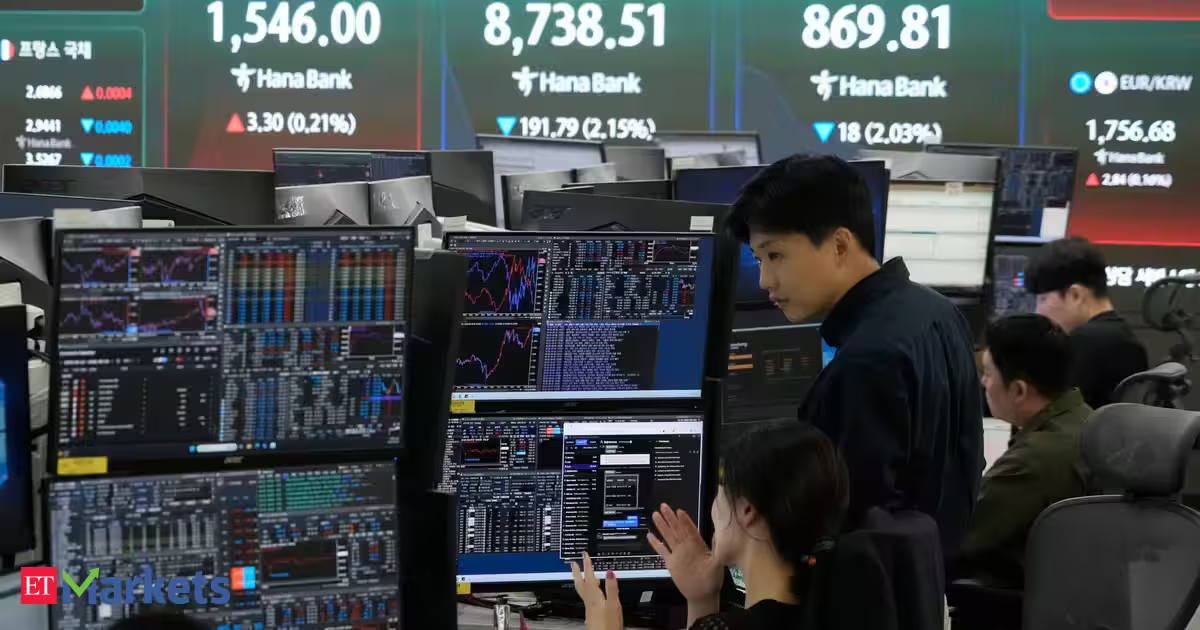
Iran said on Sunday that a deal with Oman defining new shipping lanes in the Strait of Hormuz was in its final stages but reiterated that the waterway would only reopen once the United States met other conditions.
Brent crude added 0.9% to $84.32 a barrel as shipping through the vital waterway remained at a trickle, while U.S. crude rose 0.7% to $78.74 a barrel.
The latest revival in fuel costs raises the stakes for the U.S. July consumer price report due on Wednesday where analysts look for a rise of 0.1% in the headline and 0.2% for the core.
Any upside surprise could rekindle speculation of a hike from the Federal Reserve next month.

Read more: FPIs turn buyers in IT stocks for first time in 2026, invest Rs 3,358 crore in July
“Our forecast for core CPI of 0.22% is probably not quite firm enough to prompt a hike from the Fed at the September meeting, though repeated prints closer to 0.3% could do it,” said Michael Feroli, chief U.S. economist at JPMorgan.”One thing we are watching for is any rebound in core goods prices after a two-month stretch in which they fell.”
The futures market has scaled back the chance of a September move to around 44%, from 67% a week ago.
The pullback in rate risk helped Treasuries rally on Friday and saw Wall Street close at record highs. Japan’s Nikkei followed that lead and rose 0.6% on Monday, while South Korea added 0.5%.
MSCI’s broadest index of Asia-Pacific shares outside Japan edged up 0.3%.
DOUBLE-DIGIT EARNINGS GROWTH
For Europe, EUROSTOXX 50 futures and DAX futures both dipped 0.1%, while FTSE futures fell 0.4%.
S&P 500 futures dipped 0.1%, while Nasdaq futures were little changed having climbed 5% last week amid a slew of upbeat earnings reports.
Analysts at BofA noted that with nearly 90% of S&P 500 results in, earnings per share were up 30% on the year after excluding investment gains at Alphabet and Amazon. A 76% EPS beat rate matched the strongest level since 2021.
“AI remains the stand out, with median EPS growth of 28% versus 12% for non-AI related stocks, though consensus expects AI to slow to 16% next quarter,” they said in a note.
Earnings are lighter this week but include semiconductor company Applied Materials, networking equipment maker Cisco and cloud infrastructure technology company CoreWeave.
In bond markets, yields on 10-year Treasuries were a shade higher at 4.673% with the market bracing for $125 billion in new issuance this week.
The drop in yields and general improvement in risk had pulled the U.S. dollar broadly lower, with the euro just off a seven-week top at $1.1557.
The dollar was flat on the yen at 157.85, with investors still wary of intervention should they push the yen down too far.
In commodity markets, the drop in yields helped non-interest-paying gold hold at $4,342 an ounce, having climbed more than 7% last week.


Since the generative AI narrative began accelerating on October 1, 2022, Asian technology stocks have surged 423%, outpacing both U.S. and global tech benchmarks by 228 and 221 percentage points, respectively.
Key Takeaways
- Asian tech stocks have surged 423% since October 2022, outperforming U.S. and global tech by over 220 percentage points, yet still trade at more attractive valuations with stronger earnings growth.
- Asia dominates as the physical backbone of the AI supply chain, supplying critical hardware components that U.S. and European firms largely cannot produce.
- Decades of embedded ecosystem advantages, skilled labor, and coordinated industrial policy make Asia’s tech supply chain difficult for other regions to replicate, even as reshoring efforts accelerate.
The gains raise a provocative question for investors: are the biggest winners from artificial intelligence not in Silicon Valley, but across the factories and fabrication plants of Asia?
While American companies have dominated headlines by building the large language models, cloud platforms, and consumer applications that define the AI era, a different story has been unfolding upstream. Asian technology firms have positioned themselves as the essential enablers of AI deployment, supplying the semiconductor chips, hardware, and infrastructure without which none of the AI boom would be physically possible.
A Different Role in the AI Ecosystem
The distinction between U.S. and Asian tech is structural, not incidental. Within a single AI server, Asian manufacturers supply components that American and European firms largely cannot: optical transceivers, cooling fans and modules, passive components, and server chassis. The region’s manufacturers also produce critical parts for physical AI and robotics, including actuators, sensors, and batteries.
This specialization shows up in the numbers. The MSCI AC Asia ex Japan Information Technology Index maintains a correlation below 0.6 with both the Nasdaq and the MSCI US IT Index, suggesting Asian tech stocks move to a different rhythm than their American counterparts. For investors already holding U.S. or global tech positions, that low correlation makes Asia tech a natural diversifier rather than a redundant bet on the same trend.
The opportunity set extends beyond AI hardware alone. Asia’s tech exposure spans electric vehicles and autonomous driving, healthcare technology, digital payments, e-commerce, and broader digital transformation, a diversified universe that gives investors more terrain from which to extract returns.
Why the Supply Chain Is Hard to Copy
Asia’s grip on the AI hardware supply chain did not emerge overnight, and analysts argue it will not be easily dislodged. The advantage rests on a combination of factors that developed over decades: a deeply interconnected production network spanning multiple countries, an experienced and cost-competitive workforce, and sustained government industrial policy aligned with private sector growth.
Geographic proximity between countries in the region has enabled faster innovation cycles and more rapid problem-solving, allowing Asian tech companies to iterate quickly and protect their margins. That agility is reinforced by decades of experience mass-producing high-precision components for consumer electronics, expertise now being redirected toward the complex components AI infrastructure demands.
Governments across the region have compounded this advantage through long-term, coordinated investment in infrastructure and talent pipelines. As other regions now pursue reshoring and localization strategies in response to AI demand, they face a challenge that goes beyond simply building factories: replicating an entire system of interdependencies built up over generations.
The result is that even as the United States remains the dominant source of AI-related demand, Asia has cemented its position as the world’s primary AI production hub. AI-related goods now represent a meaningful share of total exports for markets including China, Taiwan, South Korea, and Singapore.
Valuation Gap Persists Despite Outperformance
Perhaps counterintuitively, Asian tech stocks’ strong run has not erased their valuation discount to U.S. peers. Data as of May 29, 2026 shows Asian tech remains more attractively valued than U.S. tech, while also carrying stronger forecasted earnings growth, a combination that suggests the rally may not yet be fully priced in.
That gap looks more significant against the backdrop of an AI investment cycle that many analysts believe is still in its early stages. Comparisons to the 1990s technology boom suggest today’s AI capital expenditure cycle, measured as equipment and intellectual property investment as a share of U.S. GDP, has considerable room to run before reaching the peaks of that earlier era.
Industry forecasts project the global AI market will grow from more than $300 billion in 2025 to nearly $1.2 trillion by 2030, potentially driving between $3 trillion and $5 trillion in cumulative AI investment. That spending would flow toward AI chips, infrastructure, and the wider technology sector, much of it manufactured in Asia.
Risks on the Horizon
The bullish case is not without obstacles. Power constraints at data centers, production bottlenecks, and export controls on semiconductor chips and equipment all pose risks to the pace of buildout. Uncertainty over how quickly AI monetization and adoption will materialize, alongside mounting privacy, security, and regulatory concerns, adds further complexity. How effectively individual countries and companies navigate these headwinds will likely determine who captures the greatest share of the AI opportunity going forward.
The Bigger Picture
With the United States commanding roughly 76% of global technology benchmarks, investors without a dedicated Asia tech allocation may be systematically overlooking a significant and differentiated slice of the AI opportunity, one built not on chatbots and cloud subscriptions, but on the physical infrastructure making the AI revolution possible.
This article is the second installment in a five-part series examining the AI technology cycle and investment opportunities in Asia. The next installment will examine Asia’s competitive position in the AI server build-out.
Other People are Reading
Business
Contact Energy Limited 2026 Q4 – Results – Earnings Call Presentation (OTCMKTS:COENF) 2026-08-09


Seeking Alpha’s transcripts team is responsible for the development of all of our transcript-related projects. We currently publish thousands of quarterly earnings calls per quarter on our site and are continuing to grow and expand our coverage. The purpose of this profile is to allow us to share with our readers new transcript-related developments. Thanks, SA Transcripts Team
Business
Tokyo Century Corporation 2027 Q1 – Results – Earnings Call Presentation (OTCMKTS:TCNRF) 2026-08-09
Seeking Alpha’s transcripts team is responsible for the development of all of our transcript-related projects. We currently publish thousands of quarterly earnings calls per quarter on our site and are continuing to grow and expand our coverage. The purpose of this profile is to allow us to share with our readers new transcript-related developments. Thanks, SA Transcripts Team
Japan posts first current account deficit in nearly 1-1/2 years
Business
Kirin Holdings Company, Limited 2026 Q2 – Results – Earnings Call Presentation (OTCMKTS:KNBWY) 2026-08-09
Seeking Alpha’s transcripts team is responsible for the development of all of our transcript-related projects. We currently publish thousands of quarterly earnings calls per quarter on our site and are continuing to grow and expand our coverage. The purpose of this profile is to allow us to share with our readers new transcript-related developments. Thanks, SA Transcripts Team
Yes. Corporate subscriptions are available for teams and organisations, with discounted rates as user numbers increase. Pricing starts from $1,625 + GST per user.
Get in touch
to discuss the right option for your organisation.
Business News subscriptions are used by executives, investors, consultants and professionals who need to stay informed and make better decisions about the WA market. When you subscribe you’ll get
- Unlimited access to WA’s most trusted business journalism
- Data & Insights — detailed profiles of WA companies, people, projects and deals
- MyBN — a personalised feed based on the companies, people and sectors you follow
- Special publications and industry reports
- Daily and weekly email newsletters
Data & Insights is a research tool built specifically for the WA market. It draws on more than 30 years of Business News reporting, updated regularly to reflect what’s happening now. Use it to:
- Look up detailed profiles of WA companies, including financials, directors and ownership
- Find decision-makers and track their career movements
- Research live and completed projects across WA industries
- Monitor deals, appointments and market activity
- Access industry rankings and league tables
Data & Insights is updated daily by our dedicated research team, which uses the latest announcements, ASX filings and editorial coverage to keep our person, company, list and project records up to date.
Business News welcome all opportunities to make our dataset accurate, complete and current, so if you have an update request, please email the team at
general@businessnews.com.au, and we’d be happy to assist.
MyBN
is part of every subscription. It’s your personalised view of Business News. You can follow the companies, people, sectors and projects that matter to you, and get a news feed and alerts tailored to your interests. You can save articles to read later and retain only what you need.
Only subscribers have full access to all content on the Business News website.
If staying informed about the WA economy is part of your job, and/or you’re looking for networking opportunities in WA, Business News is built for you.
Business News subscribers are:
- Executives and directors tracking competitors, clients and market movements
- Investors and advisers researching companies, deals and industry trends
- Consultants and professionals staying across sectors relevant to their clients
- Business owners looking for leads, context and market intelligence
Most Business News publications cover national or global markets. Business News is focused entirely on Western Australia, which means the journalism, the data and the intelligence are all built around WA companies, people and projects — not adapted from a national feed. Data & Insights, included with every subscription, combines more than 30 years of WA-specific editorial research with live business data. There’s no comparable product for the WA market.
The Morning Digest Email provides a comprehensive wrap of the major headlines, relevant to WA business, and includes with a snapshot of the overnight news covering oil, gold and ASX-listed companies.
The Afternoon Wrap Email focuses on the news covered by our team of journalists during the course of the working day, including exclusive stories and analysis, all of which relates to WA business and the local economy.
The BN Weekender Email contains a wrap of the Business News from the week that was, highlighting the top stories in each area of WA business.
Sign up for free.
We’re happy to help.
Get in touch
and our team will come back to you.

FS KKR Capital: Risk Of Another Dividend Reset In 2026

Japan’s executives call for FX stability as weak yen intensify import-cost pressure

SK Hynix bear flag 80% done, tests Fibonacci support: Live levels

Publicly listed Muthoot Microfin and Satin Creditcare Network — the third and fourth in ranking in terms of assets under management — have both raised growth projections by around 500 basis points, with the microfinance market getting more consolidated in favour of large non-banking financial companies-microfinance institutions (NBFC-MFIs).
“Since banks including small finance banks are downsizing their microfinance portfolio, we are witnessing a higher demand,” Satin Creditcare Network chairman HP Singh said.
Cumulative microfinance portfolio of private banks shrank about 12% in the first quarter of the fiscal to Rs 79023 crore at the end of June from Rs 89548 crore three months prior, Equifax India data showed. The cumulative microfinance portfolio of small finance banks also contracted to Rs 48759 crore from Rs 50725 crore over the same period.

Meanwhile, several smaller NBFC-MFIs have either stopped or scaled down operation in the absence of institutional support, people aware said.
Muthoot has revised the advance growth guidance to 20% from a previous projection of 12-15% while Satin revised it to 20-25% from 15-20% earlier. The country’s largest NBFC-MFI CreditAccess Grameen is also chasing a 20-25% growth.
“The smaller MFIs are shrinking in the absence of liberal bank funding which is an essential raw material. This gap can be filled by larger, well capitalised firms,” Muthoot Microfin chief executive officer Sadaf Sayeed said.
The renewed stability in the microfinance sector also brings comfort to the bigger MFIs. The sector has shown sequential improvement in asset quality for the past few quarters with the implementation of stricter lending guardrails.
Till December last year, the sector’s gross portfolio continued to shrink from the record peak of Rs 4.43 lakh crore seen as on end-March 2024 as lenders followed risk-off strategy as overleveraged borrowers defaulted en masse. The March quarter saw a rebound but the concerns over irregular rainfall amid a traditionally weak first quarter led to a dip again overall.
CreditAccess Grameen managing director Ganesh Narayanan said that the firm may likely to remain within the projected growth range with respect to growth, while expecting higher growth in the typically business third and fourth quarter.

Who Lived and Who Died in the Battle of Tumbleton in the House of the Dragon Season 3 Finale

Tour Confidential: LIV's lifeline, Bryson's big request, playoffs!

Privacy Backlash Explodes Against Meta's Smart Glasses


-

 Fashion3 days ago
Frugal Friday’s Workwear Report: Cap-Sleeve Pointelle Crewneck Sweater
-

 Fashion2 days ago
Weekend Open Thread: Mattifying Sunscreen
-

 Sports4 days ago
Jordan Coyle & Cordiamo take Laya Arena Stakes at RDS
-

 News Videos2 days ago
Can Astrology Help Find Gold and Silver Trends? A Financial Astrology Guide
-
 Business4 days ago
US stocks: Dow closes at record on Mideast optimism; SpaceX, AMD drag Nasdaq
-
 Crypto World6 days ago
US Tech Stocks See Largest 5-Week Inflow in History: Can Nasdaq Break Its Downtrend?
-

 Politics4 days ago
Reform UK And Greens Sink To Lowest Favourability Ratings To Date
-

 Business5 days ago
Nvidia Stock Climbs 2.5% as Chip Sector Rally Builds Ahead of AMD Earnings, Nvidia’s Own Report Looms
-

 Crypto World5 days ago
Polymarket targets $20 billion valuation as competition heats up in prediction market sector
-

 Tech5 days ago
OpenAI, Anthropic AI agents targeted real people and systems in cyber tests
-

 Business4 days ago
Supply chain issues impact Ingredion
-
 Crypto World6 days ago
CLARITY Act Senate Vote Locked In, But 60-Vote Hurdle Looms Large
-

 Tech2 days ago
Rinn Pharma & Biopharma to join NordicPharmaTrain network
-

 Crypto World6 days ago
The Senate has one week: CLARITY’s last August window
-
 Crypto World6 days ago
California Wildfire Bets Expose Polymarket’s Dark Side
-

 Business16 hours ago
Datadog: Best Of Breed For Multiple Reasons
-
 Crypto World5 days ago
Dow and S&P 500 Hit Records on AI Earnings: When Will the Bubble Burst?
-

 Business5 days ago
McDonald’s (MCD) Q2 2026 earnings
-
 Crypto World7 days ago
Micron’s 39% Plunge and SK Hynix, Samsung’s $1.3T Spending Worries US Chipmakers
-

 Business6 days ago
CNH Industrial Shares Jump Over 15% After Beating Estimates and Raising Full-Year Earnings Guidance
You must be logged in to post a comment Login