
Crypto World
House of the Dragon Season 3 Finale Recap: Rhaenyra’s Crisis


The finale opens with Rhaenyra waking to the news that Aegon is alive, and that his return—with a still-quite-lethal Sunfyre, no less—after she declared him dead makes him some kind of messiah. Understandably, she panics, cursing the memory of Viserys (Paddy Considine) for putting her in such a terrible situation. “His prophecy has tested me again and again, and I have met its every challenge!” she complains to Daemon. He takes the opportunity to remind her of her Targaryen supremacy. So, how should she wield it? “The only quality the realm understands is strength,” Daemon says. It’s enough to get him dispatched to Tumbleton.
Baela (Bethany Antonia) urges Rhaenyra to have Lord Corlys (Steve Toussaint) rescued from the Hightowers’ clutches while Black forces are in town. He is, after all, the Hand of the Queen, and he’s sacrificed mightily for her cause. Also: “It was your fault” the Sea Snake was captured in the first place, Baela says. When Rhaenyra seems less than enthusiastic about helping him, Baela really goes off on her. “If a person is useful to you, you wield them,” she accuses. “But if not, you abandon them.” This may be true. A few scenes later, Rhaenyra abruptly banishes her paramour Mysaria (Sonoya Mizuno)—through a minion, no less. (Mysaria does get a nice severance package.) But doesn’t a responsible sovereign have to be ready to throw her friends and family under the bus in service of what she believes to be the greater good of the kingdom? I mean, wasn’t that the takeaway of six seasons of Matt Smith’s other show, The Crown? Of course, as with Elizabeth’s real-life refusal to let her sister marry a divorced man, the question of whether it’s actually prudent for the monarchy to deprioritize saving Corlys is a different matter.

Asian stocks edged higher Monday and the probability of a September US rate hike dropped sharply, giving global markets room to extend last week’s record run. The calm has one clear expiry date: Wednesday’s inflation report.
Japan’s Nikkei and South Korea’s KOSPI added marginally as the new week began. The MSCI Asia-Pacific index outside Japan also edged up, all tracking Wall Street’s Friday close, where the S&P 500 notched a fresh record high.
The CPI Report That Could Reset the Rate Trade
The shift in rate expectations drove most of last week’s action. Futures markets now price around a 44% chance the Federal Reserve raises borrowing costs at its September meeting, down from 67% a week ago. A soft US jobs report triggered the move, pushing Treasury yields lower and lifting risk appetite globally.
Wednesday’s consumer price index (CPI) report, covering July prices, is the next checkpoint. Analysts expect a 0.1% rise in headline inflation and 0.2% for core, which strips out food and energy.
JPMorgan chief US economist Michael Feroli told clients: “Our forecast for core CPI of 0.22% is probably not quite firm enough to prompt a hike from the Fed at the September meeting, though repeated prints closer to 0.3% could do it.” He flagged a potential rebound in core goods prices as a specific watch item.
The stakes around this week’s CPI are familiar for crypto markets; rising rate hike expectations tend to suppress risk appetite and weigh on Bitcoin and digital assets.
Hike odds had briefly touched 66% earlier this year before softening on cooler data. Wednesday could move that number fast in either direction.
Oil Is the Inflation Wildcard
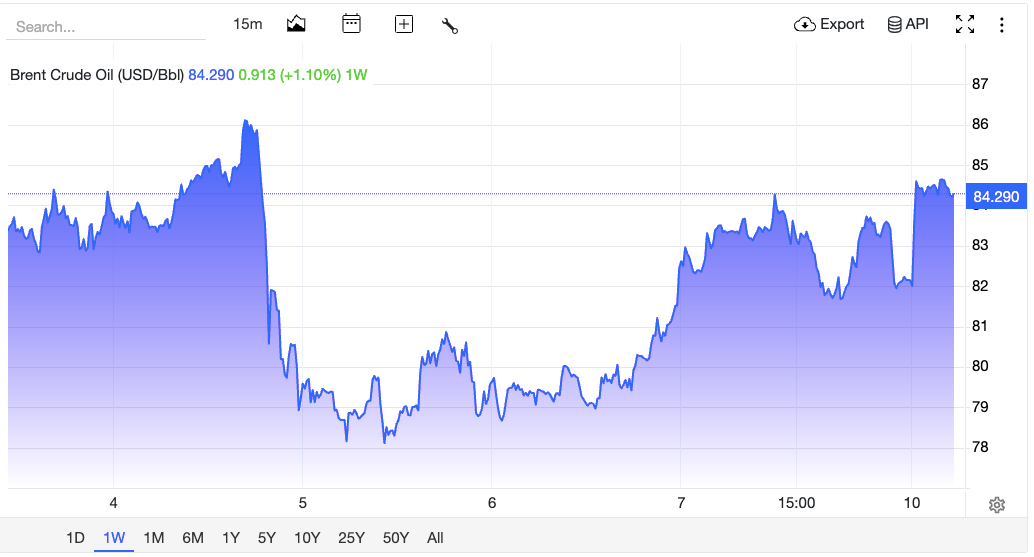
The complication is oil. Brent crude rose 0.9% to $84.32 a barrel Monday and US crude added 0.7% to $78.74. The driver: Iran said on Sunday that a deal with Oman defining new shipping lanes through the Strait of Hormuz is in “final stages,” but reiterated the waterway would only reopen once the US met separate conditions.
Shipping through the Strait, one of the world’s critical oil chokepoints, remains minimal.

Sustained oil pressure feeds directly into headline inflation. A hot CPI print Wednesday would reignite rate hike speculation and put the current rally under immediate pressure.
The dollar dropped broadly on easing rate fears, with the euro near a seven-week high at $1.1557 and gold holding at $4,342 an ounce after climbing more than 7% last week.
With nearly 90% of S&P 500 results in, Bank of America data shows earnings per share up 30% year-on-year, with AI stocks posting median growth of 28% against 12% for the rest of the index. The backdrop is strong. Wednesday decides whether it holds.
The post Asia Stocks Climb and Rate Bets Ease. Now Comes Wednesday’s CPI Test appeared first on BeInCrypto.
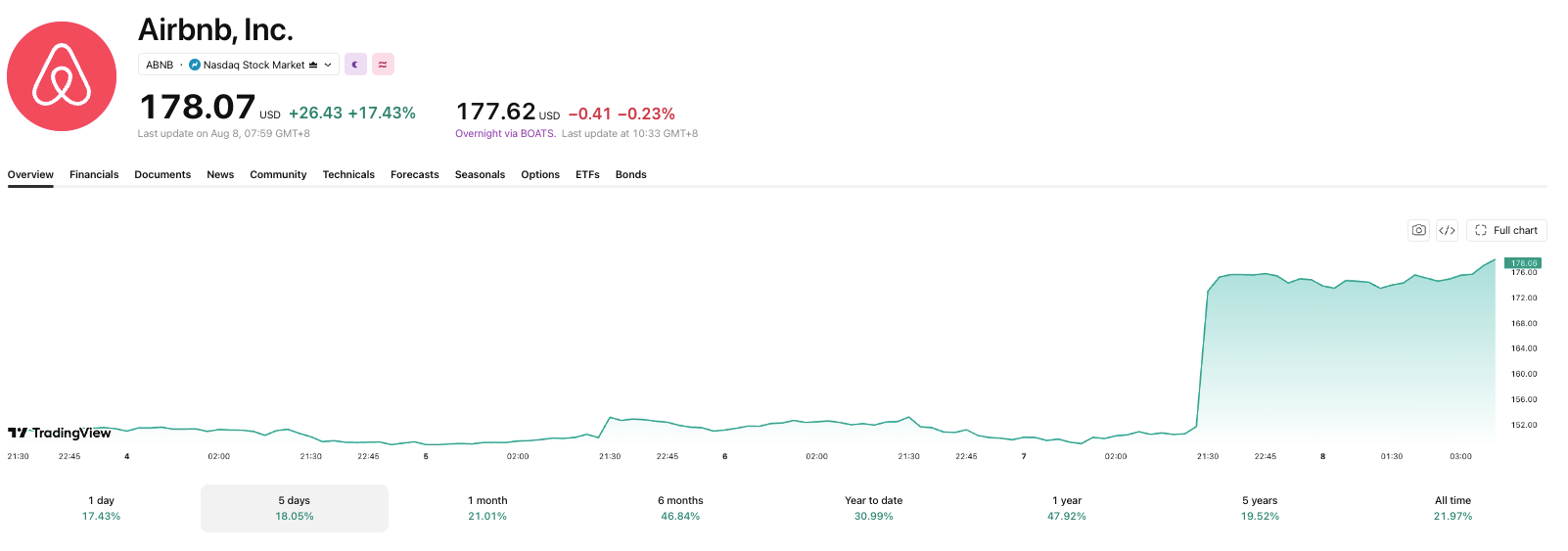
Airbnb stock hit a four-year high on Friday, gaining 17% after its CEO made one of the clearest corporate arguments yet for what AI can actually deliver. Brian Chesky did not just claim AI mattered: he showed investors the number.
Second-quarter revenue rose 17% to $3.61 billion, beating Wall Street’s estimate of around $3.57 billion, while earnings per share climbed to $1.37 from $1.03 a year earlier. Gross booking value increased 16% to $27.2 billion, nights and seats booked grew 10% to 148.3 million, and Airbnb raised its full-year revenue growth outlook to at least mid-teens, up from its previous low-to-mid-teens forecast.
How AI Cut Airbnb’s Costs by 16%
The earnings call highlighted some key figures. Customer support costs per booking dropped 16% year over year, with Airbnb’s AI assistant now resolving nearly 45% of issues without a human agent. Chesky also said AI cut the time from product concept to launch by 60% and helped the company ship nearly 80% more features compared with the same period last year.
“AI is the best thing to ever happen to Airbnb,” Chesky said on the Q2 earnings call.
That matters in a broader context where investors have grown impatient waiting for AI spending to produce measurable returns. Major tech companies have poured hundreds of billions into AI infrastructure with results that remain hard to quantify.
BeInCrypto tracked the question heading into this earnings season. Airbnb now has a concrete answer: lower costs, faster product development, and an EBITDA margin outlook raised to at least 35.5%.

Hotels and New Markets Fuel the Growth
Beyond AI, Airbnb gave investors two further growth engines. Hotel nights on the platform are growing roughly three times as fast as home rentals, and about 35% of first-time hotel guests later returned to book a home, suggesting hotels attract new travelers rather than pulling them from the core business.
Expansion markets grew roughly twice as fast as core markets, while first-time booker growth accelerated to 11%. The quarter also outpaced rivals: Expedia reported 14% revenue growth for Q2, and Booking Holdings grew more slowly still, per Airbnb’s Q2 earnings report. After a heavy earnings week, there have been a number of top US stocks to watch in August.
Can Airbnb Stock Keep Running?
However, analyst models put Airbnb’s target price at roughly $159, implying about 11% downside from Friday’s close near $178. The base-case assumption uses around 12% annual revenue growth, well below the 17% pace Airbnb just posted, which means the company does not need to sustain its current rate to eventually justify today’s price.
For investors joining after a 46% six-month run and a 17% single-day jump, the question is no longer whether Airbnb is executing. It is whether the market has already priced it in.
The post Airbnb’s CEO Says AI Is ‘The Best Thing’ to Happen to It. Stock Jumps 17% appeared first on BeInCrypto.
Crypto World
Who Lived and Who Died in the Battle of Tumbleton in the House of the Dragon Season 3 Finale

After learning her half-brother and former king Aegon II (Tom Glynn-Carney) had resurfaced in a literal blaze of glory supplied by his previously presumed dead dragon Sunfyre, Rhaenyra’s desperation to assert herself as the realm’s rightful ruler was palpable. So, she finally picked a definitive side in the ongoing struggle between Daemon (Matt Smith) and Mysaria (Sonoya Mizuno) to win her trust. Rather than continuing to work to legitimize her rule through support for the common people per Mysaria’s counsel, Rhaenyra opted for the show of brute force Daemon has been all too eager to lead the charge on. As he put it, “The only quality the realm understands is strength.”

Bitcoin’s long-running debate over “anti-spam” changes took another sharp turn this week as support for the BIP-110 soft fork proposal failed to clear the threshold needed to move forward. After a contentious process, the branch effectively stalled within hours—an outcome observers had largely expected given the economic realities of running parallel mining on a minority chain.
Meanwhile, U.S. lawmakers again pushed the timing of the CLARITY Act vote, and the market digested fresh signals across regulation, custody security, and institutional demand. Separately, Ethereum researchers advanced a proposal to curb staking rewards as more ETH is locked, while critics warned it could undermine incentives for validators and the broader ecosystem.
Key takeaways
- BIP-110’s anti-spam approach failed to attract enough miner signaling support and quickly stalled on a minority chain.
- U.S. Senate procedural steps for the CLARITY Act have been scheduled for September rather than being forced through before the August recess.
- Bitcoin’s hardware wallet security concerns have spurred new AI-assisted vulnerability scanning efforts by a volunteer “red team.”
- Ethereum’s proposed EIP-8363 would taper validator rewards more aggressively as staking participation rises, drawing strong pushback from parts of the DeFi sector.
- Spot Bitcoin ETFs recorded their strongest weekly inflows in roughly four months, underscoring renewed institutional appetite.
Bitcoin’s BIP-110 anti-spam branch stalls
Supporters of BIP-110, a proposed soft fork designed to reduce “non financial transactions” on Bitcoin—explicitly targeting activity associated with Ordinals—had hoped the change could move from debate to implementation. However, after a lengthy and heated discussion, the proposal was declared effectively “dead on arrival” following weak uptake by miners.
According to reporting from Cointelegraph, BIP-110 secured only about 2.5% support ahead of entering mandatory signaling on Saturday. As a result, it forked into a minority chain that produced just two blocks over an eight-hour period before stalling.
From an economic standpoint, critics argued the same constraints that apply to mining a parallel chain would remain: difficulty is unlikely to meaningfully improve, yet miners would still bear the cost of operating on the new branch. The difficulty adjustment mechanism requires successfully mining additional full difficulty periods (another 2,014 blocks) to change the economics—something the minority branch failed to achieve.
The governance and “neutrality” fight continues
The technical collapse of the branch does not end the broader argument over what Bitcoin should optimize for. Opponents framed BIP-110 as censorship by design—an approach that they argued conflicts with the network’s established norms around neutrality and consensus. The proposal also drew objections from prominent Bitcoin advocates.
Cointelegraph previously noted that Strategy executive chairman Michael Saylor said he understood the goal of reducing spam-like activity, but argued the method could threaten Bitcoin’s neutrality and the underlying consensus rules. Blockstream CEO Adam Back similarly warned that a consensus-level change could damage Bitcoin’s credibility and introduce risks such as making certain unspent transaction outputs unspendable.
There were also institutional ripples within the Bitcoin ecosystem. After the debate, a Bitcoin Core developer proposed removing BIP-110 backer Luke Dashjr from his role as a BIP Editor, underscoring how politically charged the “anti-spam” question has become inside governance-adjacent circles.
CLARITY Act momentum stalls until September
In the U.S. policy arena, the path toward the CLARITY Act has again shifted. Senator Tim Scott, chair of the Senate Banking Committee, said a procedural vote on the bill should occur before the August recess “without any question,” according to Cointelegraph’s reporting. Senator Cynthia Lummis also suggested there could be a last-minute push.
However, Senate Majority Leader John Thune declined to force immediate action and scheduled the cloture vote for September 15, delaying any realistic chance of passage before senators leave for the August break. Thune told Cointelegraph he “worked with sponsors of the bill,” praised Lummis’s role, and indicated the bill would be queued when lawmakers returned.
For stakeholders trying to influence the final shape of the legislation, the near-term window narrows to what can be negotiated before the cloture vote—particularly around ethics rules, stablecoin yield issues, and protections for developers mentioned in the reported coverage.
Bitcoiners escalate AI-assisted security review
Security concerns have remained a central theme for Bitcoin users, especially after prominent hardware wallet incidents. Cointelegraph reports that a volunteer Bitcoin security initiative called “Bitcoin Red Team” began an AI-assisted review of open-source Bitcoin-related repositories and quickly expanded its findings.
The group—composed of 16 volunteers—initially identified nearly 5,000 potential issues during a rapid scan mid-week. By the weekend, the number reportedly grew to 7,958 issues, including 168 critical flaws and 1,120 high-severity items.
According to Cointelegraph, the initiative includes Rob Hamilton, CEO of AnchorWatch and a Bitcoin developer known as Calle. The team used AI tools alongside human review to search for vulnerabilities, aiming to reduce the risk that weaknesses go unnoticed in widely used codebases.
Cointelegraph also tied the effort’s urgency to earlier wallet compromise claims. Developer Coinkite suggested that the Coldcard hardware wallet hacks were related to AI analysis of its source code. The article reiterates that more than $100 million was stolen by 7,300 wallets due to flaws linked to randomness used for seed phrase generation, framing the incident as a major breach that eroded confidence across cold storage practices.
In response to that trust shock, many Bitcoiners reportedly re-evaluated how they generate self-custody seed phrases. Cointelegraph notes a trend toward manual methods such as dice-based seed generation—an attempt to reduce reliance on any single entropy source.
Ethereum proposal to taper staking rewards meets strong resistance
On Ethereum, a separate but equally ecosystem-sensitive debate is unfolding around issuance and validator incentives. Cointelegraph reports that Ethereum researchers and developers proposed changes under an initiative called Tapered Issuance Burn, also known as EIP-8363.
As described in the coverage, the proposal would adjust issuance so that validator rewards decline more sharply as the percentage of staked ETH increases. Specifically, it would cut rewards entirely once the share of supply staked passes the 50% threshold. Current staking participation is cited as about 34%, with a queue of validators waiting to enter.
Supporters argue the approach could help prevent staking from becoming overly concentrated and that it aligns network incentives with usage of proof-of-stake security. But critics—especially in DeFi—fear the change could backfire by making staking less attractive as more ETH moves onto the beacon chain, potentially snowballing into reduced security benefits.
Cointelegraph also highlights backlash from parts of the ecosystem. Ether.fi founder Mike Silagadze said Ether.fi could exit staking entirely if the proposal passes, arguing it would be harmful to decentralization, Ethereum adoption, and the network’s credibility.
Bitcoin ETFs post strongest week in four months
While Bitcoin’s protocol-level governance fights continued, institutional positioning offered a more optimistic signal. Cointelegraph reports that spot Bitcoin ETFs posted their third-strongest showing since October, reflecting renewed momentum in institutional demand.
According to the article’s cited data from SoSoValue, ETFs recorded $853.54 million in inflows—five times the net amount seen across all of July—and the week was described as the best since April. Ether ETFs reportedly added another $243.7 million.
Some market participants tied the improved ETF flow picture to the ongoing hardware wallet scrutiny sparked by the Coldcard incident. Cointelegraph cites Bloomberg ETF analyst Eric Balchunas as suggesting an institutional custody connection, and also includes a direct statement attributed to Binance co-founder Changpeng “CZ” Zhao: that storing coins on exchanges is “statistically safer” than self custody.
What to watch next
BIP-110 is unlikely to return to the spotlight in the near term given its stalled minority-branch reality, but the underlying disagreement about transaction neutrality on Bitcoin remains unresolved. In the U.S., the September cloture date for CLARITY sets the next measurable checkpoint, while Ethereum’s EIP-8363 debate will hinge on whether critics can persuade stakeholders that staking incentives can be maintained without eroding DeFi participation and validator economics.


Former US Defense Secretary Mark Esper says the CLARITY Act is not merely a financial services bill, its a national security one.

Bitcoin ‘anti-spam’ fork goes nowhere fast
Supporters of the BIP-110 soft fork hoped to eradicate spam from the blockchain, but after a lengthy and heated debate the proposal has been pronounced Dead On Arrival. After securing just 2.5% support ahead of entering mandatory signaling on Saturday, it split off into a minority chain that mined just two blocks in eight hours before stalling.
This is probably no surprise given it’s just as difficult and expensive to mine on the new chain as it is on Bitcoin — but without any hope of being able to sell the block reward to recoup the costs. The difficulty would have adjusted downward if they’d managed to mine through another 2,014 blocks.
BIP-110 aimed to rid Bitcoin of non financial transactions, such as Ordinals, but opponents saw it as imposing censorship on the chain and it faced opposition from prominent Bitcoin advocates. Strategy executive chairman Michael Saylor said he shared the proposal’s objectives but argued that its approach threatened Bitcoin’s neutral rules and consensus.
Blockstream CEO Adam Back warned that the consensus-level change could damage Bitcoin’s credibility and potentially make certain unspent transaction outputs unspendable.

Clarity vote gets punted to September
Senator Tim Scott, who chairs the Senate Banking Committee, said on Thursday a procedural vote on the CLARITY Act should happen before the August recess “without any question.”
Senator Cynthia Lummis also raised hopes of a last minute vote. But despite hopes the Senators would locked in a room and forced to compromise before leaving for the August break, Senate Majority Leader John Thune declined to force the issue and later scheduled the cloture vote for September 15.
“The Dems are insistent on no Clarity vote,” Thune told Cointelegraph. “I worked with sponsors of the bill. Senator Lummis was great, and we’re getting that queued up first thing when we come back.”
Crypto lobbyists have until then to shore up the 60 votes required by negotiating on ethics rules, the stablecoin yield issue, and protection for developers in the BRCA. The real question though is whether it will be a serious attempt to pass the legislation, or if the vote has been called simply “to get people on the record” ahead of the mid-term elections as Lummis suggested.
Bitcoiners form ‘red team’ to battle AI-assisted hacks
A Bitcoin security group made up of 16 volunteers said mid-week it had found nearly 5,000 potential issues during a rapid AI-assisted review of projects in the Bitcoin ecosystem.
By the weekend that number had grown to 7,958 issues, with 168 critical flaws and 1,120 high severity issues.
Bitcoin Red Team is a volunteer security effort that includes Rob Hamilton, CEO of AnchorWatch and Bitcoin developer Calle, which has been using AI tools and human review to scan open-source Bitcoin-related repositories for vulnerabilities.
“We’re averaging on the order of 1 critical exploit per hour per person,” said Calle in a post.
The team sprang into action as a result of the Coldcard hardware wallet hacks, which developer Coinkite suggested were the result of an AI analysis of its source code. More than $100 million has been stolen by 7300 wallets, due to flaws in the random number generated used to generate seed phrases. It has become the third largest crypto hack in 2026 and helped push July’s crypto thefts total to $247 million.
The incident helped shine a light on the trust required with using a hardware wallet, and led many Bitcoiners to wonder if any wallet was truly safe?
Many are now determined to use at least 100 manual dice rolls to generate their own seed phrase.

Ethereum researchers want to rein in staking; critics say it could backfire
A group of Ethereum researchers and developers have proposed changing the network’s issuance policy to cut validator rewards more sharply as the proportion of staked ETH rises.
Tapered Issuance Burn (AKA EIP-8363) would cut rewards entirely as the percentage of supply staked crossed the 50% mark. It’s currently at 34% with a huge queue of ETH waiting to enter, and there are fears this may continue to snowball while providing progressively less benefit for the security of the network.
Despite offering some compelling arguments in favor of the proposal, it has been met with a fierce backlash, especially from DeFi protocols. Ether.fi founder Mike Silagadze suggested Ether.fi would get out of staking entirely if it goes through. He said:
“This is so disappointing on every level. […] This is bad for decentralization, this is bad for Ethereum adoption, and this is bad for the credibility of the network.”
Happy days are here again as Bitcoin ETFs see best week in four months
The spot Bitcoin exchange-traded funds registered their third-strongest showing since October as institutional demand showed signs of renewed momentum.
The haul of $853.54 million in inflows was five times the amount they netted across all of July, and was the best week since April. The Ether ETFs took in another $243.7 million.
Some industry figures believe the large inflows may be related to the Coldcard hack, which has made institutional custody more attractive than using a potentially insecure hardware wallet. Bloomberg ETF analyst Eric Balchunas suggested there may be a connection, while Binance co-founder Changpeng “CZ” Zhao said point blank: “It is statistically safer to store coins on exchanges than to self custody.”

Winners and Losers
At the end of the week, Bitcoin (BTC) is up 2% to trade at $64,814, Ethereum (ETH) is up 1.7% to trade at $1,908 and XRP (XRP) is down 5% to $1.02. The total market cap is at $2.21 trillion according to CoinMarketCap.
Among the biggest 100 cryptocurrencies, the top three altcoin winners of the week are Pump.fun (PUMP) with a 27.6% gain, LayerZero (ZRO) on 17.6%, and Curve DAO (CRV) on 16.2%.
The top three altcoin losers of the week are Injective (INJ) which was down 15.1%, Canton (CC) down 13.8% and Cronos (CRO) down 13.7%.
Prediction of the Week
Bitcoin will never fall below $60K again: Nansen founder
Nansen founder and CEO Alex Svanevik says the Bitcoin market may be approaching a bottom, suggesting that the current level around $60,000 could mark Bitcoin’s cycle low.
“My personal view is that I don’t think Bitcoin’s gonna go back below $60,000,” Svanevik says. “I think that’s the past… I think forever,” he says.
He bases this on the belief that Bitcoin serves as a hedge against central bank money creation, and he doesn’t see the global monetary expansion cycle coming to an end anytime soon.
Top FUD of the Week
Crypto wrench attacks net more than $30M so far in 2026
Criminals stole more than $30 million through physical attacks on crypto holders in the first half of this year, putting 2026 on pace to surpass the record $58 million stolen in 2025.
Chainalysis reports that 46 violent crypto-related incidents had been documented globally through late June, up from 40 during the same period in 2025. The incidents include kidnappings, home invasions and hostage situations, collectively known as “wrench attacks.”
Only 12 of the 46 attempts resulted in payment, giving attackers a 26% success rate, down from 49% in 2025.
ElizaOS token sinks 19% to record low after founder declares it ‘dead’
ElizaOS fell 19% over 24 hours to an all-time low after Eliza Labs founder Shaw Walters said the token was “dead” and that the Eliza Foundation was winding down.
CoinGecko data showed the token now has a market capitalization of $2.1 million.
“The token is dead. Completely,” Walters said, adding that he no longer owned or supported the token.
The decline represents a stark reversal for one of the AI-agent sector’s former breakout tokens. Before the project rebranded as ElizaOS, the token, then known as AI16Z, reached a peak market capitalization of $2.5 billion in January 2025, according to CoinGecko.
Walters said the development of the open-source Eliza software would continue without the token or the foundation.
CEX perpetual futures volume falls to $4T, lowest since late 2023
Crypto perpetual futures trading volume on centralized cryptocurrency exchanges (CEXs) fell to $4 trillion in July, marking a 31-month low.
Binance led CEXs with $1.4 trillion in monthly perpetual futures volume, followed by OKX with $607 billion and Bybit with $300 billion, analytics platform CryptoRank said in a Friday X post.
Perpetual trading volume on decentralized exchanges (DEXs) fell to $531 billion in July, the lowest level since June 2025, and a 21% decline from the $676 billion seen in June 2026, according to data aggregator DefiLlama.
Best Magazine Features of the Week

The Coldcard entropy flaw caused a crisis of confidence in hardware wallets. Here’s the details you need to know before you entrust Ledger, Trezor or Foundation with your Bitcoin.
Tokenized cows may have gone viral, but they’re just the latest in a long line of strange things to find a home onchain, from farts, to human skin and destroyed artworks
Ethereum’s proposed EIP-8363 staking overhaul aims to reduce issuance, but critics say it could hurt DeFi, decentralization and institutional adoption.
Cointelegraph publishes long-form journalism, analysis and narrative reporting produced by Cointelegraph’s in-house editorial team with subject-matter expertise. All articles are edited and reviewed by Cointelegraph editors in line with our editorial standards. Some articles contain affiliate links, from which Cointelegraph may earn a commission. These relationships do not influence which products we review or our editorial conclusions. Content published in here does not constitute financial, legal or investment advice. Readers should conduct their own research and consult qualified professionals where appropriate. Cointelegraph maintains full editorial independence.

This week, Wintermute said institutional investors made up 72% of its spot OTC crypto flow in the first half of 2026, versus 59% a year ago.
Professional investors are changing crypto markets by concentrating on fewer assets, utilizing derivatives, and muting the extreme price swings once associated with retail trading, the firm says.
Institutions Are Reshaping Crypto Trading Patterns
Wintermute’s 1H26 OTC report found that institutional counterparties, including hedge funds, digital asset treasuries, asset managers, and family offices, accounted for 72% of spot flow on its desk between January and June, with the figure rising from 61% in the second half of 2025 and 59% in the first half of 2025.
The company pointed out that institutional activity had become large enough to influence market direction and token performance. It wrote that “institutions are now the clear drivers of Wintermute’s OTC flow,” adding that their trading habits are changing how liquidity is distributed across crypto.
One major shift is that institutions are staying focused on a smaller group of tokens. Between the first half of 2024 and the first half of 2026, the number of unique tokens traded by institutional counterparties increased by just 24%, while among retail traders, the number expanded 76% during the same period.
Wintermute said the increase has created a market where liquidity is increasingly concentrated in fewer assets. Institutional investors have also moved more exposure into derivatives. Altcoin options notional volume on Wintermute’s desk grew 3.4 times between the second half of 2025 and the first half of 2026, as investors used options strategies to generate yield.
The report also linked institutional participation to lower volatility, with Bitcoin’s realized volatility dropping from near 70% in 2025 to about 45% now.
Wintermute CEO Evgeny Gaevoy told Bloomberg Crypto that institutions are changing the way crypto behaves as they become a larger part of trading activity. The firm wrote, “As the patient cohort grows, it is draining crypto of the volatility that once made the asset class so compelling to retail.”
BTC’s Bear Market Looks Different
While the prolonged BTC downturn has seen it drop roughly 49% from its October peak above $126,000 last year, unlike previous crypto winters, the decline has been relatively steady, with fewer sudden and extreme price plunges. The OG cryptocurrency was trading near $65,000 at the time of writing, with data from CoinGecko showing it had barely moved in 24 hours and was up just 1% across seven days.
The report’s findings track with a broader pattern of banks building out crypto infrastructure this year, including Morgan Stanley, which earlier this year announced it would be introducing crypto trading on its E*Trade Platform. The asset management firm also recently launched America’s cheapest ETH and SOL ETFs.
The post Wall Street Tightens Grip on Crypto as Institutions Now Drive 72% of Spot Flow: Report appeared first on CryptoPotato.


Kraken is entering the final stage of its latest delisting cycle, giving holders of 21 tokens until August 27 at 14:00 UTC to withdraw their assets. Afterwards, the exchange begins automatically liquidating remaining balances into markets it warns may have limited or no liquidity.
The scheduled delisting, first announced in May, affects assets that no longer meet Kraken’s internal performance or compliance standards.
Key Dates and Affected Tokens
Kraken halted trading and deposits for the affected assets on May 29. The August 27 deadline marks the final opportunity for users to withdraw their holdings before withdrawals are permanently disabled.
Any balances remaining after the cutoff will enter a five-day automatic liquidation window, during which Kraken, not users, will determine when the assets are sold.
The 21 affected tokens are AURA, BIT, BOND, BSX, FARM, GARI, K, KET, KINTO, LOBO, MOON, MV, NYM, RAIIN, RHEA, SAROS, SDN, SPC, SPICE, TEA, and TEER.
While some were already unavailable for trading before May 29, the withdrawal deadline and liquidation schedule remain unchanged.
Kraken warned that several of these assets have limited or inactive markets, increasing the likelihood of poor execution prices. If liquidity is insufficient when liquidations occur, some balances may generate minimal, or no, proceeds.
Among the delisted assets, TEER carries additional risks. According to Kraken, the project has ceased operations, on-chain transactions are no longer functioning, and trading and funding remain suspended.
As a result, holders have virtually no flexibility beyond the exchange’s scheduled liquidation process.
Why the Deadline Matters
Exchange delistings often trigger sharp declines in liquidity as trading venues remove support and market participation dries up. Investors who fail to move their holdings before withdrawal windows close can lose control over both the timing and price of their exit.
That risk is particularly acute in this case because Kraken has explicitly warned that some of the affected tokens trade in inactive markets.
What Holders Should Do
For anyone holding the affected assets on Kraken, the August 27 deadline represents the last opportunity to control their own exit.
After 14:00 UTC, withdrawals will close permanently, and any remaining balances will be liquidated by Kraken between September 1 and September 5 based on available market liquidity.
The exchange has not committed to specific execution prices, venues, or settlement terms, leaving final proceeds entirely dependent on market conditions at the time of sale.
For holders of the 21 delisted tokens, withdrawing before the deadline is the only way to avoid an exchange-controlled liquidation that could occur at deeply discounted prices, or, if liquidity disappears altogether, return little or nothing.
The post Kraken Delisting Deadline Nears: Holders of 21 Tokens Risk Near-Zero Payouts appeared first on BeInCrypto.
Top Wall Street analysts at Bank of America, JPMorgan and Oppenheimer have identified three AI stocks they believe remain well-positioned for further gains following strong quarterly earnings.
Their bullish outlooks reflect expectations that AI investment will remain strong despite ongoing concerns about valuations and the sustainability of spending.
3 AI Stocks TipRanks’ Top Analysts Are Most Bullish On in August 2026
The picks, Palantir Technologies, Amazon and Lam Research, span different parts of the AI ecosystem, from enterprise software to cloud computing and semiconductor manufacturing.
Palantir’s Commercial AI Business Continues to Accelerate
Bank of America analyst Mariana Perez Mora reiterated a Buy rating on Palantir with a $255 price target after the company’s second-quarter results exceeded expectations.
US commercial revenue surged 149% year over year, increasing its share of total revenue to nearly 40%, up from roughly 30% a year ago. The company also expanded its US commercial customer base 35% to 653, while trailing 12-month revenue per customer climbed 76% to $3.5 million.
Following the results, Palantir raised full-year guidance and now expects at least 134% US commercial revenue growth. Mora also increased her 2026–2028 revenue and earnings forecasts, citing stronger contract value and deeper customer relationships.
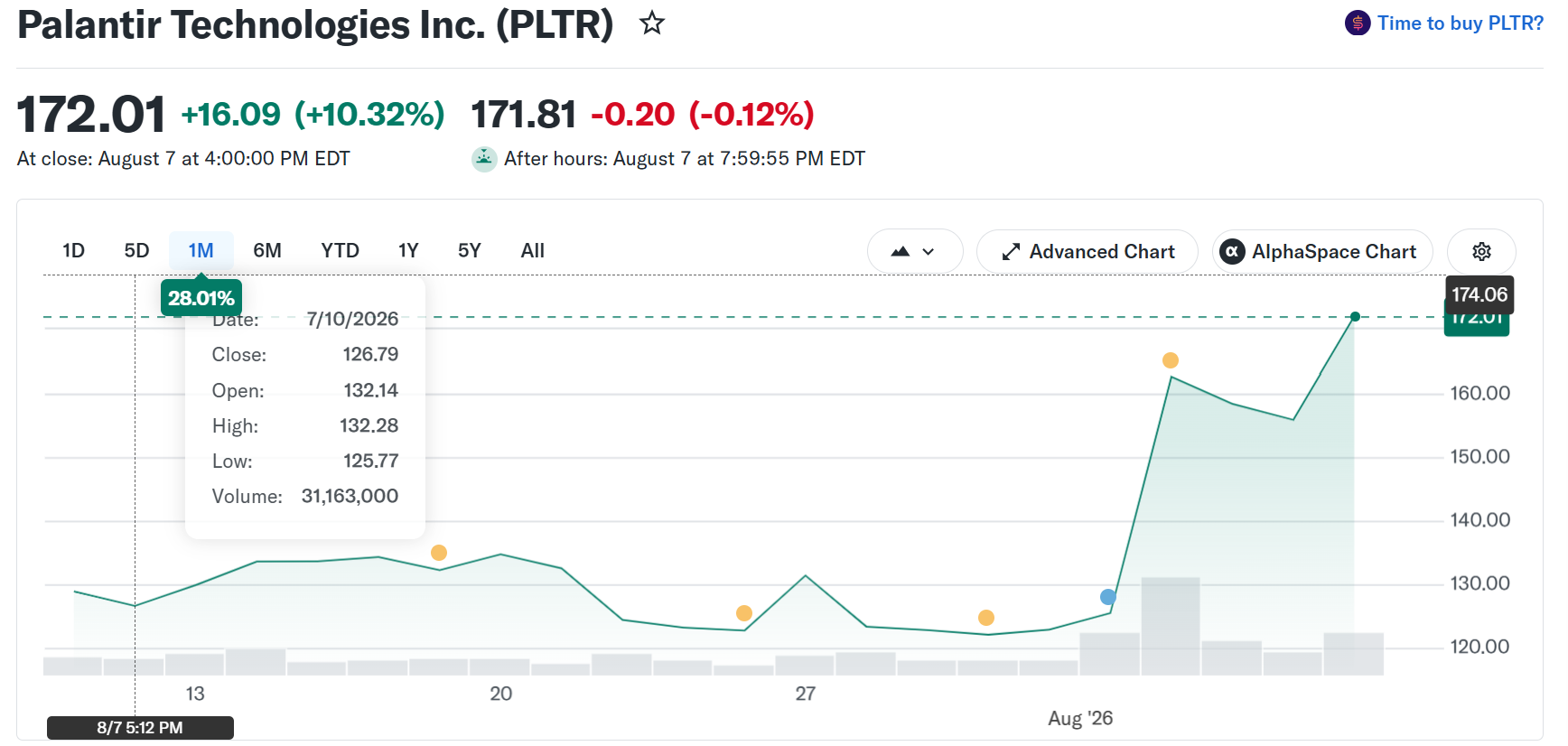
She views Palantir’s commercial business as the company’s primary growth engine, driven by customers seeking measurable returns from AI deployments. Shares closed near $172 on August 7.

Mora’s $255 target therefore implies a 48% climb above current levels.
Amazon’s AI Momentum Boosts AWS Outlook
JPMorgan analyst Doug Anmuth raised Amazon’s price target to $365 from $330 while maintaining a Buy rating and naming the stock a Best Idea.
Amazon Web Services delivered 37% revenue growth during the second quarter, its fastest expansion in 18 quarters. Meanwhile, while companywide forex-neutral revenue increased 20%, the strongest pace in five years.
AWS backlog climbed to $496 billion, up nearly 2.5x year over year and 36% sequentially. Anmuth attributed the momentum to growing AI workloads, continued demand for core cloud services and Amazon’s custom AI chips.
He modestly lifted his 2026 and 2027 forecasts, arguing that Amazon’s AI investments continue to generate attractive returns.

A move to $365 would imply a 33% move above $274, where shares closed on Friday.
Lam Research Could Benefit From the Next AI Chip Expansion
Oppenheimer analyst Edward Yang maintained a Buy rating on Lam Research with a $400 price target after the semiconductor equipment maker beat fiscal fourth-quarter expectations.
Yang highlighted stronger customer support revenue and a doubling of NAND revenue while noting management raised its 2026 wafer fabrication equipment spending outlook to the low-$150 billion range.
He also expects 2027 to be an unusually strong year as chipmakers work through supply constraints while building eight to ten new fabrication plants. Based on that outlook, Yang increased his 2027 and 2028 revenue and earnings estimates by 7% to 9%. Shares traded near $311.

He sees Lam Research as a direct beneficiary of AI-driven demand for advanced memory, logic and packaging technologies. .
AI Spending Remains the Common Theme
Although they operate in different markets, all three companies are benefiting from the same trend: rising AI investment:
- Palantir is monetizing enterprise AI software.
- Amazon is capturing growing cloud demand through AWS, and
- Lam Research supplies the manufacturing equipment needed to produce increasingly complex AI chips.
The analysts behind the calls, Mariana Perez Mora, Doug Anmuth and Edward Yang, each hold five-star ratings on TipRanks based on historical performance.
While elevated valuations remain a risk, the analysts argue that continued AI adoption, expanding cloud workloads and higher semiconductor capital spending could provide additional upside if current growth trends persist.
The post BofA, JPMorgan, Oppenheimer Name Their 3 Favorite AI Stocks, One Has a $255 Target appeared first on BeInCrypto.
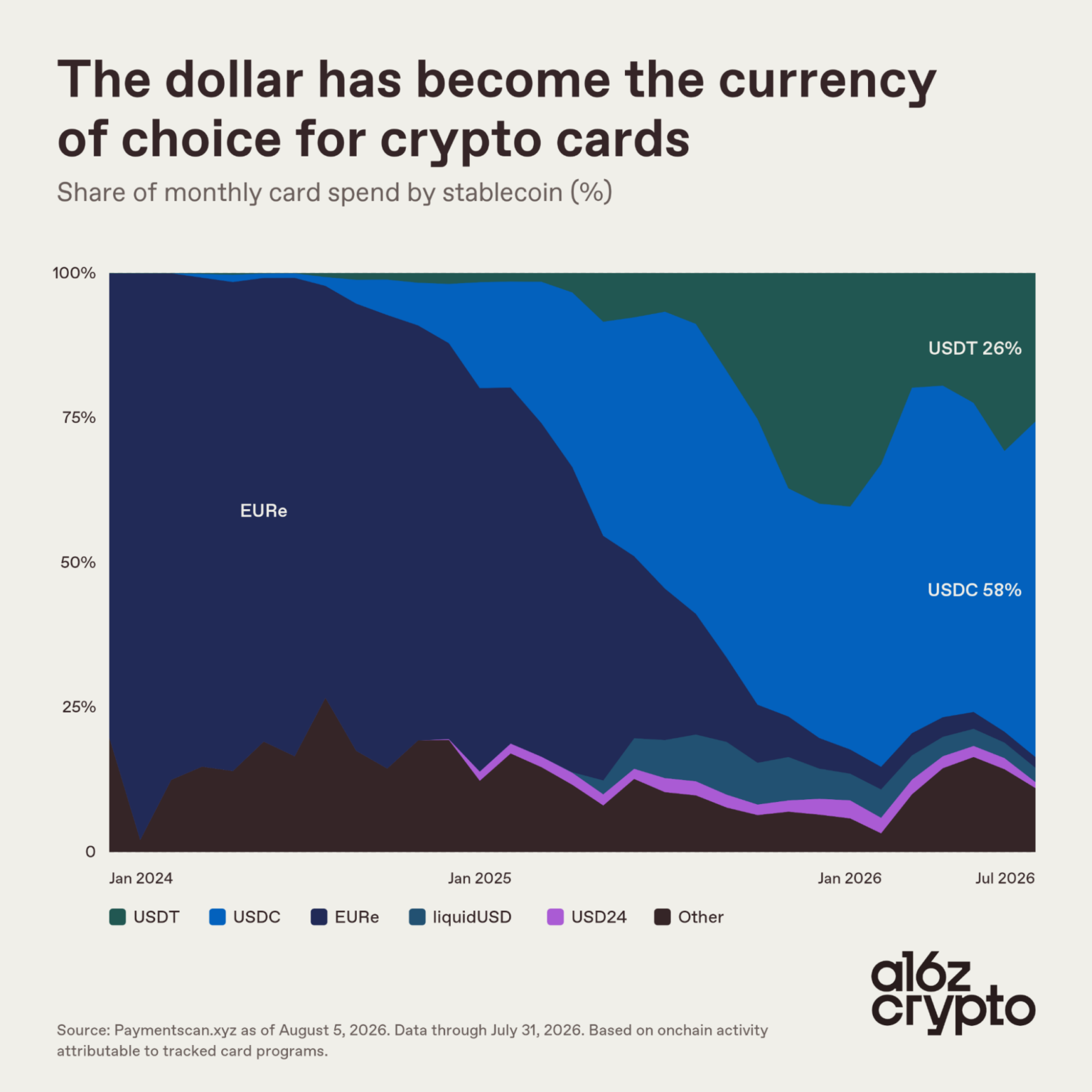
Dollar-backed stablecoins have taken over crypto payment cards. USDC (USDC) and Tether (USDT) together account for roughly 84% of card spending. The split reverses a market that was dominated by euro tokens less than two years ago.
The shift coincided with a wave of new card programs and settlement chains. Over the same period, dollar stablecoins gained share while EURe and Gnosis Pay faded.
Crypto Card Spending Goes Dollar as Euro Crashes to 2%
Crypto payment cards let people spend stablecoins or crypto assets anywhere major card networks operate. The stablecoins convert to local currency at checkout, so merchants see an ordinary card transaction.
In early 2024, the euro-backed EURe accounted for about 88% of card volume. Most of that activity ran through Gnosis.
However, that share has now fallen to roughly 2%, according to a16z crypto’s latest report. The growth of dollar-backed stablecoins has almost entirely pulled spending away from euro rails.
USDC now handles about 58% of card spending and USDT about 26%. A year ago, those figures were near 48% and 7%, respectively.
“Crypto payment card spending now happens overwhelmingly in digital dollars,” the report read.

Follow us on X to get the latest news as it happens
Card Spending Climbs Past $759 Million a Month
Meanwhile, the data shows that monthly crypto card volume reached $759 million in July. That marks a 2.5x jump from $306 million a year earlier.
When tracking began in October 2023, monthly volume sat below $1 million. Cardholders made nearly 9 million purchases in July, up from about 5.2 million a year ago.
The average purchase came to about $86. Settlement has also spread across blockchains as more programs have been launched.
Optimism (OP) now carries about 29% of card volume. Solana (SOL) and Base each hold near 19%, while Gnosis has dropped to roughly 2%.
Nearly all tracked spending still moves through Visa. However, the largest program by volume, RedotPay, self-reports its figures. It does not settle onchain with any certainty, which adds some uncertainty to the totals.
Even so, crypto card spending remains small compared to traditional networks, which process trillions of dollars each month.
Subscribe to our YouTube channel to watch leaders and journalists provide expert insights
The post USDC and USDT Now Own 84% of Crypto Card Spend as the Euro Retreats appeared first on BeInCrypto.
Earnings call transcript: Globe Telecom posts record H1 2026 revenue, stock rises 0.99%

Asia Stocks Climb and Rate Bets Ease. Now Comes Wednesday’s CPI Test

Kayla McBride buries WNBA record 10 treys as Lynx race past Wings


-

 Fashion3 days ago
Frugal Friday’s Workwear Report: Cap-Sleeve Pointelle Crewneck Sweater
-

 Fashion2 days ago
Weekend Open Thread: Mattifying Sunscreen
-

 Sports4 days ago
Jordan Coyle & Cordiamo take Laya Arena Stakes at RDS
-

 News Videos2 days ago
Can Astrology Help Find Gold and Silver Trends? A Financial Astrology Guide
-
 Business4 days ago
US stocks: Dow closes at record on Mideast optimism; SpaceX, AMD drag Nasdaq
-
 Crypto World6 days ago
US Tech Stocks See Largest 5-Week Inflow in History: Can Nasdaq Break Its Downtrend?
-

 Politics4 days ago
Reform UK And Greens Sink To Lowest Favourability Ratings To Date
-

 Business5 days ago
Nvidia Stock Climbs 2.5% as Chip Sector Rally Builds Ahead of AMD Earnings, Nvidia’s Own Report Looms
-

 Crypto World5 days ago
Polymarket targets $20 billion valuation as competition heats up in prediction market sector
-

 Tech5 days ago
OpenAI, Anthropic AI agents targeted real people and systems in cyber tests
-

 Business4 days ago
Supply chain issues impact Ingredion
-
 Crypto World6 days ago
CLARITY Act Senate Vote Locked In, But 60-Vote Hurdle Looms Large
-

 Tech2 days ago
Rinn Pharma & Biopharma to join NordicPharmaTrain network
-

 Crypto World6 days ago
The Senate has one week: CLARITY’s last August window
-
 Crypto World6 days ago
California Wildfire Bets Expose Polymarket’s Dark Side
-
 Crypto World5 days ago
Dow and S&P 500 Hit Records on AI Earnings: When Will the Bubble Burst?
-

 Business16 hours ago
Datadog: Best Of Breed For Multiple Reasons
-

 Business5 days ago
McDonald’s (MCD) Q2 2026 earnings
-
 Crypto World7 days ago
Micron’s 39% Plunge and SK Hynix, Samsung’s $1.3T Spending Worries US Chipmakers
-

 Business6 days ago
CNH Industrial Shares Jump Over 15% After Beating Estimates and Raising Full-Year Earnings Guidance
You must be logged in to post a comment Login