The search for Nancy Guthrie, the 84-year-old mother of NBC “Today” show co-host Savannah Guthrie, has entered its fifth week with no major breakthroughs reported, though authorities insist the case is far from cold as investigators pursue viable leads, forensic analysis and a flood of public tips spurred by a $1 million family reward.
Nancy Guthrie
Nancy Guthrie was last seen at her home in the Tucson area on Jan. 31, 2026, and reported missing the following day after failing to appear at a church event. Authorities, including the Pima County Sheriff’s Department and the FBI, believe she was taken against her will, classifying the incident as a suspected abduction or kidnapping. Surveillance footage released early in the investigation shows a masked individual at her doorstep, and gloves found nearby contained unknown male DNA now being processed for database matching.
As of March 3, 2026, the investigation remains active, with detectives reviewing surveillance video, timeline inconsistencies and physical evidence. The FBI has confirmed ongoing forensic testing and tip evaluation, emphasizing that verified information continues to drive progress. A retired NYPD detective described recent footage as “a good lead — better than we’ve had so far,” highlighting its potential value despite the passage of time.
On March 2, marking Day 30 since the disappearance, Savannah Guthrie and her sister Annie made their first public visit to their mother’s home since the incident began. Aerial footage captured the siblings laying flowers and a card at a growing memorial of notes, candles and tributes outside the property, which has been returned to the family with “No Trespassing” signs posted. Savannah shared images on social media, writing, “We feel the love. Please don’t stop praying and hoping with us.”
The emotional appearance followed Savannah’s Friday Instagram post reiterating the family’s $1 million reward — announced Feb. 23 — which can be paid in cash for information leading to Nancy’s recovery. The offer has generated over 1,500 new tips, officials said, reinvigorating the lead pool after an initial surge.
Advertisement
Savannah has been vocal throughout, releasing gut-wrenching videos pleading for help. In one, she acknowledged the possibility that her mother “may already be gone,” yet urged the public to come forward. “We are begging you to please come forward now,” she said in late February remarks.
The case has drawn intense national and international attention, with communities near Tucson holding vigils to mark the one-month milestone. Messages of hope and support have proliferated at the memorial, reflecting widespread sympathy for the Guthrie family.
Investigative shifts have fueled speculation. The FBI relocated much of its command post from Tucson to Phoenix last week, and the Pima County Sheriff’s Department reassigned some officers, focusing resources on dedicated missing-persons detectives. Experts caution these moves indicate strategic adjustments rather than abandonment, with one former agent calling federal prosecutors’ presence at the home “great news” for potential charges.
A man named Luke Daley and his mother were briefly detained Feb. 13 under a federal search warrant but released without charges. Daley later spoke publicly, stating he has no information about the case.
Advertisement
Sheriff Chris Nanos cleared all Guthrie family members, including Savannah and her siblings, as suspects early on. No arrests have been made, and no suspect has been publicly identified.
The disappearance’s perplexing nature — an elderly woman vanishing from her home with limited immediate clues — has perplexed investigators and captivated media. Coverage spans outlets from CNN and The New York Times to local Arizona stations, with live updates tracking Day 30 developments.
Nancy Guthrie, a private figure before this ordeal, gained broader recognition through her daughter’s platform. Some reports note her Christian faith and family-oriented life in retirement, though details remain sparse amid the ongoing probe.
Public reaction mixes hope with concern over the case potentially cooling. Experts stress it’s too early to declare it cold, citing active leads and the reward’s impact. “They still have viable leads that need to be followed,” one analyst said, pointing to forensic opportunities and public engagement.
Advertisement
As the search continues, authorities urge anyone with information — no matter how small — to contact the Pima County Sheriff’s tip line or the FBI. The family maintains hope, bolstered by community support and the outpouring at the memorial.
The ordeal underscores the anguish of prolonged uncertainty for loved ones. For the Guthries, each day without resolution heightens calls for closure. Investigators vow to persist, driven by evidence, tips and the family’s unwavering pleas.
MELBOURNE — As geopolitical fault lines deepen across the Persian Gulf, a haunting question has returned to the corridors of Parliament House in Canberra: Is Australia prepared for another protracted conflict in the Middle East?
Pixabay
With the 2026 security landscape defined by a volatile “tit-for-tat” cycle between Washington and Tehran, the Australian Defence Force (ADF) finds itself at a strategic crossroads. While the federal government maintains a policy of “calculated restraint,” military analysts and regional experts warn that the threshold for Australian involvement is shifting from “if” to “how.”
The ANZUS Factor: A Century of Commitment
The bedrock of Australia’s military involvement remains the ANZUS Treaty. Historically, Australia has been the only ally to join the United States in every major conflict of the last century. However, 2026 is not 2003.
Unlike the lead-up to the Iraq War, the current Australian government faces a more skeptical public and a Defense Force currently undergoing a massive “Pivot to the North.” Under the 2024 National Defence Strategy, the ADF has been restructured to prioritize the Indo-Pacific—specifically the maritime approaches to Australia’s north—rather than desert warfare in the Levant.
“The appetite for a ground war is at an all-time low,” says Dr. Elena Vance, a senior fellow at the Australian Strategic Policy Institute (ASPI). “But the pressure to support our primary sovereign ally, the United States, in maintaining the ‘rules-based order’ remains the gravity that pulls our foreign policy.”
Advertisement
Chokepoints and Coalitions: The Maritime Trigger
If Australia is drawn in, it likely won’t start with boots on the ground, but with hulls in the water. The Strait of Hormuz, a narrow waterway through which 20% of the world’s petroleum passes, is the most probable “tripwire.”
In early 2026, Iranian-backed “swarm” tactics involving unmanned surface vessels (USVs) have increasingly harassed commercial shipping. For Australia, this isn’t just a distant military concern—it is an economic one. Australia’s national fuel reserve remains famously thin, often cited at less than 30 days of commercial supply. A total blockage of the Strait would send Sydney and Melbourne petrol prices soaring toward $3.50 per liter within a fortnight.
Historically, Australia has contributed a Hobart-class destroyer or a Anzac-class frigate to international maritime security operations in the Gulf. In 2026, the ADF’s contribution would likely be focused on Project Sea 1905, utilizing autonomous mine-countermeasure systems to keep trade lanes open without risking high-value manned assets.
The Ground War Dilemma: Special Forces vs. Infantry
The term “Ground War” in 2026 looks vastly different than the invasions of the past. If the U.S. requests Australian assistance in a conflict with Iran, military planners suggest the ADF would offer a “niche and scalable” force rather than a brigade-strength infantry deployment.
Advertisement
1. The SASR and Commando Role
Australia’s Special Air Service Regiment (SASR) and the 2nd Commando Regiment remain the “preferred” contribution for Canberra. Their role would likely focus on:
CSAR (Combat Search and Rescue): Retrieving downed Allied pilots.
Target Acquisition: Identifying mobile missile launchers in the Iranian interior.
Advisory Roles: Working with regional partners like the UAE or Saudi Arabia.
2. The Cyber and Space Front
For the first time in an Australian conflict, the Joint Capabilities Group would lead. Iranian state-sponsored actors have already demonstrated the ability to target “soft” infrastructure. A 2026 conflict would see the ADF’s cyber-warriors engaged in defensive operations to protect Australian banks and power grids from retaliatory strikes—a “ground war” fought in servers rather than trenches.
The China Constraint: Why 2026 is Different
The most significant deterrent to an Australian ground presence in the Middle East is the “Two-Front” nightmare.
Department of Defence officials are acutely aware that any significant depletion of ADF resources in the Middle East creates a “strategic vacuum” in the South China Sea. Beijing’s increasing assertiveness near the Second Thomas Shoal and the Taiwan Strait means Australia’s premium assets—such as the F-35A Lightning II fleet and the new Hunter-class frigates—are required closer to home.
“Every soldier we send to the Gulf is a soldier we don’t have for the Pacific,” notes a retired ADF Brigadier, speaking on condition of anonymity. “In 2026, the Middle East is a distraction we can ill-afford, yet a catastrophe we cannot ignore.”
Advertisement
Public Sentiment and the “Cost of Living” Conflict
Domestic politics will play a decisive role. Unlike the 1990s, the 2026 Australian public is hyper-aware of the correlation between Middle Eastern stability and the cost of living.
A recent poll suggests that while 65% of Australians oppose “combat troop” deployment, nearly 55% support “defensive naval action” to protect fuel prices. The government’s challenge will be threading the needle: supporting the U.S. enough to maintain the alliance, but not so much that it triggers a domestic backlash during an election year.
Conclusion: A Support Role, Not a Lead Role
As it stands in March 2026, the likelihood of a massive ADF ground deployment to Iran or its neighbors is low. However, the probability of “Integrated Support”—comprising maritime patrol, cyber defense, and elite special forces—is at its highest point in a decade.
Australia’s role will be that of a “Force Multiplier.” By providing specialized high-tech capabilities, Canberra can fulfill its ANZUS obligations while keeping the bulk of its conventional forces stationed in the Indo-Pacific.
Advertisement
The “War of 2026” may not be defined by the number of boots on the ground, but by the number of bits in the cloud and drones in the strait. For the ADF, the mission is no longer just about winning a battle; it’s about managing a global ripple effect that threatens the Australian way of life.
Tantalus Systems Holding Inc. (GRID:CA) Discusses Record Revenue and EBITDA Growth in Q4 and Year-End Results Overview March 24, 2026 11:00 AM EDT
Company Participants
Peter Londa – CEO, President & Director Azim Lalani – Chief Financial Officer
Advertisement
Conference Call Participants
Deborah Honig – Adelaide Capital
Advertisement
Presentation
Deborah Honig Adelaide Capital
All right. Good morning, everyone. Thanks for joining us today. We have an update with Tantalus Systems. They just reported their Q4 and year-end results, which were fantastic. For those of you that have not listened to the earnings webinar and gone through the financials, we’re not going to do a deep dive. We’re just going to hit on the high level and really just open it up for Q&A. So feel free to access those materials. There is a replay available and as well, you can check out the financials on SEDAR or on the company’s website.
With that out of the way, I’d like to introduce Peter Londa, President and CEO; and Azim Lalani, CFO of Tantalus. Thanks for your time, gentlemen.
Advertisement
Peter Londa CEO, President & Director
Yes. Thanks for having us.
Advertisement
Deborah Honig Adelaide Capital
Yes. Great results. Maybe you can walk us through some of the high-level points.
Peter Londa CEO, President & Director
Advertisement
Absolutely. I’ll just — I’ll cover the high-level financials and commercial highlights from the quarter and the year. And then as we go, Azim can certainly dive in, in more detail to the — for those that have questions as it relates to the financial performance of the business.
So Deb, to your comments, we were really pleased with both the quarter and the way 2025 ended for our team as referenced in the materials that were presented last week, we achieved a number of significant milestones for the company. In no particular order, but
The Big Money Show panel sounds off on the escalating TSA funding crisis, blaming Democrats for worsening airport chaos as delays surge and lawmakers scramble to make a deal.
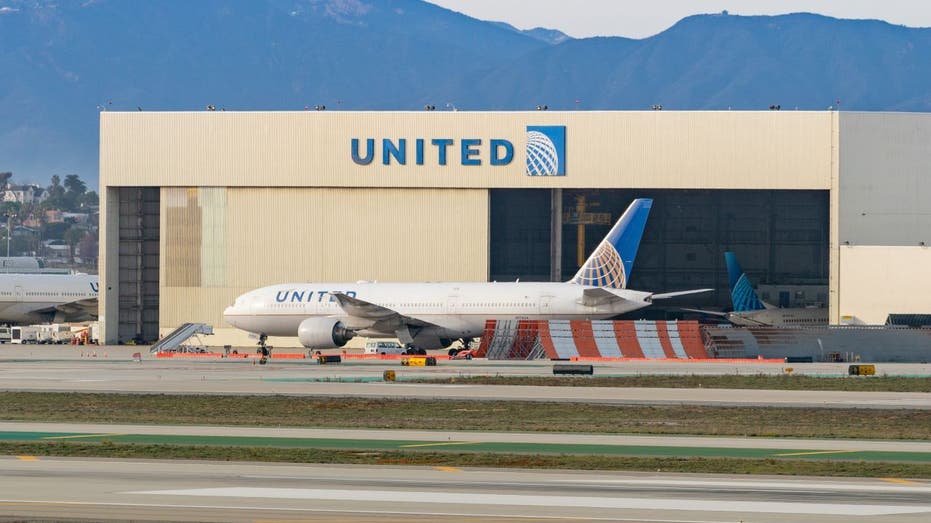
United Airlines is warning that airfares could rise up to 20% if the cost of jet fuel remains elevated for longer due to the spike in oil prices amid the war in Iran.
United CEO Scott Kirby said in an interview on Bloomberg TV on Tuesday that the airline anticipates consumer demand for air travel will soften if higher fuel prices continue to push ticket prices higher.
Advertisement
Kirby added that United has already moved to cut 5% of its capacity on routes that aren’t profitable and don’t cover the cost of higher fuel prices, though he said that demand remains very strong for now.
“Demand is incredibly strong right now,” Kirby told Bloomberg, adding that he does think that oil prices will be “higher for longer.”
United Airlines CEO Scott Kirby said elevated oil prices could push air fares higher, upward of 20%. (AaronP/Bauer-Griffin/GC Images)
“It’s reasonable for us to plan for that regardless, because the downside is pretty limited. If we leave a little bit of demand on the table by not flying as much this summer, so what, that’s not a big deal. But it gives us more optionality on the other side for the recovery,” he said in the interview.
Advertisement
Kirby said the firm’s forecast that oil prices may rise as high as $175 a barrel and remain above $100 a barrel through the end of next year is “reasonable, I hope it’s better and there’s a good chance it’s better, but I think it’s also reasonable.”
The United Airlines CEO told Bloomberg that if oil prices surge to the peak of the company’s forecast it would be a “stress event” for the airline industry, and would be “nowhere near the magnitude of what happened in COVID.”
While some global airlines have historically hedged against spikes in fuel costs through investment strategies, Kirby said in the interview that because of the company’s size it’s “really tough for us to hedge” because it moves the market when it tries to do so.
Advertisement
He said the company has been focused on its margins and has tripled the amount of cash it keeps on its balance sheet as an alternative to hedging fuel costs.
Kirby added that if oil prices remain at their current level it amounts to about an $11 billion expense for United, which would translate to about a 20% increase in airfares for the company to break even and cover that cost.
Kirby said United is anticipating changes in demand that could occur if oil prices remain elevated. (Al Drago/Bloomberg via Getty Images)
He also noted that while prices are up relative to a year ago, airfares in 2025 were 2% lower than they were in 2019, even as inflation was up 25%, so the 15%-20% rise in airfares in recent weeks is “covering half to 60% of the inflationary increase.”
Advertisement
Kirby was asked about the incident at New York City’s LaGuardia Airport over the weekend, in which an Air Canada jet collided with a fire truck while the airliner was landing. Both the pilot and first officer were killed, while dozens of injuries were reported.
He told Bloomberg that the U.S. air travel system is safe and is “by far the safest way to travel of any mode of transportation.”
Kirby added that he thinks there should be more investment in technology and staffing for the Federal Aviation Administration (FAA) and that he sees the Trump administration as being committed to those priorities, which the CEO said should garner bipartisan support.
FLSmidth & Co. A/S (FLIDY) Shareholder/Analyst Call March 24, 2026 11:00 AM EDT
Company Participants
Mads Nipper
Conference Call Participants
Advertisement
Louise Celia Korpela
Presentation
Mads Nipper
Advertisement
Dear shareholders, it is now 4:00 PM. And as Chairman of the Board, it’s a pleasure for me to welcome you to this Annual General Meeting of FLSmidth. This is the first time for decades that we are holding our AGM outside our previous headquarters in Valby. We moved away from there earlier this year. We moved into the new offices at Havneholmen, down the street here in Copenhagen. This was also the beginning of a new era for FLSmidth and I’m going to come back to that later on in my report. To take us through this AGM, the Board has selected attorney Louise Korpela. And I give the floor to you, Louise.
Louise Celia Korpela
Thank you very much. My first job as Chair is to make sure that the meeting has been duly convened and is quorate. There must be minimum 3, maximum 5 weeks’ notice via the company’s website and by sending notice to those shareholders who have so requested. The convening notice was sent out on the 27th of February, which was within the time line and also in the correct manner. It also contains, as I said, all the information which is required under Danish company law and the company’s Articles of Association, and all the information the company is requested or obligated to make available to shareholders has been made available. So the meeting has been duly convened. Behind me, you see the agenda. It contains the usual items that need to be included according to the articles and then we also have proposals from the Board of Directors concerning an updated version of the remuneration policy and also the acquisition of treasury shares and also prolongation of
New Delhi: India’s private sector growth slowed to its weakest pace in more than three-and-a-half years in March as the West Asia conflict dampened demand and output, even as international sales hit a record high, a private survey showed on Tuesday.
The HSBC Flash India Composite Purchasing Managers’ Index fell to 56.5 in March from 58.9 in February and 59.5 a year earlier. The composite PMI combines manufacturing and services indices, with readings above 50 signalling expansion and those below indicating contraction.
“Output growth eased across both manufacturing and services as the energy shock unfolds,” said Pranjul Bhandari, chief India economist at HSBC. Manufacturing activity weakened more sharply, with the PMI falling to 53.8 in March from 56.9 in February. Market volatility and consumer uncertainty linked to the conflict led to the slowest rise in factory output since August 2021. The services PMI eased to 57.2 from 58.1.
Inflationary pressures intensified during the month. Input costs, including oil, energy, food, aluminium, steel and chemicals, rose to a 45-month high, while selling prices increased to a seven-month high.
Live Events
RECOMMENDEDSTORIES FOR YOU
Advertisement
“Cost pressures intensified, but companies are absorbing part of the increase by squeezing margins,” said Bhandari.
Thousands of users worldwide are reporting disruptions to Grok, the artificial intelligence chatbot integrated into Elon Musk’s social media platform, X.
Starting approximately at 1:00 AM AEDT on Wednesday, March 25, 2026, reports began surging on outage tracking sites like Downdetector and StatusGator. Users across Australia, the United States, and the United Kingdom have noted that the AI is either failing to generate responses or is stuck on a perpetual “loading” screen.
Current Status: What We Know So Far
As of this writing, the official xAI Status Page has not yet acknowledged a widespread system failure, currently listing services as “Operational.” However, independent monitoring services tell a different story.
Report Spikes: Over 100 user-submitted reports have been logged in the last hour alone, specifically citing “Server not responding” and “App not loading.”
Regional Impact: While the disruption appears global, the highest concentration of reports is coming from major tech hubs, including California, Illinois, and London.
Error Messages: Many X Premium and Premium+ subscribers are receiving a generic error message: “Grok is experiencing issues. We are working on restoring services as quickly as possible.”
A Pattern of Instability in 2026?
This latest incident follows a string of technical hurdles for xAI in early 2026. Earlier this month, on March 10, Grok suffered a significant two-hour outage that affected both the web and mobile versions.
Industry analysts suggest that the frequent “high demand” errors and rate-limiting issues may be linked to the recent rollout of Grok-3, which significantly increased the model’s compute requirements.
“Elon Musk’s push to make Grok the most powerful AI in the world comes with massive infrastructure growing pains,” says tech analyst Marcus Thorne. “When you’re running a model of this scale directly integrated into a global social network, any minor networking hiccup becomes a massive public-facing outage.”
How to Check if Grok is Down for You
If you are currently experiencing issues with Grok, there are several ways to verify if it is a local problem or a platform-wide outage:
Advertisement
Check the Official Status: Visit status.x.ai for the official word from the engineering team.
Monitor X (formerly Twitter): Search the hashtag #GrokDown or #XDown. Usually, the community reports issues minutes before the official status pages are updated.
Try an Alternate Platform: Sometimes the Grok Web App remains functional even when the integration within the X mobile app is failing.
The Broader Context: Security and Contracts
The outage comes at a sensitive time for xAI. Just last week, U.S. Senator Elizabeth Warren sent a formal inquiry to the Department of Defense regarding the safety and reliability of Grok, following reports that the AI was being tested for use in classified systems.
A $200 million government contract is reportedly on the line, and persistent uptime issues could play into the hands of critics who argue that xAI lacks the “reputation and track record” required for high-stakes military and governmental applications.
Expected Resolution
Historically, xAI and X have been relatively quick to resolve minor networking “hiccups,” with most outages being fixed within 30 to 90 minutes. However, if the issue is related to a deeper “data poisoning” vulnerability or a server-side crash—as seen in the January 16 global outage—the downtime could stretch into several hours.
Nike Inc. shares rose more than 2% in midday trading Wednesday, trading around $53.80, as investors eyed the athletic giant’s upcoming quarterly results and signs of progress in CEO Elliott Hill’s multiyear turnaround plan.
AFP
The stock, which hit a 52-week low of $52.18 earlier this month, remains down sharply from its highs of the past year. It has fallen about 17% year-to-date and more than 20% over the trailing 12 months, reflecting persistent challenges in consumer demand, margin pressure and competition from fast-fashion rivals.
As of midday Wednesday, March 25, Nike (NYSE: NKE) shares were up $1.10, or roughly 2.1%, at $53.81 on volume exceeding 4.8 million shares. The stock closed Tuesday at $52.71 after a modest 0.65% gain. Its 52-week range spans $52.18 to $80.17, with a market capitalization near $78 billion.
Nike faces a tough environment. For the full fiscal 2025 year, the company reported a 9.84% revenue decline and a 43.53% drop in net income, underscoring the depth of its slowdown after years of pandemic-fueled growth followed by overreliance on direct-to-consumer sales.
In the most recent reported quarter — fiscal 2026 second quarter ended Nov. 30, 2025 — revenue rose 1% to $12.43 billion, beating analyst expectations of about $12.2 billion. Wholesale revenue jumped 8% to $7.5 billion, signaling improving relationships with retail partners, while NIKE Direct sales fell 8-9%. Gross margin contracted 300 basis points to 40.6%, and diluted earnings per share came in at 53 cents, topping forecasts of 37-38 cents but down from 78 cents a year earlier.
Advertisement
Net income for the quarter fell 32% to $792 million.
Hill, who took over as CEO in late 2024 after a long career at the company, has centered his strategy on “Win Now” actions. The plan emphasizes five pillars: culture, product innovation, marketing, marketplace (rebuilding wholesale) and in-person experiences. He has refocused the brand on sport and athletes, accelerated new product launches, streamlined operations and cut jobs in distribution.
“We’re in the middle innings of our comeback,” Hill said following the second-quarter results.
He has traveled globally to reconnect with leagues, teams and athletes, aiming to restore Nike’s cultural edge. In a recent New York Times profile, Hill described emulating co-founder Phil Knight’s hands-on style and pushing for faster innovation cycles, such as developing a chunky running shoe in eight months instead of the usual 18.
Advertisement
Analysts have noted early progress in North America, where wholesale momentum has helped stabilize sales. Hill has said the turnaround is spreading from Europe to Asia, though China remains a drag. The company has also explored potential strategic moves, including speculation about exiting or restructuring its Converse brand.
Investors will get a fresh look when Nike reports fiscal 2026 third-quarter results after the market close on Tuesday, March 31. Analysts expect revenue of about $11.23 billion, down from the prior year, with earnings per share around 29-32 cents. The quarter is projected to show continued pressure, including an 11% sales decline in some estimates — the steepest in recent periods.
Wall Street’s view remains mixed but leans cautiously optimistic. Consensus among roughly two dozen to three dozen analysts rates Nike a Moderate Buy or Buy, with an average 12-month price target around $73 to $76 — implying 35-40% upside from current levels. High targets reach $110, while the low sits near $54 after recent cuts.
Recent moves include Deutsche Bank lowering its target to $54 from $67 while keeping a Hold rating. UBS cut to $58 from $62. Barclays upgraded to Overweight, citing a favorable risk/reward shift. RBC Capital maintained Buy. Jefferies and others have expressed confidence in wholesale recovery, bolstered by strong results at partners like Dick’s Sporting Goods.
Advertisement
Some analysts caution about “lacking consistency and visibility,” pointing to ongoing margin headwinds, tariff impacts estimated at $1.5 billion annually and cautious full-year guidance of low-single-digit revenue growth with declining earnings per share.
Nike’s dividend yield has climbed to about 3.1% as the stock price has fallen, attracting income-focused investors. The company maintains a strong balance sheet and free cash flow, though it has faced inventory and demand normalization issues.
Broader industry context adds pressure. Competitors like Lululemon and emerging fast-fashion brands have chipped away at market share, while consumers remain selective amid economic uncertainty. Nike’s iconic status in basketball, running and global sports marketing remains a core strength, but execution on innovation and pricing will be key.
Hill has acknowledged the path “won’t be a straight line.” The company has pulled back on legacy styles, invested in new athlete-centric products and doubled down on wholesale channels after earlier DTC overemphasis.
Advertisement
Positive notes include footwear revenue gains in key regions and early wholesale momentum. Excluding headwinds from classic franchises, some periods showed underlying growth of 6% or more.
Nike also announced a new $1 billion short-term credit facility in March, providing financial flexibility.
Longer-term, analysts project fiscal 2027 revenue approaching $48-50 billion if the turnaround gains traction, with EPS recovery.
Shares have lost value for four straight years, down roughly 65% from the 2021 peak, leaving some value investors wondering if the current levels near the 52-week low represent a bottom.
Advertisement
” Nike stock has been absolutely slammed, bolstering its dividend yield,” one recent analysis noted, questioning whether it is a buying opportunity.
With Q3 results days away, the market will watch for updates on gross margin trends, wholesale traction in international markets and any forward guidance that could signal acceleration in Hill’s “Sport Offense” plan.
For now, modest buying interest reflects hope that Nike’s deep brand moat, innovation pipeline and leadership changes can restore its position as the world’s leading athletic brand. Whether the comeback delivers sustained growth or faces further setbacks will likely shape investor sentiment through 2026 and beyond.
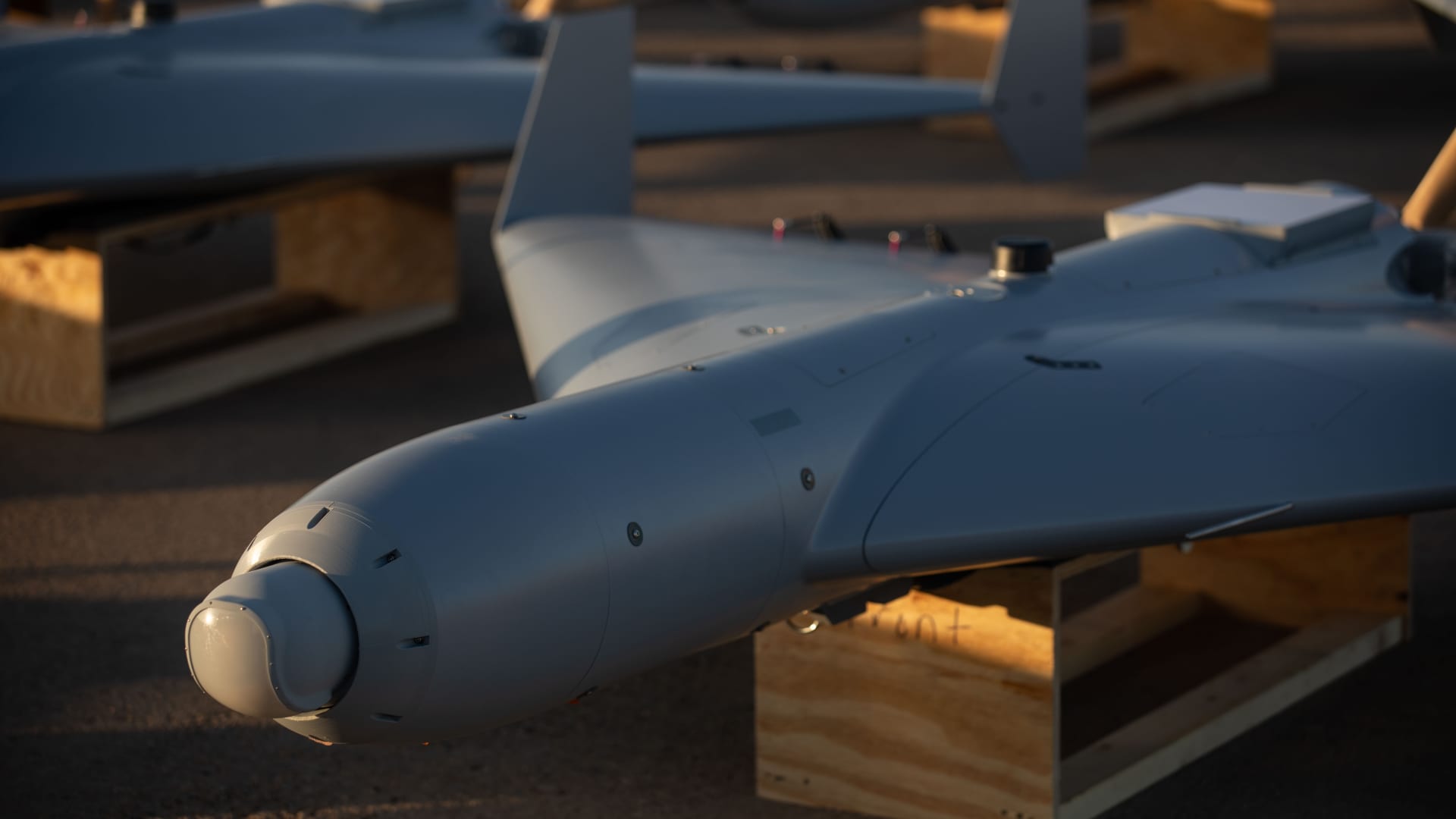
Low-cost Unmanned Combat Attack System (LUCAS) drones are positioned on the tarmac at a base in the U.S. Central Command operating area.
Source: U.S. CENTCOM
An Arizona-based battery startup led by a former General Motors executive is moving from making products for all-electric vehicles to making products for the aerospace and defense industries amid the war in Iran and growing demand for U.S. drones by the Trump administration.
Advertisement
Sion Power expects to commercialize high-energy lithium-metal battery cells for drones and other defense-related products later this year after focusing on the development of all-electric vehicles for much of the past decade, according to CEO Pamela Fletcher.
“We’re targeting to commercialize this technology,” Fletcher told CNBC exclusively. “We had hoped, and thought, that would be in automotive, and I think that possibility still exists, but the faster path, and frankly, a big need, is out there in this defense space.”
The decision is a unique example of how companies that bet on the unrealized adoption of all-electric vehicles are pivoting to different segments. Other companies have moved to the stationary storage and aerospace sectors to utilize unused battery production capacity for EVs.
Automakers in the U.S. have significantly pulled back from pure EVs and taken billions of dollars in write-downs following slower-than-expected adoption of the vehicles and changes by the Trump administration to incentives that supported them.
Advertisement
Sion Power’s planned “Licerion HE” lithium-metal battery cells will support both primary, or single-discharge, and secondary, or rechargeable, battery applications, according to the company.
The battery cells are designed for next-generation drones, autonomous systems and other mission-critical platforms that require maximum energy in the smallest, lightest possible footprint, according to Fletcher.
“Lithium-metal technology, which is what we developed, has high gravimetric energy, which means it’s a lot of energy in a lightweight pack,” said Fletcher, who began leading the company in 2024. “It works really well for things that fly.”
Fletcher said Sion Power’s lithium-metal cells are engineered to deliver energy densities exceeding 500 watt-hour per kilogram, compared with approximately 300-350 Wh/kg for today’s most advanced lithium-ion technology.
Such batteries can power drones or missiles as well as their on-board systems such as cameras, sensors and processors for combat, surveillance and other needs.
Advertisement
Sion Power has a 110,000-square-foot facility in Tucson, Arizona, with pilot manufacturing capabilities. Fletcher said it’s currently producing Licerion HE cells for defense applications and converting its production cell line from automotive battery cells to defense products, which are smaller.
Sion Power CEO Pamela Fletcher, formerly an executive at General Motors
Mario Anzuoni | Reuters
The company will continue to develop cells for other segments, such as EVs, but its main focus and growth right now is defense, which the company had been working on prior to focusing on EVs, Fletcher said.
The privately held company does not plan to be a direct supplier to the U.S. government, but it hopes to sell its products to other certified contractors, Fletcher said. The move comes as the Trump administration’s Department of Defense is exploring increasing production of U.S.-sourced Low‑Cost Uncrewed Combat Aerial System, or LUCAS, drones.
Such drones have been an integral part of the war between Russia and Ukraine as well as the Iran war.
“It’s evolved quite rapidly in the last three or four years, and now, even with the Iran war, things are changing even further,” Sion Power Chief Commercial Officer Mitch Hourtienne told CNBC. “There’s a lot of emerging applications coming out of, unfortunately, the Ukraine war, now the Iran war.”
Advertisement
Sion Power’s custom defense pack that includes its Licerion lithium-metal battery cells.
Courtesy Sion Power
Several companies other than Sion Power, such as Quantumscape, have spent years researching and developing lithium-metal batteries for vehicles, but so far there hasn’t been mass commercialization for using that technology in the automotive sector.
Lithium-metal battery cells function similarly to currently used lithium-ion cells, but have greater energy density, potentially at a lower cost. But they can be more volatile and are viewed as farther out than emerging solid-state batteries for cars, according to experts.
Advertisement
Sam Abuelsamid, vice president of market research at communications and consulting firm Telemetry, said lithium-metal cells could be used for different industries and use cases.
“It’s better for energy density. It also should reduce cost,” said Abuelsamid, an engineer and battery expert. “There’s no reason why they wouldn’t be just as effective in smaller objects, especially something that flies, like a drone.”
The biggest difference between defense and automotive is shelf life versus cycle life. Auto batteries typically require hundreds of charge life cycles, whereas defense uses require only one to 20 cycles and can demand three to eight years of shelf life.
Sion Power has raised more than $200 million for development of lithium-metal cells. Investors have included South Korean battery manufacturer LG Energy Solution, former Google CEO Eric Schmidt’s family office, Hillspire, and unnamed global automakers, according to the company.
Advertisement
The company, established in 1989 as a spin-off from Brookhaven National Laboratory, said it plans to seek further capital as its products are expected to launch and ramp up during the second half of 2026 and into 2027.
A Delta Air Lines Boeing 757-200 plane passes by the Capitol dome in Washington as it comes in for a landing at Ronald Reagan Washington National Airport, Nov. 9, 2025.
“Due to the impact on resources from the longstanding government shutdown, Delta will temporarily suspend specialty services to members of Congress flying Delta,” Delta said in a statement to CNBC.
“Next to safety, Delta’s No. 1 priority is taking care of our people and customers, which has become increasingly difficult in the current environment,” the airline said.
Delta’s Capital Desk, which is a reservation line for members of Congress and staffers, remains open.
But for now, those customers will be treated like any other passengers based on their respective Sky Miles status.
The move comes as airports around the U.S., including major hubs in cities such as Atlanta, where Delta is based, are seeing extra-long security lines as a result of elevated absences by TSA agents, who are set to miss their second full paycheck this week.
Advertisement
Read more CNBC politics coverage
Bastian last week fumed to CNBC that it is “inexcusable that our security agents, our frontline agents, that are essential to what we do, are not being paid. And it’s ridiculous to see them being used as political chips.
“So, we’re outraged,” Bastian said.
“And if there’s a call to action here — and I think over 90% of the American public supports those people getting paid — ask our folks right here in Washington to do their job, get our people paid. They can do it,” the CEO said.
United Airlines, when asked by CNBC if it had suspended its similar perks for members of Congress, said, “We don’t have any changes to announce today.”
Advertisement
CNBC has requested comment from American Airlines about its services for federal lawmakers.
Airline executives have railed against lawmakers in recent months, urging them to ensure that essential government workers like TSA officers are paid during shutdowns, which have become increasingly common.
Repeated funding impasses, including in early 2019 and as recently as last fall, ended shortly after absences of government workers who were required to work without pay increased.
Technology has become an inseparable part of modern society, influencing every aspect of our lives. From communication and healthcare to business and entertainment, technology’s rapid evolution has revolutionized the way we interact, work, and perceive the world.]
In this article, we explore the multifaceted world of technology, its impact on various sectors, and the trends that are shaping its future.
The Technological Revolution
The 21st century has witnessed an unprecedented technological revolution, driven by breakthroughs in fields such as artificial intelligence, robotics, biotechnology, and the Internet of Things (IoT). These advancements have transformed the way we live and opened up new possibilities for innovation and human progress.
Impact on Communication and Connectivity
One of the most visible effects of technology is the transformation of communication. The rise of smartphones and social media platforms has connected people across the globe, enabling real-time communication and the sharing of information. Video conferencing, messaging apps, and social networks have revolutionized how we interact with friends, family, and colleagues.
Revolutionizing Industries Through Automation
Automation powered by technology has reshaped industries by streamlining processes, increasing efficiency, and reducing human error. Manufacturing, for instance, has embraced robotics and automation to improve production speed and precision. Similarly, the finance sector has leveraged fintech innovations for online banking, digital payments, and automated investment platforms.
has also left a profound impact on healthcare, leading to improved diagnostics, treatments, and patient outcomes. Telemedicine has enabled remote consultations, wearable health devices provide real-time data, and AI-powered algorithms assist in disease detection. The convergence of healthcare and technology is unlocking personalized medicine and revolutionizing patient care.
The Digital Economy and E-Commerce
The digital economy has spawned new opportunities for businesses through e-commerce, digital marketing, and online platforms. Companies like Amazon, Alibaba, and Netflix have capitalized on technological advancements to transform their industries and redefine consumer expectations. E-commerce has not only changed the way we shop but has also altered supply chain dynamics.
The Challenge of Data and Privacy
As technology permeates every facet of life, concerns about data privacy and security have come to the forefront. The collection, analysis, and use of personal data raise ethical questions and necessitate robust regulations to safeguard individual privacy. Striking a balance between technological innovation and personal privacy remains a critical challenge.
Advertisement
Emerging Trends in Technology
Artificial Intelligence (AI) and Machine Learning: AI technologies, such as natural language processing and machine learning, are enabling computers to perform tasks that typically require human intelligence. From self-driving cars to virtual assistants, AI is transforming industries and enhancing efficiency.
5G Connectivity: The rollout of 5G networks promises faster and more reliable connectivity, enabling real-time data transmission, IoT applications, and innovations in fields like autonomous vehicles and remote surgery.
Blockchain Technology: Beyond cryptocurrency, blockchain technology is finding applications in supply chain management, healthcare, and digital identity verification, offering transparency and security in data management.
Sustainable Technology: The growing concern for the environment has prompted the development of sustainable technologies, such as renewable energy sources, green infrastructure, and circular economy solutions.
Advertisement
The Human Element: Technology and Society
Amid the technological revolution, the role of humanity remains paramount. Technology is a tool that amplifies human capabilities and addresses challenges. While AI and automation can enhance productivity, they also necessitate reskilling and upskilling to ensure a workforce that is adaptable and relevant.
Conclusion
Technology has become the driving force behind societal evolution, economic growth, and global connectivity. Its influence spans from individual lives to entire industries, reshaping the way we communicate, work, and solve complex problems. As we continue to witness technological advancements, it’s essential to embrace innovation while remaining mindful of ethical considerations, privacy concerns, and the enduring need for human creativity and ingenuity in shaping technological future.




























































You must be logged in to post a comment Login