
Business
HAL shares jump over 6%, extend gains for second straight session. What did its annual report reveal?


According to the company’s annual report released on Tuesday, HAL’s order book stood at a staggering Rs 2.55 lakh crore for FY26. The outlook for FY27 and beyond remains positive, with the company noting that its strong order book provides 7-8 years of revenue visibility.
HAL expects growth to improve through better supply chain stabilisation, capacity expansion, including significant infrastructure investments, and faster production ramp-up of key platforms, the company said in its annual report released on August 4.
Also read: Defence stocks rally on strong order books and rising exports: Are they still worth buying?
HAL key focus areas
Hindustan Aeronautics outlined its key priorities for the coming years, including increasing LCA Mk1A production to more than 24 aircraft annually and accelerating the manufacturing of the HTT-40 trainer aircraft.

The company also plans to expand its presence in the civil aviation and export markets while raising indigenisation levels to over 65-75% across its major platforms. HAL said it will continue to invest in digital transformation, artificial intelligence, and research and development for future programmes such as the IMRH, LCA Mk2, CATS, HLFT, and UAVs.
HAL FY27 outlook
The company said it is well positioned to benefit from opportunities across aircraft, helicopters, aero engines, avionics, and maintenance, repair and overhaul (MRO) projects. It added that the execution of ongoing programmes, along with expected orders for fighter aircraft, rotary-wing platforms, and upgrade projects, is likely to provide strong medium- to long-term revenue visibility.HAL said these initiatives are expected to support its long-term growth, strengthen its role in India’s aerospace and defence ecosystem, and improve its competitiveness in global markets.
Last month, the company announced that it had signed a long-term agreement with Safran Aircraft Engines for the production and supply of turbine ring forgings made from superalloys for the ‘CFM LEAP’ engine programme.
Read more: Why a Rs 72,000 crore fund manager refuses to chase defence rally now
Under the agreement, HAL will manufacture near-net-shape ring forgings for the Leading Edge Aviation Propulsion (LEAP) engine at its state-of-the-art Ring Rolling facility at HAL’s Foundry and Forge Division in Bengaluru.
These superalloy ring forgings are used in high-temperature applications in the rotating section of the aero-engine and are critical to engine performance and reliability, the company said in a release.
HAL share price performance
HAL stock has gained nearly 20% in the last six months and about 10% since the beginning of the year. Over a three-year period, the stock price has risen more than 150%, while it has surged around 800% over the last five years.
(Disclaimer: Recommendations, suggestions, views and opinions given by the experts are their own. These do not represent the views of The Economic Times)

Business
Not a moon crash, but AI sends SpaceX shares spiralling 14% lower on Wall Street. What lies ahead?
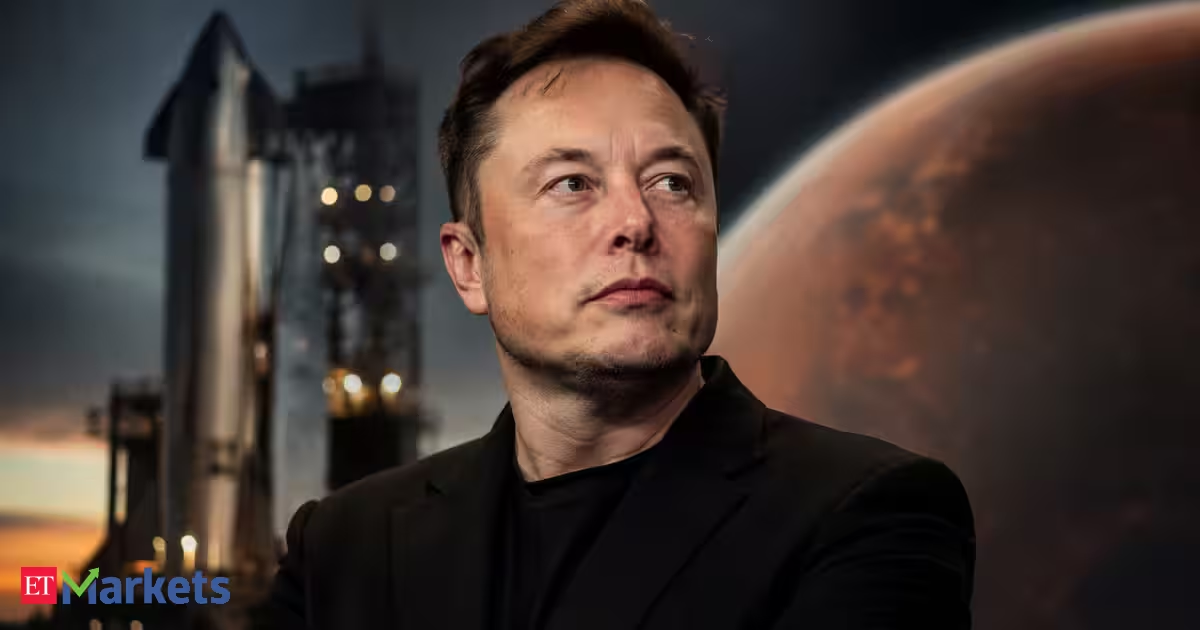
Parts of a SpaceX rocket unintentionally crashed into the Moon on Wednesday after drifting off course for nearly a year, media reports said. Astronomers have reportedly identified debris plumes from the impact using telescopes.
“The SpaceX rocket crash into the Moon is probably a good metaphor for the share price performance so far,” CNBC quoted Chris Beauchamp, chief market analyst at investing and trading platform IG, as saying. Shares of the rocket maker plunged nearly 14% to close at around $108 apiece.
Why did SpaceX shares crash?
The development comes after SpaceX released its first quarterly results following a stellar market debut earlier this year. The company reported a 92% year-on-year jump in revenue to $7.8 billion for the April-June quarter. SpaceX said it expects to achieve a $100 billion revenue run rate by December and plans to launch at least 1,000 next-generation V3 Starlink satellites within a year. The company also expects new capital deployments for AI computing to deliver payback in less than a year.
However, SpaceX’s capital expenditure ballooned to more than $18 billion from $2.83 billion a year earlier. The company’s CFO, Bret Johnsen, said he expects capital spending to remain at similar levels for the next couple of quarters. SpaceX sharply increased capital spending on AI, pouring in $15.83 billion in the second quarter, compared with $749 million a year earlier.
Also read | SpaceX plans to turn Starlink into full-fledged mobile service, targets Verizon, AT&T and T-Mobile
“The central question for SpaceX’s first quarter as a public company was whether the machine underneath the story actually works, and on that question Elon Musk and his team delivered a few positives,” Reuters quoted Thomas Monteiro, an analyst at Investing, as saying.
SpaceX share price
After raising $75 billion in the biggest-ever IPO in history, SpaceX began trading at $150 per share in June, marking an 11% premium to its IPO price of $135. After listing, the company’s shares surged more than 50% in just three sessions. The Elon Musk-led company’s shares have now fallen around 28% from the listing price.
However, the stock may see further selling pressure after IPO lockup expiries free up additional shares for trading. As many as 911.5 million shares will become eligible for trading this month, potentially putting more pressure on the stock price, Bloomberg reported.
Also read | What’s next for SpaceX shares? 5 trends investors should watch
(With inputs from agencies)
(Disclaimer: Recommendations, suggestions, views and opinions given by experts are their own. These do not represent the views of The Economic Times)
Yes. Corporate subscriptions are available for teams and organisations, with discounted rates as user numbers increase. Pricing starts from $1,625 + GST per user.
Get in touch
to discuss the right option for your organisation.
Business News subscriptions are used by executives, investors, consultants and professionals who need to stay informed and make better decisions about the WA market. When you subscribe you’ll get
- Unlimited access to WA’s most trusted business journalism
- Data & Insights — detailed profiles of WA companies, people, projects and deals
- MyBN — a personalised feed based on the companies, people and sectors you follow
- Special publications and industry reports
- Daily and weekly email newsletters
Data & Insights is a research tool built specifically for the WA market. It draws on more than 30 years of Business News reporting, updated regularly to reflect what’s happening now. Use it to:
- Look up detailed profiles of WA companies, including financials, directors and ownership
- Find decision-makers and track their career movements
- Research live and completed projects across WA industries
- Monitor deals, appointments and market activity
- Access industry rankings and league tables
Data & Insights is updated daily by our dedicated research team, which uses the latest announcements, ASX filings and editorial coverage to keep our person, company, list and project records up to date.
Business News welcome all opportunities to make our dataset accurate, complete and current, so if you have an update request, please email the team at
general@businessnews.com.au, and we’d be happy to assist.
MyBN
is part of every subscription. It’s your personalised view of Business News. You can follow the companies, people, sectors and projects that matter to you, and get a news feed and alerts tailored to your interests. You can save articles to read later and retain only what you need.
Only subscribers have full access to all content on the Business News website.
If staying informed about the WA economy is part of your job, and/or you’re looking for networking opportunities in WA, Business News is built for you.
Business News subscribers are:
- Executives and directors tracking competitors, clients and market movements
- Investors and advisers researching companies, deals and industry trends
- Consultants and professionals staying across sectors relevant to their clients
- Business owners looking for leads, context and market intelligence
Most Business News publications cover national or global markets. Business News is focused entirely on Western Australia, which means the journalism, the data and the intelligence are all built around WA companies, people and projects — not adapted from a national feed. Data & Insights, included with every subscription, combines more than 30 years of WA-specific editorial research with live business data. There’s no comparable product for the WA market.
The Morning Digest Email provides a comprehensive wrap of the major headlines, relevant to WA business, and includes with a snapshot of the overnight news covering oil, gold and ASX-listed companies.
The Afternoon Wrap Email focuses on the news covered by our team of journalists during the course of the working day, including exclusive stories and analysis, all of which relates to WA business and the local economy.
The BN Weekender Email contains a wrap of the Business News from the week that was, highlighting the top stories in each area of WA business.
Sign up for free.
We’re happy to help.
Get in touch
and our team will come back to you.

NEW YORK — The New York Times Connections puzzle for Thursday, August 6, 2026, challenged players to sort 16 words into four coherent groups of four, testing both vocabulary knowledge and lateral thinking. Puzzle number 1152 featured categories ranging from childhood playthings to famous landmarks and everyday locations defined by specific physical features.
The completed groups are as follows. Yellow, the most straightforward category, consists of classic wooden toys: Alphabet Blocks, Cup-and-Ball, Jacob’s Ladder and Lincoln Logs. These traditional items have entertained children for generations through simple mechanical or construction play.
Green groups places that contain lanes: Bowling Alley, Freeway, Supermarket and Swimming Pool. Each location features designated pathways or lanes used for movement, recreation or organization of space.
Blue gathers iconic Roman landmarks: Colosseum, Pantheon, Spanish Steps and Trevi Fountain. These well-known sites draw millions of visitors annually and represent enduring symbols of the city’s architectural and historical heritage.
Purple collects places with nets: Barclays Center, Fishing Boat, Hockey Rink and Tennis Court. Nets appear in each setting for purposes ranging from sports containment to practical catch mechanisms.
Connections requires players to identify the hidden relationships among the 16 displayed words. Correct groups turn a matching color and lock into place. Players receive four mistakes before the board is revealed in full. The difficulty progression typically moves from the most obvious yellow category to the more obscure purple one.
Hints available before full solutions pointed players toward the themes without naming them outright. One set of clues described the yellow group as child’s play, the green as locations that have tracks, the blue as Italian monuments and the purple as settings involving mesh material. These prompts helped many solvers progress when the initial board appeared disparate.
The yellow group of classic wooden toys proved accessible for players familiar with traditional playthings. Lincoln Logs, in particular, evoke construction sets made of notched wooden pieces. Cup-and-ball and Jacob’s ladder rely on simple physics and dexterity, while alphabet blocks introduce early literacy through physical objects.
The green category required recognition that lanes exist in varied environments. A bowling alley contains the tracks down which balls travel. Freeways feature multiple travel lanes. Supermarkets organize aisles that function as shopping lanes. Swimming pools often mark lanes for competitive or recreational swimming.
Blue demanded knowledge of specific Roman tourist attractions. The Colosseum and Pantheon stand as ancient architectural achievements. The Spanish Steps and Trevi Fountain represent later but equally iconic public spaces that have become essential stops for visitors to the Italian capital.
Purple tested the ability to see the common presence of nets across sports and practical settings. Tennis courts and hockey rinks use nets as part of the playing boundaries or goals. Fishing boats deploy nets as primary tools. Barclays Center, a major arena, incorporates nets in its basketball and other event configurations.
Many players reported that the puzzle felt moderately challenging, with the purple category often requiring the most thought. Red herrings occasionally appeared when words seemed to fit multiple potential themes, a common feature that rewards careful consideration of the strongest overall connections.
Connections forms part of the broader New York Times Games suite that includes Wordle, Spelling Bee and other daily challenges. The game launched as a standalone offering and quickly developed a dedicated following for its emphasis on categorical reasoning rather than pure letter guessing.
Results are typically shared through a grid that indicates the order in which groups were solved and the number of mistakes made, preserving the answers themselves for others still working on the board. Online discussion often centers on which category proved most elusive and which initial groupings led players astray.
For August 6, the mix of nostalgic toys, everyday infrastructure, classical landmarks and net-equipped locations created a balanced board that rewarded both general knowledge and careful observation. Solvers who identified the Roman landmarks early often found the remaining categories easier to isolate.
The puzzle resets daily, offering a new set of 16 words and four fresh categories each morning. Archives allow review of previous solutions, though the live experience remains the primary focus for most participants.
Thursday’s edition of Connections demonstrated the game’s continuing ability to blend accessible themes with just enough obscurity to keep the experience engaging. Players who completed all four groups without exceeding the mistake limit earned a clean board and the satisfaction of having sorted the day’s linguistic puzzle correctly.

Disney and TikTok have agreed a content-sharing deal that will allow creators to use clips from Disney films and television programmes in their videos, the two companies announced on Wednesday.
The agreement covers Disney’s subsidiaries, meaning clips from franchises including Star Wars, Toy Story and the Marvel Cinematic Universe will be available to TikTok creators. Videos made under the scheme will also be shared on Verts, Disney’s short-form video platform.
The programme will pilot in the United States before being rolled out to other countries. According to the companies’ joint announcement, creators who opt in will gain access to assets from hundreds of films and series in Disney’s library. Neither company disclosed the financial terms.
The deal follows the collapse of a $1bn (£745m) agreement between Disney and OpenAI that would have allowed people to use the studio’s characters in AI-generated videos. That arrangement was cancelled in March when OpenAI shut down its AI video generation tool Sora, citing a decision to focus on other parts of its business.
“Today, fans are celebrating our stories in entirely new ways,” said Asad Ayaz, Disney’s chief marketing and brand officer, following the announcement.
“Creators are at the heart of everything we do at TikTok,” said Dawn Yang, TikTok’s global head of entertainment. “Their creativity extends the life of films and shows into conversations that fans discover and share.”
TikTok said its platform saw an average of 6.5 million posts relating to film and TV per day last year. Fans frequently use clips from films and television shows in their videos, but without express permission these are often taken down following copyright claims, making it harder for a wide audience to engage with fan-created content around a big release.
“Disney owns some of the world’s biggest franchises but ownership of attention is shifting towards creators,” social media expert Matt Navarra told BBC News. “Hollywood used to market at fans – now it needs to give fans the raw materials to market with it, and that is quite a profound shift.”
Navarra said TikTok would also benefit from the “credibility of becoming a formal distribution partner to one of Hollywood’s biggest studios”. He added that TikTok’s recommendation algorithm gives it the power to “influence which character or scene or forgotten franchise suddenly becomes very valuable again”.
The two companies said a jointly run programme, the Disney Creator Ambassador Program, would boost some creators’ videos and give them increased visibility, access to exclusive events and career development pathways.
Gareth Sutcliffe of Enders Analysis said: “This is a deal that repositions and recovers Disney in the UGC [user-generated content] space following the content gap left by the sudden collapse of Sora.”
He said the deal was not without risk. “There is an ongoing safety debate around TikTok under European online rules,” he said. “At a minimum, Disney will need to employ significant guardrails to curate the creator content that is selected.”
Online creators and influencers are becoming more important to brands’ marketing strategies. Last year, a report from Oxford Economics said YouTube content creators contributed £2.2bn to the UK economy in 2024 and supported 45,000 jobs.
Disney launched Verts in the US in March, with plans to expand the platform to other countries.

Jamie Young
Jamie Young is Senior Reporter at Business Matters, covering SME finance, employment law and Westminster policy since 2016. He has reported on every Budget and Autumn Statement since 2018, helped make sense of the ‘covid era’ and the bounce-back loan scheme from launch through the fraud investigations, and broke the magazine’s coverage of the 2024 late-payment reforms. He joined Business Matters straight from completing his BA in Administration from Exeter University and is NCTJ-qualified. Reach him at jyoung@cbmeg.co.uk

Raleigh was founded in Nottingham in 1887 and at one stage was the biggest bicycle maker in the world, employing about 8,000 people at its peak.
It stopped making bikes in the city decades ago, and in 2024 it vacated its headquarters on Church Street in Eastwood to move to new premises less than a mile away.
Announcing plans to initiate insolvency proceedings, Nilsson said Accell had worked “to restructure [its] operations and finances”.
“Every realistic option for the future of the business has been tirelessly explored, and none have resulted in a solution to continue the group in its current form,” he said.
“Our immediate focus is to support an orderly process, provide clarity wherever possible, and work with the relevant court-appointed administrators to preserve viable activities and employment where circumstances allow.”
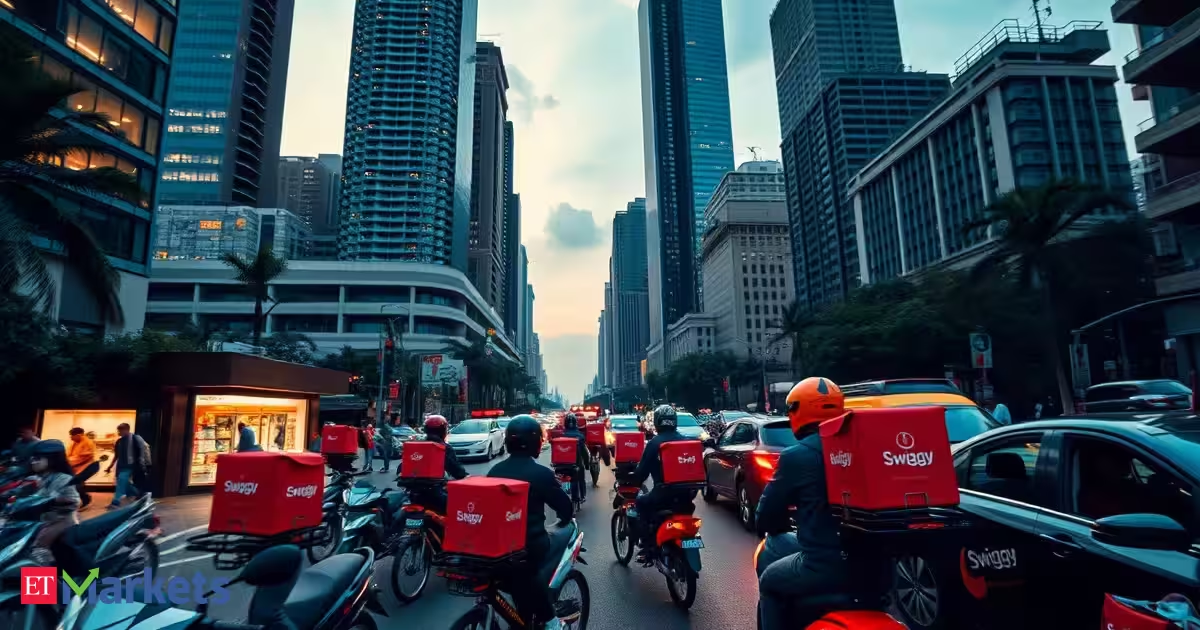
Investors cheered Swiggy’s ambitious target to achieve Rs 10,000 crore in Adjusted EBITDA by fiscal year 2031. The growth strategy relies on driving operational efficiency across its core food delivery operations, scaling up its quick-commerce vertical Instamart, and expanding out-of-home dining through Dineout.
Key growth targets for FY31
Outlining its five-year vision, Swiggy stated that it expects to more than triple its consolidated Gross Order Value (GOV) to roughly Rs 2.5 lakh crore by FY31, up from Rs 67,734 crore in FY26. This reflects a compound annual growth rate (CAGR) of over 30% over the five-year period.
Managing Director and Group CEO Sriharsha Majety noted that the five-year profitability goals are backed by solid fundamental growth across India’s food delivery, quick commerce, and dining-out spaces.
The company projects its main food delivery segment to generate Rs 5,000 crore in Adjusted EBITDA by FY31, supported by new affordability programs designed to increase order frequency among users.
Instamart and Dineout roadmap
Swiggy’s quick-commerce arm Instamart is expected to jump 4-to-5 times to Rs 1.5 lakh crore in GOV by FY31 from Rs 28,000 crore in FY26. Serving over 14 million monthly active buyers across more than 130 cities, Instamart is edging closer to EBITDA breakeven as unit economics improve and store density grows.
The out-of-home dining segment, Dineout, is projected to scale its GOV to Rs 20,000–25,000 crore by FY31 while contributing Rs 1,000 crore in Adjusted EBITDA.Swiggy also projects its earnings per share (EPS) to rebound from -Rs 16 in FY26 to Rs 30–33 by FY31. The company remains debt-free with a cash buffer of Rs 14,400 crore.
Swiggy share price performance
Swiggy shares have traded between a 52-week low of Rs 235.85 and a high of Rs 473.00. While the stock has seen consolidation over recent months, the long-term profitability guidance brought fresh buyer interest to the counter.

The stock had listed at Rs 655, a premium of nearly 11% over its issue price of Rs 590. The debut was well above grey market expectations, where the stock had indicated a listing gain of only around 1% ahead of its market debut.
Also Read |Manipal Health shares list at 11% premium to beat GMP estimates. What should allotted investors do?
Shivani Nyati, Head of Wealth at Swastika Investmart, said that despite the positive listing, the stock is trading at a premium valuation with limited margin of safety. A major portion of the IPO proceeds will be used to repay acquisition debt, leaving limited funds for future expansion, while the company also remains highly dependent on Karnataka, which contributes nearly 46–60% of its revenue.
She further said that, “Investors who received the allotment can continue to hold the stock, while fresh investors should wait for better entry levels or signs of further debt reduction before buying. Maintain a stop-loss at Rs 620 to protect listing gain.”
The company’s Rs 9,275 crore IPO was subscribed 4.92 times overall. The public issue comprised a fresh issue of 13.56 crore equity shares worth Rs 8,000 crore and an offer for sale of 2.16 crore shares aggregating Rs 1,275.22 crore, taking the total issue size to Rs 9,275.22 crore.
SBI Securities, which has assigned a Subscribing for long term rating, said the company is India’s largest multi specialty healthcare provider by bed capacity and holds leadership positions across key metro cities.It also mentioned Manipal Health’s strong track record of strategic acquisitions, which have helped expand scale, improve operating leverage, widen its geographic presence and strengthen its competitive position.
The company plans to allocate a significant portion of the fresh issue proceeds towards strengthening its financial position.
Around Rs 5,378 crore from the IPO proceeds will be used for debt repayment, helping reduce borrowing costs and improve the balance sheet. Another Rs 574 crore is planned for acquiring a minority stake in its step-down subsidiary, Sahyadri Hospitals. The remaining funds will be utilised for general corporate purposes and supporting future expansion plans.
Over FY26 to FY30, the company plans to add 2,426 beds, including 1,943 through greenfield projects and 483 through brownfield expansion. SBI Securities also expects profitability to improve on the back of the Sahyadri Group integration and lower interest costs following debt repayment using 69% of the IPO proceeds.
Also Read | Manipal Health Enterprises shares list at 11% premium over IPO price on BSE, NSE
Angel One, however, believes the valuation remains stretched. At the upper price band of Rs 590, the issue is valued at a post-issue FY26 P/E of 84.65x, which the brokerage considers expensive. While it acknowledged the company’s strong pan-India hospital network, leadership in key markets and favourable long-term industry prospects, it believes much of the expected growth is already priced in.
As a result, Angel One recommends a Neutral stance for medium- to long-term investors despite the company’s strong fundamentals.
Founded in 2010, Manipal Health Enterprises has emerged as one of India’s leading healthcare providers, with a wide network of multi-speciality hospitals, clinics and diagnostic centres.
The company provides advanced tertiary and quaternary healthcare services across key specialties, including oncology, cardiology, neurology, orthopaedics, organ transplantation and preventive healthcare.
(Disclaimer: Recommendations, suggestions, views and opinions given by the experts are their own. These do not represent the views of Economic Times)


Seeking Alpha’s transcripts team is responsible for the development of all of our transcript-related projects. We currently publish thousands of quarterly earnings calls per quarter on our site and are continuing to grow and expand our coverage. The purpose of this profile is to allow us to share with our readers new transcript-related developments. Thanks, SA Transcripts Team
Business
Which American Pop Stars Have Weighed In on BTS’s Grammy Boycott So Far This Summer Amid Growing Support
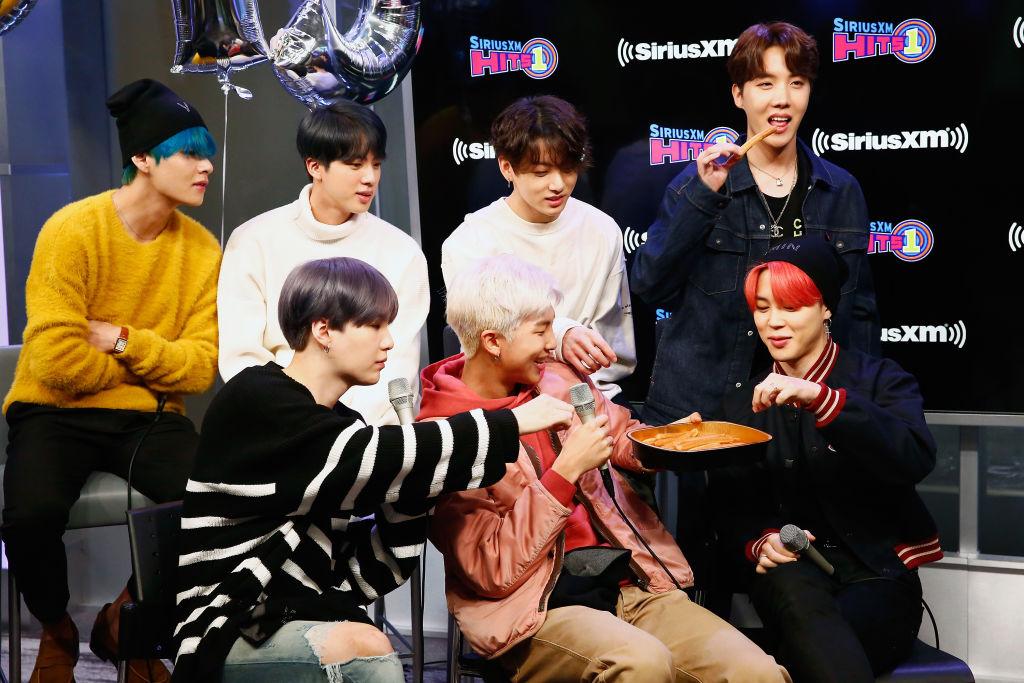
BTS’s decision to withdraw from consideration at the 2027 Grammy Awards has generated a wave of commentary since the K-pop group announced its withdrawal on July 29, but a closer look at who has actually spoken out reveals that the loudest voices so far have come primarily from within the K-pop world and the broader Asian entertainment community, rather than from mainstream American pop stars.
BTS’s seven members posted identical statements to their individual Instagram accounts announcing they would not submit music for consideration at the 69th Grammy Awards, set for Feb. 7, 2027, saying they hoped their music could be heard and loved for what it is rather than divided by region or language. The statement was widely interpreted as a response to the Recording Academy’s June 16 announcement of a new Best Asian Pop Music Performance category, which critics argue effectively walls K-pop off from the ceremony’s marquee general-field categories like Album of the Year.
Who Has Actually Spoken Out
Among the most visible reactions has come from Tablo, frontman of the Korean hip-hop group Epik High, who shared a story from BTS leader RM’s Instagram and added the message “ARIRANG > Grammys,” referencing the title of BTS’s new album. Bang Yong-guk, of the K-pop group B.A.P, similarly shared a news story about the boycott with his followers, as did Korean American actor Daniel Dae Kim, who also hosts CNN’s “K-Everything” series. Maggie Kang, the Korean Canadian co-director of Netflix’s animated hit “KPop Demon Hunters,” shared a news article about the boycott online along with a clapping emoji.
Beyond individual artists, American academics and music industry observers have offered some of the more pointed public commentary. Matthew Pellegrino, a music teacher at NYU Steinhardt and a K-pop expert, told CNN that the new Asian pop category, while framed with good intentions, effectively places Asian artists into a separate category that makes them unequal to mainstream American pop artists. Separately, a fan and observer named David Scragg told CNN he was disappointed and a little confused when he heard the Grammys planned to launch an Asian music category, saying he felt it functioned as a way to keep BTS out of the more prestigious main categories.
Notably Quiet: Mainstream American Pop Stars
Despite the volume of online commentary surrounding the boycott, a review of major entertainment coverage as of early August shows that few, if any, top-tier American pop stars, artists like Taylor Swift, Ariana Grande, Olivia Rodrigo, Doja Cat or Halsey, have issued direct, on-record statements specifically addressing BTS’s 2026 Grammy withdrawal. That relative silence stands in contrast to the amount of attention the story has received across entertainment media and social platforms, and several outlets covering the controversy have noted that celebrity reaction videos and social media roundups have circulated widely online even where the underlying substance of any individual celebrity’s comments remains difficult to verify.
A History of Crossover Between BTS and American Pop
The absence of major American pop star commentary this time around is notable given BTS’s extensive history of collaboration with, and support from, artists in the American pop mainstream. Halsey featured on BTS’s 2019 hit “Boy With Luv,” and the group’s Grammy nomination history includes featured credits alongside Coldplay for the 2022 song “My Universe.” At the 64th Annual Grammy Awards in 2022, BTS shared the stage with Olivia Rodrigo during a widely discussed live performance moment, and the band’s nominations that year came in categories that included Justin Bieber and Benny Blanco, Coldplay, and Tony Bennett and Lady Gaga as fellow nominees.
Other Artists Have Boycotted the Grammys Before, for Different Reasons
While direct comment on BTS’s specific situation from major American pop stars has been limited, the broader history of artists criticizing or boycotting the Grammys offers useful context for how the industry has previously responded to similar disputes. The Weeknd publicly boycotted the ceremony for several years after his 2020 album “After Hours” received no nominations, before ending his boycott in 2025 to perform at the show. Zayn Malik criticized the Grammys’ nomination process directly on social media in 2021, saying the system allowed favoritism, racism and networking politics to influence voting outcomes. Halsey spoke out the same year after her album “Manic” was not nominated, saying on social media that she and The Weeknd deserved better and describing what she characterized as an opaque nomination process built on relationships and favor-trading. Nicki Minaj has separately criticized the Academy for placing her song “Super Freaky Girl” in a pop category rather than a rap category, arguing it reduced her chances of winning.
The Recording Academy’s Response
Recording Academy CEO Harvey Mason Jr. addressed BTS’s decision directly, saying in a statement that he was saddened to hear the group had chosen not to participate in this year’s Grammy process, while adding that he understood and respected the decision as a fellow music creator. Mason has said the new Asian pop category was created to celebrate the depth, diversity and extraordinary growth of pop artistry coming out of Asia, and has separately noted that submitting music in a genre category does not exclude an artist from also being considered in the ceremony’s general field, which includes Album of the Year, Record of the Year and Song of the Year.
With submissions for Best Asian Pop Music Performance and other Grammy categories remaining open through Aug. 28, and nominees not expected until mid-November, there remains a window in which additional artists, American or otherwise, could weigh in publicly on the controversy. For now, the most substantive reactions have come from within the K-pop community, Asian American entertainment figures, and academic observers rather than from the mainstream American pop stars whose past collaborations and shared awards-show history with BTS might otherwise have made them a natural source of public commentary on the group’s decision.

Earnings call transcript: Swisscom posts stronger cash flow in Q2 2026
Not a moon crash, but AI sends SpaceX shares spiralling 14% lower on Wall Street. What lies ahead?
Pi Network’s PI Leads the Altcoin Rally as BTC Eyes $65K: Market Watch

Gaza recovers 112 bodies after painstaking recovery effort

Renter of Home in Anne Heche Crash Denies Settlement With Son

No Jackpot Winner as $257 Million Prize Rolls Over to $269 Million Monday Draw

Weekend Open Thread: Staud – Corporette.com

Gold & Crypto Analysis – Live || 05 Aug || Trade Time with Pranjal – Pranjal Singh

Gold And Crypto Live Trading || 05 AUG || Vivek Yadav #btc #crypto #gold

The Best Financial Strategies by Income in Canada: $50K, $100K, $150K+
-

 Fashion6 days ago
Weekend Open Thread: Wit & Wisdom
-

 Politics6 days ago
Meta enters AI-training agreement with far-right ‘propaganda rag’ Newsmax
-

 Politics4 days ago
Zack Polanski: an incitement to murder Nigel Farage?
-

 Crypto World5 days ago
MicroStrategy Post-Earnings CLARITY Act Push Could Add New Catalyst for Its Stock
-

 Crypto World5 days ago
XRP Ledger v3.3.0 brings five institutional features
-

 News Videos7 days ago
Bitcoin Enters the 3rd Stage of the Bear Market
-

 Politics7 days ago
Luke Littler’s dominance sparks GOAT debate
-

 Sports6 days ago
Seema Kaliramna Wins Discus Throw Bronze, Takes India’s CWG Medals Tally To 17
-

 Crypto World5 days ago
New York sues Kalshi over prediction market gambling
-

 Crypto World4 days ago
Crypto PAC spending tops $2M in Michigan House race
-

 Business3 days ago
DTCR: Deleveraging And A Hedge Fund Collapse Point To A Possible AI Bottom
-

 Business6 days ago
Trump Announces Hamas Disarmament Agreement as Iran Strikes Kuwait Air Base and US Attacks Pause Overnight
-
 Crypto World6 days ago
3 Fed Officials Just Explained Their Rate Hike Vote: Is Inflation Winning?
-

 Tech4 days ago
ESET tracks rise in malicious AI skills and adaptable malware
-

 Tech6 days ago
Gemini Spark can now use Chrome logins and saved passwords to run errands on your behalf
-

 Sports5 days ago
France Cricket implodes: letters hidden in a drawer and a board at war
-

 NewsBeat7 days ago
Four people die trying to cross Channel in small boats
-
Crypto World4 days ago
XRP Ledger urges node upgrade after manifest flood
-
 Tech6 days ago
Building A Reproduction PlayStation Motherboard
-

 Crypto World5 days ago
Moneyflip CEO charged in $40K murder-for-hire plot
You must be logged in to post a comment Login